AML Investigator Salary Guide (2026 Update)
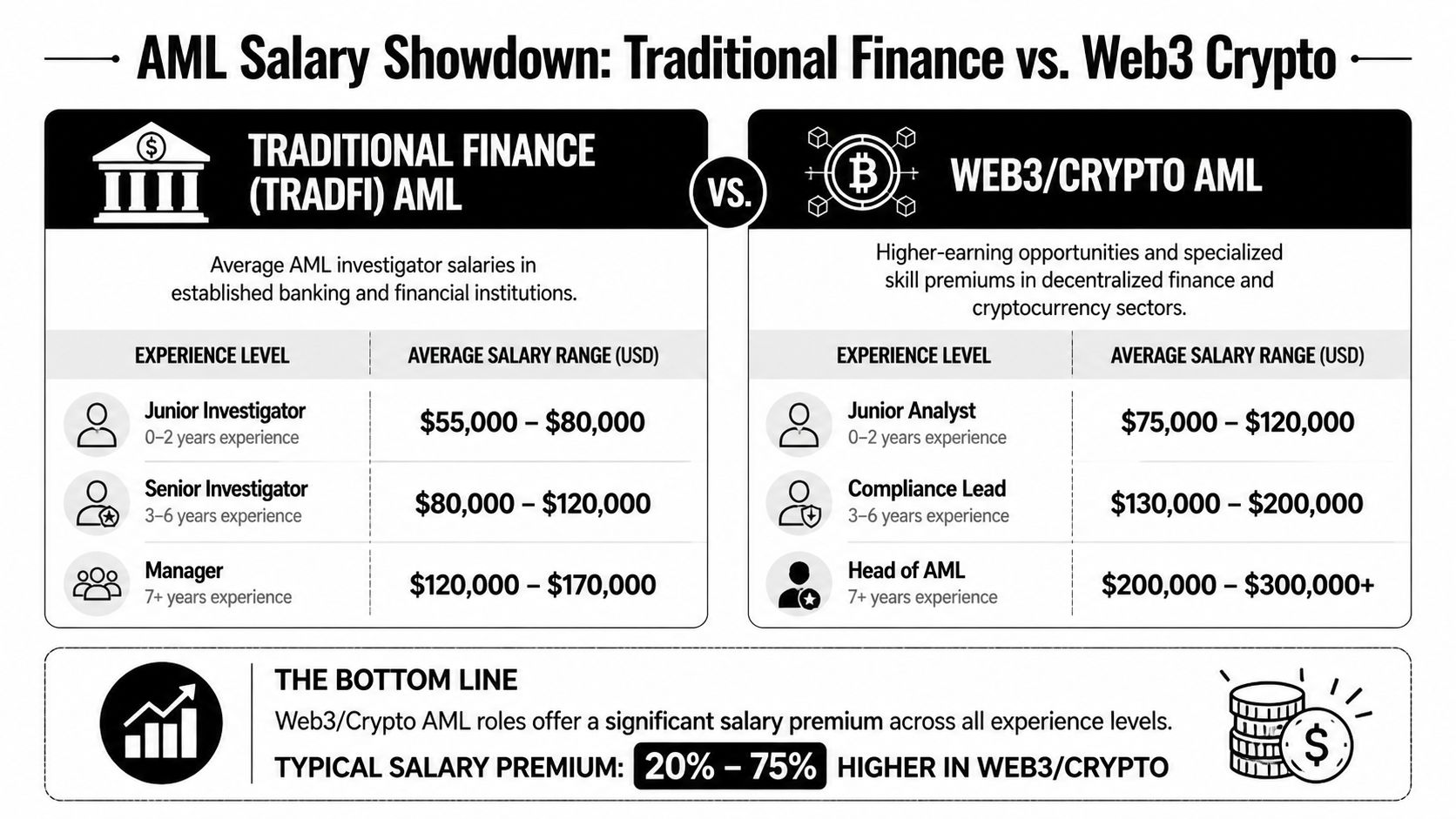
A $20,000 to $40,000 pay gap is common between standard AML investigation work and crypto-focused AML roles. That gap is the part candidates miss when they rely on generic compliance salary guides.
The market for AML Investigator Salary is no longer one market. It has split into two. Traditional institutions still hire investigators to review alerts, document cases, and escalate suspicious activity. Web3 companies pay more for investigators who can do that work and explain wallet behavior, follow funds across chains, and communicate risk clearly to product, legal, and operations teams.
That difference creates a real Web3 premium.
If you come from banking, fintech, or payments, this is the opportunity. Your investigation discipline still matters. But the higher-paying roles go to candidates who can apply that discipline to crypto-native risk, including mixers, bridges, private wallets, sanctions exposure, and fast-moving transaction patterns that do not look like card or wire activity.
Hiring managers do not pay extra for interest in crypto. They pay extra for usable judgment in a crypto environment.
That is why AML Investigator Salary has become a split market. Generalists still get interviews. Specialists get stronger offers, larger equity packages, and more room to negotiate.
What Is a Realistic AML Investigator Salary in 2026
A realistic aml investigator salary in 2026 depends on one thing more than candidates want to admit: how close you are to actual risk ownership.
If you're doing narrow review work, your ceiling is lower. If you're handling suspicious activity investigations, writing defensible narratives, and operating in a high-risk environment like crypto, your comp moves up fast. The old idea that AML is a flat compliance function isn't how hiring managers think anymore.
The baseline is broad. According to the U.S. Bureau of Labor Statistics figures cited by Financial Crime Academy, the average annual salary for AML investigators in 2021 was $67,740, with the highest 10% earning more than $104,720 and the lowest 10% earning less than $41,430. More recent salary tracking cited in the same guide shows a range from $73,458 to $111,598, which reflects the effect of specialization and experience in the role, as outlined in the Financial Crime Academy AML salary guide.
That range is useful, but it's still too generic for career decisions.
What hiring managers actually pay for
Three profiles consistently get stronger offers:
- Investigators who can write clearly: If your SAR, escalation memo, or internal case summary is weak, your technical knowledge won't save you.
- People who understand new risk typologies: In Web3, that means you can discuss bridge exposure, token movement patterns, sanctions evasion concerns, and wallet behavior without sounding like you memorized a glossary.
- Candidates who make decisions: The moment you move from “I reviewed” to “I recommended, escalated, and defended,” your market value changes.
Practical rule: If you can't explain your investigations as business risk decisions, not task completion, you're leaving money on the table.
A realistic answer for most candidates is simple. Traditional AML roles still offer a solid career. Crypto AML roles offer the sharper upside if you can prove you're more than an alert reviewer.
National and Regional AML Salary Averages
Salary spread matters more than national averages.
A U.S. AML investigator can see a modest offer in one market and a materially better one in another, even under the same title. Hiring managers are not pricing the label. They are pricing the risk profile, the business model, and how much independent judgment the role requires.
That is why broad national numbers help only as a starting point. If you want a realistic target, benchmark by region, employer type, and scope.
How to read regional salary data correctly
Use national averages to set your floor. Use local market demand to set your ask.
Large U.S. metros usually pay more for one of three reasons. The employer is competing for talent against banks, fintechs, and crypto firms in the same hiring pool. The role sits closer to product, sanctions, fraud, or high-risk customer work. The investigator is expected to write defensible narratives, escalate with confidence, and handle cross-border exposure without constant hand-holding.
San Jose is the obvious example of a high-pay market because companies there often expect more than standard alert review. They want investigators who can handle technical risk, policy ambiguity, and fast escalation cycles. That same pattern shows up across other strong U.S. hiring markets, especially where fintech and digital asset companies cluster.
A practical way to benchmark your market
This is the framework I give candidates:
| Market type | Salary expectation |
|---|---|
| Lower-cost U.S. market, review-heavy role | Often lands near the lower end of national AML salary bands |
| Major metro, bank or fintech AML role | Usually sits around the middle of national ranges |
| High-cost market, specialist or crypto-adjacent role | Frequently pushes into the upper end of AML salary ranges |
That table is more useful in interviews than a single national number because it reflects how employers budget.
Remote work changed salary geography, but not as much as candidates think
Remote roles widened access. They did not erase regional pay logic.
Plenty of U.S. employers still anchor compensation to headquarters, licensed entity location, or the cost of the candidate's home market. If you are interviewing for an American role, compare your target pay against active AML and compliance jobs in the USA, not against a generic global average.
One more point matters for Blockchain Jobs readers. Regional salary differences become more pronounced when the role touches digital assets, embedded finance, or cross-border payments. Those teams pay for investigators who can spot unusual transaction behavior early and explain it clearly to compliance leadership. The vendor and partner risk angle matters too, especially as cases like Visbanking's BSA AML intelligence show how quickly weak controls can create exposure across a banking relationship.
Use geography as a pricing tool. Do not use it as an excuse to underquote yourself.
If the job sits in a premium market or supports a higher-risk business line, ask for compensation that reflects that scope. That is how strong candidates avoid getting paid like generic alert reviewers.
The Web3 Premium Banking vs Crypto AML Salaries
The Web3 premium is real. It's not hype, and it isn't driven by company branding. It exists because crypto firms need AML investigators who can operate in a messier environment with fewer clean precedents.
Banking AML is structured. Crypto AML is fragmented, technical, and often cross-jurisdictional. That raises the bar for the candidate and the compensation for the employer that wants a good one.
Why crypto roles pay more
The premium comes from capability scarcity.
A traditional investigator may know transaction monitoring, KYC review, and escalation procedures. That's useful, but in Web3 it's not enough. Employers want someone who can understand on-chain flows, use tools like Chainalysis, TRM, or Elliptic, and connect blockchain activity to a real compliance narrative. They also want someone who can work with legal and product teams when policy doesn't yet map neatly to the technology.
Recent benchmark data puts the global average AML Investigator salary at around $89,663 per year, with Web3 and crypto-focused roles often clustering in the upper quartile. Roles explicitly tagged “AML Investigator (Crypto/DeFi)” frequently advertise total compensation closer to $100,000 to $130,000, based on CryptoJobsList AML salary data.
That should change how you value your background.
Banking experience helps, but only if you translate it
A lot of banking candidates make the same mistake. They assume crypto employers will automatically value their AML background. They won't.
You need to show that your traditional skills transfer into crypto-specific workflows:
- SAR writing becomes narrative-based blockchain investigation
- Transaction review becomes wallet and flow analysis
- CDD and EDD become source-of-funds and behavioral risk interpretation in digital asset environments
- Sanctions screening expands into wallet exposure and indirect counterparty risk
If you can't make that translation in an interview, a hiring manager will see you as a learner, not a premium hire.
A Web3 company doesn't pay extra because you came from a bank. It pays extra if you can reduce risk in a crypto-native environment on day one.
What firms are really hiring for
The strongest Web3 AML candidates usually demonstrate a blend of these abilities:
| What the employer needs | What the candidate must show |
|---|---|
| On-chain investigation | Comfort with wallet tracing and transaction patterns |
| Regulatory judgment | Ability to explain why activity is suspicious or defensible |
| Cross-functional communication | Clear writing for legal, operations, and leadership |
| Technical literacy | Working knowledge of blockchain analytics tools and DeFi mechanics |
If you want a sharp example of how new financial crime vectors are emerging around digital assets and vendor exposure, read Visbanking's BSA AML intelligence. It's useful because it shows the kind of hybrid banking-crypto risk thinking that employers now expect.
For candidates aiming higher than investigator level, reviewing live role expectations helps. A job like Global Head of AML & Regulatory Compliance at Kraken shows how fast the market moves from pure investigations into policy, regulatory strategy, and leadership.
Skills and Certifications That Boost Your AML Salary
If you want a better aml investigator salary, stop chasing credentials in the abstract. Build skills that hiring managers can verify in interviews.
Most candidates overestimate the value of a certificate and underestimate the value of operational fluency. A credential can get you shortlisted. It won't rescue you if you can't explain how you handled a risky wallet cluster, wrote a strong escalation, or distinguished unusual from suspicious behavior.

Existing salary data distinguishes between analysts at $58k to $72k and senior managers at $95k to $120k, but it doesn't quantify the salary jump tied specifically to blockchain specialization, according to the AML specialist salary analysis from AML Certification. That's the blind spot. In practice, employers don't pay for theory. They pay for usable specialization.
Foundation skills that still matter
These remain table stakes in both traditional finance and crypto:
- Case writing: Clean, defensible, concise narratives.
- Alert judgment: Knowing when to escalate and when not to.
- KYC and EDD fluency: You need to understand customer risk, not just follow a checklist.
- Regulatory communication: Investigators who can speak to audit, legal, and management always stand out.
If these basics are weak, adding crypto vocabulary won't raise your value.
The Web3 skills that change your compensation story
Candidates differentiate themselves.
- On-chain analytics: You should be able to discuss Chainalysis, TRM, or Elliptic in practical terms.
- Wallet risk assessment: Hiring managers want to hear how you'd review wallet exposure, transaction pathways, and unusual movement patterns.
- DeFi literacy: You don't need to be a smart contract auditor, but you do need to understand what a bridge, mixer, liquidity pool, and self-custody wallet mean for AML risk.
- Cross-border judgment: Crypto firms care about jurisdictional overlap, sanctions exposure, and reporting defensibility.
A good role to benchmark against is a hands-on Compliance Associate KYC position at Paxos. Look at the language used in roles like that. Employers routinely blend classic compliance requirements with digital asset expectations.
Certifications that help, and those that don't
Use certifications to your advantage, not as your identity.
A traditional AML credential helps because it signals discipline and baseline knowledge. A blockchain or crypto-focused course helps if it gives you enough confidence to discuss actual scenarios. Neither matters much if your interview answers stay vague.
The best certification strategy is simple. Pair one respected AML credential with real blockchain investigation fluency.
A quick primer like this can help you pressure-test your own knowledge before interviews:
The candidates who win better offers aren't always the most certified. They're the ones who can explain risk clearly, use the right tools confidently, and sound credible under scrutiny.
How Experience and Seniority Impact Your Earnings
The biggest salary jumps in AML happen when you stop being measured on case volume and start being trusted for judgment.
Years on a resume matter less than scope. Hiring managers pay more for investigators who can defend a decision, spot weak reasoning, and handle messy fact patterns without constant supervision. In Web3, that premium gets larger because bad judgment travels fast across wallets, counterparties, and jurisdictions.
Early career
Entry-level AML investigators usually start with alert review, case documentation, and escalation support. Through these tasks, managers decide whether you are promotable or replaceable.
The people who move up fastest write clearly, keep case files clean, and show that they understand why a case was escalated. The people who stall treat the job like inbox clearance. In crypto firms, junior candidates also stand out when they can follow transaction flow without getting lost in basic wallet terminology.
If you are early in your career, fix your writing first. Weak narratives kill compensation.
Mid career
Mid-level is where the market starts separating average investigators from higher-paid ones.
At this stage, employers expect independent judgment. You should be able to review activity, form a defensible view, explain your reasoning to compliance leadership, and hold up under challenge from operations, legal, or a regulator. In Web3, this often includes tracing wallet relationships, identifying sanctions exposure, and explaining why a pattern is suspicious in plain English.
Here is what hiring managers usually see:
| Career pattern | Hiring manager reaction |
|---|---|
| Repetitive review work | Dependable, but capped on pay |
| Independent investigations | Worth a stronger offer |
| Escalation ownership and cross-team communication | Ready for promotion |
| Policy input, QA support, or mentoring juniors | Senior-track profile |
This is also the point where traditional finance candidates can gain the Web3 premium. If you already know SAR logic, case management, and regulatory standards, add blockchain tracing fluency and crypto risk judgment. That combination gets interviews and raises your range faster than another generic certification.
Senior career
Senior investigators, managers, and MLRO-track hires are paid for accountability.
They review the hardest cases, set investigation standards, support audits, answer regulator questions, and make decisions that can survive scrutiny months later. They also protect the business from avoidable mistakes. A weak junior investigator creates rework. A weak senior investigator creates exposure.

If you want higher compensation, stop selling tenure and start proving scope. Show where you owned a difficult escalation, improved turnaround time, tightened documentation standards, trained other investigators, or influenced policy. Those are the proof points that move you into better pay bands.
Before you accept a title bump with vague compensation terms, read this 2026 global job offer guide. Seniority only pays when the role gives you real authority, clear ownership, and a package that matches the risk you are carrying.
How to Negotiate Your AML Investigator Salary
Most AML candidates negotiate badly because they talk about effort instead of business value. Hiring managers don't raise offers because you worked hard. They raise offers when you clearly reduce risk, increase speed, and improve defensibility.
If you're interviewing for an aml investigator salary bump, your negotiation needs to sound like a risk case.
Build your number before the interview
Don't walk into a process with a vague target. Decide your floor, your preferred number, and the conditions that would justify flexibility.
Use role scope, sector, and technical depth as your anchors. A crypto AML role that expects wallet tracing, sanctions awareness, and cross-functional work should not be priced like a generic back-office review role.
Remote work also shifts the balance. Traditional salary guides don't fully capture this. Glassdoor-based discussion cited in the verified data notes that top markets like New York pay around $39.52 per hour, while remote-first Web3 companies create salary arbitrage opportunities, especially for candidates who specialize in crypto compliance. The guide also notes that this premium isn't well quantified in traditional benchmarks, based on the Glassdoor AML Investigator salary overview.
That means you need to make the premium explicit yourself.
What to say in negotiation
Use language like this:
- Tie your ask to role scope: “This role combines investigations, blockchain risk analysis, and stakeholder communication. I'm targeting compensation that reflects that broader scope.”
- Show immediate utility: “I can contribute quickly because I already understand SAR-quality writing, escalation discipline, and crypto-related red flag analysis.”
- Negotiate total comp, not just base: Bonus, equity, title, remote support, and reporting line all matter.
Common mistakes that cost candidates money
Quoting a generic average too early
If you anchor yourself to a broad market average, you've already made the employer's job easier.Failing to explain crypto specialization
If you have Web3 experience, make it concrete. Mention tools, investigations, and risk categories.Ignoring offer mechanics
Equity, vesting, sign-on structure, variable comp, and review timelines matter. If you need a solid framework for evaluating the full package, this 2026 global job offer guide is a useful checklist.
Ask for compensation like someone who understands the downside of hiring the wrong investigator.
One more rule. Never negotiate like you're lucky to be considered. If a firm needs someone who can bridge AML, crypto risk, and operational judgment, they're shopping in a narrower talent pool than they think.
AML Investigator Career FAQs
Do I need banking experience to get into crypto AML
No. It helps, but it isn't mandatory.
What matters is whether you understand investigations, can write clearly, and can learn crypto-specific risk fast. A candidate from fintech, payments, fraud, or sanctions can absolutely move into Web3 AML if they can explain blockchain-related risk in practical terms.
Are blockchain certifications enough to raise my salary
No.
Certifications support your profile. They don't replace evidence. If a hiring manager asks how you'd investigate wallet exposure or explain suspicious on-chain behavior, your answer matters more than the badge on your resume.
What gets noticed fastest in interviews
Three things:
- Strong narrative writing
- Clear thinking under ambiguity
- Practical tool familiarity
If you can walk through an investigation step by step and justify your conclusion, you'll stand out.
Is remote crypto AML worth pursuing
Yes, especially if you're outside a major financial hub.
Remote-first Web3 firms often widen access to better-paying roles for candidates who can prove crypto-specific relevance. But remote doesn't mean easy. Employers still expect sharp communication, time-zone discipline, and independent judgment.
What's the fastest way to increase my market value
Pick one path and go deep.
For most candidates, the best path is this:
- strengthen core AML writing,
- learn one on-chain analytics workflow well,
- build comfort with crypto risk typologies,
- then interview for roles that need all four.
That combination is much stronger than collecting random courses and hoping recruiters connect the dots for you.
If you're ready to test your value in the market, browse open compliance and crypto risk roles on Blockchain Jobs. It's one of the better places to find Web3 employers hiring for AML, KYC, regulatory, and investigations talent without forcing you to dig through irrelevant listings.