
Crypto Legal Jobs Explained and How to Land One

You've spent years building credibility in securities, fintech, broker-dealer regulation, or financial-crime compliance. Now you're looking at crypto legal jobs and wondering whether employers want a traditional lawyer, a compliance operator, or someone who can speak fluently to engineers building products you've never used. The answer is clear: they want the person who can turn legal requirements into a launch plan, licensing workflow, monitoring control, or defensible decision.
Crypto legal hiring has moved beyond niche token advice. In H1 2026, compliance and legal represented 10.4% of 2,932 active crypto job postings, making it the second-largest function after engineering at 34.1%, according to CoinGecko's crypto hiring analysis. Within exchanges, the function accounted for 145 of 904 openings, or 16.0%, and exceeded business development and sales roles by 2.4 times.
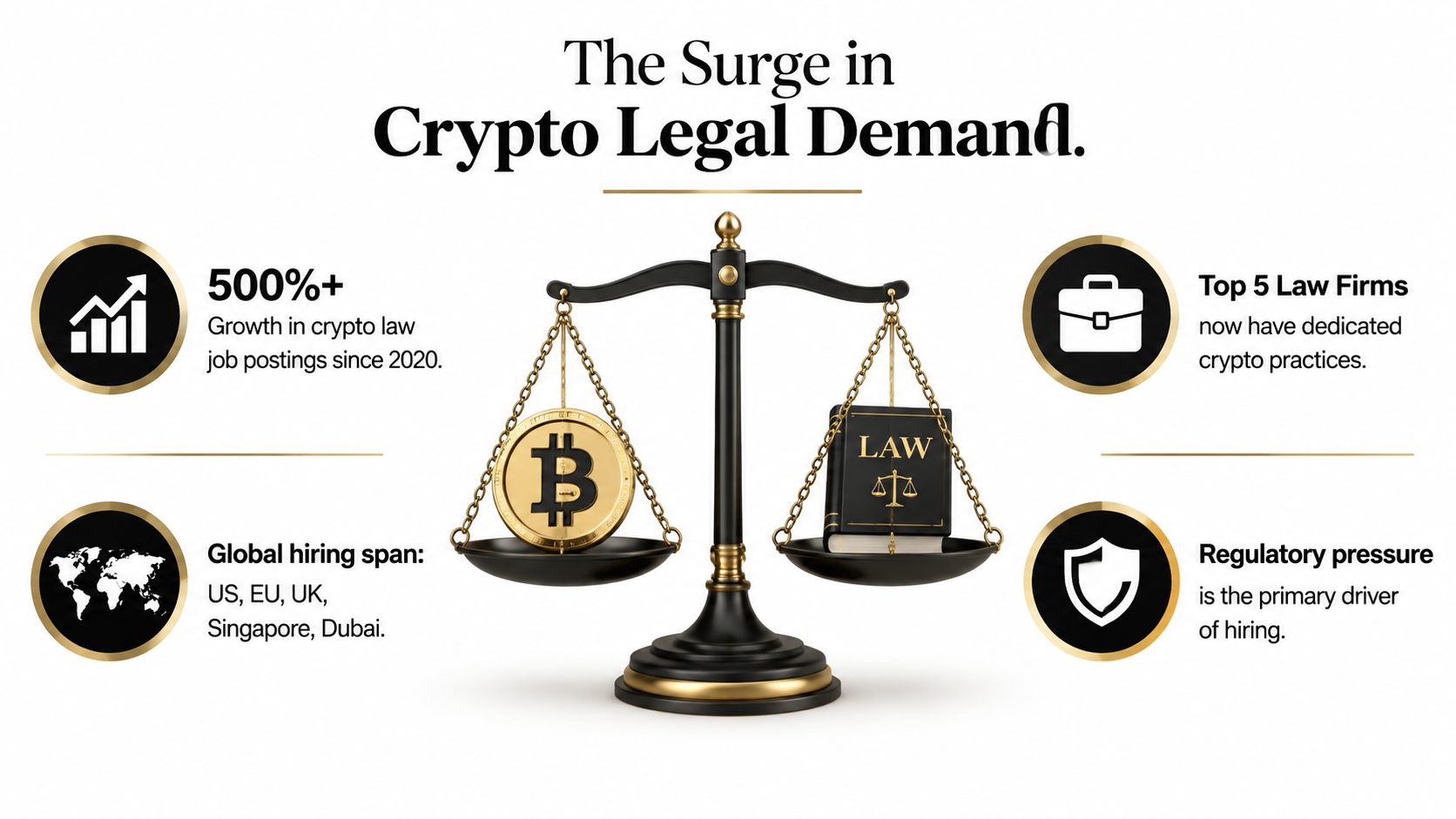
That shift changes how you should search, prepare, and interview. The strongest candidates don't pitch themselves as people who “understand crypto.” They show how they've handled licensing, controls, regulator engagement, product risk, sanctions, reporting, and cross-functional execution.
This guide takes the hiring-manager view. It identifies where demand concentrates, separates advisory roles from operational ownership, explains which qualifications carry weight, and gives you a practical way to reposition traditional legal experience. For broader context on roles across the ecosystem, you can also browse the Blockchain Jobs blog, but your priority should be the same in every search: prove that you can help a regulated crypto business operate.
Introduction to Crypto Legal Jobs and Why Demand Is Surging
A lawyer moving from a bank or fintech often makes the same early mistake. They lead with drafting skill, outside-counsel management, and general regulatory knowledge, then wait for the interviewer to connect those capabilities to crypto. Hiring teams rarely make that connection for you. You need to translate your background into the decisions a crypto company makes every day.
The market itself has become easier to read. Compliance and legal weren't separately tracked in the 2023 global crypto jobs report, yet by H1 2026 the function had become one of the clearest demand centers in the sector, as documented in CoinGecko's hiring data. That maturation matters because it signals a move from occasional specialist advice to permanent legal infrastructure.
Why the hiring model changed
Crypto companies increasingly operate across regulated jurisdictions, launch products tied to financial activity, and maintain controls that must work continuously. Counsel therefore sits inside product launches, licensing applications, market expansion, investigations, and internal training. A legal opinion that never becomes a policy, workflow, or evidence trail has limited value.
The candidate who gets hired can answer questions such as:
- Product launch: What legal assumptions must be tested before a new custody, trading, lending, or payments feature reaches customers?
- Market entry: Which license, local counsel workstream, reporting obligation, and operational control must be ready before launch?
- Control design: How will the company document customer due diligence, transaction monitoring, sanctions screening, and escalation?
- Executive communication: How do you explain a regulatory constraint to a product leader without turning the answer into an unusable memo?
Hiring manager's view: Crypto employers don't need a lawyer who only identifies risk. They need counsel who can define the control, assign the owner, and keep the business moving.
The timing is especially important for candidates who've treated crypto as a possible future specialization. The category now rewards direct regulatory product coverage, not just classic corporate counsel work. Candidates who can connect legal interpretation to implementation will stand out from applicants whose experience remains entirely document-centered.
How Legal and Compliance Work Inside a Crypto Organization
Traditional legal teams often act as review gates. A business team brings a contract, marketing campaign, or product proposal to counsel, counsel identifies issues, and the business decides what to do. Crypto legal teams still review documents, but the highest-value work happens earlier and continues after approval.
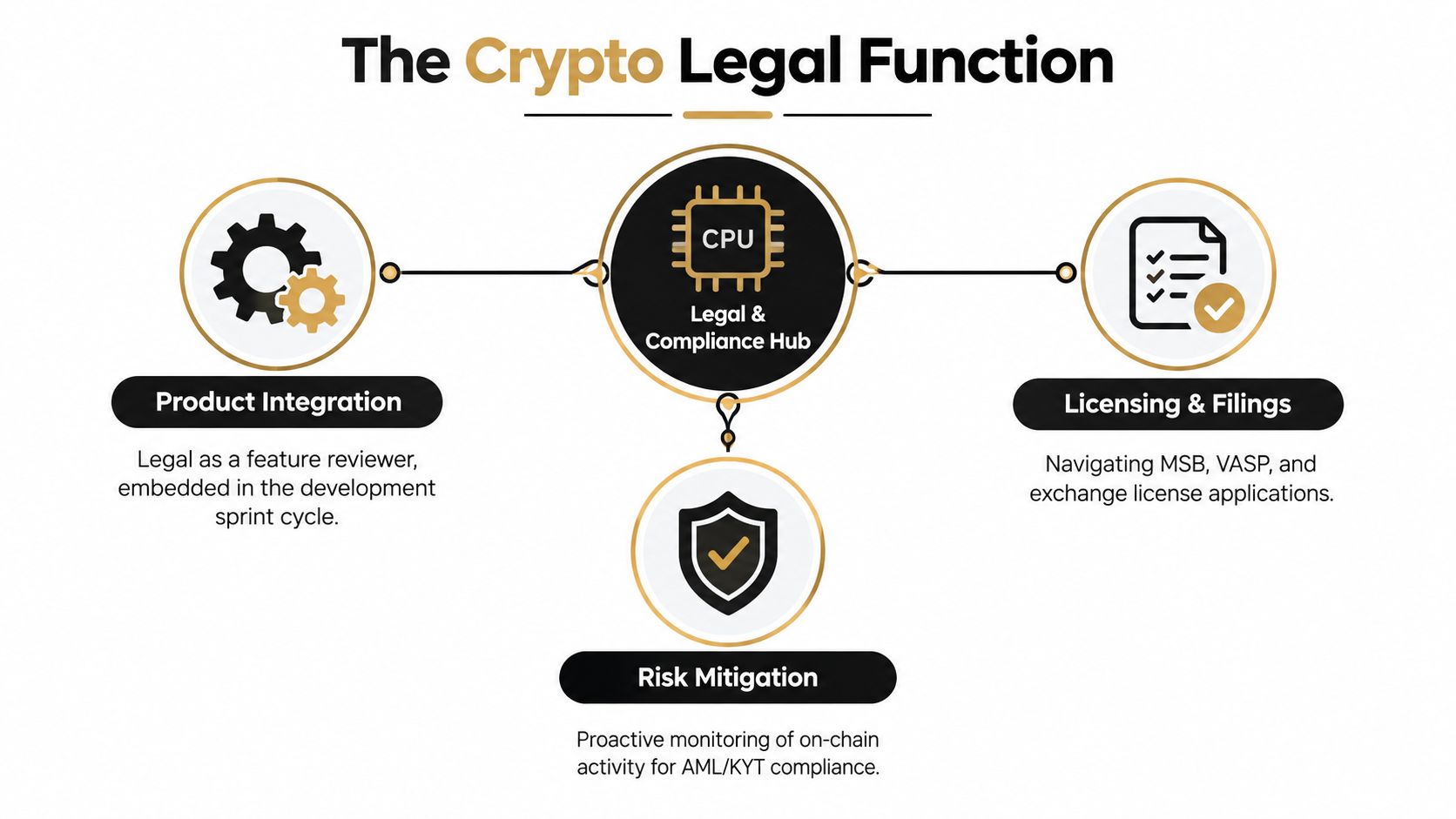
Think of legal as product infrastructure. A counsel advising an exchange may help define which customers can access a feature, what disclosures appear in the interface, which license supports the activity, how suspicious activity escalates, and what records the company retains. The work is closer to systems design than a final redline.
The operating model
A strong crypto legal function usually connects four activities:
- Interpretation: Counsel identifies the applicable legal and regulatory questions, including jurisdiction, product classification, licensing, conduct, and financial-crime exposure.
- Design: Legal and compliance convert those conclusions into policies, approval criteria, monitoring rules, escalation paths, and reporting procedures.
- Execution: Product, engineering, operations, and compliance teams implement the controls in software, customer workflows, investigations, and documentation.
- Evidence: The organization retains records showing what it decided, who approved it, how the control operated, and how exceptions were handled.
That final step separates credible operators from theoretical advisers. Regulators, auditors, banking partners, and senior executives need evidence, not only conclusions.
A candidate should also understand the practical division of labor. Regulatory counsel might interpret a licensing requirement and advise on a new product. A compliance leader may own the program, metrics, investigations, and reporting. Product counsel may work directly with designers and engineers. The boundaries vary by company, but the interview question is always similar: what did you personally own after giving legal advice?
Smaller companies may combine several responsibilities in one role. Larger exchanges may divide them among regulatory counsel, compliance officers, AML specialists, policy teams, and regional legal leads. Support resources can help with repeatable administrative work, document organization, and research. For teams evaluating that model, a curated overview of virtual legal assistants companies can provide useful context, though sensitive regulatory judgment must remain with qualified legal professionals.
Practical rule: If your resume says “advised on compliance,” be ready to explain the policy, workflow, system, training, or reporting process that changed because of your advice.
Key Crypto Legal Roles and What Each One Actually Does
Titles in crypto can mislead you. “Legal counsel” may mean product advice, licensing, commercial contracts, or a hybrid compliance role. “Compliance” may involve investigations, controls testing, regulatory engagement, and legal interpretation. Read the responsibilities before you judge the seniority.
The following table is a useful first filter. It focuses on what interviewers usually want to see, not what the title sounds like.
| Role Title | Primary Focus | Key Interview Signal |
|---|---|---|
| General Counsel | Enterprise legal strategy, governance, regulatory risk, external counsel, executive advice | You can set risk appetite, prioritize legal work, and advise leadership under uncertainty |
| Regulatory Counsel | Licensing, product regulation, jurisdictional analysis, regulatory engagement, expansion | You can translate rules into launch conditions, filings, controls, and business decisions |
| Compliance Officer | Compliance program ownership, monitoring, investigations, reporting, training | You've operated controls and can demonstrate escalation, testing, remediation, and evidence |
| AML/KYC Specialist | Customer due diligence, transaction monitoring, sanctions, suspicious activity processes | You understand alert handling, investigation quality, recordkeeping, and control effectiveness |
| Policy and Regulatory Affairs | Government engagement, policy analysis, trade associations, legislative strategy | You can turn proposed rules into company positions and communicate with policymakers |
Choosing the right lane
A corporate lawyer who wants to enter crypto should target regulatory counsel or product counsel roles only if they can show more than contract volume. Highlight work involving financial products, customer onboarding, licensing, disclosures, regulatory examinations, or operational risk.
A compliance professional may be closer to the market than a lawyer with no control ownership. AML/KYC, sanctions, transaction monitoring, and audit readiness appear together frequently in crypto compliance work. The crypto compliance job taxonomy from CryptoJobsList reflects that broad operating scope.
General Counsel roles are not shortcuts into the industry. They demand judgment across product, employment, commercial, regulatory, governance, and crisis matters. If you haven't owned a legal function or advised senior executives directly, a regional regulatory counsel or compliance leadership role may provide a stronger progression path.
Candidates should study live role patterns rather than rely on generic searches. A specialized legal and compliance jobs category helps you compare titles, employers, responsibilities, and seniority signals in one place.
Regulatory Landscape That Shapes Crypto Legal Hiring
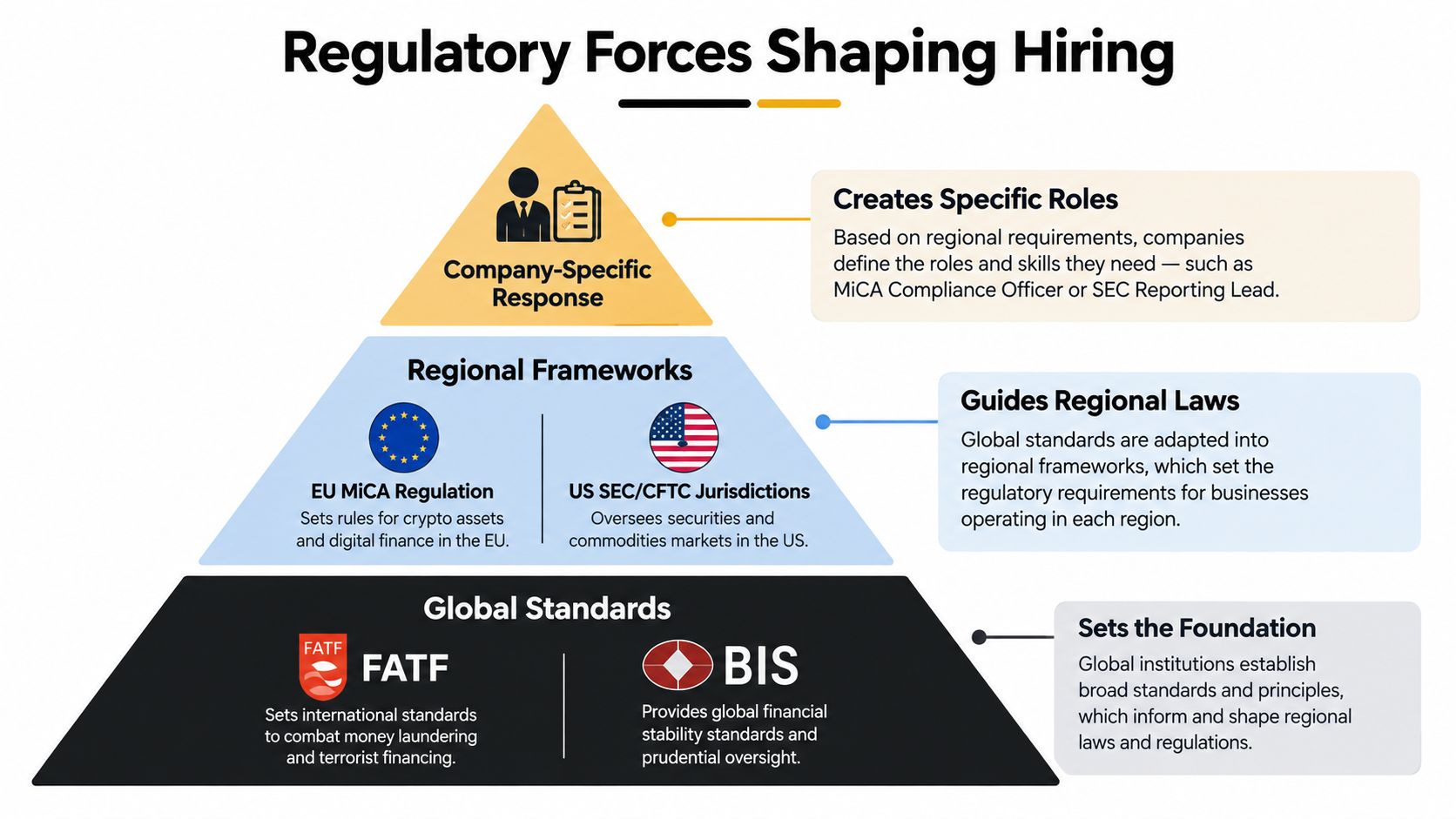
Regulation creates crypto legal jobs by forcing companies to answer operational questions. A rule doesn't merely produce a memo. It can create a licensing project, a product restriction, a monitoring requirement, a reporting process, a training program, or a new control owner.
MiCAR is a strong example. MiCA made CASP licensing mandatory from December 30, 2024, a change discussed in coverage of crypto hiring trends and the regulatory push. For candidates, the implication is practical. European roles increasingly value people who understand authorization, local implementation, conduct requirements, and the connection between licensing and product operations.
Rules become hiring requirements
The FATF-style Travel Rule illustrates the same chain. Global financial-crime standards influence regional obligations. Regional obligations shape the controls a company must build. Those controls determine whether the company needs regulatory counsel, an AML program manager, sanctions expertise, transaction-monitoring specialists, or reporting leadership.
In the United States, candidates may encounter roles requiring familiarity with the SEC, CFTC, NYDFS, FinCEN, broker-dealer regulation, securities law, and BSA/AML programs. One crypto legal jobs listing source includes roles requiring broker-dealer regulatory experience and knowledge of SEC, CFTC, NYDFS, FinCEN, and AML regimes. That background is valuable because it lets you identify not only the legal rule, but also the regulator, license, control, and evidence burden connected to it.
A major exchange role shows the modern benchmark directly. A Regulatory Legal Counsel position at Crypto.com asks candidates to advise on MiCAR, licensing and registration, financial-crime controls, conduct-of-business rules, reporting obligations, international expansion, new licenses, product analysis, external counsel, and internal training.
The geographic question therefore has a functional answer. Markets with active licensing and expansion work create demand for counsel who can manage local advisers, compare jurisdictional requirements, and keep product teams aligned. Don't describe yourself as globally experienced unless you can explain how you handled conflicts among jurisdictions and converted them into a workable operating model.
Qualifications Skills and Experience That Get You Hired
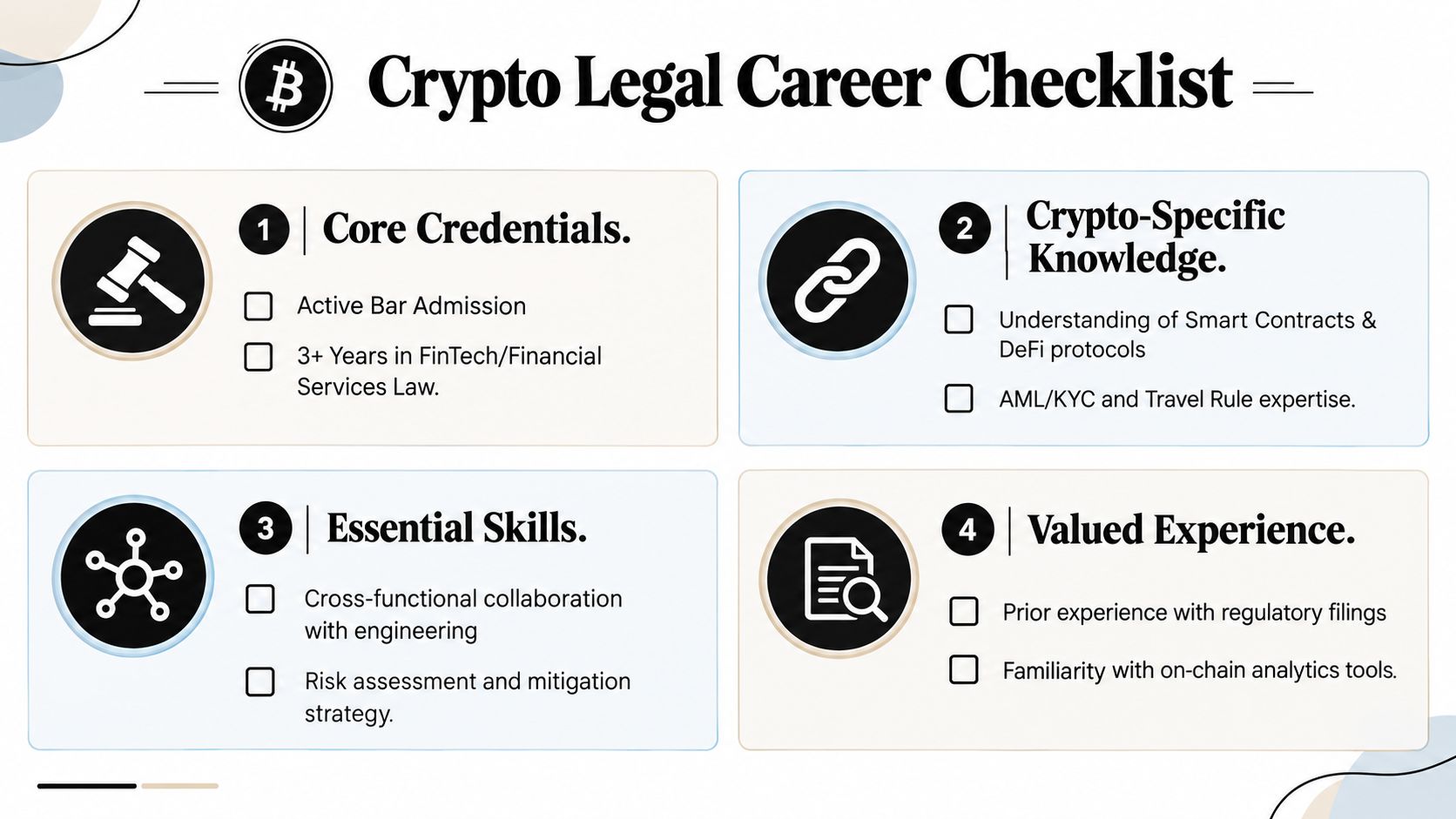
The minimum credential is often straightforward, but the hiring bar isn't. Representative postings commonly require a JD, active bar membership, and several years of relevant experience. One listing cited by Indeed's blockchain legal and compliance jobs page required a JD from an accredited U.S. law school, an active license in at least one U.S. jurisdiction, 5+ years of legal and compliance experience, and knowledge of U.S. digital-asset or financial-services frameworks.
What clears the first screen
Your resume should make four things obvious:
- Regulatory ownership: Name the regime, business line, and decision you handled. “Advised on financial regulation” is weak. “Led regulatory analysis for a broker-dealer product launch” gives the reviewer something concrete to assess.
- Control fluency: Show work involving onboarding, KYC, AML, sanctions, transaction monitoring, investigations, testing, remediation, or audit evidence.
- Cross-functional execution: Identify the teams you worked with. Product, engineering, operations, risk, finance, and executive stakeholders all matter because crypto legal work rarely stays inside the legal department.
- Jurisdictional range: Specify the markets and regulators you covered. Generic international experience won't substitute for explaining how requirements differed across jurisdictions.
Adjacent regulated-industry experience carries substantial weight. Hiring teams value securities, broker-dealer, fintech, AML, and sanctions backgrounds because those disciplines map directly to crypto operating problems. A role described through Web3.Career's crypto legal listings required 5+ years of legal experience, including at least 3 years focused on U.S. broker-dealer regulation, while another compliance role required 6+ years in BSA/AML and sanctions compliance, including program management and regulatory engagement.
How compensation reflects responsibility
Pay varies by seniority and specialization. Recent U.S. snapshots listed average yearly pay of $160,386 for cryptocurrency legal compliance and $98,949 for crypto compliance, while senior legal listings included ranges of $125,000-$175,000, $140,000-$171,000, and $224,995-$264,700, as shown by ZipRecruiter's cryptocurrency legal compliance compensation data. Treat those figures as market snapshots, not promises. Interviewers use the target band to test whether you've owned the level of regulatory responsibility the role requires.
Interview standard: Don't say you're familiar with AML. Explain how you designed, tested, investigated, escalated, documented, or improved an AML control.
How to Transition Into Crypto Legal Jobs and Ace the Interview
The cleanest transition story connects your old work to a crypto company's operating problem. A broker-dealer lawyer shouldn't say, “I'm passionate about digital assets.” They should say, “I've advised on supervision, registration, customer-facing products, and regulator interaction, and I can apply that experience to an exchange's licensing and product approval process.”
A fintech counsel should emphasize implementation. Explain how you worked with product and engineering, reviewed customer journeys, managed consumer disclosures, or built approval processes. An AML professional should focus on investigations, alert logic, sanctions escalation, suspicious activity processes, and evidence quality. The industry vocabulary matters, but the ownership story matters more.
Prepare for the questions that expose weak experience
Hiring managers commonly test whether you can move from principle to action. Prepare concise answers to questions such as:
- A product team wants to launch in a new jurisdiction. What facts do you request first?
- A proposed feature may trigger licensing or conduct obligations. How do you structure the analysis?
- A transaction-monitoring control produces too many alerts. How do you investigate and remediate the problem?
- Local counsel gives conflicting advice across markets. How do you reach a launch decision?
- A non-legal stakeholder ignores a control because it slows growth. How do you handle the disagreement?
Use a simple answer pattern: facts, rule, risk, control, owner, evidence. That sequence shows that you don't stop at legal interpretation. It also gives interviewers a way to assess your judgment under pressure.
Match your target employer to your experience
Exchanges usually demand licensing, market-entry, conduct, AML, sanctions, and product coverage. Custodians may place greater weight on custody structures, institutional clients, operational resilience, and financial-services regulation. DeFi protocols can require sharper analysis of governance, smart-contract functionality, decentralization claims, sanctions exposure, and the limits of traditional corporate structures.
Build a small interview portfolio. Include a one-page product risk assessment, a sample jurisdiction matrix, a control map, and a short training outline for non-lawyers. Remove confidential details. The purpose isn't to provide legal advice or show off formatting. It's to demonstrate that you can make complex requirements usable.
For candidates evaluating senior in-house paths, an Associate General Counsel role in crypto services can help clarify the expectations attached to enterprise-level legal ownership.
Your Next Steps to Launch a Crypto Legal Career
Treat the search like a regulated product launch. Define your target role, identify the evidence that supports your candidacy, test the gaps, and track each application as a separate workstream.
Build a focused action plan
During the first phase, choose one primary lane. Regulatory counsel, product counsel, AML compliance, sanctions, and policy roles require different proof. Applying broadly without a clear narrative makes your resume look unfocused and forces each employer to guess where you fit.
Next, rewrite your experience around ownership. Replace “provided legal advice” with the decision, process, or control you influenced. Add the relevant regulator, product, jurisdiction, stakeholder group, and outcome where confidentiality allows. If you're considering a broader securities path alongside crypto, resources that help you find securities lawyer job details can help you compare adjacent role expectations.
Then close one technical gap at a time. Study the regulatory regimes relevant to your target market, learn how AML and KYC controls operate in practice, and become comfortable discussing smart contracts, custody, wallets, transaction monitoring, sanctions screening, and Travel Rule workflows. You don't need to pretend to be an engineer. You do need to understand enough to ask precise questions.
A live search should remain specialized. On September 8, 2026, a crypto legal jobs board listed 204 open legal and counsel roles, including Lead Compliance Specialist, U.S. Regulatory Compliance Manager, and Associate General Counsel positions, according to ChainJobs' legal jobs board. That mix reinforces the central career lesson: the market includes advisory and operational work, and your application must show which kind you can own.
Track applications, referrals, interview questions, missing experience, and follow-up dates. Review the record weekly and adjust your positioning based on repeated objections. Don't wait for a perfect crypto title. A role that gives you direct exposure to licensing, controls, product decisions, or regulator engagement can create the strongest next step.
Blockchain Jobs connects legal and compliance professionals with specialized opportunities across the Web3 ecosystem, including remote-friendly roles and fresh openings from crypto companies. Visit Blockchain Jobs to search curated legal and compliance positions, compare employers, and take your next application from general interest to targeted career move.