
How Much Does a DevOps Engineer Make: 2026 Salary Guide
A DevOps engineer in the United States makes about $139,000 in average annual base salary in 2026, and total compensation rises to about $142,104. That's the straightforward answer, but it's also the part that misleads candidates if they stop there.
The question isn't only how much does a DevOps engineer make. It's which DevOps engineer, in which market, with which skill stack, and under which compensation model. I've seen candidates anchor too hard on a national average, then undersell themselves in a high-value niche or overestimate what a “remote” offer should look like when the company localizes pay.
For hiring, interviews, and negotiation, that distinction matters more than the average itself. A standard remote DevOps role and a strong Web3 remote role can sit in very different compensation bands, even when the day-to-day tooling overlaps.
Understanding the DevOps Salary Landscape in 2026
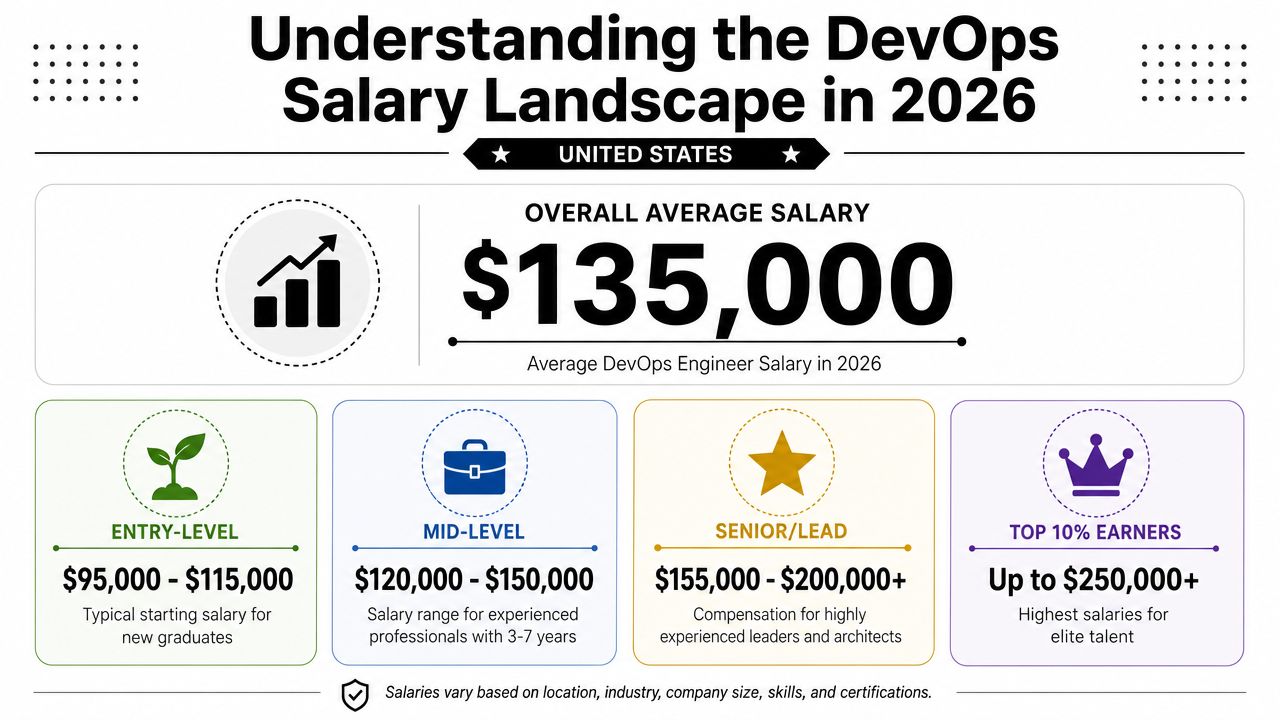
If you want a useful salary benchmark, start with the full spread, not a single headline number. In the U.S., the average annual base salary for a DevOps engineer is approximately $139,000 in 2026, with total compensation reaching about $142,104, according to Underdog's 2026 DevOps salary breakdown. The same source puts the median salary at $130,000.
That difference between average and median is worth noticing. It usually means the top end pulls the average upward. In hiring terms, that tells me there's strong upside for engineers who move into the right company, location, or specialization.
What the ranges look like by experience
The same U.S. benchmark shows a clear progression by seniority:
| Experience level | Typical pay range |
|---|---|
| Entry level, 0 to 2 years | $80,000 to $110,000 |
| Mid level, 3 to 5 years | $110,000 to $140,000 |
| Senior level, 5+ years | $150,000 to $180,000 |
For top-tier roles in places like San Francisco, compensation can exceed $190,000, based on the same Underdog salary data.
A separate U.S. salary view from EC-Council's DevOps engineer salary analysis gives another useful cut: $80,988 for entry-level roles, $114,014 for mid-level roles, and $131,642 for senior roles in 2026. I wouldn't treat one source as “right” and the other as “wrong.” Recruiters use ranges, not absolutes. What matters is the pattern. Experience still moves compensation materially.
How hiring teams actually interpret your level
Years of experience alone won't decide your band. Hiring managers usually map DevOps candidates by scope:
- Entry-level candidates can support CI/CD pipelines, troubleshoot cloud environments, and work inside established Terraform, Kubernetes, or AWS patterns.
- Mid-level candidates can own reliability for a service, improve deployment workflows, and partner with developers without heavy supervision.
- Senior candidates are expected to design systems, reduce operational risk, and influence architecture across teams.
Practical rule: If your resume only lists tools, you'll get screened as lower-level. If it shows ownership, migration decisions, incident response leadership, and platform outcomes, you'll interview at a higher band.
One more salary signal matters. Even the bottom 10% of U.S. DevOps engineers earn an average of $91,500, which tells you sub-six-figure pay is relatively uncommon in this market according to Underdog's salary report. That doesn't mean every offer should be accepted. It means DevOps remains a premium function, and candidates should negotiate like one.
How Location and Remote Work Impact Your Paycheck
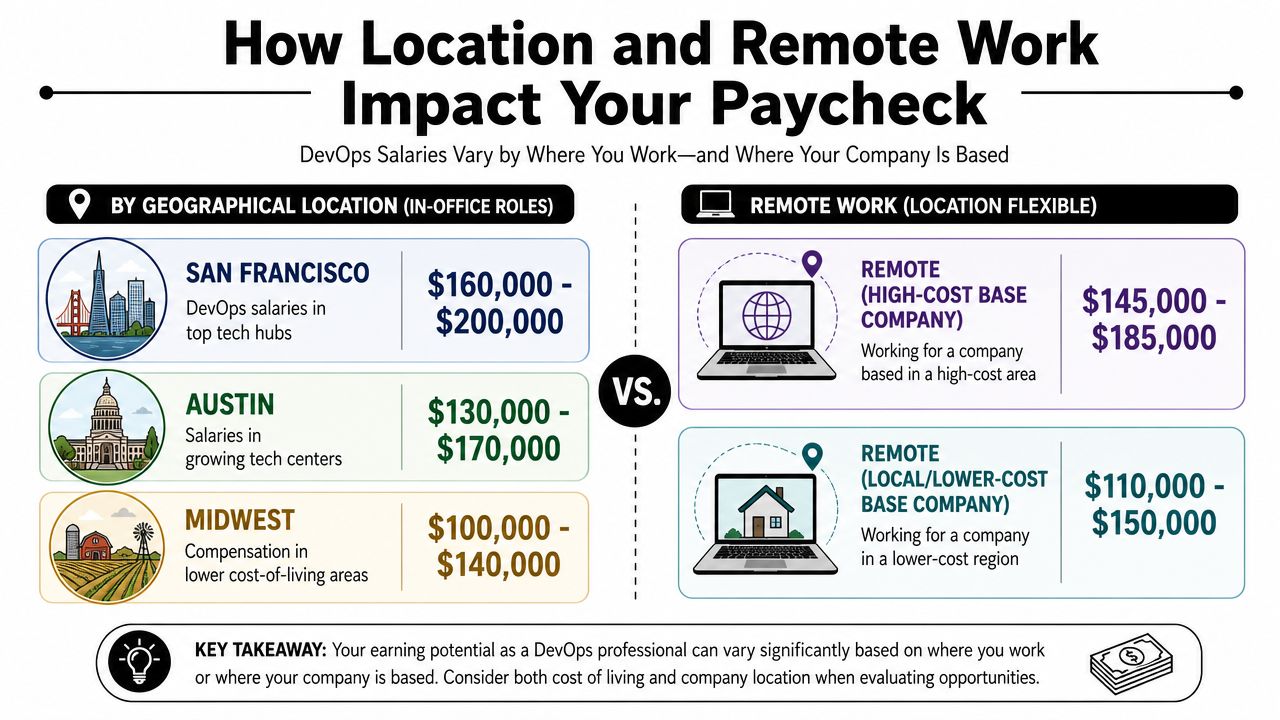
Geography still shapes DevOps pay far more than many candidates expect. In the U.S., senior DevOps engineers in San Francisco average $167,910, while the same level in Denver averages $137,223, based on EC-Council's market comparison. That gap exists because companies price roles around local competition, cost of labor, and how hard the talent is to replace.
For candidates, this changes how you should read a job description. “Remote” doesn't automatically mean national top-tier pay. It often means the company can hire beyond its office footprint while still applying a location-based compensation philosophy.
U.S. hubs versus international markets
If you're comparing offers globally, the gap gets wider. Dreamix's country-by-country salary guide reports a national average of about £60,000 in the UK and €63,600 in Germany. For Latin America, a remote mid-level DevOps engineer working for a U.S. company earns a median of $53,000.
The same source reports Ukraine at approximately €18,580, which shows how aggressive regional compression can be in practice. That's why a candidate in an emerging market can land a respected remote role and still end up nowhere near U.S. compensation.
Here's the hiring reality. Companies usually justify this in one of two ways:
- Cost-of-labor logic means they benchmark against your market, not headquarters.
- Role-value logic means they pay for the impact of the position, regardless of where you live.
The second model is better for candidates. The first is still more common than people want to admit.
Why remote salary assumptions break down
A lot of mainstream salary advice skips the remote discount. Fastlane Recruit's analysis of DevOps salary gaps points out that global self-reported pay for remote DevOps developers averages $85,759, with a starting range of $71,637 to $103,292. That's far below the U.S. senior market and a direct reminder that “remote” and “U.S.-paid” aren't synonyms.
A remote job is only premium if the company runs a premium compensation model.
That distinction matters even more for candidates planning location arbitrage. If you're relocating to a lower-cost place, your quality of life may improve even if your salary doesn't jump. Anyone evaluating a move should compare the offer against real living costs, not social media assumptions. A practical reference for that kind of planning is this guide to housing and budgets in Madeira, especially if you're weighing remote work from Europe.
If you're actively screening distributed roles, it helps to track listings that are explicitly structured for remote hiring, not just office-first companies with a remote checkbox. A focused starting point is this set of remote blockchain jobs.
The Skills and Industries That Command Higher Salaries
Not all salary growth comes from waiting for another year of experience. Some of it comes from becoming expensive to replace.
The strongest DevOps candidates don't just know AWS, Kubernetes, Terraform, CI/CD, observability, and incident response. They can connect those tools to delivery speed, uptime, security posture, and developer productivity. In interviews, that difference shows up fast. One candidate says they “worked with Kubernetes.” Another explains how they redesigned cluster workflows, cleaned up Helm deployment friction, improved release confidence, and partnered with application teams to reduce rollback pain. The second candidate gets paid more because the business risk is lower.
The industries with stronger pay
Industry matters more than many engineers think. EC-Council's salary analysis reports that the Insurance sector offers the highest median total pay at $146,369, followed by Media & Communication at $143,386.
That tracks with how hiring works. Insurance environments often demand tighter controls, stronger security practices, and more disciplined infrastructure management. Media environments tend to reward engineers who can handle scale, delivery speed, and heavy traffic patterns. Different business models, same result. Companies pay more when infrastructure mistakes are expensive.
Skills that move your offer upward
The same EC-Council breakdown says AWS proficiency can boost annual salary by up to 3%. I'd treat that as directional rather than magical. No one gets a raise because they added one cloud badge to LinkedIn. They get paid more when the skill solves hiring pain.
Focus on combinations that signal advantage:
- Cloud plus infrastructure as code. AWS with Terraform tells employers you can scale and standardize.
- Kubernetes plus platform judgment. Plenty of candidates can deploy to Kubernetes. Fewer can explain when not to add complexity.
- DevSecOps plus cross-team collaboration. Security-minded engineers who can work with developers and compliance teams stand out.
Hiring signal: Certifications help you get screened in. Practical examples help you get leveled correctly.
If you're deciding what to learn next, don't chase every tool. Build a portfolio around one clear story. For example: AWS, Terraform, GitHub Actions, Kubernetes, Prometheus, and incident management. Or GCP, ArgoCD, policy controls, and supply chain security. Coherent skill stacks are easier to hire, easier to explain in interviews, and easier to negotiate around.
The Web3 Premium DevOps Salaries in Blockchain
Generic DevOps salary guides usually miss the plot by lumping remote roles together and ignoring the fact that some remote niches pay on a completely different curve.
In Web3, top DevOps and infrastructure talent often sits closer to platform engineering, security engineering, and distributed systems than a standard deployment role. Teams need people who can run validator infrastructure, secure cloud environments, support high-availability services, manage secret handling, and work around fast-moving product releases without breaking production.

What the Web3 premium looks like
In the U.S. Web3 market, Senior Staff DevOps Engineers at firms like Ripple command a base salary range of $220,000 to $260,000 annually, according to Web3 Career salary data for DevOps jobs. That's a different class of compensation than the typical remote DevOps role.
The broader blockchain talent market supports that premium. Coursera's blockchain developer salary overview reports median total pay of $137,000 for blockchain developers overall, with salaries rising from $115,000 for 0 to 1 years of experience to $175,000 for 15+ years. The lesson for DevOps candidates is simple. Specialized infrastructure work in blockchain is rewarded when it sits close to revenue, protocol operations, or security-critical systems.
What recruiters look for in Web3 DevOps candidates
I'd separate candidates into three broad groups during hiring:
- Generalist DevOps applicants who know cloud and CI/CD but haven't operated blockchain systems.
- Adjacent infrastructure engineers who understand containers, automation, observability, and reliability, and can move into Web3 quickly.
- Domain-ready Web3 operators who already know validator setups, node reliability, exchange-grade uptime expectations, and crypto security basics.
The second group often gets interviews. The third group gets the strongest offers.
If you want a concrete example of the kind of role that sits near this premium tier, look at this blockchain DevOps engineer Kubernetes role at Binance. Job specs like that usually reveal what drives compensation: high-stakes uptime, cloud depth, container orchestration, and comfort with fast-moving production environments.
A short explainer can also help if you're moving from traditional infra into crypto infrastructure:
Web3 doesn't pay a premium for curiosity alone. It pays for engineers who can operate critical systems under uncertainty.
Beyond the Base Salary Decoding Total Compensation
Too many candidates compare offers by base salary alone. That's an easy mistake, and it's costly.
The U.S. average figures already show the gap between base and total compensation. As noted earlier, base salary sits around $139,000 while total compensation reaches about $142,104 in the 2026 U.S. benchmark from Underdog. That spread is modest in that dataset, but in practice the difference can become much larger once equity, bonuses, and benefits enter the package.
What to actually compare in an offer
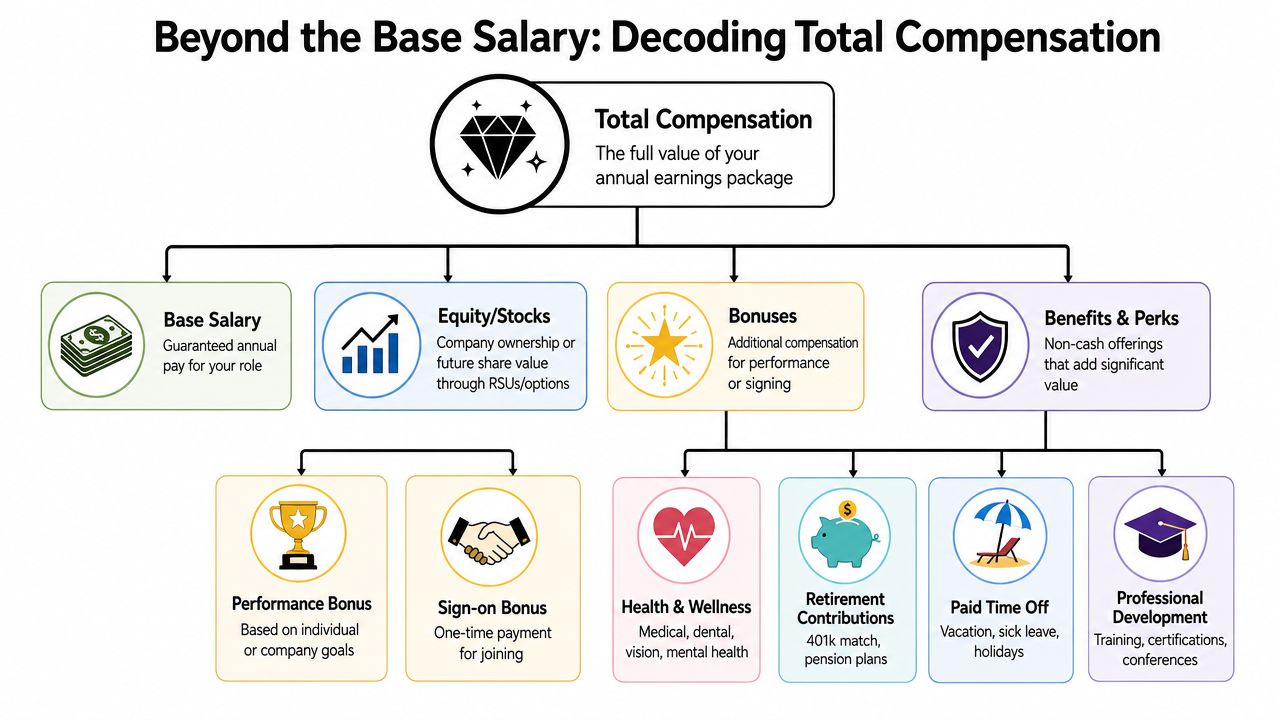
When you review an offer, break it into components:
- Base salary is the guaranteed cash.
- Bonus may be company-based, individual, or discretionary.
- Equity could come as RSUs or options, depending on company stage.
- Benefits include healthcare, retirement contributions, paid time off, and training budgets.
Candidates often overweight equity in private companies because the number of shares sounds exciting. The better question is whether the equity is likely to become liquid, what the vesting schedule looks like, and what you're giving up in guaranteed cash to get it.
RSUs, options, and the practical trade-off
For established public or late-stage companies, RSUs are usually easier to value. For startups, options can be meaningful, but they carry more uncertainty. I've watched candidates take a lower base because the equity story sounded strong, then discover the exercise terms or liquidity path made the package far less attractive than it looked.
A cleaner way to evaluate two offers is to ask:
| Offer component | What to ask |
|---|---|
| Base | Is this competitive for my level and market? |
| Bonus | Is it target-based, guaranteed, or discretionary? |
| Equity | What type is it, how does vesting work, and what is the realistic value case? |
| Benefits | Which items would I otherwise pay for myself? |
This matters even more if you're considering people or compensation-facing roles inside growth-stage companies, where package design becomes part of the job itself. Reviewing examples of senior compensation business partner roles can sharpen your thinking because those listings show how employers structure pay philosophy from the inside.
Offer filter: A higher base with weak upside isn't always better, but a flashy equity package with vague terms usually isn't better either.
Actionable Strategies to Maximize Your DevOps Earnings
Salary growth in DevOps rarely comes from one dramatic move. It usually comes from stacking good decisions. Pick the right niche. Interview for the right scope. Show ownership, not task completion. Negotiate with evidence instead of hope.
If you're trying to answer how much does a DevOps engineer make for your own career, treat the market data as a range to position against, not a number to memorize. The salary that matters is the one attached to the level you can prove.
During interviews, sell scope and outcomes
Most engineers undersell themselves by describing tools instead of impact. Don't say you “used Terraform and Kubernetes.” Say you owned infrastructure automation, improved deployment reliability, partnered with security, reduced manual release work, or supported a multi-team platform.
Use language that matches how hiring committees level candidates:
- For mid-level roles say you owned systems, supported releases, and improved reliability.
- For senior roles say you designed standards, led migrations, handled incidents, and influenced architecture decisions.
- For Web3 roles say you operated critical infrastructure, worked with security-sensitive systems, and supported production environments where downtime had immediate business consequences.
In negotiation, anchor to market logic
Candidates often ask for more money with the wrong framing. “I was hoping for a little more” is weak. “Based on the market for this scope, my background in AWS, Kubernetes, and cross-team infrastructure ownership, I'd like to discuss the top end of the range” is stronger.
A few lines that work well:
“Given the level of ownership in this role, I'm most interested in a package aligned with senior-level infrastructure scope.”
“I'm comparing opportunities partly on total compensation, so I'd like to understand flexibility across base, bonus, and equity.”
“My experience is closest to roles where platform reliability and cloud architecture are core, so I'd want the package to reflect that level.”
For candidates moving into leadership or more complex offer discussions, this guide to executive offer negotiation tips is a useful supplement because it focuses on how to structure the conversation, not just ask for more.
Build toward the premium tiers
The biggest upside usually comes from moving closer to business-critical systems. In practical terms, that means:
- Choose harder environments. Regulated sectors, high-scale media platforms, and Web3 infrastructure roles often value DevOps depth more than generic SaaS support roles.
- Get good at one cloud and one orchestration path. AWS plus Kubernetes is still a strong pairing when backed by Terraform, CI/CD, and observability experience.
- Learn to talk to multiple stakeholders. Senior compensation follows engineers who can work with product, security, backend teams, and leadership without translation friction.
- Target remote roles carefully. Don't assume a distributed job means top-of-market compensation. Ask whether the company localizes salary by geography.
- Use interviews to qualify the employer. Ask how they level DevOps talent, what the on-call burden looks like, how they define senior scope, and whether infrastructure is treated as strategic or support.
The candidates who earn more usually do one thing differently. They stop presenting themselves as operators of tools and start presenting themselves as owners of systems.
If you want to find higher-upside infrastructure and Web3 roles without digging through generic boards, browse Blockchain Jobs. It's a strong place to track remote crypto openings, DevOps and infrastructure roles, and the kinds of blockchain teams that tend to pay for specialized production experience.