How to Invest in Web3 in 2026: A Practical Playbook
The most popular advice about Web3 investing is still some version of, “Buy a few big tokens, leave them on an exchange, and wait.” That was a weak plan in 2021. In 2026 it's worse, because Web3 isn't a single bet anymore, it's a mix of liquid tokens, yield-bearing positions, venture-style exposure, and career growth.
That matters because the market itself has matured. Venture capital still keeps flowing into the space, with about $13.7 billion invested into crypto and blockchain startups in 2024 across 2,153 deals, and the largest share of crypto VC capital in Q4 2024 went to the Web3/NFT/DAO/Metaverse/Gaming category at 20.75%, or $771.3 million (Galaxy 2024 data). That's not just token speculation, it's structured capital looking for infrastructure, wallets, security, DeFi, and adjacent software.
The second change is custody and compliance. Holding everything in one exchange account is a shortcut, not a strategy, especially when your allocation spans staking, lending, and illiquid positions. The third change is the talent market. The people hiring in Web3 now reward candidates who understand token mechanics, governance, and risk, which means how to invest in Web3 and how to build a career in it are tightly linked.
Why the Old Web3 Investing Advice No Longer Works
The old playbook failed because it treated Web3 like a ticker list instead of an operating system for capital. People bought a few top tokens, ignored custody, ignored yield, and assumed the sector would reward patience alone. That approach breaks as soon as you need to think about staking, governance, token releases, or where your risk sits.
The market has shifted from simple holding to active allocation
A more useful baseline is that crypto capital is still being deployed across real company structures, not just coins. In Q2 2025, Web3 funding reached $9.6 billion across 306 deals, and capital was flowing disproportionately into infrastructure, blockchain services, mining, validation, and computing networks (CryptoRank recap). That means the serious money is often chasing the stack, not the meme.
The other outdated habit is pretending stablecoin yield doesn't matter. It does, because a Web3 portfolio usually needs a reserve you can deploy when volatility hits. If you ignore that layer, you end up fully exposed and forced to sell into weakness.
Practical rule: if your whole thesis is “just DCA into BTC and ETH,” you're missing the parts of Web3 that actually create convexity, including yield, staking, and access to early-stage upside.
NFTs are another place where generic advice falls apart. Treating NFTs as one bucket is sloppy. Some are pure speculation, some are access passes, and some are thinly traded exposure to a niche you understand. The same is true for “altcoins.” A lot of advice still sounds like one-size-fits-all, but the sector no longer behaves that way.
Hiring is part of the investing edge
Web3 compensation now rewards specialization. Blockchain developers and token economists can each earn roughly $130,000 to $210,000, while broader crypto compensation averaged around $144,000 across firms surveyed in 2025 (crypto employment statistics). If you work in the sector, your portfolio and your paycheck can both be tied to the same market.
That creates a real trade-off. Working in Web3 can sharpen your edge because you see governance, product friction, and incentive design from the inside. It also increases your exposure if your salary, bonuses, and holdings all move with the same ecosystem. The old advice never had to think about that. Today it does.
The Five Web3 Asset Classes You Can Allocate To
Serious investors need a cleaner map than “buy coins.” Web3 capital falls into distinct buckets, and each one behaves differently when markets turn. If you lump them together, you end up thinking you're diversified when you're really concentrated in one kind of beta.
What you're really buying
Layer-1 and utility tokens are the most familiar bucket. They are liquid, easy to buy, and easy to overown. Their role is broad market exposure, but in drawdowns they often move together, so a stack of alternate L1s is not diversification. Position sizing should stay modest unless you have a specific thesis about demand, fee capture, or ecosystem adoption.
DeFi positions include lending, LPs, and perps. They can generate cash flow, but they also add smart contract risk, impermanent loss, and the wrong kind of active risk. These positions need more monitoring than spot holdings, so they fit investors who read governance, understand protocol design, and can tolerate hands-on management.
Liquid staking and restaking belong in a separate bucket because they behave differently under stress. Staked ETH and restaked ETH are not interchangeable, especially if a slashing event hits. That distinction matters more than the marketing around “yield.”
Some investors treat yield as a bonus. In Web3, yield is often the price of taking a specific risk.
NFTs and tokenized real-world assets are best treated as one illiquid bucket. They need high conviction, niche knowledge, and a long horizon. They can work, but they are not a place for money you may need next quarter.
Venture-style exposure covers SAFTs, token warrants, DAO treasuries, and on-chain launchpads. This is the least liquid bucket and the one most tied to information advantage. It can also be the most career-connected, because it gives you reasons to talk to teams early.
| Web3 Asset Classes at a Glance | Liquidity | Typical Horizon | Starter % Allocation | Skill Required | Correlation to ETH |
|---|---|---|---|---|---|
| Layer-1 and utility tokens | High | Medium | Small to moderate | Basic token mechanics, market structure | Often high in drawdowns |
| DeFi positions | Medium | Medium to long | Small | Protocol risk, smart contract basics, incentive design | Usually high |
| Liquid staking and restaking | Medium | Medium to long | Small | Validator and slashing risk, yield math | High, but behavior differs in stress |
| NFTs and tokenized real-world assets | Low to medium | Long | Very small | Niche thesis, liquidity discipline, collection analysis | Often tracks macro beta |
| Venture-style exposure | Low | Long | Small, optional | Team diligence, unlock analysis, legal awareness | Indirect, but still market-sensitive |
For drawdown discipline and tactical sizing, the guide on avoiding drawdowns in prediction markets is a useful reminder that risk management beats hope when volatility spikes.
Setting Up Your Wallet, Exchange, and Bridge Stack
A shortcut. That is the problem with keeping every asset on one exchange account. A useful stack separates custody by purpose, so one mistake does not wipe out your whole portfolio. Keep a hardware wallet like Ledger or Keystone for long-term holdings, a hot wallet like Rabby or MetaMask for active DeFi, and a centralized exchange account for fiat on-ramps, liquidations, and KYC-required venues.
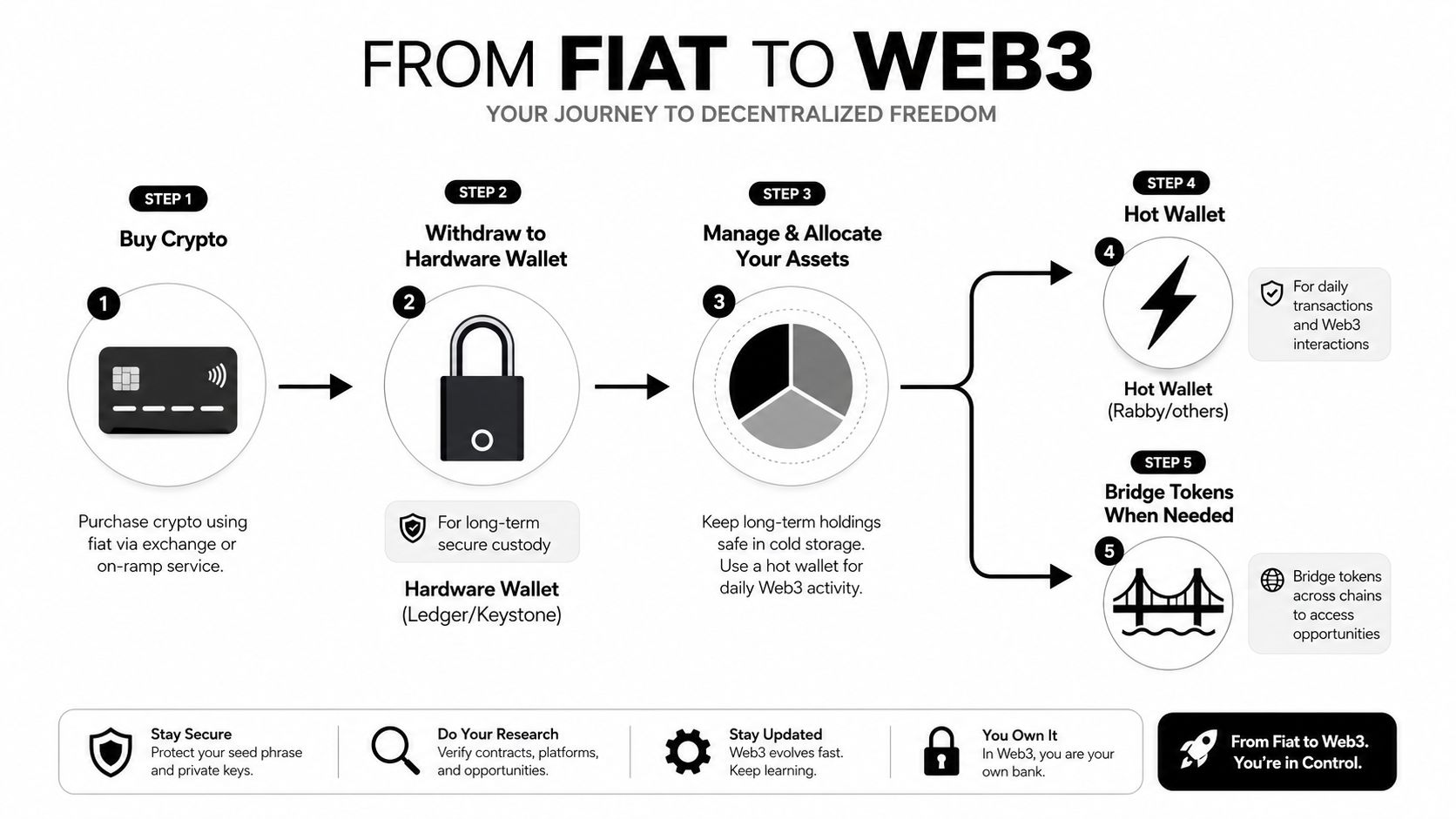
Buy the hardware wallet only from the manufacturer. Fund the exchange account by bank transfer through a regulated venue like Coinbase or Kraken, then move USDC or native ETH to cold storage for long-term holds. Bridge USDC into the hot wallet when you need it for activity. For small amounts, cross-chain swaps through UniswapX or 1inch are practical. For larger transfers, slower official bridges usually come with different trust assumptions than third-party options like Across or deBridge.
The career side matters here too. If you want to work in wallet, product, or custody roles, the posting at Senior Product Manager, Crypto Wallet shows the operational judgment protocols now expect. I have found that people who handle their own stack well usually talk about risk, permissions, and recovery in a much sharper way than casual token buyers.
Your first-time checklist should be mandatory:
- Separate email and 2FA: Keep exchange access on a dedicated email, and use hardware-based 2FA like a YubiKey, not SMS.
- Seed phrase discipline: Store the seed offline in two geographic locations, and never digitize it.
- Burner wallet: Keep a separate wallet for airdrop farming and experimental dApps.
- Tracking from day one: Maintain a simple spreadsheet for deposits, swaps, transfers, and fees.
- Vendor hygiene: Never buy hardware wallets from a reseller.
A useful reference for private number management when privacy matters is buy private number via crypto, especially if you are separating work identity from personal wallet activity.
Evaluating Protocols, Teams, and On-Chain Signals
Skip the glossy deck and read the protocol like an operator. Marketing can create attention, but it can't fake sustained usage, aligned incentives, or a team that ships through bad markets. The cleanest investors I know look at four layers: usage, governance, founder quality, and token design.
What to inspect before you buy
Start with on-chain traction. Daily active addresses, TVL trends, fee revenue, and net inflow versus emission tell you more than a narrative thread does. Tools like Token Terminal, Dune, and DefiLlama are useful because they expose whether usage is real or just promotional.
Then check governance. Who holds voting power, how concentrated are the multisigs, and how fast do proposals move from forum to execution? If all authority sits in a tiny group, that's not decentralization in any useful investor sense.
Founder track record matters just as much. Teams that have shipped products before, survived a down cycle, or worked together across multiple releases usually execute better than anonymous groups with a strong story. Token mechanics also need a separate audit. Who gets emissions, what are coming, and does the asset accrue value to holders or just to stakers?
A protocol that looks healthy on Twitter but weak on governance and unlocks is usually expensive in hindsight.
Cross-check the claimed user base against GitHub commit cadence and core contributor count. A protocol with busy social channels and thin engineering activity is a red flag. The reverse can be true too, a quiet team with steady shipping can be far more investable than a loud one with no code movement.
For a structured way to think about security and funding risk together, the framework for funding and security risks is worth keeping in your diligence stack.
| Protocol Evaluation Checklist | High-Signal Indicator | Vanity Metric to Ignore |
|---|---|---|
| Usage | Sustained fees, active users, and inflows | Social impressions |
| Governance | Concentrated ownership mapped clearly | Discord hype |
| Team | Prior shipped products and down-cycle experience | Founder aesthetics |
| Token design | Clear unlock schedule and holder accrual | Buzzwords about “alignment” |
| Engineering | Consistent commit activity and contributor depth | Roadmap slides |
The clearest mistake is believing a protocol is investable just because it's recognizable. Recognition is cheap. Durable product usage, credible governance, and sane token design are the filters.
Building a Portfolio That Survives a Crypto Cycle
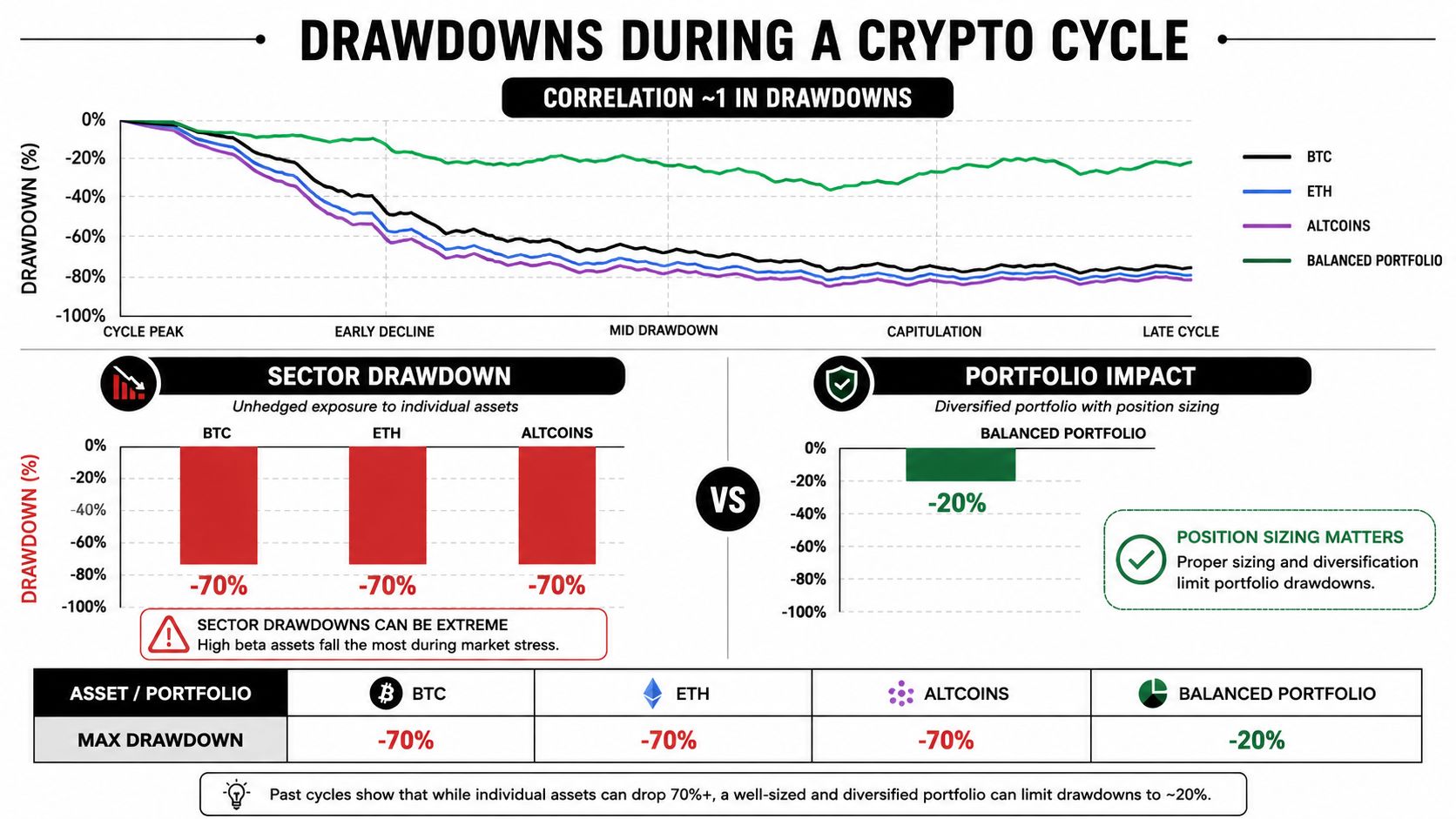
Crypto correlation gets ugly fast when the market turns. Treat that as the base case, because most assets start trading like one risk bucket during stress. The goal is to size exposure so a bad cycle does not force panic selling or put your life under pressure.
Size for survival, not for bragging rights
A resilient Web3 portfolio keeps a stablecoin reserve of 10 to 20% of portfolio NAV for opportunistic adds and yield. That reserve lets you buy when others are forced out. It also gives you room if you want to change jobs, wait for an offer, or spend time interviewing without liquidating at the wrong moment.
Use the five asset classes as a real mix, not as a label exercise. Hold liquid tokens for market exposure, DeFi for cash flow, staking for baseline yield, venture-style positions for upside, and NFTs only as a very small conviction slice. If you own five L1s, you probably own one bet with five tickers.
A quarterly rebalance schedule usually works better than monthly tinkering. Frequent trading adds fees, taxes, and noise. It also tempts you to treat every sharp move as a thesis change when it is just volatility.
| Portfolio Habit | Better Choice | Common Mistake |
|---|---|---|
| Reserve management | Keep a stablecoin buffer | Stay 100% deployed |
| Diversification | Mix across asset classes | Hold five highly correlated L1s |
| Rebalancing | Review quarterly | Chase price daily |
| Risk review | Measure beta to ETH and BTC | Assume “alt basket” means diversified |
| Position sizing | Keep losses survivable | Treat each bet as a moonshot |
The right question is not whether a position can win. It is whether it adds uncorrelated return or just multiplies the same downside you already own. If you cannot answer that clearly, the position is probably too big.
Operational Security for Investors Who Also Work in Web3
Working in Web3 raises the stakes because you are not only holding assets, you are visible inside the same ecosystem you invest in. That makes you a better target for phishing, impersonation, and sloppy approval habits. The fix is to separate functions hard.
Keep wallets, identities, and approvals separated
Use three wallet lanes. A cold hardware wallet for long-term holdings, a hot wallet for active DeFi with limited funds, and a burner wallet for testing new protocols. Store seed phrases offline, ideally on metal, and never digitize them. If one laptop, browser extension, or recruiter DM goes bad, the blast radius stays small.
Treat every token approval as a liability you can revoke. Review approvals periodically with tools like Revoke.cash, and prefer spend caps over unlimited approvals whenever the protocol supports it. Hardware-based 2FA matters here too. SMS is too easy to intercept for exchange access or recovery flows.
Phishing now targets Web3 employees through fake governance votes, airdrop claim pages, and recruiter impersonation. Those attacks work because they look like normal work. If your day job is in protocols, attackers are counting on familiarity to make you careless.
Build a wallet drain drill before you need one. Recovery is a process, not a reaction.
A role like Senior Security Engineer, Digital Asset Custody shows why custody discipline is core infrastructure, not a side concern.
Taxes and work income do not all behave the same way
Take Maya, a developer in Portugal who joins a DAO-contributing protocol. She is paid partly in stables, partly in vested tokens, and she also trades on weekends. Her compensation, staking rewards, airdrops, and trading activity can each carry different treatment depending on residency and local rules. That means she cannot assume one wallet ledger equals one tax outcome.
The landmines are familiar. Tokens received before they trade can create recordkeeping issues. Staking rewards and airdrops may not sit in the same category as salary. Short-term and long-term holding periods can change the outcome materially depending on jurisdiction. A crypto-native accountant is usually worth the fee because on-chain activity creates paperwork faster than expected.
Regulation diverges sharply across the US, EU, UK, Singapore, UAE, and Latin America, and the right structure depends on where you live, not where the protocol is incorporated. If you work and invest in the sector, your tax picture can become a two-income-stream problem with two different sets of rules. That is not something to improvise around.
Starter Strategies That Mix Capital and Career
The best starter strategies do more than try to make money. They also create a learning loop, a hiring signal, or a reason to talk to founders. That's the edge people miss when they treat investing and career planning as separate worlds.
Three workflows that actually compound
The first is the learn-and-farm loop. Put a small amount into a blue-chip DeFi protocol, then read the governance forum, watch how proposals move, and use that knowledge in an interview or contribution. You're not just earning on capital, you're building vocabulary, judgment, and familiarity with the protocol's real trade-offs.
The second is the thesis basket. If you want to work in DePIN or RWAs, build a tiny basket around that niche and use the holdings as a research engine. You'll have a better interview because you've tracked the teams, the incentives, and the product differences instead of just memorizing headlines.
The third is the venture-style network loop. A small allocation to early-stage tokens, launchpads, or a syndicate gives you a reason to meet founders early. Some of those conversations turn into hiring leads, advisory work, or later-stage opportunities.
The amount matters less than the intent. Keep every starter position small enough that a loss feels like tuition, not a life event.
A 90-day plan that runs portfolio and career in parallel
Days 1 to 30: set up the infrastructure. Buy the hardware wallet, split custody between cold and hot wallets, make a small starter position in BTC, ETH, and one stable, and map your tax obligations with a specialist. During this same window, clean up your LinkedIn, CV, and wallet-facing work samples so you're ready if a role opens up.
Days 31 to 60: add a thesis position in one sector, stake or LP a small amount, and publish one piece of public research or a useful contribution. That could be a governance comment, a short technical note, or a workflow improvement that shows competence.
Days 61 to 90: compare performance against your benchmark, prune what underperformed without a reason, increase conviction on what worked, and apply to roles, grants, or DAO working groups connected to those protocols. That closes the loop between capital and reputation.
The fastest path is rarely just “buy and wait.” It's learn, deploy, contribute, then use what you learned to get closer to the people building the thing.
For role discovery and market context, the Blockchain Jobs blog is a practical place to keep an eye on how teams are hiring and what skills they keep asking for.
If you're serious about how to invest in Web3, don't separate the portfolio from the career. Blockchain Jobs helps you see where the sector is hiring, which roles value protocol fluency, and how your experience can turn into a better investing edge. Visit Blockchain Jobs to find the roles and teams that match the way you want to build, invest, and grow in Web3.