
Your Guide to Landing a Quant Developer Job
A quant developer, at their core, builds the high-speed software that powers financial markets. They are the elite engineers responsible for turning complex mathematical models into production-grade code that executes trades in a live environment. Your success in this role is measured by the performance and reliability of the systems you build.
Think of them as the bridge between theoretical strategy and real-world execution. The main job is to create robust, high-performance software, not to produce academic research papers. This distinction is critical for your job search and interview preparation.
What a Quant Developer Actually Does
I love a good analogy, and the Formula 1 team is perfect here. The quantitative analysts (the "quants") are like the team's aerodynamicists. They're in the lab designing the car's shape and mapping out the race strategy on paper. This is the research and modeling side.
The quant developer, on the other hand, is the engineer in the pit garage. They build the actual engine, tune the suspension, and write the critical software that controls the car as it screams around the track. One designs the theory; the other turns that theory into a high-speed, functioning reality.
This distinction is absolutely key for your career path. A quant analyst is focused on research, statistical modeling, and dreaming up new trading strategies. To land a quant developer job, you must demonstrate your ability to translate those brilliant ideas into flawless, lightning-fast code. You’re judged on the performance and stability of the software you ship, not the elegance of a research paper.
The Two Arenas for a Quant Developer Career
As a quant dev, your skills are in incredibly high demand, primarily across two different worlds. Understanding the difference is crucial for targeting your resume and preparing for interviews.
Traditional Finance (TradFi): This is the classic world of hedge funds, big investment banks, and proprietary trading firms. Here, you'll be building systems for high-frequency trading (HFT), algorithmic execution, and complex risk management. Interviews will heavily focus on low-latency languages like C++ and deep system design knowledge.
Web3 and DeFi: This is the new frontier. In this fast-moving space, quant developers apply their skills to decentralized markets. You might be building automated market makers (AMMs), creating arbitrage bots that hunt for opportunities across different blockchains, or developing sophisticated on-chain trading strategies using smart contracts. Interview questions may involve smart contract security and blockchain-specific challenges.
The core difference really comes down to your ultimate responsibility. A quant analyst proposes what to do based on market data. A quant developer builds the system that actually does it, making sure it can withstand the intense pressures of live markets without breaking.
Whether you’re working in a skyscraper on Wall Street or remotely for a decentralized autonomous organization (DAO), the fundamental role is the same. You are the critical link between financial theory and profitable execution, which makes you one of the most valuable players in any modern trading operation.
Quant Developer vs Quant Analyst at a Glance
To make the distinction even clearer, let's break down the two roles side-by-side. Knowing this helps you tailor your resume and interview answers to the specific job you're targeting.
| Aspect | Quant Developer | Quant Analyst (Researcher) |
|---|---|---|
| Primary Focus | Software engineering and implementation | Research, modeling, and strategy design |
| Key Skills | C++, Python, low-latency systems, software architecture | Statistics, mathematics, econometrics, data analysis |
| Daily Tasks | Writing code, optimizing systems, debugging, deployment | Analyzing data, backtesting theories, writing research papers |
| Main Output | Production-ready, high-performance trading software | Trading strategies, mathematical models, and research reports |
Ultimately, one can't succeed without the other. The analyst's brilliant strategy is useless if the developer can't build a system to execute it, and the developer's perfect code is worthless without a profitable strategy to run.
The Core Skills That Get You Hired
To break into the world of quant development, you need what's often called a "T-shaped" skillset. Think of it this way: the vertical bar of the 'T' is your deep, specialized expertise in programming. The horizontal bar represents a solid, working knowledge across two other pillars: mathematics and finance. Firms aren't just hiring a coder; they're looking for an engineer who can truly speak the language of the markets.
This diagram helps visualize where the quant developer fits into the broader quantitative finance landscape.
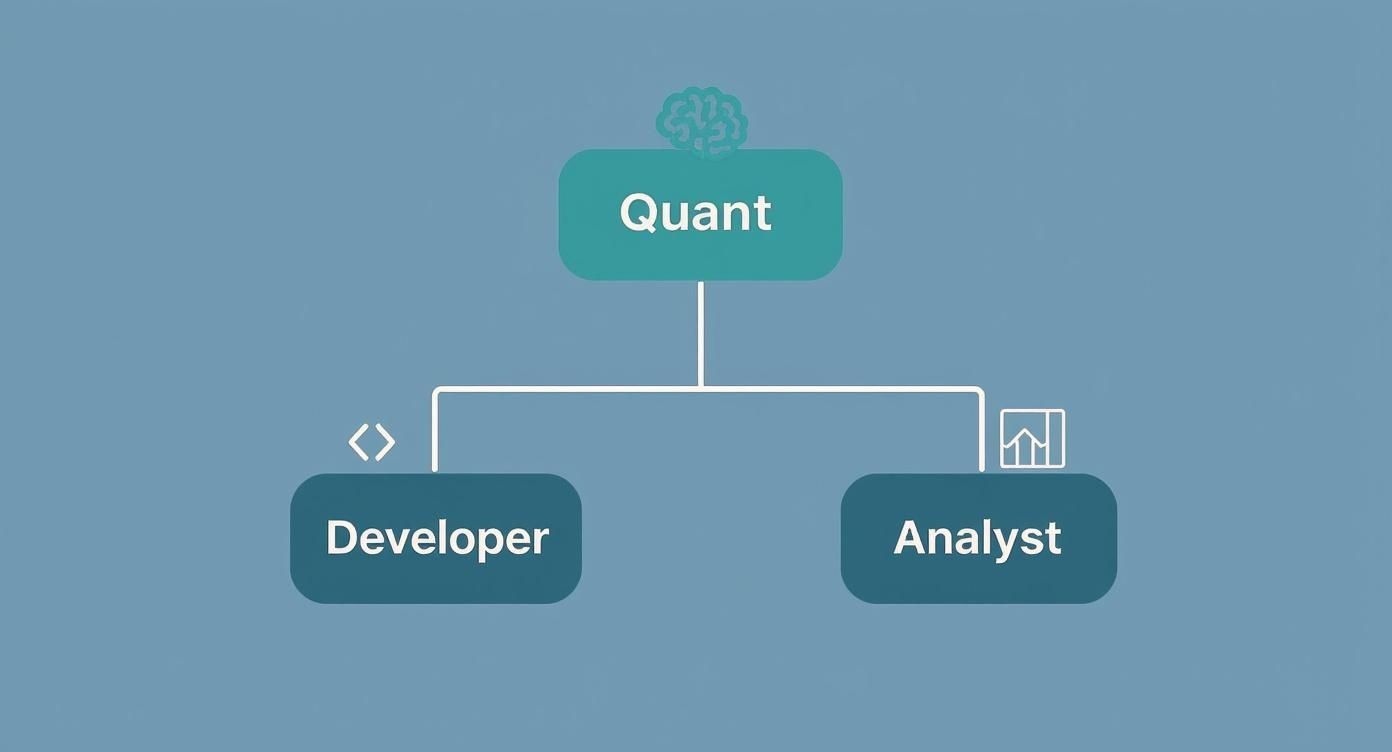
As you can see, the developer path is all about building the actual systems, which is a different focus from the analyst or researcher role, which centers more on strategy design and theory. This is the path you need to prepare for.
Programming Excellence: The Non-Negotiable Foundation
Let's be clear: your programming ability is the most critical part of your toolkit and what will be tested most rigorously in interviews. While finance uses a variety of languages, two reign supreme for very different, but equally important, reasons.
C++ for Performance: In high-frequency trading (HFT), speed isn't just a feature—it's everything. Every microsecond shaved off a trade's execution time is a competitive advantage. C++ provides the low-level memory and hardware control needed to build systems with the absolute minimum latency, making it the undisputed king for performance-critical applications. The demand for C++ quants has skyrocketed, with a reported 3.6x increase in the relative share of C++ quant roles in the UK market since 2020. Mastering C++ opens doors to the highest-paying roles.
Python for Agility: On the other end of the spectrum is Python. It’s the go-to language for research, data analysis, backtesting new strategies, and building prototypes. Its rich ecosystem of libraries—like NumPy, Pandas, and Scikit-learn—lets you test an idea and validate a model in a fraction of the time it would take in C++. The typical workflow involves proving a concept in Python before handing it over for a high-performance C++ implementation. Proficiency in both is the ideal combination to showcase.
Mathematical Intuition: Beyond Rote Memorization
You don’t need a PhD in abstract mathematics, but you absolutely must have a practical, intuitive grasp of the concepts that financial models are built on. It’s not about reciting formulas from a textbook; it's about applying the theory to solve real problems during the interview.
Hiring managers are really testing for one thing: your ability to connect a mathematical concept to a financial problem. Can you explain how matrix multiplication helps model portfolio risk? Or how calculus is used to price an option? That's the kind of intuition they want to see.
To prepare for interviews, focus on getting comfortable with these areas:
- Linear Algebra: The bedrock for portfolio optimization, risk factor modeling, and handling large datasets.
- Calculus: Absolutely essential for understanding derivatives pricing (options, futures) and how model outputs change when inputs are tweaked.
- Probability & Statistics: This is the language of uncertainty and risk. It's crucial for everything from signal processing and time-series analysis to risk management. Expect brain-teaser style probability questions.
Financial Domain Knowledge: Speaking the Lingo
Finally, you have to understand the world you're building software for. A quant developer who doesn't understand the basics of finance is like a race car engineer who has never heard of a chicane. It just doesn't work.
You need to be fluent in the concepts that drive trading decisions to pass the later-stage interviews. This includes a solid understanding of derivatives (options, futures), common risk metrics (like Value at Risk, or VaR), and market microstructure—the nitty-gritty rules of how a market actually operates.
This knowledge is what allows you to have intelligent conversations with traders and quant researchers, ask the right questions, and ultimately build better, more robust, and more profitable systems. For example, knowing the mechanics of an order book is critical whether you're building a new trading algorithm for the stock market or working on a quantitative software engineer role in crypto, where the market structure can be entirely different.
A Realistic Look at Your Daily Work
If you want to understand what a quant developer job is really like, you have to look past the stereotypes. Forget the image of a lone coder hunched over a keyboard in a dark room. The reality is far more collaborative, fast-paced, and communication-heavy. A typical day is a mix of deep-focus coding, strategic problem-solving, and constant teamwork.

Most days kick off with a stand-up meeting. You'll sync up with quant researchers and traders to go over what happened in the markets overnight, check on system performance, and flag anything unusual. If a trading algorithm didn't perform as expected, the team immediately digs into the data to figure out why. Was it a latency spike? Did an unexpected market event throw things off? This huddle is what sets the agenda for the rest of the day.
After that meeting, it’s usually time for a few hours of intense, focused work. This is when the core coding happens. You might be tasked with optimizing a piece of a high-frequency trading (HFT) algorithm in C++ to shave off precious microseconds or translating a new risk model from a researcher's whiteboard into clean Python code. The pressure is real—a single bug in your code could lead to huge financial losses.
Collaboration and Problem Solving
Afternoons often shift toward more collaborative work and testing. A quant researcher might come to you with a new trading idea, and it’s your job to translate their mathematical concept into something functional and testable. This is never a one-way street; it’s a constant back-and-forth to make sure you’ve captured the model and all its assumptions correctly.
You’ll also spend a good chunk of your time running backtests. This means simulating how a new strategy would have performed against historical market data. It's a make-or-break step for validating a model’s potential and finding its weak spots before any real money is on the line. And if a live system goes down? It's an all-hands-on-deck emergency to debug the problem and get it back online, fast.
Here's something every aspiring quant developer needs to understand: communication is just as important as coding. Your ability to explain technical trade-offs to a trader or grasp the subtle details of a researcher's model is what separates a good quant dev from a great one. This is a key soft skill evaluated in later interview stages.
Buy-Side vs. Sell-Side Environment
The rhythm of your day and your career trajectory also changes depending on where you work. Life at a hedge fund (the buy-side) is a world away from the environment at an investment bank (the sell-side).
Buy-Side (Hedge Funds, Prop Shops): Here, the goal is simple: generate direct profits from trading. The work is incredibly fast-paced and performance-driven. You can draw a straight line from the code you write to the firm's bottom line, which often means a more entrepreneurial culture and a higher financial upside.
Sell-Side (Investment Banks): On the sell-side, you're typically building systems to support the bank's clients. This could mean creating pricing models for complex derivatives or developing execution algorithms for massive institutional orders. The work is still demanding, but projects can have longer timelines within a more traditional corporate structure.
Getting this distinction is crucial for your job search. Whether you're drawn to the high-stakes, high-reward world of a hedge fund or the more structured environment of a bank, opportunities are out there. For instance, roles like this Java Quant Developer for FX & Crypto can pop up on either side of the fence, each offering its own unique challenges and rewards.
Understanding Your Earning Potential
Let's talk about the money, because let's be honest, it's a big part of the appeal. A quant developer role is one of the most lucrative jobs you can land at the intersection of tech and finance. The compensation is structured to pull in top-tier talent—people who can build complex systems that directly generate massive profits.
Your pay isn't just a salary; it's a package. Most of the time, you'll get a very competitive base salary plus a performance-based bonus that can be truly substantial. That bonus is where the real magic happens. It’s often tied directly to the profitability of the trading strategies you help create and maintain, which means your incentives are perfectly aligned with the firm's.
What Drives Your Paycheck?
Not all quant developer jobs pay the same, and a few key factors will dictate your total compensation. Knowing these will help you negotiate offers and plan your career for maximum earnings.
Where You Work (Buy-Side vs. Sell-Side): A top-tier hedge fund or a prop trading shop will almost always pay more than a large investment bank. Their entire business is trading, so your work has a direct, measurable impact on their bottom line, and your bonus will reflect that.
Your Tech Stack: Your specific skills are a huge deal. A developer who is a true master of low-latency C++ for high-frequency trading (HFT) is going to be at the absolute top of the pay scale. Speed is everything in HFT, and shaving off microseconds can be worth millions.
Your Background: While hands-on experience is king, your academic credentials still open doors and can influence your starting offer. A degree from a top university in a tough field like Computer Science, Physics, or Mathematics tells hiring managers you've got the foundational brainpower to handle the job's rigor.
Quant Developer Salary by the Numbers
So, what do the numbers actually look like? Recent data shows just how well-compensated this field is. For a quant developer in the United States, the average total compensation has hit an impressive $258,000 per year.
Of course, that's just an average. The range is enormous, with most roles falling somewhere between $177,000 and $750,000 annually. The absolute top performers, especially senior developers at elite HFT firms, can even push their total compensation as high as $825,000. You can find more insights about quantitative developer salaries and dig into the complete dataset.
The most important thing to remember is that your compensation is a package, not just a salary. In a good year at a successful firm, it's not uncommon for the bonus to be much larger than your base pay. This performance-first model is the heart of quant culture.
Here’s a rough idea of what you can expect in a couple of major financial hubs as you gain experience.
Typical Quant Developer Salary Ranges by Experience (Total Compensation)
The table below gives an overview of expected total compensation (base salary + bonus) for quant developers in major financial hubs, broken down by years of experience. Keep in mind these are estimates and can vary widely based on the firm, your individual performance, and market conditions.
| Experience Level | New York (USD) | London (GBP) |
|---|---|---|
| 0-2 Years | $175,000 - $300,000+ | £100,000 - £175,000+ |
| 3-5 Years | $300,000 - $500,000+ | £175,000 - £300,000+ |
| 5+ Years | $500,000 - $800,000+ | £300,000 - £500,000+ |
Ultimately, the sky-high financial rewards reflect the high-stakes, high-impact nature of the work. As you build your skills and prove you can deliver robust, profitable systems, your earning potential will grow right alongside them.
How to Pass the Quant Interview
The quant developer interview process is legendary for its difficulty—and for good reason. It's less of a traditional Q&A and more of a multi-stage gauntlet designed to test not just what you know, but how you think under intense pressure. Success isn't about having a cheat sheet of answers; it's about demonstrating your problem-solving process, technical depth, and mental agility live.

This isn't a role where you can take your time. The market is brutally competitive, and the hiring process has sped up dramatically. Top candidates are often fielding and accepting offers within a single week. As investment banks and hedge funds ramp up hiring, firms that drag their feet simply lose out. You can get a closer look at what’s influencing quant talent today to understand the landscape. For you, this speed means one thing: you have to be ready to perform at your absolute best from the very first call.
Cracking the Technical and Quant Rounds
Once you get past the initial HR and recruiter screens, you'll dive into the real substance: a series of technical interviews. This is where they’ll rigorously test the three core pillars of your skillset: programming, mathematics, and system design.
The coding challenges are tough. Be prepared for questions that demand a deep command of algorithms (think graph traversals and dynamic programming) and data structures (trees, heaps, hash maps). You won’t just be asked to solve a problem; you’ll be expected to write clean, production-level code on a whiteboard or in a shared editor, all while articulating your thought process clearly.
Then come the quant-specific questions. These are often brain teasers disguised as probability and statistics problems. The goal isn't to see if you can perform complex calculations in your head, but to test your logical reasoning and quick thinking.
A classic example: "You have a 100-sided die. What is the expected number of rolls to get a 6?" The interviewer isn't just listening for the correct number. They want to hear you walk them through the logic of expected value and geometric distributions, breaking down the problem from first principles.
Navigating the Final "Superday"
If you impress in the technical rounds, the final step is often an invitation to a "Superday." This is exactly what it sounds like: a final, intense round of back-to-back interviews with senior developers, quant researchers, and even portfolio managers.
At this stage, the focus expands. Your technical abilities are still under the microscope, but now they’re also assessing your team fit and how you handle real-world scenarios under pressure. You’ll be hit with more open-ended, system design-style questions.
- How would you architect a system to process one million market data ticks per second?
- What are the trade-offs between different messaging queues (like RabbitMQ vs. Kafka) for a low-latency system?
- Walk me through your process for debugging a trading algorithm that’s suddenly losing money.
These questions don't have a single "right" answer. The interviewers want to see how you approach complexity, weigh trade-offs, and communicate your design decisions. They need to know you can think like an engineer who truly understands the business impact of every line of code. Passing this final test is the last hurdle before you land that highly coveted quant developer job offer.
Your Actionable Career Roadmap
https://www.youtube.com/embed/xPxmMFPbfFU
Landing a top-tier quant developer job isn't about luck; it's about following a smart, deliberate plan. Whether you're a student, a new grad, or a developer looking to switch fields, this roadmap lays out the exact steps you need to take to build a profile that hiring managers will fight over.
Think of this as your personal checklist for breaking into the industry. We've broken it down by your starting point, so you can focus on the actions that will give you the biggest edge right now.
For the Aspiring Student
If you're still in university, you have a golden opportunity to build a foundation that screams "quant potential" long before you even graduate. Use this time wisely to get way ahead of the curve.
- Master the Right Subjects: Your coursework is your training ground. Prioritize classes in data structures, algorithms, operating systems, and computer architecture. For math, you absolutely need to load up on linear algebra, probability theory, and stochastic calculus.
- Build Something Real: Don't just do homework. Create a simple trading bot that plugs into a crypto exchange's API. This is a fantastic way to prove you can handle real-time data and execute logic under pressure, and it's a project you can talk about in interviews.
- Sharpen Your Competitive Edge: Get active on platforms like LeetCode and HackerRank. A high ranking isn't just for bragging rights—it’s a clear signal to recruiters that you have elite problem-solving skills and can pass their coding tests.
For the Recent Graduate
You’ve got the degree, which is a great start. Now, the mission is to prove you can translate that academic knowledge into real-world results. Your focus needs to shift to crafting a killer resume and networking strategically.
- Speak Their Language: Your resume has to get past automated screeners and catch a human's eye. Make sure it’s peppered with keywords like "C++," "Python," "low-latency," "data analysis," and "risk management." And remember to tweak it for every single application to match the job description.
- Network, Don't Just Apply: Cold applications have a low success rate. Instead, find quant recruiters on LinkedIn. Send them a short, professional message that shows you've done your homework, express your interest, and attach your resume. A warm introduction makes all the difference.
For the Experienced Developer Making a Switch
You've already got the hardcore software engineering skills, which is a massive advantage. Your challenge is different: you need to bridge the finance knowledge gap and reframe your experience to fit the quant world.
Your biggest asset is your proven ability to build robust, scalable software. The key is to demonstrate a genuine, self-driven interest in the financial markets and show you can learn the domain quickly.
- Bridge the Knowledge Gap: Don't wait for a job to teach you. Start a personal project analyzing historical market data or backtesting a simple moving-average strategy. This shows real initiative and helps you start talking the talk in interviews.
- Reframe Your Past: Learn to translate your previous work into quant-speak. Did you build a low-latency messaging system? That's directly relevant to high-frequency trading. Did you optimize a massive database? That's exactly what firms need for handling tick data. When you look at job descriptions, like this Quantitative Developer in crypto role, you'll start to see how your existing skills map perfectly.
Frequently Asked Questions
When you're looking at a career as a quant developer, a lot of questions pop up. It's a tough, competitive field, so let's get you some straight answers to the things most people are wondering as they prepare for interviews and plan their careers.
Do I Need a PhD to Become a Quant Developer?
Honestly, no, not usually. For a quantitative researcher role, a PhD is often a prerequisite. But for a quant developer, the focus is squarely on your elite-level software engineering and computer science skills.
Most of the time, a Bachelor's or Master's in a technical field like Computer Science, Engineering, or Math is sufficient. The real test is whether you can prove you have world-class programming and problem-solving skills during the interview. Your hands-on ability to code is what gets you hired, not the degree on your wall.
What Is the Work-Life Balance Really Like?
Let’s be real: it can be intense. The work-life balance really depends on where you land. If you're at a high-frequency trading (HFT) firm or in the middle of launching a new trading strategy, expect long, demanding hours. Market-moving events or a critical system bug don't wait for anyone.
The culture is unapologetically performance-driven. It's high-pressure and fast-paced, no doubt about it. But the incredible compensation packages are designed specifically to attract people who can not only handle that environment but thrive in it. Be prepared to discuss your ability to perform under pressure during interviews.
How Important Is Networking for This Job?
It's everything. You might be surprised to learn just how small and tight-knit the quantitative finance world is. It’s a classic case of “it’s not what you know, it’s who you know”—though you definitely need to know your stuff, too.
A strong referral from someone already working at the firm is probably the single best way to get your resume pulled from the pile and put on the top.
Make it a point to go to industry events. Get active in online communities like QuantNet. Connect with recruiters who specialize in this niche. These relationships are gold for finding out about jobs that never even get posted publicly and for getting invaluable inside info before you walk into an interview.
Ready to find your place in the future of finance? Blockchain Jobs is your go-to source for roles in Web3, DeFi, and beyond. Start exploring hand-picked opportunities at https://blockchain-jobs.com and make your next career move.