
React JS Developer Salary 2026: Maximize Your Pay

You check three salary guides, compare them to your current comp, and end up less certain than when you started. One says React pay is strong. Another flattens everything into “frontend developer.” A third ignores Web3 entirely, even though that is where many of the most aggressive offers now show up.
That gap matters. A solid React engineer can be underpaid for years because they benchmark against general frontend roles while interviewing for jobs that need far more than component work. Hiring teams do not pay the same for someone who can ship a dashboard as they do for someone who can build a production dApp UI, handle wallet flows, coordinate with smart contract engineers, and keep performance stable under ugly state conditions.
I have seen this from both sides of the table. The best-paid React candidates are rarely just “good at React.” They know where their skills fit in revenue, risk, and product complexity. They can explain trade-offs, not just syntax. They also know when a Web3 offer is premium and when it just looks premium on paper.
Your True Market Value as a React Developer
If you work in React today, your market value is probably wider than your current salary suggests. The biggest reason is specialization.
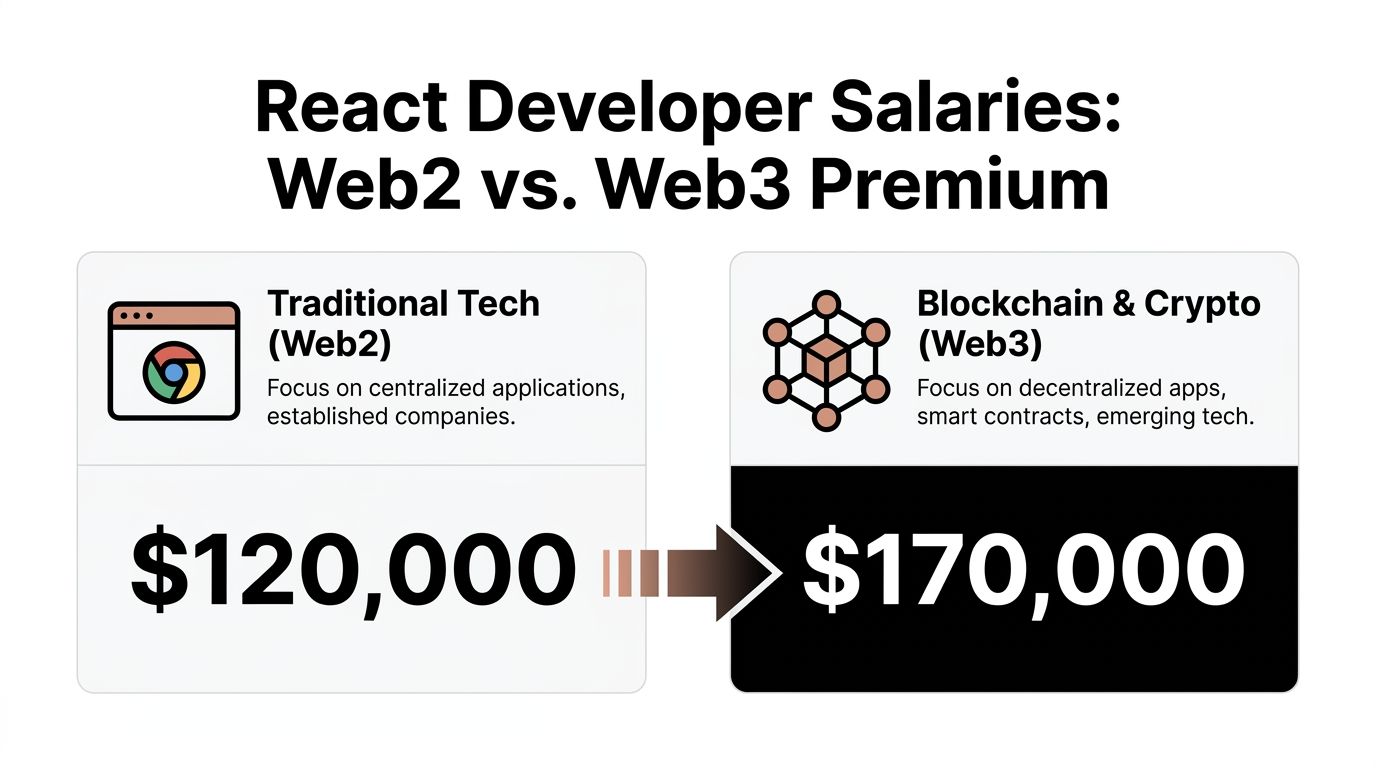
General React roles still pay well. But the underserved part of most react js developer salary discussions is the Web3 premium. Built In notes that US React developers average $105,911 to $135,000 base pay, while Web3-specific roles at crypto firms often land 20% to 50% higher total compensation at $150,000 to $250,000+, with blockchain job boards showing median listings at $180,000 for senior React roles in DeFi and NFTs (Built In React salary data).
That difference is not random. Hiring managers pay more when a frontend engineer reduces product risk in places where mistakes are expensive. In Web3, that usually means:
- Wallet integration work with tools like ethers.js or Web3.js
- State flows that survive asynchronous chain data
- Transaction UX that helps users understand pending, failed, and confirmed actions
- Security-aware UI decisions around approvals, signatures, and token interactions
- Production performance in apps that cannot feel broken during market volatility
What usually does not move salary much
A lot of developers still over-index on the wrong signals.
Knowing React basics, building a few polished portfolio clones, or listing every library you have touched does not provide an advantage by itself. Neither does calling yourself “full stack” if your backend depth is shallow and your frontend architecture falls apart under interview pressure.
Employers pay for judgment. They pay for maintainability. They pay for engineers who can enter a messy codebase and make it safer, faster, and easier to ship.
The highest salary jumps usually come from changing your market category, not from polishing your current title. “React developer” and “React engineer who can build Web3 product surfaces reliably” are priced differently.
The practical lens
When evaluating your own react js developer salary potential, ask better questions:
- What kind of product risk can I handle alone?
- Can I own frontend architecture, not just tickets?
- Can I speak to performance, state management, and DX trade-offs clearly in interviews?
- Do I solve Web3-specific UI problems that most frontend engineers avoid?
Those answers matter more than generic salary averages. They determine whether you are competing in the middle of the market or near the top.
The Global React JS Developer Salary Overview in 2026
A React developer in Berlin, Lagos, Buenos Aires, and Austin can all apply to the same remote role this week. That sounds like one market, but compensation still splits hard by region, company type, and how much ownership the role carries.
The broad benchmark still matters first. In the United States, the average annual React JS developer salary as of April 2026 is $129,348, with most salaries falling between $106,000 and $157,000, according to ZipRecruiter’s React Developer Salary data. Use that as a baseline, not a verdict on your price.
Quick reference salary table
Regional salary bands make more sense once you separate local hiring from global remote hiring.
| Experience Level | North America | Western Europe | Asia | Global Remote |
|---|---|---|---|---|
| Junior | Lower than mid and senior ranges in the same region | Lower than mid and senior ranges in the same region | Lower than mid and senior ranges in the same region | Lower than mid and senior ranges in the same region |
| Mid-Level | $115,000 | $70,000 | $40,000 | $75,000 |
| Senior | $155,000 | $95,000 | $60,000 | $105,000 |
These figures reflect common market ranges for React roles across regions and remote hiring channels. They are best used for directional pricing, not as a guaranteed offer level.
How to read these numbers correctly
North America still sets the high end for straight cash pay, especially in companies that expect architecture input, strong TypeScript habits, and close work with product and backend teams. Western Europe often comes in lower on base salary, but total quality of the offer can be stronger once you factor in benefits, time off, and lower churn. Asia is the widest category in practice. Compensation there changes sharply based on city, employer maturity, and whether the company hires locally or competes for international talent.
Remote pay deserves its own bucket.
A global remote React role often pays less than the best in-person US jobs, but it can still outperform your local market by a wide margin. That is why serious candidates compare offers against the right benchmark. A developer in a lower-paying region should not anchor only to nearby employers if the role targets distributed product teams. Filtering for remote blockchain React roles and other remote blockchain jobs usually gives a clearer signal than broad job boards that mix specialized frontend work with generic JavaScript openings.
What separates one pay band from another
Titles hide a lot. Two developers can both be called “Senior React Developer” and be priced very differently.
Hiring teams usually pay more for developers who can own a feature area end to end, make sound architecture decisions, and explain trade-offs without slowing delivery. Frontend depth matters too. Rendering behavior, caching strategy, state flow, bundle size discipline, and collaboration quality all show up in compensation, even when they are not written cleanly in the job title.
Domain also affects pay. A React engineer who has shipped in payments, SaaS, developer tools, or regulated products usually has an easier time arguing for the top of the range because the company expects fewer expensive mistakes.
A practical way to use salary data
Salary tables help with positioning, not just curiosity.
If you are a mid-level React developer in a weaker local market, but you have shipped production TypeScript, own complex UI flows, and interview well on architecture, negotiate against the remote and specialized market where that skill set is valued. That is usually the difference between accepting the default band and getting paid at the level your work supports.
The Web3 Premium How Blockchain Impacts Your Paycheck
A React developer ships polished dashboards in SaaS for one company and signs off at the end of the week. Another ships a swap flow, a wallet connection modal, and an approval screen for a DeFi product. Both write React. They do not carry the same product risk, and they should not be paid the same.
That gap is the Web3 premium.
As noted earlier, specialized Web3 React roles often price above generic frontend work. The reason is straightforward. Companies are not paying extra for buzzwords like crypto, blockchain, or decentralization. They pay more when the frontend sits close to money movement, protocol behavior, and user trust.
Why Web3 companies pay more
In Web2, a React engineer can still earn very well by building complex product surfaces. In Web3, the same engineer often has to handle a messier set of constraints at the UI layer.
A wallet can disconnect without warning. RPC responses can lag. Transaction states can remain pending far longer than users expect. A small wording mistake on an approval screen can create support load, failed conversions, or expensive trust damage. If the app is tied to trading, staking, bridging, or governance, the stakes rise fast.
That is why strong Web3 teams value frontend engineers who understand the product consequences of chain behavior, not just component structure.
What premium roles usually expect
The best-paid React roles in Web3 usually combine frontend depth with protocol awareness. Hiring teams are looking for engineers who can reduce mistakes across the whole user flow.
| Capability | Why it matters in Web3 hiring |
|---|---|
| Smart contract integration | The UI has to reflect contract behavior correctly under user conditions |
| Wallet UX | Connection, signing, rejection, and recovery flows directly affect conversion |
| Async state handling | Chain reads and writes create loading, retry, and stale data problems that basic CRUD apps rarely face |
| Performance work | Portfolio, trading, and staking screens need to stay responsive during volatile usage periods |
| Security-aware UI | Approval, signature, and permission prompts need clear language and safe defaults |
This also explains why some "frontend" listings read wider than expected. A role such as this Web3 full stack developer opening at Metrix Finance shows the pattern clearly. React is the visible requirement, but the core ask is broader ownership across the interface, data flow, and contract-facing logic.
What does not earn a premium
I have interviewed plenty of candidates who tried to price themselves as Web3-ready based on shallow exposure. That rarely works.
These signals do not move compensation much on their own:
- Using a wallet in a side project
- Shipping a token chart or price widget
- Listing Solidity without meaningful frontend to contract integration
- Talking about DeFi products without being able to explain failure states in the UI
The premium comes from reducing execution risk. Can you ship a transaction flow that handles rejection, replacement, confirmation delays, stale reads, chain switching, and user confusion without turning the product into a support queue? That is what gets paid.
Base salary still matters most
Web3 compensation packages can look better than they are because they mix cash, tokens, and remote flexibility. That structure can be attractive, but it also makes comparison harder.
My rule is simple. If the role expects you to solve chain-facing product problems, the base salary should already make sense before token upside is mentioned. Tokens are speculative compensation. Base salary pays for the work you are doing now, under deadlines, with production risk attached.
A serious Web3 frontend offer pays for present-day skill. Token upside is separate.
For React developers trying to break into Web3 or move up within it, this is the core salary shift to understand. You are not selling generic frontend delivery. You are selling the ability to make decentralized products usable, trustworthy, and hard to break.
Skills That Command Top-Tier Salaries
High compensation follows scarce, usable skill. Not buzzwords. Not course certificates. Not a GitHub full of unfinished experiments.
The React developers who reach the top bands usually combine sharp frontend fundamentals with business-safe execution. They can build quickly without making the codebase fragile.

Senior React developers in top US hubs can see total compensation rise above $280,000, driven by expertise in TypeScript, Next.js, and advanced state management. In Web3 roles, React Query proficiency for optimistic chain queries can lift compensation by another 25% over peers, based on DistantJob’s React salary analysis.
TypeScript is no longer optional
At the high end, TypeScript is not a resume accessory. It is the default language for serious React teams.
Hiring managers care less about whether you can write a type alias and more about whether you can use types to shape maintainable APIs, safer hooks, and clearer component contracts. In interviews, the strongest candidates explain where strictness helps and where it adds noise.
What works:
- Designing reusable component props without making them unreadable
- Typing async data states clearly
- Creating safer interfaces for shared hooks and utility layers
What does not:
- Showing off clever generic gymnastics nobody wants to maintain
- Treating “uses TypeScript” as proof of seniority
Next.js signals product maturity
Next.js matters because many employers want more than SPA experience. They want engineers who understand routing, data fetching trade-offs, rendering choices, and SEO-sensitive surfaces.
That applies in SaaS and in Web3. Marketing pages, docs, app shells, and public token pages all benefit from frontend engineers who know when SSR or hybrid rendering is the right call.
If your experience is only client-rendered dashboards, close that gap.
State management separates implementers from owners
A candidate who can discuss state architecture calmly usually interviews above their title.
Good teams want engineers who know when local state is enough, when Zustand is cleaner, when Redux Toolkit is justified, and when React Query should own server or chain-derived data. This knowledge often presents a challenge for many mid-level candidates. They know the libraries but not the boundaries.
The interview signal is not “I know Redux.” It is “I know why this state belongs there and not here.”
Web3-specific tools that increase value
Once you move into blockchain product work, your React stack needs another layer.
Here is the practical shortlist:
- ethers.js or Web3.js: You need to understand provider setup, contract calls, and transaction handling from the UI side.
- React Query: Especially useful when chain reads, invalidation, and optimistic experiences get messy.
- Wallet libraries and connectors: Familiarity matters because auth and transaction UX often break at integration boundaries.
- Error-state design: Not a library, but absolutely a salary skill in crypto interfaces.
A role like this full-stack engineer position using Node.js and React is a good example of where frontend skill stops being isolated. Companies increasingly want React engineers who can collaborate across API, infra, and product concerns.
The skills interviewers probe
Hiring loops for better-paid React roles usually test for these behaviors:
Debugging under ambiguity Can you reason through stale renders, race conditions, or inconsistent async results?
Trade-off awareness Do you know when memoization helps, and when it just adds noise?
Codebase judgment Can you improve structure without rewriting everything?
Product empathy Can you explain why a bad transaction confirmation flow hurts trust?
A useful technical refresher sits below if you want to revisit modern React patterns before interviews.
A practical upskilling order
If you want the shortest route to higher react js developer salary potential, I would prioritize in this order:
| Priority | Skill area | Why it pays |
|---|---|---|
| First | TypeScript depth | It affects nearly every serious frontend codebase |
| Second | Next.js | Signals broader product capability |
| Third | State architecture | Directly impacts scalability and interview performance |
| Fourth | React Query | Highly effective in data-heavy and Web3 apps |
| Fifth | Wallet and contract integration | Opens the door to premium blockchain roles |
Do not try to learn everything at once. Build one production-grade project that forces these decisions. Hiring managers trust shipped judgment more than tutorial breadth.
Structuring Your Compensation Beyond Base Salary
A strong offer is not just salary. Many React developers leave money on the table here, especially when moving from Web2 into crypto.
A company can offer a decent base and still deliver a poor package. Another can offer a slightly lower base but pair it with meaningful upside, reasonable vesting, and role scope that accelerates your next negotiation. You need to evaluate the whole structure.

The four parts of a modern offer
Most offers for React engineers in better-paying companies include some mix of these:
| Component | How to think about it |
|---|---|
| Base salary | The reliable part. Price your current market value from this first. |
| Cash bonus | Useful, but check whether it is discretionary or formula-based. |
| Equity or RSUs | More common in established startups and larger tech firms. |
| Token grants | Common in Web3. Higher upside, higher uncertainty. |
Base salary pays your bills. Everything else should be layered on top of a solid base unless you are intentionally making a higher-risk bet.
Equity and RSUs in plain English
In traditional startups, equity often means options. You usually get the right to buy shares later at a preset strike price. If the company grows and exits well, that can matter a lot. If not, it may matter very little.
RSUs are simpler. They are units that convert into actual shares over time once they vest. Candidates often prefer them because they are easier to value conceptually.
For React engineers, the key question is not “Do I get equity?” It is “Does this company make the equity believable?” Ask about dilution, refresh policy, and whether the company has a path to liquidity.
Token grants need harder questions
Web3 token packages deserve more scrutiny than many candidates give them.
Ask directly:
- What token are you granting?
- What is the vesting schedule?
- Is there a cliff?
- Are grants tied to employment status only, or also to protocol events?
- What rights or restrictions apply after vesting?
Do not let excitement replace math. Token compensation can be meaningful, but it can also be speculative, illiquid, or structured to sound richer than it is.
If the recruiter spends more time selling the token story than explaining the base salary, slow the conversation down.
Negotiation points that work
Most React candidates negotiate too late and too vaguely. They say they are “looking for something competitive.” That does nothing.
A better approach is to negotiate from contribution and comparability:
- Role scope: If the company expects architecture ownership, mentoring, and frontend-platform decisions, say so and price accordingly.
- Specialization: If you bring wallet integration, dApp UX, or protocol-facing frontend experience, treat that as premium skill.
- Risk profile: If part of comp is token-heavy, ask for a stronger base to balance uncertainty.
- Review timing: If they cannot move base now, ask for an earlier compensation review tied to defined deliverables.
What to say in practice
You do not need a theatrical script. You need clarity.
Try language like this:
“This role expects ownership across React architecture, TypeScript quality, and blockchain-facing product flows. I’m most interested in a package where the base reflects that scope, with equity or tokens as upside rather than replacement.”
That framing works because it ties compensation to business need. Hiring managers can defend that internally.
Red flags in offer design
Watch for these patterns:
- A high token number with no clear vesting details
- A weak base justified by “future upside”
- Title inflation without scope or pay alignment
- No explanation of bonus criteria
- Fast pressure to sign before you review the package carefully
A good react js developer salary negotiation ends with a package you understand. Not one you hope turns out well.
A Hiring Manager's Guide to Pricing React Roles
If you are hiring React talent, underpricing the role is the fastest way to flood your funnel with weak candidates and lose the strongest ones early. Overpricing can also backfire if the role definition is vague and attracts applicants who expect more authority than the team will give them.
The fix is simple. Price the role according to business difficulty, not title tradition.
Start with the product, not the title
“React Developer” is too broad to benchmark well on its own.
A hiring manager should first define what the engineer will own:
- Feature delivery inside an established design system
- Frontend architecture across a product surface
- Performance-sensitive UI work
- Web3 integration, wallet flows, and contract-driven experiences
- Cross-functional ownership with product, backend, and design
Those are different jobs. If you collapse them into one title, your salary band will be wrong.
Build compensation around execution risk
The strongest benchmark question is this: what goes wrong if this engineer is weak?
If the answer is “delivery slows down,” you are likely pricing a standard mid-level frontend role.
If the answer is “users cannot complete transactions, the app becomes unreliable under market stress, or the team keeps shipping unsafe UX around approvals and signatures,” then the role should be priced like specialized product infrastructure. That candidate pool is smaller.
Use a capability-based hiring rubric
A clean hiring rubric prevents compensation drift and makes offers easier to justify internally.
Consider grading candidates across these dimensions:
| Area | What strong looks like |
|---|---|
| React fundamentals | Solid component design, rendering awareness, maintainable hooks |
| TypeScript | Clear types that improve safety without overengineering |
| State architecture | Good boundaries across local, server, and shared state |
| Product ownership | Can drive features through ambiguity |
| Web3 fit | Understands wallet UX, async chain data, and frontend risk points |
When companies skip this and rely on “senior vibe,” they often misprice both average and exceptional candidates.
Good salary bands start with role clarity. Great salary bands also account for the cost of getting the hire wrong.
Do not hide behind remote flexibility
Remote work is attractive, but it is not a substitute for competitive pay. Strong React engineers know this.
If your company needs someone who can own a critical frontend surface, remote access widens the funnel. It does not erase the need to pay for skill. Companies that pitch flexibility as the main compensation lever tend to lose experienced candidates to better-structured offers.
Structure the offer to match candidate type
Different candidates value different mixes:
- Established senior in Web2 moving into Web3: Usually wants a dependable base plus measured upside.
- Crypto-native engineer: May accept more token exposure if the protocol and role are compelling.
- High-agency mid-level candidate: Often values growth path and review cadence almost as much as headline pay.
Hiring managers should explain not just the package, but the logic behind it. A thoughtful explanation signals maturity and increases acceptance odds.
Describe the role accurately
Top React candidates do not just compare salary. They compare constraints.
Be explicit about:
- Codebase condition
- Team size
- Shipping pace
- Decision autonomy
- Whether the role is senior or just under-supported
When the role is difficult, say so. Strong engineers are often more interested when the challenge is described clearly and the compensation reflects it.
The companies that hire best in this market usually do three things well. They define scope tightly, benchmark against product complexity, and make offers that respect both present skill and future upside.
Actionable Steps to Secure Your Next React Role
Most salary improvement does not happen because a developer “worked hard.” It happens because they changed how they present, target, and negotiate their skill.
If you want a better react js developer salary outcome, act on the parts you control.
Tighten your profile before you apply
Your resume should show ownership, not task lists.
Replace bullets like “built UI components in React” with outcome-oriented descriptions that show architecture, complexity, or domain relevance. Mention TypeScript, Next.js, React Query, and wallet or contract integration only if you can defend them in detail.
Interview like an owner
In frontend interviews, explain decisions.
Talk through state boundaries. Discuss rendering trade-offs. Show that you know when to simplify and when complexity is justified. In Web3 interviews, be ready to discuss transaction UX, async failures, user trust, and integration boundaries with protocol teams.
Qualify the company while they qualify you
Ask direct questions:
- What does this team consider senior-level ownership?
- Who owns frontend architecture decisions?
- How much of the role is product delivery versus platform cleanup?
- What part of the compensation is fixed versus speculative?
Those questions improve your negotiation position because they surface scope.
Build one proof project that matters
One credible project beats five shallow ones.
A good project for this market includes a clean React app, strong TypeScript, realistic state handling, and some form of Web3 interaction if that is the direction you want. It should show judgment in loading states, errors, data flow, and user safety.
Hiring managers remember candidates who can explain a difficult build clearly. They forget candidates who only showcase polished screenshots.
Search with intention
Do not spray applications across every frontend opening you can find. Target roles that match the compensation category you want next.
If you want Web3 premium roles, focus on teams building real products with clear frontend depth. If you want to benefit from remote opportunities, prioritize employers that treat frontend as a core product function. If you want to move from mid-level to senior, target roles where you can credibly own architecture and delivery.
The market is wide, but your positioning should be narrow. That is how candidates move from “one of many React developers” to “the engineer this team is willing to stretch for.”
If you want roles that match the higher end of the React market, especially in Web3, browse Blockchain Jobs for focused openings across crypto, DeFi, NFTs, infrastructure, and remote-first teams. It is one of the cleaner ways to find opportunities where React skill is tied to product complexity, not buried inside generic JavaScript listings.