
SEC Attorney Jobs: Career Paths & Salaries

You're probably staring at a job search tab with “SEC attorney jobs” typed into it, wondering why the results feel sloppy, repetitive, and weirdly broad. That's because the phrase doesn't point to one career. It points to three very different lanes, and if you don't separate them early, you'll waste weeks applying with the wrong resume, the wrong salary expectations, and the wrong interview prep.
The smart way to read this market is simple. First, decide whether you want government enforcement and rulemaking, law-firm capital markets and disclosure work, or in-house compliance, including crypto and Web3. Then match your application strategy to that lane, because each one hires differently, pays differently, and screens for different skills. If you've seen generic legal-job advice that treats all securities roles the same, compare it against an AI vs human writing comparison and you'll spot the same problem, output that looks polished but misses the substance.
What Most Job Seekers Get Wrong About SEC Attorney Jobs
The biggest mistake is treating SEC attorney jobs like a single category. A lawyer who wants to bring cases for the SEC, a capital-markets associate drafting disclosure for a public company, and an in-house attorney reviewing token-related risk at a crypto startup are all shopping in the same search results, but they are not competing for the same seat.
I see this all the time. A candidate with strong litigation instincts applies to a Corporation Finance role and wonders why nobody bites. Another lawyer with deal experience chases enforcement roles and can't figure out why the process feels glacial. The issue isn't talent, it's fit. Different employers want different instincts, different documents, and different proof points.
Sort Yourself Before You Apply
If you like building cases, interviewing witnesses, and pushing for accountability, you're looking at government enforcement. If you like filings, disclosure, and transaction work, you're in the law-firm securities practice lane. If you like helping business teams manage risk day to day, especially around public-company reporting or token-related questions, you're probably better suited to in-house or Web3 compliance.
Practical rule: if your best stories are about investigations, you're in the government lane. If they're about deals, you're in the law-firm lane. If they're about getting a product or company through regulatory friction, you're in-house material.
The market also rewards people who can read role titles with skepticism. A posting that says “SEC attorney” may really be a disclosure review role, an advisory role, or a securities compliance role. Search smart, not broad. You'll save time and avoid building the wrong resume for the wrong buyer.
What an SEC Attorney Actually Does Day to Day
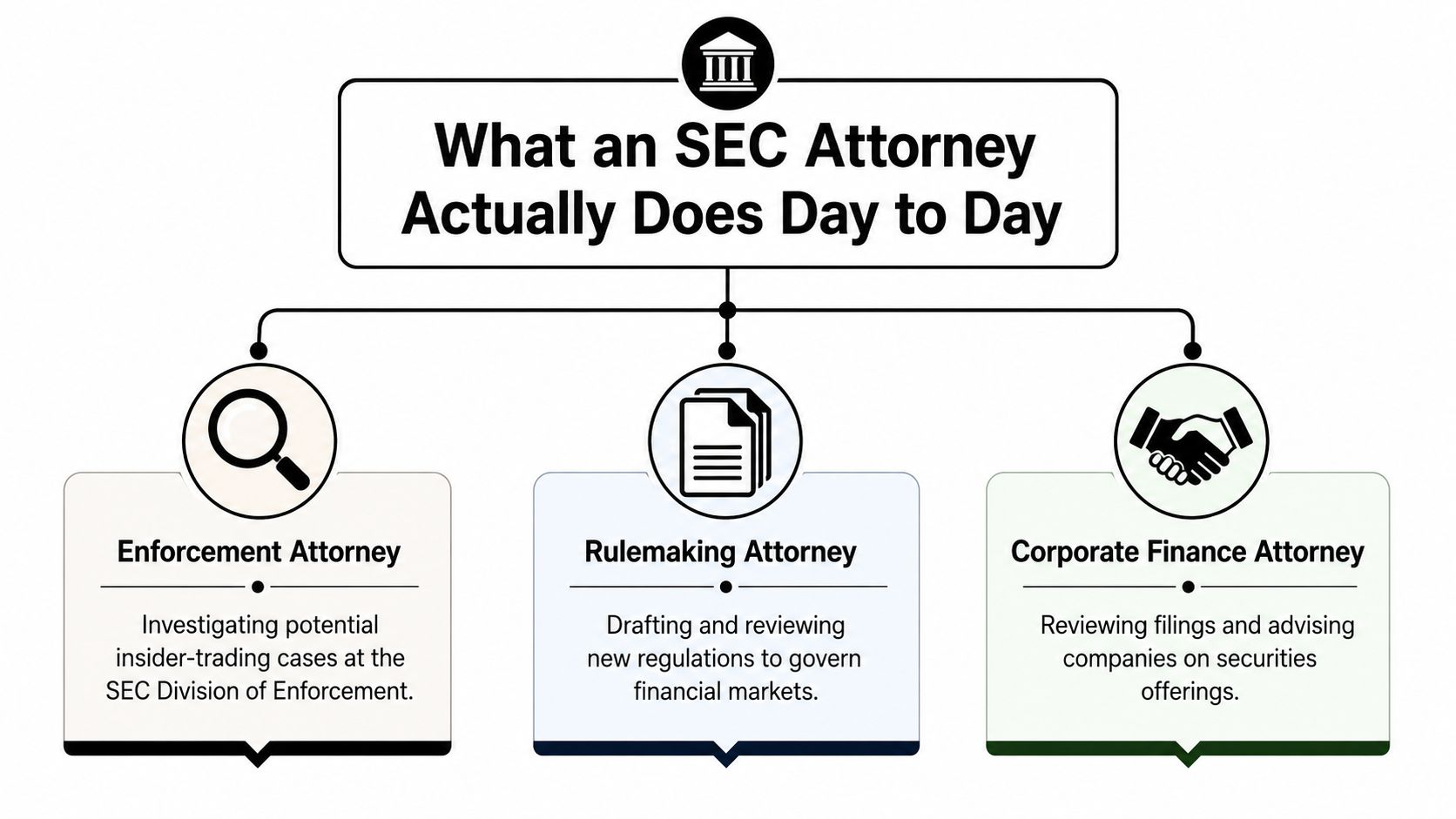
An SEC attorney isn't just a “corporate lawyer with a regulator badge.” The work changes sharply by division, and the day-to-day reality is closer to three separate jobs than one unified title.
An enforcement attorney spends time digging into conduct, documents, and timelines. A potential insider-trading matter is the classic example, but the same mindset applies to recordkeeping, whistleblower, and disclosure cases. The job is investigative and adversarial, which means you need judgment, follow-through, and a comfort level with ambiguity that many transactional lawyers don't enjoy.
A Corporation Finance attorney lives in filings. Think registration statements, comment letters, and disclosure review. The core statute set here is the Securities Act of 1933 and the Securities Exchange Act of 1934, plus periodic reporting under Forms 10-K, 10-Q, and 8-K. The work is less dramatic than enforcement, but it's technical, and it rewards lawyers who can spot disclosure risk fast and write cleanly.
A Trading and Markets attorney-advisor is closer to rule architecture. These lawyers help shape exchange rule filings and legal positions on market structure questions. For these roles, the SEC's posting says a candidate needs a J.D. from an accredited law school, active bar membership in good standing, and at least 1 year of post-J.D. experience as a practicing attorney providing advice on federal securities laws and rules or similar legal experience, plus legal research and analysis experience (SEC Trading and Markets career opportunities).
Most candidates over-prepare doctrine and under-prepare judgment. The SEC wants lawyers who can read a filing, a rule, or a fact pattern and tell them what matters.
That credential floor matters. Many entry-to-midlevel federal grades expect 1 to 3 years of post-J.D. experience, and higher grades demand specialty experience. Outside government, many “SEC attorney” openings are really public-company advisory or compliance jobs, so you should prepare for disclosure, governance, and reporting work, not just enforcement theory.
Government vs Law Firm vs In House Compared
The three lanes pay differently, hire differently, and reward different temperaments. If you want the cleanest prestige-to-skill pipeline, government can be a strong choice. If you want the highest comp and can tolerate pressure, law firms win. If you want balance and mobility into business-side roles, in-house is the practical middle.
The SEC is a real employer of attorneys. Its EEOC workforce profile lists 1,639 General Attorneys out of a 3,708-person permanent workforce and 3,846 total workers, which means attorneys make up roughly 44% of permanent staff. The same profile shows 5,262 requested positions for fiscal year 2023, up by 454 positions from fiscal year 2022, a clear sign that legal and compliance hiring remains structurally important at the agency (SEC EEOC workforce profile).
The Three Paths Side by Side
| Path | Typical Pay Band | Hiring Channel | Lifestyle | Best Exit Options |
|---|---|---|---|---|
| Government at the SEC | Below market, structured federal pay with locality adjustments | USAJOBS and agency postings | Mission-driven, slower process, more process discipline | Top law firms, in-house compliance, senior regulatory roles |
| Law firm securities practice | Highest among the three, especially in capital markets and public-company advisory | Firm websites, recruiters, law-firm job boards | Intense, billable, partner-track pressure | In-house GC track, public-company roles, crypto counsel |
| In-house or Web3 compliance | Middle of the pack, with wide variation by company stage | Company sites, recruiters, specialized boards | More predictable, business-facing, less rigid | Senior legal leadership, product counsel, compliance leadership |
The pay spread is real. LinkedIn currently shows 8,000+ SEC attorney jobs in the United States, with 7,975 full-time roles, major concentrations in New York (471), Los Angeles (342), Chicago (231), and Washington, DC (139), plus 1,467 remote listings. ZipRecruiter puts U.S. average annual pay at $108,160, with a median wage of $99,600, a 25th percentile of $80,100, and a 75th percentile of $125,100 as of June 2026 (LinkedIn SEC attorney jobs).
If you want a broader securities-law career map, the tactical overview at how to pursue a securities lawyer role is useful context. For Web3-minded lawyers, the internal posting at https://blockchain-jobs.com/jobs/associate-general-counsel-crypto-services-fireblocks-3 is a good example of how those roles are packaged in practice.
How to Apply for SEC Government Attorney Roles
Federal applications punish lazy candidates. If you send a private-sector resume into USAJOBS and call it a day, you're giving the SEC a reason to move on.
Start with the basics. Build a complete USAJOBS profile, then be prepared for agency-specific screening and, in some cases, USA Hire assessments. The SEC's attorney appointment packet asks for a resume with a detailed work history and employment dates by month and year, plus law school transcripts and proof of bar membership. That package matters because incomplete applications may not be considered for attorney roles (SEC attorney appointment packet).
The Rules That Quietly Knock People Out
The SEC's own vacancy language is blunt. A Disclosure Review Attorney vacancy requires U.S. citizenship, compliance with Selective Service rules for males born after 12/31/59, a J.D. or LL.B. plus active bar membership in good standing in a U.S. jurisdiction, and a pre-employment security investigation with favorable background results possibly required for selection (SEC USAJOBS vacancy).
The agency's own division pages also matter. Some SEC divisions state directly that they are not currently accepting applications for certain attorney tracks, which means blind applying is a bad use of time. Check the posting date, the division, and the application channel before you spend energy on essays and transcripts.
Know The Grade You're Aiming For
The SEC's hiring structure often runs through SK-11 through SK-14, with GS-equivalent thinking behind the scenes. Entry-to-midlevel applicants should not spray applications everywhere. If you don't have the experience the posting asks for, especially securities-adjacent practice, you're likely too junior for the slot.
Apply only when the posting matches your actual level. Federal hiring is slow, but it's not random, and mismatched applications only bury stronger ones.
For a private-sector contrast, the job search at https://blockchain-jobs.com/jobs/mid-level-financial-services-associate-attorney-washington-tpo-search shows how much cleaner the in-house recruiting flow can be compared with federal paperwork.
Resume Strategy for Law Firm and In House Securities Roles
A federal resume is too long and too bureaucratic for most private-sector searches. If you're targeting law firms or in-house roles, cut it down and make the work product obvious.
Lead with capital-markets transactions, disclosure filings, and the statutes you've used. A good private-sector securities resume should make it easy to see whether you've touched the Securities Act of 1933, the Securities Exchange Act of 1934, Forms 10-K, 10-Q, and 8-K, and NYSE/Nasdaq listing rules. That's the language employers are screening for now, especially in compliance-heavy hiring.
Show Experience, Not Just Seniority
Current listings favor people who already combine law-firm and in-house experience. That's the experience mismatch most candidates miss. Firms and companies want attorneys who can step in and work immediately on disclosure, governance, and regulatory reporting, not someone who only has broad litigation or generic corporate exposure.
Use numbers where they help. Quantify the deal size you touched, the number of filings you reviewed, the transaction types you supported, and the business lines you advised. If you worked on a public offering or a reporting cycle, make that visible. If you handled a tricky disclosure issue, say what changed in the filing and why it mattered.
Recruiter rule: if the resume reads like a job description, it loses. If it reads like a record of filings, issues, and judgment calls, it gets callbacks.
Tailor your cover letter by practice group. Capital markets partners want to hear about pace, accuracy, and deal judgment. Public-company advisory teams want clarity on disclosure risk and client responsiveness. For Web3 in-house roles, keep the resume tighter but add context around protocols, digital assets, and governance, because those teams care whether you understand how product, compliance, and legal interact.
The Synopsix piece on vetting questions for CFO searches is a useful reminder that senior finance-facing legal hiring often hinges on how well you can interrogate business risk, not just recite law.
Compensation Realities Across the Three Paths
The money is not equal, and pretending otherwise wastes candidate time. If compensation is your primary driver, law firms usually win. If stability and mission matter more, government can still be the right move. If you want flexibility with decent pay, in-house is the compromise.
Federal SEC roles sit on SK/GS-style pay structures with locality adjustments, which is why a government attorney's paycheck often feels modest next to market rates. The tradeoff is real. You're buying benefits, a public-service brand, and a strong exit signal to firms and companies that respect regulatory experience.
Law-firm securities roles are the top end of the market because they're tied to transaction volume and client billing. Third-party postings illustrate the spread clearly, with a securities attorney temp role at $90 to $110 per hour and a public-company advisory associate role at $310,000 to $390,000 annually. That's the range candidates should have in mind when they compare firms against government offers.
Don't Buy The First Salary Number You See
In-house and Web3 compensation depends heavily on company stage, the legal team's maturity, and whether equity or tokens are part of the mix. Early-stage companies can pay less cash but offer more upside. Mature companies tend to pay steadier base salaries and care more about risk management and process.
Compensation alone shouldn't decide the lane. Federal work can set up a strong regulatory career. In-house can deliver predictability and better control of your calendar. Law firms can maximize cash, but the cost is usually pressure, hours, and a narrower life outside the job.
Interview Preparation and Screening Mechanics
The interview process is where a lot of smart lawyers get exposed. They prepare for doctrine, but the hiring teams are testing judgment, stamina, and whether they can function inside the specific machine that's hiring them.
At the SEC, expect a structured process. You may face USA Hire-style assessments and behavioral interviews tied to federal competencies. If you get a tentative offer, a security process can follow, and that's where your prior financial disclosures, outside affiliations, and background details can come up. The agency wants to know whether you'll fit the compliance environment, not just whether you can cite the statute.
What To Study For SEC Interviews
Review recent SEC enforcement actions, especially ones involving recordkeeping, whistleblower issues, or disclosure failures. The agency has remained active on off-channel communications and whistleblower-related matters, including actions tied to employment agreements and written policies, which tells you the SEC still cares about how firms preserve records and protect reporting channels. Read recent Division of Corporation Finance staff guidance as well, because disclosure issues come up constantly in interviews and day-to-day work.
Law-firm interviews are different. They're usually a case-style walk-through of a recent registration statement or disclosure issue. Partners want to see how you think through facts, risk, and client pressure. They care less about a memorized rule and more about whether you can identify the key issue in front of you and communicate it cleanly.
In-house and Web3 interviews blend technical and practical questions. You'll get securities-law questions, then culture-fit questions, then stakeholder-management questions. Many teams also use a written exercise. They want to see whether you can make a clean recommendation to business leadership without burying the point in legal theory.
The best prep asset is a short set of deal stories. You need two-minute versions of your strongest matters, one about a filing, one about a problem you solved, and one about a moment you pushed back.
The Web3 angle is the underpriced hiring frontier for securities-trained lawyers. Crypto-native companies need counsel who can handle token classification issues, broker-dealer questions, ATS-style rule work, governance, and DAO liability while still speaking product and business. Roles like Associate General Counsel at Uniswap Labs show up on crypto job boards because the market wants lawyers who understand both SEC-regulated work and decentralized systems. If you've spent two to five years in federal or law-firm securities work, you can often step into a higher title than you'd get at a traditional company.
To make that jump, read crypto-native legal and policy coverage consistently, join relevant fintech and securities-law communities, and consider credentials that signal seriousness, such as a fintech certification or a securities LL.M.. You're not trying to become a coder. You're proving that you can translate securities law into a business that moves faster than traditional finance.
Your 30 60 90 Day Plan and Where to Find SEC Attorney Jobs
Start with a hard 30-day sprint. Rewrite your resume for the lane you want, build or clean up your USAJOBS profile if you're targeting the SEC, and make a target list of firms, companies, or crypto employers. Don't apply yet unless your materials are coherent.
At 60 days, start informational calls, submit the first applications, and rehearse your deal stories. At 90 days, you should be in interview mode, following up cleanly, and negotiating from a position of specificity instead of panic.
Where To Search By Lane
Use USAJOBS for SEC government roles. Use traditional legal job boards and firm websites for law-firm openings. For Web3, use crypto-specialized boards that tag legal and compliance jobs instead of dumping every role into one feed.
The screenshot below is a good reminder of what a focused Web3 board looks like in practice.
For crypto and Web3 legal roles, the dedicated Legal and Compliance jobs board is where you'll see the relevant openings first, including category-tagged listings that make the search less wasteful.
If you're serious about moving in securities law, stop chasing generic “law jobs” and start targeting the lane that fits your background. Blockchain Jobs is the fastest way to see live Web3 legal and compliance openings in one place, including roles that sit at the intersection of SEC fluency, product risk, and digital-asset regulation. Visit Blockchain Jobs and use it to find the next step that matches your experience, not just your keyword search.