
6 Smart Contract Examples for Blockchain Job Interviews
A hiring manager asks you to write one function, explain one failure mode, and defend one design choice in under ten minutes. You don't need to recite an entire protocol. You need to show that you understand state changes, permissions, economic incentives, and what happens when assumptions fail. These six smart contract examples repeatedly surface in that exchange because they map directly to the work blockchain teams hire for, from token integrations and NFT infrastructure to DeFi mathematics, treasury security, and governance. They also create stronger portfolio evidence than a collection of unfinished tutorials. Build a small version, test its edge cases, document the trade-offs, and connect code behavior to operational and legal requirements such as the legally binding contract essentials. That combination helps you answer interviews today and develop judgment for more senior roles later.
1. ERC-20 Token Contract
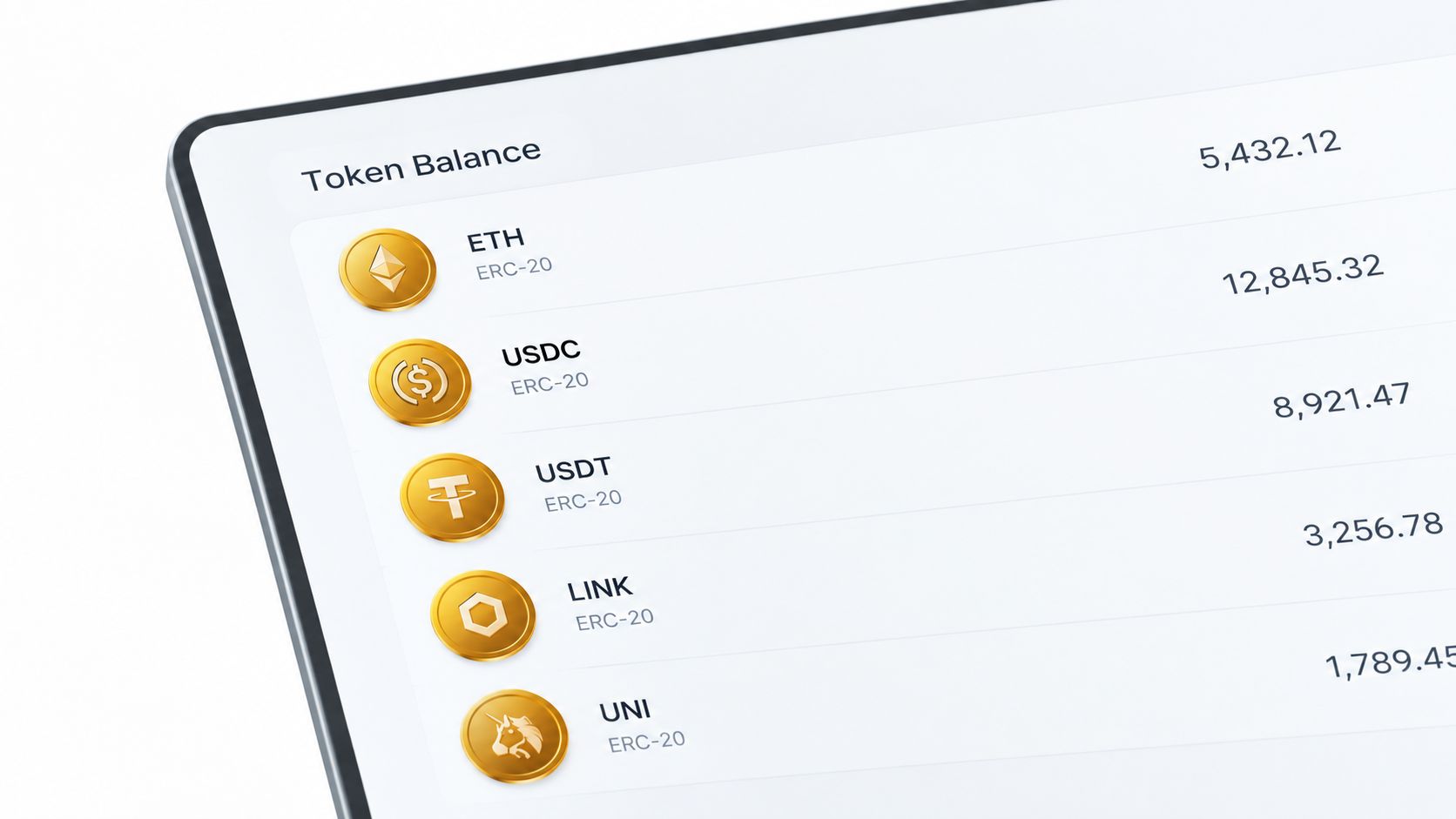
Start with an ERC-20 token to show an interviewer that you understand an interface, not just a deployment script. The standard gives wallets, exchanges, and DeFi applications predictable functions such as totalSupply, balanceOf, transfer, approve, transferFrom, and allowance, plus Transfer and Approval events. USDC, USDT, UNI, and LINK use this interaction model. A comparison of ERC-20 and ERC-721 can demonstrate that you understand the difference between fungible and non-fungible assets.
The interview question usually centers on direct payment versus delegated spending. transfer moves tokens from the caller's balance. After an allowance exists, transferFrom lets a spender move tokens from another account. That distinction creates practical review points: allowance exhaustion, zero-value transfers, insufficient balances, and the approve race condition.
What this proves in an interview
Build the portfolio version with OpenZeppelin's ERC-20 base contract, then explain each inherited function instead of treating the library as a black box. Foundry or Hardhat tests should cover:
- Balance enforcement: A transfer reverts when the sender lacks sufficient tokens.
- Allowance behavior:
transferFromreduces allowance correctly, including maximum-allowance edge cases. - Event accuracy: Successful transfers and approvals emit the expected events.
- Zero-value behavior: Tests document how the implementation handles zero-value transfers.
Be ready to discuss checks-effects-interactions, even though a basic token transfer mainly updates internal balances. State changes and external calls still require deliberate ordering. Explain how you would reduce allowance risk, such as requiring users to lower an allowance before setting a new value or choosing a safer approval flow where appropriate.
Make the code review evidence concrete. Compare a custom _transfer with OpenZeppelin's implementation, document how each handles zero-value transfers and event emission, and state why unaudited copy-pasted code creates review risk. That short comparison shows both implementation judgment and the ability to read production dependencies.
2. ERC-721 Non-Fungible Token Contract
ERC-721 changes the state model: every token carries a unique identifier and its own ownership record, so identity, authorization, metadata, and recipient compatibility become design decisions. CryptoKitties exposed the practical impact of NFT activity on Ethereum, while Bored Ape Yacht Club collections and Ethereum Name Service domains show how the same standard can represent very different assets.
A common interview question is why use safeTransferFrom instead of transferFrom. The safer method checks whether a receiving contract can handle NFTs, reducing the chance of sending an asset into a contract with no recovery path. The ERC-721 standard also requires ERC-165 interface support and a Transfer event whenever ownership changes, including minting from the zero address and burning to it.
The portfolio evidence that matters
Build a minting contract with explicit access control, a supply cap, and tests for ownership transfers. Your explanation should connect each choice to a practical risk, especially the metadata decision:
- On-chain metadata: Durable and independently verifiable, but potentially expensive and restrictive for rich media.
- IPFS metadata: Suitable for distributed hosting, but dependent on content availability and correct URI management.
- Centralized metadata: Convenient to update and operate, but introduces a trusted dependency and possible mutability.
Lead with the trade-off you would ship: for a portfolio project, IPFS metadata with a documented URI-management plan is the defensible default. Explain how permanence, cost, user expectations, and upgrade policy shaped that choice.
Senior interviewers may ask about batch minting and gas trade-offs, including why ERC-721A-style approaches can reduce repeated storage work while making implementation details more complex. They may also ask how marketplaces detect supported interfaces through supportsInterface.
Your project should include a frontend or script that displays ownership, token URI data, and emitted events. Add tests for unauthorized minting, transfers to receiver contracts, duplicate token identifiers, and metadata updates if the design permits them. That evidence answers the interview question, proves careful state handling, and gives reviewers something concrete to inspect.

3. Uniswap V2 Constant Product Automated Market Maker
A Uniswap V2-style automated market maker gives interviewers a direct way to test mathematics and adversarial thinking. Two tokens sit in a liquidity pool, and the pricing relationship follows x * y = k. Traders interact with the pool instead of an order book, while liquidity providers deposit assets and receive fees.
Don't stop at writing a swap function. Derive the output amount from the invariant, include the fee adjustment, and explain why the pool's reserves change after a trade. A candidate who can calculate the result but can't discuss slippage, impermanent loss, or sandwich attacks hasn't demonstrated protocol-level understanding.
Questions that separate implementation from judgment
Work through a numerical example in your portfolio, but label your assumptions clearly rather than presenting an unexplained result. Explain how an external price move can leave a liquidity provider with a different asset mix and a different outcome from holding the original assets. Then show how a minimum-output parameter protects a trader from receiving an unexpectedly poor execution price.
You should also know why MEV matters. A public transaction can reveal a user's intended trade before execution, allowing other participants to reorder transactions or trade around it. Slippage limits reduce execution risk, but they don't eliminate every form of market manipulation. A strong answer connects user protection to transaction ordering, pool depth, and oracle design.
Study the pair contract's _update logic and TWAP accumulator behavior. A senior interviewer may ask how an oracle should use historical observations rather than trusting a single spot price. Compare constant product pools with constant sum designs and concentrated liquidity in Uniswap V3. Your portfolio can include a small swap interface, invariant tests, reserve accounting, and a note on why liquidity pools work.
A short visual walkthrough can help you explain the transaction lifecycle during an interview.
4. Gnosis Safe Multisignature Wallet
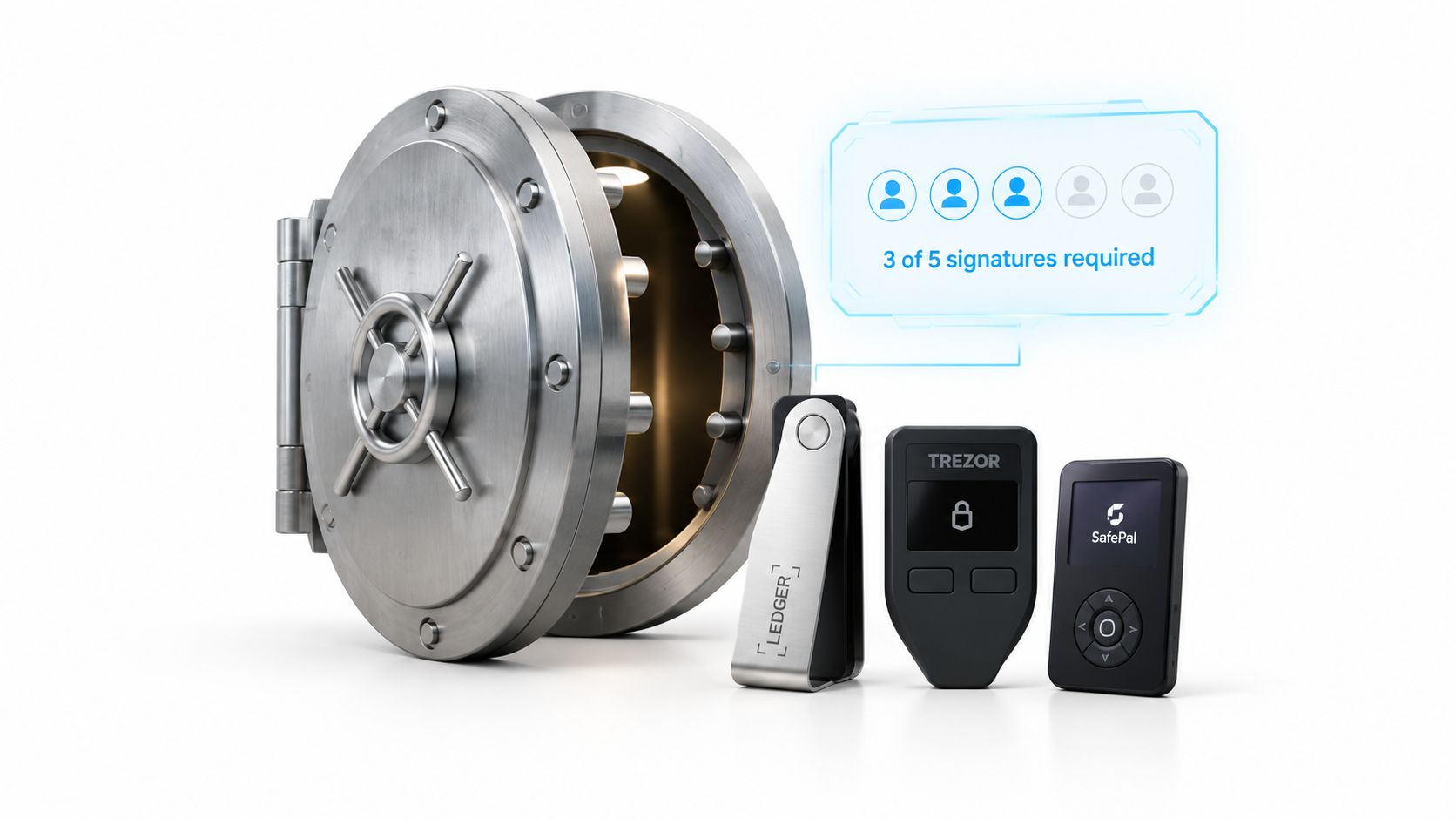
A Safe-style multisignature wallet is where the interview shifts from code to organizational design. The owner set, the signing threshold, and the approval flow all shape how the wallet behaves under pressure. Protocol treasuries, grant programs, enterprises, and DAOs use this pattern because shared authorization is part of the security model, not an afterthought.
The interview question is why the organization picked that threshold and owner set. A 2-of-3 setup is easier to run, but it tolerates fewer compromised or unavailable signers than a 4-of-7 setup. Moving from 2-of-3 to 4-of-7 buys tolerance for two offline or compromised signers, at the cost of coordinating seven key holders for routine transactions.
What to inspect in the execution path
Walk through execTransaction, including nonce validation, signature checks, transaction data, and the final call. Explain how replay protection works and why signers must verify exactly what they approve. Safe's proxy architecture, modules, and guards also create review surfaces. A poorly reviewed module can weaken the protection the wallet is meant to provide.
Your portfolio evidence should show a simulated treasury with separate roles and a clear recovery procedure. Document signer security with hardware wallets, separate devices, and controlled signing environments. Document key rotation for compromise, loss, or staff changes. Treat every module as privileged code that needs review and testing. Explain what happens when a signer is unavailable or a transaction is rejected.
You do not need to reproduce the full production wallet. You do need to show that multisig security combines contract logic with operating procedure. That distinction is central to smart contract audit practice, where reviewers examine code paths and administrative trust together.
5. Aave Flash Loan Contract
A flash loan compresses borrow, execution, and repayment into one transaction. The borrower gets assets without conventional collateral, uses them immediately, and must return principal plus fee before the transaction ends. If anything breaks, the whole call reverts. That makes the receiver contract a tight piece of logic with a wide security surface.
Interviewers usually want the lifecycle in order. The pool lends, the receiver callback runs, the receiver performs its operation, the pool checks repayment, and the transaction reverts if the required amount is missing. The receiver also has to confirm that the callback came from the expected pool and that the initiator is authorized. Without those checks, an attacker can call the callback directly or distort the assumptions about who started the loan.
Build for adversarial conditions
Forked mainnet testing with Foundry or Hardhat gives your portfolio more credibility than a happy-path unit test. Recreate real liquidity, token approvals, swap outcomes, and repayment paths. Add explicit slippage and profit checks so the receiver does not repay the loan while still losing user funds.
The February 2020 bZx attacks showed how a flash loan could cheaply skew a Uniswap-based price oracle that the lending protocol trusted for collateral valuation. The flash loan was the funding tool. The oracle weakness was the actual failure point. Keep that distinction clear, because interviewers often probe whether you understand mechanism versus root cause.
Write tests for an unauthorized callback, insufficient repayment, unfavorable execution, manipulated price input, and a profitable route that completes successfully. Then describe what your receiver does when a downstream protocol reverts. That shows composability awareness, plus the discipline to design for failure instead of only for the happy path.
6. On-Chain Governance, Timelock and Token Vesting Contracts
Governance and vesting show whether you can model time, authority, and irreversible actions. A governance system typically moves through proposal, voting, queue, and execution states. A timelock inserts a delay between approval and execution, while vesting releases tokens according to rules such as a cliff followed by linear releases.
The most important interview question concerns voting power. Read it from a past block rather than the current balance, or a participant may acquire tokens temporarily and influence a proposal through flash-loan-funded voting. Candidates should also explain quorum and approval threshold separately. One documented DAO configuration uses a majority threshold of more than 50% and a quorum default of 20% of total voting power, as described in the DAO voting configuration. The design issue is not just arithmetic. Low turnout, concentrated ownership, and participant-only threshold calculations can affect legitimacy.
Demonstrate the state machines
Walk through what happens when a proposal is canceled, fails quorum, reaches its threshold, enters a timelock, and becomes executable. Explain why the timelock gives users and operators a safety window, and how emergency cancellation or administrative powers affect trust.
For vesting, write the released amount formula and test the boundaries:
- Before the cliff: No tokens should be claimable.
- During the schedule: Claims should reflect elapsed time and the configured release rate.
- After the end: The beneficiary should receive the remaining vested amount.
- Revocation: The contract must state who can revoke, what happens to unreleased tokens, and whether revocation is possible at all.
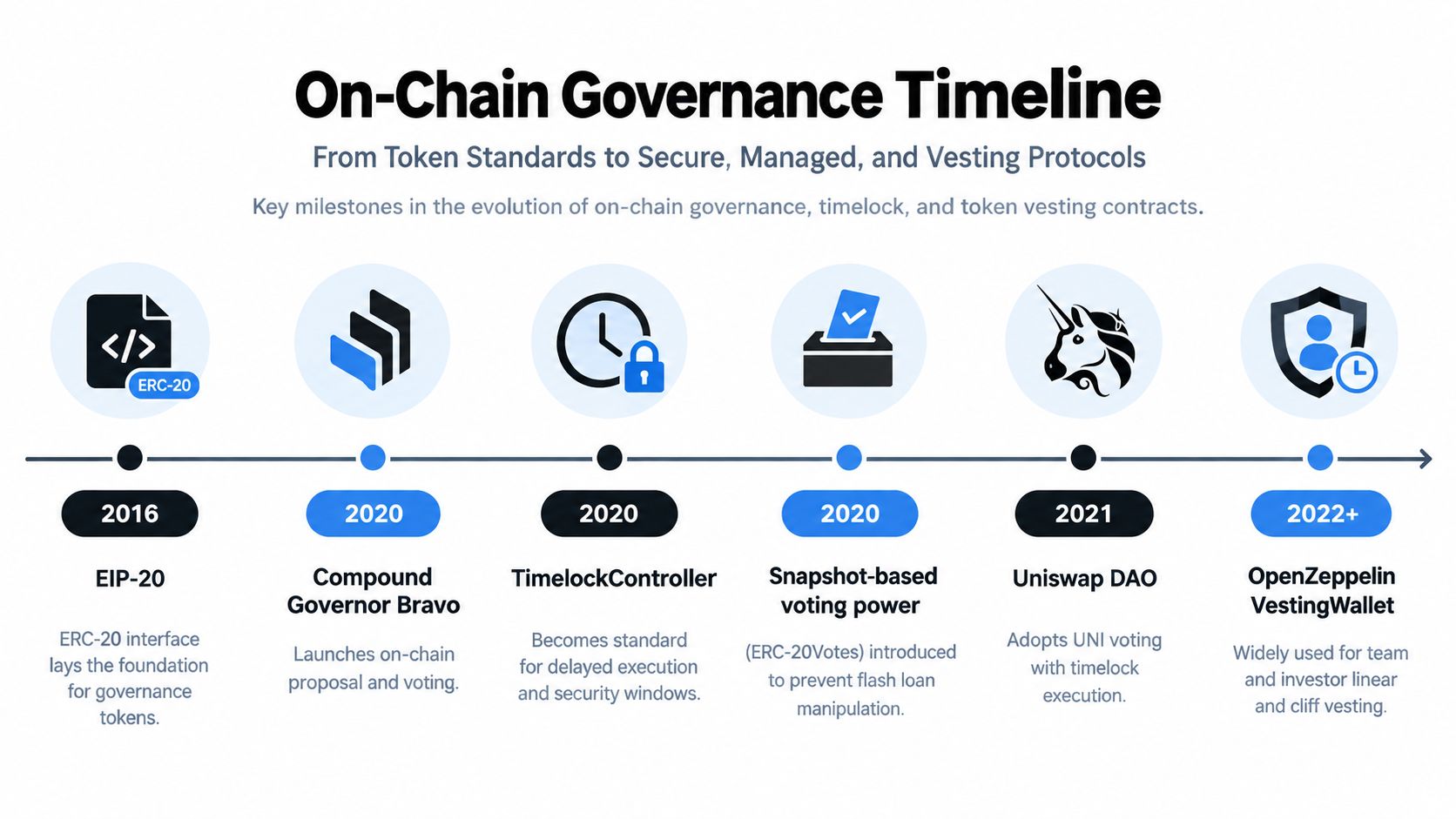
Use OpenZeppelin's Governor, VestingWallet, and TimelockController concepts as reference points, but document your own assumptions. A timeline makes the portfolio easier to review and connects proposal execution, delayed authority, and vesting milestones.
6 Smart Contract Examples, Feature Comparison
| Item | Implementation Complexity 🔄 | Resource Requirements ⚡ | Expected Outcomes ⭐ | Ideal Use Cases 💡 | Key Advantages 📊 |
|---|---|---|---|---|---|
| ERC-20 Token Contract | Low, standard interface, minimal control flow | Low gas per transfer; dev effort: basic tests & OpenZeppelin use | Interoperable fungible token widely supported | Currencies, stablecoins, governance tokens, basic token launches | Universal compatibility; well-audited reference implementations |
| ERC-721 NFT Contract | Medium, per-token ownership, safeTransfer checks, metadata | Higher gas for minting/storage; metadata hosting choices affect ops | Unique on‑chain ownership with marketplace compatibility | Art, collectibles, gaming items, domain names (ENS) | Flexible metadata, marketplace support, audited extensions |
| Uniswap V2 AMM (Constant Product) | Medium‑High, invariant math, factory/pair architecture | Capital-intensive for LPs; swaps incur gas and slippage costs | Permissionless liquidity, on‑chain price discovery; LP fees earned | Decentralized exchange, price oracles, liquidity provision | Simple, auditable invariant; permissionless pools; built‑in TWAP |
| Gnosis Safe Multisig Wallet | Medium, proxy pattern, threshold signatures, modules | Operational overhead (multiple signers), slightly higher tx gas | Strong treasury protection with coordinated approvals | DAO treasuries, enterprise custody, multi-signer governance | Reduces single-key risk; extensible modules and audited codebase |
| Aave Flash Loan Contract | High, atomic callback flow, repay-in-tx guarantees | Low capital needed but complex dev; gas-intensive and MEV-sensitive | Enables capital-efficient arbitrage/liquidations; high attack surface if misused | Arbitrage bots, collateral swaps, composable DeFi flows | No collateral required; atomic execution limits lender exposure |
| On-Chain Governance + Timelock & Vesting | High, proposal lifecycle, timelock, snapshot voting, vesting math | Significant governance token distribution, audits, ongoing ops | Transparent, auditable decision-making and scheduled token releases | Protocol governance, DAOs, team/investor vesting schedules | Timelock safety windows; verifiable vesting; modular governance frameworks |
Turning Smart Contract Examples Into Your Next Offer
Don't present these projects as six unrelated coding exercises. Choose two or three that match the role you want, then build small contracts with focused scope, readable tests, and documented assumptions. A token and NFT project suit integration-heavy engineering roles. An AMM or flash loan receiver gives DeFi teams evidence of mathematical and adversarial reasoning. A Safe or governance project better demonstrates authorization, operations, and protocol administration.
For each project, write a short engineering note. State what the contract does, who can call each privileged function, which invariants must remain true, and what happens when an external dependency fails. Include a test summary covering successful execution, rejected inputs, boundary conditions, and adversarial paths. Interviewers can learn more from a clear explanation of one failed test and its fix than from a large repository with no design rationale.
The strongest candidates also distinguish detectable code patterns from exploitable attack paths. A 2025 analysis of 136,969 real-world contracts found that 4,364 were flagged by vulnerability detectors, while 75.25% of flagged contracts were judged unexploitable. Among 1,080 contracts considered exploitable, only 66, or 6%, had been exploited, according to the peer-reviewed analysis. That evidence supports a better portfolio format: include attacker prerequisites, transaction traces, economic assumptions, invariant tests, monitoring needs, and remediation trade-offs.
Your career progression depends on widening the context around the code. Ethereum documentation distinguishes read calls from writes that change blockchain state, and explains how the ABI encodes functions, inputs, outputs, and events for applications to use when interacting with contracts. Build a small dashboard that reads balances, submits a mint or swap, and displays decoded events. That single addition demonstrates contract work, frontend integration, indexing awareness, and operational communication.
You should also discuss deployment readiness, not just technical correctness. A cross-jurisdiction legal-risk study reported that only 23% of surveyed jurisdictions had clear legislation defining self-executing code as legally binding contracts, while 76% lacked clear legal definitions or enforceability criteria, as reported in the legal-risk study. Explain how your design handles identity, privacy, sanctions, oracle errors, compromised keys, upgrades, pauses, and disputes. The code may automate an outcome, but the product still needs governance and accountability.
Finally, use these projects to target roles deliberately. Review HiredBySkill's hiring perspective, identify the skills a posting emphasizes, and tailor your project note to those requirements. Then search blockchain engineering, DeFi, security, protocol operations, product, and QA roles on blockchain-jobs.com. A tested contract with a concise risk explanation gives a hiring manager a concrete reason to continue the conversation.
Blockchain Jobs connects candidates with opportunities across Web3, including Engineering, DeFi, Security, Product Management, DevOps, Legal and Compliance, and Data roles. Use your smart contract portfolio to target remote-friendly openings and fresh listings, then visit Blockchain Jobs to find roles where these skills can lead to your next interview.