Your Guide to Web Design Jobs Salaries in 2026
Talking about money can feel tricky, but when you're preparing for job interviews or negotiating a promotion in web design, knowing your market value is non-negotiable. The good news is that even at the entry-level, the pay is solid. For 2026, most new designers can expect to see offers between $49,000 and $71,000 a year.
Once you have a bit of experience under your belt, say one to four years, those numbers start to climb, putting you in a stronger negotiating position. The average salary range for an early-career designer shifts up to $56,000 to $85,000. Think of these figures as your starting point—a reliable benchmark as you field your first offers and plan your next career move.
What to Expect for Your Web Design Salary in 2026

Jumping into web design provides a comfortable financial launchpad, and there’s a clear path for your income to grow as you advance your career. Your first salary is just that—a start. Your career progression and earning potential depend on the skills you add to your toolkit and the types of roles you pursue. Let's dig into what those starting numbers look like so you can walk into your next interview with confidence.
Getting a handle on these numbers helps you do more than just pay your bills. It allows you to realistically evaluate job offers, negotiate from a place of strength, and map out your career goals. Whether you’re targeting a creative agency, a big tech firm, or a fast-moving Web3 startup, knowing the industry’s baseline pay is your biggest advantage in a job interview.
Your First Steps on the Salary Ladder
When you start your job search, you’ll notice that salary data can vary. Different sites report slightly different averages, but they all tell the same story: experience is your key to higher pay.
Data from Payscale for 2026 shows an entry-level designer with less than a year of experience earns an average of $49,349. After just one to four years on the job, that number bumps up to $56,755. It’s a clear and direct reward for the hands-on experience you’re gaining, which you should highlight in your resume and interviews.
Other sources suggest the outlook might be even better. A 2025 guide from Coursera puts the median pay for an entry-level role at $71,000 once you factor in bonuses. That same data shows junior designers hitting $85,000, which really drives home the importance of looking at the total compensation package during negotiations, not just the base number.
Your first job offer is more than just a paycheck—it sets the precedent for your entire career. Securing a strong starting salary creates a higher baseline for all your future raises, promotions, and new job offers.
Web Designer Salary Ranges at a Glance 2026
To give you a clearer picture of what to expect, we've pulled together data from several reliable sources. This table compares salary ranges for web designers who are just starting out versus those with a few years of experience, giving you a handy reference for your job search and salary negotiations.
| Experience Level | Average Annual Salary (Payscale) | Median Annual Salary (Coursera) | Typical Range (Elementor) |
|---|---|---|---|
| Entry-Level (<1 Year) | $49,349 | $71,000 | $45,000 – $71,000 |
| Early-Career (1-4 Years) | $56,755 | $85,000 | Varies by specialization |
Seeing these numbers in one place really highlights the financial milestones you can hit early in your career. When you go into an interview armed with this industry data, you're not just guessing—you're making an informed ask. This gives you the confidence to negotiate for the salary you're worth.
And if you're looking to really accelerate your earning potential, the Web3 space is where the opportunity is. A platform like Blockchain Jobs is a great place to find remote UX/UI and design roles in DeFi and other decentralized projects. Acquiring these specialized skills often comes with a significant pay bump, allowing you to outpace the salary growth in more traditional design roles.
The Web3 Premium and Why It Matters for Your Career
While a career in traditional web design is solid, there's a major factor that designers focused on career progression can't ignore: the Web3 salary premium. A clear divide is emerging, centered around this new, blockchain-based internet. For designers, this isn't just about picking up a few new buzzwords; it's a genuine opportunity to tap into a market that pays significantly more for a specialized skill set.
Think of it this way for your career: a great chef will always find work in a good restaurant. But a chef who’s mastered the complex art of molecular gastronomy? They're in a completely different league, commanding top dollar. Right now, Web3 is the molecular gastronomy of the design world. It requires a deeper, more specialized understanding, and companies are paying a hefty premium to hire talent with these skills.
Why Do Web3 Design Jobs Pay More?
Those higher salaries you're seeing in Web3 aren't just speculative hype. They're a direct result of the unique design challenges and incredibly high stakes involved in designing for decentralized platforms.
When you're designing a typical e-commerce site, your main goal is a smooth checkout. But when you’re designing a decentralized finance (DeFi) app, you're responsible for making complex, irreversible financial transactions feel intuitive and secure. A design flaw isn't just bad UX; it could mean a user loses thousands of dollars. Hiring managers are looking for candidates who understand this.
This calls for a rare mix of classic UX skills and a grasp of completely new concepts:
- You're not just designing buttons; you're designing economies. In an interview, you need to show you understand tokenomics—how digital tokens and incentives function—to create interfaces that clearly communicate value, risk, and reward.
- You have to build trust with pixels. In a decentralized world with no central bank or customer service, the design is the trust signal. Your job is to create transparent, predictable, and error-proof flows.
- Your primary job is to make the complex feel simple. Blockchain is technically complicated. A great Web3 designer acts as a translator, turning that complexity into an experience anyone can use without a computer science degree. This is a key value proposition to emphasize.
Because these skills are so hard to find and the financial impact of good design is massive, companies are in a talent war. This intense demand meeting a low supply of qualified designers is exactly what creates the "Web3 premium" you can leverage in your job search.
A designer who can create an intuitive experience for a complex DeFi protocol is not just a designer; they are a critical bridge between a revolutionary technology and its mainstream adoption. This value is directly reflected in their compensation.
Positioning Yourself for High-Value Web3 Roles
The good news is that you don't have to discard your existing design skills to move into Web3. Your foundation in UX principles, visual design, and user research is more critical than ever. The key to a successful career transition is to reframe and build upon those skills in a Web3 context.
First, immerse yourself. Don't just read about it—do it. Use dApps (decentralized applications), set up a crypto wallet, and try to buy an NFT. This firsthand experience is priceless; it gives you the empathy to spot user pain points and talk about them intelligently in an interview.
From there, start building a portfolio that proves you can solve Web3-specific problems. To show hiring managers you're ready, you could try:
- Redesigning an existing dApp. Find a popular DeFi or NFT platform that’s notoriously confusing and create a case study showing how you’d improve the user experience.
- Creating a concept project. Dream up a new decentralized service and design the interface for it, making sure to explain your thinking around tokenomics, security, and building user trust.
Once you have tangible work to show, you can target roles that demand these skills. For example, a quick search for a Web3 Creative Designer on Blockchain Jobs shows that companies want professionals who can merge top-tier design craft with a real understanding of the crypto world. Taking these steps is how you'll stand out, gain leverage in salary negotiations, and future-proof your career in one of tech's fastest-growing sectors.
Your journey as a web designer isn't a straight line—it's a series of stages, each with its own focus, responsibilities, and earning potential. Think of it less like climbing a ladder and more like a career progression where you master new levels of ownership and influence.
When you're starting out as a Junior Designer, your world revolves around execution. You're given a specific task—design this screen, create these assets, follow this style guide—and your job is to nail it. Your career goal is to build a reputation for being reliable, detail-oriented, and eager to learn the tools of the trade.
Moving into a Mid-Level role is your first taste of real ownership. You’re no longer just executing tasks. You're starting to own smaller features, contribute your own ideas, and make design decisions with more freedom. This is where you prove to hiring managers and your current boss that you can think beyond the pixels and are ready for more responsibility.
The Jump From Doing to Leading
The leap from mid-level to Senior Designer is one of the biggest in your career, and the salary bump reflects that. As a senior, you're not just a doer; you're a leader. You're expected to guide entire projects from a vague concept to a polished launch, mentor junior designers, and confidently explain your design choices to executives and stakeholders.
Becoming a senior isn't just about perfecting your craft in Figma. It's about making the entire team better. Hiring managers want to see that you can think strategically and elevate others.
To fast-track that promotion or land a senior role, start acting like one:
- Be a feedback magnet. Actively seek feedback from senior designers, PMs, and engineers. This shows you're proactive about your growth.
- Mentor someone. Find a junior designer who could use guidance. Teaching is one of the best ways to demonstrate leadership potential.
- Own the presentation. Volunteer to present your team’s work. Articulating the "why" behind your designs is a non-negotiable skill for a senior.
This is also where we see a major split in compensation, especially between traditional tech companies and the Web3 world.
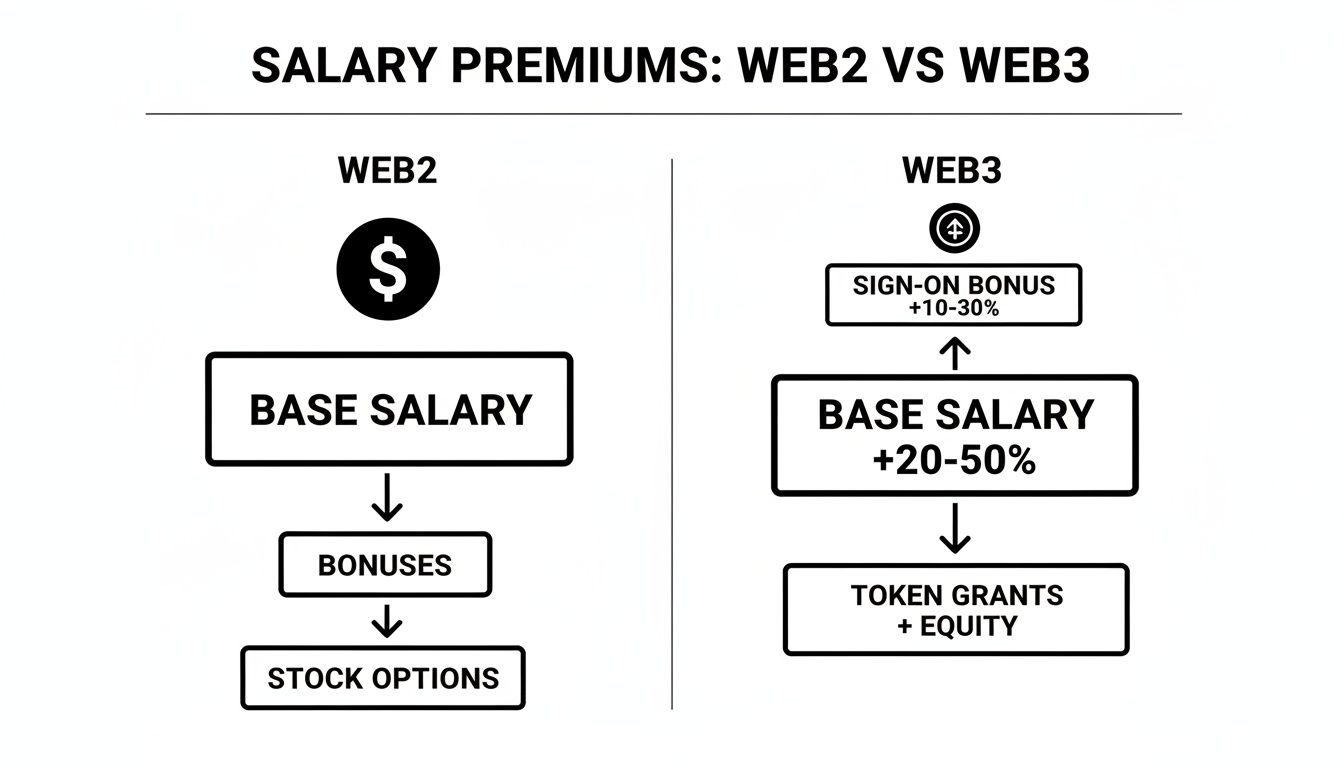
While a Web2 role offers a stable and predictable salary, a Web3 position often layers on significant premiums and token incentives. This can radically change your total compensation package, which is a huge factor for career-focused designers.
To give you a clearer picture of how this progression plays out, here's a breakdown of the typical career path for a web designer, including salary expectations for 2026.
Web Designer Career Path and Salary Progression (2026)
| Role Level | Key Responsibilities | Typical Salary Range (US) | Web3 Salary Premium |
|---|---|---|---|
| Junior Designer | Executing defined tasks, creating assets, learning tools. | $60,000 – $85,000 | +15-20% |
| Mid-Level Designer | Owning small projects, contributing to design decisions. | $85,000 – $115,000 | +20-25% |
| Senior Designer | Leading projects, mentoring junior designers, strategy. | $115,000 – $160,000+ | +25-40% |
| Lead/Principal Designer | Team management, setting design vision, solving business problems. | $160,000 – $250,000+ | +30-50% |
As you can see, each step up the career ladder involves a significant shift in both responsibility and financial reward.
Reaching the Top: Lead and Principal Roles
Once you move beyond the senior level, the career path often splits. You can become a Lead Designer (a management role) or a Principal Designer (an elite individual contributor).
As a Lead, your focus shifts from hands-on design to people and process. You're managing a team of designers, setting priorities, and ensuring the overall quality of your team's output. Your success is measured by your team's success.
A Principal, however, remains on the front lines. They’re the ones tackling the company's most ambiguous and difficult design challenges. They set the standard for design quality across the entire organization and act as a key advisor on high-level product strategy.
To get to this level, you must connect your work to the company's bottom line. In interviews, ask questions like: what are our biggest business challenges, and how can design be the solution? As you start looking for these advanced roles, you'll see what top companies value. You can get a good sense of the landscape by browsing the various design jobs available in the USA to see the skills and experience currently in demand.
Decoding Your Total Compensation Package

When an offer lands in your inbox, your eyes probably jump straight to the base salary. It's only natural. But focusing on that single number can be a huge mistake—a higher base doesn't automatically equal a better offer.
To really know what a company is putting on the table, you have to look at the entire picture. Your total compensation is the sum of all its parts, and understanding each piece is how you accurately compare different opportunities, especially when weighing a traditional tech role against a Web3 startup. This knowledge is your biggest asset during salary negotiations.
Beyond the Base Salary
Think of your base salary as the foundation. It’s the guaranteed, predictable part of your income. But great companies build on top of that foundation with other incentives to attract and retain talented designers. When you start asking smart questions about these other elements in an interview, you signal that you're a serious professional who understands your long-term value.
Here are the key components you need to dig into when you receive an offer:
- Performance Bonuses: This is extra cash tied to your work or company performance. Ask the hiring manager how these are structured. Are they a guaranteed part of your compensation plan? What percentage of your base do they typically represent?
- Equity (Stock Options or RSUs): This is where you get a piece of the pie—an ownership stake in the business. At public companies, you’ll often see Restricted Stock Units (RSUs). At startups, stock options are more common, giving you the right to buy shares at a fixed price.
- Retirement Plans: A solid 401(k) with a company "match" is a massive long-term benefit. A company match means they contribute money to your retirement alongside you, which is essentially free cash that supercharges your savings.
- Professional Development: Does the company offer a budget for courses, conferences, or certifications? This is a direct investment in your career growth and a great sign they want to help you progress from a junior to a senior designer.
Total compensation isn’t just about your take-home pay today. It's the entire financial package—including future windfalls from equity and what your employer chips in for retirement. A lower base salary with phenomenal benefits and a strong equity grant can easily be worth more down the road.
The Web3 Factor: Tokens and Contractor Rates
The Web3 space adds another exciting layer to designer pay: token grants. Much like stock options, these are allocations of a project's native cryptocurrency. If you join a project that takes off, the value of those tokens can skyrocket. It's a high-risk, high-reward element that's unique to this industry.
When you're evaluating an offer with a token component, you must ask about the vesting schedule—the timeline for when you gain full ownership of the tokens.
This "total value" mindset is just as critical for freelancers and contractors. A classic career mistake is to peg your hourly rate to what a salaried employee earns. That approach completely ignores all the costs you're now shouldering yourself.
To set a proper contract rate, you have to factor in:
- Self-Employment Taxes: In the US, this is a hefty 15.3% right off the top, on top of your income taxes.
- Business Expenses: All your tools—Figma, Adobe Creative Cloud, new hardware, and office supplies—come out of your pocket.
- Benefits: You're now responsible for your own health insurance, retirement savings, and any paid time off you want to take.
- Profit Margin: After you've covered all your costs and paid yourself a "salary," you need to add a margin of 20-30% to stay profitable and grow your business.
Let’s run the numbers. A salaried designer making $100,000 works roughly 2,080 hours per year, which breaks down to about ~$48/hour. But a freelancer charging that rate would go broke fast. To cover all the extra costs and actually run a sustainable business, that same freelancer needs to be charging $90-$120/hour or even more. Doing this math ensures you're never undervaluing your work, whether you're negotiating a full-time role or a new contract.
Skills and Specializations That Increase Your Salary
Ever wonder why two designers with the same "Senior" title can have salaries that are tens of thousands of dollars apart? That gap almost always comes down to a potent mix of specific skills, industry specialization, and where you choose to work.
Getting a handle on these factors is how you take control of your career path and your paycheck. Instead of just waiting for raises, you can be deliberate about the skills you learn, making yourself a far more valuable hire. This is your playbook for making smart career moves that pay off.
High-Value Technical Skills Employers Pay For
Hiring managers are looking for more than just someone who can make pretty mockups. They need designers armed with a modern toolkit who can solve real business problems. When you can show proficiency in a few key areas on your resume and in interviews, you immediately stand out and can justify a higher salary.
The trick is to signal to hiring managers that you’re the person who can close the gap between the design and engineering teams.
- Mastery of Design and Prototyping Tools: Being proficient in Figma is the bare minimum today. Real mastery means building complex design systems, creating high-fidelity interactive prototypes, and using advanced features to make the team more efficient. This is non-negotiable for any top-tier role.
- A Practical Grasp of Front-End Code: You don't have to be a developer, but knowing your way around HTML, CSS, and basic JavaScript is a game-changer. It proves you can have intelligent conversations with engineers and design products that are actually feasible to build.
- Advanced UX/UI Principles: This is what separates a designer from a decorator. In an interview, be ready to talk about how you used A/B test results or user research to make a critical call on a project. Show you have a deep understanding of user psychology, information architecture, and how to use data to guide your decisions.
A designer who gets code and data isn't just a creative; they're a strategic partner. They can spot technical roadblocks, argue for a better user experience with hard evidence, and help the entire development process run smoother. That kind of versatility is exactly what companies are willing to pay a premium for.
The Power of Industry Specialization
While generalists are always needed, specialists often command higher salaries because they solve specific, high-stakes problems. One of the fastest ways to boost your earning potential is to target a booming industry. When you frame your experience around industry-specific challenges in an interview, you show you can deliver value from day one.
Think about it: any good designer can work on an e-commerce site. But a designer who specializes in FinTech has a unique understanding of how to build trust when users are handing over sensitive financial information—a skill you can highlight in your job search.
These high-demand industries consistently offer higher web design jobs salaries:
- FinTech: Designing for banking apps and investment platforms requires an obsession with security, clarity, and regulatory compliance.
- SaaS (Software-as-a-Service): Creating complex interfaces for business software demands a deep knowledge of user workflows and data visualization.
- Blockchain/Web3: As we’ve covered, this is the new frontier. Designing for dApps and DeFi is all about translating complex technology into simple, intuitive user experiences.
So when you're prepping for your next interview, don't just call yourself a "UX/UI Designer." Position yourself as a "SaaS UX Designer who specializes in streamlining onboarding flows" or a "Web3 Designer with proven experience creating intuitive NFT marketplaces." This specific positioning makes your value undeniable and gives you serious leverage when it’s time to talk numbers. Your career isn't just about what you can do—it's about where you choose to do it.
Negotiating the Salary You Deserve
Let's talk about one of the biggest career mistakes any designer can make: leaving money on the table. It’s common, especially early in your career, to accept an offer out of sheer relief. But negotiating your salary isn't confrontational. It's about professionally communicating your market value to start your new job feeling valued from day one.
Most people think negotiation only happens after an offer is on the table. That’s a mistake. You start negotiating the second you walk into your first interview. Every conversation, every project you discuss, and every question you answer is an opportunity to prove the unique value you bring. By the time a formal offer arrives, you should have already built a strong case for why you’re worth top dollar.
Handling the Salary Expectations Question
At some point, a recruiter will ask, "So, what are your salary expectations?" It's a question that can trip up even experienced candidates. If you give a single number too early, you risk boxing yourself in. Your goal is to show you've done your research while keeping your options open.
A great way to handle this sounds something like this: "Based on my research for a role with these kinds of responsibilities in this area, and factoring in my experience with [mention a key skill like UX research or Figma design systems], I've seen that compensation tends to fall in the $X to $Y range. Of course, I'd want to look at the full picture—base, benefits, any bonuses—before landing on a specific number."
This approach works wonders because it:
- Proves you've researched web design jobs salaries and aren't just picking a number out of thin air.
- Anchors the conversation around a range you've determined is fair for your skills.
- Smartly pivots the discussion toward total compensation, which is what really matters.
Framing Your Counteroffer
Once you have that initial offer in hand, it's time to prepare your counter. A strong counteroffer is never just a higher number you dreamed up; it's a short, professional business case that ties back to the value you've already demonstrated throughout the interview process.
This is where your prep work pays off. Your response should lean on clear data points. You can reference industry salary benchmarks, mention a competing offer (if you have one), or circle back to a specific, high-value skill that wasn't fully discussed during the interviews.
Think of your counteroffer as a mini-proposal. You're not issuing a demand. You're presenting new information that helps justify a revised number, working with the hiring manager to find a figure that makes everyone happy.
For instance, if you're a designer stepping into the Web3 world, you have a solid justification for a higher salary. You might say, "Thank you so much for the offer! I'm incredibly excited about the opportunity to build intuitive experiences for your DeFi platform. Given my background in making complex financial products feel simple for users, I believe a base salary of [Your Higher Number] would be a more accurate reflection of the specialized value I can bring to the team."
When to Negotiate Beyond Salary
Sometimes, a company can't budge on the base salary due to budget constraints. But that doesn't mean the negotiation is over. This is a perfect opportunity to get creative and negotiate other valuable perks that contribute to your career growth and well-being.
If the base salary is firm, consider asking for:
- A one-time signing bonus to help close the gap.
- An increased professional development budget for courses, books, or conference tickets.
- More paid time off or a more flexible remote work arrangement.
- A performance and salary review after six months instead of the standard year.
By being strategic and professional, you're not just fighting for more money. You're showing the hiring manager that you're a thoughtful, creative problem-solver—exactly the kind of person they want on their team. It sets an incredibly positive tone for your entire career with the company.
Common Questions on Web Design Salaries
When you're gearing up for interviews or just trying to map out your career, money questions are always top of mind. Let's tackle some of the most common ones designers ask.
What’s a Realistic Starting Salary for a Web Designer?
In 2026, if you're just starting out as a web designer in the US, you can realistically expect to see offers between $50,000 and $75,000 a year. Where you fall in that range depends on your location, the type of company, and the strength of your portfolio. A role in the Web3 space, for instance, will almost always pay more right out of the gate because of the specialized skills involved.
Quick tip for your interviews: When the salary question comes up, don't get stuck on the base number. Talk about the total compensation and tie your specific skills back to the role. This helps anchor your value at the higher end of that starting salary range.
How Much More Can I Really Make by Specializing in Web3?
A lot more. Specializing in Web3 and blockchain design can easily boost your earning potential by 20-40%, and often even more. It's not uncommon for senior UX/UI designers in Web3 to pull in salaries well over $150,000. And that's before you even factor in token incentives, which can add a significant chunk to your total pay. This kind of specialization gives you incredible leverage when you're at the negotiation table.
Should I Be a Salaried Employee or Go Freelance?
This is the classic career debate, and the right answer really boils down to your personality and what you want from your career.
- Salaried Life: This is your path if you value stability and a clear career progression. You get a steady paycheck, benefits like health insurance and a 401(k), and a clear ladder to climb within a single company.
- Freelance Life: This route is all about flexibility and control. You can earn much higher hourly rates (think $75-$150+), but you're running your own business. That means finding your own clients, handling your own taxes, and managing the admin side of things.
Plenty of designers do both at different points in their careers, finding a balance between the security of a full-time role and the freedom of contract work that suits their long-term goals.
Ready to find a web design role where your skills are truly valued? The best opportunities in the Web3 ecosystem are on Blockchain Jobs. You can browse curated design roles in DeFi, NFTs, and more.