
What Is DCA in Crypto and How to Use It Wisely
DCA in crypto means buying a fixed dollar amount of an asset at regular intervals to smooth out volatility. 59.13% of crypto investors in a 2026 Kraken survey said it was their primary strategy, and 83.53% had used it at least once, which tells you this is the market's default habit, not a clever edge.
That popularity hides the underlying question, though. DCA is useful when you want discipline, steady exposure, and less emotional noise, but it can also lag a clean lump-sum entry when price trends up for a long stretch.
What DCA Actually Means in Crypto Markets
Most explainers call DCA “safe” and stop there. That's lazy, because DCA is a discipline, not a guarantee, and crypto punishes people who confuse process with outcome.
The clean definition is simple: Dollar-Cost Averaging means buying a fixed amount of an asset at regular intervals instead of making one large purchase, with the goal of reducing the effect of short-term volatility on your average entry price over time, as described by Kraken's crypto guide on dollar-cost averaging and its Spanish version of the same concept. It is a rule-based habit, not a prediction that prices will cooperate.
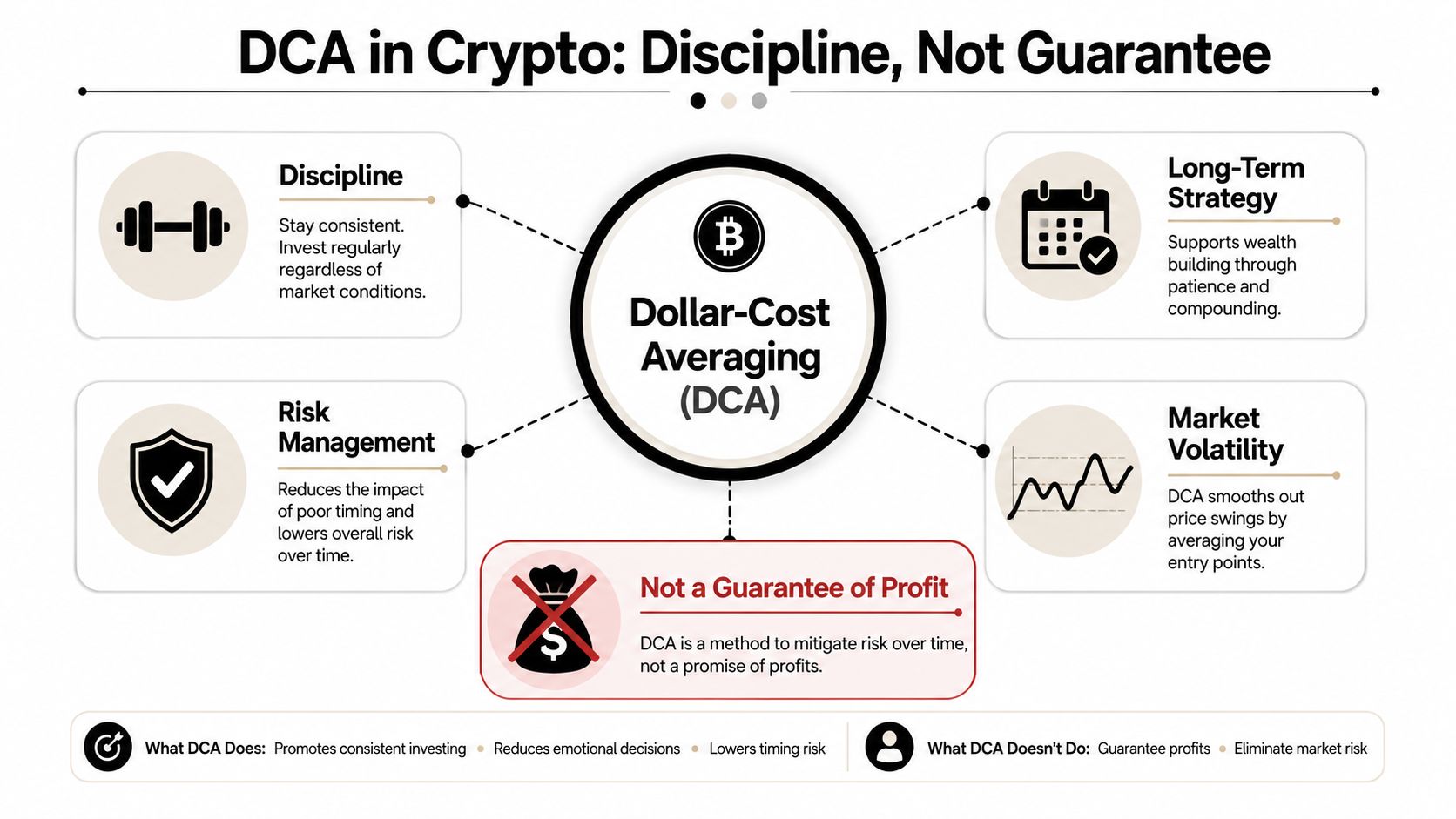
The reason DCA became mainstream is obvious once you've watched enough cycles. A 2026 Kraken survey, referenced in the TrendXBit research note, found that 59.13% of crypto investors identified DCA as their primary strategy, and 83.53% had used it at least once, which means it's now a default behavior for people trying to build exposure without making one scary all-in bet. In practical terms, that's why DCA shows up everywhere from Bitcoin accumulation plans to ETH treasury policies.
A better way to think about it is as a portfolio operating system. If you're a Web3 professional, DCA is also a career signal. It shows you can follow a process, tolerate volatility without flinching, and explain your decisions in an interview without sounding like you've been glued to candlesticks all day.
If you want a broader framing of how DCA sits beside other trading approaches, the resource 10 proven crypto strategies is a useful complement to this more blunt take. For roles and hiring context in the space, the ecosystem overview at Blockchain Jobs is a practical place to map how portfolio habits connect to real Web3 careers.
Practical rule: Use DCA when you want repeatability and fewer bad emotional calls, not when you're trying to outguess a market that's already trending hard in one direction.
How Dollar-Cost Averaging Works Step by Step
The mechanics are boring on purpose, and that's the point. You pick an amount, pick a schedule, and buy no matter what the chart is doing.
A simple Bitcoin example makes this clear. If you buy $100 of Bitcoin every Monday for a quarter, the dollar amount stays fixed while the quantity of BTC changes with price. That structure is what gives DCA its smoothing effect, because cheaper weeks buy more coins and expensive weeks buy fewer. Coinbase's crypto basics guide uses the same recurring-buy logic, including weekly and monthly schedules, to show that DCA is defined by repetition, not by guessing the right entry.
The logic behind the schedule
The interval matters less than is commonly thought. Weekly, monthly, and quarterly schedules all work because the core principle is the same, a fixed outflow that keeps you invested without turning every purchase into a market-timing referendum.
For a working example, say the BTC price is $30,000 in week one, $28,000 in week two, $32,000 in week three, and $29,000 in week four. Your $100 buys different fractions of Bitcoin each time, but your decision rule never changes. That's the whole advantage, because your process stays stable while price swings around it.
What changes, and what doesn't
The recurring amount should stay fixed. If you keep changing the dollar amount because you feel bullish or scared, you're no longer doing DCA, you're improvising.
Buy the same amount on the same schedule, then leave the chart out of the decision.
That's why DCA is easy to explain in under a minute to a colleague, a hiring manager, or a teammate in treasury. It's a systematic buying rule that substitutes consistency for timing skill.
What the Backtest Numbers Really Show
The historical numbers matter, but only if you read them correctly. They don't prove DCA is magic, they show what happens when a disciplined buying rule meets a volatile asset that eventually trends upward.
One published backtest cited in the verified data said a weekly Bitcoin DCA from 2018 through early 2026 returned approximately 1,145%, a period that included the 2018 crash, the 2020 pandemic selloff, and the 2022 FTX-driven bear market. That result is useful because it shows how DCA behaves when prices are ugly, chaotic, and emotionally exhausting, which is exactly when many people abandon their plan.
| Strategy | Period | Starting Capital | Ending Value | Approx Return |
|---|---|---|---|---|
| Weekly Bitcoin DCA | 2018 through early 2026 | Not stated | Not stated | Approximately 1,145% |
| Weekly Bitcoin DCA | 2019 through 2024 | $2,620 | About $7,913 | Not stated |
| Gold | 2019 through 2024 | Not stated | Not stated | 34% |
| Dow Jones | 2019 through 2024 | Not stated | Not stated | 23% |
A smaller example from the same source said a $10 weekly DCA from 2019 through 2024 grew $2,620 into about $7,913, outperforming gold's 34% and the Dow Jones' 23% over the same span. That's not a license to worship DCA, it's a reminder that a recurring-buy habit can work well when the asset's long-run direction cooperates with your schedule.
What the backtests actually prove
They prove that DCA can be powerful during drawdowns because it buys more units when price collapses and fewer when price rallies. They do not prove that DCA rescues a bad asset choice, and they do not mean every coin deserves a recurring-buy plan.
That distinction matters in crypto careers too. In interviews, weak candidates talk about backtests like they're guarantees. Strong candidates explain that the asset, the regime, and the holding period matter more than the slogan.
Blunt truth: DCA works best as a behavior framework. The asset still has to be worth owning.
DCA vs Lump Sum and When Each Wins
This is the comparison many individuals skip because it forces a real decision. If you have capital now, you need to decide whether to deploy it all, or spread it out and accept some missed upside.
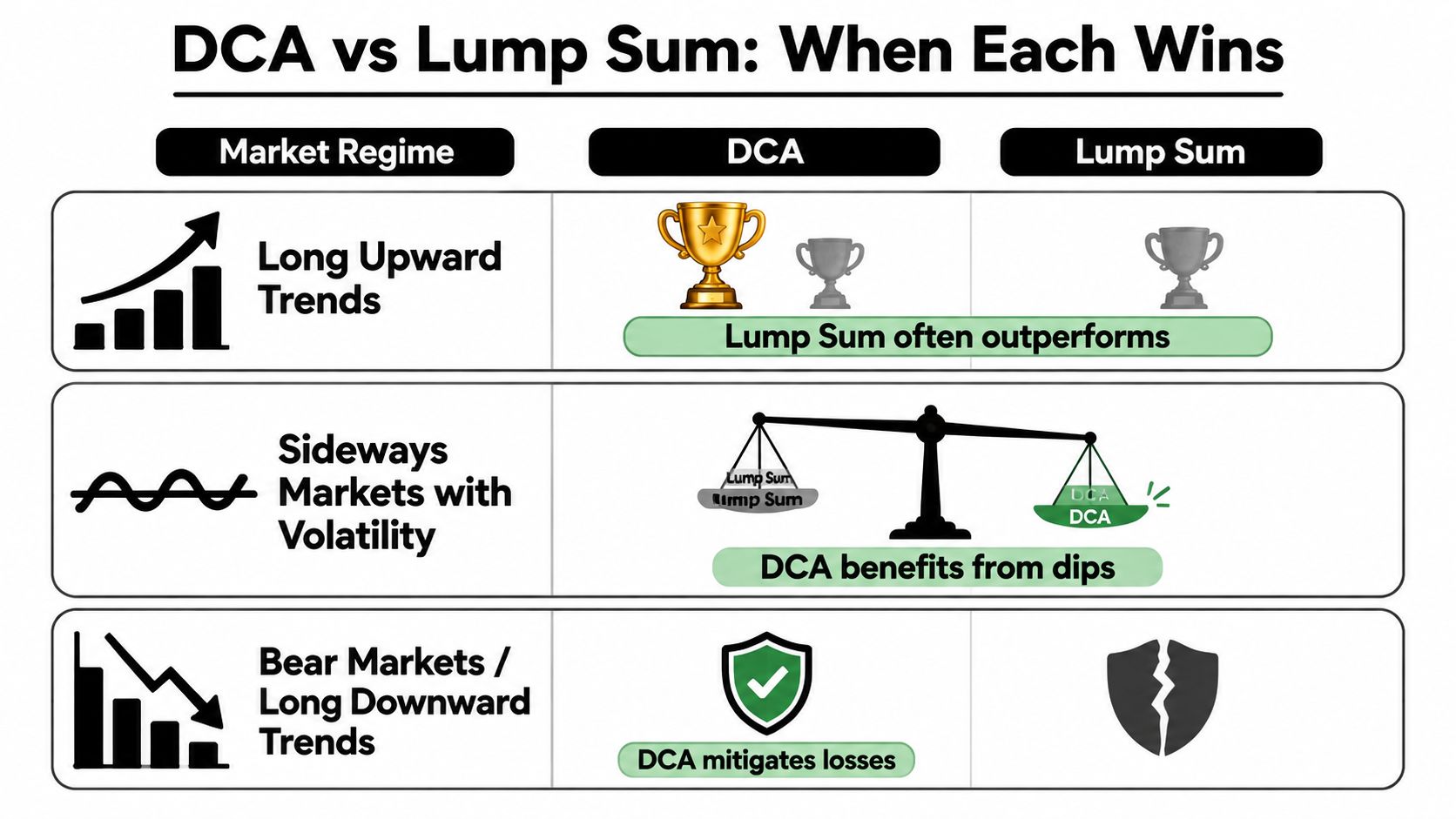
In a long upward trend, lump-sum usually wins because money on the sidelines isn't compounding. DCA leaves part of your capital idle longer, so if price keeps climbing, your later buys happen at worse levels than an immediate entry would have delivered. That's the opportunity cost nobody likes to admit.
In a sideways, choppy market, DCA tends to look better because it keeps putting cash to work while impatient buyers wait for a cleaner confirmation that may never come. The rhythm of recurring purchases helps you avoid freezing, which is a bigger problem in crypto than most traders want to confess.
In a sustained bear market, DCA's structure does the heavy lifting. You keep buying through the decline, your cost basis falls as units accumulate, and the rebound can reward the larger position you've built. That's why the habit feels strongest in ugly markets.
The right move for many Web3 professionals is a hybrid. If you receive a bonus, vesting event, or token distribution, deploy a lump sum on the portion you already know you want in the market, then use DCA for the cash flow that arrives later. That way you capture immediate exposure without betting your whole plan on one perfect timestamp.
Setting Up a DCA Program Across Exchanges and DeFi
A good DCA program is operational, not philosophical. If it's hard to maintain, it's not a strategy, it's a good idea waiting to fail.
Start with the venue. On centralized exchanges, recurring buys are usually the simplest route because the exchange handles scheduling and execution. That's also why many investors prefer to keep the process boring, especially when they're juggling payroll, token vesting, and a full-time role.
Decide where the money comes from
Use payroll cadence as your anchor. Weekly schedules fit people who want frequent exposure and tight habit loops, while monthly schedules are easier to match with salary inflows and reduce administrative clutter.
Choose the funding source that keeps fees and friction low. If you're moving money manually every time, you'll eventually skip a week. If you automate it, the plan survives your workload, your travel, and the kind of market panic that tempts people to “pause” the rules they promised themselves.
Pick the right execution layer
Some crypto sources describe DCA beyond simple spot buying, including application to BTC, ETH, or diversified baskets through centralized exchanges or DeFi. That makes sense for professionals who want exposure across a few assets without building a separate trading decision every time.
If you're exploring automation beyond exchange recurring buys, a technical overview like the guide to building a Solana trading agent can help you think clearly about workflow design, even if your actual use case is much simpler than a bot. The useful habit is the same, define rules first, then let execution follow the rules.
Keep custody and career optics in mind
You also need to decide whether purchases stay on-exchange, move into self-custody, or sit in a mix. That choice affects security, recovery steps, and how much operational maturity you can speak about in an interview.
For candidates targeting DeFi strategy roles, the job framing matters. A role like the one listed at Blockchain Jobs' DeFi Strategist opening is exactly the kind of position where a clean DCA framework can signal that you understand liquidity, process, and portfolio discipline.
Interview advantage: If you can explain your DCA setup, your custody choice, and your review cadence without hand-waving, you sound like someone who can run capital responsibly.
Costs, Taxes, and Risks That Eat Into DCA Returns
DCA looks cheap until the friction shows up. Automation does not erase costs, it just makes them easier to ignore.
Transaction fees are the first drag. Exchange commissions add up fast, and on-chain gas can make recurring buys a bad choice if you are executing directly on a costly layer. If you are running a DCA plan on Layer 1 Ethereum without a cheaper execution path, the fee burden can eat into the whole point of the strategy.
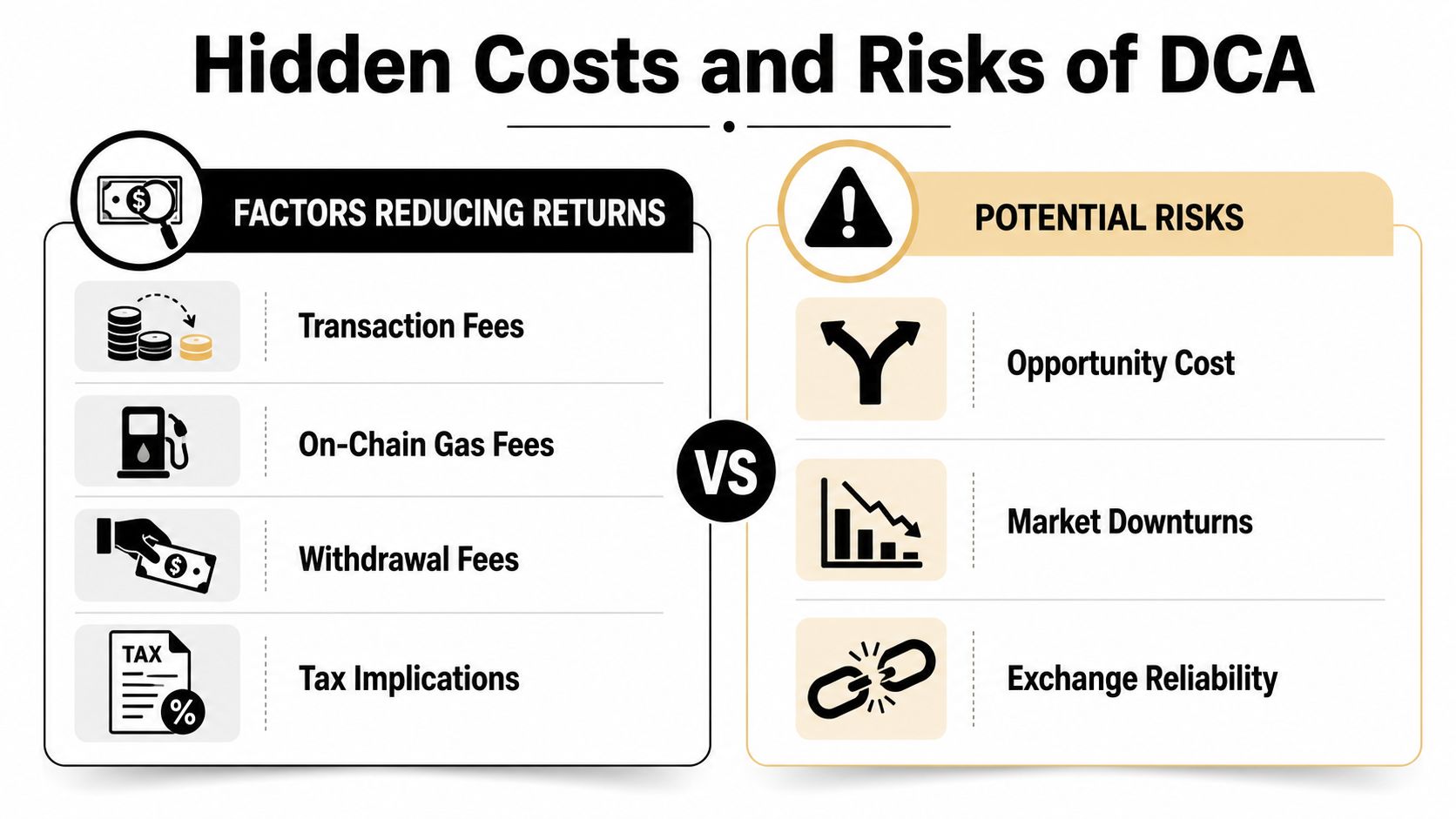
Taxes create the next layer of friction. Every recurring purchase adds another cost-basis lot, so a high-frequency DCA program can turn into a record-keeping mess quickly, especially if you also receive token compensation from an employer. Managing that complexity is part of the job for a crypto tax content writer, because clean records are required if you want the strategy to stay usable instead of becoming a filing headache.
Operational risk sits underneath both. API keys, exchange custody, and smart-contract exposure on DeFi tools all create failure points that a neat spreadsheet will not fix. A disciplined professional should know which part of the stack can break, who controls the keys, and what happens if a platform pauses withdrawals.
The career angle is straightforward. If you can explain your fee controls, custody choices, and tax awareness clearly, you have a real edge in treasury, ops, and compliance interviews. It shows you are not just a speculator with a recurring order, you understand how to manage capital like it belongs in a company environment.
Building a Career-Proof Crypto DCA Strategy
A career-proof DCA plan should match your income, your conviction, and your tolerance for pain. If a bad market would force you to sell, the position is too large.
My preferred setup is hybrid. Use a lump sum for known windfalls, then fund a smaller recurring DCA from monthly cash flow. That gives you immediate exposure where it makes sense and steady accumulation where discipline matters more than timing.
A practical checklist
- Set the cadence first. Weekly works if you want tighter discipline, monthly works if you want less overhead.
- Pick one execution venue. Centralized exchange, self-custody, or a mixed setup, but don't improvise each month.
- Track tax lots from day one. Every purchase should be easy to reconcile later.
- Review custody and fees quarterly. If the setup is clunky, simplify it before it becomes expensive.
- Keep the size survivable. Size the plan so a severe drawdown doesn't break your budget.
The best DCA programs are boring, resilient, and easy to explain. That matters in your portfolio, and it matters in interviews, because hiring managers trust people who can run a repeatable process without drama.
If you work in Web3, treat DCA as part of your operating style, not just your investment style. It gives you a way to build exposure, talk intelligently about risk, and show that your decisions are grounded in process, not impulse.
If you want a clearer path into Web3 roles where this kind of discipline matters, visit Blockchain Jobs and look for positions that reward process, treasury thinking, and market literacy. It's a direct way to connect your investing habits with the kind of crypto career that values them.