
Android Dev Hiring: Playbook for 2026

You're probably staring at the same problem right now. The Android role has been open long enough that recruiters keep sending people who can name every library in the ecosystem, but cannot explain how they shipped a real app, handled lifecycle issues, or made a release survive production. That is a hiring system problem, and it shows up fast when the funnel is built for keyword matching instead of shipping judgment.
Android dev hiring needs an operating model because the market is narrow where it matters and noisy everywhere else. In the UK contract market, job-trend data showed only 70 contract vacancies for Android Developer titles in the six months to 8 October 2025, which was 0.21% of all UK contract jobs and 0.23% of the job-title category. In England's permanent market, Android Development roles were 121 vacancies in the six months to 2 August 2026, equal to 0.13% of all permanent jobs in England, down from 524 in the comparable 2025 period, with a quoted 10th percentile salary of £47,250 (IT Jobs Watch). That is concentrated demand, not mass-market hiring.
The U.S. market is still large enough to keep supply competitive. One industry estimate reports 26,458 Android developers employed in the United States and 237,147 active Android developer openings, with projected employment growth of 21% from 2018 to 2028 and about 284,100 new jobs over that decade (Zippia trends). Broader software hiring is also expanding, so Android talent sits inside a growing ecosystem, not a dead-end niche.
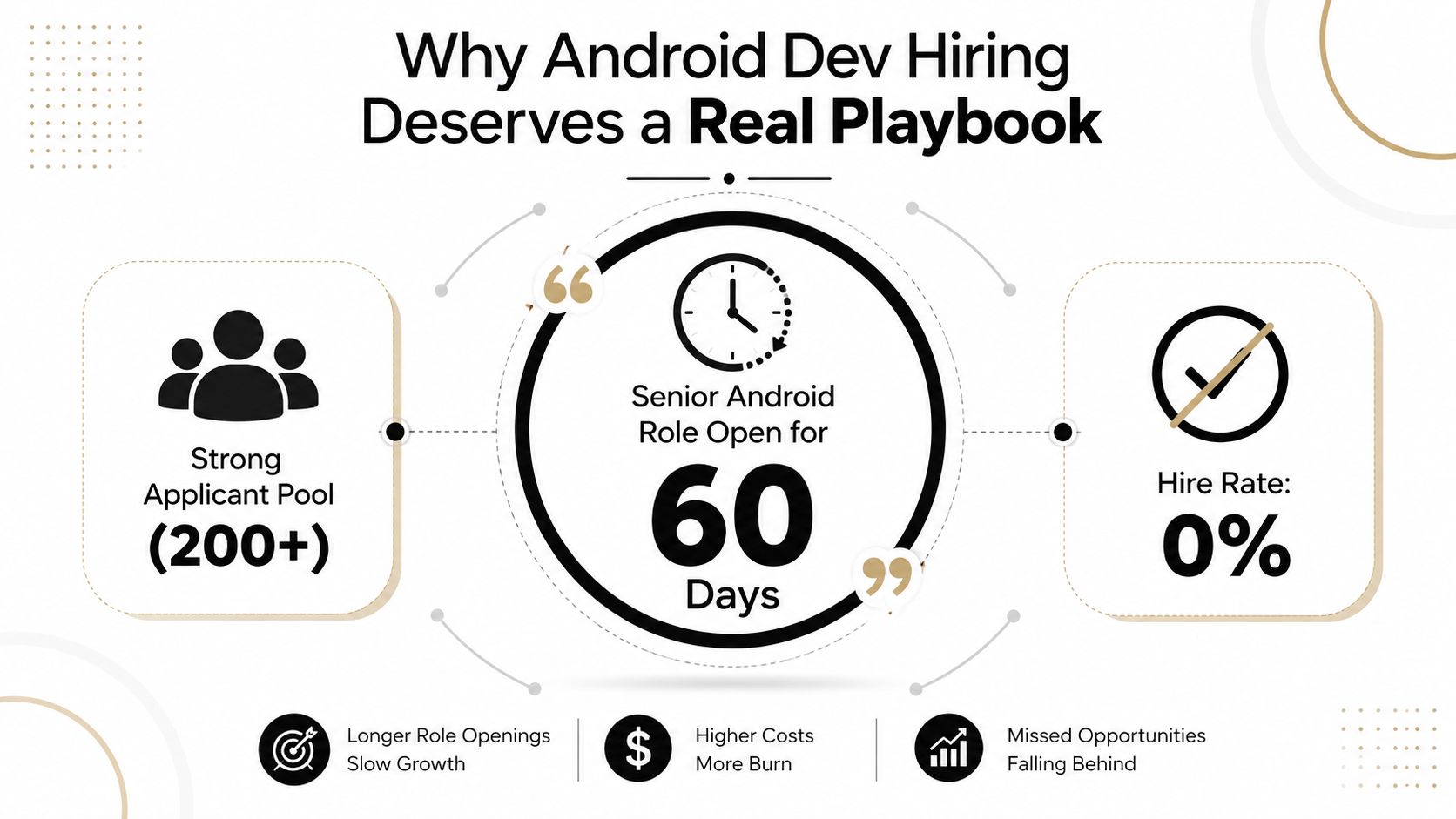
Practical rule: if you still hire Android like general backend engineering, you are behind. Android needs a narrower funnel, better rubric design, and far less faith in raw applicant volume.
The companies that win here treat sourcing, screening, interviews, compensation, remote design, and onboarding as one system. Senior Android hiring is usually a 4 to 8 week process, with a 30 to 45 day target time-to-hire, and teams that connect coding platforms to an ATS can speed tech hiring by about 30% (One Hour Digital). If your pipeline takes longer than that, your funnel is probably too subjective, too keyword-driven, or too dependent on the wrong channels.
A narrow market also means your applicant expectations need calibration. Across software hiring, companies interview about 21 candidates per hire, only 3% of applicants reach an interview, and roughly 27% of interviewed candidates receive an offer. Another benchmark recommends a 30% to 50% pass-through rate between stages, with rates below 30% signaling weak pre-screening and rates above 50% suggesting excessive risk aversion (Rockstar Developer University). Those numbers matter because Android hiring fails when teams confuse activity with quality.
Blockchain Jobs mobile app developer opening is a useful example of how specialized boards can surface mobile roles inside adjacent ecosystems, which is exactly the kind of channel mix Android hiring needs.
Writing an Android Job Description That Signals Seniority
A good Android JD filters for shipping ability, not keyword hoarding. If you load the posting with every buzzword in the ecosystem, you'll scare off strong developers who've built real products but haven't touched your exact niche. That's especially true in Android, where the best candidates usually have depth in the core stack and only selective exposure to the long tail of device or domain-specific tools.
Start with the core stack, then rank it by seniority
The baseline should be simple: Kotlin, Android SDK, Android Studio, Gradle, REST/JSON, SQLite or Room, and Git. ZipRecruiter's Android hiring guide also names Jetpack components, Material Design, and testing frameworks like Espresso and JUnit for advanced roles, which gives you a clean progression from entry-level fluency to senior-level architecture and test discipline (ZipRecruiter). LinkedIn's guide adds deployment and performance signals such as shipping to Google Play, memory management, threading, and code benchmarking (LinkedIn).
A strong JD should separate must-haves from nice-to-haves like this:
- Entry level: Kotlin, Android SDK, Android Studio, basic REST integration, version control.
- Mid level: Room, modular code, lifecycle awareness, practical testing.
- Senior: Jetpack, release ownership, performance tuning, architecture decisions, mentoring.
Rule of thumb: if a requirement doesn't help you distinguish a candidate who can ship from one who can only talk, cut it.
The mistake I see most often is over-weighting niche domain history. If you insist on Android Auto, Wear OS, BLE, or OTT experience, you're filtering for unusually rare prior exposure, not engineering potential. Use those as bonus points, not gatekeeping criteria.
For a concrete reference point, the Android engineer role on HiredBySkill shows how a senior-facing posting can emphasize engineering depth without turning into a laundry list. That's the bar.
Blockchain Jobs senior Android engineer role is another good example of how an adjacent ecosystem can still surface Android leadership roles without bloating the JD with unnecessary niche demands.
Sourcing Android Candidates Beyond the ATS
ATS filters help, until they become the hiring strategy. If you let keyword matching do all the work, you end up screening out strong Android engineers who wrote the right code, shipped the right apps, and used the wrong resume phrasing. The fix is simple. Build a sourcing motion that finds proof of work before a parser decides who gets seen.
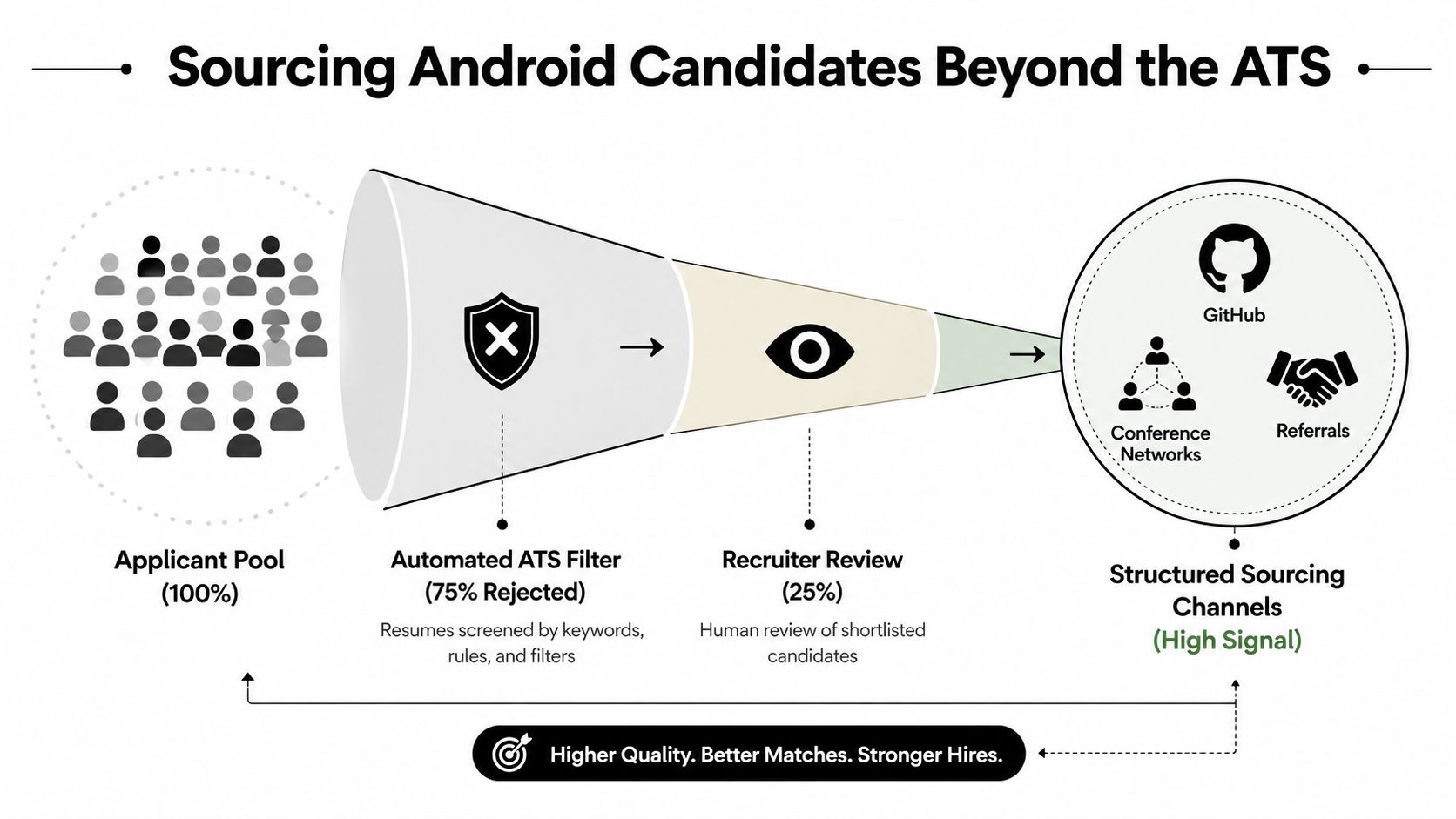
Build channels that find actual Android builders
LinkedIn and generic job boards are not enough. Senior Android talent shows up in GitHub repos, Kotlin community groups, conference speaker lists, referrals, and niche boards that already attract relevant engineers. If you are hiring for Web3 or mobile-first products, a board like Blockchain Jobs remote mobile engineer opening can surface candidates who already work close to the kind of system and release complexity you need.
The correction is operational. Keep the ATS, but do not let it be your quality gate. Search by shipped work, not just title strings. A candidate who has built production apps, written about architecture choices, or contributed to open source is worth more attention than a resume packed with vague mobile keywords.
Here is the sourcing loop I would use:
- Start with public proof of work. Look for repos, published apps, conference talks, or technical writing that shows real Android depth.
- Check adjacent community presence. Kotlin meetups, Android Discords, conference speaker rosters, and open-source contributions all matter.
- Use referrals with intent. Ask your strongest mobile engineer for names, not just a stack of LinkedIn profiles.
- Recover ATS rejects manually. If someone has Android depth but missed a keyword, bring them back into the process.
Keep the funnel narrow, not lazy
You do not want more applicants. You want more useful pass-through. A healthy sourcing process should filter for people who can ship, not just people who can get past your form. The source data in the guide to vetting mobile consultants is a useful reference when you are deciding whether to use a consultant or fractional recruiter to cover sourcing while your team focuses on interviews.
Use funnel quality as the signal. If your process is set up well, each stage should preserve enough signal that you are not rebuilding the whole pool at every handoff. Raw applicant volume is a vanity metric. Candidate quality after the first screen is what matters.
Hiring for Consumer Apps Versus Web3 Mobile Teams
Consumer Android hiring and Web3 mobile hiring overlap more than most managers admit. Both need Kotlin, clean async code, secure storage, offline-first thinking, and real comfort with release discipline. The difference is in the surface area around the app, not the fundamentals.
Hire the fundamentals first
If a candidate has shipped a high-traffic consumer app, they've usually wrestled with lifecycle bugs, flaky APIs, performance trade-offs, and product pressure. Those are portable skills. A crypto-native Android developer who lacks architecture discipline can be much harder to coach into a production-grade mobile environment than a strong consumer-app engineer learning a new SDK.
That's why I'd weight transferable engineering ability above narrow domain history. The ability to reason about state, concurrency, error handling, and testability matters more than whether someone has already built mobile crypto wallets or touched deep linking into dApps. Prior exposure helps, but it shouldn't decide the hire by itself.
A candidate's best signal is not “has done your exact thing before.” It's “has solved hard mobile problems in a way that will survive your codebase.”
Use domain experience as a bonus, not a gate
Domain-specific knowledge does matter in Web3 mobile teams. Biometric authentication, secure key storage, wallet flows, on-chain SDK integration, and protocol-adjacent UX patterns can shorten onboarding. But those should sit behind the core Android bar, not replace it.
GENTY recruitment's write-up on hiring LATAM engineers is a useful reminder that remote talent strategies can expand your pool without lowering the bar, especially when you need mobile engineers who can collaborate across time zones and product disciplines (GENTY recruitment). That matters for Web3 teams because the best Android candidate may not be in your city, or even your region.
Use this split in your scorecard:
- Non-negotiable: Kotlin, Android fundamentals, architecture judgment, debugging skill.
- Strong advantage: secure storage, wallet flows, offline sync, release ownership.
- Nice to have: previous work in crypto, dApps, or protocol-aware mobile UX.
If you're hiring for a Web3 product, don't ask for a clone of your current stack. Ask for a mobile engineer who can absorb the stack quickly and make sound product decisions under pressure.
The Android Interview Funnel From Screen to Offer
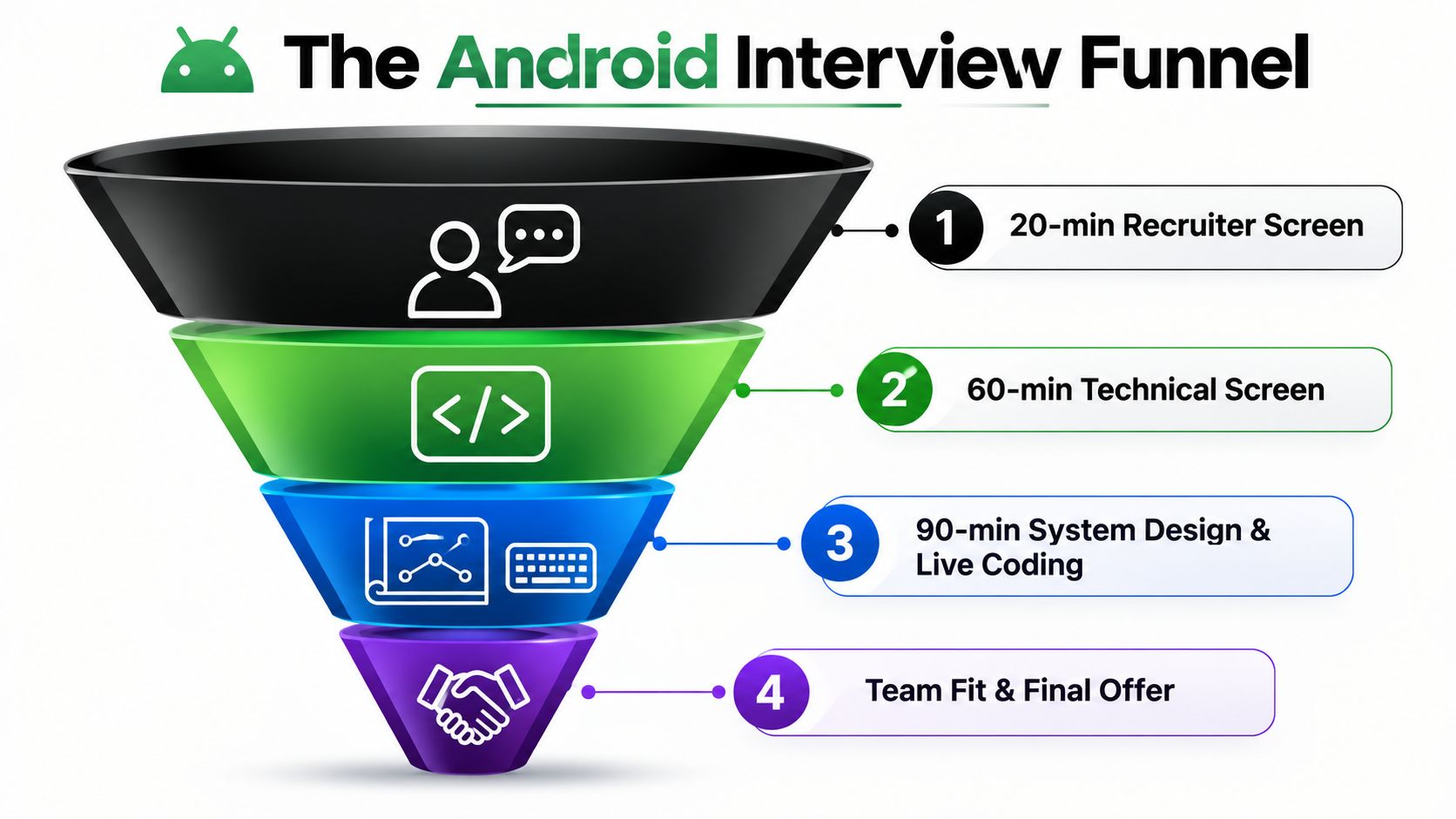
A sloppy interview funnel turns Android hiring into a popularity contest. Strong candidates get lost when the screen is vague, the rubric changes by interviewer, or the team lets one impressive round outweigh the rest. As noted earlier, candidates who look strong on paper can still fail a single interview attempt, which is exactly why every stage needs a repeatable rubric.
Make the screen short and specific
Start with a recruiter screen that lasts 20 minutes and only covers stack, years shipping, and motivation. Ask what they built, what part of the Android surface they owned, and what kind of product they want to work on next. Skip the generic culture chat. It burns time and tells you almost nothing.
Then run a 60-minute technical screen focused on Kotlin coroutines, lifecycle, or a small debugging task. The point is to see how they reason, not whether they can recite trivia. Ask them to trace a race condition in a view model or explain why a screen restores state after rotation. Those questions expose real Android judgment fast.
Use the system design round to separate seniority
For senior candidates, give a take-home Android assignment scoped to 3 to 4 hours, then close with a design round covering MVVM, Clean Architecture, modularization, offline-first strategies, and testing. Share the evaluation criteria before they start. If you do not, you will end up scoring polish instead of engineering quality.
A useful rubric stays grounded in the work itself:
- Correctness: does the app work?
- Maintainability: is the structure easy to follow?
- Android awareness: lifecycle, threading, and state handling.
- Testing: did they cover the parts that fail in real life?
- Trade-offs: can they explain what they would improve next?
Practical rule: if two interviewers would score the same candidate very differently, the round is too subjective.
Consumer apps need questions about UI state, offline resilience, and release hygiene. Web3 mobile teams need the same core bar, plus secure storage, signing flows, and protocol integration. Keep the interview shape consistent, then make the problem statements reflect the product you ship.
Salary Benchmarks and Remote Trade-Offs
Compensation has to match the market you are hiring in, not the market you wish you had. If you are hiring in England, the earlier salary data shows a £47,250 permanent floor in the dataset, which is a signal for where the bottom of the market sits, not a full offer strategy. If you are hiring in the U.S., the Android pool is larger and still growing, with 26,458 employed developers and 237,147 active openings, plus projected growth of 21% from 2018 to 2028 and about 284,100 new jobs over that decade.
The wider software market is expanding too, with U.S. employment for software developers, QA analysts, and testers projected to grow 17% from 2023 to 2033. Android pay pressure will keep showing up, especially for senior people who can move between product teams without a lot of hand-holding.
| Seniority | Indicative Range | Remote Fit | Key Lever |
|---|---|---|---|
| Junior | Entry-level market pricing | High if mentored well | Learning speed |
| Mid | Mid-market compensation | High | Shipping consistency |
| Senior | Premium compensation in major markets | Very high, if process is tight | Architecture and ownership |
Remote-first hiring helps when your local market is thin or expensive. It creates problems when your team has no real system for async collaboration, code review discipline, or overlap windows. If you widen location, you need to widen your expectations around written communication and self-management too.
Remote hiring is not a cost hack. It is a distribution strategy, and it only works if your interview process measures how people work across time zones and handoffs.
Offer bands should be clear before the final round. Strong candidates do not wait around for a team that is still figuring out comp. If the range is fuzzy, expect to lose them to a team that can close fast.
Onboarding, Diversity, and Your First 90 Days
Onboarding is where a lot of Android hiring fails. Teams celebrate the offer, then hand the new hire a repo link and hope for the best. If you want an Android developer shipping in week two instead of wandering through setup for a month, the first day has to be operationally ready.
Make the first week practical
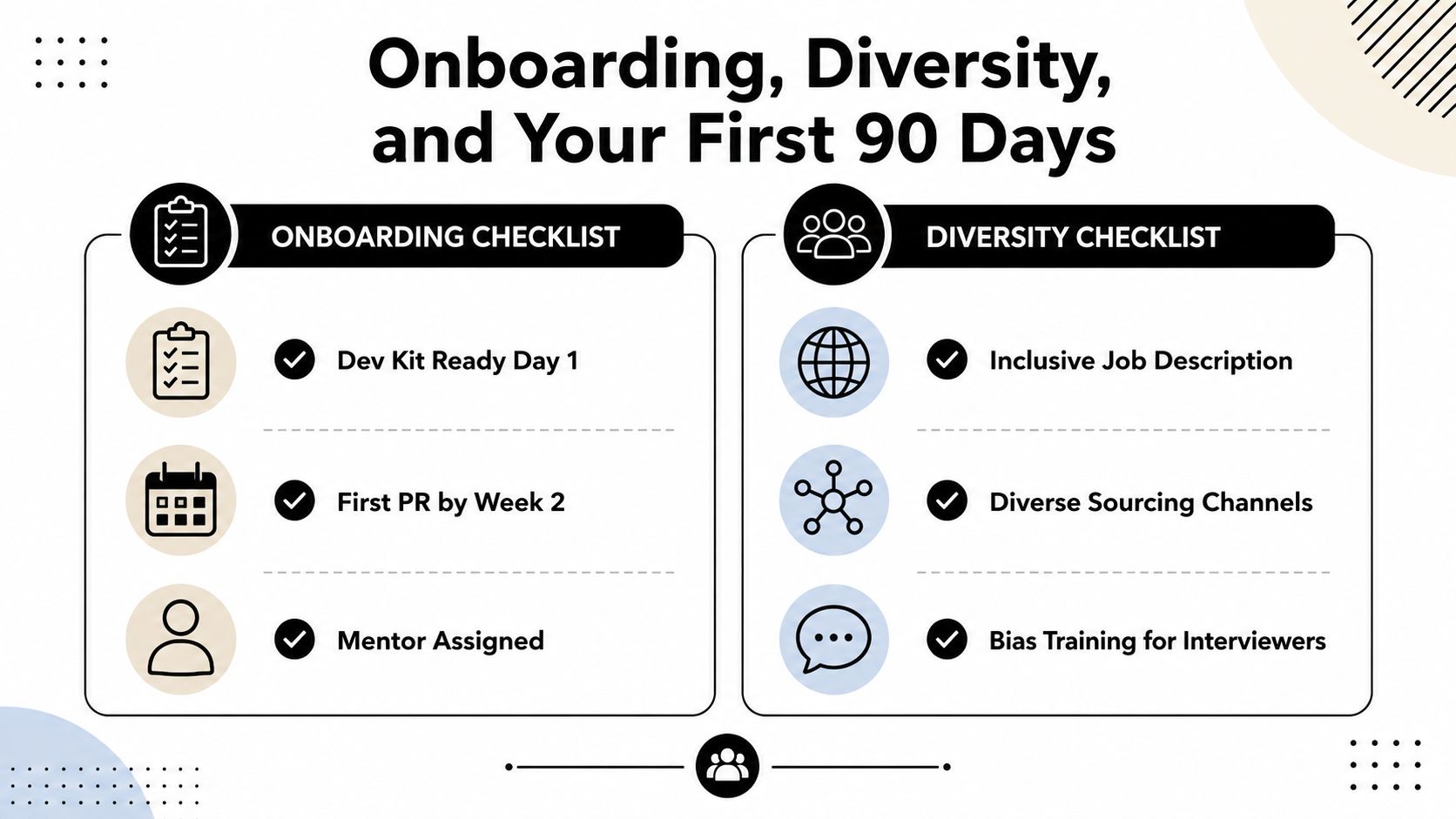
The onboarding checklist should be boring in the best way. Give them device lab access, repo access, a first-week starter bug, a senior buddy, and a clear definition of done for the first sprint. That's not extra process. It's how you stop your new hire from spending their first ten days untangling access issues.
NC State's Android labor data shows that postings commonly ask for a bachelor's degree 51.18% of the time, a master's 16.02% of the time, and a doctoral degree 5.36% of the time (NC State). That distribution tells you something useful: education shows up often, but advanced degrees are not the main filter. Experience and portfolio evidence still carry more weight.
Drop unnecessary filters without lowering the bar
If you want more diversity in the pool, remove degree requirements unless they're absolutely necessary. Then widen sourcing channels and make sure interviewers have a rubric before they talk to candidates. A diverse job description and a narrow, consistent evaluation process do more than any generic DEI statement ever will.
For the first 90 days, I'd track three things:
- First PR speed: did they land code quickly?
- Product understanding: do they know why the app exists?
- Ownership: can they handle a bug or feature without constant handholding?
The highest-value onboarding signal is simple. If your new Android hire can read the codebase, ask sharp questions, and ship a small change without drama, you hired well.
If you need Android candidates who can ship, Blockchain Jobs gives you a focused way to reach mobile talent inside crypto-native and adjacent technical communities. It's a practical place to look when generic boards are producing noise instead of serious applicants. Visit Blockchain Jobs if you want your next Android search to start with a tighter, more relevant pool.