Jobs in Blockchain: The 2026 Career Guide
In 2025, blockchain and Web3 employers added 66,494 roles globally, a 47% increase from 2024, although hiring remained below the 2022 peak, according to CoinGecko's crypto hiring analysis. That rebound changes the career question. You're no longer asking whether jobs in blockchain exist. You're deciding whether your strongest route is technical infrastructure, regulated product work, or a hybrid of both.
Hiring managers aren't looking for crypto enthusiasm alone. They want people who can secure production systems, manage regulatory exposure, ship products, explain complex infrastructure, and operate effectively across distributed teams. The candidates who win are specific about the business problem they solve and can prove they've done relevant work.
The Current State of Blockchain Hiring
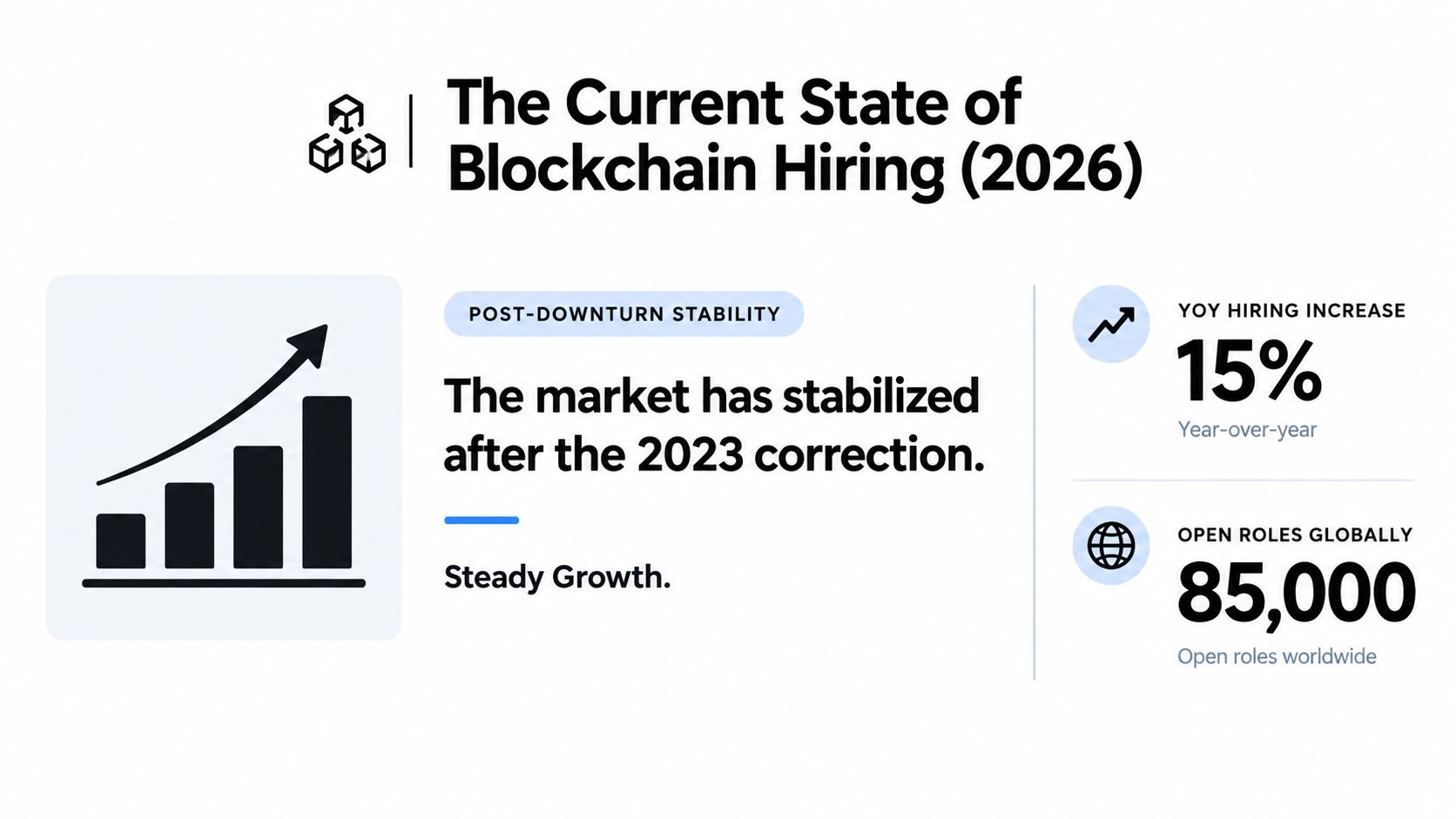
Blockchain hiring has rebounded, with 66,494 new global roles in 2025, a 47% year-over-year increase, while remaining below the 2022 peak, according to Coincub figures reported by CoinGecko. North America led demand, with the United States accounting for 21,612 jobs, as reported in the same analysis. Europe and Asia were close in aggregate.
The geography matters because employers now hire for more than crypto-native engineering. Regional compliance knowledge, product operations, finance, marketing, legal work, and customer support all affect whether a blockchain business can serve customers and operate within local rules. A candidate who understands institutional purchasing or local regulation can offer more value than a generalist developer presenting another interchangeable demo.
What the rebound means for candidates
The rebound is changing the type of work being hired. Blockchain companies need compliance, product, and go-to-market teams alongside engineers. The market is developing from experimental builds into regulated distribution, customer trust, repeatable revenue, and day-to-day business operations.
A legal professional who interprets digital-asset rules, a product manager who understands wallets and settlement flows, or a marketer who builds credible protocol communities each has a practical entry point. You do not need to present yourself as an engineer. Show how your existing discipline solves a blockchain business problem.
Study how employers describe these roles before applying. The Blockchain Jobs blog provides role language, market themes, and examples of skills companies request.
Hiring reality: Replace “I'm passionate about Web3” with “I can reduce compliance risk, improve protocol adoption, or ship secure on-chain functionality.”
Choosing Between Technical and Non-Technical Tracks
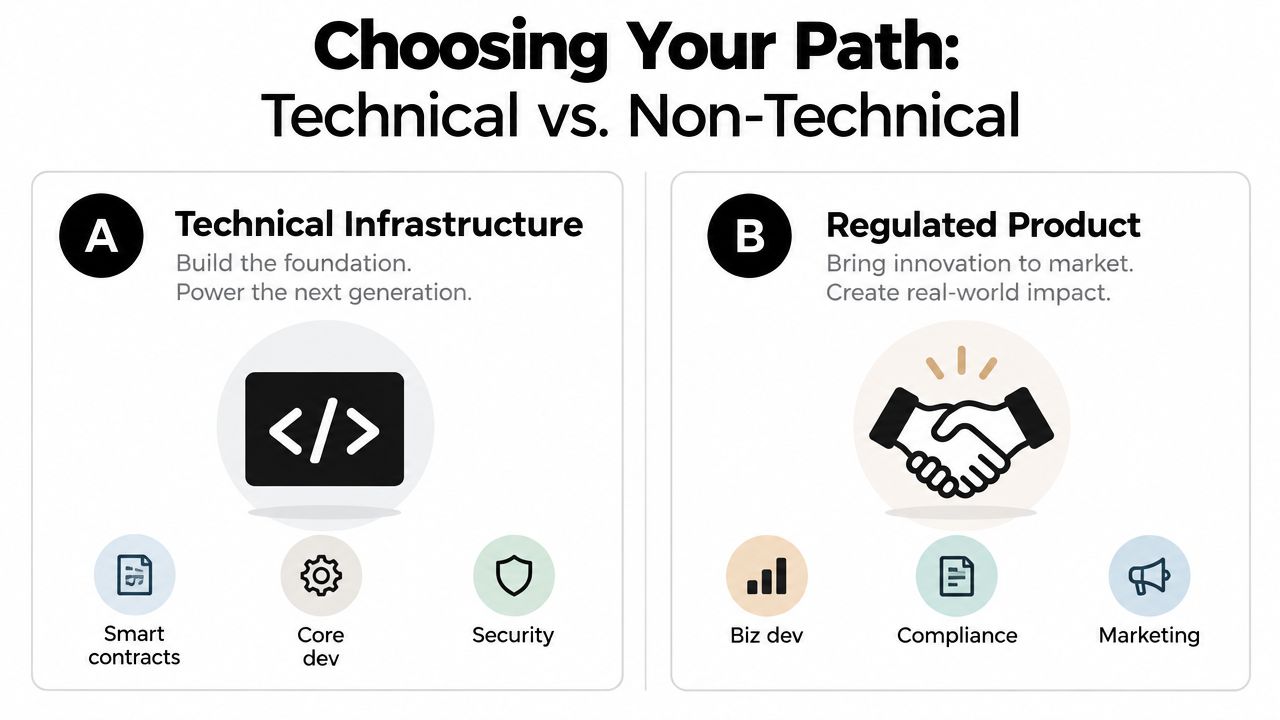
The technical path offers the clearest specialization premium, but it isn't the only serious route into blockchain. In H1 2026, engineering represented 34.1% of 2,932 active postings, while compliance and legal represented 10.4%, according to Tiger Research's hiring analysis. Those figures show that regulated and operational roles form a meaningful part of the market, not a fallback category.
Technical infrastructure suits candidates who enjoy systems reasoning, code review, testing, and failure analysis. Typical roles include smart-contract engineer, protocol developer, security engineer, core developer, infrastructure engineer, and developer tools specialist. Hiring managers assess deployed work, testing discipline, language depth, and your ability to explain security tradeoffs.
The regulated product track suits professionals from legal, compliance, finance, operations, product, partnerships, and marketing. These candidates still need blockchain literacy. They should understand custody, wallets, token mechanics, governance, transaction flows, risk controls, and the operational consequences of decentralization. They don't necessarily need to write Solidity.
Compare the paths honestly
| Career track | Hiring managers look for | Strong entry evidence |
|---|---|---|
| Technical infrastructure | Solidity or Rust depth, testing, security tooling, protocol reasoning | GitHub repositories, audits, deployed contracts, technical writing |
| Regulated product | Digital-asset knowledge, risk controls, stakeholder management, regulatory judgment | Policy work, product briefs, compliance processes, market analysis |
| Hybrid operations | Clear writing, technical fluency, project ownership, cross-functional execution | Launch documentation, governance contributions, operating playbooks |
Your existing career should determine the first move. A payments compliance specialist should learn how blockchain custody and transaction monitoring alter familiar controls. A product manager should analyze a protocol's user journey, incentive design, and failure points. A marketer should demonstrate that they can communicate technical value without making unsupported promises.
Engineering remains attractive, but don't learn to code just because generic advice says you should. If you already have valuable expertise, deepen its blockchain application first. Candidates exploring the technical route can review engineering roles on Blockchain Jobs to see how employers separate smart contracts, infrastructure, security, and other specialties.
In-Demand Skills and the Specialization Premium
Generic Web3 knowledge rarely earns interviews. Hiring managers pay attention to evidence that a candidate can handle a scarce task safely in production. A 2025 talent analysis estimated roughly 26,000 active blockchain developers globally against more than 440,000 open positions, implying about a 17:1 gap for smart-contract roles, according to PIN's blockchain recruiting analysis.
That gap rewards demonstrated specialization, not course completion. “I know Solidity” says little. A repository that shows a contract you wrote, tested, fuzzed, documented, and reviewed for access-control and upgrade risks gives a hiring manager something concrete to assess.
Technical skills with hiring signal
Demand remains strong for smart-contract security, Rust, Layer 2 systems, zero-knowledge proofs, cross-chain interoperability, tokenomics, and AI integration. Choose one primary technical area and build enough depth to explain design decisions, failure modes, and production tradeoffs.
For EVM roles, focus on Solidity, Foundry or Hardhat, testing, static analysis, access control, upgrade patterns, and gas-aware design. Solana-oriented candidates should build practical Rust skills and understand its account model. Study Layer 2 architecture, bridging risks, or zero-knowledge concepts after you can demonstrate the fundamentals.
Technical infrastructure is only one route into the 2026 hiring market. Compliance, product, and operations teams increasingly need people who understand digital assets and can apply that knowledge to controls, customer journeys, and business decisions. Treat these tracks as specialized careers, not fallback options.
Build evidence that matches the function:
- Compliance: Map a digital-asset product's transaction lifecycle and identify control points.
- Product: Write a brief for custody, payments, governance, or tokenized assets.
- Tokenomics: Model incentives, participant behavior, and failure scenarios.
- AI integration: Show how automation can support research, monitoring, support, or development without weakening controls.
For structured learning, use a free online skill-building guide to organize study before paying for specialized courses or certifications.
Portfolio standard: Build fewer projects, but make each one reviewable. Show the problem, your decisions, tests, risks, and result without forcing a recruiter to guess.
Navigating Remote Work and Salary Expectations
A 50% year-on-year decrease in remote job availability and 30% of roles requiring five days in the office show why fully remote crypto work is no longer a safe assumption, according to a 2025 industry report (Silicon Republic). Employers still hire distributed talent, but timezone overlap, scheduled collaboration, and occasional office attendance now shape many offers.
Make location part of your job strategy from the first search. Separate remote, hybrid, and location-bound roles, and state your available time zones clearly. Full remote work narrows the target list and increases competition, so apply where your working arrangement matches the employer's requirements.
Calibrate compensation with evidence
A September 2026 market snapshot covered around 2,380 roles across 301 companies in the previous 30 days, with median pay of $175,000 across 1,268 listings. Treat those figures as market context, not a personal entitlement. The snapshot combines different functions, seniority levels, locations, and employment structures, so it cannot set your individual rate.
Technical scarcity can support higher compensation in smart-contract security, protocol engineering, and low-level systems. Compliance, product, legal, and operations candidates should compare offers with equivalent roles in those functions, then adjust for digital-asset expertise and company risk. A compliance lead who understands custody controls may command a premium, but the premium comes from applicable knowledge, not the crypto label alone.
Ask these questions before naming a final number:
- Is compensation paid in fiat, tokens, equity, or a combination?
- Does the range apply globally or only to a specific hiring location?
- What office attendance and timezone coverage does the team require?
- How will the company evaluate performance after joining?
- What risks attach to variable compensation?
For a focused search, use the remote blockchain jobs category. Confirm working hours, location limits, and compensation terms in the full description before investing time in interviews.
How Web3 Hiring and Interviews Work
A crypto hiring process often begins with visible proof, not a polished résumé. A founder may discover your GitHub repository, governance contribution, security write-up, or thoughtful protocol discussion before a recruiter contacts you. Build evidence that shows how you think, not just a list of tools you have used.

The first screen may happen through email, Discord, Telegram, or a conventional recruiting call. Expect questions about what you built, why you chose a particular protocol, and how you handle uncertainty. Crypto-native managers look for independent judgment, careful communication, and the ability to move quickly without taking reckless shortcuts.
For technical roles, the process may progress from a code review to a take-home exercise. A typical assignment could ask you to identify a reentrancy risk, explain delegatecall behavior, design a protocol component, or defend a testing strategy. Prepare to explain assumptions, failure modes, tradeoffs, and how you would monitor the work after deployment. Production reasoning matters more than memorizing algorithm puzzles.
Non-technical candidates face demanding interviews as well. A compliance applicant may need to explain how controls differ across custody, transfers, and decentralized governance. A product candidate should discuss user incentives, wallet friction, transaction failure, and the risks of poor token design. A marketing applicant must explain a protocol clearly without making financial promises or hiding technical limitations.
What to bring to the interview
Bring a short portfolio with links and context. For each item, explain the problem, your role, the decision you made, and what you would change now. If you discuss a public protocol, separate observed facts from your judgment and identify the evidence behind each conclusion.
A clear explanation of technical interview meaning for HR can help non-technical hiring partners understand what an assessment tests. Strong candidates often lose momentum when they answer for a specialist while speaking to a generalist, so adjust the level of detail without weakening the substance.
Use the following video as a preparation prompt, then practise explaining your answer aloud rather than memorising terminology.
Ask interviewers how they handle incident response, code review, regulatory change, and product prioritisation. Their answers reveal whether the company has operating discipline, clear ownership, and a credible way to turn its narrative into working products.
Finding Quality Roles and Using Blockchain Jobs
Job search quality depends on filtering, not volume. General boards often mix legitimate openings with vague descriptions, recycled listings, and roles that don't explain the product, reporting line, or employment structure. A specialized search should help you move quickly from broad interest to a shortlist you can investigate.
Start with function. Separate engineering from security, DevOps, product, legal, compliance, marketing, finance, data, and AI roles. Then filter by location, remote status, seniority, and recently added listings. Early applications can help, but speed never replaces verification.
A practical screening process
Read the job description like an operator. Look for the product, the user, the manager, the expected deliverables, and the technical or regulatory context. Be cautious when a listing relies on hype, asks for funds or wallet access, avoids naming the employer, or promises undefined token upside instead of describing responsibilities.
Research the company through its documentation, product, public team presence, and hiring communication. Ask whether the role is newly created or replacing someone, what success looks like, and how the company funds the position. Never send seed phrases, private keys, or payments during a hiring process.
Blockchain Jobs organizes listings across categories such as Engineering, Legal & Compliance, Product Management, DevOps & Infrastructure, Security, AI & Machine Learning, Marketing, and Operations. Its Recently Added Jobs feed can support a focused routine, while examples of other specialist sources include the HireDevelopers.com jobs page for broader technical opportunities.
Build a repeatable application routine
Save searches for only the functions you can credibly perform. Tailor the opening of your résumé to the role's actual problem, then attach one or two relevant proof points. A security candidate should lead with audits, testing, or vulnerability analysis. A compliance candidate should lead with controls, licensing, investigations, or policy implementation.
Don't apply to every role with “blockchain” in the title. Apply where your evidence matches the work, and use the interview to test the employer as carefully as they test you.
Building Your Long-Term Web3 Career Strategy
A first blockchain job is useful only if it compounds your capability. Protocols change, funding cycles turn, and job titles disappear. Your durable advantage is a portfolio of skills that travels across chains, products, and business models.
Technical candidates should build cross-chain literacy without becoming shallow generalists. Learn how different execution environments, bridges, custody models, and governance systems create different risks. Non-technical candidates should connect domain expertise to the same infrastructure. A lawyer who understands protocol operations becomes more valuable than one who only repeats general digital-asset terminology.
A focused 90-day plan
Days 1 to 30: Choose one target role, audit ten relevant job descriptions, and identify the recurring requirements. Close the most obvious skill gap through a structured project, technical reading, or regulatory analysis.
Days 31 to 60: Publish proof. Ship a repository, write a protocol teardown, contribute to documentation, review governance proposals, or create an operating playbook. Ask practitioners for precise feedback instead of general networking conversations.
Days 61 to 90: Apply selectively, request referrals from people familiar with your work, and rehearse role-specific interviews. Track every application, response, skill gap, and useful conversation so your search improves each week.
Career principle: Credentials open a conversation. Verifiable work and trusted judgment keep you in the conversation.
Build a reputation that survives one employer or protocol. Participate in open-source work, community governance, technical discussions, and clear public writing. The goal isn't to become visible everywhere. It's to become credible in a narrow problem that employers repeatedly need solved.
Blockchain Jobs gives candidates a focused place to search across engineering, product, compliance, operations, security, marketing, and other Web3 functions, including remote-friendly opportunities and recently added listings. Visit Blockchain Jobs to choose your track, filter for roles that match your evidence, and start applying with a sharper career strategy.