
What Is the Average Salary for an IT Recruiter? A Career Guide

Let's talk numbers and career strategy. When you look at the total compensation package, the average salary for an IT recruiter in the U.S. generally falls somewhere between $80,000 and $95,000 a year.
But that's just a baseline. For anyone serious about a career in talent acquisition, that number is the starting point, not the destination. On the low end, an entry-level recruiter might start with a base salary around $51,000. On the other hand, a senior talent partner who specializes in a high-demand niche can command over $126,000. Understanding this range isn't just about knowing what you'll earn; it's the first step in charting a career path that maximizes your income potential.
What Is a Typical IT Recruiter Salary?
Trying to pin down a single "typical" salary for an IT recruiter can be misleading for your career planning. While national averages are a useful benchmark for job interviews, your actual paycheck will be a direct reflection of your experience, your performance, and the strategic career moves you make.
Think of the average salary as the ground floor. Your real earning power comes from how you build on that foundation—through the skills you master, the professional network you cultivate, and the niche you choose to dominate. For anyone entering the field or planning their next promotion, it's more strategic to break down salary expectations by experience level. Compensation for a junior recruiter is designed to reward learning the ropes, while a senior recruiter's pay is structured around their proven ability to land mission-critical, high-impact candidates.

To give you a clearer picture for your career goals, here's a quick look at how salary ranges typically progress with experience.
IT Recruiter Average Salary At A Glance
| Experience Level | Typical Annual Salary Range | Average Hourly Rate |
|---|---|---|
| Entry-Level (0-2 Years) | $51,000 – $75,000 | $25 – $36 |
| Mid-Level (2-5 Years) | $75,000 – $105,000 | $36 – $50 |
| Senior-Level (5+ Years) | $105,000 – $126,000+ | $50 – $60+ |
As you can see, the jump from one level to the next is significant. This table is a powerful tool for career planning, highlighting how quickly your earning potential can accelerate as you build a track record of successful placements.
From Sourcing Coordinator to Senior Talent Partner
The journey from an entry-level role to a senior one is where you build a high-value career and see serious salary growth. Here’s what that progression looks like in terms of skills and compensation:
- Entry-Level (0-2 years): Your primary goal is to master the craft—perfecting sourcing techniques, building robust candidate pipelines, and understanding the tech landscape. Compensation is typically a base salary with smaller, more frequent commissions to incentivize early wins.
- Mid-Level (2-5 years): You now have a solid track record and can manage the full recruitment cycle autonomously. Your compensation reflects this independence with a higher base salary and more substantial performance bonuses tied to hiring targets.
- Senior-Level (5+ years): At this stage, you're a strategic partner to the business. You likely have a deep specialization in a niche like Web3 or AI and command a top-tier salary with significant commission potential tied to placing those game-changing hires.
Your career progression is tied directly to your results. The more value you create—by filling critical roles faster or unearthing talent no one else can find—the more leverage you have in salary negotiations. It's that simple.
How to Benchmark Your Worth for an Interview or Raise
Whether you’re preparing for a job interview or building a case for a promotion, you need to come armed with data. Right now, the average salary for an Information Technology Recruiter in the United States sits at $84,921 annually, according to PayScale_Recruiter/Salary). This figure signals a competitive market for tech talent—and for the recruiters who can find them.
This number has been climbing steadily, driven by explosive demand in areas like blockchain. A quick analysis of currently open technical recruiter jobs provides a real-time pulse on what companies are willing to pay. The data confirms the wide range of $51,000 to $126,000, reinforcing a key career insight: your experience and specialization are the biggest factors determining your paycheck.
What Really Drives a Higher Recruiter Salary?
The national average salary for an IT recruiter is a great baseline, but let's be honest—it doesn't tell you how to become a top earner. A few key factors can take your earnings from average to exceptional. If you learn how to strategically leverage these variables, you’ll not only climb the career ladder faster but also significantly boost your income.
Think about it from a hiring manager's perspective. A recruiter filling standard IT helpdesk roles is valuable, but they operate in a crowded field. A recruiter who can find and land a Senior Solidity Developer for a crucial DeFi project? That person is a strategic asset. Companies pay a premium for recruiters who deliver talent that directly fuels growth. Learning to operate in these high-stakes niches is the key to career progression.

Location Still Packs a Punch
Even as remote work becomes standard, geography still influences your paycheck. Recruiters based in or near major tech hubs like Silicon Valley, New York, or Austin often see higher salary offers. Why? You're closer to client HQs, top-tier talent pools, and the heart of innovation.
This proximity gives you a career advantage, even in a fully remote role. The data shows that a recruiter based in Berkeley, CA, can earn an $88,337 annual salary—a 4% jump above the national baseline. This "location premium" reflects the fierce competition for talent in hotbeds for emerging tech like blockchain and AI.
Niche Specialization: Your Ultimate Salary Lever
If you want to make one career move that will radically increase your earning potential, it's this: specialize. General IT recruiting is a volume game. Niche recruiting is a value game. By focusing on a specific, high-demand vertical, you transition from being a resume-pusher to a strategic consultant.
Specialization is your path to building deep market knowledge, cultivating an exclusive talent network, and mastering the technical jargon that hiring managers are desperate for someone to understand. That expertise is rare, making you indispensable.
Here are the high-growth fields where specialist recruiters are building lucrative careers:
- Cybersecurity: As digital threats grow, the demand for security professionals has skyrocketed. Recruiters who can find elite cybersecurity talent are always in a strong negotiating position.
- Artificial Intelligence (AI) & Machine Learning (ML): The AI talent war is intense. If you can speak the language of engineers and data scientists and identify top performers, you'll be compensated handsomely.
- Web3 & Blockchain: This is arguably one of the most profitable niches for career progression. The talent pool is small, the technology is complex, and the demand is off the charts.
Recent IT salary trends show overall compensation rising by 8-10%, largely due to AI adoption and talent scarcity. When AI-skilled developers command $179K and cybersecurity experts hit $192K, the recruiters placing them are positioned to earn massive commissions tied to that value.
The High-Value Niche of Web3 and Blockchain Recruiting
For an IT recruiter aiming for the highest compensation bracket, specializing in Web3 and blockchain is a strategic career move. This space operates on a different financial level, fueled by intense demand for a tiny pool of qualified talent. Mastering this niche is a direct path to leveling up your career and your income.
Think of it this way: a general IT recruiter is fishing in a large ocean with many other boats. A Web3 recruiter is a specialist hunting for rare, high-value catches in deep waters. The equipment is more advanced and the environment is tougher, but the reward for success is massive. That’s why the average salary for an IT recruiter in Web3 can easily be 10-25% higher, and often more.
Why Web3 Recruiting Commands a Premium
What drives this salary premium? It comes down to the high-stakes nature of the Web3 talent market. Companies building decentralized applications (dApps), DeFi protocols, or NFT marketplaces need talent with skills that are still alien to most of the tech industry.
You're not just looking for another software engineer; you're hunting for professionals with very specific, hard-to-find skills:
- Protocol Engineers: The architects who build the foundational layers of blockchain networks.
- Smart Contract Auditors: The security experts who find critical bugs in code that secures millions of dollars.
- Solidity or Rust Developers: Engineers fluent in the core languages of blockchain, a skillset that remains incredibly rare.
Placing these roles is a career-defining achievement. The right hire can make or break a project. Companies know this and will pay top dollar—both in salary for the candidate and in fees for the recruiter. To see what roles companies are hiring for now, check a specialized resource like the Blockchain Jobs blog for a real-time look at the skills driving demand.
When you successfully place a Senior Solidity Developer for a leading DeFi protocol, your commission isn't just a bonus; it's a reflection of the immense value you delivered. These placements can result in commission checks that surpass what a generalist recruiter makes in several months.
Building Your Expertise for Higher Earnings
Pivoting into this niche requires a serious commitment to building specific market knowledge. You don't need to become a developer, but you must understand the landscape well enough to speak the language and identify top talent during interviews.
To command a higher salary in Web3 recruiting, focus your professional development on learning the differences between blockchains (e.g., Ethereum vs. Solana), grasping the core concepts of decentralization, and networking within the crypto community. This specialized knowledge is what hiring managers pay a premium for, turning your expertise into a powerful lever for career growth and higher earnings.
Understanding Your Compensation Structure
When you receive a job offer for a technical recruiter role, the base salary is just the beginning. To truly understand your earning potential and negotiate effectively, you have to analyze the entire compensation structure: the mix of base salary, commission, and potential bonuses.
Think of it like an investment strategy. A high base salary is like a safe bond—predictable and steady. A high-commission structure is like a high-growth stock—riskier, but with huge potential upside. Neither is inherently better; the right fit depends on your risk tolerance, confidence in your abilities, and career goals. Knowing which structure suits you is your biggest advantage in any job interview or negotiation.
The diagram below shows how specialization impacts your value and, consequently, your compensation.
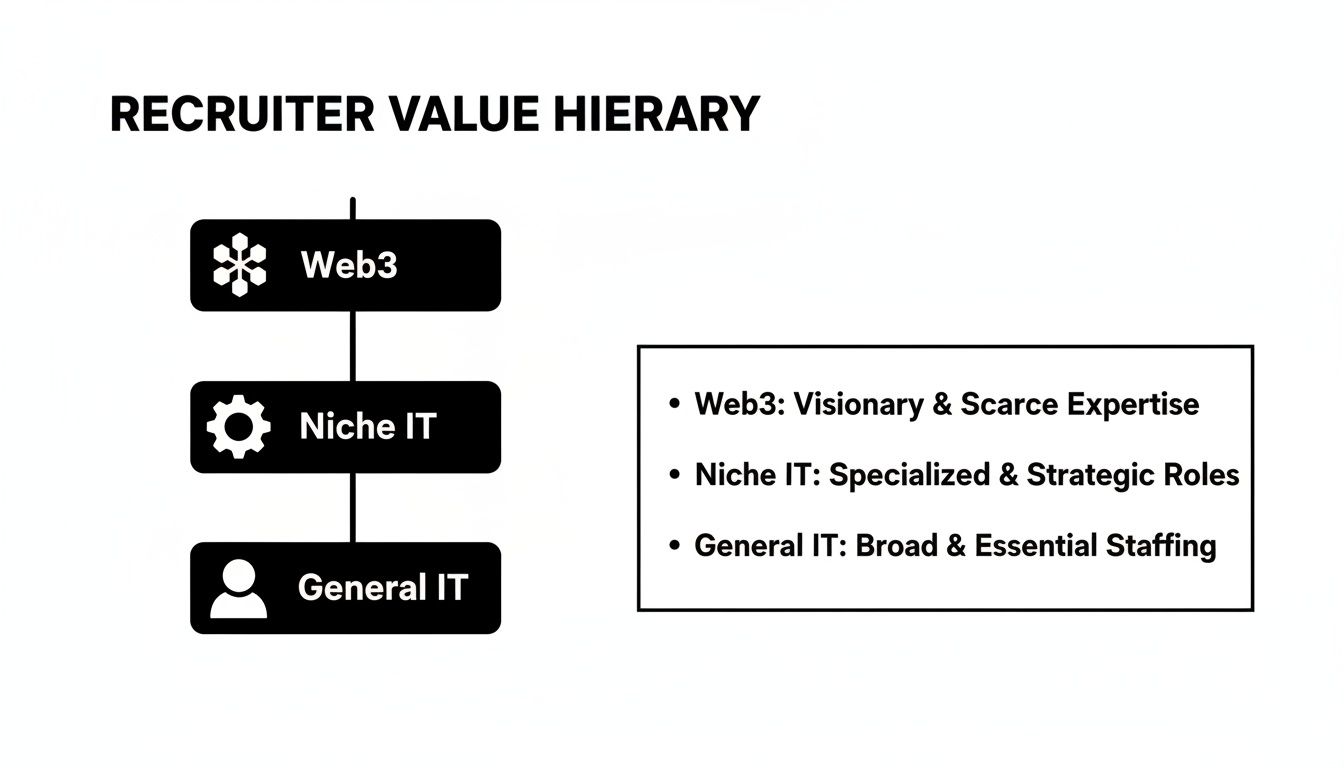
The more specialized your niche, the more leverage you have to negotiate a pay package that rewards your unique expertise.
Decoding Commission and Bonuses
For agency recruiters, commission is the engine of your income. It's what turns a good year into a great one. The standard model is a percentage of the first-year salary of a placed candidate, typically between 15% and 25%.
Let's do the math: placing a senior blockchain developer at a $120,000 salary with a 20% commission nets you $24,000 from a single hire. This is why the average salary for an IT recruiter can be misleading. A few key placements can launch your earnings far beyond the industry baseline.
In-house roles often use bonuses tied to broader company goals:
- Hiring Goals: A cash bonus for hitting quarterly or annual hiring targets.
- Time-to-Fill: Incentives for filling mission-critical roles ahead of schedule.
- Company Performance: Tying your success to the company's through profit-sharing or stock options.
Your pay structure signals what the company values. A commission-heavy plan prioritizes individual performance. A bonus-heavy model rewards collaboration and long-term contributions to the company's success. Use this insight in interviews to find a role that aligns with your work style.
Comparing IT Recruiter Compensation Models
The career decision between an agency and an in-house role often comes down to how their pay structures align with your personal and financial goals.
Understanding these compensation philosophies is key. The principles are similar to how companies structure other performance-based roles, like the sales compensation plans at top firms. Here’s how the two main models compare for your career planning.
| Compensation Model | Typical Base Salary | Typical Commission | Best Career Fit |
|---|---|---|---|
| Agency (Low Base/High Commission) | Lower, but consistent and predictable. | High, often uncapped, and performance-driven. | Self-starters confident in their ability to make consistent placements and who want to maximize their earning potential. |
| In-House (High Base/Low Commission) | Higher and very stable, providing a strong foundation. | Lower, usually structured as performance bonuses. | Recruiters who value income stability and want to focus on the long-term strategy of building a single company's team and culture. |
Ultimately, the best path depends on whether you're motivated by the direct financial rewards of high-stakes placements or by the strategic work of internal team building.
How to Negotiate a Higher Salary
Knowing your market value is one thing; successfully negotiating it is another. Salary negotiation is a core professional skill, and as a recruiter, it’s your chance to demonstrate the same persuasive talent you use to close top candidates. To secure a top-tier offer, you must build a data-driven business case that proves your value.
This goes beyond quoting the average salary for an IT recruiter. It's about showcasing your specific, measurable accomplishments to frame your past performance as a forecast of the success you’ll bring to a new employer.
Build Your Business Case
Before entering any salary discussion, do your homework. Research market rates for recruiters with your specific experience and niche. But your most powerful negotiation tool is your own track record. You must translate your achievements into quantifiable results that a hiring manager can't ignore. Don't just say you're "good at filling roles"—prove it.
- Time-to-Fill Metrics: "I consistently reduced the average time-to-fill for senior engineering roles by 25%, which accelerated critical project timelines."
- Revenue Generated (Agency): "My placements last year directly generated over $350,000 in revenue for the firm."
- Candidate Quality & Retention: "Over 90% of my placements last year were rated as high-performers after their first anniversary, demonstrating a strong fit and reducing hiring churn."
Metrics like these transform the negotiation. It’s no longer about what you want; it's about what your proven results say you deserve.
Negotiation isn't about making demands. It's about demonstrating your worth. Frame your salary request around the value you’re going to create, using your past wins as undeniable proof. This turns it into a smart business decision for them, not just another expense.
Map Your Career Progression for Maximum Earnings
Your salary should grow with your career. To ensure you're consistently increasing your earnings, you need a clear progression map. The path from junior sourcer to Head of Talent Acquisition is built on mastering specific skills that command a higher premium at every level.
- Sourcer/Junior Recruiter: Focus on mastering sourcing tools and building candidate pipelines. Success is measured by activity and initial placements.
- Full-Cycle Recruiter: Take ownership of the entire hiring process. Your value increases as you prove you can manage stakeholder relationships and close difficult roles independently.
- Senior/Lead Recruiter: Specialize in a high-demand niche like blockchain or AI. You become a strategic advisor, using deep market knowledge to land transformative talent.
- Talent Acquisition Leader: Shift focus from individual placements to building and leading recruiting teams. Your impact is measured by the success of the company’s overall hiring strategy.
By deliberately developing the skills for the next level, you create natural checkpoints to renegotiate your compensation, ensuring your salary grows in lockstep with your expertise.
Got Questions About IT Recruiter Pay? We've Got Answers.
When mapping out your career as an IT recruiter, compensation questions are always top of mind. Whether you're new to the field, considering a career change, or preparing for a performance review, getting clear answers is essential for your professional growth. This section tackles the most common questions to help you plan your next move.
Understanding these details gives you the confidence to negotiate effectively during job interviews and build a career that meets your financial goals.
What's a Realistic Starting Salary for an Entry-Level IT Recruiter?
If you're starting your career, a realistic base salary is in the $50,000 to $65,000 range. But don't focus only on the base. Your total compensation, including commission and bonuses, is where the potential lies.
A first-year recruiter who learns quickly and makes consistent placements can realistically see their total earnings climb toward $70,000 or more. Your primary goal at this stage is to master the fundamentals: sourcing, screening, and building relationships. Excelling here will set the stage for significant income growth in the years to come.
Who Makes More: In-House or Agency Recruiters?
This is the classic career crossroads for recruiters. The truth is, one isn't definitively "better" for earnings; they offer different risk-and-reward profiles.
In-House Corporate Recruiters typically receive a higher, more stable base salary. Bonuses are tied to company performance or hitting hiring targets. This is an excellent path if you value stability and want to focus on the long-term growth of a single company.
Agency Recruiters start with a lower base salary but have uncapped earning potential through aggressive commission structures (typically 15-25% of a candidate’s first-year salary). A top-performing agency recruiter can significantly out-earn their in-house peers, but this comes with higher pressure and less income predictability.
Choosing between in-house and agency is a key career decision. You are trading the security of a higher base salary for the massive upside of a commission-driven role. Consider this carefully when planning your career path.
How Much More Can I Make if I Specialize in Web3?
Specializing in a high-demand niche like Web3 is one of the fastest ways to accelerate your career and income. A Web3 recruiter can command a salary 10-25% higher—and often more—than a generalist IT recruiter.
The reason is simple supply and demand. There is a feeding frenzy for a small pool of talent skilled in areas like smart contract development or DeFi. A senior Web3 recruiter who can consistently place elite talent can easily see their total compensation exceed $150,000, driven by large commissions on high-paying roles.
Does Working Remotely Affect an IT Recruiter's Salary?
For a skills-based role like tech recruiting, geography is becoming less of a factor in compensation. While some companies initially tried to adjust salaries based on local cost of living, the intense war for talent has largely eliminated this practice for high-demand roles.
Today, especially in competitive fields like Web3, companies must offer salaries competitive with major tech hubs to attract the best recruiters, regardless of their location. This shift is a huge advantage for your career, allowing you to earn a top-tier salary without the high cost of living in a major city. Ultimately, your skills, network, and track record—not your zip code—determine your value.
Ready to find a high-impact role in one of tech's most exciting fields? At Blockchain Jobs, we connect top talent with leading companies in the Web3 ecosystem. Explore curated opportunities in DeFi, NFTs, and more.