Hire smart contract developers: A 2026 Guide to Top Talent

Before you even think about writing a job post, let’s get one thing straight: hiring a smart contract developer starts with a crystal-clear picture of who you need. This isn't just about a job title; it's about building a detailed blueprint of the exact person who will thrive on your team and protect your project from disaster.
Getting this first step right is everything. From an applicant's perspective, a specific job description signals a professional team that knows what it's doing. For you, the hiring manager, it’s what separates a smooth hiring process that attracts genuine experts from a chaotic one that drowns you in unqualified resumes.
Defining Your Ideal Developer Profile

A vague "looking for a blockchain developer" post is a huge red flag for the pros you actually want to hire. It tells them you haven't defined the role, which suggests a disorganized project. You have to be specific because the competition for this talent is absolutely fierce.
The global Blockchain Developers Market is exploding, projected to grow from an estimated USD 119.93 billion in 2025 to USD 218.30 billion by 2032. That blistering growth, detailed in recent blockchain developer market analysis, means you’re not just hiring; you’re competing. A precise developer profile is your most critical tool for standing out.
Nailing the Technical Must-Haves
First things first: what’s your tech stack? This is the most important filter for any candidate. Are you building on an EVM chain, or have you ventured into a newer ecosystem like Solana?
- Languages: For Ethereum, Polygon, or Avalanche, Solidity is king. For ecosystems like Solana or Polkadot, Rust is the standard. Most developers specialize, so be clear about which you require.
- Frameworks: Do you need someone who lives and breathes Hardhat or Foundry? Mentioning your specific testing and deployment pipeline shows you run a professional shop and helps candidates visualize their daily workflow.
- Security Tools: Don't just hope for a security-conscious developer. Look for hands-on experience with tools like Slither for static analysis or Mythril for symbolic execution. This is a massive green flag for a candidate and a key interview topic.
Go beyond just listing tech. Think about the depth of expertise you need. Are you looking for a senior architect who has deployed battle-tested DeFi protocols? Or will a sharp mid-level developer who has shipped a few NFT collections fit the bill? Clarifying seniority helps set expectations for compensation and career progression.
To help you map this out, a skills matrix can be incredibly useful. It forces you to prioritize what's truly essential versus what would just be a bonus.
Smart Contract Developer Skills Matrix
| Skill Category | Essential Skills (Examples) | Nice-to-Have Skills (Examples) | Interview Focus & Career Impact |
|---|---|---|---|
| Programming Language | Solidity (for EVM) or Rust (for Solana/Polkadot) | Yul, Go, JavaScript/TypeScript | This is the first technical screen. Mastery here is the ticket to a senior role. |
| Blockchain Concepts | Deep understanding of the EVM, gas optimization, immutability | Knowledge of L2s/sidechains, cross-chain communication | Foundational knowledge prevents costly architectural mistakes and security holes. |
| Frameworks & Tools | Hardhat, Foundry, Truffle, Web3.js/Ethers.js | Tenderly, Alchemy, Infura | Experience with these tools signals a professional workflow and faster onboarding. |
| Security | Knowledge of common attacks (reentrancy, front-running), Slither | Formal verification experience, audit participation | In Web3, security isn't a feature; it's the foundation of trust and career longevity. |
| Token Standards | ERC-20, ERC-721, ERC-1155 | EIP-2612 (permit), EIP-4337 (Account Abstraction) | Mastery of standards shows a developer is up-to-date and ready to build. |
| Soft Skills | Meticulous attention to detail, clear communication | Experience mentoring junior devs, public speaking/writing | Immutable code requires extreme precision. Mentoring signals leadership potential. |
This matrix isn't just a checklist; it's a strategic tool. Use it to align your team, create a profile that is realistic, and design targeted interview questions.
Connecting Skills to Real-World Goals
Instead of just listing requirements, frame them in terms of impact. What will this person actually build? This helps ambitious developers see a path for career growth and contribution, which is far more compelling.
For example, if you're building a DEX, you need someone who gets AMM logic, understands the nuances of liquidity pools, and is obsessed with gas optimization. If it’s an NFT marketplace, their world should revolve around ERC-721/1155 standards and secure metadata handling.
My Go-To Tip for Hiring Managers: Create a simple "skills-to-features" map. On one side, list a key feature like "on-chain governance." On the other, list the specific skills needed to pull it off, like "experience with Compound/Aave governance contracts and a deep understanding of timelocks." This simple exercise brings incredible clarity to your job description and interview plan.
Why Soft Skills are Non-Negotiable in Web3
In the high-stakes, immutable world of smart contracts, technical chops are only half the story. A developer’s mindset can be the difference between a successful launch and a catastrophic exploit. This is a key area to probe during interviews.
Here's what I always look for:
- A Security-First Mindset: The best developers are productively paranoid. Ask them about their process. How do they think about edge cases and potential attack vectors? This isn't just a skill you learn; it's a fundamental part of how they approach their work.
- Collaborative Problem-Solving: Smart contract development is a team sport that includes auditors, frontend devs, and product managers. You need someone who can clearly articulate complex trade-offs, not a lone wolf who works in a black box. Assess this by asking them to explain a complex topic simply.
- Meticulous Attention to Detail: There’s no "move fast and break things" when code is law. A single slip-up can be permanent and cost millions. A methodical, precise, and almost obsessive attention to detail is a must-have, not a nice-to-have.
With this detailed profile in hand, you're no longer just throwing a job post into the void. You have a guide for writing a compelling description, designing targeted interviews, and making a confident hire. Platforms that focus specifically on remote blockchain developer jobs are excellent places to find candidates who already fit this specialized mold.
Crafting a Job Description That Attracts Top Talent

Let's be honest: a generic job description gets your browser tab closed instantly. In a market this hot, your JD is your first sales pitch, and it has to do more than list tasks—it needs to sell a mission and a career path. The best developers aren't just looking for a paycheck; they're looking for a problem worth solving.
So, ditch the boring corporate intro. Lead with the "why." What are you building? Why does it matter? And most importantly, how will this specific person make a critical impact? You’re not filling a seat; you’re recruiting a key player who will solve fascinating challenges. That shift in perspective is everything.
Go Beyond the Standard Responsibilities List
Top-tier talent wants to know what they'll own. They're driven by impact, not a checklist of duties. Your job description needs to paint a clear picture of what success looks like and how their work will help them grow professionally.
It's about framing contributions, not just tasks.
Instead of: "Write and test smart contracts."
Try: "You will own the development of our V2 lending protocol, architecting secure and gas-efficient smart contracts that will manage millions in user assets."
Instead of: "Collaborate with the team."
Try: "You'll work directly with our Head of Protocol and lead auditors to establish new security benchmarks, with a clear path to influencing our on-chain governance model."
See the difference? The first version is a task. The second is a responsibility with real stakes and a hint of career progression. This language immediately tells a candidate you’re looking for a partner, not just a pair of hands to write code.
An effective job description is a narrative, not a checklist. It should clearly answer a candidate's unspoken questions: "What will I build? Why does it matter? And how will this role help me grow?"
Transparency on What Truly Matters
Experienced Web3 devs are vetting you just as hard as you're vetting them. They want to know what's under the hood—both in your tech and your culture. Being upfront about the details isn't just nice; it builds immediate trust and filters for the right people.
Get specific about the things that signal a serious, professional operation:
- Your Tech Stack and Tooling: Don't be vague. State that you use Foundry for testing, Slither for static analysis, and Tenderly for debugging. This shows you're committed to professional-grade tooling and gives candidates a clear picture of their work environment.
- Security Philosophy: This is non-negotiable. Detail your multi-sig process, name your audit partners (if you have them), and describe your security-first mindset. For a smart contract developer, this is a massive green flag.
- Approach to On-Chain Governance: How are technical decisions made? Can developers get involved? Highlighting a path to influence beyond code is a huge draw for ambitious talent.
Illustrate a Clear Path for Career Progression
The best developers are always thinking about what's next. If your job description feels like a dead-end role, they'll pass. You need to show them a clear future within your project.
Don't just make vague promises about growth. Lay out a tangible roadmap that shows you're invested in their career.
For example, you could outline a potential journey:
- In the First 90 Days: The focus will be on getting up to speed with our codebase, shipping your first audited feature, and integrating with the team.
- Within 6-12 Months: You'll be taking the lead on a major new protocol module, mentoring a junior developer, and becoming a key voice in our architectural design sessions.
- Beyond the First Year: There are paths to evolve into a Senior or Staff-level role, where you'd have the opportunity to shape the project's long-term technical direction and even represent us at industry events.
When you spell out a growth plan like this, you’re not just offering a job. You’re offering a career-defining opportunity. That’s how you get the attention of the high-caliber developers you actually want to hire.
Sourcing and Screening Candidates Beyond LinkedIn
Let's be honest. The best smart contract developers—the ones you actually want to hire—aren't polishing their LinkedIn profiles. They're deep in the weeds of Web3, building, arguing in Discords, and shipping code. If your entire strategy relies on LinkedIn, you're missing out on the top 10% of the talent pool, period.
You can't just post a job and pray. In this market, that’s a recipe for disappointment. You need to become a talent detective, actively hunting for proof of skill in the wild. This is the only way to find candidates who can pass a rigorous interview.
Finding Talent in Their Native Habitats
The trick is to look for talent on platforms where developers do things rather than just list their credentials. This is where you find the raw, verifiable evidence of skill, passion, and how they work with others. You can literally watch their careers develop in real-time by observing their contributions.
GitHub is the Ground Truth: A developer’s GitHub profile is their most honest resume. Don't just glance at the contribution graph. Dig into their commit history. Are the comments insightful? Are the pull requests well-documented and thoughtfully explained? Seeing someone contribute meaningfully to respected open-source projects tells you more than any interview question ever could.
Discord & Telegram Are the Town Squares: These platforms are where the real conversations happen. Be in the technical channels of relevant protocols. Watch for the people who consistently ask sharp questions and, more importantly, provide clear, helpful answers to others. These are often your hidden gems—brilliant engineers who are fully engaged and demonstrate strong communication skills.
Hackathons are a Goldmine for Rising Stars: Events hosted by platforms like ETHGlobal are an incredible source of hungry, emerging talent. Track the winners and active participants. You find people who are passionate enough to build on their weekends and are actively looking to level up their careers.
A Structured Screening Process for Web3
Once you have a list of interesting people, you need to filter them effectively. A generic HR screening process won't cut it. You need to quickly tell the difference between a genuine expert and someone who's just tinkered a bit.
Your entire screening process should be built to answer one question: Can this person be trusted with millions of dollars in an immutable environment? It’s not just about "Can they code?" It's about "Can they code securely and meticulously?"
First, tighten up your resume review. Look for things you can verify on-chain. If they list a project they deployed, go find it on Etherscan. Read the contract code. This is the ultimate proof-of-work.
From there, a short initial screening call can save you dozens of hours. The goal isn't to grill them, but to probe for real-world depth. These questions work wonders:
- "Tell me about a time you had to optimize a smart contract for gas. What specific techniques did you use, and what were the trade-offs?" A real pro will have a story. Vague, textbook answers are a major red flag.
- "What are your thoughts on the latest EIPs around security or account abstraction?" This tells you if they're just doing a job or if they're genuinely passionate and invested in their own professional development.
- "Walk me through your personal security checklist before deploying a contract to mainnet." A strong candidate will immediately talk about static analysis tools, comprehensive test suites, peer reviews, and maybe even formal verification. This reveals their day-to-day discipline.
This kind of targeted screening ensures that the people who make it to a full technical interview are the ones worth your team's valuable time. And if you want to start with a pre-vetted pool, specialized boards that list blockchain engineering jobs can be a great place to source candidates who are already active in the space.
Designing a Practical Technical Interview Process
Let's be honest: most technical interviews are broken. They’re high-pressure exams that filter out brilliant, practical builders in favor of candidates who just happen to be good at abstract puzzles. When you're trying to hire a smart contract developer, this approach isn't just ineffective—it's dangerous.
Your goal should be to simulate the job, not administer a test. The entire process needs to feel less like an interrogation and more like a collaborative work session. You want to see how they think, how they approach security trade-offs, and how they write code that others have to live with. This is how you assess if they are ready for the role and its responsibilities.
The Live Coding Session: Practical Problems, Not Puzzles
Forget asking a candidate to reverse a binary tree on a whiteboard. Instead, give them a simplified but intentionally flawed ERC-20 contract and ask them to find and fix the bugs. This one simple task tells you volumes about whether they have the security-first mindset that this job demands.
You’re not looking for a perfect solution in 30 minutes. You’re looking for their thought process. Do they immediately spot common vulnerabilities like reentrancy or integer overflows? Do they ask clarifying questions? Do they think about gas optimization, perhaps by suggesting calldata instead of memory? This is a direct test of on-the-job skills.
With the smart contract platforms market projected to explode from USD 2.69 billion in 2025 to a staggering USD 16.31 billion by 2034, the competition for genuine talent is only getting tougher. Your interview process is your single biggest advantage in identifying developers who are ready for the next step in their career. You can learn more about the market's explosive growth and talent challenges to see why getting this right is so critical.
The Take-Home Assignment: A Window into Their Workflow
While a live session is great for seeing how someone solves problems under pressure, a take-home assignment reveals how they build when they have time to think. This is your chance to assess their ability to take a set of requirements and turn them into well-architected, production-ready code.
A classic assignment is to ask them to build a simple staking contract. Give them a clear spec but leave a few details intentionally vague. Seeing if they ask clarifying questions is a huge signal of seniority and a collaborative spirit.
When I review a take-home project, the first thing I look at is the testing suite. A comprehensive set of tests using a framework like Foundry or Hardhat shows a level of discipline and attention to detail that is absolutely non-negotiable for a professional smart contract developer.
This exercise isn't just about the final contract; it’s about seeing their entire development process in action—a key indicator of their fit for your team.
The diagram below maps out the initial phases of this hiring funnel, starting from where we find talent all the way to the first screening call.
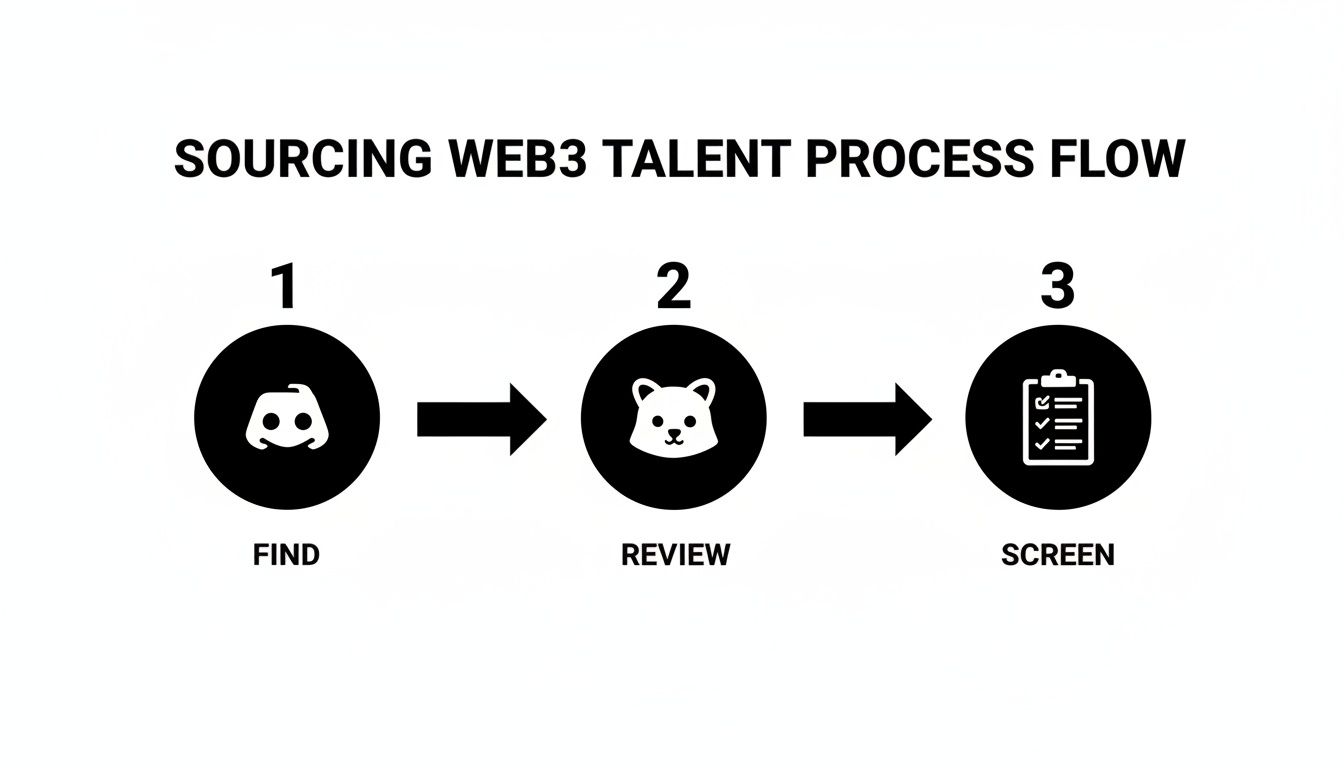
Notice how the flow emphasizes verifiable proof of work—like a solid GitHub profile—over a traditional resume. This is key in the Web3 space.
Assessing Architecture and Protocol-Level Thinking
Finally, the system design interview is where you separate the coders from the architects. This is a high-level conversation, not a coding test. This stage is crucial for senior roles where a developer's decisions will have long-term impact.
Here’s where you can really gauge a candidate’s depth of experience. Move beyond simple questions and get into real architectural debates:
- "Walk me through how you'd design a decentralized oracle. What are the biggest security risks we'd need to solve for?"
- "Let's talk about upgradeability. What are the pros and cons of the different proxy patterns, and in what scenario would you choose one over the others?"
- "How would you architect a system to minimize MEV (Maximal Extractable Value) for our users?"
A great candidate won't just recite textbook answers. They’ll ask you clarifying questions, discuss the trade-offs of each approach, and even challenge your assumptions. This collaborative discussion is the final proof point you need to feel confident you’ve found a future technical leader.
To tie this all together, here’s a look at how these different stages can be structured to create a comprehensive technical assessment.
Technical Interview Stages and Focus Areas
A well-rounded interview process combines multiple formats to test a candidate's full range of abilities, from hands-on coding to high-level architectural strategy.
| Interview Stage | Primary Objective | Example Task or Question |
|---|---|---|
| Live Coding Challenge | Assess on-the-spot problem-solving, security mindset, and code quality. | "Here is an ERC-721 contract with several vulnerabilities. Find and fix them, explaining your reasoning as you go." |
| Take-Home Assignment | Evaluate code architecture, testing discipline, and ability to work from a spec. | "Build a simple vesting contract with a comprehensive test suite. Document your design choices." |
| System Design Interview | Gauge protocol-level understanding, grasp of trade-offs, and security philosophy. | "Design a cross-chain bridge. What are the key security concerns, and how would you mitigate them?" |
By combining these stages, you get a holistic view of a candidate's skills. You're not just hiring a coder; you're hiring a technical partner who is ready to grow with your project.
Closing the Deal and Fostering Long-Term Success
You've spent weeks sourcing, screening, and interviewing candidates. Finally, you’ve found the one. But getting that verbal 'yes' is just the first step in the final, most delicate phase.
Let’s be real: in this market, elite developers are fielding multiple offers. A slow, uninspired, or clumsy closing process can undo all your hard work in an instant. This is where you prove your project isn't just another gig, but a career-defining move. The final steps—the offer, the onboarding, and the long-term vision—are what turn a great hire into a long-term team member.
Crafting an Offer They Can't Refuse
In Web3, compensation is more than just a number; it’s a story about your project's future. It's a blend of stability, upside, and ownership. A generic, one-size-fits-all offer tells a candidate you don’t really get it.
To really stand out, think of your offer as a balanced portfolio tailored to career goals:
- Competitive Base Salary: This is the bedrock. It provides the financial stability everyone needs. Do your homework on industry benchmarks, factoring in experience, location, and the current market.
- Equity (Stock Options): If you're incorporated, equity is crucial. It gives developers a real stake in the company's long-term success, aligning their hard work with your growth.
- Token Incentives: This is the Web3 game-changer. Offering your project’s native tokens provides direct ownership in the protocol they’re building. For candidates who are mission-aligned, the potential upside here is incredibly motivating.
How you blend these components sends a clear signal. A higher base salary might attract more risk-averse talent, while a package heavy on tokens and equity will excite the entrepreneurial minds who are ready to bet big on your project's success.
Structured Onboarding for Immediate Impact
A new developer's first 90 days will make or break their long-term success with you. Throwing them in the deep end leads to confusion and kills productivity. A structured plan, on the other hand, empowers them to start contributing quickly and confidently.
A solid onboarding roadmap needs to hit three key areas:
- Technical Immersion: Get them access to the full codebase and schedule dedicated walkthroughs with senior engineers to explain the "why" behind key design decisions.
- Security Protocol Deep Dive: Your new hire must be rigorously trained on all security practices, from your multi-sig signing process and incident response plan to your relationships with audit firms. This is a critical step in entrusting them with responsibility.
- A Clear 30-60-90 Day Plan: Don't leave them guessing what success looks like. Outline specific, achievable goals for their first three months. This gives them a clear path to their first "win." For example, the first 30 days focus on understanding the codebase; the next 30 on shipping a small feature; by the final 30, they could be taking ownership of a larger component.
Onboarding isn’t just about handing someone a laptop. It's a strategic process designed to accelerate a new hire's journey from employee to impactful team member, setting them up for long-term career growth.
Driving Retention and Long-Term Growth
Hiring smart contract developers is a talent war in 2026's Web3 landscape. The smart contracts market, valued at USD 684.3 million in 2022, is projected to explode to USD 73,773.0 million by 2030, a staggering 82.2% CAGR. This demand creates a serious talent shortage, making retention as critical as recruitment. You can see the full market analysis on the growing demand for smart contract expertise for a deeper look.
Keeping your best people requires a deliberate, ongoing investment in their careers. The most ambitious developers will leave if they feel they are stagnating.
Here are practical strategies to build an environment they won’t want to leave:
- Define a Clear Career Path: Show them what the journey from Senior Developer to Protocol Architect or Head of Engineering actually looks like. Discuss these milestones in one-on-ones and provide the mentorship they need to get there.
- Provide a Continuous Learning Budget: Web3 moves at a dizzying pace. Offering a dedicated budget for conferences, courses, and security workshops shows you’re invested in keeping their skills sharp and relevant.
- Encourage DAO and Governance Participation: Let them get involved with the broader ecosystem. This not only helps them grow their network but also brings invaluable insights and new ideas back to your team.
- Recognize and Reward Ownership: When a developer ships a major protocol upgrade or catches a critical bug, celebrate it. Public recognition and performance-based bonuses are powerful tools for motivation and career satisfaction.
When you invest in your developers' growth, you’re doing more than just keeping them around. You're building a resilient team that becomes the foundation of your project's success. It’s also worth exploring how leading Web3 companies are structuring their teams and benefits to stay ahead of the curve.
Frequently Asked Questions About Hiring
When you're hiring a smart contract developer, you're not just filling another engineering role. The stakes are incredibly high, the talent is scarce, and the questions that come up are unique to this space. Here's how to approach the most common hiring challenges.
What Is a Competitive Salary for a Smart Contract Developer in 2026?
You have to think beyond a simple base salary. In 2026, compensation for top-tier talent is a package deal, and the base is just one part of it.
For a senior Solidity or Rust developer with real, on-chain experience—we’re talking about developers who have shipped protocols that have actually secured user funds—a base salary between $150,000 and $250,000 USD is the typical range. But here's the key: the best offers are always sweetened with a significant token package or equity. This gives them skin in the game and aligns their success with the project's. That's how you attract people with an owner's mindset, not just a contractor's.
What Is the Biggest Red Flag During an Interview?
It's one thing: a shallow grasp of security. Anyone can memorize a list of common attacks from a blog post. The real test is whether they understand the why behind them.
The moment a candidate gives you a textbook definition of reentrancy but can't explain the checks-effects-interactions pattern or talk through the trade-offs of different mitigation strategies, you should be concerned. It signals a lack of practical, battle-hardened experience. You need someone who has seen things break. True experts don't just classify bugs; they think in threat models and understand that every line of code is a security decision.
A candidate who can talk openly about a past security mistake is gold. If they can explain a vulnerability they missed, what they learned from it, and how it permanently changed their coding habits, you're likely talking to a great developer. That kind of humility is a sign of true seniority.
Should I Prioritize Experience with a Specific Blockchain?
It's a common trap to get fixated on finding someone who has only worked on, say, Ethereum. It feels safer, but it’s often better to look for strong foundational skills that are transferable.
A developer who truly understands smart contract architecture, security patterns, and gas optimization can jump from Ethereum to Polygon or Avalanche without much friction. A great Rust developer can move from Solana to another Rust-based chain. Focus on their problem-solving ability and whether they have a security-first mindset. Those are the skills that define a great developer's career, no matter what chain they’re building on.
How Important Is a Computer Science Degree?
In Web3, proof-of-work trumps a piece of paper every time. A candidate's GitHub profile is their real resume and portfolio.
Forget the diploma and look for tangible evidence of their skills during the interview process. Here's what actually matters for career progression in this field:
- Deployed Contracts: Can you find their work on a block explorer? Reading the code they’ve shipped is the ultimate litmus test.
- Open-Source Contributions: Have they contributed to well-known protocols or developer tools? This shows they can collaborate and write code that meets a high bar.
- Audit Contest Participation: Have they found legitimate bugs in contests on platforms like Code4rena or Secureum? This is direct proof of a sharp security mind.
A CS degree might provide a good theoretical base, but a proven track record of shipping secure, efficient code is the only credential that truly counts for career advancement as a smart contract developer.
Ready to find the specialized talent you need without the guesswork? Blockchain Jobs is the premier job board for connecting with pre-vetted, crypto-native professionals. Post your job today and reach the developers who are actively building the future of Web3. Find your next hire at https://blockchain-jobs.com.