
Average Salary of a Network Engineer 2026: Earn More

Network engineering pays well. Specialized network engineering pays a lot better.
If you want the short answer on the average salary of a network engineer, the U.S. market supports solid six-figure compensation, and the ceiling rises fast once you add seniority, strong certifications, or infrastructure experience that maps cleanly to distributed systems. The mistake most engineers make is treating salary like a fixed benchmark. It is not. It is a positioning problem.
I have seen candidates undersell themselves because they quote one average number and stop there. Hiring teams do not think that way. They price based on risk, complexity, business impact, and scarcity. A network engineer who can keep enterprise routing stable is valuable. A network engineer who can secure node infrastructure, support multi-cloud environments, and speak clearly about uptime, resilience, and automation is in a stronger category altogether.
That matters even more if you want to move into blockchain infrastructure, DevOps-heavy environments, or protocol operations. Those employers are not just buying packet knowledge. They are buying reliability, incident judgment, and systems thinking.
This is the practical lens you should use throughout your career. Know the benchmark. Know where you sit on the curve. Then build the profile that pushes you into the upper band.
Introduction
The headline number is good, but the range is what should get your attention. In the United States, the average annual salary for a Network Engineer is $109,040, with the 25th percentile at $89,000, the 75th percentile at $133,500, and top earners reaching $143,000, according to ZipRecruiter’s April 2026 salary data.
That spread tells you something important. Employers are not paying one market rate. They are paying different rates for different levels of influence.
If you are early in your career, this means the floor is still attractive. If you are mid-career, it means there is true upside left on the table. If you are already senior and still getting average offers, your résumé or interview positioning probably needs work.
I am opinionated on this point. Too many network engineers let recruiters define their value by job title alone. That is lazy hiring logic. The better way to price yourself is by the systems you can design, the outages you can prevent, and the complexity you can handle without supervision.
The best-paying opportunities also tend to reward adjacent skills. Cloud networking, security hardening, automation, and decentralized infrastructure all push compensation higher. In Web3, that effect is even stronger because employers need engineers who understand resilience in environments where downtime, latency, and trust assumptions matter.
Practical takeaway: Stop asking, “What is the average?” Start asking, “What would make a company pay me above the average?”
National Salary Benchmarks for Network Engineers
A network engineer can sit in an $80,000s pay band or break well into six figures with the same title. That gap is the point. National averages are useful for orientation, but they are weak pricing tools unless you compare multiple datasets and then map them to the kind of environment you work in.
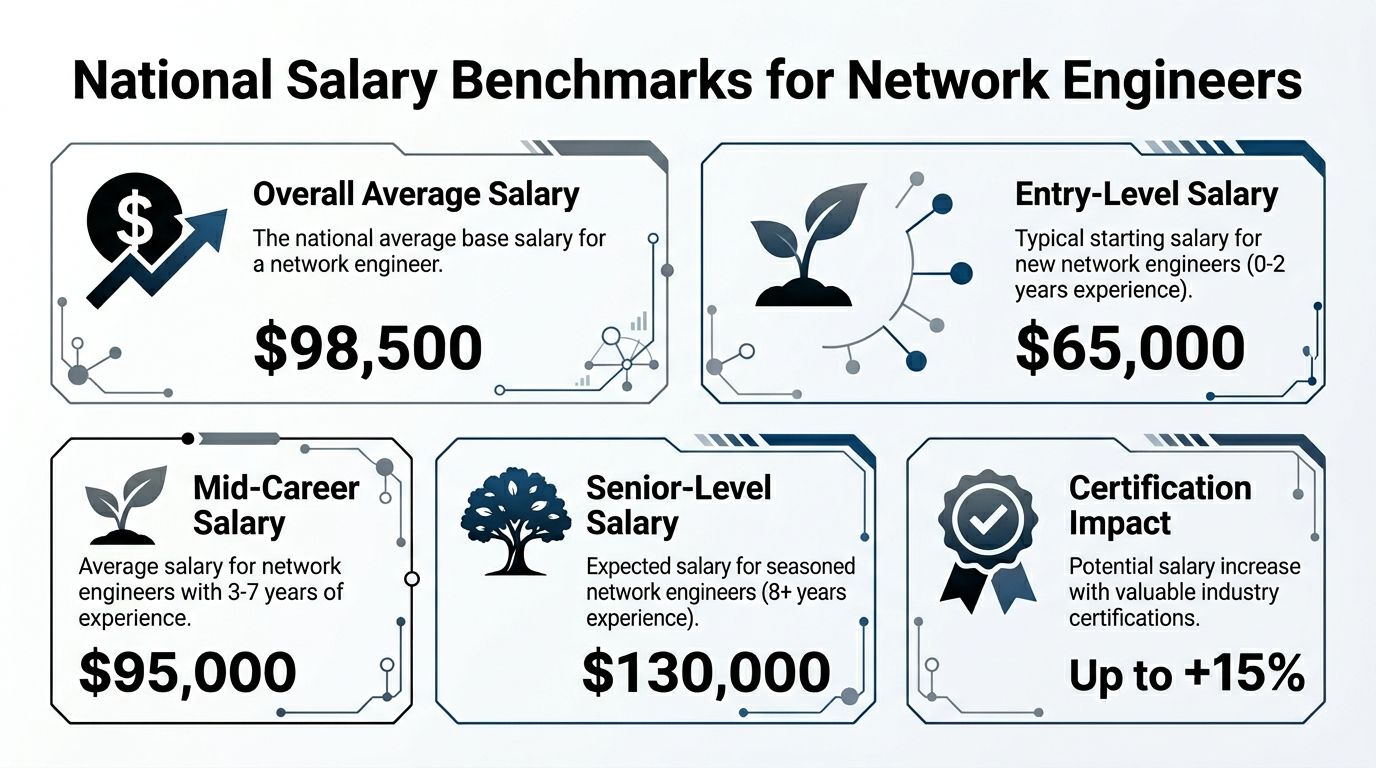
What the national averages say
Salary platforms do not measure the same slice of the market. Some focus on self-reported compensation. Others pull from job postings or employer submissions. That is why one source can show a strong six-figure average while another reports a much lower base salary range.
Here is the practical read on the benchmark sources already cited in this article:
- ZipRecruiter shows a national average above $100,000, with a wide spread between lower and upper percentiles.
- Talent.com places the average higher and shows stronger upside for experienced engineers.
- PayScale reports a lower average base salary and reminds you that title alone does not guarantee premium pay.
- Built In is useful for comparing compensation in tech-forward employers where total pay often matters more than base alone.
You do not need one perfect number. You need a defendable range.
My advice is simple. Treat the low end as the price of generic network support. Treat the middle as the market rate for engineers who can run production reliably. Treat the upper band as the rate for engineers who combine networking with automation, security, cloud, or high-availability infrastructure.
How to read benchmarks like a recruiter
Recruiters do not price you by title in isolation. They price risk, scope, and replacement difficulty.
A lower offer usually means the employer sees the role as ticket-driven support, routine configuration work, or limited ownership. A stronger offer usually means they expect you to handle outages, capacity planning, architecture decisions, vendor coordination, and business-critical uptime without hand-holding.
That distinction matters even more if you want the Web3 premium covered later in this article. Blockchain companies are not looking for someone who can just maintain switches and firewalls. They pay more for engineers who can support distributed infrastructure, secure exposed systems, automate repetitive work, and keep latency-sensitive environments stable under pressure.
Build a salary range that matches your market
Do not benchmark by title alone. Benchmark by company type, system complexity, and revenue impact.
An internal IT network engineer at a traditional employer is competing in one salary band. A network engineer supporting cloud-heavy infrastructure, exchange connectivity, validator environments, or security-sensitive platforms is competing in another. That is where the premium starts to show up.
Use live market data to test your assumptions. Review current U.S. blockchain and crypto infrastructure roles and compare three things: the responsibilities, the technical stack, and the level of ownership. If the role expects cloud networking, automation, incident response, and security hardening, the salary target should move up with it.
Recommendation: Build your target range from three inputs: broad salary benchmarks, live job descriptions, and niche roles in Web3. That method is far more credible in interviews than quoting a single average.
Deconstructing Your Total Compensation Package
A network engineer who focuses only on base pay leaves money on the table.
That mistake gets expensive fast in startup, remote, and Web3 hiring. A traditional employer may offer a solid salary with predictable benefits. A Web3 company may keep base pay similar, then add bonus, tokens, or equity that changes the true value of the offer. If you want the Web3 premium, compare the full package, not the headline number.

Base salary is only the anchor
As noted earlier, national salary data shows that bonuses already play a meaningful role in network engineering pay. In Web3, the gap gets wider because some employers add equity or token upside on top of cash compensation.
Treat that upside carefully. A token grant with no liquidity plan is not equal to cash. Equity in a private company can be valuable, but only if you understand vesting, dilution, and the path to a payout. I tell candidates to score every offer in two columns: guaranteed compensation and speculative compensation. That keeps you from overvaluing upside that may never materialize.
What to review before you say yes
Review the offer in layers, starting with what is guaranteed and ending with what is conditional.
- Base salary: Confirm that it matches the scope of the job, the on-call load, and the level of ownership.
- Annual bonus: Ask for the target percentage, the payout formula, and the last payout history if they will share it.
- Sign-on bonus: Count it once, then move on. It does not fix weak long-term pay.
- Equity or tokens: Ask how vesting works, when you can sell, and what events must happen before the grant has true value.
- Benefits: Health insurance, retirement match, time off, home office support, and training budgets all affect your full take-home value.
If you want a clear framework for separating salary from the rest of the offer, Benely’s guide to Total Employee Compensation is a useful reference.
The questions strong candidates ask
Strong network engineers do not stop at technical interviews. They press for specifics once the offer is on the table.
Use these questions:
- How is the bonus calculated, and what percentage of employees received it last cycle?
- What does the equity or token grant represent in plain terms?
- What is the vesting schedule, and are there cliffs, exercise costs, or liquidity restrictions?
- How often are salaries reviewed, and what usually triggers an increase?
- Is on-call work part of the role, and is there extra compensation for it?
- What budget is attached to certifications, labs, or security training?
Recruiter advice: If a company gets vague about bonus mechanics, equity terms, or on-call expectations, assume the package is weaker than it sounds.
How Experience Location and Certifications Shape Your Pay
The fastest way to raise your salary is to increase the value of the problems you can own.
Experience usually drives the biggest jump. Location still affects the ceiling. Certifications matter when they make you easier to hire for a specific kind of role. Use that order when you plan your next move.

Experience moves you into a different pay bracket
Early-career network engineers get paid to execute. Senior engineers get paid to decide.
That difference shows up in salary, but the primary driver is scope. Once you are trusted to design changes, lead incidents, reduce risk, and coordinate across infrastructure, security, and application teams, you stop competing with junior and mid-level candidates. You enter a narrower and better-paid part of the market.
Hiring managers usually pay more for four things:
- Design ownership: You shape network architecture, migration plans, and resilience standards.
- Incident command: You handle outages calmly, assign work clearly, and restore service without making the blast radius worse.
- Cross-functional execution: You work well with cloud, platform, security, and software teams.
- Operational maturity: You automate repetitive work, document standards, and know which changes need caution.
If your résumé reads like a ticket queue, expect mid-level pay. If you want senior compensation, show outcomes, scale, and decisions made under pressure.
Location still changes what companies will pay
Remote work did not erase geography. It changed who benefits from it.
Some employers still anchor compensation to major metro markets. Others pay for hard-to-fill skill sets, especially when the role includes hybrid cloud, security-heavy infrastructure, high-stakes uptime, or after-hours incident ownership. Your best move is to target roles where the work is expensive to get wrong.
That matters even more if you want the Web3 premium covered later in this guide. Employers building decentralized infrastructure often care less about your zip code and more about whether you can run production systems with strong reliability habits. Review current Web3 DevOps and infrastructure roles on Blockchain Jobs and compare how often employers mention validators, node operations, observability, automation, and security. Those details tell you where pay rises fastest.
A practical rule. Do not search by title alone. Search by environment complexity.
Certifications help when they support the job you want next
Certifications do not raise your value on their own. They support a story the employer already wants to believe.
Use them with intent:
- CCNA works best for early-career candidates who need proof of baseline networking knowledge.
- CCNP helps when you are targeting design, escalation, and higher-complexity operational roles.
- CISSP strengthens your position when the role includes security ownership, policy, or risk-sensitive infrastructure.
- Cloud networking certifications carry more weight when your work crosses VPC design, connectivity, segmentation, and distributed systems.
Random badge collecting is a waste of time. Pick the target role first, then choose the certification that removes the biggest hiring objection.
This video gives a useful career-level perspective on how networking paths evolve over time.
My blunt recommendation
Chasing salary with tenure alone is slow. Chasing it with stacked certifications is inefficient.
Do this instead:
| Goal | Best move |
|---|---|
| Break into the field | Get a baseline cert and real troubleshooting exposure in production or lab environments |
| Move to mid-level | Show ownership of changes, incident response, and repeatable documentation |
| Move to senior | Lead architecture decisions, automation efforts, and cross-team delivery |
| Move into Web3 infrastructure | Build fluency in distributed systems, Linux, cloud networking, observability, and security-focused operations |
Best salary move: Employers pay more for engineers who can own complexity, reduce downtime, and handle infrastructure that carries real business risk.
The Blockchain Premium Unlocking Higher Salaries in Web3
The biggest upside for network engineers willing to reposition is found here.
Traditional salary guides tell you what the broad market pays. They rarely tell you what happens when networking skills become part of decentralized infrastructure, validator operations, node reliability, cross-chain connectivity, or security-sensitive backend systems. That is a different labor market.
Why Web3 pays more for the same foundation
Network engineers in Web3 solve harder operational problems.
They deal with systems where uptime matters publicly, security failures carry immediate consequences, and infrastructure often spans cloud environments, self-managed services, observability tooling, and protocol-specific components. Employers in this space do not just want somebody who understands switches, routing, and firewalls. They want somebody who can think through reliability, failure domains, latency sensitivity, automation, and adversarial conditions.
That combination is scarce.
One underserved angle in salary coverage is the premium for decentralized infrastructure work. Engineers specializing in blockchain and Web3 networking can command 30% to 50% higher pay than traditional averages, and senior DevOps and Infrastructure roles on blockchain-focused job platforms often list $150,000 to $250,000 base, according to Indeed-referenced salary commentary on this segment.
What skills trigger the premium
The premium is not for enthusiasm about crypto. It is for operational relevance.
Hiring managers pay more when your background maps to work like this:
- Running and hardening node infrastructure
- Supporting distributed systems with strict uptime expectations
- Building secure networking layers for multi-region deployments
- Automating deployment, failover, and recovery workflows
- Troubleshooting performance issues across cloud and self-hosted environments
A strong Web3 infrastructure candidate often has a traditional networking core plus exposure to Linux, cloud platforms, observability, security, and automation. If you only present yourself as a “network person,” you will get filtered into the wrong salary band.
How to position yourself for Web3 hiring
You do not need to pretend you are a protocol engineer if you are not one. You do need to translate your experience into language that matters to Web3 employers.
On your résumé and in interviews, emphasize:
- Resilience: What systems did you keep available under stress?
- Security: What did you harden, isolate, or monitor?
- Automation: What repetitive infrastructure work did you eliminate?
- Scale: What complexity did you manage across regions, clouds, or environments?
- Ownership: What did you personally design, not just support?
If you want to understand how this part of the market talks about infrastructure and hiring, the editorial perspective at https://blockchain-jobs.com/blog is useful for spotting recurring themes and role patterns.
Straight advice: Web3 employers pay more when you sound like an infrastructure owner, not a ticket-closer.
Exploring Real-World Network Engineer Salary Examples
A network engineer can earn a solid mid-market salary or break into a compensation tier that looks closer to senior cloud and infrastructure pay. The difference usually comes from employer type, technical scope, and how close the role sits to revenue-critical systems.
Sample Network Engineer Salaries
| Role Title | Company Type | Experience | Location | Base Salary Range | Notes |
|---|---|---|---|---|---|
| Network Engineer | Regional employer | Mid-level | Atlanta | Regional-market compensation | Good reference point for stable enterprise networking work |
| Senior Network Engineer | Large tech company | Senior | Bellevue | Higher big-tech band | Broader ownership and stronger employer premium |
| Principal Infrastructure Engineer | Specialized finance firm | Senior to principal | Major market | Top-tier infrastructure pay | High compensation usually follows high-risk, high-availability environments |
| Senior DevOps or Infrastructure Engineer | Web3 or blockchain company | Senior | Remote or hybrid | Premium infrastructure band | Often paired with equity or token upside, depending on the company |
These examples matter because they show how fast pay changes once the job moves from support-heavy networking into infrastructure ownership.
A regional enterprise role can pay well, but premium employers pay for business impact. Big tech pays more for scale. Finance pays more for uptime, security, and failure tolerance. Web3 companies often pay more for engineers who can keep distributed infrastructure stable under pressure.
That is the key comparison candidates should make.
What these examples mean
Three patterns show up consistently:
- Employer tier changes the ceiling. A recognizable tech company, trading firm, or well-funded Web3 startup can pay far above a standard regional benchmark.
- Infrastructure ownership pays better than ticket volume. Engineers who design, automate, secure, and troubleshoot production environments get stronger offers than engineers framed as general support.
- Web3 creates a clear premium for the right profile. If your background includes Linux, cloud networking, observability, automation, and secure multi-region operations, you can often compete for roles above traditional network-engineer bands.
The Web3 premium is not about hype. It is about scarcity. Companies building blockchain infrastructure need engineers who understand reliability, latency, failover, hardening, and incident response. Traditional network engineers already have part of that foundation. The money improves when you present yourself as an infrastructure operator with networking depth, not just a network administrator.
How to use salary examples without fooling yourself
Do not compare titles first. Compare the problem you are being hired to solve.
A “Senior Network Engineer” role at one company might mean firewall changes, escalations, and vendor coordination. At another, it can mean owning production connectivity across cloud environments, automating recovery workflows, and protecting critical systems. Those are not the same job, and they should not command the same pay.
Use salary examples as filters:
- Target roles tied to uptime, resilience, security, and automation
- Treat broad salary bands as a signal to inspect scope, not a guarantee
- Prioritize employers where infrastructure failure has direct financial cost
- Check Web3 job boards such as Blockchain Jobs to benchmark how blockchain and infrastructure employers describe higher-paying roles
Generic averages still have value. They set the floor. Your upside comes from choosing the right market segment and positioning your experience for it. If you want higher pay, stop benchmarking yourself only against local network support roles. Benchmark yourself against infrastructure jobs in cloud, finance, and Web3, where your skills carry a stronger premium.
A Practical Guide to Salary Negotiation
Most engineers negotiate too late and too vaguely.
They wait until the offer arrives, react emotionally, and throw out a bigger number without a clear business case. That is weak strategy. Good negotiation starts before the first interview.
Start with a range, not a wish
Build your number from three inputs:
- Market benchmark
- Role complexity
- Your evidence
Your evidence is the part that matters most. Bring concrete examples of systems you owned, incidents you resolved, migrations you led, and environments you improved. Employers pay more when they can picture you solving their problems.
Answer salary expectation questions cleanly
Do not be defensive. Do not say, “I’m flexible,” and hope for the best.
Use something like this:
“Based on the scope of this role, current market benchmarks, and my background in network reliability, automation, and production support, I’m targeting a package aligned with upper-market compensation for this level.”
That answer keeps you positioned as a serious candidate. It also gives you room to discuss total compensation, not just base salary.
Negotiate the role, not just the paycheck
You get better pay when the employer sees you as harder to replace.
That means you should frame your value around outcomes:
- Reduced downtime
- Improved resilience
- Faster incident recovery
- Better network security posture
- Stronger automation and documentation
This works far better than saying you are “ Г‡” or “a fast learner.” Those phrases do not move salary bands.
Know what to push on
If base salary is tight, negotiate the parts employers can move more easily.
Try these:
- Review timing: Ask for a compensation review after a defined ramp period.
- Sign-on support: Useful when you are leaving bonus money behind.
- Certification budget: Especially relevant if the role expects growth into cloud, security, or platform ownership.
- Remote flexibility: Valuable if commute or relocation costs are significant.
- Title leveling: A stronger title can matter at the next job search.
Handle low offers without sounding desperate
Stay calm and specific.
A direct response works best:
“I’m interested in the role, but the current package does not reflect the level of responsibility we discussed. Based on my background and the scope here, I would need a stronger package to move forward.”
That is better than overexplaining.
One mistake to avoid
Do not reveal your minimum too early.
If a recruiter asks what you currently make, redirect to the value of the role and your target range. Your old salary is often the least useful number in the conversation, especially if you are moving from a lower-paying company, region, or specialty.
Conclusion Charting Your Career and Salary Trajectory
The average salary of a network engineer is strong. The effective career strategy begins with the upside above average.
If you are benchmarking broadly, the U.S. market supports healthy six-figure compensation for many network engineers. If you build toward senior ownership, target stronger employers, and align your skills with high-demand infrastructure work, your ceiling rises fast. If you add decentralized systems, automation, and security-minded operations, the compensation picture gets even better.
My advice is simple. Stop treating salary as a static market number. Treat it like a result of role selection, skill positioning, and negotiation discipline.
The engineers who earn more do three things well. They choose harder problems. They present their experience in business terms. They interview like operators, not applicants.
If you want to track where infrastructure pay is moving, explore live roles on Blockchain Jobs. Use it as a market research tool, not just a job board. Study the salary bands, compare the required skills, and look at how Web3 employers describe infrastructure ownership. That is how you spot the next salary jump before everyone else does.