
How to Build a DevOps Infrastructure Team for Web3
At 3 a.m., a validator misses a slot. The on-call engineer is a smart contract developer who has never opened a Grafana dashboard, the runbook is out of date, and the post-mortem lands on the CTO's desk. The uncomfortable conclusion is obvious: the project has outgrown ad-hoc infrastructure.
That moment changes the hiring question. You're no longer asking whether you need “a DevOps person.” You're deciding which reliability risks deserve dedicated ownership, how to test candidates under realistic pressure, and how to build a career ladder that keeps strong infrastructure engineers engaged. For blockchain teams, the answer must account for always-on nodes, validator slashing, RPC performance, key custody, and deployments where a small operational mistake can affect an entire network.
Why Blockchain Projects Need a Dedicated DevOps Infrastructure Team
Traditional application operations assume that a failed deployment can be rolled back, a server can be replaced, and traffic can be shifted while the team investigates. Blockchain infrastructure is less forgiving. Validators participate in consensus, nodes maintain state that must remain coherent, indexers process workloads that users depend on, and RPC latency can affect trading, bridging, and wallet activity.
A Web3 infrastructure team also manages several risk categories at once:
- Always-on node operations: Validators, full nodes, archive nodes, RPC services, and indexers need continuous monitoring and disciplined upgrades.
- Consensus exposure: Validator downtime, incorrect failover, or poor key handling can create slashing risk.
- Mempool and MEV sensitivity: Deployments and transaction propagation may require timing, privacy, and ordering controls that ordinary CI/CD practices don't address.
- Multi-chain custody: Teams often operate across networks with different clients, upgrade schedules, signing models, and operational assumptions.
- Recovery complexity: Restoring a node isn't only a matter of restarting a process. State, keys, peers, snapshots, client versions, and network health all matter.
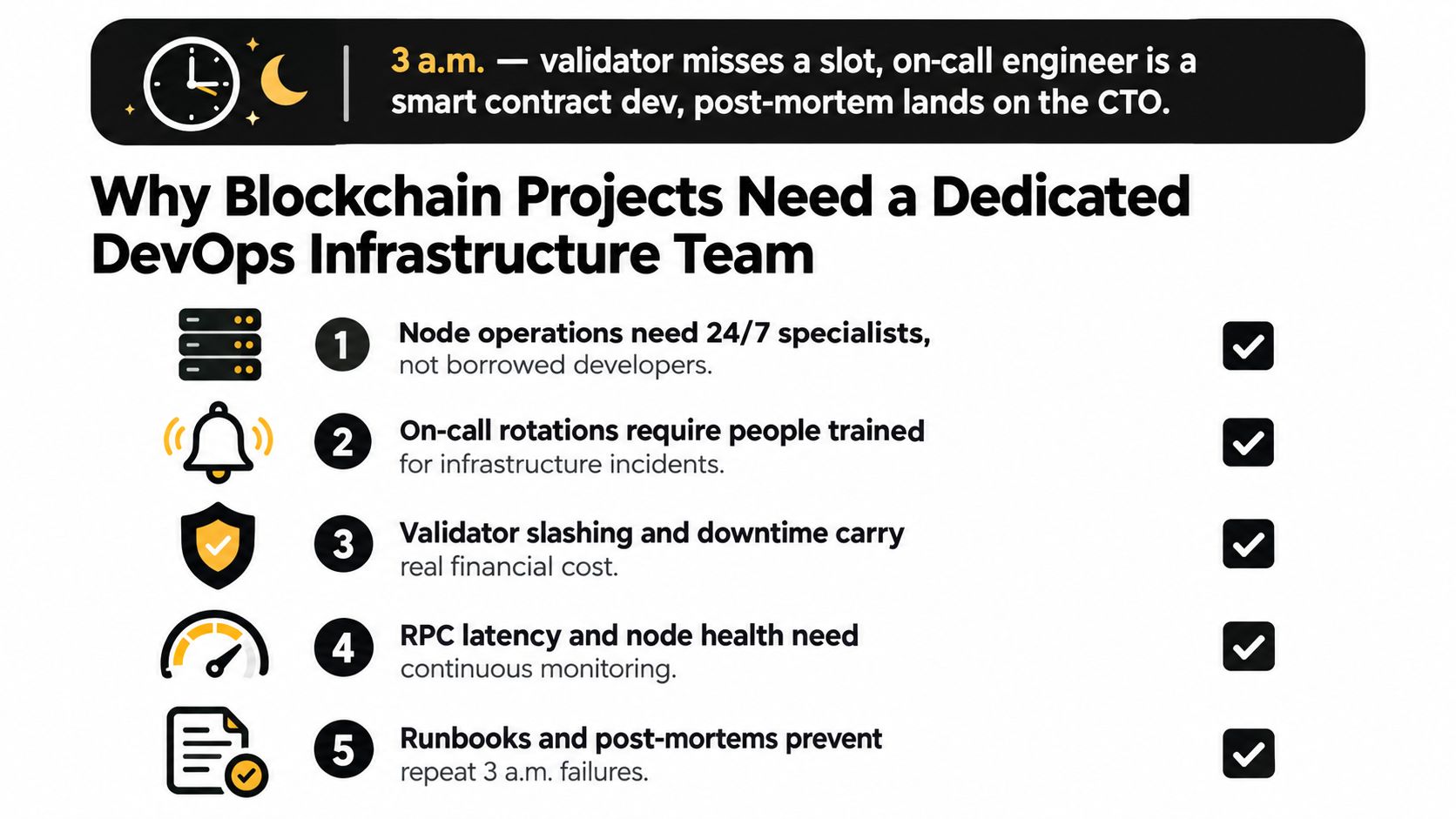
Practical rule: Hire for operational ownership, not familiarity with crypto vocabulary.
A single generalist can bootstrap a network or automate a first deployment. That person shouldn't remain the only owner once the protocol has meaningful uptime, security, and upgrade obligations. Teams building infrastructure for real-world blockchain apps need repeatable operations, clear escalation paths, and people who understand how infrastructure decisions affect protocol behavior.
The three signals that hiring can't wait
Track pager incidents per week, missed upgrade windows, and security audit findings that point to infrastructure rather than code. None of these signals requires an advanced platform. Your incident channel, release calendar, and audit backlog already contain the evidence.
If the pager keeps waking developers, infrastructure work is competing with protocol delivery. If upgrades repeatedly slip because nobody owns client testing, rollback planning, or coordination, the team has a capacity problem. If auditors keep identifying IAM, secrets, network, or host-hardening gaps, adding another application engineer won't solve the problem.
The first hire should restore operational ownership. The second should make that ownership durable through automation, observability, and documented recovery.
Core Roles and Skills for a Web3 Infrastructure Team
The strongest candidates can explain what they operated, what failed, and what trade-off they made. A polished resume that lists Ethereum, Kubernetes, and Terraform is not enough. Ask candidates to reconstruct a real incident, identify the first misleading signal, and explain why their chosen response was safer than the alternatives.
The four seats that matter first
Node and Validator Operator. Look for deep Linux troubleshooting, consensus-client internals, snapshot and peer management, key custody, and upgrade discipline. A strong candidate can explain why a team might pin a specific Geth version after a consensus bug, then describe how they would test and roll out the next version. They should also be able to distinguish validator failover from merely starting a second signer, and explain how slashing protection changes the recovery plan.
Platform or SRE Engineer. This person owns Kubernetes, Terraform, observability, capacity planning, and incident command. Ask them to design an alert for a degrading RPC cluster without creating noisy pages, then ask how they'd turn production events into a reliable post-mortem. Strong answers connect metrics, logs, traces, runbooks, and human escalation instead of treating dashboards as the solution.
Smart Contract CI/CD Engineer. Require practical experience with Foundry or Hardhat, deterministic builds, contract verification, deployment manifests, and upgrade governance. Give candidates a pipeline failure where the bytecode doesn't match the intended source and ask them to isolate the cause. The best candidates treat release provenance, approval boundaries, and reproducibility as operational controls, not paperwork.
Security and Infrastructure Hardening Engineer. Test cloud IAM, network policies, secrets management, validator DDoS mitigation, and incident response. Ask for a least-privilege design for deployers, operators, and signers, then introduce a compromised build credential. A credible candidate explains containment, evidence preservation, rotation, and service restoration in that order.
| Role | Must-Have Skills | Top Interview Signal |
|---|---|---|
| Node and Validator Operator | Linux, consensus clients, key management, snapshots, peer operations | Explains safe failover and slashing protection without hand-waving |
| Platform or SRE Engineer | Kubernetes, Terraform, observability, incident command | Connects an alert to diagnosis, mitigation, and prevention |
| Smart Contract CI/CD Engineer | Foundry or Hardhat, deterministic builds, verification, upgrade governance | Debugs a bytecode or release-provenance mismatch methodically |
| Security and Infrastructure Hardening | IAM, network policy, secrets, DDoS mitigation, response | Prioritizes containment and recovery during a credential compromise |
A useful reference point for role scope is a senior reliability leadership opening such as this Director of Site Reliability Engineering role. It illustrates why infrastructure leadership spans systems, reliability, and cross-functional execution rather than tools alone.
Skills that compound across the team
Add FinOps, on-call rotation design, runbook writing, and stakeholder communication to every role scorecard. Infrastructure engineers who can explain cloud waste, simplify a handoff, or write a recovery procedure multiply the effectiveness of specialists around them.
Choosing the Right Org Structure for Your Stage
Org structure should follow operational load, not an abstract preference for centralization. Count validators, supported networks, monthly deploy frequency, audit cadence, and the number of engineers currently sharing on-call responsibility. Then choose the smallest structure that gives critical systems clear ownership.
| Structure | Best At Stage | Strength | Risk |
|---|---|---|---|
| Embedded DevOps inside protocol squads | Under roughly 15 engineers | Fast iteration and close product context | Thin on-call coverage and siloed knowledge |
| Centralized platform team | Around 25 or more engineers and 3 or more chains | Shared CI/CD, observability, and operational standards | Can become a bottleneck that product teams route around |
| Hybrid platform core with embedded SREs | Mid-stage protocols with several services or networks | Central standards with local ownership | Requires explicit boundaries and careful prioritization |
Embedded teams
Embedding infrastructure ownership inside each protocol squad works when the system is still small and the engineers need to move quickly. The trade-off is predictable: every squad invents some of its own monitoring, runbooks, and deployment habits, while the on-call burden spreads across people who may not operate infrastructure often enough to build confidence.
Hire versatile engineers here, but don't confuse versatility with unlimited availability. If the same developer writes contracts, manages validators, and handles every overnight incident, the organization is saving headcount by borrowing reliability from personal exhaustion.
Centralized platform
A centralized team becomes attractive once shared services and network diversity create duplicated work. One group can provide Terraform modules, deployment pipelines, observability standards, upgrade automation, and common access controls. The danger is a platform queue. If product teams must file a request for every environment or operational change, they'll create unofficial paths around the platform.
Set a service catalog, publish ownership boundaries, and give protocol teams safe self-service paths. Centralization should remove repeated work, not move every decision into one approval queue.
The hybrid default
For a mid-stage protocol, choose a small platform core plus embedded SRE ownership. The core team maintains paved roads, shared tooling, guardrails, and reliability standards. Embedded engineers stay close to validators, RPC, bridge, or sequencer workloads and remain accountable for outcomes.
Use this decision rule this quarter: if one squad can cover incidents and upgrades without routinely borrowing help, embed the role. If several squads repeat the same infrastructure work, centralize the platform capability. If both conditions are true, use the hybrid model and write down who owns each production service.
Hiring and Interview Loops That Actually Predict Performance
Start with a scorecard, not a job title. For a senior blockchain SRE, define production responsibilities, must-have capabilities, useful but nonessential experience, compensation band, on-call expectations, and the outcomes expected during the first ninety days. A vague description attracts tool collectors and makes interview feedback impossible to compare.
A four-stage loop
Recruiter screen. Confirm scope, availability for on-call work, communication habits, and compensation expectations. Ask the candidate to describe the most serious production incident they personally handled. Fail fast if they claim ownership but can't explain the system, the impact, their decision, or what changed afterward.
Architecture interview. Ask the candidate to design validator failover and an incident-response path. Probe the trade-offs between uptime, decentralization, key custody, recovery speed, and operational simplicity. A candidate who treats “more replicas” as a complete answer, or refuses to reason about uptime versus decentralization, shouldn't progress.
Hands-on debugging. Give them a mainnet-style failure scenario: a client upgrade has completed on some nodes, RPC error rates are rising, and the deployment log looks green. Ask them to form hypotheses, identify the next evidence, protect consensus participation, and communicate a rollback or hold decision. You're testing prioritization and safe action, not trivia.
Values and behaviors interview. Explore blameless incident response, documentation, disagreement, and escalation. Ask for an example of stopping a risky release or challenging a senior engineer. A candidate who frames every incident as someone else's fault will damage your learning loop.
| Stage | Duration | Goal | What to assess | Fail-fast red flag |
|---|---|---|---|---|
| Recruiter screen | Short conversation | Confirm scope and motivation | Ownership, communication, on-call fit | Can't describe personal production responsibility |
| Architecture interview | 60 minutes | Test system judgment | Failover, custody, observability, trade-offs | Treats redundancy as the entire reliability plan |
| Debugging exercise | 60 minutes | Observe operational reasoning | Evidence gathering, containment, rollback judgment | Makes irreversible changes before establishing facts |
| Values and behaviors | 45 minutes | Test team compatibility | Accountability, documentation, escalation | Blames individuals and resists post-mortems |
For distributed hiring, regional talent can expand coverage without weakening the bar. A structured guide to Hire Latin American Developers can help managers think through remote collaboration, but geography should never substitute for an incident-based assessment.
A practical benchmark for role scope is the DevOps infrastructure job category. Use it to compare responsibilities across openings, then build your own scorecard around the systems the candidate will operate.
The scorecard
Score each dimension independently: technical depth, operational judgment, security discipline, communication, and learning behavior. Require written evidence from each interviewer. Don't average away a severe security concern because a candidate performed well on Kubernetes trivia.
Measuring the Team on Reliability and Business Outcomes
Ticket count is an activity measure, not a team outcome. One industry report says approximately 51% of platform teams still use ticket reduction as a primary KPI (VMware's State of Platform Engineering report), but fewer tickets can mean self-service is working, or it can mean engineers stopped reporting friction. Measure what users and protocols experience.
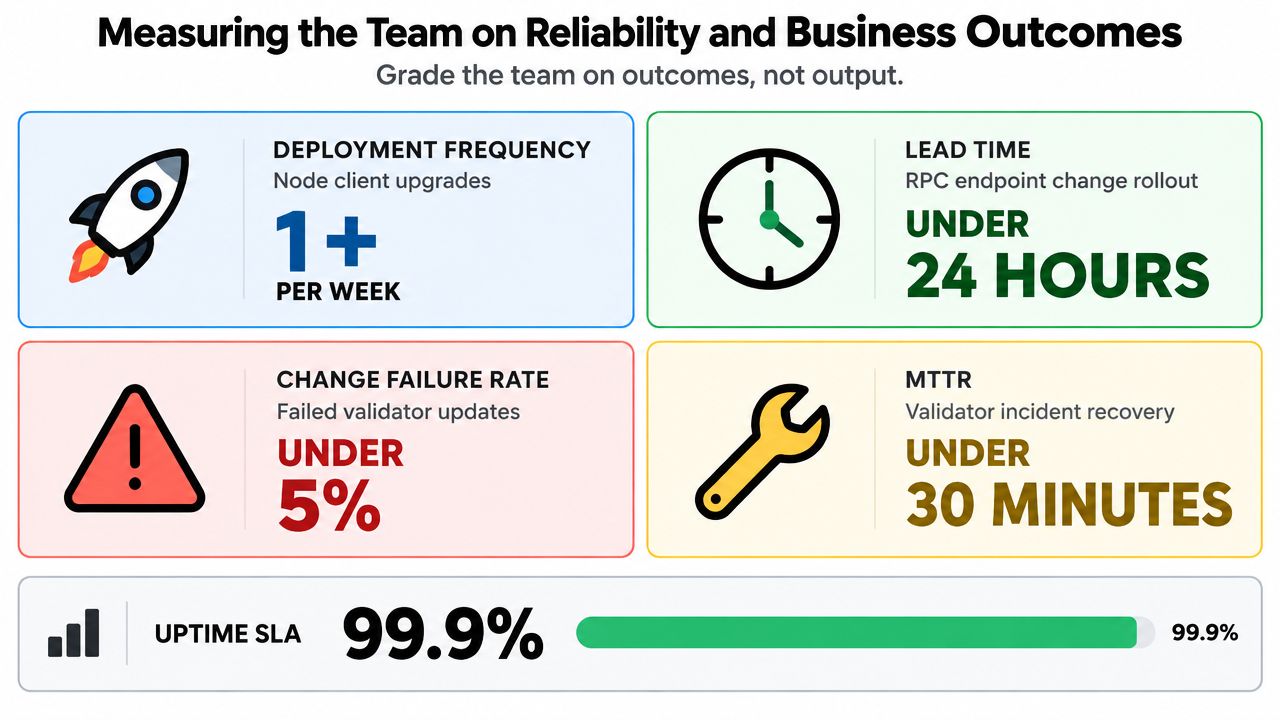
Use the four DORA metrics as the delivery spine: deployment frequency, lead time for changes, change failure rate, and time to restore service. Build them from deployment, rollback, and incident records, then join those records so speed and stability remain visible together. DORA implementations commonly define time to restore as the median time an incident stays open in production (Atlassian's DORA metrics guide).
Translate delivery metrics into protocol reality
- Deployment frequency: client upgrades, node releases, and infrastructure changes that reach production.
- Lead time: time from approved change to safe rollout across the required services.
- Change failure rate: validator update failures, rollback-triggering releases, and incident-linked changes.
- Time to restore: time to recover validator participation, RPC service, bridge operations, or sequencer availability.
Pair those with validator uptime, missed attestations, bridge incident recovery, RPC restoration time, protocol fee uptime, sequencer availability, and customer-impact minutes. Don't reward faster shipping if failed deployments and rework are rising. GitLab's DORA documentation also emphasizes throughput and stability together, with rework as a useful additional view of lost capacity (GitLab's DORA metrics documentation).
A monthly review should show the metric, trend, owner, customer impact, and next corrective action. When a number moves the wrong way, ask what changed in the system and what decision the team will make, not who deserves blame. For reducing fragile manual workarounds, document the workflow and apply a deliberate strategy for reducing manual workarounds.
Onboarding and Remote Practices That Stick
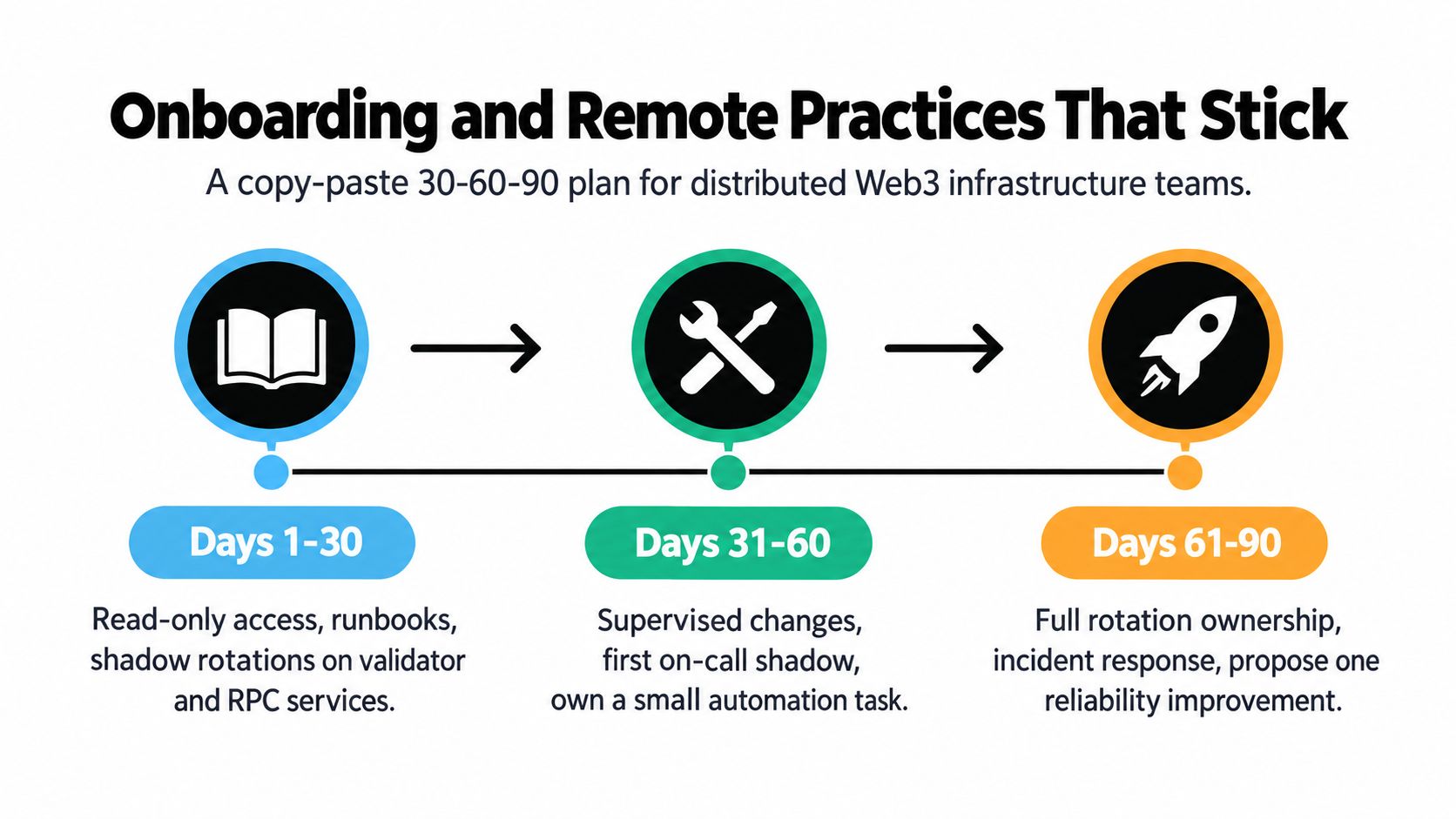
A new infrastructure hire shouldn't receive production access on day one. They should receive context, a safe way to observe, and a clear path to independent ownership. The following 30-60-90 plan works for a distributed Web3 infrastructure team because each milestone produces evidence of judgment rather than merely completing orientation tasks.
Days 1 to 30
Give the engineer read-only access to dashboards, repositories, incident history, deployment records, and runbooks. Have them shadow validator and RPC rotations, join incident channels, and explain the service map back to their manager. Their first deliverable should be a documented gap in a runbook, not an unsupervised production change.
Days 31 to 60
Assign ownership of a small service or automation task. The engineer takes a first non-shadow on-call shift with a buddy and writes a post-mortem for a low-severity incident, even if the incident happened before they joined. The point is to test whether they can reconstruct facts, identify contributing conditions, and propose a practical control.
Days 61 to 90
Move the engineer into full rotation ownership. Require one self-chosen reliability project and a 30-minute presentation to the team covering the problem, evidence, design, rollout plan, and rollback path. Managers should evaluate clarity and operational safety, not just whether the project shipped.
Remote habits that survive pressure
- Async standups: Name the owner, current risk, and next action. Don't turn them into status essays.
- Decision logs: Record the decision, alternatives rejected, owner, and review trigger.
- Incident debriefs: Record every debrief and link it to the incident, dashboard, and follow-up work.
- Time-zone overlap: Define the hours when escalation, pairing, and release decisions require live availability.
- Remote-first kit: Standardize hardware, security keys, backup access procedures, and home-network expectations without asking engineers to improvise security.
Publish the role and onboarding expectations alongside a clearly filtered remote blockchain jobs directory, so candidates understand that remote work includes operational obligations, not just location flexibility.
Career Paths and What to Do Next
A useful infrastructure career ladder starts with Node Operator, progresses through Infrastructure Engineer, reaches Senior or SRE Lead, and culminates in Head of Infrastructure. Each step adds judgment. The engineer moves from running systems, to automating them, to owning reliability and capacity, and finally to setting strategy, budget, hiring standards, and risk tolerance.
The progression is visible in compensation as well as scope. A 2026 salary summary reports an average DevOps engineer base salary of $131,556, based on 3,900 salaries tracked over the 36 months leading up to May 2026, while Built In reports an average annual salary of $133,817 (the salary summary). Treat these as market reference points, not promises. Compare base pay, equity, on-call expectations, location, level, and specialization before setting a band.
Cloud credentials can help candidates pass an initial screen. A training-market report states that 68% of enterprises expect DevOps professionals to hold at least one cloud certification (the certification interview resource), but certification won't replace evidence of operating production systems. A homelab, open-source contribution, client troubleshooting write-up, or reproducible deployment project gives interviewers something more useful to evaluate.
Actions for managers and candidates
Managers should finalize a role scorecard, publish the canonical interview loop, and align compensation with current Web3 market data. Candidates should map their gaps across Linux, cloud, consensus clients, security, incident response, FinOps, and communication, then build a portfolio that demonstrates decisions rather than screenshots.
The next skills gap is already forming around AI-driven incident response and cloud-cost optimization for high-throughput chains. Reports indicate that nearly half of organizations treat generative AI as a core part of platform-engineering strategy, while FinOps teams increasingly need to account for AI token usage as an operating expense (Platform Engineering reports). Hire people who can govern AI-assisted changes, inspect automated recommendations, control cost, and preserve human accountability during incidents.
Blockchain Jobs gives Web3 teams a focused place to find candidates across DevOps, infrastructure, security, engineering, and related functions, while helping professionals discover roles aligned with their specialization. Visit Blockchain Jobs to publish an infrastructure opening, compare relevant opportunities, or take the next step in your blockchain career.