
Average Venture Capitalist Salary in 2026: A Full Guide
The search for the average venture capitalist salary often anticipates a single, clear figure. The data says that's the wrong question.
The most useful baseline is the VC Platform Compensation Survey, which reported a median base salary of $165,000, a 10th percentile of $75,945, and a 90th percentile of $350,000. That's not a tight market range. It's a warning. VC compensation swings hard based on role, seniority, and firm economics.
If you're trying to break into venture, especially in Web3 or crypto, a key skill isn't memorizing a headline number. It's learning how to read an offer the way a hiring partner or recruiter does. Base salary matters. Bonus mechanics matter. Carry matters. In crypto-native funds, token exposure can matter just as much as cash. The candidate who understands those trade-offs usually negotiates better and chooses better roles.
Why the Average VC Salary Is a Myth
The phrase average VC salary creates false confidence. It suggests there's a normal offer for venture roles, and there isn't.
I see candidates make the same mistake over and over. They compare one associate title to another, assume the market has a clean midpoint, and miss the variables that drive pay. In venture, title inflation is common, role design is inconsistent, and firm economics shape compensation more than any generic benchmark ever will.
Two jobs with the same title can have very different value. One associate role might be heavy on sourcing, CRM work, and market mapping. Another puts you in partner meetings, expects you to run diligence, and asks you to build conviction on live deals. Firms pay for scope, judgment, and trust. They do not pay for title symmetry.
That's why the spread matters more than the so-called average. A median can help you orient, but it won't tell you whether your offer is strong for your actual seat. The better question is whether the package matches the role's investing exposure, the fund's fee base, and your path to promotion.
A useful comparison comes from demystifying virtual assistant rates. A headline rate looks clear until you examine what is included, how the work is structured, and what the buyer is really paying for. VC compensation works the same way.
For job seekers, this changes how to benchmark an offer. Ask:
- What function am I performing? Investment, platform, operations, research, or a hybrid role.
- How close am I to the investment committee and portfolio companies? Proximity to decision-making usually raises long-term earning power, even when short-term cash is similar.
- How established is the fund? A mature franchise usually has more predictable cash compensation than an emerging manager still building scale.
- What does advancement look like? A lower base can make sense if the path to senior responsibility is real and near-term. It rarely makes sense if upside is vague.
One more point matters in Web3 and crypto VC. Candidates often overprice upside and underprice liquidity risk. Token exposure, carry promises, and access can be attractive, but they should not be treated like guaranteed cash. Strong candidates know how to discount uncertain upside and negotiate from that reality.
The practical rule is simple. Benchmark the actual job, the actual fund, and the actual compensation structure. Anything less is how candidates accept weak offers with impressive titles.
Deconstructing VC Compensation Beyond Base Salary
Base salary is the easiest number to compare and the easiest number to misread. In venture, the package is built from cash today, cash at year-end, and upside that may take years to prove out.
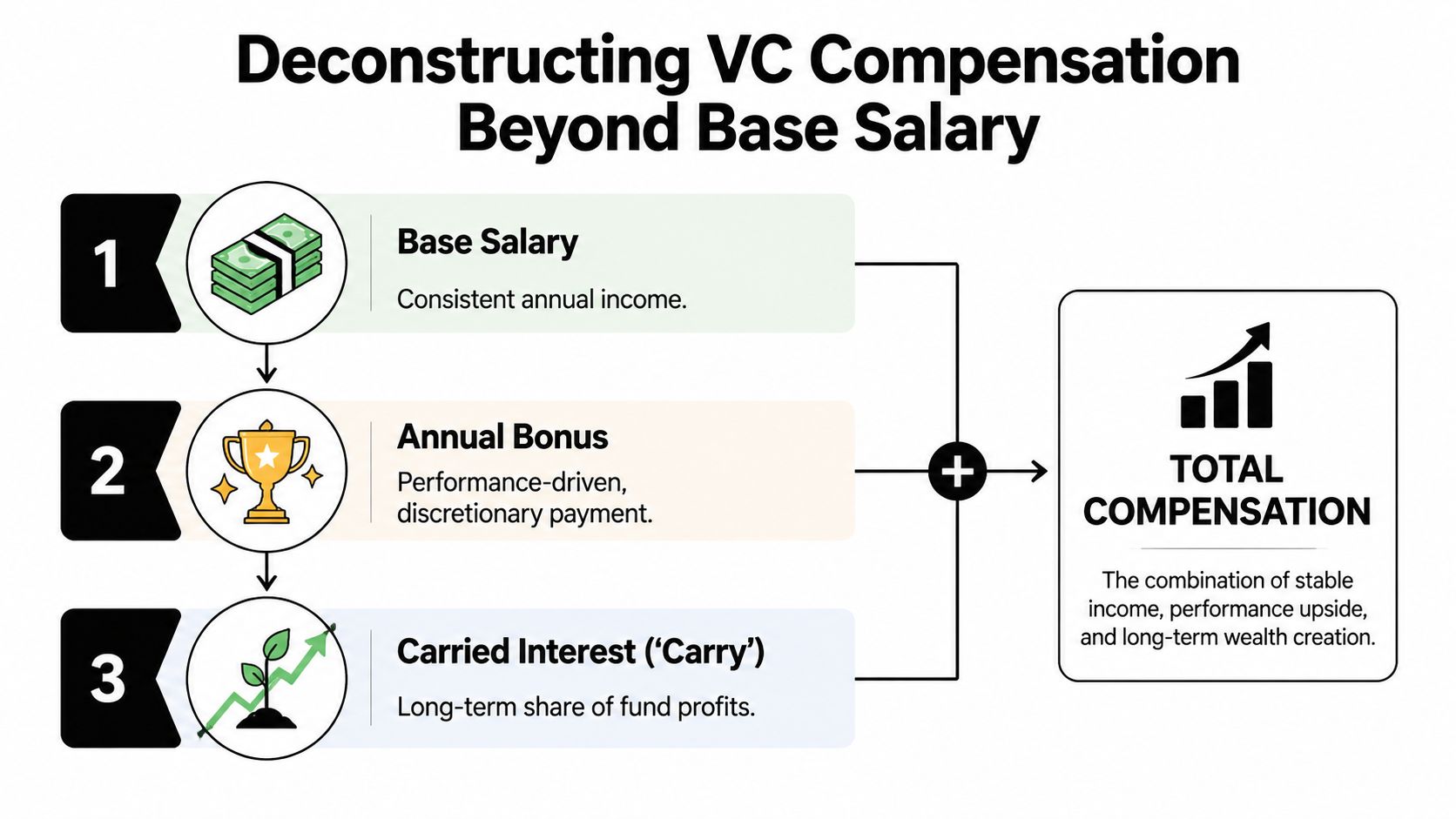
Base salary pays your bills
Base salary is the fixed part of the package, and in most firms it is funded by management fees. That matters because fee income is usually steadier than investment returns. Established franchises can often support more predictable cash compensation. Smaller or newer funds may offer strong brand value, partner access, or sector exposure, but less room on guaranteed cash.
For candidates, the question is not just "What is the base?" Ask what the base says about the fund. A high base can signal stable economics, but it can also mean slower promotion and less upside sharing. A lower base can be rational if the role gives real investment reps, faster advancement, or meaningful participation in carry.
The same pricing logic shows up in other service-heavy markets. A guide on demystifying virtual assistant rates makes the point well. The headline number means little until you know the scope, seniority, and operating model behind it. VC offers work the same way.
Bonus is where offer quality starts to separate
Many first-time candidates treat bonus as part of salary. That is a mistake.
At one firm, bonus is tied to a defined review process and paid consistently. At another, it depends on partner judgment, fund budgeting, or whether the year felt strong. Those are very different economics, even if the offer letter uses similar language.
Ask what drives payout:
- Firm performance. Is bonus tied to management company results, fundraising progress, or portfolio marks?
- Individual contribution. Are sourcing, diligence, portfolio support, recruiting, or platform work measured explicitly?
- Discretion. Does a partner decide the number, or is there a framework?
- History. How often has the target bonus been paid in full?
A vague answer does not always kill the opportunity. It does mean you should discount the number in your own model. If bonus is loosely defined, value the offer on base salary first and treat bonus as potential upside.
"Usually paid" is weaker than "paid under a documented process with a consistent track record."
Carry is the part candidates misunderstand most
Carry is a share of fund profits. It is also the part of compensation that gets oversold in recruiting conversations, especially in smaller funds and in Web3.
The presence of carry matters less than the terms. Junior candidates often hear "you'll get carry" and assume they are getting a meaningful ownership stake. In practice, the grant may be tiny, delayed until promotion, subject to a long vesting schedule, or lost if you leave before distributions happen. If the fund is early in its life, the wait can be long.
On these matters, job seekers can make better decisions than the field. Do not ask only whether carry exists. Ask when it starts, what percentage of the pool is allocated to your level, how vesting works, and what happens if you leave after three years but before realizations. In crypto funds, ask the same questions for token participation, side vehicles, and any co-invest rights. Those details determine whether the upside is meaningful or marketing.
A live market example helps. A senior associate investment strategy role may look attractive on title and mandate alone, but the compensation quality depends on how much of the package is fixed cash versus bonus or long-dated upside.
Use this framework when reviewing an offer:
| Compensation element | What to ask | Why it matters |
|---|---|---|
| Base salary | Is this tied to a formal band or negotiated case by case? | Shows how much flexibility exists and whether future raises are structured |
| Bonus | Is payout formula-based or discretionary? | Tells you how predictable annual cash compensation really is |
| Carry | Is it granted at hire, after promotion, or only for senior staff? | Changes the long-term value of the role more than title does |
A strong VC offer is a package with clear economics, not a flashy title plus vague upside. Candidates who separate guaranteed cash from contingent upside usually negotiate better and avoid weak offers dressed up as rare opportunities.
Salary Benchmarks by VC Role and Seniority
Title bands in venture look cleaner on paper than they do in hiring. Two firms can both post an "associate" role and mean very different jobs, different expectations, and different pay. For raw benchmark ranges, I would start with the Growth Equity Interview Guide's VC salary resource. Then I would adjust for scope, fund quality, and whether the role has real investing responsibility.
What each level usually means
Pre-MBA associate roles often sit at the widest pay spread in venture. The guide cites $70,000 to $200,000 in base salary and $30,000 to $150,000 in bonus. That gap exists for a reason. At one fund, the job is market mapping, note-taking, and founder outreach. At another, the associate is expected to source deals, build internal conviction, and survive in partner meetings.
Post-MBA associate compensation in the guide reaches $100,000 to $300,000 in total compensation. This is usually the first level where your previous seat matters a lot. Candidates coming from banking, growth equity, product, or an operating role at a strong startup often have more room to negotiate because the firm is buying pattern recognition, founder credibility, or sector access.
Principal or VP roles in the guide land at $140,000 to $340,000. By this point, firms expect more than execution support. You are expected to bring a view on markets, handle founder relationships well, and contribute to investment decisions in a way that junior staff usually cannot. If a firm wants principal-level judgment on an associate-level package, that is a compensation problem, not a title nuance.
At the top end, general partners may earn $500,000 to $2,000,000 in total cash compensation. That range reflects a different job entirely. Fundraising, LP management, brand, portfolio signaling power, and track record start to matter as much as investing skill.
Quick benchmark table
| Role | Benchmark compensation | What candidates should infer |
|---|---|---|
| Pre-MBA Associate | $70,000 to $200,000 base, plus $30,000 to $150,000 bonus | The spread usually reflects whether you are doing research support or acting like a junior investor |
| Post-MBA Associate | $100,000 to $300,000 total compensation | Prior deal reps, operator credibility, and sector knowledge can shift your offer materially |
| Principal or VP | $140,000 to $340,000 | Cash matters, but this is the level where carry access starts separating strong offers from average ones |
| General Partner | $500,000 to $2,000,000 total cash compensation | Senior economics depend heavily on franchise value, fundraising ability, and ownership of upside |
How candidates should use these benchmarks
Benchmarks help only if you match them to the actual mandate.
A live posting can make that easier. If you review a senior associate investment strategy role, do not anchor on the title first. Read for decision rights, investment exposure, and whether the role is support-heavy or directly on the investing track.
I use three checks when calibrating a VC offer against market data:
- Decision rights: Are you sourcing and screening, or are you expected to present recommendations and defend them?
- Relationship ownership: Do you just assist with founder calls, or are you expected to own company relationships over time?
- Promotion logic: Is there a real path to principal, or is the role designed to stay execution-focused?
These details change the right salary comparison.
A candidate doing principal-level work under a senior associate title should not negotiate off a generic associate number. The stronger argument is role scope. In practice, that is how candidates get paid closer to the top of a band instead of the middle. In Web3 and crypto funds, this matters even more because titles are often less standardized and the upside can be pushed into tokens, carry, or co-invest access rather than cash.
Key Factors That Influence Your VC Salary
Two people can hold similar titles in venture and still end up on completely different compensation paths. The difference usually comes from the firm around them, not just the job on paper.
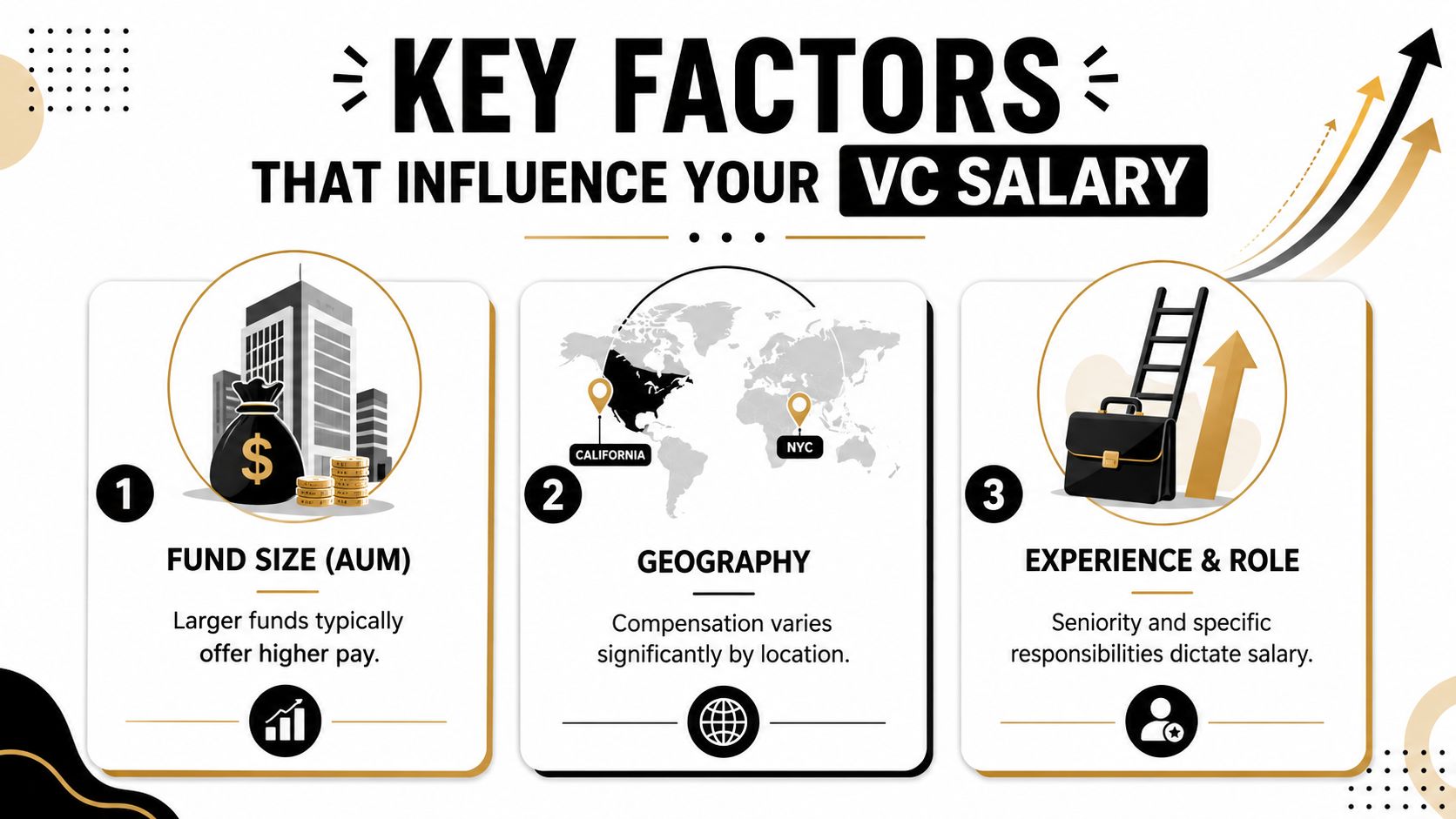
The most useful recent signal here comes from Newcomer's compensation reporting, which showed investment partners averaging $317,000 in salary in 2025, analysts at $78,000, and professionals at firms with five or more funds earning about $512,000 a year in salary plus bonus versus $350,000 at smaller firms. That gap is why broad averages are so misleading.
Fund size changes everything
A larger, more mature fund usually has stronger fee economics, more institutional process, and more room to pay competitively. Smaller or newer firms often have talent upside, but they may not have the same cash flexibility.
For candidates, the trade-off usually looks like this:
- Established multi-fund platform brings stronger cash compensation, clearer infrastructure, and often better-defined roles.
- Smaller emerging manager may offer broader exposure, faster learning, and potentially better access to long-term upside if the firm succeeds.
Neither is automatically better. It depends on your risk appetite and where you are in your career. If you need predictable cash and formal training, bigger is often safer. If you already have reps and want accelerated responsibility, a smaller fund can be the better move.
Geography still matters, but less than candidates think
Location affects compensation, but candidates often overstate cost of living and understate ecosystem density. What usually pays more isn't just the city. It's the concentration of talent, LP relationships, founder networks, and competition for experienced investors.
That said, geography should be read together with fund maturity. A top fund in a major hub tends to price talent differently than a first-time manager operating outside the main capital centers.
This short explainer is worth watching because it frames compensation through the operating realities of the industry, not just salary bands.
Experience is more than years
In venture hiring, "experience" rarely means pure tenure. Firms pay up for candidates who reduce risk. That can come from investing background, operator credibility, crypto-native network depth, technical fluency, or founder empathy.
Here's how I'd rank what tends to improve compensation most in interviews:
- Proven investment judgment through memos, sourcing quality, or past picks
- Relevant network density with founders, angels, operators, and LP-adjacent relationships
- Category expertise in a fund's target market, especially in technical sectors
- Ability to represent the firm externally with credibility
A candidate with five years of generic finance experience often loses to a candidate with sharper sector credibility and better founder access.
A practical framework for evaluating offers
When you're comparing offers, use three filters instead of one.
| Factor | High-cash signal | Higher-upside signal |
|---|---|---|
| Fund maturity | Established multi-fund firm | First or early fund with room to grow |
| Firm platform | Defined bands and structured bonuses | Flexible roles with broader scope |
| Your fit | You match the exact mandate today | You can expand into a larger role quickly |
That's the lens that makes the average venture capitalist salary useful. Not as a single number, but as a set of clues about where value sits.
The Web3 and Crypto VC Difference
Crypto-native venture changes the compensation conversation because the upside isn't always packaged in the traditional VC way. Cash still matters. Carry still matters. But in Web3, candidates also need to understand token exposure, advisory economics, and the timing risk that comes with more liquid but more volatile assets.

What changes in a crypto-native fund
In a traditional fund, junior candidates usually focus on salary, bonus, and whether carry is available. In a crypto fund, the package can include additional moving parts:
- Token grants or token-linked incentives tied to the fund, studio, or related ecosystem work
- Advisory allocations for helping portfolio projects with token design, go-to-market, governance, or ecosystem growth
- Liquidity timing risk because value can appear earlier on paper but still be hard to realize cleanly
- Regulatory and structural complexity that can make two offers with similar upside language very different in practice
Candidates often get dazzled by token packages. A token package can be meaningful. It can also be illiquid, highly volatile, or subject to vesting and transfer rules that make it much less attractive than it first appears.
A realistic comparison
Take two hypothetical roles. The first is at a traditional early-stage software fund with solid salary and predictable bonus. The second is at a crypto-native fund offering lower cash but meaningful token participation tied to advisory work and ecosystem involvement.
The second role may outperform if the platform is strong, the token design is credible, and the team has a real ability to help projects launch and sustain adoption. It may also underperform badly if the fund overuses token upside to compensate for weak cash economics.
That's why candidates need to press on details. If a fund discusses token compensation, ask how it works operationally. Is it direct, vested, discretionary, project-specific, or tied to separate entities? If the answer is fuzzy, value it cautiously.
What sophisticated candidates ask
The strongest Web3 candidates don't dismiss token upside, but they don't price it at face value either. They ask questions like:
- What portion of compensation is cash versus variable crypto-linked upside
- Who controls token allocation decisions
- Whether participation is tied to firm tenure, portfolio support, or deal involvement
- How the fund thinks about liquidity, vesting, and conflicts
A good role in crypto VC often rewards people who can bridge investing, community, product instinct, and market structure. That hybrid skill set can make a candidate unusually valuable.
For people evaluating crypto-adjacent finance roles, this kind of distinction shows up in adjacent openings too, such as this crypto fund accounting manager role, where the economics of digital assets affect compensation thinking even outside direct investing seats.
In Web3 VC, upside can arrive in forms that look exciting before they look understandable. Understandable comes first.
How to Negotiate Your VC Compensation Package
Most candidates negotiate venture offers too narrowly. They spend all their energy on base salary, then accept vague language on bonus, carry, and token participation. That's where money gets left on the table.
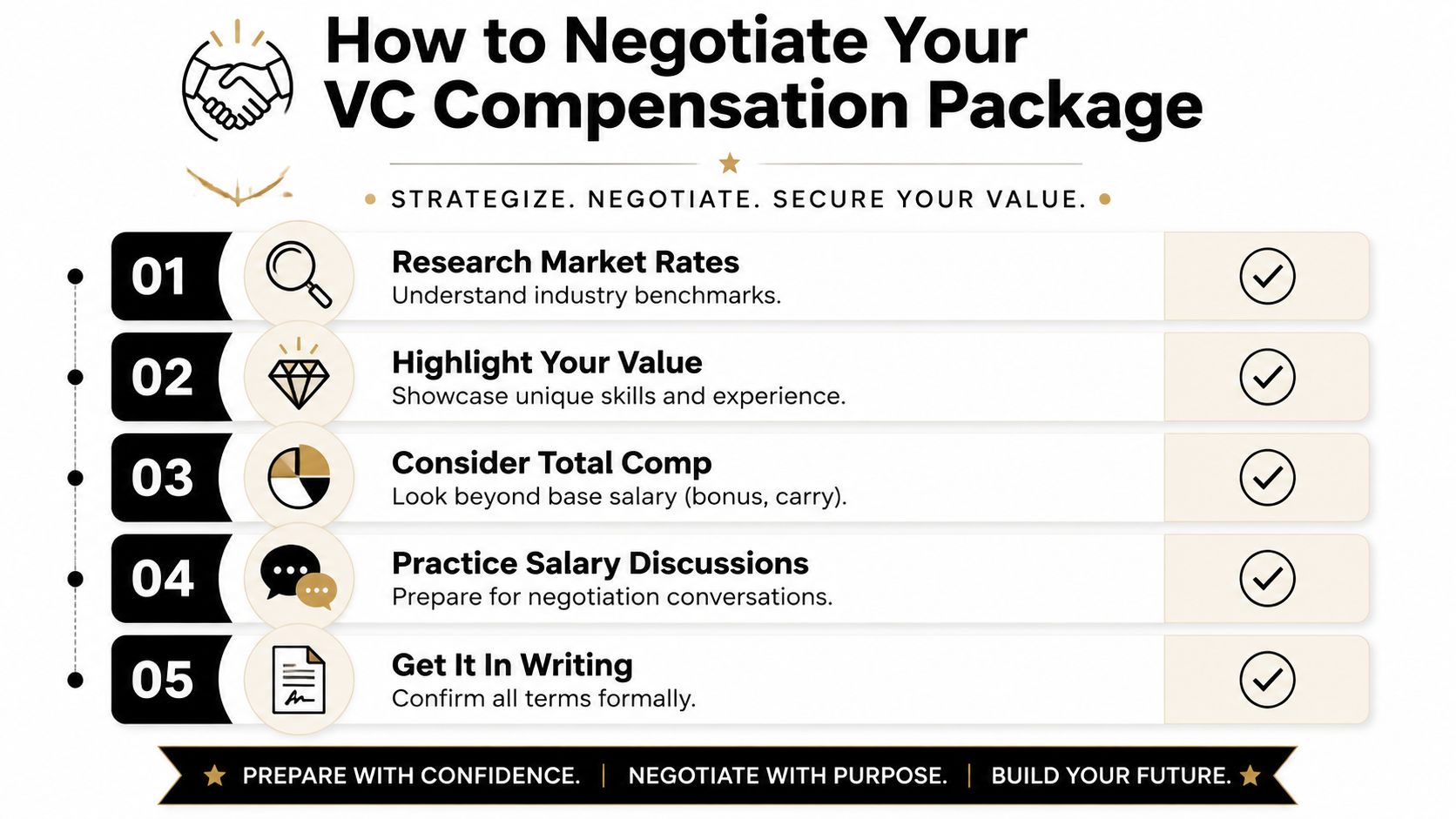
What to ask before you counter
A strong negotiation starts with diagnostic questions. You want enough clarity to understand whether the offer is tight because of policy, because of fund economics, or because they're waiting to see if you'll ask.
Use questions like these:
How is bonus determined in practice
You're looking for structure, not a promise.Is carry part of this role now or only after promotion
This tells you whether the firm really views you as part of the investment engine.How do you benchmark this role internally
That helps reveal whether the title is masking broader responsibility.For crypto funds, how are token incentives documented
If there's no clear process, discount the value.
What good negotiation sounds like
You don't need aggressive language. You need precise language.
Try lines like:
Based on the scope we've discussed, especially around investment work and portfolio support, I'd like to revisit the total package rather than base salary alone.
Or:
I'm aligned on the role. Before we finalize, I'd like to understand whether there's flexibility on bonus structure, carry participation, or the timing of eligibility.
For general salary prep, Proficiently's salary negotiation guide is a useful companion because it covers the communication side well. In venture, the same principle applies. Calm, specific candidates negotiate better than theatrical ones.
What works and what doesn't
| Approach | Usually works | Usually doesn't |
|---|---|---|
| Anchor to market context | Yes, if tied to role scope and firm type | No, if you throw out random averages |
| Negotiate total comp | Yes, especially for carry or token-heavy roles | No, if you focus only on base |
| Ask for written specifics | Yes, especially for variable compensation | No, if you accept verbal reassurance |
One last point matters. If a firm can't move on salary, there may still be room elsewhere. Ask about title calibration, earlier carry review, clearer bonus criteria, or token grant documentation. Negotiation isn't just about getting more. It's about reducing ambiguity.
If you want to keep tracking how compensation and hiring standards evolve across the space, spend time with the market coverage on the Blockchain Jobs blog. Better information usually leads to better timing, and better timing improves both offers and career moves.
If you're exploring your next move in venture, crypto, or broader Web3, Blockchain Jobs is one of the better places to find roles that reflect how this market hires. You can browse investing, finance, operations, product, engineering, legal, and growth positions across the ecosystem, including remote-friendly opportunities and crypto-native teams that don't show up on generalist job boards.