Land Top Blockchain QA Jobs: A 2026 Roadmap

You're probably in one of two camps right now. You already work in QA and keep seeing blockchain roles that look better paid, more technical, and harder to break into than they really are. Or you've tested fintech, payments, APIs, or distributed systems and suspect that Web3 is less about hype than about applying the same rigor in a riskier environment.
That instinct is right. Blockchain QA isn't a separate planet. It's QA with higher consequences, messier infrastructure, and less tolerance for shallow testing. The candidates who get hired aren't always the ones who know the most jargon. They're the ones who can explain how they'd prevent bad releases across smart contracts, wallets, off-chain services, and user flows.
From Traditional QA to Blockchain Pioneer
A lot of strong testers talk themselves out of blockchain QA jobs before they even apply. They see terms like RPC, gas, forks, wallets, finality, reorgs, and Solidity, then assume the role belongs to protocol engineers or smart contract auditors.
That's rarely how hiring teams think. Good managers know that test design, bug isolation, automation discipline, risk analysis, and release judgment still matter more than buzzword fluency. The problem is that candidates often present themselves as generic QA people when the role needs someone who can apply those fundamentals to a decentralized product.
The opportunity is real. The Web3 industry added 66,494 new roles in 2025, a 47% rebound from 2024, and North America posted over 21,000 jobs, according to Coincub's Web3 jobs report. That matters because maturing teams stop treating QA as an afterthought. They need people who can keep shipping velocity without accepting smart contract, wallet, or infrastructure risk blindly.
If you're coming from Web2, your biggest adjustment isn't learning everything at once. It's learning where traditional QA assumptions break. A passing UI flow doesn't mean the transaction settled correctly. A green staging environment doesn't mean mainnet-like conditions are safe. A bug that would be annoying in SaaS can become irreversible once contract code is live.
Practical rule: In blockchain QA interviews, hiring managers don't expect you to know every protocol. They expect you to know how to think when rollback isn't simple.
That's also why shift-left thinking matters more here than in many standard web apps. If you want a strong primer on redefining software quality, it helps frame why earlier validation matters so much when the cost of release mistakes is high.
If you're still trying to enter the space from the ground floor, this guide on landing entry-level blockchain jobs is useful background. But for QA specifically, the hiring bar usually comes down to one question: can you prove you know how to test systems that combine code, infrastructure, and money movement?
Mastering the Blockchain QA Skill Stack
Hiring managers usually sort candidates into three buckets fast. They understand blockchain concepts but can't test well. They test well but don't understand how blockchain products fail. Or they bridge both well enough to be useful from week one.
That third group gets interviews.
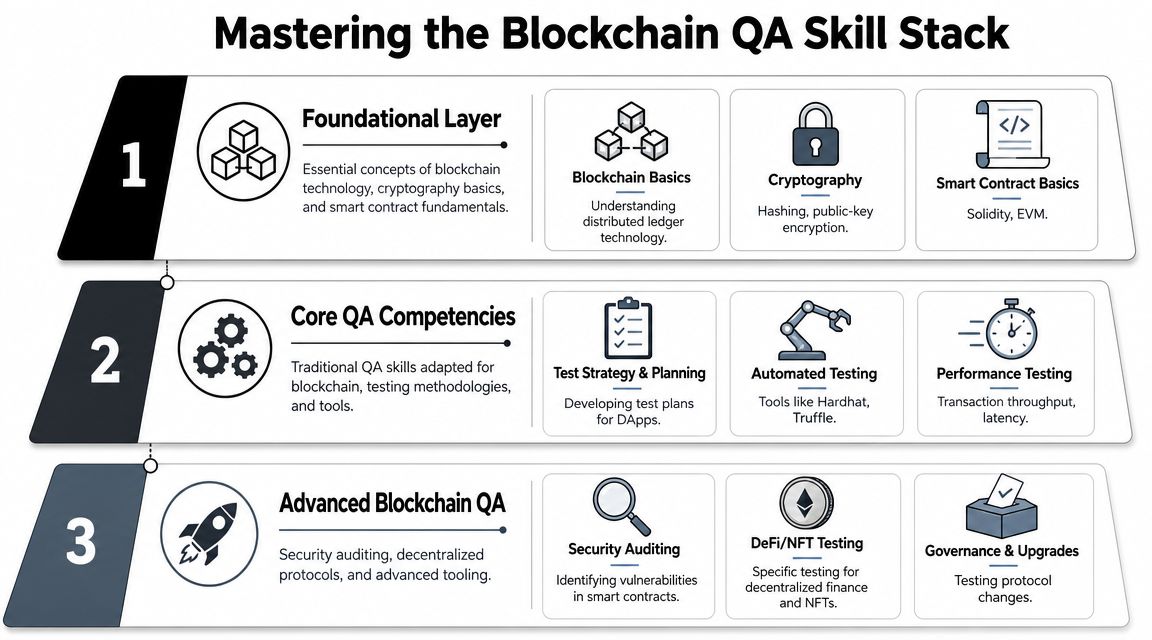
Foundational layer
Start with the mechanics you'll need to discuss without sounding vague.
You should understand what a transaction is, what confirmation means, what gas affects, how a wallet signs actions, and how a smart contract differs from a normal backend service. You don't need to become a protocol researcher, but you do need to explain failure modes clearly. If a transaction is pending, dropped, reverted, or succeeds on-chain while the UI misreports state, you should be able to talk through what you'd verify.
From a hiring perspective, this matters because weak candidates treat blockchain as a black box. Stronger candidates know where to look when symptoms don't match what the user sees.
A simple benchmark is this. Can you answer these without drifting into generalities?
- Transaction lifecycle: What would you validate between wallet submission and confirmed on-chain state?
- Network differences: Why can the same flow behave differently on local nodes, testnets, and production-like environments?
- Gas and fees: How might fee assumptions affect usability, error handling, and edge cases?
If you can discuss those with confidence, you already sound more credible than many applicants.
Application layer
Many teams first encounter difficulties. Most blockchain products aren't just smart contracts. They're dApps connected to wallets, RPC providers, indexers, APIs, auth layers, and front-end state management.
Candidates often say they've tested end-to-end flows. Good. But in Web3, “E2E” has to mean more than clicking through a UI. I want to hear how you'd test wallet connection states, chain switching, stale balances, delayed indexing, RPC failures, and mismatches between on-chain truth and off-chain displays.
A lot of job postings reflect that reality. They ask for ownership of automated regression, CI/CD integration, UI and API testing, and non-functional coverage using tools like Playwright, Selenium, pytest, k6, JMeter, or Locust. That's because blockchain apps often fail at the seams between systems, not just inside a happy-path feature.
If your testing story ends at “I ran the user journey and it passed,” you'll sound junior even if you have years of QA experience.
What works better is speaking in failure-oriented terms:
| Area | What hiring managers want to hear |
|---|---|
| Wallet flows | You can test connect, disconnect, wrong-network, rejected-signature, and re-auth patterns |
| RPC dependencies | You think about flaky nodes, rate limits, delayed reads, and fallback behavior |
| Front-end state | You validate loading, pending, success, revert, retry, and stale-data conditions |
| CI/CD | You know how tests fit into release gates, not just local execution |
If you're moving from manual testing into this kind of role, this guide on remote manual QA tester jobs helps with the transition. But for blockchain roles, you'll need to show that manual skill has evolved into technical quality ownership.
Smart contract layer
Hiring decisions often hinge on this.
According to guidance cited from ConsenSys, effective smart contract testing needs unit tests, scenario-based tests, and integration tests on a testnet, and relying only on end-to-end tests is a common failure mode because it misses low-level bugs in immutable contract code, as noted in this overview of crypto QA roles. That single point tells you a lot about what interviewers care about.
They want to know whether you understand test layering.
Here's the practical version:
Unit tests catch contract logic errors early.
Every function should be tested for expected behavior, rejected behavior, and boundary conditions.Scenario tests prove the business logic holds under realistic sequences.
Not just one transfer, but approve then transferFrom, stake then claim, pause then retry, or role changes after state changes.Integration tests expose what breaks when contracts interact with wallets, oracles, services, or other contracts. Often, assumptions collapse in such situations.
A weak candidate says, “I'd test the app on a testnet.” A stronger one says, “I'd cover contract functions at unit level, run scenario tests for edge inputs and permissions, then verify contract interactions in a local fork or testnet before release.”
What actually gets noticed
You don't need mastery of every framework. You do need enough depth to demonstrate how you'd work.
Hiring teams usually respond well when candidates can show a stack like this:
- Automation tools: Hardhat or Foundry for contract tests, Playwright or Selenium for UI flows
- API and backend validation: pytest, Postman, or custom scripts
- Performance awareness: k6, JMeter, or Locust for off-chain service behavior
- Delivery discipline: CI pipelines, test gating, and reproducible environments
The mistake is trying to appear broad without depth. Pick one contract testing workflow and one end-to-end stack. Build something small. Explain it clearly. That wins more interviews than reciting a tool list.
Building a Job-Winning Resume and Portfolio
Most resumes for blockchain QA jobs fail for a simple reason. They read like generic QA resumes with a few Web3 keywords stuffed into the summary.
Hiring teams don't want keyword stuffing. They want evidence.

Rewrite your experience in the language of risk
You don't need to invent blockchain experience. You do need to translate your work in a way that makes the overlap obvious.
Compare these two descriptions:
- “Tested payment features across web and mobile.”
- “Validated transaction flows across UI, API, and backend reconciliation, including failure handling and regression coverage.”
The second one sounds closer to what a Web3 team needs because it signals systems thinking.
The same goes for infrastructure and automation work. Public crypto QA listings increasingly favor automation-first candidates who can own E2E suites, CI/CD integration, and performance testing, as reflected in public crypto QA job requirements. If your resume still centers only on manual execution, you're underselling yourself.
Use bullets that show ownership:
- Built regression coverage for multi-step transaction or payment workflows
- Designed test strategy for API, UI, and backend integration points
- Added CI checks that blocked unstable builds from release
- Investigated flaky tests and reduced noise in release pipelines
- Validated edge cases around latency, retries, permissions, and asynchronous state changes
A portfolio beats a claims-heavy summary
When I review candidates, a small public portfolio often matters more than an extra certification. It proves you can work with the stack and communicate clearly.
A strong blockchain QA portfolio can be compact. It should include things like:
- A GitHub repo with contract tests for a simple ERC20, staking, or marketplace contract
- A short test plan for a dApp flow such as connect wallet, switch network, approve, submit, confirm
- Bug reports or exploratory notes that show you can isolate causes instead of logging vague failures
- Readme documentation explaining setup, assumptions, and why specific cases were covered
Hiring signal: A portfolio tells me how you think when nobody gives you a script.
You can also publish a small write-up showing how you tested a forked protocol locally, how you handled event timing issues, or how you found a mismatch between front-end state and contract state. That kind of work is hard to fake.
Make your resume easy to screen
Recruiters and hiring managers still filter fast. Clean structure matters. Customized wording matters. ATS compatibility matters.
If you want to pressure-test formatting and keyword alignment, tools that focus on best ATS CV tools can help you catch obvious issues before you apply. For layout and role positioning, this guide to resumes for web developers is also useful because many of the same clarity principles apply to QA engineering resumes.
One more practical note. Don't list every tool you've touched. List the tools you can defend in an interview.
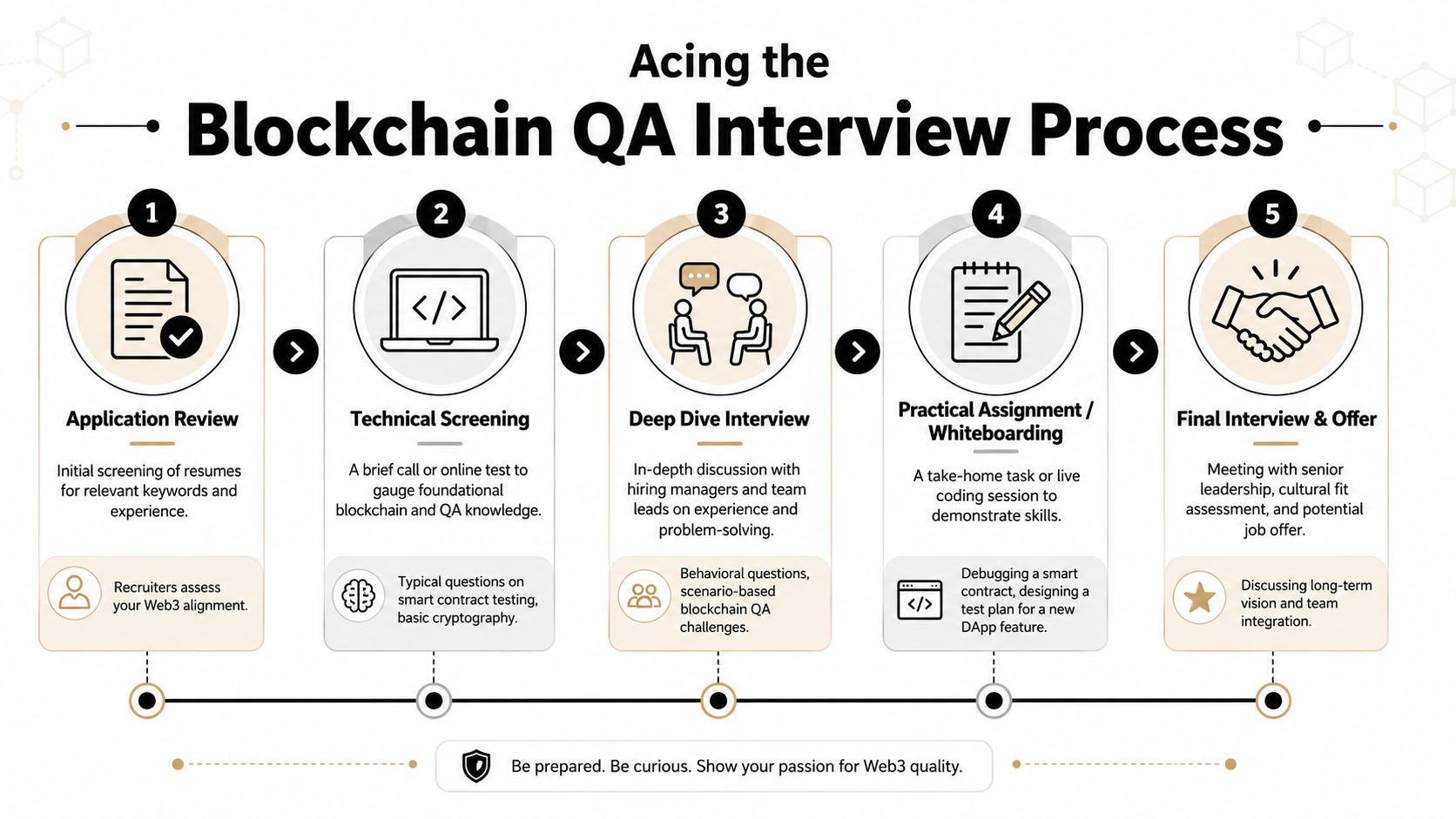
Acing the Blockchain QA Interview Process
Most blockchain QA interview loops are less mysterious than candidates think. They usually follow a predictable pattern. Resume screen, technical conversation, deeper problem-solving, practical exercise, then final alignment.
What changes in Web3 is the content. Interviewers care less about whether you memorized definitions and more about whether you can reason through messy state, permanent code, and infrastructure uncertainty.
Here's the usual shape of the process.
What recruiters and hiring leads are screening for
The first call is often simple. They're checking whether your background maps to the role and whether you understand what blockchain QA involves.
If I ask, “What interests you about testing Web3 products?” I'm not looking for ideology. I'm looking for signs that you understand the test surface. Wallets, smart contracts, async transactions, off-chain integrations, release risk. Candidates who speak concretely move forward.
The next stage usually gets more technical. Questions often sound like this:
- How would you test a staking contract?
- What's the difference between testing on a public testnet and testing on a local mainnet fork?
- How would you handle a bug where the transaction succeeds on-chain but the UI still shows failure?
- What should be covered by unit tests versus end-to-end tests?
A weak answer jumps straight to tools. A better answer starts with risk and layers.
What good answers sound like
Suppose you're asked how to test a staking contract. A strong response doesn't need deep protocol theory. It should show structure.
You might say you'd verify core contract rules first: deposit behavior, reward accrual logic, withdrawal constraints, role permissions, and failure conditions. Then you'd design scenario tests around repeated stakes, partial withdrawals, timing boundaries, and unauthorized actions. After that, you'd validate integrations such as wallet signing, event handling, displayed balances, and delayed updates from off-chain reads.
That answer works because it shows separation between contract correctness and application behavior.
Don't answer blockchain QA questions as if the only test layer is the browser.
Performance questions also come up more often than candidates expect, especially for teams with high transaction volume or dependency-heavy products. If you need practice on that angle, this guide for QA performance interviews is a useful prep resource.
A few paragraphs later in the process, many teams give some version of a practical task. Before that, watch a short example discussion to calibrate expectations:
A realistic take-home example
A common assignment would look something like this:
You receive a simple token contract with transfer and approve functions. You're asked to write tests using Hardhat, explain edge cases, and note anything you'd want clarified before production.
What interviewers really evaluate:
| Submission area | What they want |
|---|---|
| Coverage | Happy path plus failure cases, permissions, and boundary behavior |
| Clarity | Readable test names, sensible grouping, clean setup |
| Judgment | Comments on assumptions, gaps, and risk areas |
| Professionalism | Instructions that let another engineer run the suite quickly |
Candidates often lose points by overfocusing on volume. Twenty shallow tests aren't better than eight thoughtful ones.
A strong submission usually includes:
- Direct function tests for expected outcomes and reverts
- Edge cases such as zero values, unauthorized calls, or repeated approvals depending on contract logic
- Brief notes on what should later be covered by integration or UI tests
- A clean readme with setup and execution steps
Interview mistakes that cost offers
The most common misses are predictable:
- Tool dumping: naming frameworks without explaining how you've used them
- No risk prioritization: treating all bugs as equal
- UI-only thinking: ignoring contract, backend, or infrastructure layers
- Weak bug communication: describing symptoms without isolation steps
- No curiosity: failing to ask clarifying questions about protocol rules or product behavior
Good candidates make the interviewer's job easy. They think out loud, define assumptions, and show where they'd start testing first.
Navigating Salary and Finding High-Impact Roles
Compensation in blockchain QA is real, but the market is narrower and more specific than many job seekers assume. A lot of people see a few eye-catching roles and conclude that every QA opening in Web3 pays premium rates. That's not how it works.
The jobs with the strongest compensation usually ask for more than testing basics. They want a mix of automation ownership, backend awareness, cloud comfort, and enough Web3 experience to avoid expensive mistakes.
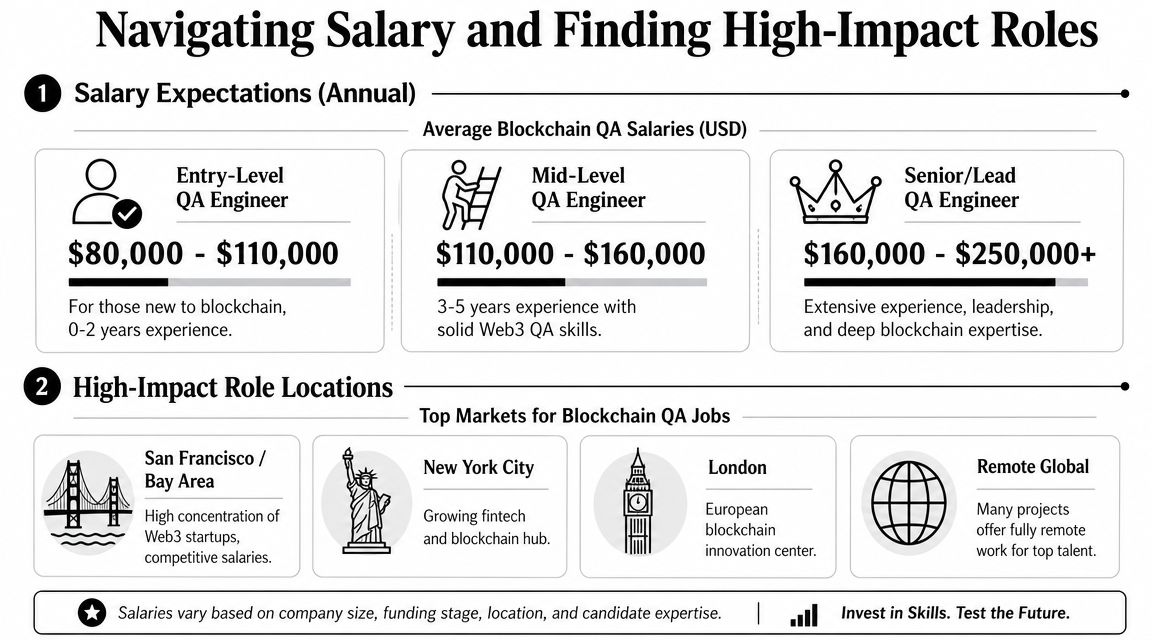
What salary ranges actually tell you
Current listings show that salary bands can vary widely. Some U.S.-based blockchain QA roles are listed around $87k to $145k, while others show $160k to $240k, and listings can also include requirements such as backend languages, AWS, Web3 experience, or even language expectations, as reflected in recent blockchain QA job listings.
The takeaway isn't just that pay is wide. It's that specialization changes pricing.
A candidate who can execute manual test cases for a dApp may qualify for some roles. A candidate who can design automated contract tests, reason about cloud services, improve CI quality gates, and discuss infrastructure failure modes competes for a different class of role.
Where stronger roles tend to show up
Large job boards can help, but many high-impact blockchain QA jobs surface through narrower channels first. Teams often recruit through:
- Protocol and product communities on Discord or Telegram
- GitHub activity around open-source repos and issues
- Founder and engineering networks on X and industry communities
- Specialized job boards focused on crypto and Web3 roles
That last category matters because broad job platforms often flatten role context. A niche board can make it easier to filter for Web3-specific QA, remote-friendly openings, and adjacent engineering roles. Blockchain Jobs is one example of a dedicated board that lists QA roles alongside engineering, DevOps, security, and product jobs across the Web3 ecosystem.
How to judge role quality before you apply
Not every blockchain QA opening is worth your time.
Look for signals that the team understands quality as engineering work:
- Clear ownership language: mentions of strategy, automation, CI, performance, or release quality
- Specific stack details: references to contract testing, wallet flows, APIs, or infrastructure
- Cross-functional interaction: evidence that QA works with engineering, product, and DevOps
- Defined product surface: DeFi, wallets, exchange features, identity, NFTs, or protocol infrastructure
Be cautious when a role sounds like “test whatever developers built” with no mention of tooling, environment strategy, or release process. That usually means the team wants QA coverage without QA investment.
The best blockchain QA jobs don't just ask you to find bugs. They trust you to influence how software gets shipped.
Your First 90 Days in a Blockchain QA Role
Getting hired is only the first filter. The first three months decide whether people see you as a test executor or as a quality engineer they can trust.
Days 1 to 30
Learn the product at the architecture level. Read the contracts, trace the user flows, understand the wallets involved, and map where off-chain services influence what users see. Spend time with developers early. You want to know which failures hurt users most and which parts of the stack are already fragile.
Don't rush to redesign everything. Start by understanding how the current team releases, what tests already exist, and where confidence is low.
Days 31 to 60
Find a contained win. Improve one flaky suite. Add missing edge-case coverage to a risky contract flow. Document a user journey that currently lives only in someone's head.
Credibility takes shape. Teams trust new QA hires when they reduce uncertainty quickly and communicate clearly.
Days 61 to 90
Start thinking beyond today's regression pack. Look at release gaps, monitoring blind spots, and upcoming protocol or feature changes that will affect test strategy. The broader software developer, QA analyst, and tester field is projected to grow 15% from 2024 to 2034, with strong long-term demand according to the U.S. Bureau of Labor Statistics outlook. In blockchain QA, that long-term value usually goes to people who keep learning new protocols, tools, and validation approaches instead of freezing their skill set at the point of hire.
Your first 90 days should leave the team with three impressions. You learn fast. You test thoroughly. You improve the system, not just the checklist.
If you're ready to turn that into a real search, Blockchain Jobs is a practical place to look for blockchain QA roles alongside adjacent engineering and infrastructure positions, especially if you want to compare how different Web3 teams define quality ownership before you apply.