
Crypto Trader Salary: The 2026 Guide for Job Seekers

Most advice about crypto trading careers starts in the wrong place. It treats "trader" as a single job title, then mixes together hobbyist speculation, prop-style risk taking, and institutional quantitative work as if they pay on the same curve.
They don't.
If you're evaluating a crypto trader salary as a job seeker, the only useful question is this: are you trying to get paid for taking personal market risk, or are you building a career inside a firm that pays for research, execution, and risk management? That distinction changes everything about compensation, interviews, and long-term earning power.
The Crypto Trader Salary Myth
The loudest voices in crypto still sell the image of the independent day trader. That image attracts candidates, but it doesn't describe where most durable compensation sits.
The market splits into two very different realities. One is the retail day trader, where income is volatile and often negative. The other is the institutional quant trader, where firms pay for repeatable process, tooling, and risk control. As ZipRecruiter's cryptocurrency trader salary overview notes, existing content often fails to distinguish between the retail day trader and the institutional quant trader, and it reports that 90% of retail traders reportedly stay broke or earn nothing, while institutional quant traders can earn $180,000 to $325,000+.
That gap produces the biggest hiring mistake I see. Candidates walk into interviews talking about conviction, intuition, and "reading the market." Employers hiring serious trading talent usually want something else. They want evidence that you can turn noisy information into a disciplined edge.
What job seekers get wrong
Retail trading and professional trading don't reward the same habits.
- Retail framing: You focus on personal PnL, social media narratives, and discretionary calls.
- Institutional framing: You focus on process design, market structure, research hygiene, position sizing, and controlled execution.
- Hiring implication: A recruiter will value a tested strategy log, a backtesting workflow, or a risk framework more than screenshots of winning trades.
Most candidates chase the word "trader" when they should be targeting the operating model behind the role.
If you need a sober reset on what trading income really looks like outside recruiter copy and crypto Twitter, Colibri Trader's realistic trading guide is worth reading. It helps separate romanticized trading narratives from the practical question of whether a strategy can support actual income.
Where the real career opportunity sits
The high-paying lane isn't "be passionate about markets." It's be useful to a market maker, hedge fund, exchange, or prop-style desk.
That means your goal shouldn't be to prove you're bold. It should be to prove you're employable inside a professional system. Once you see the market that way, the crypto trader salary conversation stops being about hype and starts being about role design.
Crypto Trader Salary Benchmarks by Role
The salary ladder in crypto trading is steep, but it isn't random. Pay tends to rise when a candidate moves from execution support into strategy ownership, and then again when they add quantitative depth.
According to Glassdoor's 2026 crypto trader salary data, the average annual salary for a Crypto Trader in the United States is $158,395. The same source shows that entry-level positions can start as low as $36,000, while highly specialized roles such as a Crypto Quant Researcher at Citadel Securities carry base salaries between $250,000 and $350,000.
Crypto Trader Compensation Tiers 2026
| Role / Tier | Experience Level | Total Compensation (Annual) | Common Responsibilities |
|---|---|---|---|
| Entry-Level Analyst or Trainee Trader | Early career | $36,000 to $48,000 | Trade support, market monitoring, execution assistance, training, mentorship |
| General Crypto Trader | Developing to mid-career | $158,395 average in the U.S. | Market execution, risk monitoring, strategy implementation, desk reporting |
| Senior Quant Researcher or Institutional Quant Trader | Advanced specialist | $250,000 to $350,000 base | Model development, systematic strategy research, execution optimization, risk systems |
That table matters because candidates often compare the wrong jobs. A trainee role with full mentoring isn't a "bad version" of a quant seat. It's a different rung on the ladder.
How to read the ladder correctly
The first salary jump usually comes from moving beyond observation. If you're only watching markets and relaying notes, you're replaceable. Once you can own part of the decision chain, such as risk flags, research output, or execution logic, your value increases.
The second jump comes from specialization. That's why quant-heavy seats pull away so sharply from generic trader titles.
A practical way to evaluate postings:
- Look for training language. If a role offers full training and mentorship, expect lower starting pay and stronger emphasis on coachability.
- Look for tool ownership. If the job includes model research, automation, or low-latency execution work, compensation usually rises.
- Look for institutional signals. Team structure, strategy language, and references to market making or systematic execution usually indicate a more serious pay band.
For context on how volatile independent trading income can be compared with salaried roles, Rize Trade's insights on day trader earnings are useful. It helps candidates avoid benchmarking a professional role against highly inconsistent self-directed trading outcomes.
What recruiters actually infer from title inflation
A lot of candidates over-index on the title "trader." Recruiters don't. They read the work behind it.
If you're applying to something like this DeFi quant trader opening at GSR Markets, the hiring team will care less about whether you've called yourself a trader and more about whether you've built the skills that produce trading outcomes inside an institutional workflow.
Hiring filter: Titles open doors. Demonstrated decision quality gets offers.
Deconstructing Total Compensation in Crypto
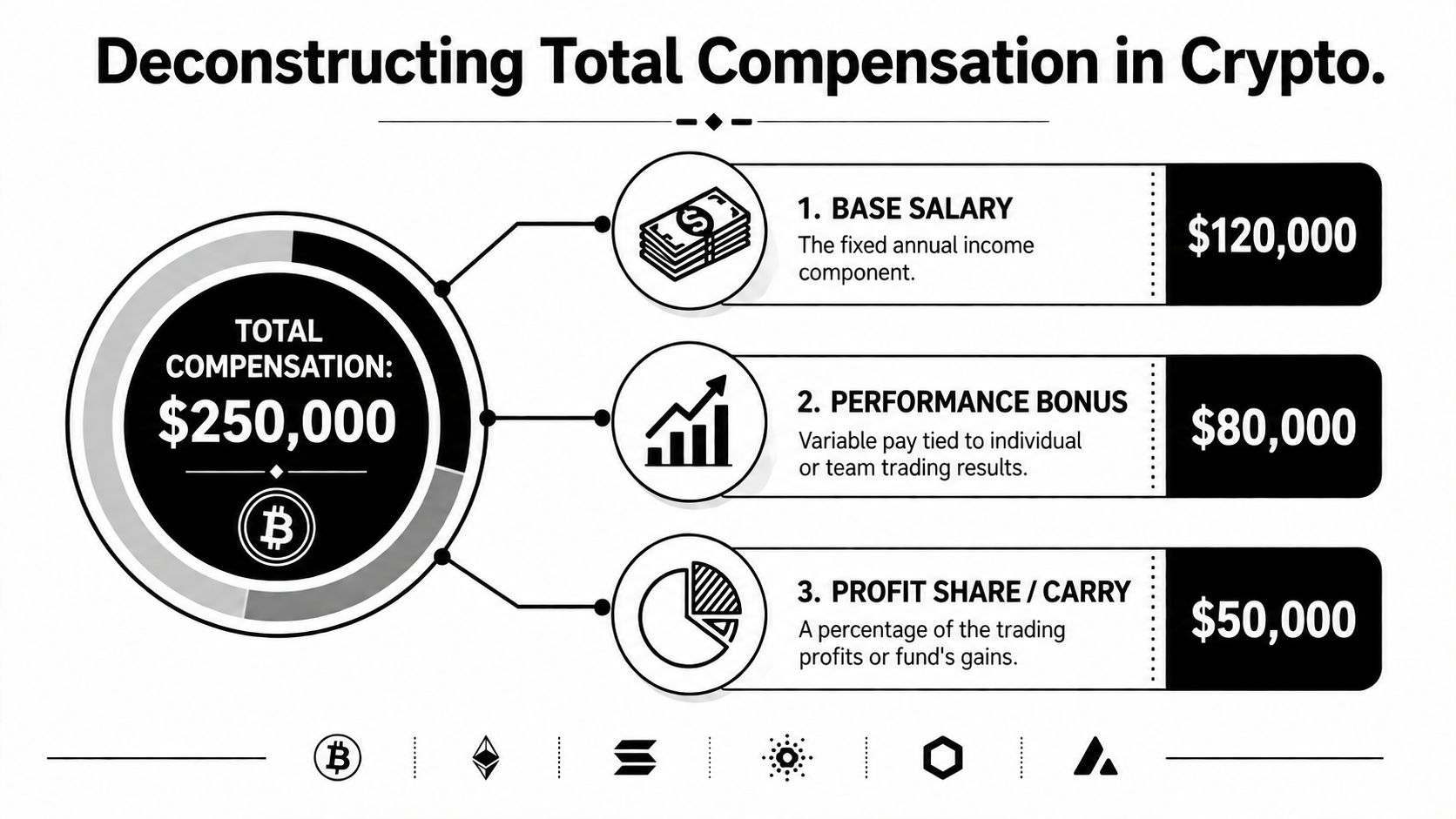
A crypto trader salary almost never stops at base pay. You need to evaluate a compensation stack, not a single number.
That stack usually includes base salary, a performance-linked component, and some version of upside that can expand or shrink with market conditions. Candidates who only negotiate the headline salary often misread the actual value of the offer.
The compensation stack
Start with the fixed part. That's your base salary. It's what protects you when markets cool, desks de-risk, or token prices fall.
Then ask about the variable layers:
- Performance bonus tied to individual or desk results.
- Profit share or carry tied to realized gains or strategy contribution.
- Token or equity exposure that can increase upside, but also introduces valuation risk.
Many candidates get trapped. They treat speculative upside as guaranteed compensation. It isn't.
What market cycles do to offers
In the 2024 to 2025 down market, average total crypto compensation dropped 26% to $263,000, while token-heavy pay became less valuable. The same market cycle showed that token grants can inflate compensation by 40% to 60% in bull markets, which makes offer evaluation highly sensitive to timing, according to Dragonfly Capital commentary on crypto compensation.
That changes how you should interview. When a hiring manager quotes a large total package, don't stop at the total.
Ask these questions instead:
- How much is fixed base pay?
- What triggers the performance component?
- Is profit share realized in cash, tokens, or deferred form?
- What assumptions sit behind the token valuation?
- What happened to team compensation during the last weak market?
Interview rule: If a company can't explain how the variable portion is earned and valued, you should discount it mentally.
How to compare two offers
A lower headline offer can be stronger if the base is solid and the upside mechanics are clear. A larger quoted package can be weaker if most of it depends on token marks that may not hold.
When candidates negotiate well, they don't reject upside. They separate bankable compensation from speculative compensation and price the uncertainty correctly.
The Quant Premium Skills That Maximize Your Salary
The fastest way to increase your crypto trader salary isn't to become louder about your market views. It's to become harder to replace.
Firms pay a premium for people who can build, test, and improve systems. That's why quant roles sit in a different salary bracket from general trading roles.

According to CryptoJobs trading compensation data, general Crypto Trader compensation averages $70,686 globally, while Quant Traders average $185,000 annually. The same source notes that advanced skills such as C++ for low-latency systems can push base salaries for related developer roles into the $180,000 to $270,000 range.
Why firms pay the quant premium
A discretionary trader can have strong instincts. But a firm can scale code, research pipelines, and execution infrastructure more reliably than instinct.
That's why the market values skills like:
- C++ for low-latency systems and market access tooling
- Python for research workflows, backtesting, and data analysis
- Statistical modeling for signal design and reliability testing
- Risk management frameworks that survive noisy conditions
- Execution logic that reduces slippage and operational error
The salary difference isn't just about intelligence. It's about commercial usefulness. If you can help a desk execute faster, model better, or manage risk more precisely, your contribution is easier to justify in compensation discussions.
What hiring managers look for in quant-leaning candidates
They want evidence, not aspiration.
A strong candidate usually shows some mix of:
- A backtesting project with clear assumptions
- Strategy notes that explain why a signal should exist
- Evidence of coding comfort in Python or C++
- Understanding of market microstructure and execution trade-offs
- Clean thinking around position sizing and drawdown control
A candidate who can explain why a model fails is often more hireable than one who only talks about wins.
The practical upskilling roadmap
If you're trying to move from generic analyst work into higher-paying seats, don't study randomly. Build toward the interview.
Start with research fluency in Python. Then add statistics that help you test whether a signal is noise or edge. After that, decide whether you're aiming for research-heavy roles or low-latency engineering-heavy roles. The latter tends to reward C++ and performance thinking more directly.
The central point is simple. Six-figure compensation in crypto trading usually follows technical advantage, not market enthusiasm. Once candidates internalize that, their career decisions become much sharper.
How Employer Type and Location Impact Pay
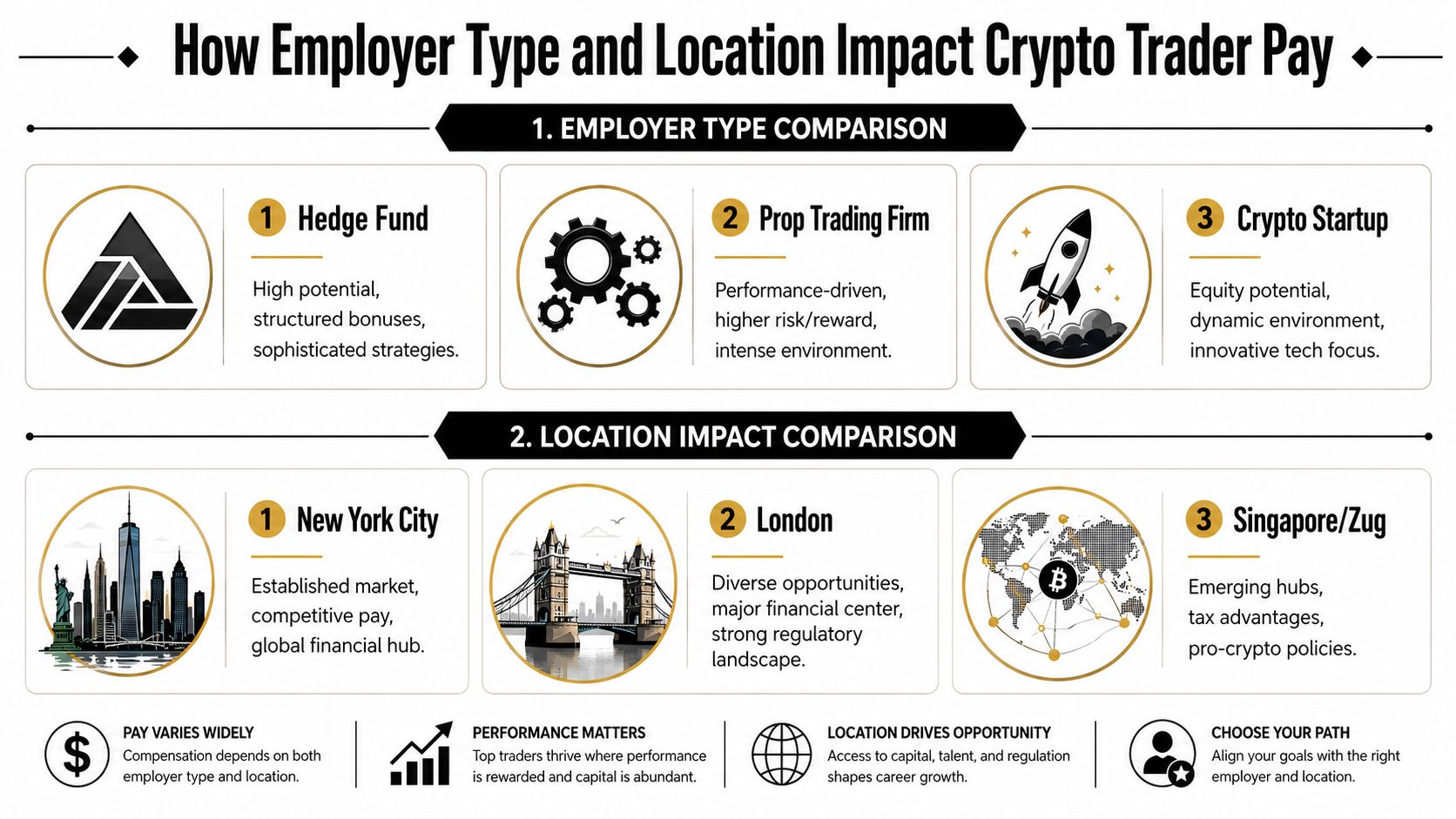
Two candidates with similar skills can receive very different offers because they picked different employers. In crypto, compensation structure is often a reflection of business model first, title second.
Employer type changes the risk profile
A hedge fund usually offers a more structured package and clearer performance expectations. A prop-style firm may tie more of your outcome to direct trading results. A startup can offer upside and fast responsibility, but often with more ambiguity around how compensation evolves.
Here is the trade-off recruiters see most often:
- Hedge fund: More process, more structure, stronger reporting discipline
- Prop trading environment: Sharper performance pressure, faster feedback, potentially more direct upside
- Crypto startup: Broader responsibilities, more title flexibility, but more uncertainty around comp design
No option is automatically better. It depends on whether you want training, stability, immediate responsibility, or upside exposure.
A quick market scan helps here. Blockchain jobs in the USA gives a useful view of how employer type changes role mix, from trading seats to adjacent quant and research functions.
Location still matters, even in remote crypto
Crypto talks like it's borderless. Compensation doesn't behave that way in practice.
New York, London, Singapore, and Zug still matter because firms in those hubs tend to build denser teams, stronger institutional relationships, and more formal compensation bands. Remote roles can flatten geography, but they don't erase employer expectations around timezone coverage, regulatory familiarity, and hiring competition.
This overview adds useful context for anyone comparing work environments across markets:
The better question to ask
Don't ask only, "Which employer pays more?"
Ask:
- Which employer teaches the most transferable skills
- Which compensation structure matches my risk tolerance
- Which environment gives me the strongest next job
- Which location or remote setup helps me stay close to decision-makers
The best-paying job on paper can be the wrong career move if it doesn't improve your market value two years later.
Landing and Negotiating a Top Crypto Trading Job
Most candidates lose before the first interview because their resume reads like a fan of markets, not a professional who can help a desk make decisions.
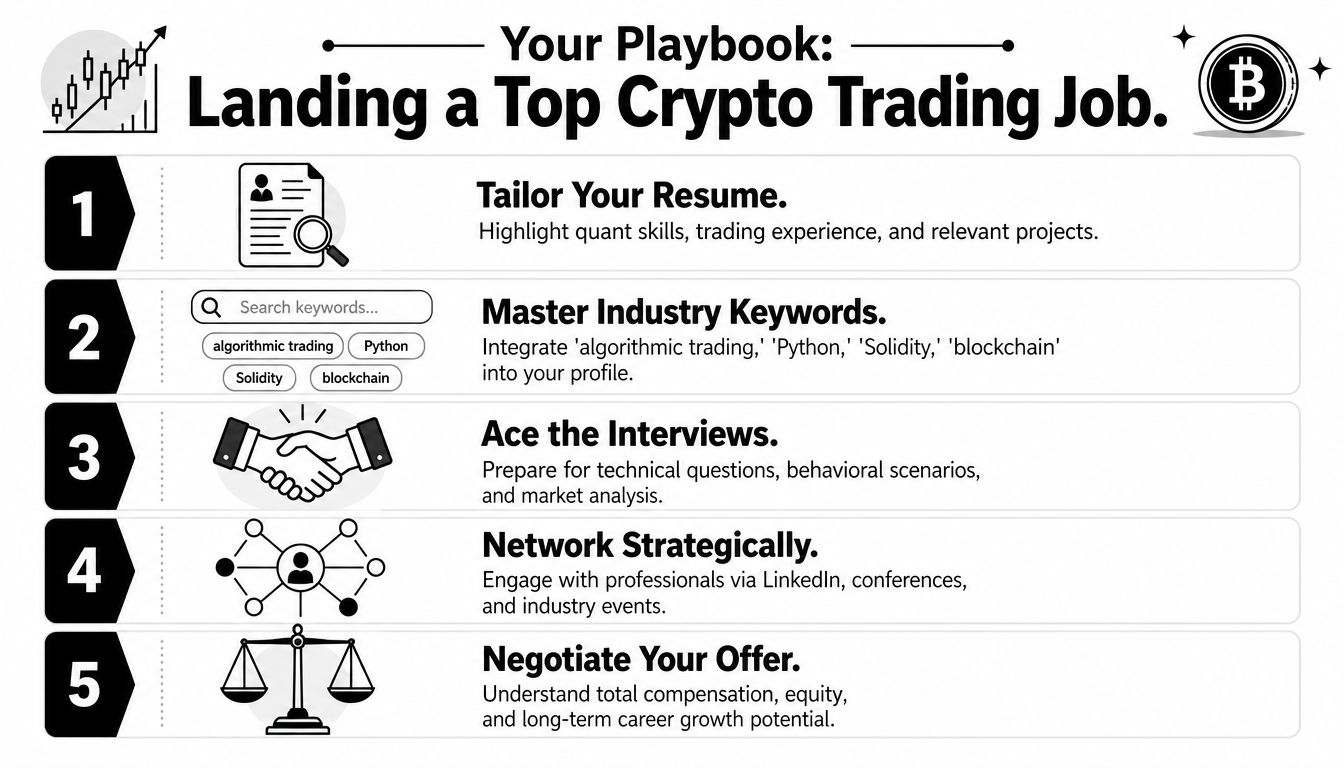
If you want a higher crypto trader salary, build your candidacy around what firms can verify. Recruiters look for evidence of repeatable thinking, technical fluency, and role fit.
What to put on the resume
Strong resumes in this category usually foreground skills and outputs, not identity statements.
Useful keywords and proof points include:
- Algorithmic strategy work: Mention backtesting, signal research, or execution logic if you've done it.
- Risk management: Show that you understand drawdown control, position sizing, and exposure monitoring.
- On-chain analysis: If you've used blockchain data in research, make that visible.
- Programming tools: Python belongs near the top if it's part of your workflow. C++ matters when targeting low-latency or infrastructure-heavy roles.
- Project evidence: GitHub repos, notebooks, strategy writeups, and simulation work all help.
A role like this derivatives trader opening at Anchorage Digital is a good reminder that serious employers hire for judgment plus execution discipline, not just "trading passion."
How to prepare for interviews
Interview loops often split into three buckets.
First, technical depth. Can you explain your research process, your assumptions, and how you'd test a strategy? Second, market judgment. Can you discuss liquidity, volatility, derivatives, or execution trade-offs without bluffing? Third, behavioral fit. Can you operate inside a controlled, accountable team?
Practical rule: Bring one project you can defend line by line. Recruiters remember candidates who can explain decisions under pressure.
One strong way to sharpen your story is to frame your background like a progression: what you built, what you learned, where your edge is developing, and what type of desk can use it.
For candidates coming from independent trading or evaluation programs, Alpha Scala's 2026 funded trader roadmap can help you think about how to present discipline, rules-based execution, and capital stewardship in a way employers understand.
How to negotiate without guessing
You need an anchor. In traditional finance, a first-year Sales & Trading Analyst earns $135,000 to $160,000 all-in, according to Wall Street Prep's sales and trading salary guide. That's a useful benchmark because it gives candidates a credible external reference when discussing market-rate compensation for structured trading roles.
Use that benchmark carefully.
- If the role is junior and training-heavy, use it as a directional comparator, not a demand.
- If the role requires quant skills, systematic research, or derivatives expertise, use it to justify a stronger base.
- If the offer leans heavily on variable upside, push for clarity on the guaranteed portion before accepting comparisons.
The best negotiators don't just ask for more money. They show why their skill mix reduces hiring risk.
Your Path to a Six Figure Crypto Career
A six-figure crypto career is real. The myth is that it comes from acting like a retail trader with better luck.
The durable path is narrower and more practical. You build institutional-grade skills. You learn how compensation is structured. You target employers whose business model supports serious trading work. Then you present yourself as someone who can improve a desk's process, not just someone who likes markets.
The roadmap that actually works
Three levers matter most:
- Specialization: Generic trading interest doesn't command premium pay. Quantitative and execution-focused skills do.
- Compensation literacy: Base salary, bonus, profit share, and token exposure don't carry the same risk. Treat them differently.
- Employer selection: The right desk can accelerate your earnings and credibility faster than a flashy title at the wrong company.
There's also a mindset shift that separates strong candidates from noisy ones. Stop asking whether crypto trading can make you rich. Start asking what problems a firm will trust you to solve.
If you can answer that with evidence, you're no longer competing with the retail fantasy. You're competing for actual jobs.
And that's where the best crypto trader salary outcomes live.
If you're ready to turn that strategy into applications, Blockchain Jobs is a strong place to find Web3 trading, quant, research, and adjacent finance roles across the ecosystem. Use it to compare live openings, study how employers describe the skills they want, and target the firms that match your next step.