
How to Land DevOps Engineer Entry Level Jobs (A Realistic 2025 Guide)
Trying to land your first DevOps job can feel like a classic catch-22. You need experience to get a job, but you need a job to get experience. Here's the good news: devops engineer entry level jobs aren't a myth. They're just disguised, often asking for foundational skills you can build and prove yourself.
The secret from a hiring perspective is that smart companies aren't just counting years on a resume. They're looking for candidates who can demonstrate practical problem-solving skills from day one. This guide is your roadmap to becoming that person and acing the interview.
Your Realistic Starting Point for a Career in DevOps
Let's be honest, the term "entry-level DevOps" stirs up a lot of debate online. You'll hear plenty of people say it's a mid-level or senior role, and they're not entirely wrong. True DevOps mastery comes from a deep understanding of both development and operations, which usually takes time to build in a professional setting.
But here's the hiring reality: the demand for DevOps talent is huge, and there simply aren't enough seasoned pros to go around. This has forced companies to invest in promising newcomers who can demonstrate potential and a solid, self-taught foundation.
This means "entry-level" in DevOps has a unique definition. It doesn't mean you're a blank slate. It means you've taken the initiative to build job-ready skills on your own time. Hiring teams are looking for a specific mindset and a core set of skills that prove you're ready to contribute and grow into a valuable team member.
What Hiring Managers Actually Look For
When a company posts a junior DevOps position, they know they aren't getting a ten-year veteran. They're betting on potential. They're looking for someone who gets the fundamentals and, more importantly, has a portfolio that proves they can actually do the work.
Here’s what really gets a hiring manager's attention:
- A Problem-Solving Mindset: In an interview, can you look at a hypothetical system, spot the weak points, and articulate how you would automate a fix? This demonstrates the core DevOps philosophy in action.
- Hands-On Project Experience: A GitHub profile showing a CI/CD pipeline you built from scratch is infinitely more powerful than a dozen online course certificates. It's tangible proof you can apply your knowledge.
- Understanding of Core Tools: You don't need to be a master of everything. But you absolutely need to be functional with the essentials—think Git, Docker, and at least one major cloud provider like AWS. You will be asked about these in technical interviews.
- Eagerness to Learn: The tools we use today might be old news tomorrow. A great candidate is someone who can talk about how they stay current, what tech blogs they read, and what new tool they're experimenting with. This shows passion and adaptability.
From a hiring manager's perspective, the DevOps job market has gotten tight. You can't just list buzzwords on your resume anymore. A clean GitHub portfolio, hands-on labs, and a few real projects you can explain in detail during an interview will put you ahead of 90% of the pack.
This guide will walk you through the concrete steps to build these exact qualifications. We'll cover everything from picking the right skills to acing the interview. To see what hiring managers are asking for right now, check out real-world job postings like this DevOps Intern opportunity. It’s a great way to align your learning with market demand.
Building Your Core DevOps Technical Toolkit
Let's be honest—recruiters and hiring managers see hundreds of resumes that all list the same buzzwords. To actually stand out for DevOps engineer entry-level jobs, you have to build a practical, hands-on toolkit. It’s not about knowing a little bit about every tool. It's about deeply understanding a few key ones and proving you can use them to solve problems—and then being able to articulate that in an interview.
Your learning path should be built around the core pillars of DevOps. This way, you’re not just collecting tool names for your resume, but building interconnected skills that mirror how professional teams work. Think of it like preparing for an interview: you need a solid foundation of knowledge before you can answer complex questions.
This journey is all about turning abstract concepts into a concrete plan for your career.
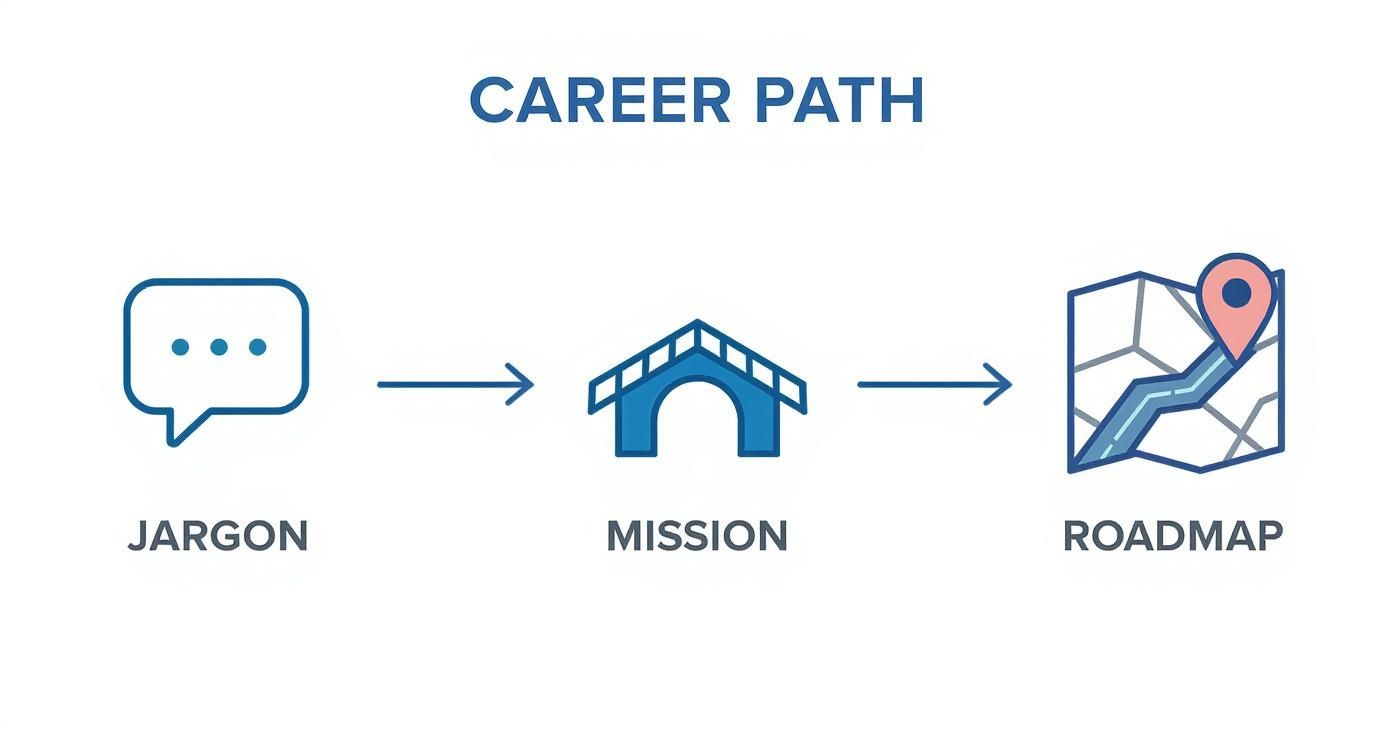
The real takeaway here is that a successful career starts when you can translate the jargon into a clear mission, which then directly informs your skills roadmap.
The Undeniable Fundamentals
Before you touch the fancy automation tools, you have to master the absolute basics. Every single DevOps role is built on two foundational technologies: Linux and Git. Skipping these is like trying to become a chef without knowing how to hold a knife. You won't make it past the first technical screen.
- Linux: The vast majority of servers in the cloud run on Linux. You need to get comfortable working in the command line, understanding file systems, managing permissions, and writing basic shell scripts. This isn't optional—it's the language of the infrastructure you'll be managing day-to-day.
- Git: Git is the bedrock of modern software development and Infrastructure as Code (IaC). You must know how to create repositories, branch, merge, and—most importantly—handle merge conflicts. Your future team will live and breathe Git, so fluency is a non-negotiable entry ticket.
Mastering Containers and Cloud Platforms
Once you're solid on the basics, the next layer is containers and the cloud. This is where you start building and deploying applications in a modern, scalable way, which is what hiring managers want to see.
Containers, powered by tools like Docker, solve the classic developer problem: "Well, it works on my machine." They package an application with all its dependencies into a single, portable unit. For a hiring manager, seeing that you can write a Dockerfile to containerize a simple application is a massive green light that you understand modern deployment practices.
Of course, your containers need a place to run, which is where cloud providers come in. You don't need to learn them all; just pick one of the big three and go deep:
- Amazon Web Services (AWS): The undisputed market leader with the most extensive set of services.
- Google Cloud Platform (GCP): Well-regarded for its strengths in Kubernetes and data analytics.
- Microsoft Azure: A major player, especially in enterprise environments.
Sign up for a free-tier account and start experimenting. Learning to launch a virtual machine (like an EC2 instance), configure a simple network, and use object storage (like S3) are the first concrete steps to proving your cloud competence. Many real-world job posts, like this SysAdmin/AWS Engineer role, explicitly call out these fundamental cloud skills.
From a hiring perspective, a candidate who can explain why they chose a specific AWS service for a project is far more impressive than someone who just lists ten services on their resume. It shows critical thinking, not just memorization—a key trait for career progression.
Automating Everything with CI/CD and IaC
Now we get to the heart of DevOps—automating the manual, repetitive work of building, testing, and deploying software and infrastructure. This is where you create the most value and what interviewers will probe deeply on.
Continuous Integration/Continuous Deployment (CI/CD): Tools like Jenkins, GitLab CI, or GitHub Actions automate the entire pipeline. Your goal should be to build a simple pipeline that automatically tests and packages your code every time you push a change to Git. This proves you understand the core feedback loop of modern software delivery.
Infrastructure as Code (IaC): Instead of manually clicking around in a cloud console (which is slow and error-prone), IaC tools like Terraform or Ansible let you define your entire infrastructure in configuration files. This makes your environments repeatable, version-controlled, and fully automated. Being able to write a simple Terraform script to spin up a server is an incredibly powerful skill that will grab a recruiter’s attention.
To give you a clearer picture, this table breaks down the core skill areas and the essential tools you should focus on first.
Core DevOps Skill Areas and Key Tools for Beginners
| Skill Area | What It Solves | Essential Tools to Learn | Where to Start |
|---|---|---|---|
| Operating Systems | Managing the server environment where applications run. | Linux (Debian/Ubuntu or CentOS/RHEL) | Learn basic shell commands, file permissions, and package management. |
| Version Control | Tracking and managing changes to code and configurations. | Git, GitHub | Master the git clone, branch, commit, push, and merge workflow. |
| Containerization | Packaging applications and their dependencies for consistency. | Docker | Write a Dockerfile for a simple web app and run it as a container. |
| Cloud Computing | Providing on-demand infrastructure and services. | AWS, GCP, or Azure (Pick One) | Launch a virtual server, configure a basic network, and use object storage. |
| CI/CD | Automating the build, test, and deployment pipeline. | GitHub Actions or Jenkins | Create a pipeline that runs tests and builds your Docker image on every commit. |
| Infrastructure as Code (IaC) | Defining and managing infrastructure through code. | Terraform | Write a Terraform script to provision the cloud resources you learned about. |
Focusing on one tool from each of these categories will give you a well-rounded and practical foundation that hiring managers are actively looking for.
Putting in the effort to build this toolkit pays off. For entry-level DevOps engineers in the United States, salaries reflect just how high the demand is. As of late 2025, the average hourly wage was about $60.53, which can translate to an impressive annual salary of around $125,900.
While the average for someone with less than a year of experience is closer to $86,194, supplemental pay like bonuses can easily push total compensation over $110,000, highlighting the strong earning potential right from the very start of your career.
Creating a Portfolio That Gets You Hired
Your resume might get your foot in the door, but a killer portfolio is what seals the deal for devops engineer entry level jobs. Think of it this way: your resume tells a hiring manager what you know, but your portfolio shows them what you can do. That distinction is everything in a technical interview.
In DevOps, your GitHub profile is your portfolio. It’s the first place most technical recruiters and hiring managers go after seeing an application. A clean, well-documented profile with real projects instantly puts you ahead of candidates who only have a resume.

A setup like this isn’t just about storing code; it’s a professional showcase. It signals that you're organized, you value clear communication, and you take your craft seriously—all traits of a future senior engineer.
The Anatomy of a Standout Project
A project that just follows a tutorial line-by-line isn't going to impress a hiring manager. The real goal is to prove you can think through a problem and apply your knowledge of the DevOps lifecycle to solve it—because that's the job.
So, what makes a portfolio project interview-ready?
- It Solves a Real Problem: Start with a clear "why." For instance, "Manual deployments were tedious and error-prone, so I automated the entire process with a CI/CD pipeline." This frames your work with business value.
- It Integrates Multiple Tools: Don't just show you know Docker. Show you can make Docker talk to Jenkins to deploy an app on AWS. This mimics a real-world tech stack and shows you can think systemically.
- It's Meticulously Documented: Your
README.mdis your project’s elevator pitch. It needs to explain the purpose, the architecture, and how to get it running. Crucially, it should also highlight the challenges you ran into and how you solved them.
Hiring managers aren't just looking for perfect code. They're looking for your thought process. Explaining how you debugged a tricky networking issue in your Kubernetes cluster is often more valuable than the final solution itself. It shows resilience and problem-solving skills.
Project Idea: Deploy a Web App with a Full CI/CD Pipeline
This is the classic DevOps portfolio project for a reason. It touches on almost every core competency and proves you can get code from a developer’s laptop to a live environment, safely and reliably. It's the perfect story to tell in an interview.
Your mission is to completely automate the deployment of a simple web application. A basic Python Flask or Node.js app will work perfectly.
- Containerize It: First, write a
Dockerfilefor the application. This is ground zero for demonstrating your grasp of containerization. - Build Your Infrastructure with Code: Use Terraform to script the cloud infrastructure. You could spin up a simple Kubernetes cluster (like EKS on AWS) or just a basic EC2 instance to run your container.
- Create the Automation Pipeline: Use GitHub Actions or Jenkins to build your CI/CD pipeline. The key is to have it trigger automatically every time new code is pushed to your main branch.
- Map Out Your Pipeline Stages: A solid pipeline will have clear stages: build the Docker image, push it to a registry (like Docker Hub or Amazon ECR), and then deploy that new image to your infrastructure.
This single project instantly gives you talking points for Git, Docker, Terraform, a cloud provider, and CI/CD tools. That covers a huge chunk of most junior DevOps job descriptions. If you're targeting more advanced roles, you could even explore how to deploy your project onto unique infrastructure to really stand out.
Make Your GitHub Profile Your Portfolio
Once your project is ready, you need to merchandise it. Your GitHub profile is the perfect storefront for your skills.
- Pin Your Greatest Hits: Pin your most complex and well-documented projects to the top of your profile. This is the first thing a hiring manager will see.
- Craft a Killer Profile
README.md: Treat your main profileREADME.mdlike a landing page. Introduce yourself, list your core skills with icons, and provide links to your best work. - Keep the Green Squares Coming: That contribution graph is a powerful visual. Consistent commits signal that you're an active learner—a huge plus for any employer looking for someone with long-term potential.
By treating your GitHub as a living portfolio, you're not just telling people you have the skills. You're proving it. That makes it much easier for a hiring manager to justify bringing you in for an interview.
Crafting Your DevOps Resume and Personal Brand
Think of your resume and online profiles as your digital handshake. For devops engineer entry level jobs, they're often the only thing a recruiter or hiring manager sees before deciding if you’re worth a 30-minute conversation. You must move beyond a simple list of skills and tell a compelling story about your potential and achievements.
This isn't about fancy formatting; it's about strategic communication that gets you past automated filters and impresses a human reviewer.
From Project to Powerful Resume Bullet Point
Hiring managers skim resumes in seconds. Your mission is to give them a reason to stop and read. The best way to do this is by showing the impact of your work, not just listing the tasks you did.
This is where the STAR method (Situation, Task, Action, Result) becomes your secret weapon for writing compelling bullet points.
Let’s translate a portfolio project into a resume-ready achievement:
- Situation: Manual deployments for a personal web app were slow, error-prone, and took over 20 minutes per update.
- Task: The goal was to completely automate the deployment process to improve speed and reliability.
- Action: I built a full CI/CD pipeline using GitHub Actions that automatically tested, containerized the app with Docker, and deployed it to an AWS EC2 instance managed by Terraform.
- Result: This new pipeline cut deployment time by 95% (from 20 minutes to under 1 minute) and eliminated manual deployment errors.
From a hiring manager's perspective, quantifying your results is a game-changer. Metrics like 'reduced deployment failures by 75%' or 'cut server provisioning time in half' instantly translate your project work into real business value.
This approach transforms a simple school project into a powerful, metric-driven accomplishment. It directly answers the silent question every manager has: "Can this person save my team time and money?"
Optimizing Your Resume with Keywords
Before a human ever sees your resume, it’s almost certainly going through an Applicant Tracking System (ATS). To get past these bots, you have to speak their language.
Pull up 3-5 job descriptions for roles you're excited about. Look for the patterns and weave them naturally into your project descriptions.
| Keyword Category | Example Keywords from Job Descriptions | Where to Place Them on Your Resume |
|---|---|---|
| Cloud Platforms | AWS, EC2, S3, IAM, VPC | Put these in your skills section and within your project bullet points (e.g., "Deployed application to AWS EC2..."). |
| CI/CD Tools | Jenkins, GitHub Actions, GitLab CI | Name the specific tool you used in the "Action" part of your STAR-method bullet point. |
| Containerization | Docker, Kubernetes (K8s) | List them under skills and be specific about how you used them to containerize an application. |
| IaC Tools | Terraform, Ansible, CloudFormation | Feature these prominently in your project descriptions to show you have hands-on experience. |
When you layer these terms into your STAR-method stories, you end up with a resume that's both compelling for a human reader and perfectly optimized for the ATS.
Building Your Brand on LinkedIn
Your LinkedIn profile is more than an online resume—it's your professional storefront. A well-maintained profile brings recruiters to you.
1. Craft a Headline That Gets You Noticed
Your headline is prime real estate. Don't waste it with "Seeking opportunities." Be specific and pack it with keywords.
- Weak Headline: Student interested in DevOps
- Strong Headline: Aspiring DevOps Engineer | AWS Certified | CI/CD, Docker, Terraform
The stronger headline instantly tells recruiters your focus, a key certification, and your core technical skills. It’s an immediate signal that you’re a serious candidate.
2. Tell Your Story in the Summary
Use the "About" section to connect the dots. Write a short paragraph about your passion for automation, call out a key portfolio project, and state your career goals. This is your chance to show some personality and ambition.
3. Engage with the Community
Building a brand isn't a passive activity. Follow influential DevOps leaders and companies you admire. Share insightful articles or comment thoughtfully on posts. This shows you're engaged with the industry and helps you build a professional network. Active participation makes you a visible member of the community, not just another resume in a stack.
Navigating the DevOps Interview Gauntlet
You've put in the work, built a portfolio, and your resume is polished. Now it's time for the final push: the interview process. This is where you turn your preparation into a job offer.
The interview process for devops engineer entry level jobs can feel like a marathon, but it becomes less intimidating once you understand the stages. Think of it as a series of checkpoints designed to test three core things: your technical skills, your problem-solving process, and your team fit.

Uncovering the Best Job Opportunities
Before you can ace the interview, you have to find the right openings. While big job boards are a start, the best opportunities are often found elsewhere.
- Niche Job Boards: Sites like Blockchain Jobs are gold because they connect you with companies in a specific ecosystem that are actively looking for people with your skills.
- Company Career Pages: Pick 10-15 companies you'd love to work for and bookmark their career pages. Many roles are posted here before they hit mainstream sites.
- Community Slack/Discord Channels: Join communities for tools like Kubernetes or Terraform. Most have dedicated #jobs channels where hiring managers post directly, giving you a direct line.
This proactive strategy puts you in front of higher-quality, less-crowded opportunities and shows initiative—a trait every hiring manager values.
The Typical Interview Stages Decoded
While the exact steps can vary, most DevOps interviews follow a predictable four-stage pattern. Knowing what’s coming is half the battle.
Stage 1: The HR Screen
This is a quick, 15-30 minute non-technical chat with a recruiter. Their goal is to check baseline requirements like salary expectations, work authorization, and your motivation for applying.
Hiring Manager Tip: Don't just answer questions—ask them. Inquire about the team's structure, the biggest challenges the team is facing, and what success looks like in this role. It shows you're engaged and thinking strategically.
Stage 2: The Technical Deep-Dive
Here you’ll talk to a senior engineer or the hiring manager. Expect a mix of conceptual questions and practical "whiteboarding" exercises to verify the skills on your resume.
Be ready to tackle questions like:
- "Explain the difference between a container and a virtual machine."
- "Walk me through the stages of a CI/CD pipeline you've built."
- "What is Infrastructure as Code, and why is it important?"
They might also ask you to write a simple Dockerfile or a basic Terraform config. They're not looking for perfection; they want to see your thought process.
Stage 3: The Take-Home Challenge
Many companies use a take-home assignment to gauge your practical skills. You might be asked to build a small CI/CD pipeline or write a script to automate a task.
Treat your submission like a professional project. Include a well-written README.md that explains your approach, any assumptions you made, and clear instructions. This is a massive opportunity to showcase your documentation skills—a critical part of any DevOps role.
Stage 4: The Team-Fit Interview
If you've made it this far, they're confident you can do the job. This final stage, often a panel interview, is about seeing if you're someone they'd want to work with.
This part is heavy on behavioral questions. Use the STAR method to frame your answers to prompts like:
- "Tell me about a time a deployment failed. What did you do?"
- "Describe a complex technical challenge you solved on a project."
- "How do you stay up-to-date with new technologies?"
Be honest, enthusiastic, and let your passion for learning come through. Your answers here reveal your problem-solving style and how you collaborate under pressure.
The demand for these skills is no joke. A recent analysis from the first half of 2025 found that DevOps Engineer was the top category in infrastructure job postings, accounting for a massive 36.7% of all openings. That shows just how crucial this career path has become. When you combine it with Site Reliability and Platform Engineering roles, these specialties make up over 71% of the entire infrastructure job market, boasting a median global salary of $185,000. You can explore more data on these market trends to see how they impact your job search.
Got Questions? We've Got Answers
Stepping into the world of DevOps can feel like learning a new language. Having questions is a good sign—it means you're thinking critically about your career path. Let's tackle some common hurdles.
Do I Really Need a Computer Science Degree?
Absolutely not. While a CS degree provides a good theoretical foundation, it’s not a requirement for devops engineer entry level jobs. I’ve hired and worked alongside brilliant engineers who came from backgrounds in network administration, QA testing, and even non-technical fields.
What truly matters is demonstrated skill. A strong GitHub portfolio showcasing real-world projects—CI/CD pipelines, containerized apps, and IaC setups—is far more valuable to a hiring manager than a transcript. Practical skills and a proven desire to learn will always win.
Which Programming Language Should I Learn First?
It's easy to get analysis paralysis here. For a beginner, focus on Python. It's versatile and fantastic for scripting, automation, and interacting with APIs—all core DevOps tasks.
Right alongside Python is Bash. As a DevOps engineer, the Linux command line is your office. Being able to write a quick Bash script to automate a repetitive task isn't just a nice-to-have; it's a fundamental, day-one skill that will be tested in interviews.
The goal isn't to become a master of five languages. Pick one—Python or Bash—and get really good at it. Proving you have deep knowledge in one area is far more impressive to a hiring manager than having a shallow understanding of many.
How Can I Get Experience if No One Will Hire Me?
This is the classic chicken-and-egg problem. The answer is to create your own experience. The days of landing a tech job with just a resume full of buzzwords are over. You need to show, not just tell.
Personal projects are your interview ammunition. Don't just read about tools; use them to build something you can talk about.
- Take a simple personal website and build a complete CI/CD pipeline for it with GitHub Actions.
- Find an open-source app, containerize it with Docker, and deploy it to a small Kubernetes cluster.
- Spin up your own cloud playground on AWS and manage it entirely with Terraform.
Most importantly, document everything on GitHub. Your READMEs should tell the story of what you built, the problems you solved, and what you learned. This isn't just a learning exercise; it's your professional portfolio and the source of your best interview answers.
The job market is actually shifting in your favor. While big tech has slowed hiring, there’s been a 47% jump in job openings for candidates with 0 to 3 years of experience since late 2023. Startups and medium-sized companies are hungry for people with practical DevOps skills. For a deeper dive into these numbers, you can read the full analysis of the 2025 job market.
Ready to find the perfect role to launch your career? At Blockchain Jobs, we connect talented engineers with leading companies in the Web3 space. Explore DevOps and infrastructure jobs today!