Land Remote Entry Level Web developer Jobs
So, you’re ready to break into tech with your first remote web developer job? It’s a fantastic goal, and with the right strategy, it's more achievable than you might think. This isn't just about showing off your coding chops; it’s about proving you have the discipline and communication skills to excel from anywhere. Let's build your blueprint for navigating the hiring process and landing that role.
Your Game Plan for a Remote Web Dev Career

Landing a remote developer job requires a different mindset. Hiring managers are looking for more than just a coder—they need a proactive team member who can manage their own time and communicate with crystal clarity. Every part of your application is a test of your remote-readiness.
A well-documented project on GitHub? That shows you can work asynchronously and communicate effectively without constant meetings. A clean, concise resume? That proves your written communication is professional. Your goal is to show, not just tell, that you're a low-risk hire who can thrive without direct supervision.
Setting Realistic Expectations
Your job search is a marathon, not a sprint. The good news is the market is hungry for talent. As of early 2025, there are over 227,000 active web developer openings in the US alone. Even better, the US Bureau of Labor Statistics projects an 8% growth in this field through 2033, which is way faster than the average for all other jobs.
But high demand doesn't mean it's easy. Be prepared to dedicate three to six months to your search. The key is consistent, targeted effort—not just blasting your resume into the void.
A successful remote job search isn't about applying everywhere. It's about making a compelling case to a few select companies that you are the low-risk, high-potential candidate they need.
Mapping Your Skills to Remote Roles
Before you apply, take an honest inventory of your skills through the eyes of a hiring manager. They aren't just scanning for programming languages; they're looking for evidence that you can integrate into a distributed team.
Create a simple map of your strengths that you can directly translate to your resume and interview talking points:
- Technical Skills: List your core stack (HTML, CSS, JavaScript, React, Node.js, Git). Be ready to discuss your proficiency level for each during an interview.
- Collaboration Tools: Mention specific experience with tools like Slack, Asana, or Jira. Even using them for personal projects is valuable evidence.
- Remote-Ready Traits: This is where you connect your skills to job requirements. Frame personal projects as proof of self-discipline. Detail your problem-solving process in README files to demonstrate clear communication. Your professional writing in your resume and portfolio is your first proof point.
When you know what remote companies are really looking for, you can shape your entire application to match. For instance, if you're targeting backend roles, analyze a job description like this Junior Backend Node.js Engineer position to see which skills they prioritize. This turns your job hunt from a numbers game into a strategic mission to get an interview.
Build a Portfolio That Screams "Hire Me"
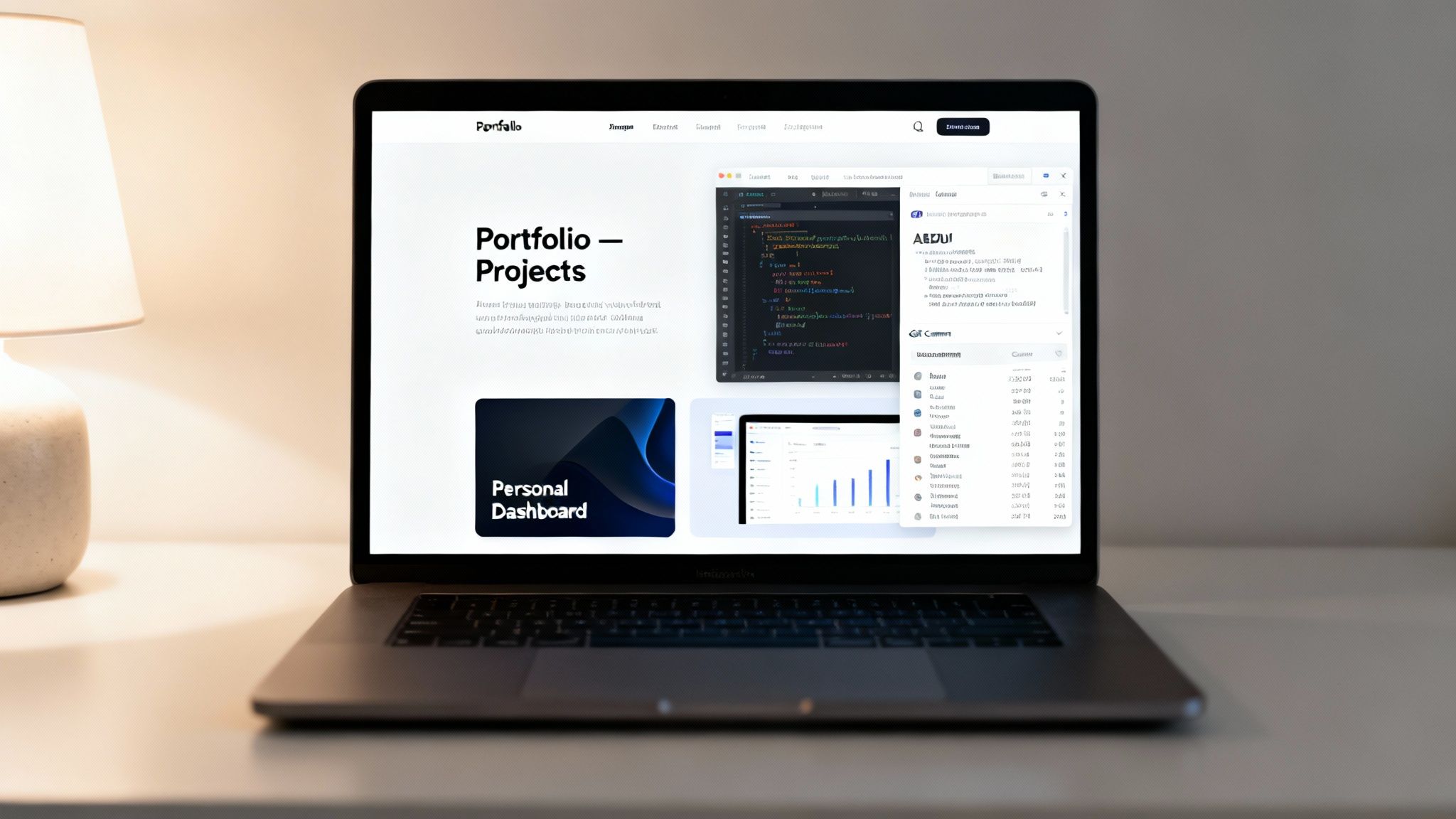
For a remote web developer, your portfolio is your single most powerful interview tool. It's not a gallery; it's a living testament to your ability to ship quality work, document it professionally, and operate autonomously.
A hiring manager for a remote role is trying to de-risk their decision. They are asking: "Can this person manage their own time? Can they communicate clearly about their work? Can we trust them to deliver from another time zone?" A killer portfolio answers all of these questions with a resounding "yes" and is your best path to career progression.
Move Beyond Generic Tutorial Projects
We've all built a to-do list app or a weather widget. These are crucial for learning, but they won't get you hired. Hiring managers see hundreds of them. To stand out and pass the initial screening, your projects must demonstrate initiative and problem-solving skills.
Think like an employer: they want to hire people who solve problems. The best way to prove you can do that is by building projects that solve a real-world problem, even a small one that affects your daily life. A project born from a genuine need gives you a compelling story to tell in an interview and is guaranteed to be unique.
Project Ideas That Impress Remote Recruiters
Quality over quantity is the rule. Aim for two to three polished, impressive projects that showcase skills relevant to remote work, like API integration and user-centric design. These projects become the core talking points of your interviews.
Here are a few actionable ideas:
- A Personal Dashboard: Build a single-page app that pulls data from several public APIs (e.g., GitHub for your latest commits, a crypto tracker, a weather service). This directly proves you can work with external data sources, a common task in any web developer job.
- A Niche E-commerce Front-End: Pick a niche you're passionate about and build a sleek storefront. Focus on creating a smooth user experience with a functional shopping cart and product filtering. This demonstrates you can build practical, user-facing features that drive business value.
- A Simple Collaborative Tool: Create a minimalist Trello-style board or a shared "read-it-later" service. This shows you can think about multi-user interactions and application state, which is critical for team-based projects.
Projects like these provide tangible proof of your abilities. In a competitive market for roles like this Software Engineer Internship at Ripple, unique projects are what move your resume from the "maybe" pile to the "must-interview" pile.
Document Your Work Like a Pro
For a remote team, how you communicate about your code is just as important as the code itself. Your documentation, especially your README.md file and Git commit history, is a direct reflection of your communication skills and ability to work asynchronously.
A project with a messy commit history and no README is a huge red flag for a remote hiring manager. It signals a lack of clarity and poor communication habits—absolute deal-breakers for a distributed team.
Treat your README as the project's landing page for a recruiter. It must be clear and comprehensive.
Actionable checklist for every project README:
- Project Title & Description: A concise summary of what it is and what problem it solves.
- Live Demo Link: Non-negotiable. Deploy it using free services like Netlify or Vercel to make it instantly accessible.
- Technologies Used: A clear list of the key languages, frameworks, and libraries.
- Setup & Installation: Step-by-step instructions on how to run it locally. This proves you understand the full development lifecycle.
- Challenges & Lessons Learned: A brief, honest section about a technical hurdle you overcame. This demonstrates a growth mindset and problem-solving skills—key topics for any interview.
Finally, maintain a professional Git history. Your commits should tell the story of your development process. Instead of "updated files," use descriptive messages like "feat: implement user authentication." Adopting standards like Conventional Commits signals to a hiring manager that you’re ready to collaborate on a professional team.
Getting Your Resume Past the Bots and into Human Hands
Before a hiring manager sees your resume, it must pass through an Applicant Tracking System (ATS). For anyone seeking a remote entry-level web developer job, optimizing for this software is your first critical test. Your strategy is two-fold: format for the machine, but write for the human.
Since you're starting out, your projects are your work experience. They are the concrete proof that you can apply the skills listed in a job description. Your resume's job is to make that connection undeniable for both the ATS and the hiring manager.
How to Please the Applicant Tracking System
Fancy resume designs confuse the ATS. Stick to a clean, single-column layout with a standard font. The system is looking for keywords. Go through target job descriptions and mirror their language precisely. If they ask for "RESTful APIs" or "Next.js", ensure those exact phrases are in your resume.
- Be Specific in Your Skills: Don't just list "JavaScript." Break it down into "JavaScript (ES6+)," "React.js," "Node.js," and "Express.js" to create more keyword matches.
- Use Keywords in Project Descriptions: Instead of "built a cool app," use action verbs and technical terms: "Developed a full-stack e-commerce application using React for the front end and a Node.js with Express for the back-end API."
- The Right File Format: Always submit as a PDF unless explicitly told otherwise. It preserves formatting and ensures what you see is what the recruiter sees.
This isn't cheating; it's speaking the system's language to ensure your qualifications get a fair review.
Think of your resume as an API for your career. It needs to be well-structured and return the exact data the system (and the recruiter) is querying for. If the job asks for
Git, your resume should clearly stateGit.
Making Your Projects and Remote-Ready Skills Shine
Once past the ATS, your resume needs to impress a human. Your projects section is your main stage. Treat each project like a mini case study that showcases results.
For each portfolio project, use this structure:
- Project Title & Links: Provide clickable links to the Live Demo and GitHub Repo. Make it easy for them.
- Tech Stack: List the key technologies.
- Bulleted Accomplishments: Use 2-3 bullet points to describe what you built and the problems you solved. Quantify achievements where possible.
Here’s an example that will catch a recruiter's eye:
Personal Finance Dashboard | Live Demo | GitHub Repo
Tech Stack: React, Chart.js, Node.js, Express, PostgreSQL
- Engineered a secure REST API to handle user authentication and process financial data from a PostgreSQL database.
- Integrated Chart.js to create dynamic, interactive visualizations of user spending habits, improving data clarity.
- Implemented responsive design principles with CSS Grid, ensuring a seamless user experience across mobile and desktop devices.
Don't forget to explicitly list collaboration tools like Git, Asana, Trello, Slack, and Jira. This sends a direct signal that you understand the operational toolkit of a modern, distributed team and can onboard quickly.
Polishing Your Professional Footprint
A recruiter will immediately open tabs for your LinkedIn and GitHub profiles. An inconsistent or unprofessional online presence can end your candidacy.
On LinkedIn, optimize your headline. Change "Aspiring Web Developer" to something confident and specific, like "Front-End Developer | React, TypeScript & Web Accessibility." This is your professional branding.
Your GitHub profile is your technical portfolio. Make it interview-ready:
- Pin Your Best Work: Pin your top 3-4 projects. These should be your most impressive and best-documented ones.
- Write a Clear Bio: State your technical interests and the type of role you're seeking.
- Those Green Squares Matter: A consistent contribution history shows dedication and a genuine passion for coding—a powerful signal to employers.
A keyword-optimized resume combined with a sharp digital presence creates a powerful narrative: you are a proactive, skilled, and organized developer serious about launching a successful remote career.
Find Remote Developer Jobs Before Anyone Else
The best remote entry-level web developer jobs often get filled before they hit massive job boards. To get ahead, you need a smarter strategy that focuses on niche platforms, developer communities, and targeted networking. This isn't just about finding more listings; it's about connecting with companies that are genuinely committed to hiring and developing remote talent.
Forget spending hours scrolling through giant aggregators where your application is one of thousands. Your time is better spent where you have a higher chance of being noticed.
Looking Beyond the Mega Job Boards
Big job sites are a volume game. Niche platforms dedicated to remote work and tech are a quality game. Companies posting on these boards are typically remote-first, understand the culture, and are looking for serious applicants. The signal-to-noise ratio is much higher.
Here are a few of the best platforms to focus your job search:
- We Work Remotely: A trusted and large community specifically for remote work, with a strong developer section.
- Remote OK: Excellent for tech roles, often featuring transparent salary ranges which helps in your research and negotiation.
- FlexJobs: A subscription service where every listing is hand-screened, eliminating scams and low-quality opportunities.
This infographic lays out the core pieces of a job-search strategy that will actually get you noticed on these kinds of platforms.
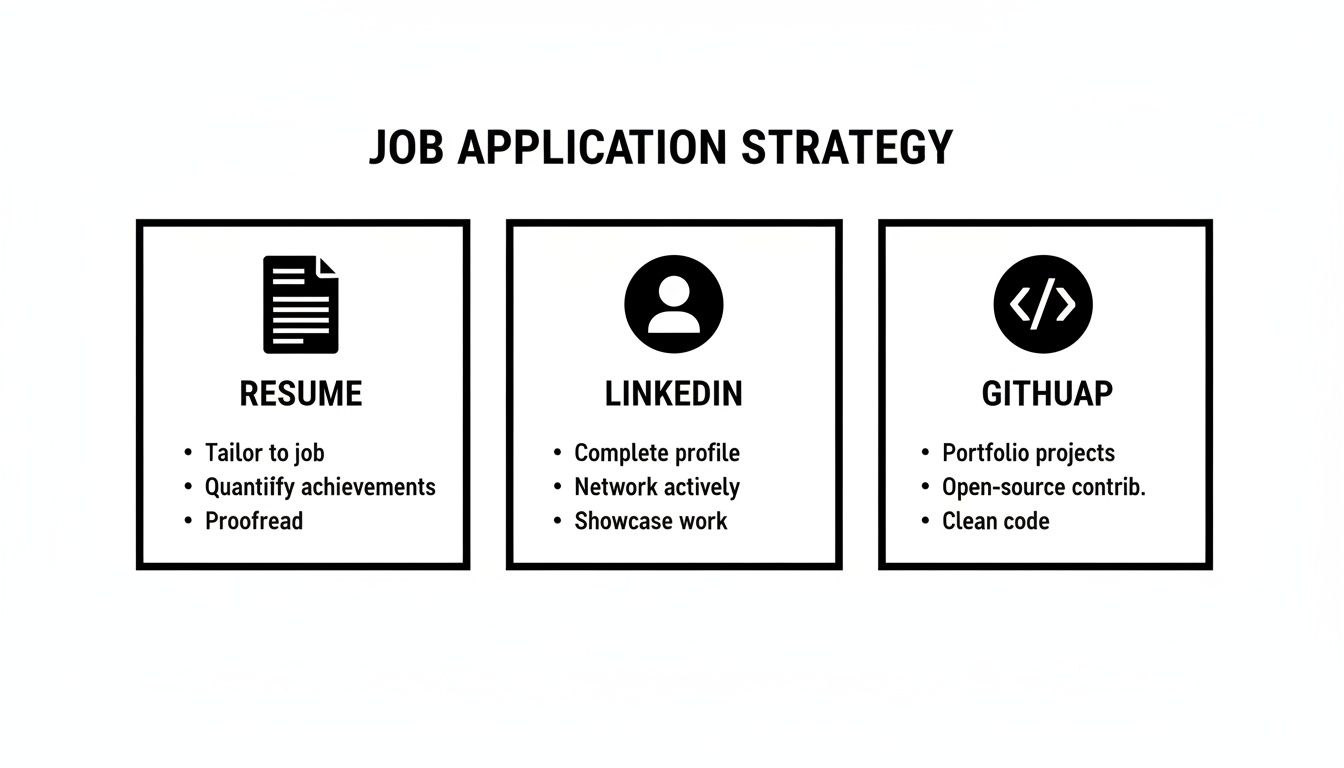
Ensuring your resume, LinkedIn, and GitHub tell a consistent, professional story is critical. It shows you’re a well-rounded candidate who is strategic about their career progression.
The Emerging Web3 Frontier
Another powerful strategy is to target tech sectors that are remote-native. The Web3 and blockchain space is a prime example. These companies were built on a decentralized philosophy, so remote work is their default operating model, not a perk.
This creates a massive opportunity for entry-level developers. The industry is growing rapidly, and companies are hungry for talent that is eager to learn. Niche job boards are your direct entry point into this ecosystem.
The Web3 space gives junior developers a unique edge. Because so much of the tech is new, companies often care more about your passion for learning and your ability to adapt than they do about having years of experience in some old-school legacy stack.
Specialized job boards filter out the noise, connecting you directly with innovative companies. By focusing your search here, you can discover incredible roles, like this remote Fullstack Software Engineer opening on the Special Projects Team, that you'd likely never find elsewhere.
Top Platforms for Remote Entry-Level Developer Jobs
To focus your search, this table compares some of the best platforms. Align your strategy with the platforms where the companies you want to work for are hiring.
| Platform | Best For | Key Feature | Entry-Level Friendliness |
|---|---|---|---|
| We Work Remotely | A broad range of remote tech roles | One of the largest and most trusted remote job communities. | High - Plenty of junior and entry-level listings. |
| Remote OK | Tech-focused roles with salary transparency | Detailed company info and salary data are often included. | Medium - More mid-level, but good entry roles pop up. |
| Blockchain Jobs | Web3, crypto, and decentralized tech | Highly curated list of jobs from leading Web3 companies. | High - The industry's demand for talent welcomes new devs. |
| FlexJobs | Vetted, scam-free flexible and remote jobs | Every job is manually verified for legitimacy. | High - Strong filtering options to find entry-level roles. |
| Developer Communities | Finding unlisted jobs and building a network | Direct access to hiring managers and team members. | Very High - Reputation and contribution matter most. |
A mix of niche boards and active community involvement is the most effective approach to finding high-quality opportunities.
Get Involved in Developer Communities
Never underestimate the power of networking. Many of the best opportunities come from referrals or connections made before a job is ever formally posted.
Become an active, helpful member of online developer communities. Find the Discord or Slack channels for technologies you're learning. Ask good questions, but more importantly, try to answer them. Share your work, offer to help others debug code, and be a positive presence. This isn't about spamming your portfolio; it’s about building a reputation as a curious, collaborative developer. Hiring managers and senior engineers are always in these communities. When a new role opens up, you’ll already be a known, trusted entity.
Nailing the Remote Interview and Technical Challenge

The remote interview is a multi-stage audition for a spot on a distributed team. Every step, from the initial video screen to the technical challenge, is designed to assess your communication skills, problem-solving ability, and capacity for autonomous work.
Hiring managers are looking for signals that you are a reliable, self-sufficient professional. The easiest way to send that signal is with a professional, distraction-free video call setup. It's a simple, powerful way to show you're serious and respect their time.
Setting the Stage for a Flawless Remote Interview
Your interview environment makes an immediate impression. A chaotic background or poor audio can make you seem unprofessional before you answer a single question. Treat it like an in-person meeting.
Use this pre-interview checklist:
- Test Your Tech: Check your camera, microphone, and internet connection 30 minutes before the call.
- Find Your Light: Sit facing a window or a soft light source. Avoid having a bright light behind you.
- Curate Your Background: A clean wall or a tidy bookshelf is ideal. A simple, professional virtual background is a good alternative.
- Silence the World: Close unnecessary browser tabs, silence your phone, and let others in your space know you can't be disturbed.
A well-prepared interview setup is a powerful non-verbal cue. It tells the hiring manager you're organized, proactive, and capable of maintaining a professional remote workspace. It's your first chance to prove you're ready for remote work.
Navigating Live Coding and Take-Home Projects
This is where you prove your technical competence. Whether live coding or doing a take-home project, the goal is to showcase your thought process.
In a live coding session, you must talk through your thought process out loud. Silence is your enemy. Explain your initial approach, discuss the trade-offs of different solutions, and narrate as you code. This transforms a test into a collaborative problem-solving session, which is exactly what employers want to see.
For a take-home project, your time management and documentation are being evaluated. Break the project into small, logical chunks and use clear Git commit messages to show your progress. This demonstrates your ability to structure work and communicate asynchronously. Your README file is just as important as the code; use it to explain your design choices and provide clear instructions.
Remember, the earning potential in this field is huge. Globally, remote web developers pull in an average of $70,969 USD annually, and in the US, entry-level remote developers can start around $94,149. You can explore more detailed salary data to see what's possible. Your performance in the technical interview is what unlocks that potential, proving you are a low-risk hire ready to contribute from day one.
Negotiating Your First Remote Developer Salary
Receiving your first offer is a huge milestone, but the process isn't over. Salary negotiation sets the foundation for your future earnings and career progression. It's easy to feel pressure to accept the first number, but a well-prepared, professional negotiation is expected and respected.
Your most powerful tool is data. Research salary benchmarks for remote roles, keeping in mind that companies may use location-based or location-agnostic pay scales. Finding out their model is a key piece of information.
In the United States, the average salary for an entry-level remote web developer is around $94,149 per year. However, the range is vast, from $63,000 to $153,000. This wide gap indicates that there is almost always room to negotiate. You can explore more detailed salary breakdowns to arm yourself with market data.
Look Beyond the Base Salary
A great offer is more than the base salary. Remote-first companies often compete on benefits that enhance the remote work experience. Evaluating the total compensation package is essential to understanding the offer's true value.
Key benefits to look for and potentially negotiate:
- Home Office Stipend: A one-time or annual allowance for your desk, chair, and other equipment.
- Monthly Wellness or Internet Subsidy: A recurring stipend for your internet bill, gym membership, or other wellness-related expenses.
- Professional Development Fund: A dedicated budget for courses, conferences, and certifications to accelerate your career growth.
A job with a slightly lower base salary but a generous home office stipend and a real budget for learning could easily be more valuable in your first year. You're not just earning a paycheck; you're investing in your future.
How to Frame Your Counteroffer
When you make a counteroffer, be professional, confident, and data-driven. Simply asking for more money is ineffective. Connect your request to your value and your research.
Here is a script you can adapt:
"Thank you so much for this offer; I'm really excited about the opportunity to join the team. Based on my research for similar remote entry level web developer jobs and my skills in [mention a key skill from the job description, like React or API integration], I was targeting a salary closer to [your desired number]."
This approach is effective because it's a reasoned, evidence-backed statement. It shows you know your worth and are prepared for a professional conversation, which is a positive trait for any future employee.
Common Questions About Remote Developer Jobs
As you navigate the hiring process, a few common questions and concerns always arise. Here's how to tackle them head-on.
How Do I Stand Out With No Professional Experience?
This is the classic entry-level dilemma. The solution is to create your own experience. Your portfolio is your professional track record. Build two or three complex applications that solve a real problem.
For each project, write a detailed README on GitHub that tells a story: What problem did you solve? What technical challenges did you overcome? How would you improve it in the future? This demonstrates initiative and communication skills, which are highly valued in remote settings.
Another powerful strategy is contributing to open-source projects. Even fixing a typo in documentation shows you can use Git, navigate a large codebase, and collaborate within a team structure. For a hiring manager, this real-world proof is often more compelling than a traditional job title.
Your portfolio and open-source contributions aren't just code samples. They are tangible proof that you can learn, build, and work with a team without someone looking over your shoulder.
Are Coding Bootcamps Enough to Get Hired Remotely?
A bootcamp provides a strong foundation, but it's the work you do after graduation that gets you hired. Employers, especially for remote roles, need to see that you are a self-starter who can apply learned concepts independently.
To leverage your bootcamp experience for your job search:
- Build something unique. Move beyond the standard curriculum projects.
- Network actively. Join developer communities on Discord or Slack.
- Continue learning. Pick up a new framework or technology to show you're proactive about skill development.
Hiring managers for remote positions are fundamentally looking for proactive problem-solvers. Your post-bootcamp hustle is the best evidence you can provide that you fit that profile and are ready for a long-term career.
What Are the Most Critical Non-Technical Skills?
While your coding skills get you the interview, your soft skills get you the job and help you succeed long-term. Three are non-negotiable for remote developers.
First, excellent written communication. Your work will happen in tools like Slack, email, and Jira or Asana. The ability to articulate complex technical ideas clearly in writing is a core job requirement.
Second, proactive problem-solving. You must demonstrate that your first instinct is to research and attempt to solve problems independently before asking for help.
Finally, time management and self-discipline. Remote companies operate on trust. They need to be confident that you can manage your own schedule and deliver high-quality work on time without direct supervision.
Ready to find your place in the future of tech? On Blockchain Jobs, you can explore hundreds of curated roles in the Web3 ecosystem, from engineering to marketing. Start your search today at https://blockchain-jobs.com.