
Crypto Jobs USA Salaries Roles and How to Get Hired

The U.S. crypto market directly employs only 34,000 people, yet it supports 232,000 total jobs and contributes more than $55 billion to the U.S. economy in 2026, according to National Cryptocurrency Association reporting covered by The Block. That's the central contradiction behind searches for crypto jobs USA: this is a relatively small direct labor market with unusually high pay, broad supplier demand, and a hiring mix that reaches well beyond engineering.
If you're pursuing a role, don't treat crypto as a lottery ticket or assume that adding “Web3” to your résumé will create interviews. Hiring managers look for shipped work, security awareness, regulatory judgment, and the ability to operate across technical and commercial teams. Employers, meanwhile, need to stop budgeting as if protocol engineering is the only function that matters.
Introduction to the US Crypto Job Market Today
Crypto hiring in the United States is a small direct labor market with unusually high economic reach. A 2026 industry report estimates more than $55 billion in economic contribution in 2026, including about $31 billion in worker income. Average crypto-related pay is around $133,000, more than double the national median wage. That premium explains the competition for specialized openings.
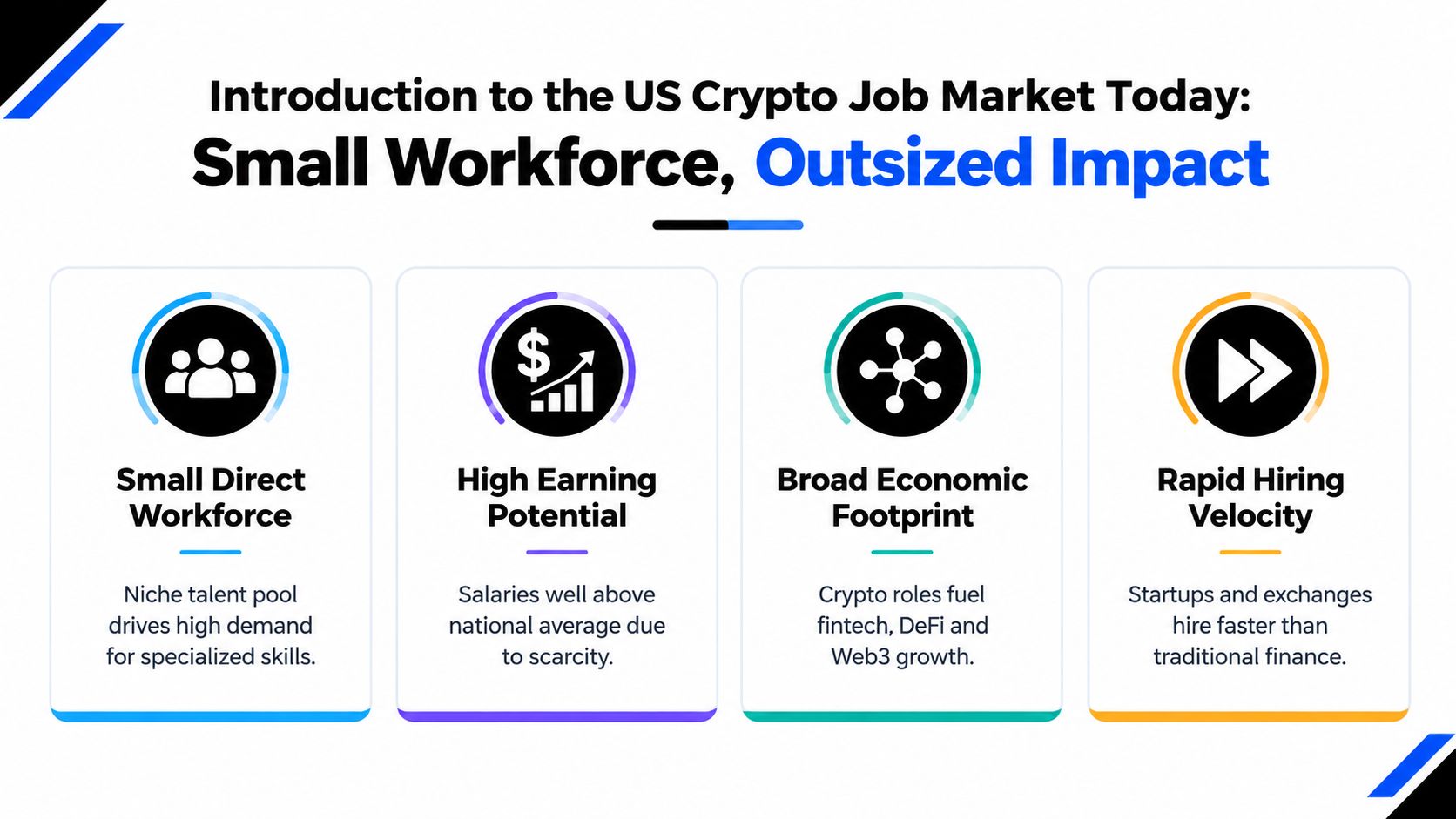
High pay reflects expensive problems. Smart-contract engineers reduce exploit risk, compliance leads make institutional onboarding possible, and data engineers keep exchanges dependable. Product, finance, operations, legal, security, and institutional sales also influence revenue and whether a company can operate at scale.
The market is concentrated, not evenly distributed
California, New York, and Texas account for about 60% of U.S. crypto jobs, according to the same NCA-referenced report. That concentration affects networking, office expectations, and employer density. Remote roles broaden access, but candidates still compete most effectively when they target companies and functions with clear hiring demand.
Position yourself around a costly business need. Show protocol reliability, smart-contract security, compliance judgment, finance operations, product delivery, or institutional customer work. Token enthusiasm alone rarely earns an interview.
Hiring reality: A credible work sample beats a loud crypto identity. Show what you built, shipped, reviewed, measured, or operationalized.
Most In Demand Crypto Role Categories in the USA
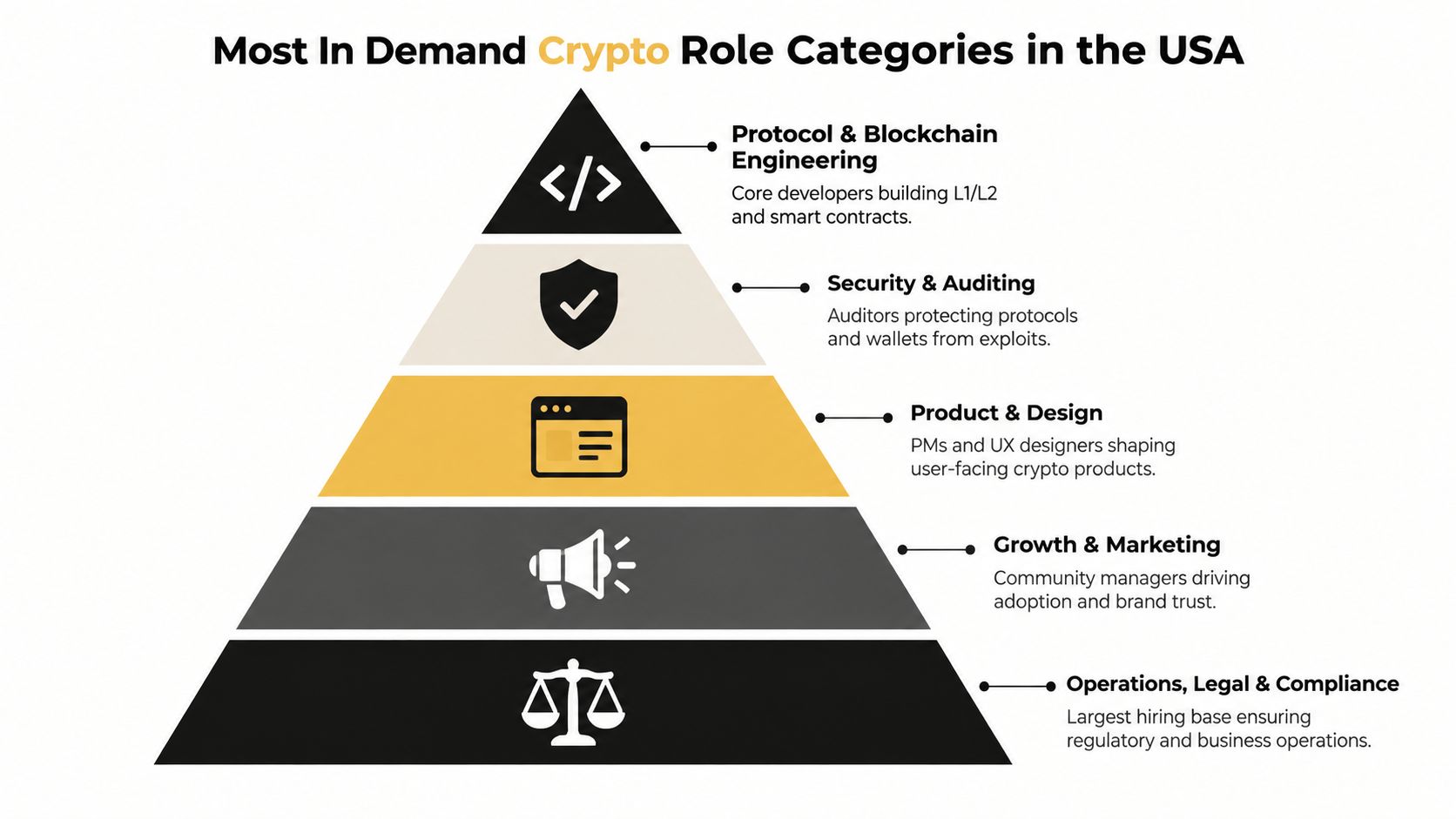
Crypto hiring resembles fintech more than many candidates expect. Engineering builds the rails, but compliance, finance, legal, product, security, and operations determine whether a company can launch, serve customers, and satisfy oversight requirements.
U.S. industry data places software, blockchain, and data engineering at 10,100 direct roles, followed by compliance, finance, and business operations at 5,450, with executives and managers at 5,100, according to recent sector reporting. Those figures show why “crypto developer” is too narrow a career strategy.
Technical roles carry the product risk
Protocol and blockchain engineers work on consensus systems, smart contracts, node infrastructure, wallets, indexing, and cross-chain components. The strongest candidates can explain failure modes, testing strategy, upgrade controls, and how their code behaves under adversarial conditions.
Security and auditing sit close to the core. Employers want people who can reason about access control, reentrancy, oracle assumptions, key management, formal verification, and incident response. A candidate who can review deployed contracts and communicate risk to non-engineers is more useful than one who only lists Solidity or Rust.
Data engineering and analytics also matter. Exchanges, protocols, and infrastructure companies need reliable pipelines, dashboards, anomaly detection, and usable reporting. Candidates who connect technical data work to fraud prevention, liquidity, customer behavior, or operational decisions stand out.
Non-technical roles are not secondary
Compliance, legal, finance, and operations form a major hiring base because regulated crypto products need controls around onboarding, transaction monitoring, reporting, accounting, treasury, vendor management, and customer support. A compliance candidate with payments or financial-crime experience should explain how they'd translate policy into workflows, not merely recite regulatory vocabulary.
Product managers and designers must handle unusual user problems, including wallet recovery, signing flows, custody choices, network fees, and trust signals. Growth and community teams face a similar burden. They need to build adoption without making claims that create legal, reputational, or customer-support problems.
For candidates, use adjacent skills strategically. An engineer should learn threat modeling and product communication. A lawyer should understand wallet architecture and transaction flows. A marketer should know the product well enough to distinguish education from financial promotion.
Browse engineering roles in crypto only if engineering is your actual strength. Otherwise, search by the business problem you can solve.
Salary Benchmarks and Where Crypto Jobs Cluster
Crypto pay depends on the work behind the title. Salary aggregators place average U.S. blockchain-role pay around $104,686, with a typical range of roughly $59,500 to $112,000. Another source reports average blockchain developer pay of about $136,000, with a low-to-high band of $70,000 to $200,000, according to ZipRecruiter's blockchain salary data.
These figures cover different talent markets. General blockchain development sits alongside protocol engineering, smart-contract security, cryptography, and distributed-systems work. Pay also changes with company stage, location, equity or token compensation, and responsibility for production reliability.
| Role Tier | Average Annual Pay | Typical Range | Premium Driver |
|---|---|---|---|
| General blockchain role | $104,686 | $59,500 to $112,000 | Specialized domain knowledge and relevant delivery |
| Blockchain developer | $136,000 | $70,000 to $200,000 | Protocol complexity, security responsibility, and total compensation |
| U.S. blockchain roles in current listings | $187,200 annualized from $15.6K monthly median | $147,600 to $213,600 annualized from $12.3K to $17.8K monthly | Employer, seniority, and scarcity of proven skills |
Listing data provides a separate market signal. Indeed's U.S. blockchain job data reports 197 open jobs across 71 hiring companies, a $15.6K median monthly salary, and a middle-50% range of $12.3K to $17.8K per month based on 251 salaries from 56 employers. Use those figures to frame expectations, not to promise a specific offer.
Geography changes the negotiation
California, New York, and Texas hold about 60% of U.S. crypto jobs, according to the NCA-referenced geographic breakdown. Hiring clusters there because exchanges, fintech companies, venture-backed startups, legal advisers, auditors, and institutional partners operate within the same networks.
That concentration does not make engineering the only route in. Compliance, legal, finance, product, operations, and security teams support the small direct headcount that keeps larger financial and technology businesses running. Candidates who connect their specialty to onboarding controls, audit readiness, treasury, customer risk, or production operations can compete for higher-value work without presenting themselves as generic blockchain applicants.
Remote hiring can widen the employer pool, but it does not erase location effects. Companies still anchor offers to their hiring market, and candidates gain an advantage when they can overlap with core hours and attend important in-person sessions.
Separate base pay from equity, tokens, bonuses, benefits, and clawback terms. Ask who owns audit readiness, incident response, and production operations. If the role carries security or regulatory responsibility, negotiate around that exposure rather than relying on a generic title.
Remote Versus On Site and Work Authorization Realities
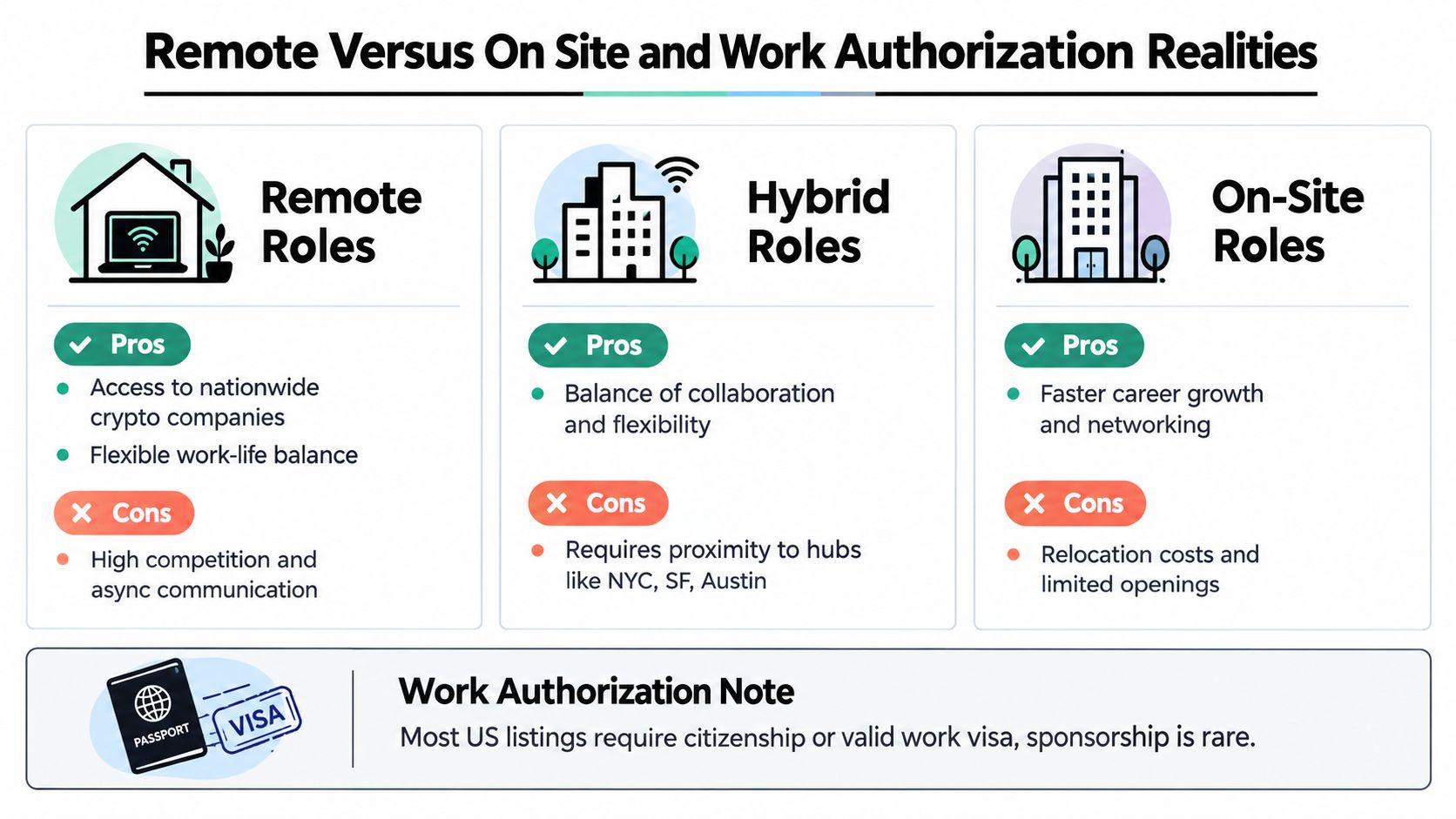
Remote, hybrid, and on-site roles each solve different problems. Don't choose based on lifestyle alone. Choose based on the company's operating model, your level of experience, and whether the role depends on confidential collaboration or regulated processes.
Use the work model as a screening filter
Remote work gives you access to companies outside your immediate area and can suit engineering, content, analytics, and community roles. The trade-off is heavier competition, asynchronous communication, and less informal access to senior decision-makers.
Hybrid work often fits product, compliance, legal, and leadership teams that need regular coordination. It's strongest when the company clearly defines office days, collaboration expectations, and the reason proximity matters. “Hybrid” shouldn't mean an undefined demand to appear at headquarters whenever a manager asks.
On-site work can accelerate learning for junior candidates because feedback, pairing, and networking happen naturally. It also creates relocation costs and limits the set of realistic openings. Review remote crypto jobs with the same rigor you'd apply to an office role, especially around time zones and travel requirements.
Before applying, ask yourself:
- Time-zone fit: Can you attend the recurring meetings that matter without making your schedule unsustainable?
- Security constraints: Does the employer prohibit certain work from shared spaces or unmanaged devices?
- Career stage: Do you need close mentorship, or can you produce independently with written specifications?
- Travel expectations: Are conferences, team offsites, customer meetings, or regulatory work part of the role?
- Communication quality: Does the company document decisions, or does remote work mean chasing context?
Work authorization needs direct answers
Many U.S. listings require citizenship or an existing valid work visa, and sponsorship is uncommon. Don't bury this issue until the final interview. State your authorization status accurately, ask whether sponsorship is available, and confirm whether the employer's legal entity can employ you in the stated location.
Employers should publish authorization requirements clearly. Ambiguous listings waste recruiter time and create avoidable candidate frustration, particularly when a role involves regulated financial activity or access to sensitive infrastructure.
Where to Find Crypto Jobs in the USA That Actually Hire
Generic searches produce noise. A better approach combines crypto-native job boards, company career pages, professional communities, and direct evidence of recent hiring.
Build a focused sourcing routine
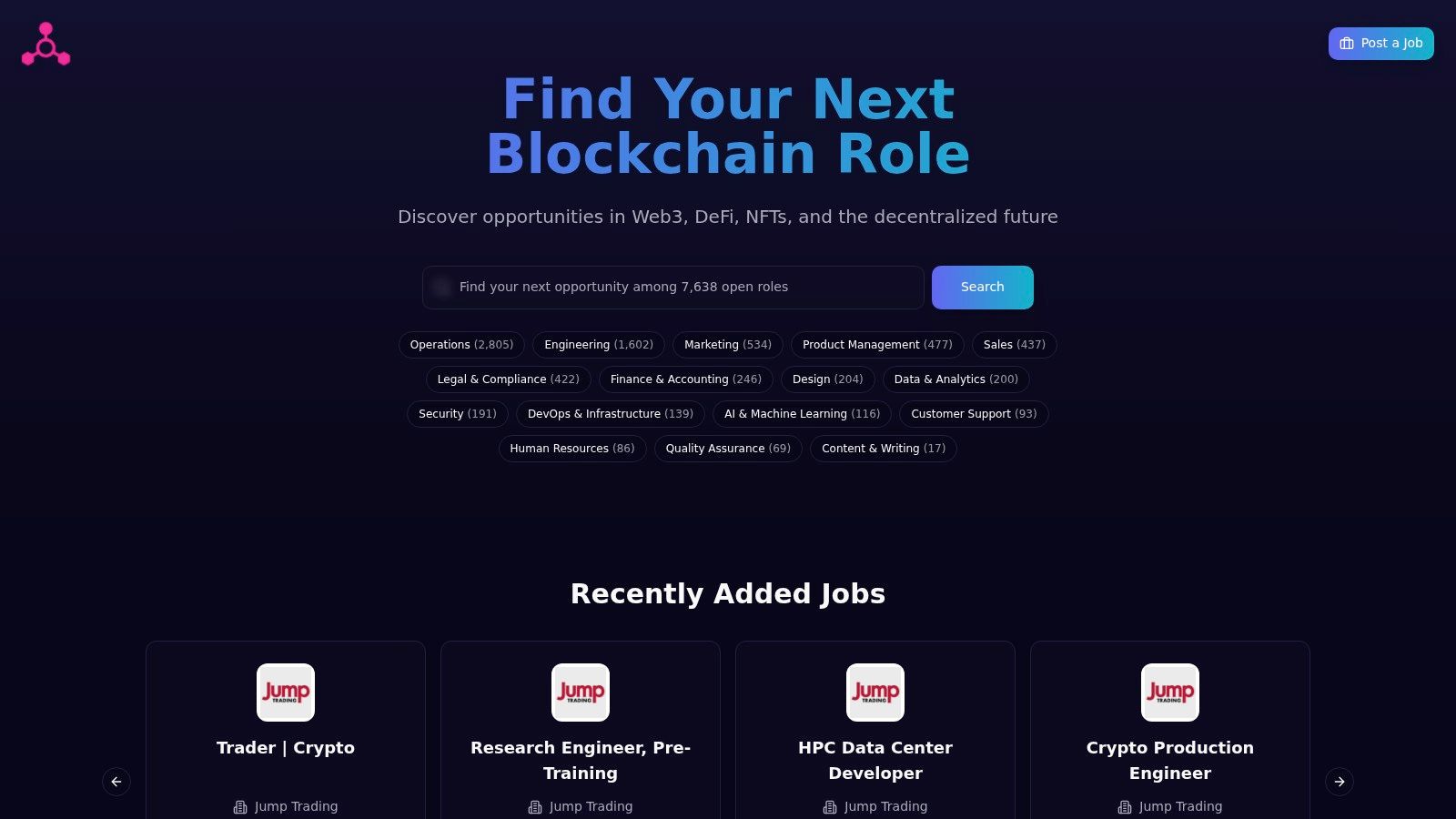
Start with category filters, not one broad phrase. Search engineering, security, product, legal and compliance, finance, operations, marketing, data, and customer support separately. A compliance professional who searches only “crypto jobs” will miss roles filed under legal operations or financial crime.
Next, check company career pages for firms you can evaluate seriously. Look for evidence of an actual operating product, named hiring teams, clear responsibilities, and an interview process that matches the level of the role. Ignore listings that rely on hype, vague token promises, or unrealistic requests for one person to own every function.
Community channels can reveal roles before they reach large boards. Follow protocol Discords, governance forums, developer communities, hackathons, and contributors whose work you respect. Don't enter a community and immediately ask for a job. Earn attention by answering technical questions, submitting useful pull requests, or explaining a product problem clearly.
Move quickly without becoming careless
Recently added feeds help you identify fresh openings, but speed should support judgment, not replace it. Prepare a tracker with the employer, role, location, authorization requirement, contact, application date, interview stage, and follow-up date.
Use U.S. crypto jobs to narrow the market by geography, then compare each listing against your evidence. Apply when you meet the core requirements and can tailor your materials. Mass-applying with the same résumé makes your search feel busy while producing little signal.
A referral works best when the referrer can describe your work. Ask for an introduction after you've identified a specific team problem you can solve, not after sending a generic message about loving Web3.
Practical rule: Ten well-researched applications with strong evidence are more useful than a large pile of untailored submissions.
How to Tailor Your Resume Portfolio and Ace Web3 Interviews
Hiring managers scan for proof. “Passionate about decentralization” tells me almost nothing. A deployed contract, an audit finding, a production incident you resolved, a dashboard used by operators, or a community program with clear ownership gives me something to assess.
Rewrite the résumé around shipped outcomes
Put the technical or business result first, then the tools. Instead of listing Solidity, Rust, Hardhat, or Foundry as isolated keywords, explain what you built, tested, deployed, reviewed, or maintained. Mention chain architecture, integrations, observability, access controls, incident response, or compliance workflows when those details are relevant and accurate.
Candidates from traditional finance should translate their experience into crypto operating language. Describe reconciliation, custody, transaction monitoring, payments, controls, audits, or treasury work in terms that a digital-asset employer understands. Product candidates should show how they handled onboarding friction, signing flows, custody choices, or user trust.
If you're applying for distributed work, use this guide to tailor your resume for remote roles. Keep the document easy to scan, and make your location, work authorization, time zone, and work model clear.
Make the portfolio inspectable
A strong portfolio lets the reviewer verify your contribution quickly.
- Engineers: Link GitHub repositories, deployed contracts, test coverage, architecture notes, and threat models. Explain what you personally owned.
- Security candidates: Show redacted findings, severity reasoning, remediation advice, and how you communicate risk without overstating certainty.
- Product and design candidates: Include user flows, prototypes, product decisions, usability trade-offs, and evidence that you understand wallet or transaction behavior.
- Compliance and legal candidates: Present a concise framework, control map, policy analysis, or onboarding workflow. Protect confidential information.
- Marketing and community candidates: Show campaigns, editorial work, governance participation, launch planning, and how you handled accuracy and trust.
Prepare for each interview stage
A 2026 U.S. Web3 hiring guide says processes commonly take 2 to 4 weeks and may include an application, short screen, paid or unpaid take-home, technical or case interview, and culture conversation. Shipped work can outweigh résumé claims, so prepare to defend decisions rather than recite terminology.
For the screen, give a concise narrative: what you've shipped, what problem it solved, what went wrong, and what you'd do differently. For the take-home, state assumptions, document trade-offs, test edge cases, and avoid building an oversized demo. For technical or case interviews, explain failure modes and operational consequences. For culture interviews, demonstrate judgment around security, compliance, customer harm, and disagreement.
Career Progression and Hiring Best Practices for Long Term Growth
Crypto careers compound when you become useful across boundaries. An engineer can progress from implementation to technical ownership, then lead architecture, security, or protocol strategy. Product managers can move from feature delivery into platform, institutional, or ecosystem leadership. Compliance and legal professionals can grow into policy, risk, licensing, or general counsel roles. Marketing and community specialists can advance into growth, communications, or ecosystem strategy.
The durable skill is not “knowing crypto.” It's knowing how to ship safely in a system where code, money, users, regulators, and public communities interact.
Employers should build cross-functional teams from the start. Budget compliance, finance, security, and operations alongside engineering. Price audit readiness and production reliability into compensation, and give candidates a clear decision process instead of stretching interviews indefinitely.
Candidates should follow a simple progression plan:
- Choose a durable lane: Pick engineering, security, product, compliance, operations, finance, or growth.
- Add one adjacent capability: Learn enough of another function to collaborate credibly.
- Ship public evidence: Publish code, analysis, product work, documentation, or community contributions.
- Track ownership: Keep records of decisions, incidents, launches, and measurable responsibilities.
- Target stronger teams: Move toward employers with real customers, clear controls, and serious technical standards.
The U.S. market rewards specialists who can work cross-functionally. Build that profile, and your next role becomes a progression step instead of another speculative application.
Use Blockchain Jobs to search focused openings across engineering, product, compliance, operations, marketing, security, and other Web3 functions. Filter for U.S. and remote opportunities, review fresh listings, and apply with a portfolio that proves you can contribute from day one.