Entry Level Developer Salary: A Guide for Your 2026 Job Hunt
Let's get right to the point: the entry level developer salary for a general software job in 2026 is a great starting point. But if you want to jumpstart your career and earnings, specializing in Web3 is the most strategic move you can make. A typical new developer might see a median base salary around $95,000, while a new blockchain developer can often command a starting salary closer to $130,000.
Your 2026 Salary Starting Line

Before you step into an interview, you need to know your value. Think of your salary potential as the starting line in your career race. For most software engineers, that line is already impressive. For those diving into the blockchain world, it's like getting a massive head start.
This number isn’t just trivia; it's your anchor in any negotiation. Walking into a salary discussion armed with this data gives you the confidence to ask for what you're worth, because you know exactly what the market is paying. This is a crucial first step in any job search.
The Generalist Vs. The Specialist
In the United States, an entry-level software developer can expect a median salary of $95,000 per year. The typical salary band sits between $77,000 and $120,000. That alone makes tech one of the most lucrative fields for new grads. Tack on performance bonuses, which can add another $18,000 to $34,000, and you've got a fantastic financial foundation.
But here’s where the story gets really interesting from a career progression standpoint: specialization. The demand from hiring managers for developers who understand blockchain is off the charts. The talent pool is much smaller and the challenges are far more complex, which naturally drives salaries skyward.
For a new developer entering the Web3 space, the average starting salary is a whopping $130,500, with most offers falling between $121,000 and $140,000. This premium isn't an accident—it's driven by intense competition for skilled smart contract and DeFi engineers in a market where talent is scarce.
We're not talking about a small pay bump here. That's a 30-40% increase over a generalist software role. If you want to maximize your earning potential right out of the gate, specializing early in a high-demand field like Web3 is one of the smartest career moves you can make.
To put these numbers into perspective for your job search, here's a quick side-by-side comparison.
2026 Entry-Level Developer Salary At a Glance (US Median)
| Role | Median Base Salary (2026) | Typical Bonus Range |
|---|---|---|
| Software Developer (General) | $95,000 | $18,000 - $34,000 |
| Blockchain Developer | $130,500 | $15,000 - $40,000+ |
As you can see, choosing to focus on blockchain gives you a significant advantage in base compensation from day one. This is key leverage to bring into any interview.
Putting Your Skills Into Action
Knowing the numbers is one thing, but turning them into a job offer is what counts. Your portfolio, your GitHub activity, and how you perform in interviews are what will transform these benchmarks into your reality.
As you sharpen your skills, focus on the areas Web3 companies are desperate to hire for:
- Smart Contract Development: Getting comfortable with Solidity or Rust will make you an immediate and high-value candidate.
- Decentralized Finance (DeFi): If you can demonstrate a deep understanding of the protocols powering this new financial ecosystem, you'll be highly sought after in interviews.
- Backend Engineering: Every great dApp needs a robust and scalable backend. This is a foundational skill that is always in demand.
A great next step is to explore the current engineering roles on our job board to see exactly what skills employers are looking for. This isn't just about finding any job—it's about strategically placing yourself in the most valuable and rewarding part of the market to accelerate your career.
Understanding Why Web3 Roles Command a Premium
That significant salary bump you see when jumping from a general software role into Web3 isn't just a fluke. It's the direct result of powerful market forces you can use to your advantage in a job interview. The easiest way to think about it is classic supply and demand.
Imagine a modern-day gold rush. Suddenly, there are thousands of new companies digging for digital gold, but only a handful of developers actually know how to operate the specialized machinery needed to get it. That's the Web3 job market in a nutshell.
This creates an intensely competitive hiring environment. Companies aren't just looking for talent; they're fighting for it. The pool of developers who are truly skilled in core blockchain tech like Solidity, Rust, and advanced cryptography is tiny compared to the explosion in demand. Every Web3 startup and established company pivoting into the space is fishing from the same small pond, which gives you, the candidate, immense leverage.
The High Stakes of Immutable Code
But it's not just a numbers game. The very nature of Web3 development adds another layer of value you can highlight during your interview process. When you write code for a normal website, a bug is usually a quick fix. You patch it, deploy the update, and the damage is contained.
In the world of blockchain, the stakes are completely different.
Code deployed to a blockchain is often immutable—once it's out there, you can't just go back and change it. A single mistake in a smart contract can lead to millions of dollars being drained by hackers in minutes. This isn't just a bug; it's a catastrophic failure.
Companies aren't just paying for your ability to write code. They are paying for your precision, your security-first mindset, and the expertise needed to prevent those multi-million dollar mistakes. Your value isn't just in what you build, but in the disasters you help the company avoid.
This is a powerful frame to bring into your interviews. You’re not just a coder; you're a guardian of digital assets. Talking about your skills in this way shows you understand the business risks and justifies the premium salary you're asking for. This specialization is valuable even in adjacent roles, like this Web3 Creative Designer position, where deep ecosystem knowledge is a must.
Data Backs the Web3 Salary Premium
The numbers don't lie, and they are your best friend in a negotiation. In the blockchain space, entry-level developers can command an average salary of $130,500 per year, which is a massive 37% higher than their peers in general software roles.
This premium is a direct reflection of the demand for niche skills in smart contracts, DeFi, and cryptography. In fact, the talent pool is so small that blockchain firms are often forced to offer salaries in the $121,000-$140,000 range right out of the gate, and that's before you even factor in tokens or equity.
With the global blockchain market projected to soar past $39 billion by 2025, this trend isn't slowing down. For new developers, skills in Solidity and Rust are a golden ticket to a better starting offer. You can see more data on how different tech niches stack up in this detailed salary analysis.
Grasping these market dynamics—scarcity, high-stakes work, and explosive growth—is your key to unlocking a top-tier salary. It shifts the conversation from "what's a fair starting wage?" to "what's the market value for someone who can navigate this demanding environment?" This positions you not as a cost, but as a crucial investment for any Web3 company.
Decoding Your Full Compensation Package
When a Web3 company makes you an offer, looking only at the base salary is a rookie mistake. That number is just the starting point. To truly evaluate a job offer and compare it to others, you need to analyze the entire compensation package.
Think of it like this from a career-building perspective: your base salary is your stable foundation. It’s the reliable cash you can count on every month for rent, food, and life. But the other parts of the offer, like equity and tokens, are your high-growth assets. They come with more risk, sure, but they also have the potential for huge returns, linking your financial future directly to the project's success.
Base Salary: The Foundation of Your Pay
Your base salary is the guaranteed income you’ll get, no matter what happens in the market. This is the bedrock of your finances. For any developer just starting out, a solid base is crucial because it gives you stability in an industry known for its wild price swings.
This is the number you'll negotiate first, and it needs to be high enough to cover all your living expenses, savings goals, and any student debt you might have. A company offering a competitive base salary is showing they are serious about hiring and retaining talent. It’s a sign that they care about your stability, not just gambling on a future token rally.
The diagram below breaks down exactly why Web3 roles can demand such high salaries in the first place—leverage you can use in your negotiation.
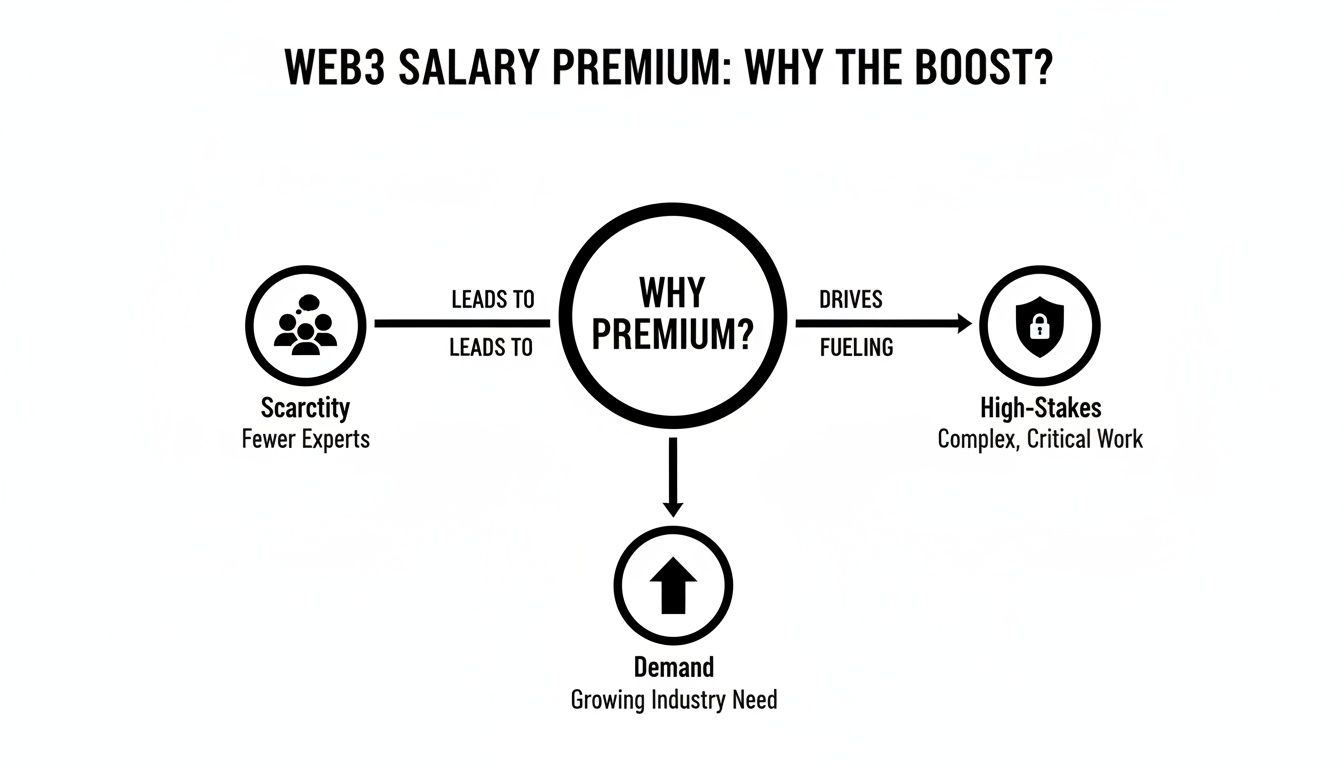
It’s this simple formula—high demand, few experts, and high-stakes work—that gives you the leverage you need to lock in a strong base salary.
Equity: The Long-Term Company Bet
Equity is your slice of the company pie, usually given as stock options. It's a long-term bet on the organization's growth. But here's the catch for your career planning: equity isn't cash you get on day one. It almost always comes with a vesting schedule.
This is just a timeline for earning your shares. A very common schedule is a four-year vest with a one-year cliff.
- The Cliff: You get nothing for your first 12 months. If you leave on day 364, you walk away with zero equity.
- The Vesting: On your one-year anniversary, 25% of your shares "vest," meaning they become available to you. The remaining 75% typically vests in smaller chunks every month or quarter for the next three years.
This is a powerful tool for companies to keep talent around. When you get an offer, always ask about the vesting schedule. A shorter schedule or a smaller cliff is a negotiable point and is better for you because it lowers your risk of leaving before you’ve earned a meaningful stake in the company.
Token Grants: The High-Growth Wildcard
Token grants are what set Web3 compensation apart. This is often the highest-risk, highest-reward part of your pay. Instead of company stock, you get a set amount of the project’s native cryptocurrency.
Just like equity, tokens usually have a vesting schedule. The big difference is liquidity. Vested stock in a private startup can be hard to sell, but vested tokens can often be sold on an open exchange almost immediately. This gives you a much faster path to cash.
Of course, that speed comes with a price: volatility. A bull run could send the value of your tokens soaring, potentially doubling or tripling your total annual income. But a bear market could just as easily cut their value by 80%. If you're more risk-averse, it's a perfectly reasonable negotiation tactic to ask for a higher base salary in exchange for fewer tokens. Knowing how to weigh these trade-offs is exactly the kind of strategic thinking that compensation experts, like a Total Rewards Analyst, do every day. It shows a potential employer that you understand the financial realities of the space.
How to Maximize Your Salary Offer
Think of the first salary number a company gives you as an opening bid, not a final price. That initial offer is just a starting point in a conversation, and you have more influence over the final number than you might realize. The key is understanding what makes a company willing to pay more.
Hiring managers aren't just trying to fill an empty chair; they're trying to solve a very specific, often urgent, problem. The more you can prove that you are the best solution to that problem, the more flexible they'll be with compensation. It all comes down to showing them what you can do.
Your Technical Skillset as a Salary Driver
Let's be blunt: not all programming languages are created equal when it comes to your paycheck. Your tech stack has a huge impact on your earning potential, especially in a specialized field like Web3. Knowing a general-purpose language like Python is great, but mastering a high-demand, niche language like Solidity or Rust puts you in a completely different ballpark in a hiring manager's eyes.
Why? Scarcity and risk. Companies building on blockchains like Ethereum or Solana are desperate for developers who can write secure, efficient smart contracts. There just aren’t enough of them to go around, which gives you incredible negotiating power.
- High-Demand Languages: Skills in Solidity, Rust, and Go often get a significant salary bump because the talent pool is small and the work is absolutely critical to the business.
- General-Purpose Languages: Being proficient in Python or JavaScript is fundamental. You can make yourself even more valuable by mastering Web3 libraries like Ethers.js or Web3.py.
When a hiring manager sees a resume with real Solidity experience, they don't just see a buzzword. They see someone who can jump into their core product, reduce project risk, and start contributing from day one. That’s worth a lot of money to them.
Think of your skills as a toolkit. A basic set of wrenches is useful for many jobs. But for high-stakes, specialized work, you need precision instruments. In Web3, Solidity and Rust are those precision tools, and companies will pay a premium for the craftsperson who knows how to use them.
The Power of Your Project Portfolio
For anyone breaking into the industry, your project portfolio is your single most important asset. It's often more persuasive than your resume. A degree tells a hiring manager what you learned in a classroom; a well-maintained GitHub profile shows them what you can actually build.
But a portfolio full of old class assignments won’t move the needle. To really stand out and justify a top-tier salary, your projects need to show initiative and prove you can solve problems like a real-world engineer.
- Deploy a Smart Contract: Build and deploy a simple token or a basic dApp on a testnet. This shows you understand the entire lifecycle, not just writing code in an editor. This is a key talking point for an interview.
- Contribute to Open Source: Find a DAO or a small open-source Web3 project and make a contribution. Even fixing a minor bug or improving documentation proves you can navigate a professional codebase and collaborate.
- Build a Full-Stack dApp: Create a project that has both a smart contract backend and a frontend that a user can interact with. This demonstrates that you see the big picture of how decentralized applications work.
When a hiring manager sees a portfolio with these kinds of self-driven projects, they see a candidate who is genuinely passionate and can work independently. Those are two of the most valuable—and bankable—qualities you can have.
Company Stage and Location Factors
The kind of company you join and its approach to location will also shape your compensation package. An early-stage startup, for instance, might offer a lower base salary but try to make up for it with a more generous grant of equity or tokens. On the flip side, a large, well-funded protocol can probably offer a bigger base salary but with a smaller piece of the potential upside. This is a crucial decision for your career trajectory.
Location is the other big variable. Even though many Web3 jobs are remote, companies have different philosophies on how they pay. Some pay a "global" rate, meaning you get a San Francisco-level salary whether you live in California or Kansas. Others adjust their offers based on your local cost of living. You need to figure out their policy before you start talking numbers.
The table below breaks down how these factors really look from the hiring manager's side of the desk.
Salary Modifiers for Entry-Level Web3 Developers
Understanding what a hiring manager is thinking is your secret weapon. They are weighing risk versus reward, and the more you can position yourself as a low-risk, high-reward hire, the better your offer will be.
| Factor | Potential Salary Impact | Hiring Manager's Perspective |
|---|---|---|
| Specialized Skillset (e.g., Solidity) | High Positive | "This candidate can contribute to our core product immediately, reducing risk and training costs." |
| Strong Project Portfolio | High Positive | "This candidate has proven, tangible skills and is a self-starter. They are less of a hiring risk." |
| Early-Stage Startup | Lower Base, Higher Equity | "We need to preserve cash but can offer significant upside if the company succeeds." |
| Established Protocol | Higher Base, Lower Equity | "We can offer stability and a competitive cash salary to attract proven talent." |
| Remote (Location Agnostic) | Highest Potential | "We compete for global talent and must offer top-tier rates regardless of location." |
By keeping these variables in mind, you can walk into any negotiation with a clear-eyed view of your own value. You'll be able to confidently ask for a salary that truly reflects what you bring to the table.
Negotiating Your First Developer Salary Like a Pro

Getting that first job offer is a huge moment. It's easy to feel like you have to grab the first number they throw at you, especially when you're just starting out. But here's a secret: the offer isn't the finish line. It's the starting pistol for negotiation.
Believe it or not, companies expect you to negotiate. It’s a standard part of the process.
Think of it less as a confrontation and more as a final, collaborative interview. They want to hire you, and you want to work there. The goal is simply to land on a package that feels fair, truly reflects your market value, and kicks off your career on the strongest possible footing.
Step 1: Know Your Value and Do the Research
Walking into a negotiation without a number is like flying blind. But it can't just be a number you want; it has to be a number you can defend. That means you need to do your homework.
Use the salary data in this guide as your starting point. Then, dig deeper. Scour job boards like Blockchain Jobs for similar roles and see what they're listing. If you know anyone in the space, ask them what seems realistic.
Your goal is to build a justifiable salary range for your specific situation. Having a data-backed target—like “$125,000 to $140,000 for an entry-level Solidity developer at a remote-first startup”—is infinitely more powerful than just saying, "I was hoping for more."
From our side of the table, a candidate who can clearly explain their salary expectations based on real market data comes across as professional and prepared. It shows you’ve done your homework and you’re treating this as a serious business discussion.
Step 2: Let Them Go First
Here’s a classic piece of negotiation advice: always let the other side name the first number. At some point in the interview process, a recruiter will likely ask about your salary expectations. This is your cue to politely deflect.
Try saying something like: "My main focus right now is finding the perfect fit, and I'm confident we can agree on a fair salary if we both feel it’s a match. To help me understand, could you share the approved range for this position?"
This simple question puts the ball in their court. It forces them to reveal their budget and gives you a concrete starting point to negotiate from, rather than accidentally lowballing yourself.
Step 3: Articulate Your Value Beyond the Resume
When you make your counteroffer, you have to back it up with a "why." This isn't about your personal bills or student loans; it's about connecting your unique skills directly to the company's pain points.
Frame your argument around the value you bring to the table.
- Reference a Specific Skill: "Based on my research, the market rate for developers with hands-on experience deploying smart contracts to a testnet is in the higher end of the range. My project, [Project Name], which I built and deployed on the Sepolia testnet, shows I can contribute from day one."
- Highlight Your Portfolio: "My GitHub shows my active contributions to [Open-Source Project], which proves my ability to collaborate effectively in a shared codebase—a key requirement you mentioned for this role."
- Connect to Their Needs: "Security was a big topic in our conversation. I spent extra time in my personal projects implementing checks for common vulnerabilities like reentrancy, which shows my security-first mindset."
This approach anchors your request in tangible proof of what you can do. It transforms your ask from a personal request into a compelling business case for the hiring manager.
Step 4: Negotiate the Entire Package
A fantastic offer is about more than just the base salary. If a company can’t budge much on that main number, it’s time to get creative with the rest of the compensation package. This is especially true in Web3, where the total package can hold enormous potential.
Think bigger and consider negotiating for:
- A Signing Bonus: A one-time payment when you start can easily bridge the gap if the base salary is just shy of your target.
- A Shorter Token Vesting Cliff: For many crypto roles, your tokens don't start vesting until after a one-year "cliff." Negotiating that down to six months means you get access to those high-growth assets sooner, which lowers your personal risk.
- Professional Development Budget: Ask for a dedicated budget for conferences, courses, and certifications. It’s an investment in your skills that pays them back directly.
- Remote Work Stipend: See if they’ll provide a budget for setting up a proper home office, covering your internet bill, or paying for a co-working space.
Thinking about the full package shows you’re a strategic, long-term thinker—a quality every hiring manager loves to see. By walking into negotiations with a clear strategy, you’re not just trying to land a job; you’re working to secure the best possible launchpad for your entire career.
Your Career Path from Entry Level to Senior Developer
Landing your first job and locking in a solid entry-level developer salary is a massive win, but it's just the first step. You should think of your initial role as a launchpad, not the final destination. The developers who build the most rewarding careers are always thinking about their next move, strategically picking up skills that will open doors for them down the road. A great hiring manager isn't just filling a seat; they're looking for people who have the drive to become future leaders on their team.
The path from an entry-level developer to a mid-level and then senior role is a well-worn one. But in the fast-paced world of Web3, that journey often happens on a much faster timeline. The key is to be intentional about your growth from day one.
The Journey from Junior to Senior
The jump from junior to mid-level developer is all about shifting from taking direction to taking ownership. As a junior, you'll be given well-defined tasks to complete. As a mid-level engineer, you’ll be trusted to own entire features from concept to completion. You won't just write the code—you'll help shape the requirements and spot potential problems before they happen.
Moving from mid-level to senior is an even bigger leap. It stops being about your personal code output. Senior developers are force multipliers; they make the entire team more effective. Hiring managers are looking for people who can mentor junior engineers, lead tough architectural decisions, and explain complex technical ideas to non-technical folks like product managers or marketers.
Your salary progression is tied directly to your level of ownership and impact. A junior developer adds value by writing code. A senior developer adds value by making sure the right code gets written by the entire team, preventing costly mistakes and steering the project forward.
This shift in responsibility is exactly what justifies the big salary bumps at each stage. You’re evolving from someone who completes tasks to someone who solves strategic problems for the business.
Exploring Your Future Career Paths
The traditional "Senior Developer" track isn't your only option, especially in Web3. This space has spawned all kinds of fascinating career paths that build on a strong technical foundation. Thinking about these possibilities early on can even make you a more impressive candidate in interviews, as it shows you have a long-term vision.
- Protocol Specialist: If you genuinely love digging into the nitty-gritty of how blockchains work, you could specialize in core protocol development. These are some of the most demanding—and highest-paid—roles in the entire industry.
- Developer Relations (DevRel): Are you a great communicator who enjoys teaching other people? A move into DevRel might be a perfect fit. You'll be the vital link between a company and its developer community, writing tutorials, speaking at conferences, and channeling feedback to the internal team.
- Product Management: Technologists who find themselves obsessed with the "why" behind the "what" often become fantastic product managers. You'd get to use your deep technical insight to guide a product's overall strategy and roadmap.
How to Accelerate Your Growth (and Your Salary)
No matter which path you're eyeing, a few key activities act as powerful career accelerators. These are the things that make hiring managers' eyes light up because they signal real passion, initiative, and a commitment to growing beyond the 9-to-5.
First, continuous learning is completely non-negotiable. Web3 tech changes at a blistering pace, and you have to stay on top of new tools, languages, and protocols to remain a valuable hire.
Beyond that, contributing to open-source projects is one of the best things you can possibly do for your career. It proves you can collaborate in a professional setting and gives you a public portfolio of your work. Finally, get involved. Build your network by joining hackathons, participating in DAOs, and just being an active voice in the community online. More often than not, these are the connections that lead you to your next great opportunity.
Frequently Asked Questions
When you're just starting out, it's natural to have a lot of questions about salaries, the job hunt, and what a career in Web3 actually looks like. Let's tackle some of the most common ones from the perspective of a hiring team.
Do I Need a CS Degree for a High Entry-Level Developer Salary?
Honestly, not always. While a computer science degree never hurts, the Web3 world is a bit different. Here, proof of skill often speaks louder than a diploma. A rock-solid portfolio filled with personal projects, open-source contributions, and a clear grasp of languages like Solidity or Rust can easily put you ahead of a candidate with a degree but no hands-on experience.
Think of it this way: for many hiring managers, your GitHub is your resume. It shows you have the drive and the practical know-how to build things that work, which is what they’re really hiring you to do.
How Does Location Affect a Remote Web3 Developer's Salary?
This really comes down to the company's philosophy on pay. Some of the most competitive Web3 companies have a location-agnostic salary policy—they pay a top-tier rate no matter where you're based. This is a huge win for developers living in places with a lower cost of living.
On the other hand, many companies still tie their salary bands to your geographic location. The best thing you can do is ask about their compensation strategy early in the interview process. It’s a completely professional question, and it shows you’re thinking seriously about the role and your career.
Remember, an interview is a two-way street. You're not just there to be evaluated; you're evaluating them, too. Asking about their pay philosophy shows you're a strategic candidate who cares about the company's culture.
Are Token-Based Compensation Packages Too Risky for New Developers?
They definitely carry more risk than a pure cash salary, but they also come with a much higher potential reward. The smartest way to handle this as an entry-level developer is to negotiate a base salary that comfortably covers all your living expenses and savings goals.
You can then view the token or equity part of your package as a high-growth, long-term investment. This approach secures your financial stability while still giving you a stake in the project's potential success. You can even try to negotiate the vesting schedule, which shows a potential employer you're thinking ahead about your long-term commitment.
How Do I Get a Web3 Job with No Professional Experience?
In Web3, your portfolio is your experience. When a hiring manager can't look at a list of previous employers, they look for tangible proof that you can code.
- Build and Deploy: Don't just write code—ship it. Create your own smart contracts and get them running on a public testnet. This shows you understand the entire development cycle.
- Jump into Hackathons: These are fantastic for showing you can build something functional under pressure and work well with a team.
- Contribute to Open Source: Pick a DAO or a protocol you admire and start contributing. You can start small by fixing bugs or improving documentation. This is direct proof you can navigate a real-world, professional codebase.
These actions do more to prove your abilities to a hiring manager than a traditional resume ever could.
Ready to find a company that values what you can build? Blockchain Jobs is the top job board connecting developers with leading opportunities in the Web3 space. Check out thousands of roles and find your fit today at https://blockchain-jobs.com.