Your Guide to Landing Full Stack Developer Remote Jobs
The demand for skilled full stack developers who can work remotely has never been higher. Companies are in a fierce race to hire talent who can build and manage their entire tech stack, creating a gold rush for developers with end-to-end expertise. This is a critical moment for your career.
This isn't just about a few tech startups. From legacy corporations to nimble Web3 projects, hiring managers are competing for the same pool of versatile developers. This guide provides actionable insights to help you navigate the hiring process, ace your interviews, and accelerate your career progression in the remote job market.
Why Remote Full Stack Roles Are Booming
The move to remote work wasn't a temporary fad; it’s a permanent shift in how top-tier tech teams operate. For you, as a full-stack developer, this completely changes the game. Your location no longer matters—your skills are what get you hired, opening up a global market of opportunities that were once out of reach.
This creates a powerful dynamic for your career. Companies need developers who can expertly handle both the front-end experience and the back-end logic, and they're willing to look anywhere in the world to find them. This gives you unprecedented leverage in your job search.
The Numbers Behind the Demand
The data paints a clear picture of growth and opportunity that directly impacts your hiring potential. Recent market analysis shows not just a high volume of job openings, but also seriously competitive salary packages that you can target.
This infographic breaks down the key trends you need to know to position yourself effectively.
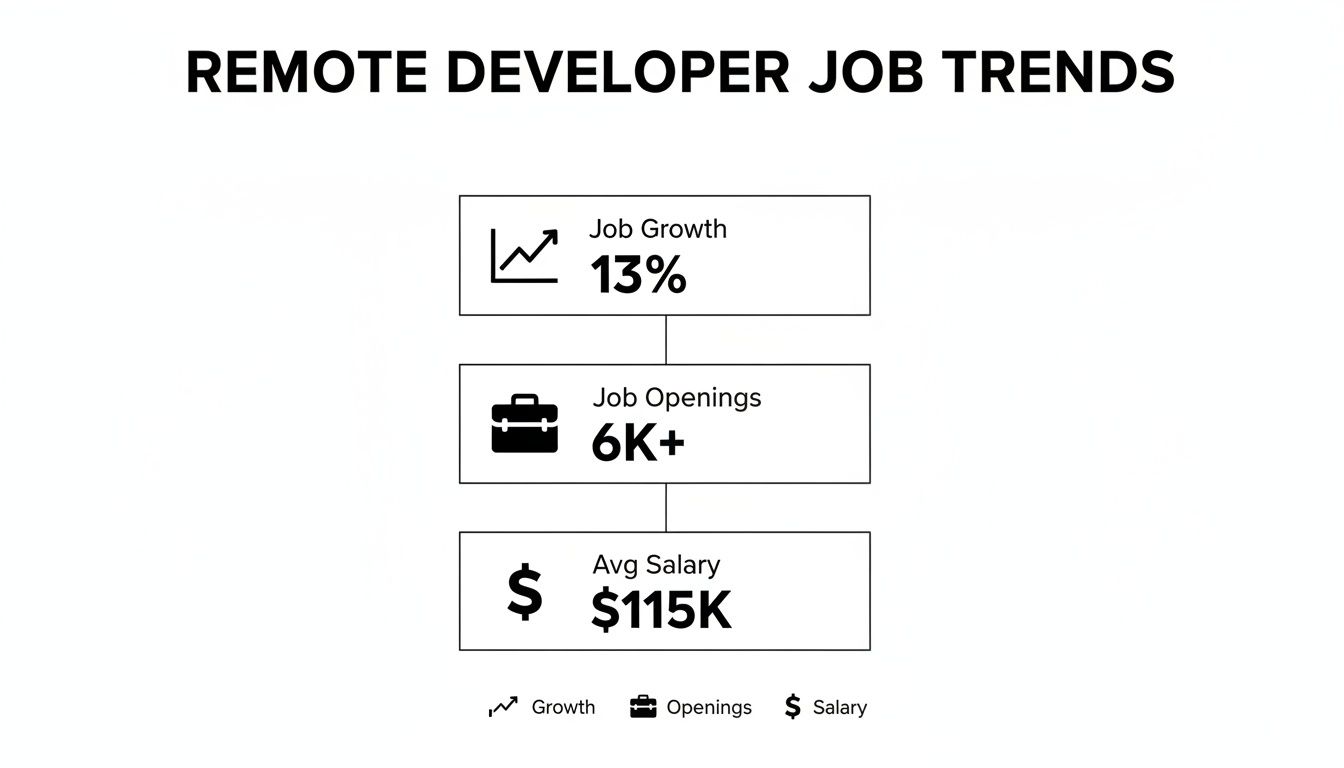
These aren't fuzzy, far-off predictions. They reflect the real opportunities available right now that you can apply for today.
What This Means for Your Career
So, how does this translate into your job search and career growth? It means you have significant leverage. As of early 2026, there are over 6,032 US-based remote full stack roles currently open. The national average salary sits at a solid $115,406 per year.
For senior developers, especially those targeting companies in major tech hubs, that figure often climbs into the $140,000 to $150,000 range during offer negotiations.
To give you a clearer idea of what you can expect to earn, here’s a look at how salaries break down by experience level in the US market.
Remote Full Stack Developer Salary Snapshot (2026)
| Experience Level | Average Annual Salary Range |
|---|---|
| Entry-Level (0-2 years) | $85,000 – $110,000 |
| Mid-Level (3-5 years) | $110,000 – $145,000 |
| Senior-Level (6+ years) | $145,000 – $180,000+ |
Of course, these numbers can vary based on your specific tech stack, the company's funding, and your negotiation skills, but they provide a strong baseline for what you should be asking for in interviews.
The real story here is long-term stability for your career. The industry is projected to see 13% job growth between 2020 and 2030—more than double the average for all other jobs.
This sustained growth means that every hour you spend sharpening your full-stack skills is a direct investment in a secure and profitable career path. Hiring managers are actively searching for talent, and specialized job boards make it easier than ever to connect with them. For example, you can find a huge number of remote blockchain jobs that specifically call for full-stack developers, showcasing just how deep the demand runs in high-growth sectors.
Building a Skillset That Hiring Managers Want
When hiring managers evaluate a remote full-stack developer, they aren't just ticking off language boxes on a checklist. For remote roles, they're hunting for a specific combination of skills that proves you're a low-risk, high-impact hire who can build modern, scalable products without constant hand-holding.
Your tech stack is your first impression in any job application. It needs to be solid and align with what companies are looking for.
The Full-Stack Foundation
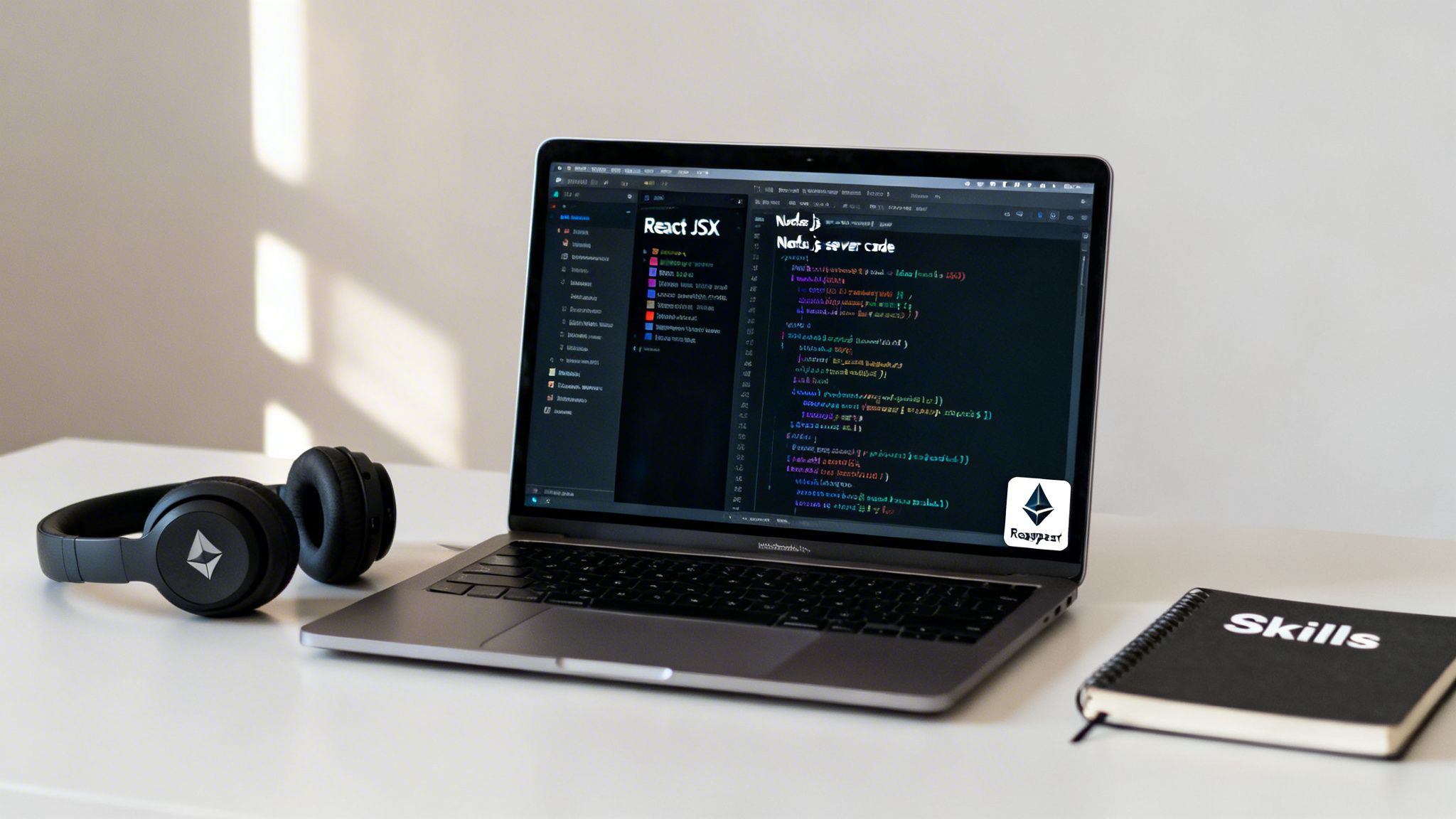
On the front-end, you absolutely need deep experience with a component-based framework to pass the technical screen. React is still king, but real fluency in Vue.js or Svelte is just as impressive. To stand out in an interview, you need to go beyond basic syntax—be prepared to discuss your opinions on state management, the component lifecycle, and performance optimization techniques.
For the back-end, the ability to architect and build clean, robust APIs is simply non-negotiable. The classic Node.js and Express combo is always a great bet, especially for JavaScript-heavy roles. However, demonstrating experience with Go or Python (especially with a modern framework like FastAPI) signals versatility. It shows a hiring manager that you know how to pick the right tool for the job, a key trait for senior-level progression.
Advancing into Web3 Technologies
This is where you can really separate yourself from the pack and unlock higher-paying roles. Adding blockchain-specific skills to your resume shows you’re not just keeping up with trends—you’re getting ahead of them. It’s a massive plus for any hiring manager in the decentralized space.
These skills are all about building with a security-first mindset, which is a critical talking point in Web3 interviews.
- Solidity: This is the go-to language for writing smart contracts on Ethereum and other EVM-compatible blockchains. Knowing how to write, test, and securely deploy contracts is a golden ticket for career advancement.
- Ethers.js or Web3.js: Your front-end is useless if it can't talk to the blockchain. These libraries are the essential bridge, allowing your app to read on-chain data and let users interact with your smart contracts.
A developer who can build a slick React front-end on a Node.js API is valuable. But a developer who can also wire that entire stack into a secure Solidity smart contract using Ethers.js? That's a completely different level of value that hiring managers will pay a premium for.
The Skills That Seal the Deal
It’s not just about the code. For full stack developer remote jobs, hiring managers are looking for proof that you can operate effectively in an asynchronous, distributed environment. You can often find these unspoken requirements by reading between the lines of a full-stack engineer job description.
This is where your knowledge of the supporting ecosystem becomes a major asset in interviews. Have you set up CI/CD pipelines to automate testing and deployment? Do you use Docker to containerize your applications for consistency? Are you comfortable deploying to cloud services like AWS or Vercel?
When you talk about your projects, don't just list technologies. Frame your work in terms of how you built for scalability, security, and maintainability. That’s what engineering leaders want to hear, and it turns a simple skills list into a compelling story of why you’re the right person for their team.
Creating a Portfolio That Stands Out Remotely
When you're chasing full stack developer remote jobs, your portfolio isn't just a gallery of past projects—it's your primary sales pitch to get an interview. A hiring manager can't just pop by your desk; your portfolio has to do all the talking, proving you can ship high-quality code, solve real business problems, and work effectively on your own.
The biggest mistake developers make is simply listing projects with a title and a tech stack. To get hired, you need to frame every project as a mini-case study that answers the questions every remote hiring manager is asking.
From Project Description to Problem Solved
Instead of just stating what you built, you need to explain why it mattered from a business or user perspective. A typical project description reads: "Built a MERN stack e-commerce app." This tells a hiring manager almost nothing about your problem-solving ability.
Let's reframe that to make it interview-ready.
Problem: Small artists were losing significant revenue to high platform fees when selling prints online. They needed a low-cost way to manage inventory and handle payments.
My Contribution: I built a full-stack e-commerce platform from scratch using the MERN stack. I implemented a custom Stripe integration that cut transaction costs by 2% compared to off-the-shelf platforms and developed a RESTful API for seamless product inventory management.
Outcome: The platform now supports over 50 artists, processing thousands in sales with minimal overhead. The inventory system alone saves them an average of three hours of admin work per week.
This format immediately shows you understand business needs and can deliver tangible results—a key factor for hiring.
Showcasing Web3 and Advanced Skills
To land higher-paying, more interesting roles, you must show you're thinking about future-facing technology. Contrast a standard web app with a project in the Web3 space to demonstrate your forward-thinking approach.
- Standard Project: A social media dashboard built with React and Firebase. Fine, but common.
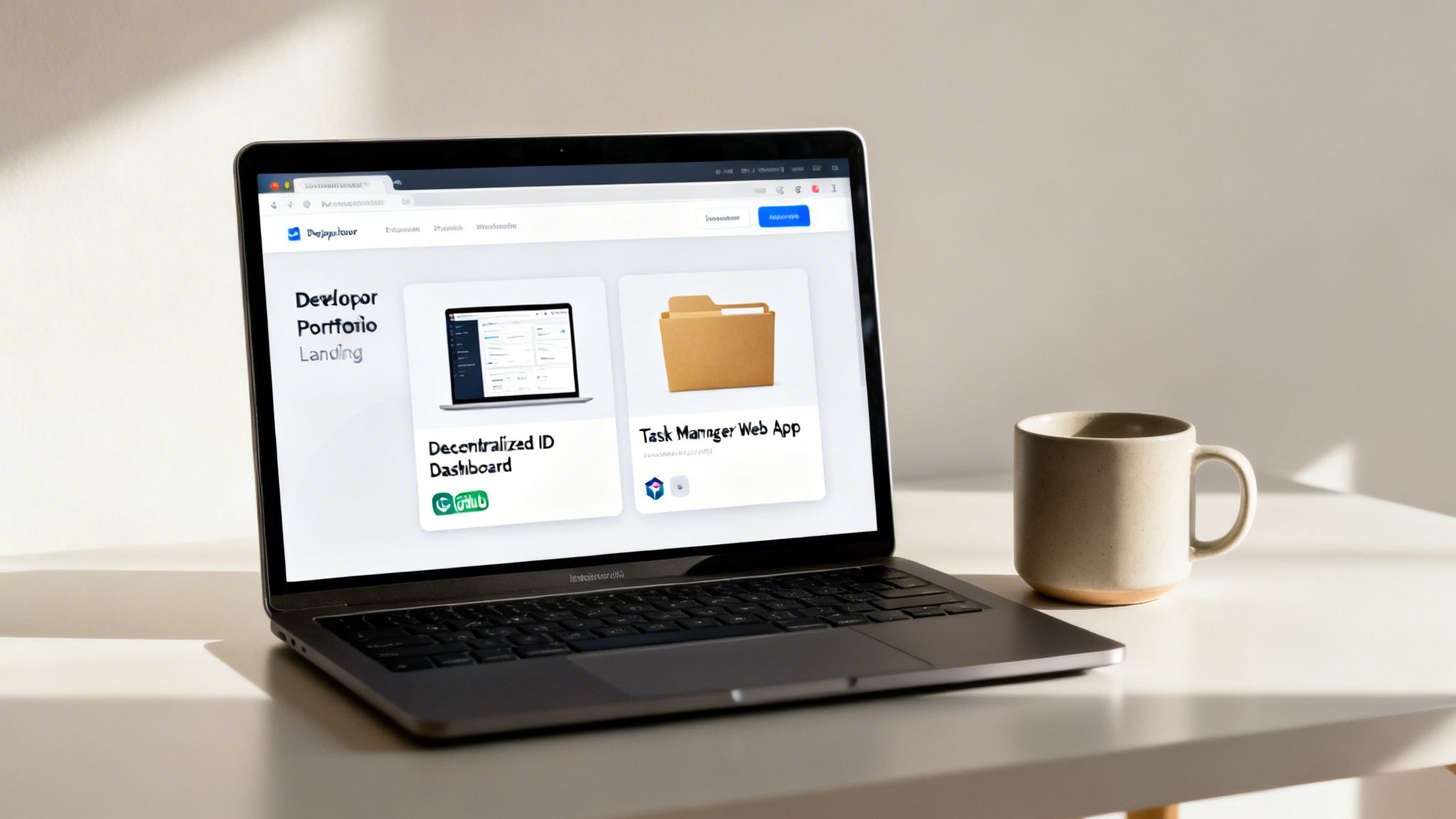
- Web3 Project: A decentralized identity dashboard built with React, Ethers.js, and Solidity smart contracts. It empowers users to manage their on-chain identity and credentials without relying on a central company.
By describing the Web3 project in your portfolio and interviews, you open the door to discussing complex topics like smart contract security, blockchain interaction, and user-owned data. This signals to a hiring manager that you're not just a coder—you're a builder who understands next-generation architecture.
Your GitHub Is Your Remote Resume
For remote roles, your GitHub profile is under a microscope. Hiring managers will dig through it for clues about how you work. A messy, neglected GitHub is a huge red flag that suggests poor organizational habits.
Here’s how to make a killer first impression to pass that initial screen:
- Pin Your Best Work: Pin your top 3-4 projects. These must be your most complete, impressive, and well-documented repositories.
- Write Excellent READMEs: Every project needs a
README.mdthat clearly explains what it is, why you built it, and exactly how to run it locally. Pro tip: Include screenshots or a GIF of the project in action to grab a recruiter's attention. - Show Clean, Consistent Commits: Your commit history tells the story of your thought process. Use clear messages ("feat: implement user authentication endpoint") instead of lazy ones ("fixed stuff"). This is a clear indicator of a professional workflow that remote teams value.
Your portfolio and GitHub are the evidence that proves you have the technical chops, communication habits, and problem-solving mindset to be an exceptional remote full-stack developer.
Finding and Applying to High-Quality Remote Jobs
Alright, you’ve done the hard work. Your portfolio is sharp, and your GitHub is clean. Now for the real challenge: finding a role that will advance your career. Spraying your resume across giant job boards is a fast track to burnout. To land one of the truly great full stack developer remote jobs, you need a targeted strategy.
The biggest time-sink for most job seekers is sifting through endless listings on massive platforms. LinkedIn and Indeed are flooded with roles that are either low-quality, require you to be in a specific city, or are "remote-friendly" in name only. It's a numbers game you're unlikely to win.
Where to Look for Curated Roles
The secret is to skip the noise and go straight to curated sources. Niche job boards that focus on remote work or a specific industry like Web3 are absolute goldmines for high-quality opportunities.
Platforms that specialize in a niche tend to have a much higher concentration of serious companies that understand and value remote talent. For instance, you can browse a curated list of blockchain engineering jobs knowing that these companies are already bought into the remote model. This saves you hours of digging and lets you focus your energy on what matters: crafting a standout application that gets you an interview.
One of the biggest lessons for your job search is understanding the massive difference between "remote-friendly" and remote-first. A “remote-friendly” company often tolerates remote work, which can hinder your career progression. A true remote-first company designs its entire culture and workflow for a distributed team, offering better growth opportunities.
So, how do you tell them apart during the application process? The job description usually gives it away.
- Asynchronous-First: Do they talk about their process for written communication and documentation using tools like Slack or Notion? That’s a great sign of a mature remote culture.
- A Truly Global Team: If their team members are listed as being in different countries and continents, they have the infrastructure to support global talent.
- Structured Onboarding: They should mention a specific, thought-out process for getting new remote hires integrated and productive.
Be wary of red flags like "occasional office visits required" or rigid "9-to-5 EST" hours for a role advertised to a global talent pool. These often signal a culture not truly built for remote success.
Tailoring Your Application to Get Noticed
Once you've zeroed in on a promising opportunity, a generic application is a waste of your time. Hiring managers are scanning for evidence that you can solve their specific problems.
Treat the job description like a cheat sheet. Pull out the key technologies, core responsibilities, and any pain points they mention. Your resume and cover letter should directly mirror that language to pass automated screening and catch the recruiter's eye.
If the job description says, "We need someone to build scalable back-end services with Go and deploy on AWS," your resume can't just list "Go" and "AWS" in a skills section.
That's too passive. Instead, write a bullet point that proves you've done it:
"Architected and deployed scalable back-end microservices in Go, leveraging AWS Lambda and API Gateway to support 100,000+ daily active users."
This is how your application goes from being just another resume in the pile to the one that secures the interview. You're not just listing a skill; you're demonstrating a direct solution to their needs.
Mastering the Remote Interview and Negotiation
The remote interview is a different beast. It's not just a test of your technical skills; it’s an evaluation of how effectively you communicate and build rapport through a screen. To land one of these full stack developer remote jobs, you must master this stage of the hiring process.
From the first recruiter chat to the final technical deep-dive, every interaction proves your readiness for a distributed team. The best candidates don't just show up—they anticipate the quirks of a virtual interview and use them to their advantage.
Nailing the First Impression: Your Remote Setup
Before you say a word, your environment is communicating for you. A cluttered background, poor lighting, or a crackly mic signals a lack of professionalism to a hiring manager. Think of your interview space as your personal stage.
- Test Your Tech: An hour before the call, do a full tech check. Camera, microphone, internet connection—the works. Nothing stalls an interview faster than the "Can you hear me now?" dance.
- Curate Your Background: A clean, simple background is best. A neutral wall is perfect. A non-distracting virtual background is your next best option. This shows attention to detail.
- Optimize Your Presence: Place your camera at eye level and ensure your face is lit from the front. This makes you look far more engaged and professional on screen.
These details demonstrate that you’re a serious candidate who understands the nuances of remote communication. It’s your first, unspoken test of remote competency.
Excelling in the Technical Interview
The remote technical interview, especially a live coding session, is designed to see how you think. The absolute key here is to over-communicate. The interviewer can't see you thinking, so you must narrate your thought process.
First, repeat the problem back in your own words to confirm your understanding. Then, talk them through your initial ideas, the different solutions you're considering, and why you're choosing one over the other. If you get stuck, explain what you're thinking and what you'd try next. This shows how you tackle real-world problems collaboratively.
Silence is your enemy in a remote coding interview. The interviewer wants to see how you think and collaborate. A running commentary of your approach turns the exercise from a solo test into a collaborative problem-solving session, which is exactly what they are looking for.
Answering Remote-Specific Questions
Expect questions designed to vet your self-discipline and communication skills for remote work. Hiring managers need to trust you’ll be productive without direct supervision. Prepare specific, concrete examples for questions like:
- "How do you stay aligned with a distributed team's goals?"
- "Describe a time you resolved a conflict with a colleague in a different time zone."
- "What is your process for documenting your work for asynchronous collaboration?"
These questions are your opportunity to prove you already possess the remote-first mindset and work habits they need on their team.
Negotiating Your Remote Offer
Once an offer lands, the real career conversation begins. With a remote role, it's about much more than just the salary. A great offer is one that supports your work-life balance and long-term career growth in a distributed setting.
Look past the base number and negotiate the entire package:
- Asynchronous Policies: Ask about core working hours and meeting culture. A company that values deep work will protect its developers' time, which is crucial for your productivity and career satisfaction.
- Professional Development: Is there a dedicated budget for courses, conferences, or certifications? This is a huge signal that they’re invested in your long-term growth.
- Career Path: Ask how performance reviews are handled remotely and what advancement to a senior or lead position looks like for someone who isn't in the office.
Asking these questions shows you're thinking like a long-term partner, not just a temporary hire. A solid remote offer is an investment in your success, and getting it right lays the groundwork for a thriving career.
Common Questions from Aspiring Remote Developers
Thinking about making the leap to a remote full-stack role? It’s a big career move, and it's natural to have questions. Let's tackle the most common ones to help you move forward with confidence.

Do I Need a Computer Science Degree?
For most modern tech companies, no. While a CS degree never hurts, it's not the golden ticket it once was. Hiring managers today care far more about what you can do.
They want to see that you can solve real problems. A stellar portfolio packed with complex projects and an active GitHub profile will always speak louder than a diploma. They are tangible proof of your skills and drive—the exact traits needed to succeed in a remote role.
Is Web3 Experience a Must-Have?
For a general full-stack role, no. But for career progression and standing out, it's a huge advantage. It signals to hiring managers that you're adaptable and willing to learn emerging technologies, instantly setting you apart from other candidates.
For jobs at Web3 companies, however, it becomes non-negotiable. If you're just starting, you don't need a massive project. Building a simple dApp to mint an NFT is enough to prove your interest and give you something concrete to discuss in an interview.
A major red flag in a remote job offer is when a company can't clearly explain its processes for asynchronous communication, virtual team building, or performance reviews for distributed employees. A mature remote company will have thoughtful, well-defined answers to these questions.
What Are Red Flags in a Remote Job Offer?
Beyond the usual warning signs—like a vague job description or an exploding offer—look for remote-specific red flags. Be wary if a company seems to have an "in-office" default culture or can't explain how remote employees fit into their career progression framework.
Drill down on the details during your interviews. Ask questions like:
- Communication: "How does the team actually work asynchronously across time zones?"
- Growth: "What does a real career path look like for a remote developer here?"
- Culture: "What do you do intentionally to build team camaraderie when everyone is distributed?"
If you get vague answers, the company is likely "remote-friendly" on paper but not truly remote-first in practice. The best remote roles—and career opportunities—come from companies that have built their entire operational rhythm around a distributed workforce.
Ready to find your next opportunity in the decentralized world? Blockchain Jobs is the premier job board for roles in Web3, DeFi, and beyond. Find curated remote and hybrid roles from top companies in the space and take the next step in your career today.