
10 Back End Dev Jobs Resources for Web3
You've searched for backend engineer, opened promising listings, and discovered that the remote role excludes your country, the engineering job is mostly frontend work, and the Web3 opening expects protocol experience you haven't built yet. Searching harder won't fix those mismatches. You need better sources and a clearer way to judge each opportunity.
The best back end dev jobs won't all share the same title. Search for API engineer, platform engineer, infrastructure engineer, and software engineer alongside backend developer. Then distinguish teams building product services from those working on indexing, wallets, distributed infrastructure, or protocol software.
Combine specialist Web3 coverage with broad job boards, technical filters, remote-location checks, and employer research. Use each resource for a specific decision rather than submitting the same application everywhere.
Practical rule: Confirm the work, employment eligibility, and compensation before investing in a lengthy application.
Your application should connect your experience to the employer's actual systems. Interviews should also help you assess the opportunity: who owns deployments, how engineers handle incidents, what support you'll receive, and whether the role develops the skills you want next. These resources serve different parts of that process.
1. Blockchain Jobs
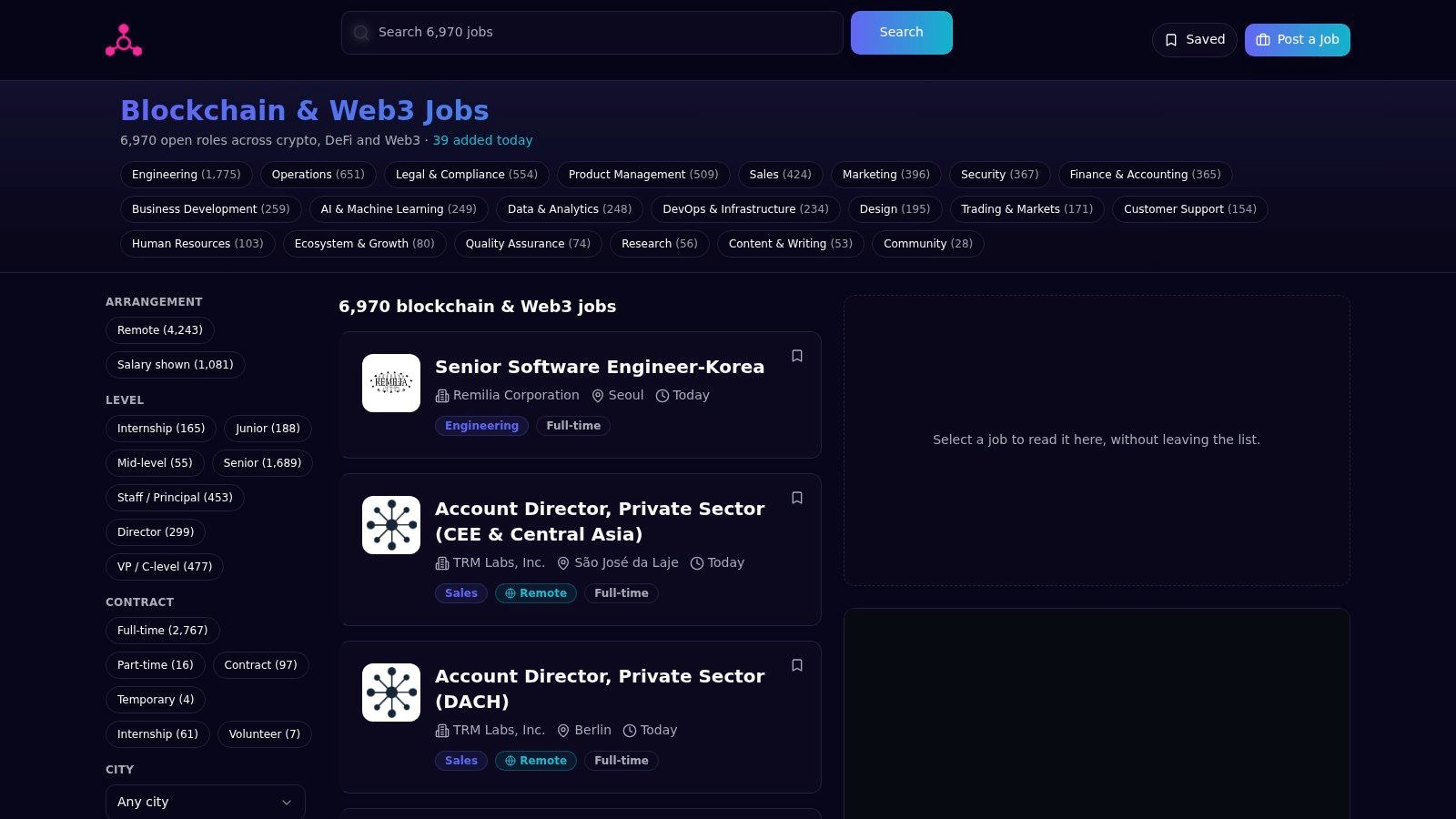
General boards scatter crypto roles under inconsistent titles, so a Web3-focused search works better on a specialist board. Blockchain Jobs gathers blockchain, crypto, and DeFi openings in one place, letting you weigh backend positions against adjacent infrastructure, security, and data work.
A recent snapshot of its listings showed 6,970 open roles, with 39 added in a single day, 4,243 marked remote, and 1,081 disclosing salary. Treat those figures as a point-in-time sample rather than a guarantee of today's volume.
How to read a Web3 backend listing
Run the filters in a deliberate order, and know what each one rules out:
- Remote plus region. A remote tag alone tells you little. Confirm your country is eligible before reading the description; many remote postings still exclude entire continents.
- Salary disclosure. In that snapshot, only 1,081 of 6,970 listings showed pay. Filtering for it shrinks the pool sharply but removes the postings most likely to waste your time.
- Employment type. Contract, part-time, and full-time listings sit side by side. Setting this early avoids falling for a role structured differently than you need.
Then read for the actual system. Application services, chain-data indexing, wallet infrastructure, and protocol software each demand different proof, and the title alone will not tell you which one you are looking at.
Employers on the board include TRM Labs, Ripple, Binance, Coinbase, Kraken, and Chainlink Labs. Judge the team, not the logo: two backend roles at the same company can involve entirely different technical exposure. The platform reports filled positions at TRM Labs, Alchemy, and Doublezero, though past placements say nothing about your odds.
When you apply, lead with evidence of reliable services, database work, external integrations, and production ownership. New to blockchain? Name the transferable engineering problem you solved. Enthusiasm is not technical experience, and Web3 hiring teams can tell the difference.
2. LinkedIn Jobs
Choose LinkedIn Jobs when you need broad employer coverage plus a route to people inside the company. Search by title, location, and company, save useful searches, and create alerts. Searching and applying are generally free, with optional paid Premium features.
A listing is only part of its value. Professional profiles and connections let you identify potential teammates, understand their backgrounds, and approach a relevant contact with a focused question.
Make your profile support the application
Your headline should describe your technical value, not just your availability. Put backend languages, database experience, and service ownership ahead of a generic Web3 label, and keep employment dates consistent with your résumé.
Use these LinkedIn profile photo tips for presentation basics, but prioritize clear project descriptions and credible technical evidence.
- Best use: Find employers, track new postings, and pursue informed referrals.
- Main drawback: Listings can be duplicated or attract many applicants, and some applications redirect to employer sites.
- Application move: Send contacts a short explanation of the role fit, supported by relevant work, rather than asking strangers for an unspecified referral.
For interviews, research the team's responsibilities before discussing architecture. Ask whether backend engineers own deployment and on-call work or hand those responsibilities to another group. That distinction matters more to your progression than a broad software-engineer title.
3. Indeed
Use Indeed to broaden your search beyond technology companies and Web3-native employers. Its general-purpose coverage is useful when you're considering backend roles that build transferable experience before a later blockchain move.
Search by title, keyword, company, or location, and set email updates for relevant matches. Job searching and applications are generally free, although some postings send you to external application systems.
Expand by skill without losing relevance
Run separate searches for backend developer, API engineer, Python, and Java. Read the responsibilities before applying, because a language match doesn't establish that you'll work on services, persistence, or infrastructure.
For distributed opportunities, use this guide to remote backend developer jobs alongside the listing's actual employment restrictions. Confirm location eligibility directly rather than relying on the search label.
- Advantage: Broad employer and location coverage helps uncover roles with less obvious titles.
- Trade-off: Repeated and less-relevant results require manual screening.
- Safety step: Verify the employer and application destination before sharing sensitive personal information.
If direct Web3 applications aren't progressing, consider a role offering meaningful API ownership, database reliability work, and production support. In interviews, ask what changes you'd own independently and how code reaches production. Choose the experience that closes your skills gap, not merely the title closest to your target.
4. Dice
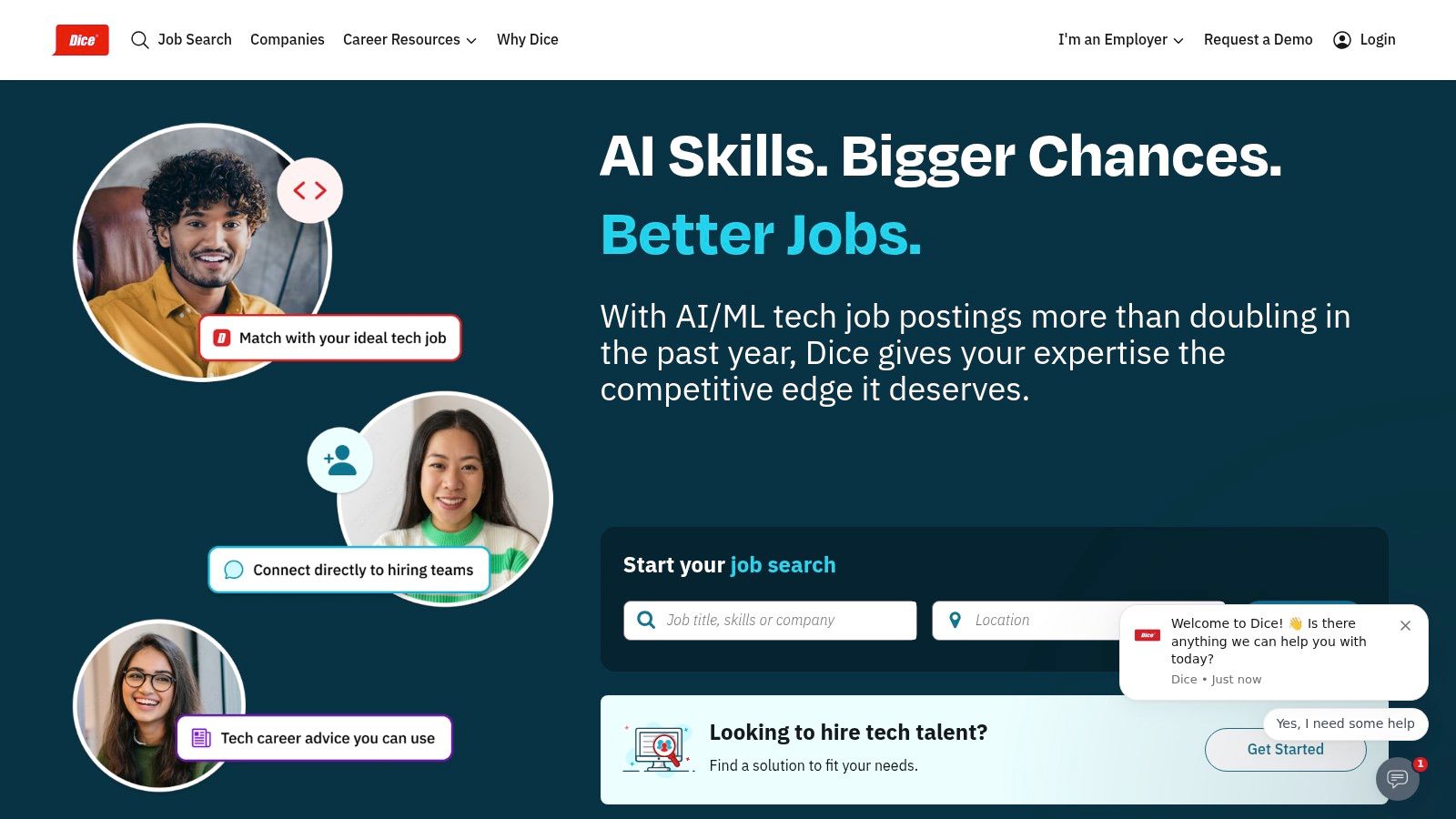
Dice is the strongest fit here for a skills-first search. Use Dice's technology job search to narrow opportunities around languages, platforms, experience, location, and job preferences. Candidate profiles and search are generally free.
Its technology focus helps when broad boards return loosely related software roles. Candidate profiles, alerts, and career resources support an ongoing search, but technical keywords still need close reading.
Match infrastructure claims with evidence
Docker was used by 71.1% of respondents, AWS by 43.3%, and Kubernetes by 28.5% in the Stack Overflow 2025 technology survey. Those are adoption signals, not proof that every employer requires those tools.
Use relevant terms in searches, then distinguish hands-on responsibilities from a technology list. Don't describe yourself as proficient in Kubernetes if your experience stops at following a deployment tutorial.
- Search advantage: Skill-focused filtering helps compare language- and platform-specific positions.
- Search limitation: Some opportunities come through recruiters or staffing firms rather than the employer.
- Interview preparation: Be ready to explain packaging, deployment, health checks, logs, rollback, and secrets management for a service you've built.
Ask recruiters who employs the candidate, whether the role is permanent or contract, and which requirements are essential. Dice is less useful for exploring nontechnical careers, but valuable when you already know the engineering work you want.
5. Wellfound
If you want to work close to a product and accept broader responsibilities, start with Wellfound's startup jobs. It focuses on early-stage and growth-stage companies, with free candidate profiles and applications.
Company and role details can help you assess product focus and stage. Compensation and work-location information depend on what employers provide, so resolve missing details before committing to a substantial interview exercise.
A broad startup role is attractive when responsibility comes with support. It's a weak fit when the employer expects independent infrastructure ownership without experienced backup.
Ask what ownership actually includes
For a backend opening, establish whether you'll build APIs, maintain databases, operate cloud infrastructure, integrate blockchain services, or cover all of them. Ask who reviews architecture decisions and who helps during incidents.
Wellfound's advantage is startup context alongside engineering opportunities. Its limitations are narrower coverage of traditional employers and substantial variation in compensation, stability, and hiring processes.
Before applying, compare your experience against the team's immediate needs. A junior candidate should prioritize accessible reviewers and scoped delivery work; an experienced engineer should establish authority over architecture, reliability, and technical priorities.
Prepare an interview example that connects a product requirement to a backend decision. Explain the trade-off you made, how you tested it, and what you'd change under different constraints. That's more persuasive than listing frameworks without explaining their purpose.
6. Built In
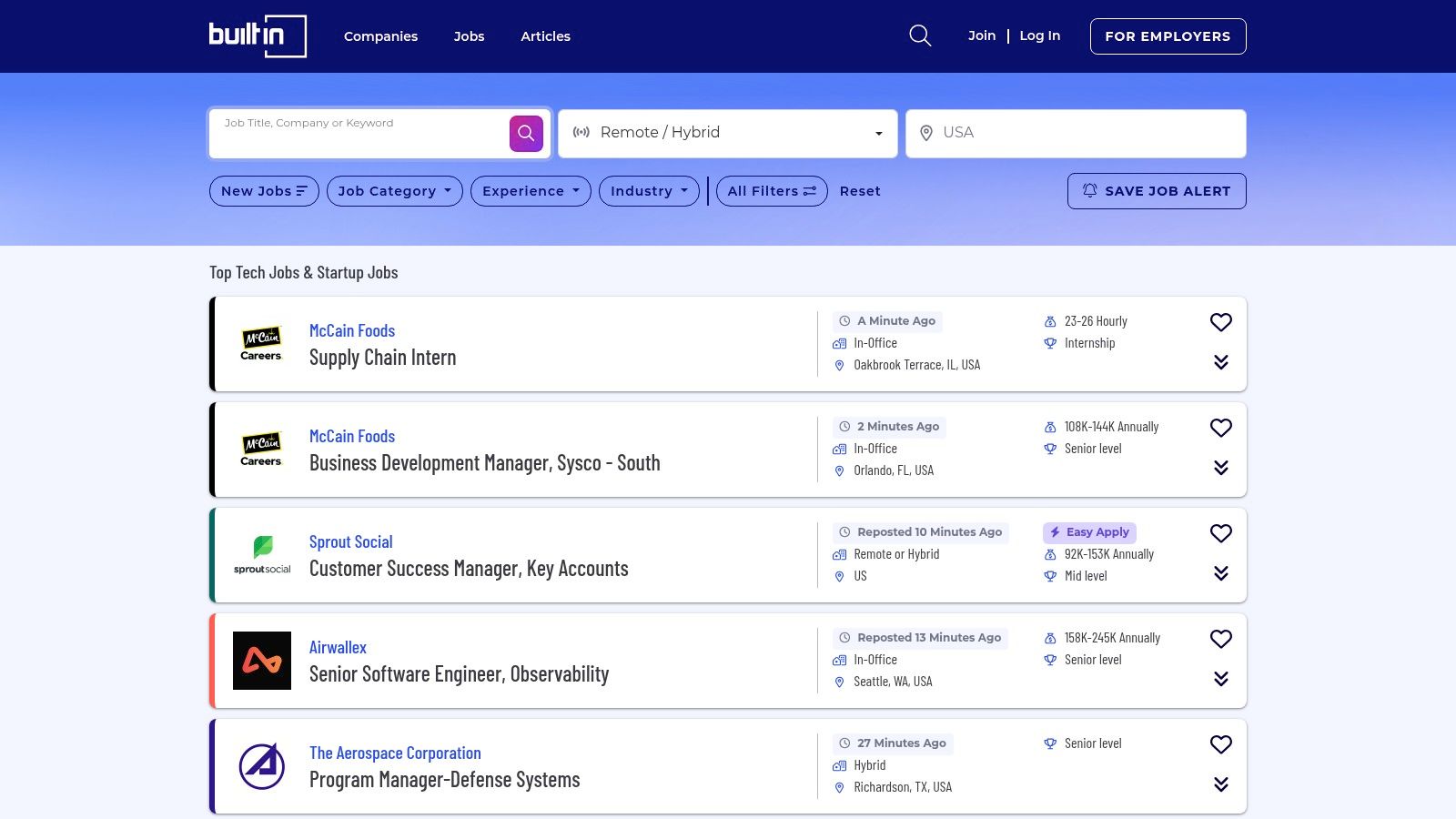
Use Built In when employer context matters as much as the opening itself. It combines technology-focused listings with company information, making it useful for comparing US tech employers, local markets, and remote opportunities.
Searching is generally free. Coverage varies by city and specialty, and some relevant jobs appear under broader software-engineering titles rather than backend developer.
Compare the team behind the title
Company profiles provide starting points for research, not a substitute for asking the hiring manager specific questions. Look for alignment between the employer's product, the listed stack, and the work you want to own.
- Product fit: Identify whether the service supports customer transactions, internal operations, analytics, or developer infrastructure.
- Technical fit: Check whether the role emphasizes API delivery, data modeling, distributed processing, or operations.
- Career fit: Ask how engineers expand their scope and who provides technical guidance.
Built In's advantage over a general board is its focus on technology employers and company context. Its drawback is uneven listing breadth, with some applications completed on employer sites.
For Web3 candidates, use it to compare blockchain opportunities with conventional backend roles offering strong engineering practice. Don't reject a noncrypto employer if the team offers the reliability, security, and distributed-systems experience your target Web3 roles require. Confirm that experience through concrete interview questions about recent projects.
7. Y Combinator Jobs
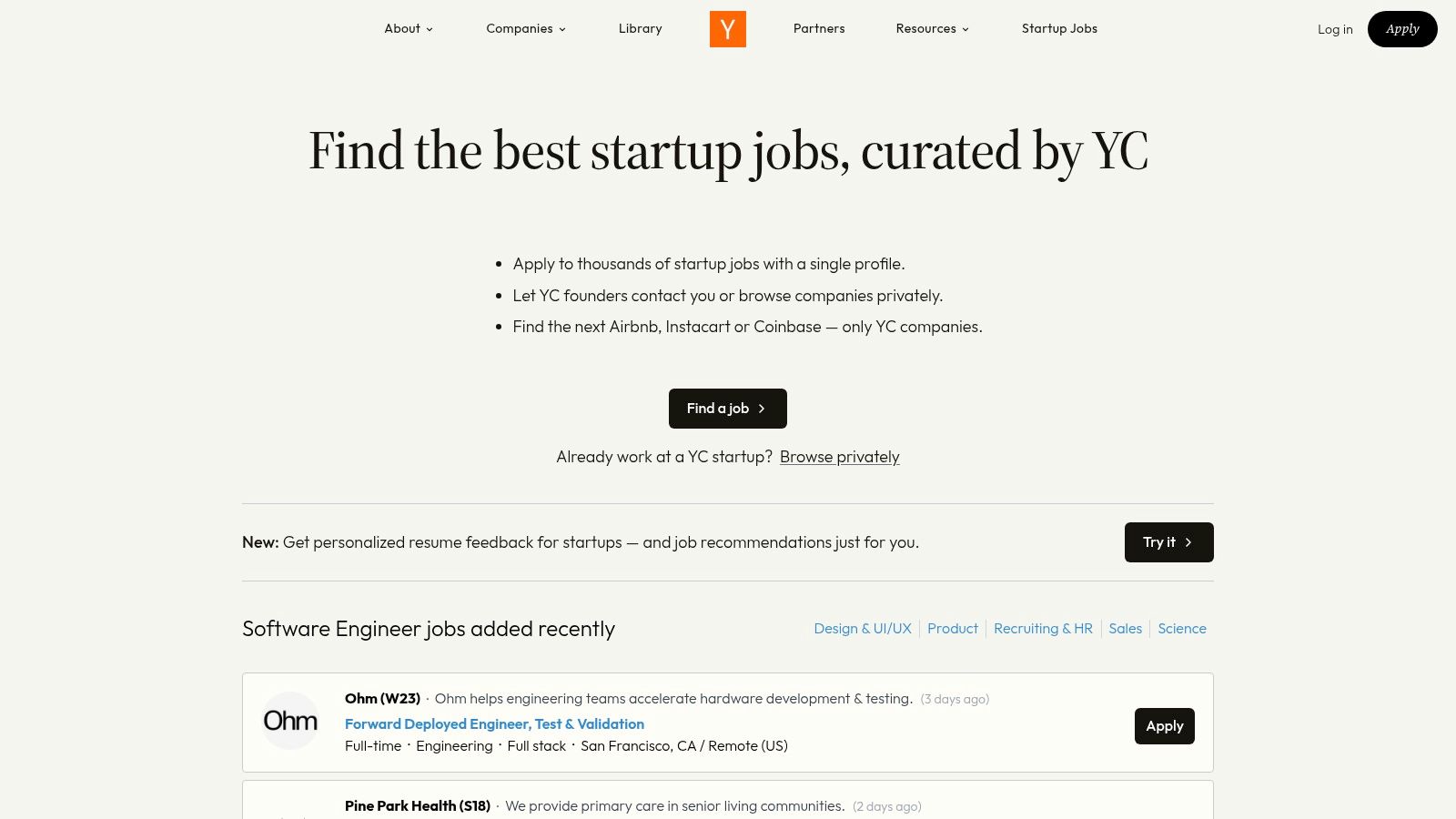
Y Combinator Jobs gives you a defined employer pool: companies in the Y Combinator startup network. Choose it when you want startup opportunities with clear company affiliation rather than the widest possible search.
Candidates can create a profile and search for free. Engineering listings can carry backend specialty tags, while some include compensation, location, and remote-status details.
Evaluate scope before selling versatility
A smaller team can give you access to founders and broad product responsibilities. It can also require work beyond backend development, so establish the expected balance before presenting yourself as comfortable doing everything.
Ask which backend problem prompted the hire. Then ask what the team expects you to deliver, who will review it, and how much operational support exists.
- Best fit: Engineers who want direct product involvement and are comfortable discussing trade-offs with a small hiring team.
- Main limitation: The employer pool is narrower than on general boards, and openings change as companies hire.
- Credibility signal: A maintained service with clear documentation, tests, and deployment instructions is stronger evidence than an unexplained technology list.
For a Web3 startup, distinguish off-chain application services from contract integrations and protocol work. Don't assume they require identical preparation. Tailor your application around the relevant responsibility, and explain any blockchain learning gap directly rather than obscuring it with broad claims about decentralization.
8. We Work Remotely
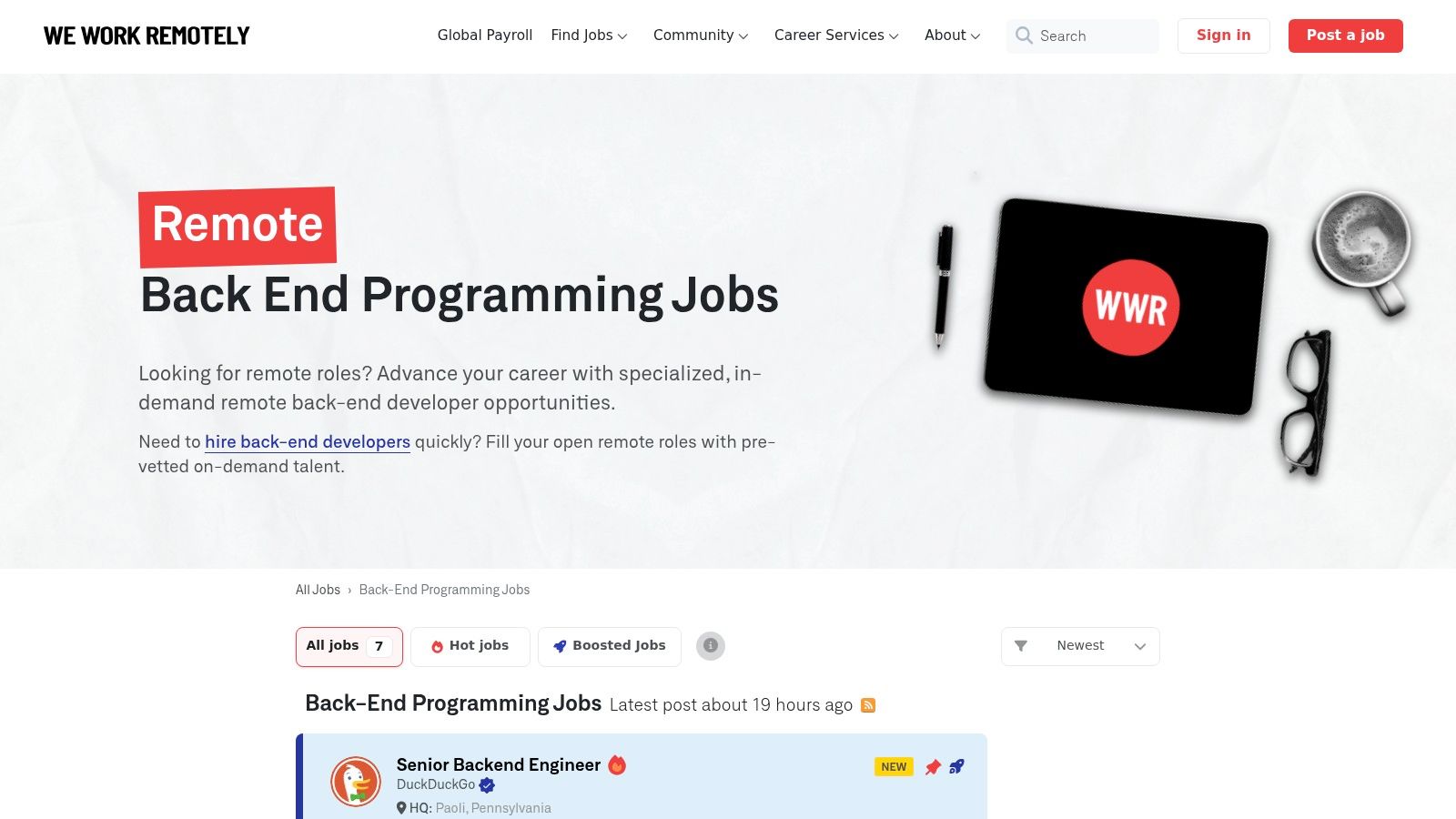
Choose We Work Remotely when remote work is nonnegotiable. Its remote back-end programming category lets you focus on distributed opportunities without relying entirely on broad title searches.
Browsing and applying are generally free. The trade-off is scope: you won't see the local hybrid and office-based roles that broader boards include, and the mix of available listings changes.
Separate remote work from employment eligibility
Check permitted countries, US-state restrictions, required working hours, and employment arrangements before tailoring an application. Remote doesn't automatically mean the employer can hire you wherever you live.
Treat location eligibility as an application prerequisite, not a detail to resolve after the technical interview.
Use listing tags to narrow options, then verify the full description. Ask whether time-zone overlap is occasional or part of the normal working day.
For interviews, prepare examples of written technical communication, documented decisions, and clear handoffs. Show how another engineer can run your project, reproduce a bug, and understand the reasoning behind a change.
The board's advantage is a focused remote search. Its limitation is that you must still verify each employer's restrictions and working practices. For Web3 infrastructure roles, also ask how distributed teams coordinate deployments, incident response, and on-call coverage. A remote arrangement is only useful if its expectations fit your life.
9. Remote OK
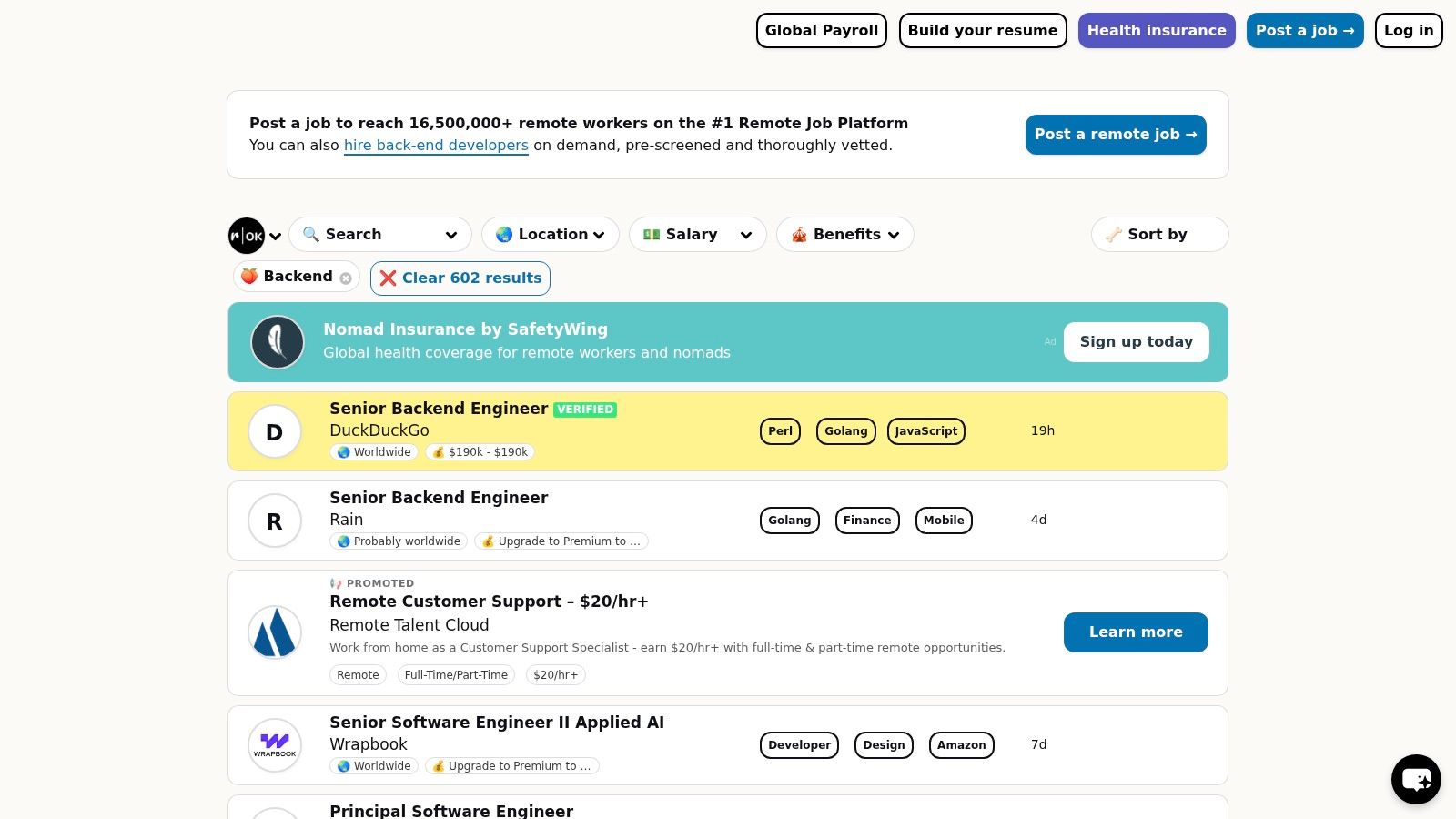
Use Remote OK's backend listings as another remote-discovery channel, especially when you want roles beyond a local technology hub. Its searchable category, location tags, salary filters, email alerts, and feeds support focused browsing.
Browsing is free, with optional premium access. Geographic scope varies by listing, and some salary details may be estimates rather than employer-confirmed compensation.
Verify the details behind the filters
Use filters to reduce the search workload, not to replace due diligence. Confirm that the employer's application page matches the role, location, and compensation information you initially saw.
- Eligibility: Establish whether the opening is worldwide, US-only, or limited to another region.
- Compensation: Distinguish employer-provided ranges from estimates, then ask about currency and employment arrangement.
- Application destination: Verify the employer before submitting personal information.
The guide to becoming a remote backend engineer can help you frame your preparation around delivery and collaboration rather than location alone.
Remote OK is convenient for remote-only discovery, but don't use it as your sole source. Compare promising roles with specialist Web3 listings, then apply through the employer's stated process. In interviews, ask how remote engineers gain technical influence and promotion opportunities, particularly if you're aiming for senior or platform responsibilities.
10. Glassdoor
Before accepting an interview process or comparing offers, use Glassdoor to research the employer. It combines job listings with company reviews and salary information, making it useful for due diligence rather than discovery alone.
Job searching and company research are generally free. Reviews are user-submitted, and salary figures can be estimates that vary by level, location, and employer.
Turn research into interview questions
Read feedback for themes, then ask the hiring team about the specific working conditions that matter to you. A review from another department doesn't establish how the backend team operates.
Use this back-end developer salary guide to structure compensation research. Compare responsibility and location rather than assuming identical titles deserve identical packages.
- Research strength: Employer feedback and compensation information sit alongside job discovery.
- Research limitation: Reviews won't represent every employee or team, and application paths vary.
- Interview action: Ask how the team handles incidents, promotion decisions, engineering workload, and compensation reviews.
For Web3 roles, clarify how base pay, equity, and any token-based component are structured. Ask about vesting conditions and restrictions rather than treating every component as interchangeable.
Glassdoor should help you formulate better questions, not make the decision for you. Give the greatest weight to clear answers from the actual hiring team and written terms that match what recruiters discussed.
Top 10 Back-End Developer Job Resources Compared
| Platform | Specialty & scale | Search experience | Best for | Standout value | Candidate / employer pricing |
|---|---|---|---|---|---|
| 🏆 Blockchain Jobs | Web3, blockchain, crypto, and DeFi; 6,970 listed roles | Filters for remote work, location, seniority, salary, and job type; daily alerts | 👥 Web3 candidates and crypto-native employers | ✨ 4,243 remote roles, broad career categories, and a focused Web3 audience | 💰 Candidate access; employer posting price not stated |
| LinkedIn Jobs | Broad roles across industries and employers | Search, saved searches, alerts, profiles, and networking | 👥 Candidates using connections or recruiter outreach | ✨ Combines job search with professional networking | 💰 Search generally free; optional paid Premium |
| Indeed | General-purpose listings across industries and locations | Keyword, company, and location search; email alerts | 👥 Candidates exploring varied employers and role titles | ✨ Broad coverage and flexible keyword searches | 💰 Search and applications generally free |
| Dice | Technology and technical roles | Skill and experience filters, alerts, profiles, and career resources | 👥 Candidates focused on technical careers | ✨ Skill-focused search for technology roles | 💰 Search and profiles generally free |
| Wellfound | Startup roles, including engineering | Candidate profiles and matching; some listings show pay and location | 👥 Engineers interested in early- or growth-stage startups | ✨ Startup context and access to smaller teams | 💰 Candidate access and applications free |
| Built In | Technology employers and US tech hubs | Search across markets and remote roles; company profiles | 👥 Candidates comparing tech employers and locations | ✨ Company research alongside job listings | 💰 Job search generally free |
| Y Combinator Jobs | Jobs at Y Combinator-backed startups | Search by specialty; some listings include pay and location | 👥 Candidates interested in startup roles | ✨ Access to the YC startup network | 💰 Candidate search free |
| We Work Remotely | Remote roles, including back-end programming | Dedicated remote category and job tags | 👥 Candidates seeking remote back-end work | ✨ Remote-first job discovery | 💰 Browsing and applying generally free |
| Remote OK | Remote jobs across industries, including back-end roles | Searchable categories, filters, tags, and alerts | 👥 Candidates prioritizing remote work | ✨ Remote-focused search with location and salary filters | 💰 Browsing free; optional premium access |
| Glassdoor | Job listings with company reviews and salary information | Role and location filters plus employer research | 👥 Candidates comparing companies and compensation | ✨ Reviews and salary estimates alongside listings | 💰 Job search and company research generally free |
Turn Job Searches Into a Backend Career Strategy
Build a repeatable search process instead of maintaining an endless collection of open tabs. Use Blockchain Jobs for Web3 relevance, a broad board for employer coverage, a technical board for stack matching, and remote-focused resources when location flexibility is essential. Use employer research to decide where an application deserves your time.
Keep a record of each promising role's responsibilities, stack, location restrictions, compensation status, and application stage. Search broadly enough to discover adjacent titles, but apply selectively enough to explain why your experience matches the work.
Make each application technically credible
Before applying, confirm employment eligibility and identify unanswered compensation questions. Tailor your résumé around the product and stack, then attach evidence that supports your claims: a documented API, database design, deployment workflow, test suite, or maintained open-source contribution.
Keep public profiles consistent, and use this guidance on how to tidy your profiles for job before recruiter conversations. Professional presentation supports credibility, but it doesn't replace technical substance.
- For junior progression: Prioritize code review, mentorship, manageable ownership, and exposure to production systems.
- For senior progression: Seek responsibility for service boundaries, migrations, reliability, security, and incident decisions.
- For platform or staff progression: Ask about cross-team influence, infrastructure ownership, architectural decisions, and mentoring expectations.
- For Web3 specialization: Identify the chain-specific knowledge required and separate it from general backend competence.
Use interviews as a mutual assessment. Explain a design decision, its failure modes, and how you validated it, then ask the team to describe a recent operational problem and how engineers resolved it.
Document outcomes as your scope grows
Backend careers benefit from evidence of sustained ownership. Electric Capital found that established crypto developers with at least two years of experience grew 27% year over year and produced 70% of crypto code commits in its 2024 Developer Report. That measures contribution activity, not hiring odds, but it supports taking maintenance and continuity seriously.
Record what you changed, why it mattered, how you tested it, and what happened afterward. Use measured outcomes when you have them, and describe improvements qualitatively when you don't. Never manufacture performance figures to make a résumé sound stronger.
Choose your next role for the work you'll learn to own, not just the title you'll receive. A well-supported backend position can build the production judgment you need for senior engineering, platform leadership, or specialized Web3 infrastructure work.
Blockchain Jobs brings backend, engineering, and infrastructure opportunities together across the Web3 ecosystem, with filters for location, remote status, seniority, and employment type. Visit Blockchain Jobs to find relevant openings, compare their responsibilities, and apply with evidence that matches the team's needs.