How to Land Solidity Developer Jobs in 2026

39% average annual growth in crypto developers since Ethereum launched in 2015 doesn't mean Solidity syntax alone will get you hired. The strongest candidates prove they can ship production contracts with rigorous testing, security review, and audit-ready documentation.
That distinction explains why many technically competent applicants struggle with Solidity developer jobs. They can write a token, explain inheritance, and complete a tutorial, but they can't show how their code behaves under adversarial state changes, whether an upgrade preserves storage, or how they validated a scanner finding. Hiring teams aren't only buying familiarity with a language. They're assessing whether you can make irreversible software safer.
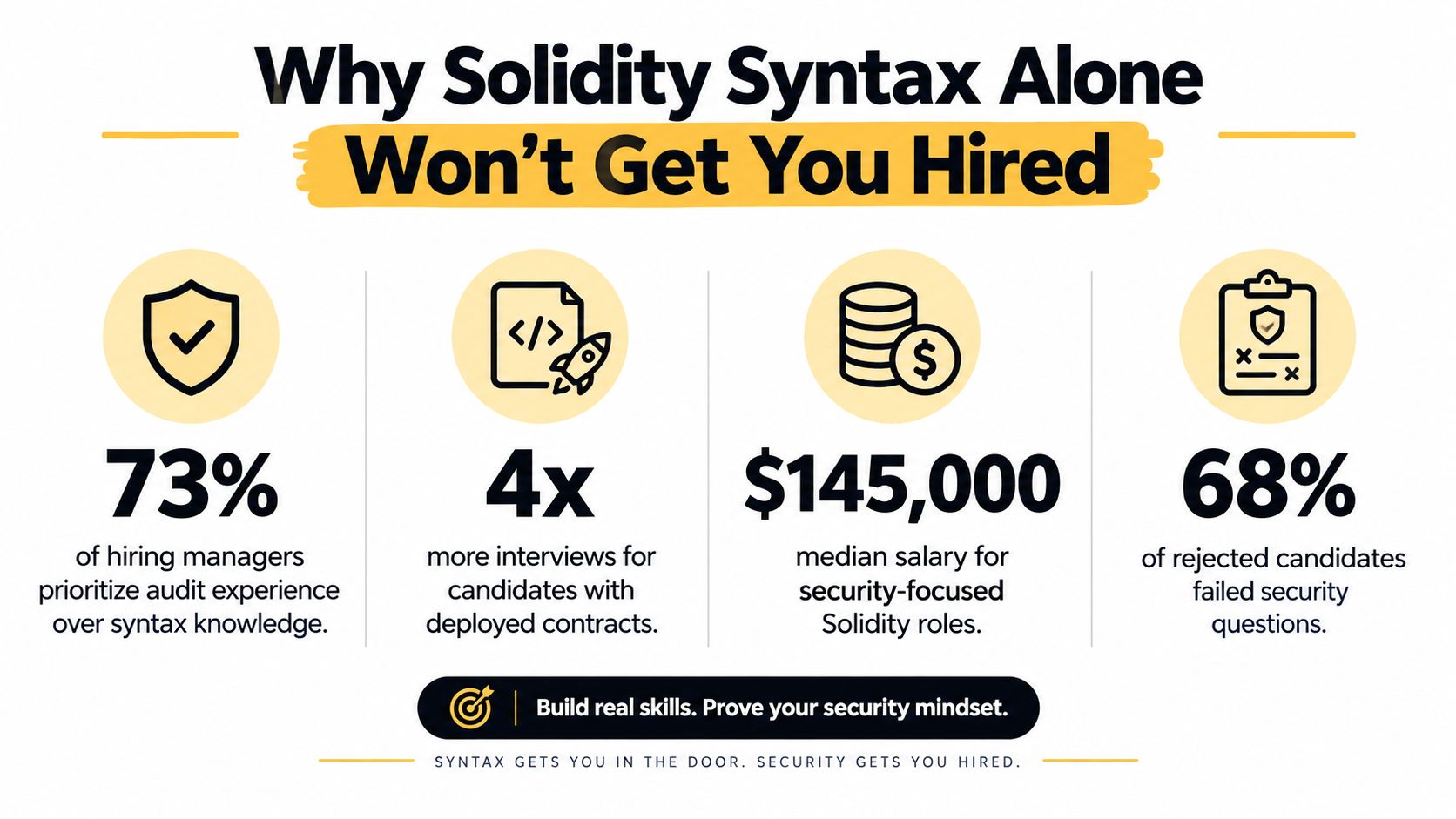
Why Solidity Syntax Alone Won't Get You Hired
The common assumption is simple: learn Solidity, build a few contracts, and apply. In practice, hiring managers often use Solidity as an entry filter, then evaluate the engineering discipline around it. A candidate who knows syntax but can't reason about authorization, external calls, oracle assumptions, or proxy initialization creates more risk than value.
The market itself is no longer a small experimental niche. Electric Capital's 2024 Developer Report analyzed 902 million code commits across 1.7 million repositories. It found that crypto developers grew at an average annual rate of 39% since Ethereum launched in 2015, while Ethereum remained the leading ecosystem for total developer activity on every continent in 2024. EVM-compatible chains also accounted for 74% of developers working across multiple chains, which matters because Solidity remains central across Ethereum and much of its Layer 2 ecosystem.
What seniority changes
The developer pool is growing, but experienced contributors carry a disproportionate share of production work. Developers with at least two years in crypto increased 27% year over year in 2024 and produced 70% of all code commits, according to the same report. Meanwhile, 39,148 developers explored crypto for the first time during 2024, so entry remains possible, but newcomers need stronger evidence to stand out.
A junior applicant can demonstrate useful fundamentals through clean contracts, meaningful unit tests, and clear documentation. A mid-level applicant should show fuzzing, invariant testing, deployment discipline, and the ability to remediate a real finding. A senior applicant needs to reason about protocol architecture, economic assumptions, upgrade paths, incident response, and review standards.
Hiring reality: A contract that compiles is an exercise. A contract with threat modelling, adversarial tests, documented assumptions, and validated remediation is evidence.
Legacy experience can also become a liability when it isn't paired with version awareness. Solidity developers who learned older compiler behavior but can't explain dependency patches, arithmetic semantics, or proxy storage risks may carry hidden production risk. Employers want proof that you can maintain contracts across changing toolchains, not just reproduce familiar syntax.
The Skill Stack Web3 Employers Score
Hiring decisions increasingly separate language knowledge from shipping capability. Solidity is the base layer, while employers assess how you test, investigate, optimize, deploy, and communicate engineering decisions. A candidate becomes easier to evaluate when those abilities appear in a repository rather than only on a résumé.
Recent survey reporting found Foundry was the primary framework for 57% of respondents in 2025, up from 51% in 2024. The figures appear in this summary of Solidity engineering trends. Toolchain fluency has become visible evidence of how a candidate works, which makes the adoption figure useful context even though framework choice alone does not determine employability.
Junior expectations
Junior developers should write readable Solidity, use OpenZeppelin components appropriately, and explain basic access control and reentrancy risks. Their repositories should include unit tests for successful and rejected calls, covering unauthorized users, paused states, invalid inputs, and boundary conditions.
They also need to read tool output without treating it as a final verdict. A junior candidate may not solve every complex protocol issue, but should reproduce a finding locally, describe its impact, and explain how a proposed fix changes behavior.
Mid-level expectations
Mid-level engineers add fuzz testing, invariant testing, integration tests, and gas profiling. They understand that safety depends on interactions among functions, roles, dependencies, oracles, and external protocols. Strong evidence includes an explanation of why an invariant matters, which state transition violated it, and how regression tests prevent the same failure from returning.
Layer 2 architecture and off-chain integration matter at this stage. Candidates should understand how deployment assumptions, bridges, indexers, signing services, and asynchronous operations affect contract behavior. Gas optimization belongs in the same evaluation, but measured improvements carry more weight than clever-looking code.
Senior expectations
Senior engineers define security properties before implementation, review upgradeability and authorization architecture, and challenge assumptions that the chain does not enforce. They can assess formal-verification claims, design security gates in CI, and judge when an optimization creates excessive audit or maintenance risk.
Oracles, cross-chain messaging, delegatecall, emergency controls, and economic attacks require architectural judgment. The strongest interview answers connect a vulnerability to attacker capabilities, protocol incentives, operational constraints, and a safe remediation plan.
A résumé listing Solidity, Hardhat, and Foundry is easy to scan. A portfolio showing why a test exists, what a fuzz campaign found, and how a gas report changed an implementation provides evidence that is harder to dismiss.
Building a Portfolio That Proves Production Readiness
Tutorial repositories rarely distinguish you because they demonstrate completion, not ownership of risk. A hiring manager wants to see what you chose to test, what failed, how you investigated it, and whether you understood the consequences of changing the code.
Start with one focused protocol rather than a collection of disconnected examples. A lending component, vault, staking system, or permissions module can work if the repository exposes meaningful state transitions and security assumptions. The project doesn't need to imitate a large protocol, but it must make your engineering decisions inspectable.
Repository evidence that carries weight
A credible repository should include:
- Pinned build inputs: Lock the Solidity compiler and dependencies, commit the configuration, and make the build reproducible.
- Adversarial tests: Add unit, integration, fuzz, and invariant tests. Explain the security property behind each important test.
- Analysis output: Run tools such as Slither, preserve relevant output, and classify findings manually rather than hiding inconvenient alerts.
- Gas evidence: Include Foundry gas reports or comparable benchmarks, then explain the trade-off between cost, readability, upgradeability, and safety.
- Deployment records: Provide verified source code where applicable, deployment scripts, addresses, network assumptions, and design decisions.
- Security review: Document vulnerabilities you found, proof-of-concept reproduction, remediation, and regression validation.
Compiler discipline is a particularly strong signal because many developers underestimate maintenance risk. A study of 55,046 real-world Solidity contracts found that more than 98% used older compilers without vulnerability patches, while more than 25% were potentially vulnerable because of missing security patches, according to the empirical findings published by KAIST researchers.
Show that upgrades won't break the protocol
Create a branch that updates a deliberately outdated contract. Record the compiler and dependency changes, run differential tests against the original behavior, and inspect storage layout, proxy initialization, ABI assumptions, and gas regressions.
Your README should state what changed and why the migration is safe. Include CI configuration, lockfiles, audit responses, and an explicit note about emergency or paused states. This is more persuasive than claiming that the project is “production ready” without showing the work behind that label.
Avoid inventing credentials or implying that a tutorial deployment equals mainnet experience. If you haven't shipped to mainnet, say so. A carefully scoped testnet project with excellent threat modelling can create more trust than an unexplained deployment that happens to use a public network.
Cracking the Security-Focused Technical Interview
A conventional coding challenge can show whether you can implement a function. It can't reliably show whether you'll recognize an unsafe delegatecall, an incomplete authorization check, or an invariant that fails only after several state transitions.

A stronger assessment gives you a small protocol, a pinned compiler, and OpenZeppelin dependencies. You implement the feature, write tests, run static analysis and fuzzing, classify findings using SWC or OWASP categories, and explain trade-offs involving gas, upgradeability, access control, oracles, and reentrancy.
The important comparison is recall versus precision. Automated tools help surface possible problems, but human triage decides which findings are exploitable and what remediation preserves intended behavior.
Why green scanners aren't enough
A study of 47,587 Ethereum contracts found that nine analysis tools jointly detected only 48 of 115 vulnerabilities in a curated dataset. The same study reported that 92% of tool-generated alerts were false positives on a manually labelled sample, as documented in the empirical evaluation of smart-contract analysis tools.
That evidence changes how you should present tooling in an interview. Don't say, “Slither found nothing.” Say which tools you ran, which classes of risk they cover, what limitations remained, and what manual review you performed afterward.
Use the smart-contract auditing guide to structure practice reviews around threat modelling, exploit reproduction, and remediation validation. For broader preparation, these job interview tips and tricks can help with communication, but they won't replace technical evidence.
A good interviewer may ask you to prioritize several findings in a short contract. Explain attacker access, affected funds or state, exploit preconditions, severity, and the smallest safe fix. Then describe the regression test that proves the vulnerability no longer works.
The Ethereum security guidance recommends extensive unit testing and custom checks with Slither, Echidna, and Manticore. Put that progression into practice before the interview. A junior candidate should interpret findings, a mid-level candidate should design meaningful properties, and a senior candidate should establish security requirements at the architecture level.
Where to Find Stable and Remote Solidity Roles
The most visible role isn't always the best role. Solidity hiring tends to cluster around security, Layer 2, DeFi, infrastructure, and institutional projects, so a search focused only on “Solidity developer” can miss adjacent roles where your evidence fits better.
The talent base is globally distributed. A 2025 survey covered 1,095 respondents across 87 countries, with India representing 19.9% of respondents, according to the survey summary on blockchain hiring. That distribution creates opportunity, but remote access doesn't remove every employment constraint.
Evaluate the role structure, not just the title
Ask where the legal entity can hire, whether the role is employee or contractor, which hours require overlap, and whether on-call security responsibilities apply. Regulated financial products may impose residency requirements. Protocol operations may need rapid coordination during incidents. Token-funded projects can offer autonomy but may provide less stability than infrastructure employers or established audit firms.
Read the compensation structure carefully. Token or equity exposure can change the risk profile, while salary, benefits, legal protections, and project runway may matter more for someone seeking continuity. Don't treat “remote” as a guarantee that you can work from any location or timezone.
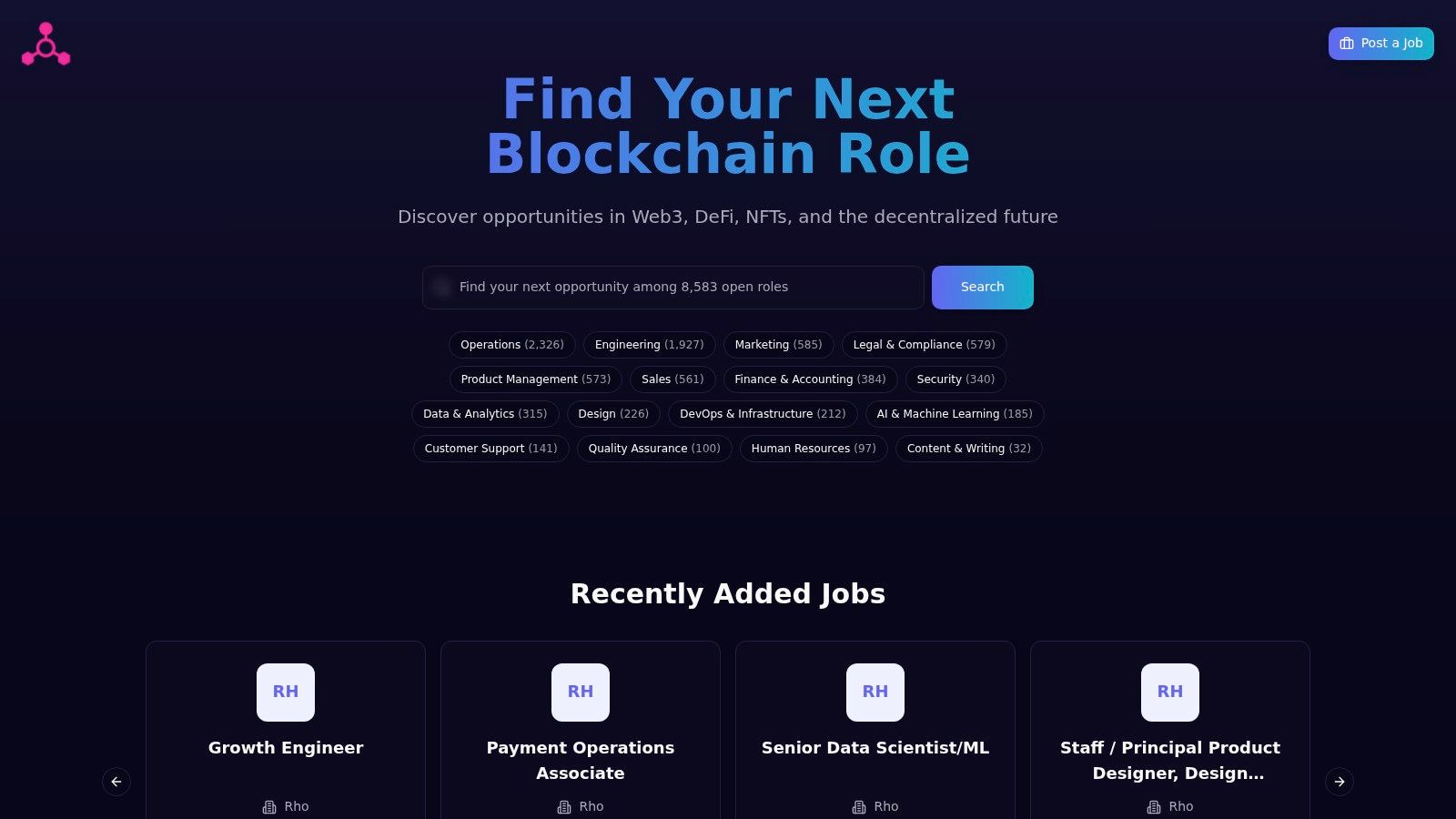
A practical application filter is to record each opportunity's technical domain, location eligibility, overlap expectations, contract structure, security duties, and deployment stage. That turns a noisy search into a set of comparable decisions. It also gives you language for interviews, because you can explain why your portfolio matches the employer's actual risk.
Remote engineers need more than a quiet desk. Written design reviews, readable pull requests, careful handoffs, and incident communication are part of the job. Candidates working across time zones may also benefit from this practical guide on staying productive in remote work.
For a focused search, review remote Solidity developer jobs with the same scrutiny you'd apply to the technical assessment. A stable role is defined by its responsibilities, operating model, and ability to support safe engineering, not by a remote label alone.
Your Action Plan for Landing the Offer
Treat your job search as an engineering project with observable outputs. Start by auditing your GitHub as if you were reviewing another developer's repository. Remove abandoned experiments from the foreground, improve the README for the strongest project, and make the build, test, analysis, and deployment workflow easy to run.
Then create a portfolio sequence that demonstrates progression:
- Establish correctness: Write unit and integration tests for expected and rejected behavior.
- Attack the state machine: Add fuzz and invariant tests that target adversarial transitions.
- Review the implementation: Run static analysis, classify findings, reproduce important issues, and validate fixes.
- Measure trade-offs: Produce gas reports and explain why a cheaper implementation is or isn't safer.
- Prove maintenance skill: Upgrade a compiler or dependency in a branch, inspect storage layout, and document the migration.
- Package the evidence: Link directly to tests, analysis output, deployment scripts, and security decisions in your résumé.
Tailor each application to the protocol's actual needs. A DeFi team should see oracle and economic-risk reasoning. An infrastructure team should see deployment reliability and monitoring. An audit firm should see vulnerability classification, clear reports, and remediation quality.
Track applications like experiments. Record the role, evidence submitted, interview stage, objections, and response. Guidance on measuring real response rates can help you distinguish a weak portfolio from a poorly targeted search.
The durable advantage isn't knowing one framework or memorizing vulnerability names. It's repeatedly demonstrating that you can turn uncertain requirements into tested, reviewable, maintainable contract systems.
Blockchain Jobs brings together specialized opportunities across engineering, security, DeFi, infrastructure, and other Web3 functions, including remote-friendly roles. Visit Blockchain Jobs to search current listings, compare roles against your security-focused portfolio, and find employers looking for evidence that you can ship safely.