A Guide to Hiring Backend Developers for Web3 Projects
Before you post a job opening, you must have a crystal-clear picture of the Web3 backend developer you’re trying to hire. This isn't about finding a generic "blockchain dev." It's about meticulously mapping your project's technical needs to a specific, high-demand skillset. Getting this right from the start is the most critical step in the hiring process—it’s what separates a game-changing hire from a costly mistake that sets your roadmap back months.
Defining the Web3 Backend Developer You Actually Need
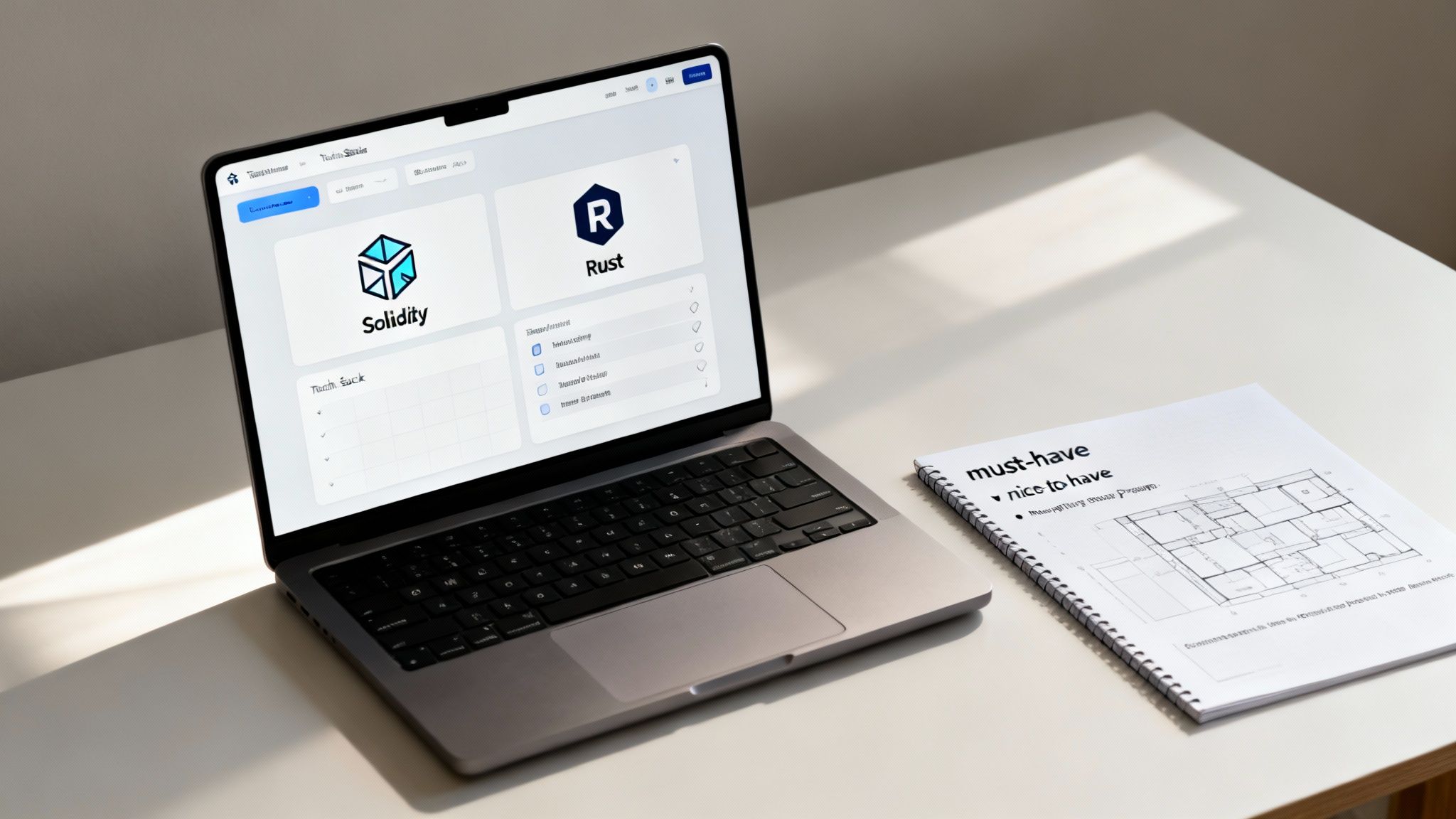
Your first move isn’t to scour LinkedIn; it’s to sit down with your technical leadership. The mission is to hammer out a precise candidate profile that draws a hard line between absolute necessities and desirable extras. This initial clarity will sharpen every other stage of hiring, from the language in your job description to the design of your technical interview.
The Web3 job market is white-hot. We've seen a staggering 300% surge in job openings since 2023, a direct result of decentralized tech going mainstream. This boom is particularly intense for backend roles, as projects race to build scalable infrastructure for Layer 2s and DeFi protocols.
What does that mean for your hiring strategy? Competition is fierce. For blockchain-focused developers, Rust is now the most in-demand language, making up 40.8% of placements, with Solidity close behind at 35.8%. You must be incredibly precise to stand out and attract the right engineering talent.
Distinguishing Must-Haves from Nice-to-Haves
Every hiring manager dreams of a unicorn candidate who checks every box, but effective hiring is about prioritization. Your tech lead is your most valuable ally in defining what truly matters for success in the role.
Grab a whiteboard and create two columns:
- Must-Haves: These are the deal-breakers. A candidate lacking these skills simply cannot perform the job, no matter how brilliant they are. This list should include deep system design knowledge, mastery of your primary backend language (e.g., Rust, Go), and proven experience building scalable, secure APIs. These are the skills you will test for rigorously in the interview process.
- Nice-to-Haves: These are skills that would accelerate a new hire’s ramp-up time or add unique value, but they can be learned on the job. Think familiarity with a specific L2 scaling solution, contributions to an open-source Web3 project, or experience with a particular cloud provider like AWS. Frame these as career growth opportunities.
A classic hiring mistake is creating a laundry list of ten "must-have" technologies. A great senior engineer can master a new framework in weeks, but they can't learn fundamental architectural thinking on the fly. Focus your interview process on core competencies, not a checklist of tools.
Core vs. Specialized Skills for Web3 Backend Roles
In Web3, the line between a traditional backend engineer and a blockchain specialist can be blurry. Both need strong foundations, but the specialized skills differentiate top candidates and directly impact project success. Use this table to structure your interview questions and job requirements.
| Skill Category | Core Backend Skill (Web2/Web3) | Specialized Web3 Skill (High-Demand) | How to Assess in an Interview |
|---|---|---|---|
| Languages | Go, Python, Node.js | Rust, Solidity, Go (with Web3 libraries) | Ask them to compare language trade-offs for a specific on-chain task (e.g., Rust vs. Go for a high-performance node). |
| Databases | SQL (Postgres), NoSQL (MongoDB) | Indexing protocols (The Graph), decentralized storage (IPFS, Arweave) | Pose a system design question about building a dApp that requires fast access to historical on-chain event data. |
| Architecture | Microservices, REST/GraphQL APIs | Smart contract architecture, node infrastructure, L2 scaling patterns | Ask them to design a system that bridges assets between two different blockchains, focusing on security and atomicity. |
| Security | API security, AuthN/AuthZ | Smart contract auditing, cryptographic principles, private key management | Present a vulnerable piece of Solidity code and ask them to identify the flaw and explain how to fix it. |
| Tooling | Docker, Kubernetes, CI/CD | Hardhat, Foundry, Ethers.js, Web3.js | Inquire about their preferred testing and deployment pipeline for smart contracts and have them justify their choices. |
Understanding this distinction helps you craft a job description and an interview process that attracts and validates candidates with the right blend of foundational strength and niche Web3 expertise.
Aligning Skills with Your Technical Roadmap
The most effective way to define your ideal candidate profile is to pull up your project's 6-12 month roadmap. What are the biggest technical challenges you need to solve? The answers point directly to the skills you need to hire for.
For instance, if your main objective is launching a new protocol on Solana, a developer with deep Rust experience and a solid grasp of the Sealevel runtime is a non-negotiable must-have. But if you’re building a cross-chain DeFi app, you’ll prioritize experience with EVM compatibility and smart contract interoperability.
This Smart Contract Backend Engineer role is a great example of how these specific requirements translate into a real-world job description.
Looking ahead ensures you’re not just hiring for today's tech debt, but for your future success. It transforms hiring from a reactive chore into a strategic investment.
Writing Job Descriptions That Top Engineers Actually Read
Let’s be honest: most job descriptions are terrible. They're a laundry list of requirements and corporate jargon that repel top talent. In a market this competitive, your job description must be a marketing asset—your first and maybe only shot at grabbing the attention of a great backend developer who isn't actively looking.
The key is to stop filtering and start selling a career opportunity. Top-tier engineers are motivated by solving hard, interesting problems and growing their skills. Your job post must nail the "why" behind the role, not just the "what."
Get specific. Forget the generic mission statement. Are they going to be wrestling with a DeFi protocol that secures millions in TVL? Building the foundational infrastructure for a new Layer-2? Frame the role around the impact and technical challenges they'll own.
Instead of, “Responsible for maintaining our APIs,” try: “You’ll own the design and scaling of our core settlement API, a system processing thousands of transactions per second that directly secures user assets.” The second version screams ownership, scale, and consequence—three things that will excite a talented engineer about their career progression.
Ditch the Corporate Fluff
Engineers have a finely tuned radar for corporate nonsense. Buzzwords like "synergy" and "disruption" are an immediate turn-off. They want to hear about the tech, the team, and the problems they'll get to solve. Be direct and authentic in your job description.
A classic mistake is opening with a long-winded paragraph about your company. Flip the script. Lead with the most exciting technical challenge of the job itself.
- Be explicit about your tech stack. List the languages (Go, Rust), databases (PostgreSQL, CockroachDB), infrastructure (Kubernetes, AWS), and any Web3 tools (Hardhat, The Graph) they'll get to master.
- Show them a path forward. What does career progression look like? Will they mentor junior devs, present at conferences, or lead a new project from scratch?
- Talk about your engineering culture. Are you a team that lives and breathes rigorous code reviews? Do you value pair programming, or is it more of an asynchronous, deep-work environment? Be real about how your team operates.
The best job descriptions read less like an HR document and more like the first chapter of an exciting technical career. They sell a vision of interesting work, professional growth, and meaningful impact, which is far more powerful than a list of required qualifications.
How to Find Talent Beyond LinkedIn
If your entire sourcing strategy is posting on LinkedIn, you're fishing in the most over-crowded, competitive pond there is. To find the best backend developers, especially in a niche space like Web3, you have to go where they are. This means engaging in the communities they already trust.
Think of it this way: instead of casting a massive net, you’re using a spear in smaller, more promising waters.
Niche Channels to Start Exploring
- Developer Hangouts: Platforms like Discord and Telegram are the new town squares. Find the official servers for Rust or Solana developers. Don’t just drop a job link and run. Participate. Answer questions, offer insights, and build a genuine reputation first. This makes your eventual outreach feel personal, not transactional.
- The Open-Source World: GitHub is more than a code repository; it’s a living portfolio. Look for developers contributing to projects relevant to your stack. You can assess their code quality, collaboration style, and passion before you even send the first message.
- Specialized Web3 Job Boards: This is a no-brainer. Using a platform where candidates are already crypto-native gives you a massive head start. These are professionals actively seeking roles that match their specific Web3 skills and career ambitions. For a great real-world example, check out this Backend Java Engineer position at Binance, which clearly outlines the specific Web3 context and technical demands.
By diversifying where you look, you’ll find incredible candidates who would have never seen your LinkedIn post. That’s how you get a real hiring edge.
Designing a Technical Screening Process That Doesn't Scare Away Talent
So, your job description is out there, and the applications are rolling in. Now comes the hard part: figuring out who can actually do the job.
This is where your technical screening process comes in, and it's a delicate dance. Make it too tough or irrelevant, and you'll alienate the very people you want to hire. Make it too easy, and you won’t learn a thing. The goal is to build a filter that reveals how someone thinks and solves problems, not just how well they've memorized algorithms.
An effective screening process should feel less like an exam and more like a preview of the actual work. It must respect their time while giving your team a clear signal on their technical depth, coding style, and communication skills. For Web3 roles, this is where you can really dig into their grasp of decentralized systems.
The quality of candidates hitting this stage is a direct result of how well you attracted them in the first place.
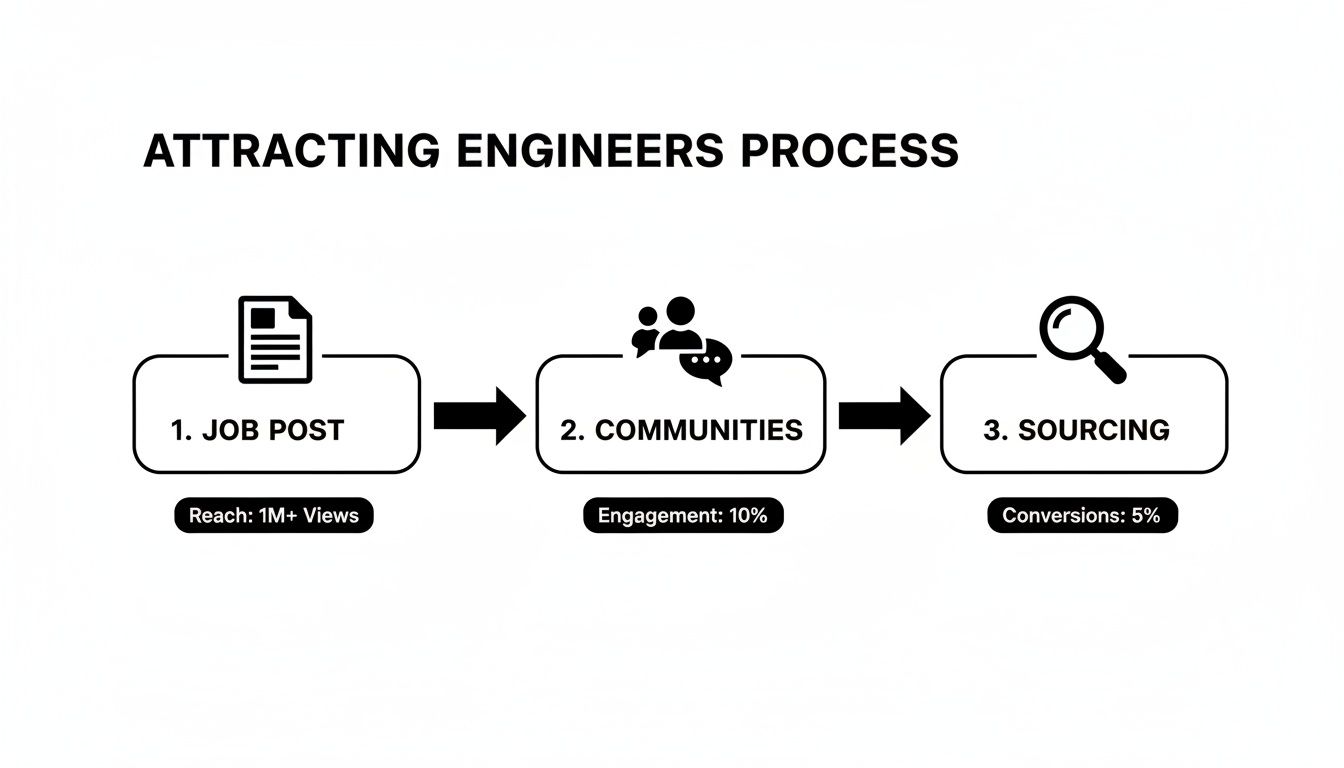
A great job post and smart sourcing lead to a stronger pipeline. Now, let's figure out how to screen them effectively.
The Initial Phone Screen
The first real conversation shouldn't be a high-stakes coding quiz. Treat this initial 30-45 minute call as a two-way sanity check for technical fundamentals and clear communication. Forget complex system design for now; this is about verifying their core knowledge and seeing if they can explain technical concepts clearly.
Stick with practical, open-ended questions that tie back to their resume:
- "Pick the most challenging project on your resume and walk me through the architecture. What were the big trade-offs you had to make?"
- "Imagine you're building a public API that handles sensitive data. How do you approach securing it?"
- "Tell me about a time you hunted down a nasty performance bug. What was your process?"
Listen for the why behind their answers. A strong candidate won't just recite definitions; they'll discuss constraints, lessons learned, and the real-world trade-offs they had to weigh.
The Big Debate: Take-Home vs. Live Coding
At the heart of any technical screen is the coding challenge itself. You generally have two options: a take-home project or a live coding session. The best choice depends on what skills are most critical for the role.
| Challenge Type | What It's Great For | The Downside |
|---|---|---|
| Take-Home Assignment | Seeing their actual code quality, project structure, testing habits, and ability to work independently on a realistic problem. | It's a significant time commitment for candidates, and you can't see their real-time thought process. |
| Live Coding Session | Assessing real-time problem-solving, how they communicate under pressure, their debugging instincts, and their raw thought process. | The pressure-cooker environment isn't realistic for most day-to-day work and can favor quick thinkers over deep, methodical ones. |
For backend roles, a well-scoped take-home assignment usually provides a richer signal. It mimics the deep, asynchronous work they'll be doing and gives them a chance to produce code they're proud of. It also respects that different people solve problems at different paces.
Your coding challenge should be a miniature version of a problem your team has actually solved. This makes the task relevant and gives the candidate a genuine taste of the work, turning the screening into a two-way evaluation.
Crafting a Take-Home That Works
If you opt for a take-home, the design of the task is everything. You must respect the candidate's time while maximizing the signal for your team.
A great take-home assignment has a few key ingredients:
- It’s completable in 4-6 hours, max. Anything more is disrespectful to candidates who have jobs and families. Be explicit about the time box and tell them you aren't expecting a "perfect," production-ready monolith.
- The goal is crystal clear. Provide a clear problem statement, define the expected inputs and outputs, and list key constraints. For a Web3 role, something like, "Build a simple API that queries on-chain data from a public testnet and caches the results" is perfect.
- It allows for some creativity. Don't write a super-prescriptive guide. The best tasks leave room for them to make their own architectural choices. This is your window into their design philosophy.
- It requires a
README.mdfile. This is non-negotiable. Ask them to explain their design choices, provide setup instructions, and discuss any trade-offs. This tests their written communication and documentation skills—essential for any effective engineering team.
Conducting Interviews That Reveal True Potential
Once a candidate clears the practical coding challenges, the real evaluation begins. The interview is your chance to connect their on-paper skills with how they’ll actually perform on your team. This is where you dig deeper than code to understand their architectural thinking, collaboration style, and whether they’re genuinely excited by the problems you’re solving.
A well-designed interview process gives you a complete picture, ensuring your final choice isn't just based on how well they solved one puzzle. The goal is to see how they think, not just what they know.
Remember, the interview is a two-way street. It’s your best shot at selling your company’s vision and the exciting technical hurdles they’ll get to overcome. For them, it’s a peek behind the curtain into your engineering culture and where their career could go.
Probing Architectural Thinking in the System Design Round
For any senior backend role, the system design interview is the main event. It separates engineers who can follow a blueprint from those who can draw one from scratch. This isn't about looking for a single "right" answer; it's about watching their thought process unfold.
Kick things off with a broad problem that mirrors a challenge your team might face, like, “Design a system to track real-time voting for a DAO proposal.”
What you’re really looking for is how they approach the unknown:
- Clarifying Questions: Do they jump straight into drawing boxes, or do they pause to ask critical questions about scale, security requirements, and potential constraints? A good candidate interviews the problem before solving it.
- Trade-off Analysis: Can they clearly articulate the pros and cons of using a centralized cache versus an on-chain solution? Can they debate the trade-offs between different data stores?
- Scalability and Bottlenecks: A great sign is when they proactively identify weak points in their own design and suggest ways to mitigate them before you even ask.
The best candidates don't just present a solution; they defend it. They explain why they chose a specific database or API architecture and can adapt their design as you introduce new requirements. This reveals true depth of understanding.
Uncovering Collaboration and Mindset with Behavioral Questions
Technical brilliance is only half the picture. A genius-level engineer who can't collaborate or take feedback can drain the entire team. Behavioral questions are your most effective tool for assessing these crucial soft skills and culture fit.
Steer clear of generic questions like "What are your weaknesses?" Instead, use prompts that require them to tell a story about a specific past experience. This provides concrete evidence of their behavior.
Insightful Behavioral Questions to Ask
- "Tell me about a time a project you were on was failing. What did you do to help turn it around, and what was the outcome?" (Tests for ownership and resilience.)
- "Describe the most complex technical disagreement you've had with a colleague. How did you handle it, and what did you learn?" (Reveals collaboration and communication style under pressure.)
- "Walk me through a technical decision you made that was a mistake in hindsight. What was your thought process, and what would you do differently now?" (Assesses humility and the ability to learn from errors.)
- "What part of the Web3 space are you most excited to learn about in the next year, and why?" (Gauges genuine passion and a growth mindset beyond the job description.)
These questions push candidates to reflect on how they operate. The answers often give you a clearer signal on long-term career potential and team fit than any technical test can. After all, finding the right people is a specialized skill in itself, which is why roles like a Principal Technical Recruiter exist—to find that perfect blend of technical expertise and personal strengths.
Making a Competitive Offer and Onboarding for Success

You’ve gone through the gauntlet of sourcing, screening, and interviewing. You've finally found the one. It’s easy to feel like you’re at the finish line, but this is where many companies fumble the ball.
Securing a top-tier backend developer in the cutthroat Web3 space isn't just about sending an offer letter. It’s about presenting a compelling, well-researched package and backing it up with a seamless transition plan that sets them up for long-term success. A weak offer can undo all your hard work, while a strong one, paired with a great onboarding experience, makes saying "yes" a no-brainer.
Benchmarking Web3 Compensation
Standard salary guides don't apply in Web3. The compensation landscape is different, driven by a serious talent shortage and the unique inclusion of assets like tokens. Getting this right is critical to closing your top candidate.
Backend developer salaries in the blockchain world are skyrocketing. In the U.S., a typical blockchain developer can expect an average of $146K per year. Newer engineers might start around $121K, but experienced hands can easily pull in $187K or more. For specialized roles, it's not uncommon to see packages hitting $130K–$270K when you factor in token equity. For a deeper dive, explore a full report on the Web3 job market for more detailed insights.
A competitive offer tells a story about a candidate's future with your company. It should clearly lay out the entire value proposition—base salary, bonuses, equity, and the potential upside of tokens. Be transparent about how everything works together to reward their impact.
Don't just think in terms of cash. You have other powerful levers:
- Equity: For startups, equity is your ace in the hole. Explain the grant size, strike price, and vesting schedule. Frame it as what it is: a real opportunity for them to own a piece of the success they're about to help build.
- Token Warrants/Allocations: This is a massive differentiator in Web3. Offering a stake in your protocol's native token directly aligns the developer’s financial incentives with the health and growth of the ecosystem.
- Benefits: Never underestimate the basics. Great health insurance, truly flexible hours, a professional development budget, and a solid remote work policy all signal a culture that supports long-term career growth.
Creating a Structured Onboarding Plan
The moment your offer is accepted, the retention clock starts ticking. The first 90 days are make-or-break. A chaotic, "sink-or-swim" onboarding process is the fastest way to create buyer's remorse. The goal is to give them a structured path to feeling productive, integrated, and confident in their decision to join.
Your onboarding should feel less like HR paperwork and more like a clear career roadmap for their first three months.
The 30-60-90 Day Framework
- First 30 Days: Learn the Ropes. The goal is immersion, not immediate output. Your new hire should focus on setting up their dev environment, meeting the team, and digging into documentation. Assign them an onboarding buddy—a peer who can answer questions and help them navigate the codebase. Their first tasks should be small, low-risk bug fixes to build confidence.
- Next 30 Days: Start Contributing. By now, they should be comfortable enough to take on their first small features. They should be joining code reviews, participating in sprint planning, and getting a feel for the system architecture. Their manager should set clear, achievable goals and provide consistent feedback.
- Final 30 Days: Build Ownership. At the 90-day mark, your new developer should be operating with more autonomy. They should be tackling more complex problems and adding value to technical discussions. This is the perfect time to check in about their career goals and discuss their growth path within the company.
Common Questions About Hiring Web3 Backend Developers
Hiring a backend developer for a Web3 project isn't like filling a typical software role. You're dealing with new tech, a specific talent pool, and higher stakes. Getting this wrong is painful.
Let's tackle some of the most common questions that arise when building a killer Web3 engineering team.
Should We Prioritize Deep Web3 Experience or Strong Backend Fundamentals?
This is the big one. The answer is almost always: prioritize strong backend fundamentals. Core engineering skills—system design, database architecture, scalability, security—are the bedrock of a great developer. A talented backend engineer can learn the specifics of a new blockchain protocol.
The reverse is rarely true. An engineer who only knows a few Web3 frameworks but can't design a robust system from first principles will eventually hit a wall. The decentralized world is unforgiving; you need architects who can build for the long haul, not just specialists in today's hot library.
Bet on the strong engineer who is genuinely curious about Web3. Their ability to reason about complex systems will be far more valuable for their long-term career progression and your company's success.
How Do You Assess a Candidate's True Skill with a Specific Blockchain?
You have to dig deeper than just asking if they've "used" a protocol. Real expertise shows up when a candidate can explain the why behind the what.
During the technical interview, give them a problem specific to that ecosystem:
- For an EVM Candidate: Ask them to walk you through debugging a reentrancy bug or designing a gas-efficient contract interaction. See if they can debate the trade-offs of different upgrade patterns.
- For a Solana Developer: Quiz them on the account model and PDAs. A fantastic question is to have them architect a system that avoids account contention.
- For a Cosmos Developer: Go deep on their knowledge of the IBC protocol. Ask how they'd approach building a custom module from scratch.
A practical take-home project that forces them to interact with a devnet is also a great way to separate theory from applied skill.
What Are the Biggest Red Flags to Watch For During Interviews?
Technical skills are key, but certain attitudes during the interview can signal future headaches. Spotting these can save you from a very expensive hiring mistake.
A huge red flag is a candidate who can't discuss the trade-offs they made on past projects. If they can only tell you what they built but not why—or what other paths they considered—it suggests they were just following orders, not thinking critically.
Another warning sign is a lack of curiosity. The best engineers are always asking questions. They should be probing you about your tech stack, team culture, and roadmap. If they have no questions for you, they might not be genuinely invested in a long-term career with your company.
Finally, be wary of candidates who consistently blame others for past project failures. This points to a lack of ownership and accountability. You need people who are coachable and willing to own their mistakes—an essential trait for any high-performing team.
How Can We Hire and Integrate Remote Backend Developers Effectively?
The Web3 world is global and remote-first, so mastering this is non-negotiable. When screening for remote roles, specifically look for excellent written communication skills and a history of working autonomously.
Tweak your behavioral interview questions for the remote reality:
- "Tell me about a time you had to resolve a technical disagreement with a colleague in a different time zone."
- "How do you ensure your work is visible to the team when you're working asynchronously?"
- "Walk me through your process for documenting a complex feature you shipped."
Once hired, a structured onboarding is everything. Don't just throw them in the deep end.
- Assign an Onboarding Buddy: Give them a dedicated peer who can answer questions and show them the ropes.
- Schedule Daily Check-ins: For the first few weeks, a quick 15-minute sync can make all the difference in making them feel like part of the team.
- Ensure Your Documentation is Flawless: For a remote engineer, your technical docs are their lifeline. They need to be clear, complete, and easy to find.
When in doubt, over-communicate. It’s the single best way to make a new remote hire feel connected and set them up for a successful career with your team.
Finding the right talent is the single most important thing you'll do for your Web3 project. At Blockchain Jobs, we connect innovative companies with the specialized engineers, product managers, and marketers building the future of the decentralized web. Post a job today and get in front of a curated audience of crypto-native professionals.