Know what is a smart contract: A Guide for Your Web3 Career

At its most basic, a smart contract is just a program that runs on a blockchain. But it’s a special kind of program. Think of it less like an app on your phone and more like a super-powered vending machine.
You put in a specific input (like cryptocurrency), and it’s programmed to automatically spit out a specific output (like a digital asset or access to a service). There’s no need for a cashier or a bank—the code itself enforces the rules of the agreement. This simple idea of automated, unstoppable agreements is what makes them the bedrock of almost everything in Web3, and understanding them is your first step toward a career in the space.
Why Smart Contracts Matter for Your Career
If you're looking to break into the blockchain space, you have to get comfortable with smart contracts. It’s no longer a niche developer topic. For job seekers, being able to talk intelligently about how smart contracts work tells a hiring manager you understand the fundamental logic of Web3.
This isn't just about coding. A product manager who gets the limitations of smart contracts can design much safer and more realistic applications. A lawyer who understands their mechanics can better advise on the tricky compliance landscape. Even marketers who can explain why a product is decentralized and automated will have a huge edge. It's the language of the industry, and fluency pays off in job interviews.
The Foundation of Trust and Automation
When you’re in a job interview, two concepts will almost certainly come up when discussing smart contracts. Nailing these shows you've done your homework.
- Immutability: Once a smart contract is deployed on a blockchain, its code is set in stone. It can't be altered or deleted. This creates a powerful guarantee that the rules won't suddenly change on you.
- Trustlessness: Because the blockchain network itself executes the code, you don’t have to trust the other person in the transaction. You just have to trust the code, which is open for anyone to inspect and verify.
The idea has been around for a while—computer scientist Nick Szabo first theorized about "smart contracts" way back in 1994. But they were just a concept until blockchains provided the right environment. The launch of Ethereum in 2015 was the real game-changer, giving developers a platform to build and run them, which kicked off the massive demand for people skilled in languages like Solidity and platforms like the EVM.
To help you get these core ideas straight, here’s a quick breakdown of what they mean and why they're critical for your career path.
Smart Contract Core Concepts at a Glance
| Concept | Simple Explanation (Analogy) | Why It Matters for Your Career |
|---|---|---|
| Self-Executing Code | A digital vending machine. You put in coins (crypto), it automatically gives you a soda (digital asset). No cashier needed. | Shows you understand automation, which is key for roles in DeFi, DAOs, and protocol design. |
| Immutability | Writing something in permanent ink. Once it's on the blockchain, it cannot be erased or changed. | Crucial for security, auditing, and legal roles. You need to grasp the high stakes of "code is law." |
| Trustlessness | Two people making a bet and giving the money to a neutral robot to hold until the winner is decided. | This is the foundation of decentralization. Explaining this well proves you understand Web3's core value proposition. |
| Transparency | The code for the vending machine is posted on the front for everyone to see and check before they use it. | Important for roles in user trust, community management, and product marketing. Transparency builds confidence. |
Knowing these concepts is more than just memorizing definitions; it’s about understanding a completely new way of building systems and businesses online.
In short, getting a real handle on what a smart contract is—and what it isn't—is your ticket to the most interesting and valuable roles in Web3. It proves you can think critically about decentralized systems, a skill that companies are desperately looking for and willing to pay a premium to find.
How Smart Contracts Actually Work on the Blockchain
It’s one thing to know the idea of a smart contract, but to build a career in this space, you need to get your hands dirty with how they actually function. Whether you're a developer, product manager, or even in compliance, understanding the mechanics is what separates the casual observer from a serious professional.
Everything starts with code. A developer writes the contract's logic—all the "if this, then that" rules—using a language like Solidity for Ethereum or Rust for Solana. For hiring managers, finding a candidate who can clearly walk you through this lifecycle is a huge green flag; it shows they don't just know the buzzwords, they know how the machine works.
This diagram breaks down the basic journey from a simple agreement to an automated program running on the blockchain.
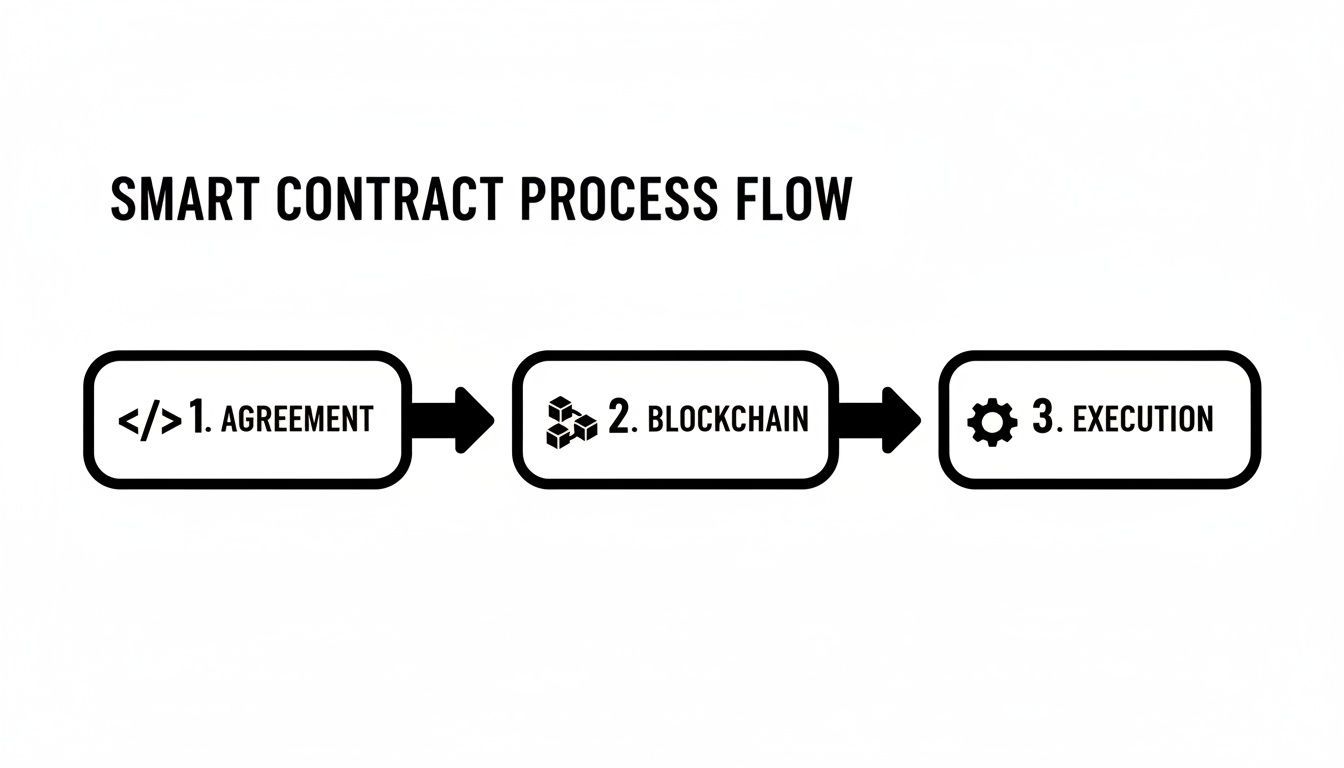
This three-step process—code the agreement, publish it to the blockchain, and let it run on its own—is the backbone of every single decentralized application you see today.
From Code to Unstoppable Program
Once the code is written, it doesn't just run on a server like a typical app. It has to be translated and permanently set into the blockchain. This is where the technical details become real career differentiators.
- Compilation: First, the human-friendly code (like Solidity) gets compiled into bytecode. Think of this as translating English into a language that the blockchain’s computer, the Ethereum Virtual Machine (EVM), can understand.
- Deployment: Next, a user pays a fee, called gas, to deploy this bytecode onto the blockchain. This is a real transaction that gets broadcast across the network, confirmed by thousands of computers (validators), and then sealed into a new block forever.
- Execution: The contract is now live at a permanent, unique address. From this point on, anyone can interact with it by sending a transaction to that address, which kicks off the functions baked into its code.
A developer who truly gets gas optimization isn't just a coder; they're a business asset. Writing efficient contracts that use less gas saves the company and its users real money, a skill that's always in high demand.
Why This Process Matters in a Job Interview
When you can speak confidently about these mechanics, you signal a much deeper level of expertise. A product manager who knows that transactions need time to be confirmed will design a better user experience, managing expectations around delays. A developer who can explain the nuances of the EVM proves they understand the very ground they’re building on.
And this isn't just an Ethereum thing. While other blockchains like Solana don't use the EVM, they follow the same core principles of compiling code and deploying it to a decentralized network. You'll see specialized skills for these platforms pop up in job listings all the time, like this Solana Program Engineer role on Blockchain Jobs.
Ultimately, proving you understand the fundamental lifecycle of a smart contract shows any team that you’re ready to build, not just talk.
From Digital Cash to a World Computer
If you want to ace a job interview, you need to grasp the why behind the technology. Knowing that a smart contract is just code is entry-level. Explaining why it had to be invented? That’s what shows real expertise. This backstory isn’t just trivia; it’s a powerful narrative about how this industry came to be and where you fit in.
It all starts with Bitcoin. As incredible as it was, Bitcoin was built to do one thing really well: be digital cash. Its scripting language was deliberately simple, focused entirely on secure, straightforward transfers of value. You could send Bitcoin from Alice to Bob, but you couldn't build a complex app on top of it. This wasn't a flaw; it was a feature designed for maximum security.
But innovators saw so much more potential. They started asking, "What if a blockchain could do more than just track a ledger? What if it could run any program we could dream up?"
The Birth of the Programmable Blockchain
That single question set off a chain reaction. The idea of smart contracts took blockchain from a simple accounting system to a worldwide coordination tool for entire markets and organizations. In 2013, a young programmer named Vitalik Buterin, recognizing Bitcoin’s scripting limits, proposed Ethereum as a platform for decentralized applications.
When Ethereum launched in 2015, it kicked off what many call “Blockchain 2.0.” For the first time, programmable contracts unlocked a universe of new possibilities. You can dig into some of the major milestones in blockchain history to see the full picture.
This one innovation—making the blockchain programmable, or Turing-complete—is what turned a simple ledger into a global, decentralized computer. It was the breakthrough that opened the door for DeFi, NFTs, and DAOs.
This shift didn't just change the technology; it completely redrew the map for talent. The demand for specific skills exploded, moving way beyond the early days of needing only protocol researchers and core developers.
A New Job Market Emerges
The move to programmable blockchains gave rise to a whole ecosystem of jobs that hadn't existed just a few years earlier. Companies weren't just building a currency anymore; they were building entire digital economies from the ground up, and they needed a totally new kind of workforce to make it happen.
Suddenly, the talent needs grew to include:
- Solidity and Rust Engineers who could write the actual application logic for dApps.
- Formal Verification Specialists and Security Auditors to hunt for vulnerabilities in code that, once deployed, could never be changed.
- Legal and Compliance Experts to figure out how this new world of automated, on-chain agreements fits with traditional regulations.
- Product, UX, and Data Roles focused on making smart contract-driven experiences that real people could actually use.
Understanding this history gives you a far more compelling story to tell hiring managers. It shows you don’t just know what a smart contract is—you know why it’s the engine driving the entire Web3 job market today.
Real-World Industries Powered by Smart Contracts
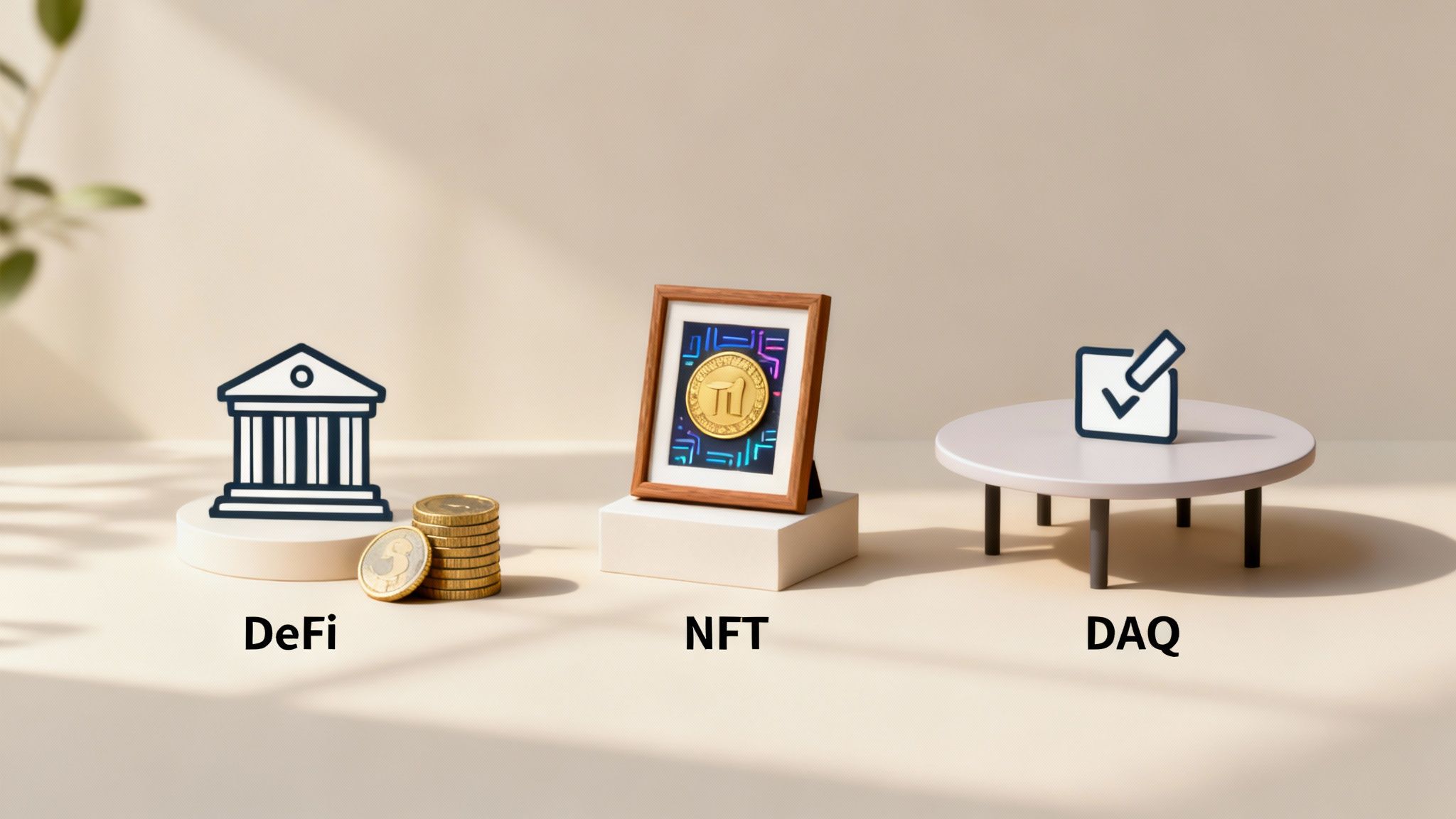
Understanding the theory is one thing, but if you're looking for a job, you need to know where the action is. Smart contracts aren't just an academic exercise; they are the bedrock of entire multi-billion-dollar industries that are constantly looking for talent. Connecting your skills to these booming sectors makes you a much more compelling candidate.
The rise of smart contracts is directly linked to programmable blockchains like Ethereum. Take the DeFi sector, for instance. It's built almost entirely on smart contracts and saw its total value locked (TVL) skyrocket from under $1 billion in 2019 to tens of billions during the 2020–2021 bull run. This explosion created a huge demand for people who understand on-chain logic, a story you can dive deeper into by exploring the history and impact of blockchain technology.
This rapid growth means that hiring managers across the US, EU, and Asia are putting smart contract engineers, security auditors, and product managers at the very top of their hiring lists.
Decentralized Finance (DeFi)
At its core, DeFi is all about rebuilding traditional financial services—think lending, borrowing, and trading—but with automated, transparent smart contracts instead of banks. This sector is arguably the biggest employer of Web3 talent.
Automated Market Makers (AMMs) and lending protocols are always on the lookout for developers who can write secure and gas-efficient Solidity code. But the opportunities don't stop with engineering.
- Key Roles: Smart Contract Engineer, Protocol Designer, Quantitative Analyst, DeFi Product Manager.
- Skills in Demand: A solid grasp of financial concepts, tokenomics, risk management, and the ability to design systems that are both secure and make smart use of capital.
Non-Fungible Tokens (NFTs)
NFTs are simply unique digital items—like art, music, or collectibles—where ownership is verified by a smart contract. The NFT boom created an entirely new job market for creators, developers, and marketers. Right now, marketplaces and gaming studios are leading the hiring push.
For a job seeker, this means even non-technical roles need some smart contract savvy. A Community Manager who understands ERC-721 contracts can better explain a project's value, and a Product Manager can design better experiences for both artists and collectors.
- Key Roles: NFT Marketplace Manager, Web3 Community Manager, Smart Contract Developer (specializing in ERC-721/1155), Digital Artist.
- Skills in Demand: Community building, digital marketing, a working knowledge of intellectual property, and a good sense of user experience in a world of digital ownership.
Decentralized Autonomous Organizations (DAOs)
Think of DAOs as internet-native organizations run by code and member votes, all managed through smart contracts. They need people to manage their funds, coordinate projects, and build the governance tools that keep things running smoothly. This opens the door to unique roles that mix technology, community management, and operations.
- Key Roles: DAO Community Manager, Governance Specialist, Treasury Manager, Full-Stack dApp Developer.
- Skills in Demand: Community moderation, treasury management, proposal writing, and experience with established governance frameworks like Compound Governor or Aragon.
By focusing on one of these specific industries, you can tailor your resume and interview prep to show you're not just a candidate—you're a problem-solver ready to contribute from day one.
Building Your Smart Contract Skill Set
Knowing what a smart contract is puts you ahead of the curve. Knowing how to build or manage one? That puts you at the top of the hiring list.
Think of this as your action plan. Whether you're a developer aiming to build the next big DeFi protocol or a non-technical pro looking to break into the space, this is how you develop the practical, in-demand skills Web3 companies are looking for right now.
For aspiring builders, the journey starts with code. Solidity is the undisputed king for Ethereum and other EVM-compatible chains, which means it shows up constantly in job descriptions. But if you're drawn to high-speed ecosystems, Rust is the language powering platforms like Solana and its popularity is exploding.
Simply knowing a language isn't enough, though. To really stand out, you have to prove you can build things that are both secure and efficient. That means getting your hands dirty with the tools of the trade.
The Developer's Essential Toolkit
Hiring managers want to see more than just language fluency; they're looking for a full-stack Web3 mindset. Your goal should be to build a portfolio that shows you can write, test, and deploy code that's ready for the real world.
- Development Frameworks: Tools like Hardhat and Foundry are non-negotiable. They are the sandboxes where you compile, test, and launch your contracts. Being comfortable here shows you grasp the entire development lifecycle.
- Testing Libraries: In a world where code can't be changed, testing is everything. Demonstrating you can write bulletproof tests with libraries like Chai and Ethers.js is a massive green flag for any employer.
- Security Libraries: A smart developer doesn't reinvent the wheel, especially when it comes to security. Using battle-tested libraries like OpenZeppelin Contracts for standards like ERC-20 or ERC-721 signals maturity and a security-first approach.
For a junior developer, a GitHub profile with well-tested projects using Hardhat and OpenZeppelin is more valuable than any certificate. It’s tangible proof you can contribute safely and effectively from day one.
Skills for Non-Technical Professionals
You don't need to write code to be a critical player on a Web3 team. But you do need to understand the mechanics. Your expertise in product, marketing, or operations becomes ten times more valuable when you can speak the language of the blockchain.
To become truly effective, focus on getting a solid grip on these concepts:
- Tokenomics: Get inside the head of a protocol and understand how its token creates incentives and guides what users do. This is vital for product managers designing systems that last and for marketers telling a story that resonates.
- Governance Mechanics: Learn how DAOs actually work—how smart contracts facilitate voting and guide community decisions. This knowledge is gold for anyone in community, operations, or legal roles.
- On-Chain Analytics: Start playing with tools like Dune Analytics or Nansen. The ability to read on-chain data to see what users are really doing is a superpower for anyone in a business-focused role.
Building this foundation means you can talk shop with the engineers, weigh in on strategic decisions, and prove you're not just another tourist in Web3. You'll be an indispensable part of the team.
Why Smart Contract Security Is a Career Superpower

When we talk about smart contracts, we’re not just talking about code—we’re talking about code that often acts as an irreversible vault holding millions, sometimes billions, of dollars. A single mistake deployed to the blockchain is permanent. That’s why a 'security-first' mindset isn't just a good habit; it’s a career-defining skill.
Hiring managers are desperate for candidates who understand this. Whether you're a developer, a product manager, or even in a legal role, demonstrating a deep awareness of the risks makes you a standout applicant. It shows you can think beyond just features and protect user funds and the project's reputation from day one.
Understanding the High-Stakes Game
You don’t have to be a hardcore developer to grasp the major threats. Take a reentrancy attack, for instance. This is a common bug where a malicious contract can keep withdrawing funds from a target contract before the system has a chance to update its balance. It’s like an ATM glitch that lets you pull out cash over and over again before your account registers the first withdrawal.
Understanding concepts like this shows a hiring manager you appreciate the immense responsibility that comes with building on the blockchain. You’re not just thinking about features; you’re thinking about resilience.
This is exactly why smart contract audits are an absolute must for any serious project. Think of professional auditors as ethical hackers. They comb through every line of code, trying to break it in every way imaginable to find vulnerabilities before bad actors do. Their job is to stress-test the logic and make sure the contract behaves exactly as intended, especially under pressure.
Knowing what auditors look for gives you a huge advantage. It helps you build stronger systems from the start and lets you ask smarter questions during a job interview, proving a level of maturity that companies are actively seeking. This kind of specialized expertise is precisely what top firms are looking for in blockchain security engineer job listings.
At the end of the day, a deep respect for security will always make you a top-tier candidate in the Web3 space.
Your Smart Contract Career Questions Answered
Trying to figure out where you fit in the Web3 job market? You're not alone. Let's tackle some of the most common questions people have about building a career around smart contracts.
Do I Need to Be a Programmer to Work with Smart Contracts?
Not at all. While the developers who write the actual code in languages like Solidity or Rust are obviously crucial, the entire ecosystem needs people with a solid understanding of what smart contracts do.
Think about it: product managers need to know the capabilities and limitations to design good products. Lawyers have to navigate the compliance maze. Marketers need to explain the benefits to users. Having functional literacy—knowing what’s possible and what’s not—is a huge advantage in almost any role, from operations to the C-suite.
What Is the Most Important Skill for a Smart Contract Developer?
Beyond knowing the code, the number one skill is an obsession with security. Smart contracts are often immutable and control a lot of money, so one tiny mistake can lead to disaster.
Top employers are looking for developers who live and breathe security. They want people who write clean, gas-efficient code and know how to defend against common attacks like reentrancy. If you can talk about patterns like Checks-Effects-Interactions in an interview, you're signaling that you have the security-first mindset of a senior developer.
How Can I Get Practical Experience for My Resume?
The best way is to just start building. Don't try to build the next Uniswap on day one; start with small, focused projects that prove you can apply your skills.
A simple NFT minting contract, a decentralized voting app, or a basic escrow system are all fantastic portfolio pieces. They create tangible proof of what you can do.
Interactive tutorials like CryptoZombies are great for learning the ropes. From there, use a framework like Hardhat or Foundry to build and test your own ideas. Contributing to open-source projects on GitHub, even with small bug fixes, also gets your name out there. This kind of hands-on experience is exactly what companies are looking for in roles like this Engineering Manager position for smart contracts.
Ready to find your place in the Web3 world? At Blockchain Jobs, we connect talented professionals with leading companies in the blockchain space. Explore thousands of curated opportunities in engineering, product, marketing, and more. Find your next role at https://blockchain-jobs.com.