
How Much Do HR Generalists Make? 2026 Salary Guide
HR Generalists in the U.S. make an average base salary of about $63,373 to $65,839 in 2026, and total compensation can run from $45,000 to $80,000. That’s the right starting point if you’re asking how much do hr generalists make, but it’s not the full answer if you work in a fast-moving market like Web3.
In practice, HR pay is less about the job title alone and more about the business problem you solve. A generalist who processes onboarding paperwork and answers policy questions sits in a different market than one who can hire globally, support remote teams, manage people ops systems, and keep a decentralized company compliant.
That difference matters on both sides of the hiring table. Candidates need to know what their background is worth before they accept a title that undersells them. Founders need to know when they’re hiring an administrative generalist, when they’re hiring a culture-and-compliance operator, and when they’re really hiring a strategic people lead under a generalist title.
Your Guide to HR Generalist Salaries in 2026
HR Generalist pay in the U.S. clusters in the mid-$60,000 range for base salary, with wider total compensation depending on scope, company stage, and industry, as noted earlier from the same national salary dataset.
That baseline helps. It does not price the actual job many companies call an HR Generalist.
I see this mistake on both sides of the market. Founders budget for a mid-level administrator, then ask that person to build onboarding, support recruiting, manage HR systems, coordinate payroll, draft policies, and handle employee issues across several states or countries. Candidates do the reverse. They accept a generalist benchmark for a role that is closer to a first People Ops hire.
In Web3, the gap gets wider. A token-funded startup, a remote-first DAO-adjacent company, and a traditional software business can all post “HR Generalist” roles, but they are buying very different skill sets. If the job includes global hiring support, contractor classification, payroll coordination across borders, or crypto-related compensation questions, national averages become a starting point, not a reliable offer target.
What this range means in real hiring terms
Candidates should treat the national average as a reference point. Your price moves up when you can solve messy operating problems without much structure around you.
Founders should budget based on risk and workload. If you are still deciding whether to keep HR administration outside the company, compare a full-time salary, benefits, software costs, and management overhead against external support such as small business payroll and HR services. That exercise usually makes the decision clearer. Some teams need part-time operational coverage. Others already need a builder who can create repeatable people processes before hiring mistakes get expensive.
A practical rule applies here. If one person will own hiring coordination, onboarding, policy rollout, employee support, and HR systems, pay for the scope of that responsibility.
That matters even more in blockchain companies. Lean teams, remote work, and niche compliance questions raise the market value of HR Generalists who can operate independently and handle ambiguity without creating avoidable risk.
Decoding the Average HR Generalist Salary Range
The spread is wider than many candidates expect. National HR Generalist pay runs from entry-level compensation in the low-$50,000s to senior compensation around $80,000, but that range only helps if you separate guaranteed pay from package headlines and match the number to the actual job.
Start with base salary. Then review total compensation, which may include bonus, profit sharing, or other variable pay. Candidates often compare one company’s total package to another company’s base salary and end up overstating the offer. Founders make the same mistake when they budget around optimistic bonus assumptions instead of guaranteed cash cost.
In Web3, that gap gets bigger. Some startups keep cash compensation tighter and try to offset it with token grants, equity, or performance upside. That can work for the right hire, but it does not change market expectations for an HR Generalist who is carrying operational risk, handling sensitive employee issues, and building process in a fast-moving company.
Entry level, early career, and senior bands
A practical read of the salary bands looks like this:
| Career stage | Typical compensation level | Hiring interpretation |
|---|---|---|
| Less than 1 year | As noted earlier, entry-level HR Generalists average total compensation in the low-$50,000s | Best fit for structured environments with documented processes, close management, and limited ownership |
| 1 to 4 years | Early-career professionals commonly move into the low-$60,000s in total compensation | Often ready to run onboarding, employee support, HR administration, and day-to-day people operations with less oversight |
| Broad market average | Mid-market HR Generalist base pay commonly sits around the low-to-mid $60,000s | Reasonable benchmark for a solid generalist role with clear scope and manageable complexity |
| Senior HR Generalist | Senior compensation often reaches around $80,000, as noted earlier | Better benchmark for roles with systems ownership, policy design, employee relations judgment, or multi-state compliance exposure |
Titles blur quickly.
Someone may be new to the "HR Generalist" title and still deserve early-career or mid-market pay because they have already handled recruiting coordination, onboarding, HRIS updates, leave administration, employee documentation, or people operations support. I see this often with candidates coming from startup operations roles. The title looks junior. The usable skill set is not.
That matters even more in blockchain companies, where small teams expect one person to cover a broad set of responsibilities. If the role includes contractor onboarding across jurisdictions, payroll coordination for distributed teams, or policy support for crypto-native compensation structures, a plain national average will understate the actual market rate.
What base pay doesn’t tell you
Two offers with the same headline number can produce very different outcomes for both sides.
A $68,000 base with a modest, well-defined bonus plan is a different offer from a $60,000 base paired with highly conditional upside. For candidates, the first package usually provides more stability. For founders, the second package may look cheaper on paper but can create hiring friction if the role already carries first-HR-hire complexity.
Use this checklist when comparing offers:
- Base salary first. This is the fixed amount that covers living costs and sets the floor for the offer.
- Bonus mechanics next. Ask how it is calculated, who approves it, and what percentage gets paid in practice.
- Variable pay reality. Profit sharing, token upside, or commission-style incentives can add value, but they should not replace fair cash compensation for core HR work.
- Scope of ownership. A narrow support role and a builder role should not sit in the same pay band.
- Risk exposure. If the person is expected to handle employee relations, compliance coordination, or cross-border people operations with minimal support, the package should reflect that.
A simple rule applies here. The more ambiguity, judgment, and operational ownership the role carries, the less useful the average salary becomes. In Web3 hiring, niche capability raises pricing fast.
What Factors Drive Your HR Generalist Pay?
Salary spread for HR Generalists is wide for one reason. The title stays the same while the risk, scope, and operating environment change fast.

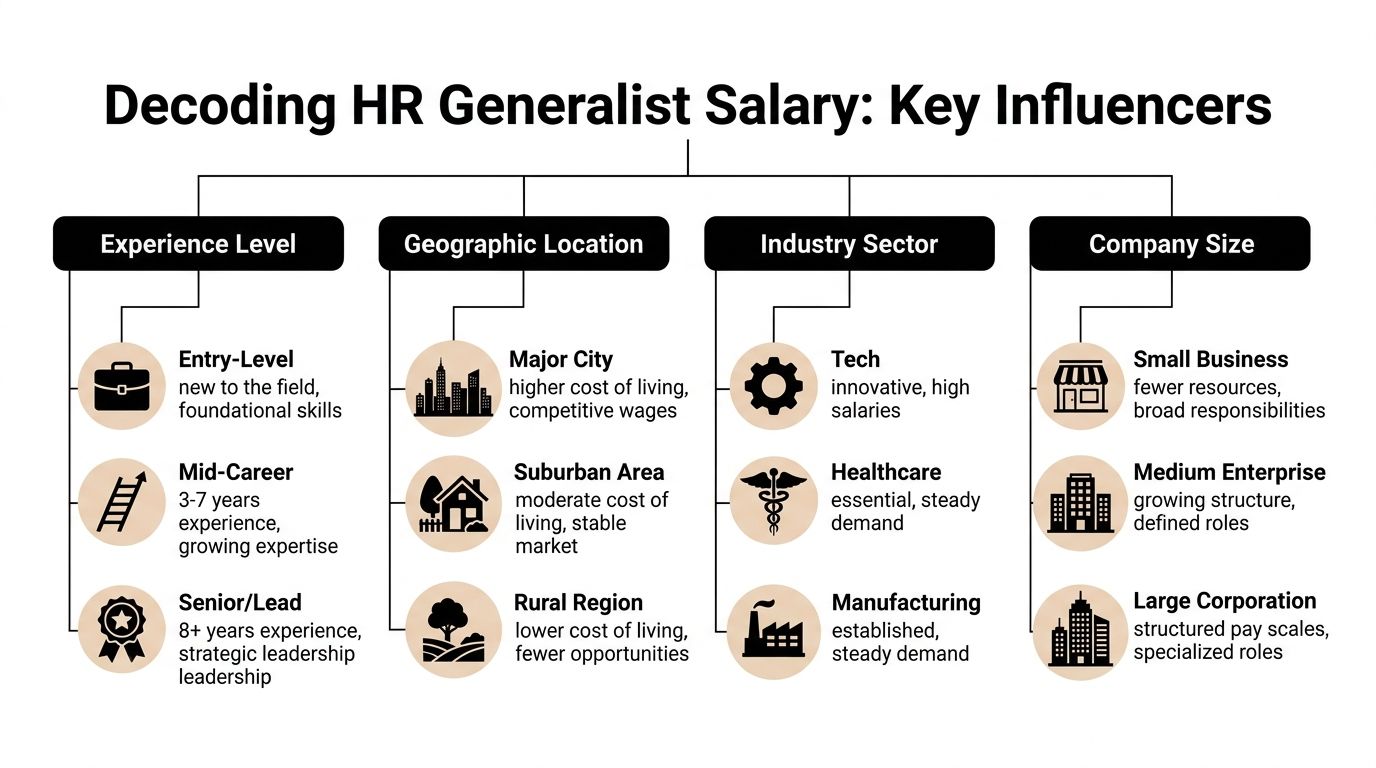
The biggest drivers are location, industry, company stage, and the kind of problems the employer expects one person to solve. As noted earlier, broad market data shows a meaningful gap between lower-paid generalist roles and higher-paid positions in specialized sectors and expensive talent markets. In Web3, that gap usually gets wider because companies often need one hire to cover people operations, hiring process design, compliance coordination, and manager support at the same time.
Location sets the floor, but remote work does not erase it
Geography still shapes compensation.
A company hiring in San Jose, New York, London, or another expensive talent market is competing against employers with bigger budgets and more mature HR teams. Even if the role is remote, strong candidates compare your offer against what they could earn in those markets, especially if they already know how to support distributed teams.
Founders miss this point all the time. They post a remote HR Generalist role, budget to a national average, and then discover the candidate pool they want has worked in tech, handled cross-border hiring, and expects pay closer to a specialist market. Remote broadens access. It does not automatically lower the rate.
Industry changes the job, and the pay follows
An HR Generalist in a low-complexity environment can focus on onboarding, documentation, and day-to-day employee support. In a regulated or high-pressure industry, the same title carries more judgment and more downside if execution slips.
That is why some sectors consistently pay above generic averages. The work requires tighter documentation, more policy discipline, better manager coaching, and fewer operational mistakes.
Web3 fits that pattern. A blockchain company may be small, but the people risks are not. International contractors, token-related compensation questions, fast hiring swings, and unclear policy edges all raise the value of an HR Generalist who can keep operations clean. If the company needs someone who can spot issues early instead of reacting after they become expensive, skill in predictive analytics in HR becomes more than a nice-to-have. It becomes part of the pay discussion.
Company stage changes what “generalist” really means
Early-stage companies often use the title too loosely.
At a larger employer, an HR Generalist may step into a defined system with legal support, recruiting support, established workflows, and clear escalation paths. At a startup, especially in Web3, the first HR hire may be expected to write policies, clean up recruiting operations, support onboarding, answer employee questions, coordinate vendors, and help founders avoid preventable compliance mistakes.
That is a broader job. It should be priced as a broader job.
I usually tell candidates to read for verbs, not titles. If the role asks you to build, standardize, own, or introduce processes, you are not being hired just to maintain an HR function. You are being hired to create one. That carries more value in the market and more execution risk for the company.
Specialization raises pay faster than title inflation
Candidates often focus too much on seniority labels. Employers often do the same.
In practice, pay moves faster when the person can handle work that is hard to replace. Examples include global mobility support, contractor classification, HRIS administration, people analytics, compensation benchmarking, employee relations triage, and remote-first policy design. In Web3, experience with distributed teams and fast-growth hiring usually matters more than whether the title says HR Generalist or Senior HR Generalist.
For founders, the budgeting rule is simple. If you need someone to reduce chaos, protect the company, and build repeatable systems, budget above a basic generalist band.
For candidates, the career rule is just as simple. If you can solve higher-risk problems in a niche market, your pay should reflect that.
How to Earn a Top-Tier HR Salary
The fastest path to higher pay isn’t chasing titles. It’s becoming hard to replace.

In broad HR markets, many candidates can handle basic onboarding, employee paperwork, and policy administration. Fewer can run an ATS cleanly, produce reliable people data, coach managers through hiring decisions, and support a remote-first workforce without dropping compliance details. In Web3, that gap widens further.
Build skills that change the hiring conversation
Founders pay more willingly when they believe one hire reduces risk and improves execution.
That’s why standard HR credentials still matter. SHRM-CP, PHR, and real fluency in tools like BambooHR, Rippling, Workday, Greenhouse, Lever, Deel, and Remote signal that you can operate, not just advise. The certification itself won’t carry your salary. The operating credibility behind it will.
A second lever is analytical capability. HR teams that can forecast hiring friction, turnover risk, workflow gaps, or manager bottlenecks become more valuable than teams that only report after the problem appears. If you want a strong primer on that direction, predictive analytics in HR is worth reading because it reflects where modern people teams are headed.
Web3 specialization creates salary leverage
At this stage, the title “HR Generalist” starts to undersell the role.
A Web3-savvy HR professional may need to understand remote-first team design, async communication norms, contractor-heavy workforce models, global onboarding, and the practical differences between traditional compensation structures and crypto-native packages. Even when a lawyer or finance lead owns the final structure, HR often becomes the person translating that complexity into a workable employee experience.
Candidates who can do that move out of the generic-pay bucket.
Here’s what usually helps most:
- Remote culture operations: You can build rituals, documentation, onboarding flows, and manager habits that work without an office.
- Global employment coordination: You know how to partner across payroll, EOR, contractor, and compliance workflows.
- Systems ownership: You can make HRIS, ATS, and reporting tools produce clean data leaders can trust.
- Compensation fluency: You can discuss salary, equity, and token-related questions with precision and restraint.
- Manager enablement: You don’t just support employees. You improve the people decisions managers make.
The premium skill in startup HR isn’t empathy alone. It’s operational judgment.
A useful way to assess your market value is to ask whether your work saves leaders time, prevents expensive mistakes, or improves hiring quality. If the answer is yes, you have a stronger case for top-tier pay than someone whose work stays purely administrative.
This short video gives a practical view of how HR capabilities can compound into stronger career outcomes.
Finding High-Paying HR Roles on Blockchain Jobs
Two candidates can search the same market and come away with completely different results because they filter for different signals.
The first candidate looks for “HR Generalist” and applies broadly. They click listings with generic language, minimal scope detail, and vague reporting lines. Those jobs may still be solid, but they often blur into less impactful work because the employer hasn’t clearly defined what success looks like.
The second candidate reads for complexity. They search roles through the human resources jobs board and focus on wording that signals ownership, systems responsibility, or specialized operating context.
What stronger listings tend to say
High-value HR roles often use language like this:
- People Operations Generalist
- HR Generalist, Remote Global Team
- People Operations Partner
- HR and Talent Operations
- HR Systems and People Operations
- Generalist supporting global payroll and onboarding
- Partner to founders and hiring managers
- Build and scale people processes
Those phrases matter because they hint at the actual job. “Support” usually pays differently from “own.” “Coordinate” is narrower than “build.” “People operations” often signals a broader systems and process remit than a classic administrative HR position.
How candidates should read a posting
Candidate A sees “handle employee documentation, assist with onboarding, respond to HR inquiries.” That role may be stable, but it’s likely more execution-focused.
Candidate B sees “design onboarding workflows, support global hiring, maintain HR systems, partner with leadership on process improvement.” That’s still a generalist role on paper, but the market often values it differently because the company needs stronger judgment and wider scope.
Use this quick screen when evaluating listings:
| Listing signal | Usually means |
|---|---|
| Narrow admin tasks | Lower leverage, easier to substitute |
| Cross-functional partnering | More visibility and stronger career progression |
| Systems ownership | Higher trust and broader operational impact |
| Global or remote-first scope | Greater complexity and better negotiation ground |
For founders, the same logic applies in reverse. If you write a broad, strategic role and price it like a basic coordinator position, better candidates will screen themselves out before the first interview.
Negotiating Your HR Generalist Compensation Package
Negotiation gets easier when you stop defending your title and start pricing your value.

One of the most useful realities in this market is that entry-level progression data for HR Generalists is thin. Verified reporting notes that 2025 to 2026 pay progression data is poorly covered, especially for global remote Web3 roles, and that candidates with blockchain-specific skills have significant bargaining power to negotiate based on demonstrated value rather than weak historical benchmarks, according to Botable’s review of HR generalist pay progression.
That gap helps you if your experience is unusual. It helps less if you negotiate like a generic candidate.
Build your case around business impact
Don’t anchor the conversation with “I’ve been in HR for X years, so I deserve more.” Anchor it with scope.
Say what you’ve owned. Say what systems you’ve run. Say what kinds of teams you’ve supported. Say what complexity you can absorb from founders and managers.
Good negotiation points include:
- Breadth of responsibility: You’re not only handling employee requests. You’re supporting hiring, onboarding, systems, and manager workflows.
- Operational maturity: You can turn messy people processes into repeatable ones.
- Remote and global context: You understand the friction points that decentralized or distributed teams deal with.
- Specialized market knowledge: You can operate in a Web3 setting without needing months of translation.
Ask for compensation that reflects the cost of replacing your judgment, not just the cost of your time.
Negotiate the whole package
Candidates often leave money on the table because they negotiate only on base salary. In startup hiring, that’s incomplete.
You should also review:
Bonus structure
Understand whether it is discretionary, formula-based, or tied to company performance.Equity or token-related upside
Ask how the company explains vesting, liquidity assumptions, and the practical meaning of the grant.Learning budget
For HR, this can matter because systems knowledge and compliance literacy raise your value quickly.Remote support
Equipment, workspace support, or travel expectations should be clear before you sign.
A live example helps. If you’re considering a role similar to the Senior HR Systems & People Operations Specialist position at Consensys, pay attention to the title composition itself. “Senior,” “systems,” and “people operations” each imply more influence than “generalist” alone. That should shape how you frame compensation discussions.
What founders should do differently
If you’re making your first HR hire, don’t ask candidates to educate your managers, build onboarding, own the HR stack, clean up recruiting operations, and support compliance while offering a package built for administrative support. Strong operators can spot that mismatch immediately.
The cleanest negotiation outcomes happen when the company admits the scope clearly and budgets for it upfront.
Building Your Career in Web3 Human Resources
The baseline answer to how much do hr generalists make is useful, but it won’t define your career. True upside comes from moving out of the generic category and into a role where your judgment, systems fluency, and market-specific knowledge are hard to replace.
For candidates, that means gaining practical advantage. Learn the tools. Get strong at manager support. Understand remote operations. Become the person who can help a startup hire, onboard, document, and scale without chaos. Roles like the People Operations Generalist opening at Lorikeet are a better model for where the market is heading than the old narrow view of HR administration.
For founders, the lesson is simple. Early HR isn’t overhead when the hire is good. It’s infrastructure. In Web3 especially, the right people operator protects hiring quality, improves retention conversations, keeps processes coherent, and gives managers structure before bad habits calcify.
Specialization is the key factor. In this market, a generic HR title can still lead to a very non-generic career.
If you're hiring or exploring your next move in Web3, Blockchain Jobs is the place to find specialized HR, people operations, and broader crypto-native roles that match realities of decentralized teams.