
Do You Get Paid for an Externship? Your 2026 Guide

You're probably staring at an externship listing right now, trying to decode the actual offer. It looks promising. The team is building in Web3, the work sounds close to what you want, and the posting talks about “exposure,” “mentorship,” or “ecosystem experience.” What it doesn't say clearly is whether you'll get paid.
Here's the blunt answer. Sometimes, but often not. And in blockchain, the answer gets messier because payment might come as fiat, crypto, a stipend, expense coverage, or a vague promise of conversion to full-time.
That's why “do you get paid for an externship” is the wrong question if you stop there. The better question is this: what exactly are they offering, what value are you creating, and does this role move you closer to a real job offer? If you're doing meaningful work for a protocol, research team, security shop, or product org, you should treat compensation as part of a broader hiring conversation, not as an awkward afterthought.
Understanding Externships Versus Internships
Most candidates mix up externships and internships because employers use the terms loosely. That creates bad decisions. People accept unpaid roles expecting hands-on ownership, or they pass on strong observational roles because they assume “unpaid” means “worthless.”
Externships usually give you short-term exposure. You observe, shadow, attend meetings, and learn how a team operates. In a blockchain setting, that might mean sitting in on protocol research calls, watching a security team review findings, or following a product manager through roadmap planning.
Internships usually involve more direct contribution. You ship code, draft documentation, support growth campaigns, test user flows, or analyze on-chain data. That difference matters because employers evaluate them differently.
What each one does for your career
An externship helps when you need proximity to the field. If you're trying to break into smart contract security, token design, governance operations, or Web3 product work, exposure can still be powerful. You build context fast, meet people inside the industry, and get language for interviews that candidates without any crypto experience don't have.
An internship helps when you need proof. Hiring managers want evidence that you can contribute under real conditions. If you wrote Solidity tests, reviewed vulnerabilities, handled community operations, or documented a protocol integration, you've got stronger material for interviews.
Practical rule: Take an externship for access. Take an internship for leverage.
A simple decision filter
Use this before you say yes:
- Choose an externship if you need industry exposure, mentorship, or a credible brand on your resume.
- Choose an internship if you already have baseline skills and need demonstrable output.
- Push for clarity if a company calls something an externship but expects production work.
- Walk away if the role demands real deliverables, sets fixed deadlines, and still hides compensation details.
If your goal is hiring, don't chase labels. Chase signal. A strong externship can absolutely help you land a job, but only if you can turn it into stories about judgment, learning speed, and team fit.
Assessing Externship Compensation Norms
The general market is straightforward. Unlike internships, where approximately 57% are paid with an average hourly rate of $34 as of March 2026, externships are predominantly unpaid and focus on short-term exposure rather than compensated labor. If an externship offers payment, it's often minimal and structured as a stipend or reimbursement rather than a standard hourly wage, according to Extern's 2026 guide on internship and externship pay.
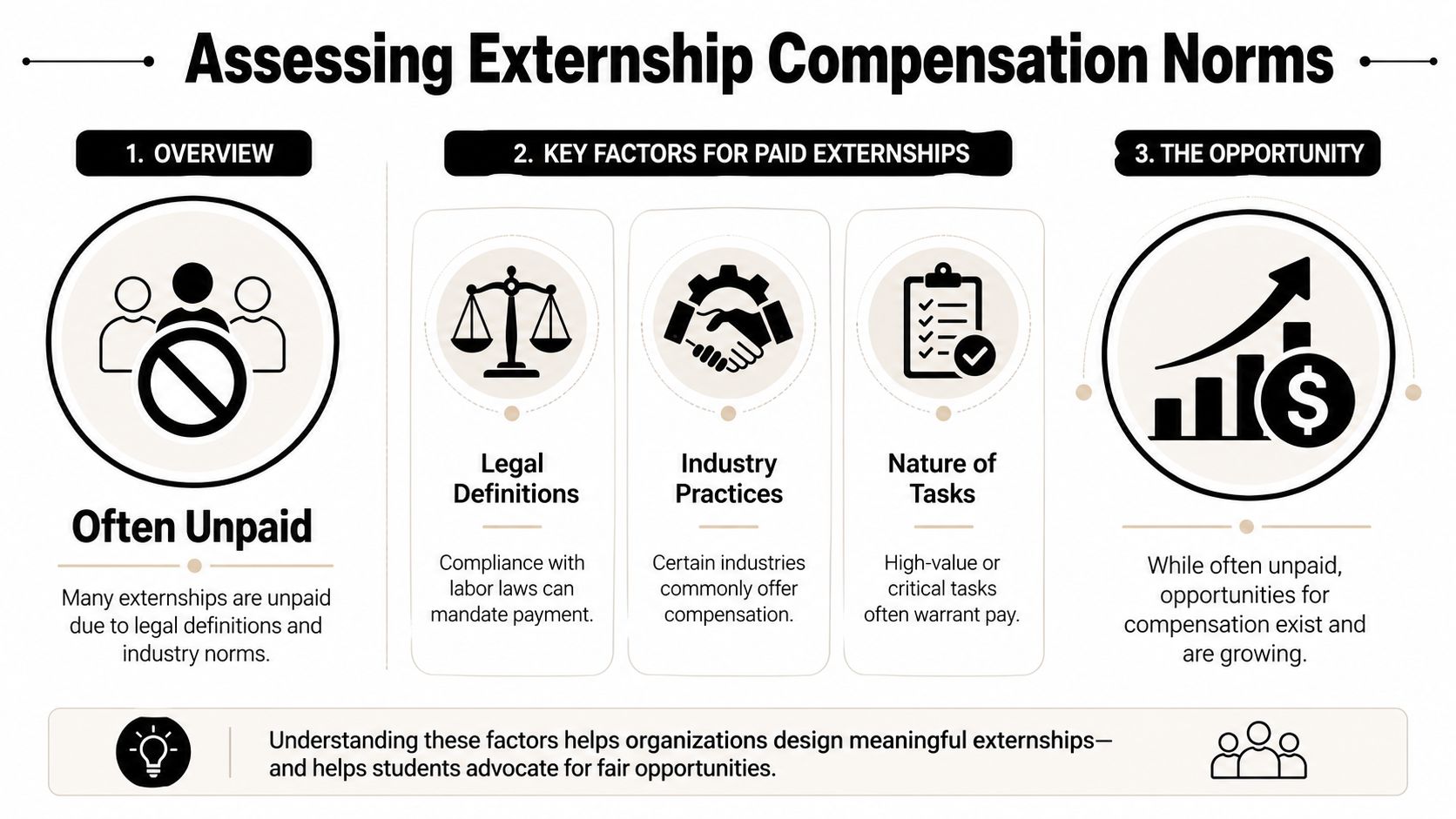
That's the baseline. Don't go into an externship search expecting automatic pay. Go in expecting ambiguity, then force clarity before you accept.
Why most externships don't pay
Most externships sit on the “learning first” side of the line. Employers frame them as observational experiences, universities may connect them to academic requirements, and teams often treat them as a low-risk way to expose candidates to the work without formal employment structure.
That's why compensation, when it exists, often shows up in other forms:
- Expense support for travel, housing, or school-related costs
- Stipends instead of hourly pay
- Program perks such as direct mentorship or access to hiring managers
- Resume value through brand association and network access
Those benefits can matter. But they shouldn't distract you from the key issue. If the company expects output that looks like real labor, you should ask harder questions about pay.
What usually drives payment
Some fields break the unpaid pattern more often than others. Penn Career Services notes a key data gap around paid externships by industry, especially in higher-value sectors such as healthcare, engineering, and technology. That gap matters because broad advice like “most externships are unpaid” can hide meaningful exceptions.
Here's the practical lens I use with candidates:
| Factor | What it means for pay |
|---|---|
| Observation only | Usually unpaid |
| Technical contribution | More likely to justify payment |
| Academic requirement | Often unpaid or lightly subsidized |
| High-demand skill set | Stronger case for stipend or wage |
| Direct path to hiring | More room to negotiate compensation |
If you're in the UK or working across borders, pay structure gets even more complicated once tax, payroll, and contractor status enter the discussion. For candidates comparing short-term arrangements, this complete guide for UK contractors is useful because it helps you understand how temporary work can be structured beyond a simple salary.
What to ask before you apply
Don't wait until the final interview. Ask early.
- “Is this observational or contribution-based?” That tells you whether they expect labor.
- “Is there a stipend, reimbursement, or token component?” Companies often leave this out unless you ask.
- “How do past externs convert into paid roles?” That gets to hiring intent.
- “What does success look like by the end of the program?” If the answer includes deliverables, your bargaining power increases.
If you're reviewing active early-career listings, a role like this Web3 internship opportunity can help you compare how employers describe responsibilities, expectations, and growth paths. Read postings like a recruiter would. The wording tells you a lot.
If the company says “externship” but expects code, research, design, or operations output, treat compensation as negotiable from the start.
Examining Web3 Externship Pay Models
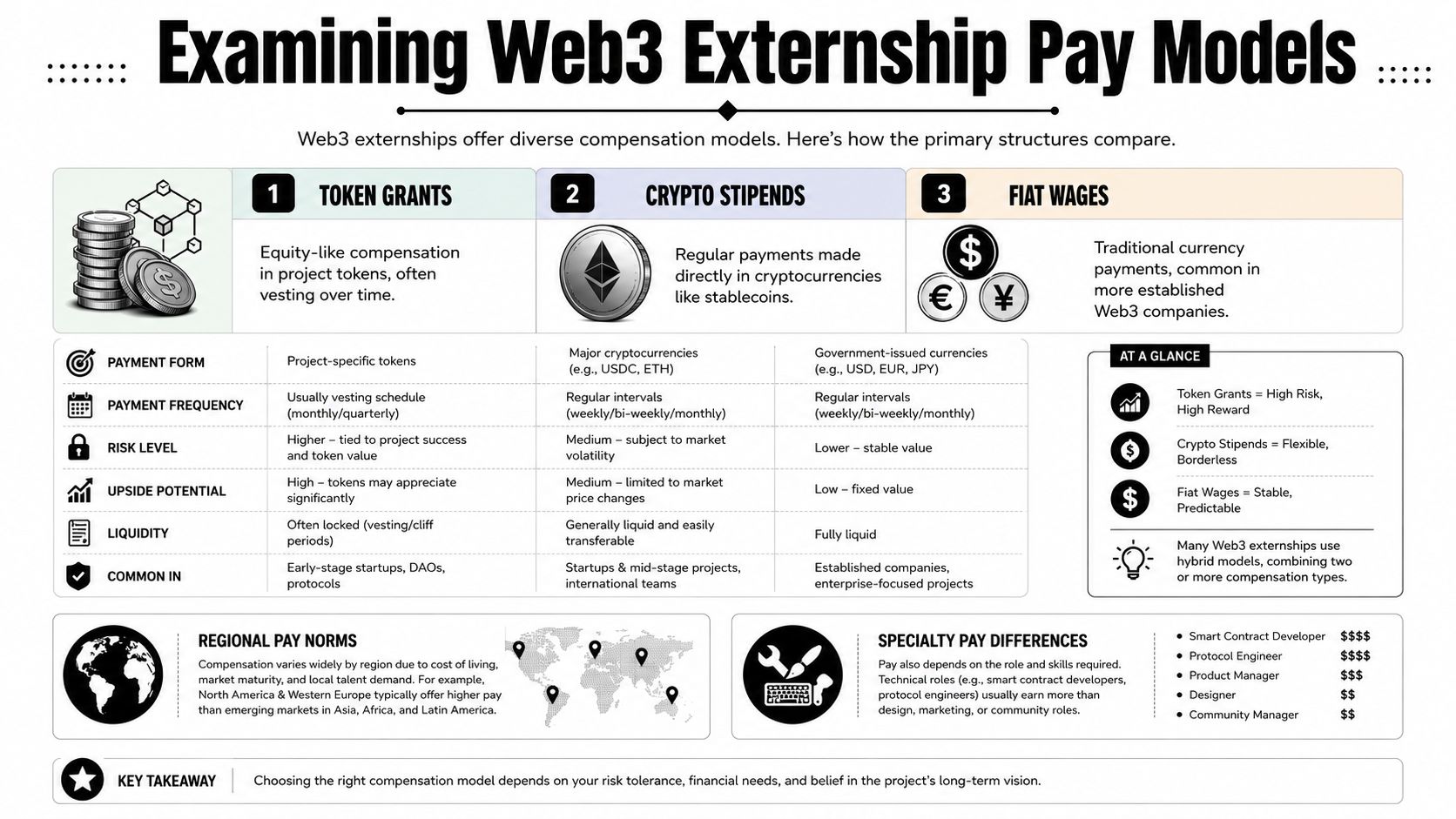
Web3 doesn't follow one clean compensation model. That's why candidates get confused. You might see one team offering fiat wages, another paying in stablecoins, and another floating token grants that sound exciting but aren't liquid, guaranteed, or easy to value.
In the United States blockchain sector, paid internships command a median hourly wage of $16.47, with most roles clustering between $14.42 and $19.23 per hour as of May 2026, based on ZipRecruiter's blockchain intern pay data. That gives you a floor for many technical and adjacent roles, even if an employer insists on calling the position an externship.
Three pay models you'll actually see
Fiat wages
This is the cleanest option. You get paid in local currency, on a normal payroll or contractor schedule. Established firms tend to prefer this because it's easier to administer and easier for candidates to evaluate.
Best for: candidates who want predictability, legal clarity, and easier salary comparisons.
Crypto stipends
Some teams pay regular amounts in crypto, often because they operate globally or have payment constraints. This can work well if the amount is clearly defined and the payout schedule is written down.
Best for: remote-first candidates comfortable with wallets, volatility, and cross-border setups.
Token grants
This often leads to disappointment. Token compensation can be valuable, but only if the token has real utility, a credible distribution plan, and terms you understand. If they can't explain vesting, transfer restrictions, or what the grant represents, it's not serious compensation. It's speculation.
Best for: candidates joining projects early who understand protocol risk and are willing to trade certainty for upside.
Regional and role differences
Global teams often structure pay around local constraints. Nethermind's internship program explains that it pays either the local national minimum wage or a fixed $6.25/hour floor, using crypto in countries where direct fiat payment is difficult. That's one of the clearest real-world examples of how decentralized teams adapt compensation to legal and operational reality.
Role type also changes the conversation. Security, smart contract development, protocol research, and infrastructure work usually justify stronger pay discussions than purely observational community or content roles. If you want a benchmark for what “technical enough to command pay” looks like, this security research internship at CertiK is the kind of listing worth studying.
Ask one blunt question: “Is this compensation designed to pay me now, or to maybe reward me later?” Those are not the same thing.
Negotiating Your Externship Compensation
Most candidates negotiate too late and too softly. They wait for an offer, then ask, “Is there any chance this could be paid?” That's weak. It frames compensation as a favor.
Frame it as a hiring decision instead. If the team wants meaningful work, they should define meaningful compensation.
A useful benchmark exists. Blockchain internships in the United States show a concrete hourly rate of $28.70 as of June 15, 2026, with most workers earning between $20.43 and $36.54 per hour based on experience, location, and employer, according to ZipRecruiter's blockchain internship pay data. You don't need to demand that exact number in every externship interview. You do need to use it to show that early-career blockchain work has market value.
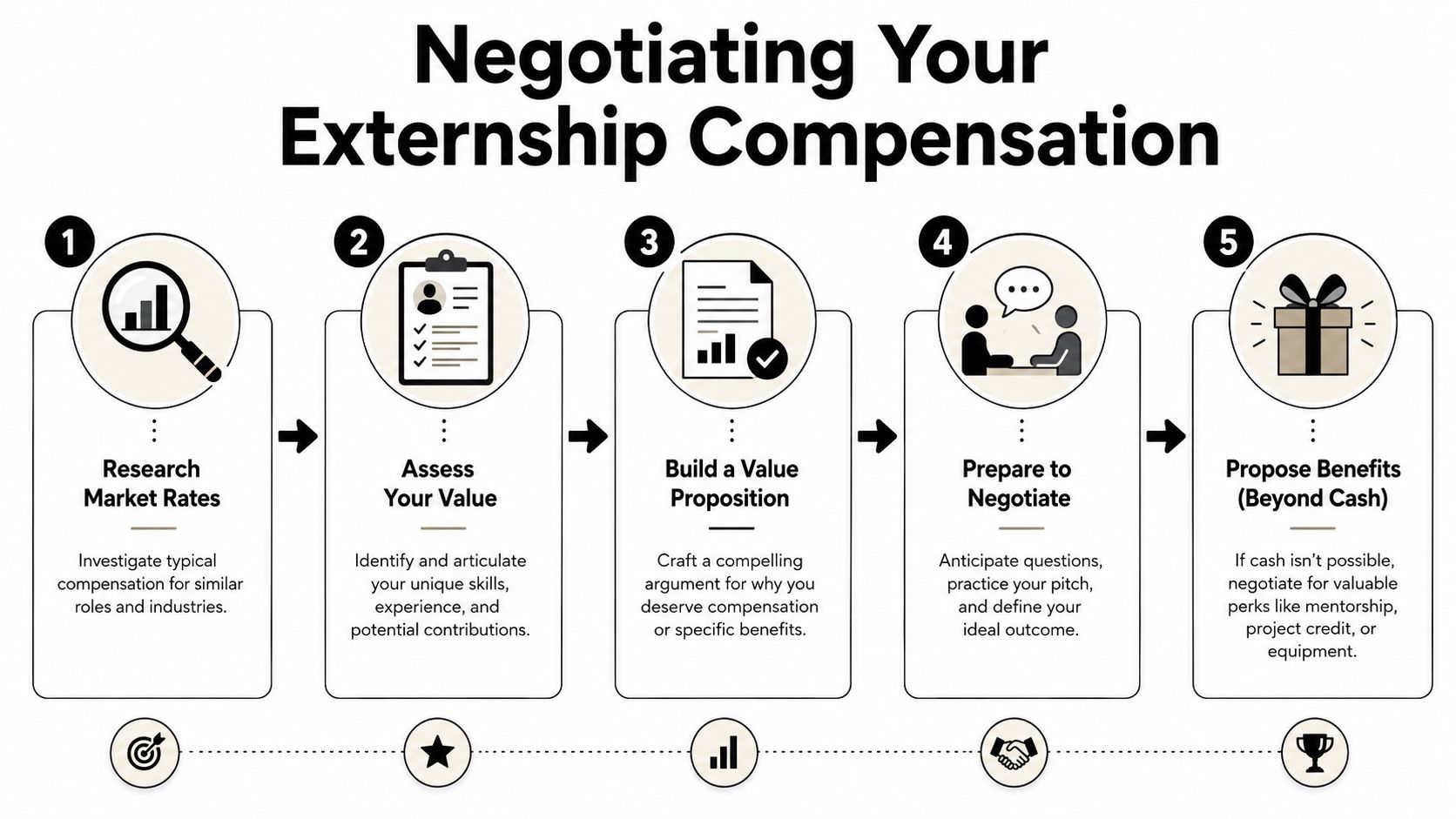
Use this five-part negotiation script
1. Anchor to the work, not the title
If they say “externship,” don't argue about labels. Ask about tasks.
- Will you write or review code?
- Will you produce research memos?
- Will you support product, design, or growth work?
- Will your output be used by the team?
If the answer is yes, your compensation ask becomes much easier.
2. Show your relevance fast
Your advantage comes from specificity. Mention the things that save them time or reduce risk.
Examples that matter in Web3:
- Solidity familiarity
- TypeScript or backend tooling
- smart contract testing
- vulnerability detection
- governance research
- tokenomics analysis
- community moderation in crypto-native channels
- product documentation for complex protocols
Don't say you're “passionate about blockchain.” Everybody says that. Say what you can do.
Offer packages, not just one ask
If a team can't support a normal wage, give them options.
- Hourly or fixed stipend if you'll be producing work regularly
- Expense reimbursement if the role includes travel, hardware, or coursework support
- Token component plus cash floor if they're a startup with limited fiat budget
- Formal conversion review at a defined point if they insist on a lower-paid trial structure
Candidates often gain an advantage. Employers often can't move on one item, but they can move on structure.
Here's a useful primer before that conversation:
What to say in the interview
Use plain language.
“If this role is primarily observational, I'm open to discussing it differently. If I'm contributing to research, code, or execution, I'd like to structure compensation in a way that reflects that.”
That sentence works because it's professional and hard to dismiss.
Tie compensation to conversion
This is the part candidates miss. Your best negotiation point may not be the initial pay. It may be the path to the full-time offer.
Ask:
- What milestones would make you comfortable converting this role?
- Who evaluates the extern?
- What deliverables matter most?
- When would a conversion discussion happen?
If they can't answer those questions, the externship may be labor without a hiring plan. That's not career progression. That's drift.
Exploring Alternatives to Direct Payment
Not every externship will pay hourly wages, and that doesn't automatically make it a bad opportunity. It does mean you need to evaluate the full package with discipline.
One problem is that the market doesn't give candidates clean industry-by-industry data. Penn Career Services highlights that paid externship distinctions by sector are poorly quantified. So you can't rely on generic expectations. You need to inspect the offer itself.
What counts as meaningful non-wage compensation
Some alternatives are useful. Some are fluff.
Worth considering
- Academic credit if it helps you graduate or gain recruiting access
- Housing or travel reimbursement if the role would otherwise cost you money
- Equipment support if you need a secure device, design software, or setup for remote work
- Token grants if terms are clear and you understand the risk
- Direct mentorship and hiring access if you'll regularly work with decision-makers
Usually overrated
- “Exposure”
- “Community access”
- “Potential upside” with no terms
- vague promises of future employment
- certificates that don't connect to hiring managers
How to evaluate token or stipend offers
Use a simple filter.
| Offer type | Good sign | Red flag |
|---|---|---|
| Stipend | Defined amount and timing | “We'll figure it out later” |
| Reimbursement | Written categories and approval process | Open-ended verbal promise |
| Token grant | Clear vesting and ownership terms | No explanation of unlocks or restrictions |
| Equity-like package | Documented rights and conversion terms | Hand-wavy founder language |
Don't accept non-cash compensation unless the team can explain it in plain English.
There's also a legal side. The distinction between shadowing and productive work matters. If you're contributing actual code, designs, research, or operations output, the compensation conversation gets more serious. And if payment is in crypto or tokens, you need to understand how the company handles documentation, reporting, and timing. If they dodge every operational question, assume they haven't built a real program.
Locating Paid Externship Opportunities in Web3
If you want a paid externship in crypto, don't search like a generalist. Search like a candidate who understands how Web3 teams hire. Many won't even use the word “externship.” They'll post “intern,” “fellow,” “apprentice,” “research assistant,” or “ecosystem contributor.”
In the Web3 and blockchain sector, the majority of internships, and by extension many structured externships, are paid, with compensation varying by employer size and role. Established firms such as Chainlink Labs and Algorand Foundation offer paid roles with benefits including 401-K and equity, while smaller startups may offer unpaid opportunities, according to Blockchain Council's overview of blockchain internships.

Search smarter with role-language filters
Use combinations that match how teams post openings:
- “blockchain intern” + remote
- “security research intern”
- “protocol research internship”
- “Web3 product intern”
- “crypto marketing internship”
- “governance analyst intern”
- “ecosystem intern”
- “Solidity intern”
Then add filters around compensation clues:
- stipend
- paid
- contractor
- token
- equity
- remote
Look where hiring intent is visible
You want listings that show one of three things:
- concrete responsibilities,
- a real team behind the role,
- a believable path into long-term work.
A live listing like this Polymarket summer internship opening is a good model to study because it shows how serious teams frame early-career roles around actual business needs.
Use communities to verify the offer
Don't trust a listing on title alone. Verify it through people.
Try this workflow:
- Join the project's Discord or Telegram. See how the team speaks about contributors.
- Check GitHub activity. Active repos often signal real work, not cosmetic hiring.
- Review team pages and leadership profiles. You want evidence of operators, not anonymous promises.
- Message alumni or current interns. Ask what work they performed and whether pay was clear.
The best paid externship opportunities usually look like hiring funnels in disguise. The team wants to test talent before making a bigger commitment.
If you're serious about getting paid and getting hired, prioritize teams with mature operations. They usually have better-defined scopes, cleaner compensation discussions, and stronger odds of conversion.
Advancing Your Career After an Externship
An externship only pays off if you convert it into stronger positioning. Don't leave with a generic line on your resume and nothing else. Leave with proof.
Turn the experience into interview material. Document what you observed, what you contributed, what problems you understood, and how the team made decisions. If you handled technical work, save sanitized examples of your process. If you didn't ship output, focus on what you learned about protocol operations, security review, user research, or product prioritization.
Ask for three things before the program ends:
- a referral,
- a concrete LinkedIn recommendation or written endorsement,
- a conversion conversation.
This matters across adjacent financial sectors too. If you're comparing crypto career paths with other markets, this ultimate guide to forex professionals is useful because it shows how specialized finance talent often turns early practical experience into clearer job positioning.
My opinion is simple. Treat every externship like an audition for a full-time role. If you show judgment, speed, communication, and technical depth, hiring managers stop seeing you as a student. They start seeing you as a lower-risk hire.
If you want to turn short-term Web3 experience into a real job pipeline, explore current roles on Blockchain Jobs. It's one of the fastest ways to find crypto-native openings across engineering, product, security, marketing, legal, and operations, including early-career opportunities that can lead to full-time offers.