
How to Become a Cryptographer: A Web3 Career Guide

You've probably hit this point already. You can build smart contracts, reason about protocol design, and maybe even ship backend Rust or Go, but once the conversation turns to elliptic curves, zero-knowledge proving systems, threshold signatures, or MPC trade-offs, the room gets smaller fast.
That's where a lot of strong engineers stall. They assume cryptography is reserved for PhDs proving new theorems on whiteboards. In hiring, that assumption filters out good candidates long before the interview starts.
The practical reality is different. Web3 teams don't only need people who invent primitives. They need engineers who can implement cryptographic systems safely, audit how those systems fail in production, and make sane trade-offs under real constraints like gas, latency, developer ergonomics, and adversarial behavior. That's the Applied Cryptographer path. It's a serious path, and for many candidates, it's the one that gets them hired.
Beyond Theory Your Roadmap to a Cryptography Career in Web3
A hiring manager drops a take-home in your inbox. Review a wallet architecture that uses threshold signing, explain the trust assumptions, and point out where implementation risk is higher than the cryptography itself. Plenty of strong engineers can read the code. Far fewer can explain whether the system is safe.
That gap has hiring value. The U.S. Bureau of Labor Statistics, as summarized by Cryptomathic's overview of blockchain technology and cryptography, projects strong growth for blockchain-related work, and that demand exists because real blockchain systems depend on signatures, hashing, key management, and protocol design working under attack.
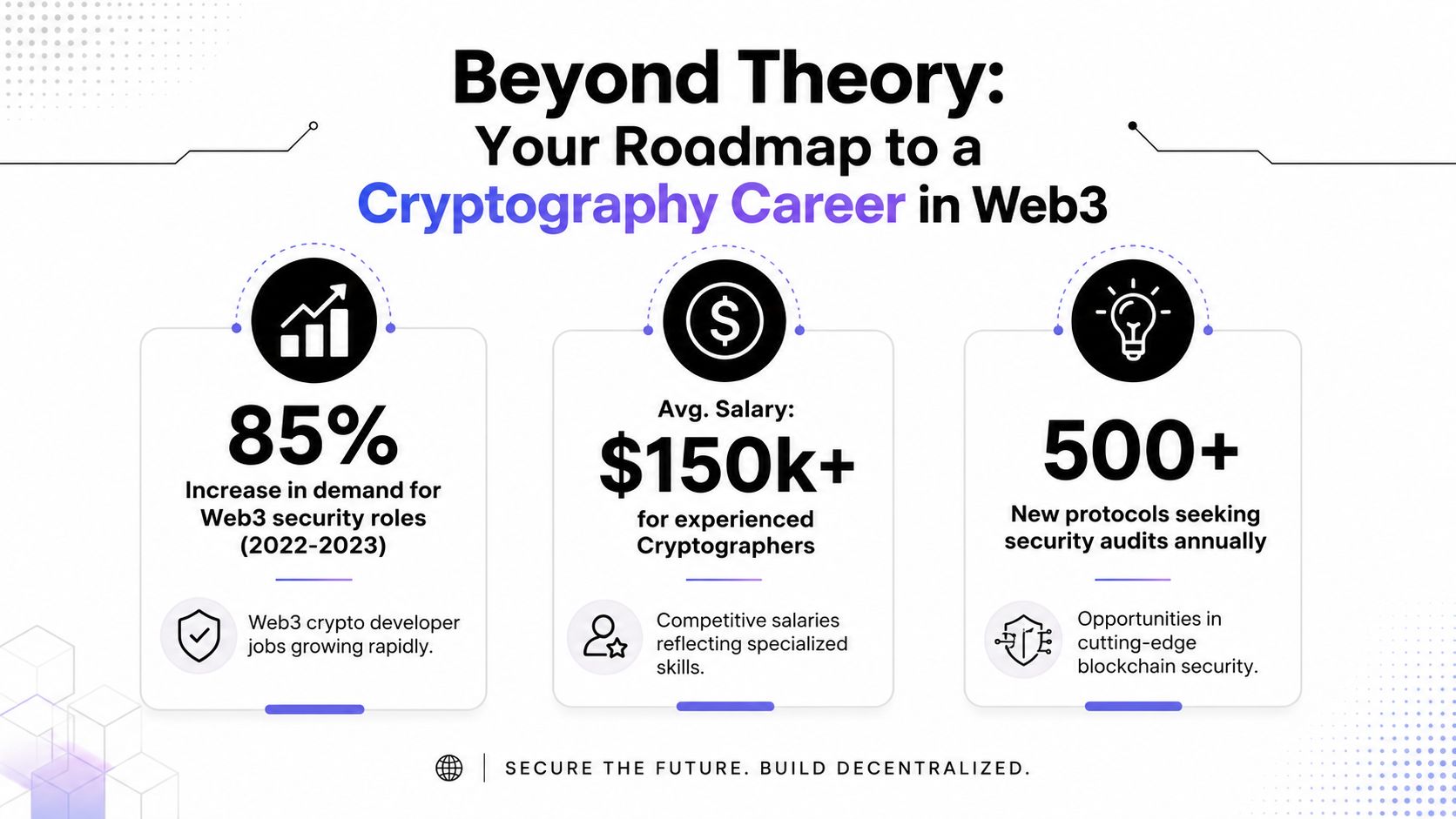
The part many career guides miss is the split between research cryptography and applied cryptography. Web3 hires for both, but the larger practical market is on the applied side. Teams need people who can review protocol assumptions, integrate existing primitives without introducing side-channel or key-handling mistakes, and catch failures before they hit mainnet.
I hire for that skill set regularly. I care less about whether a candidate has written a novel proof and more about whether they can look at a signing flow, identify the core trust boundary, and tell me what breaks if one participant goes offline, lies, or leaks entropy.
That is why the Applied Cryptographer path matters for engineers without a PhD. It maps to actual work:
- Reviewing cryptographic implementations for misuse of audited libraries and unsafe custom changes
- Shipping production code in Rust, Go, or Solidity that handles keys, proofs, and signatures correctly
- Assessing protocol composition risk where sound building blocks become unsafe once combined
- Translating cryptographic trade-offs into decisions that product, protocol, and security teams can act on
The market reflects that split. Roles asking for MPC, OpenSSL, SGX, or blockchain node security are often hiring for engineers who can apply cryptography in production, not academic researchers. A posting for a security engineer working on OpenSSL, MPC, blockchain, node APIs, and Intel SGX is a good example of where this path leads.
Security leadership sees the same pattern. The essential guide for software leaders frames security engineering as a discipline built around implementation, systems thinking, and risk reduction. Cryptography hiring in Web3 follows that same logic.
Strong candidates do not wait until they feel academically finished. They build enough theory to reason clearly, then prove they can use it on real systems where latency, gas cost, operational complexity, and adversarial pressure all matter at once.
Mastering the Cryptographers Foundation
A candidate gets through the first screen, says they want to work in cryptography, then falls apart on basic questions about nonce reuse, curve assumptions, or side effects in signing code. I see that pattern more than lack of raw intelligence. Applied cryptography hiring in Web3 filters for people who can connect theory to production behavior.
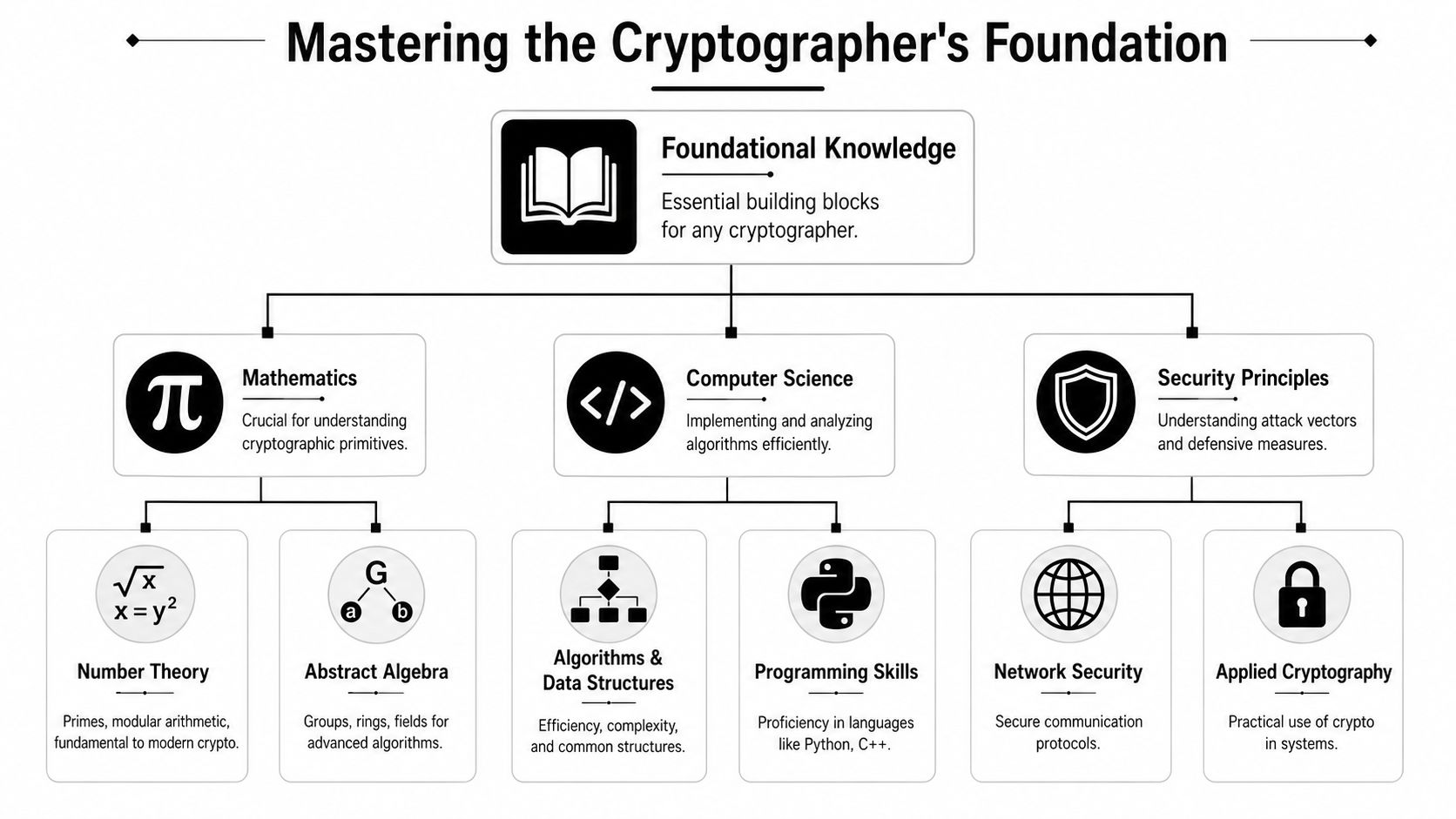
The baseline is simple. You need enough mathematics, computer science, and security depth to explain why a scheme works, what assumptions it depends on, and how an implementation can still fail even when the primitive is sound. For many employers, a bachelor's degree in computer science, mathematics, or a related field is the standard starting point, and advanced degrees are more common in research-oriented roles than implementation-heavy ones. That distinction matters because this guide is about the applied path, where proof of judgment and engineering skill carries more weight than academic pedigree alone.
Learn the math that shows up in real systems
Learn the math you will use in reviews, protocol discussions, and implementation work.
- Number theory shows up in modular arithmetic, finite fields, and discrete log assumptions. In Web3 work, that means understanding why signature schemes, commitments, and proving systems behave the way they do.
- Abstract algebra explains groups, rings, and fields well enough to reason about elliptic curves, pairings, and scheme composition without hand-waving.
- Probability matters for randomness, adversarial advantage, soundness errors, and failure modes around nonce generation or biased sampling.
- Computational complexity matters because production systems have limits. A construction can be secure on paper and still be unusable once proving time, verifier cost, latency, hardware constraints, or gas enter the equation.
I do not expect every applied candidate to write proofs. I do expect them to catch when a design implicitly assumes a trusted setup, strong entropy, honest majority behavior, or a threat model the product team does not have.
Write code the way cryptography demands
Applied cryptographers get hired on code quality as much as conceptual clarity.
For Web3, Rust and Go show up constantly in clients, proving infrastructure, and services around key management, validators, and signers. Python is still valuable for prototyping attacks, testing assumptions, and building analysis tools. C or C++ matters when you work close to performance-critical libraries or inherited cryptographic code.
Here is the standard I use in interviews:
| Foundation area | What it means in hiring | Web3 example |
|---|---|---|
| Rust or C++ | You can reason about memory, unsafe behavior, performance, and API misuse | Reviewing a proving library, signature module, or MPC implementation |
| Python | You can test ideas quickly and write useful tooling | Building scripts to check transcript consistency, edge cases, or malformed inputs |
| Go | You can ship production services and work comfortably with distributed systems | Implementing signer services, validator workflows, or key-handling infrastructure |
The trade-off is real. Candidates who study only theory struggle to ship safe software. Candidates who only code often miss the assumptions that make a scheme secure in the first place.
If your security base still needs work, read this essential guide for software leaders. It explains the broader engineering context cryptography sits inside, which matters because hiring managers rarely want a narrow specialist who cannot reason about system risk.
A live security engineer role covering OpenSSL, MPC, blockchain nodes, APIs, and Intel SGX shows the mix clearly. Employers are often looking for someone who can move between cryptographic primitives, implementation details, and systems constraints without losing the thread.
Build security instincts, not just subject knowledge
The strongest applied candidates ask better questions than everyone else.
They ask what assumptions a primitive relies on, where randomness comes from, how malicious participants change the threat model, what breaks under partial compromise, and which failures come from code rather than mathematics. They also know when not to use custom cryptography, when a standard library is safer than a clever optimization, and when operational simplicity beats a more elegant design.
That is the foundation that gets people hired for Web3 cryptography work. Not perfect academic coverage. Clear reasoning, careful implementation, and the judgment to spot where real systems fail.
The Degree Debate Academic vs Applied Pathways
The question comes up in almost every serious conversation about how to become a cryptographer. Do you need a PhD?
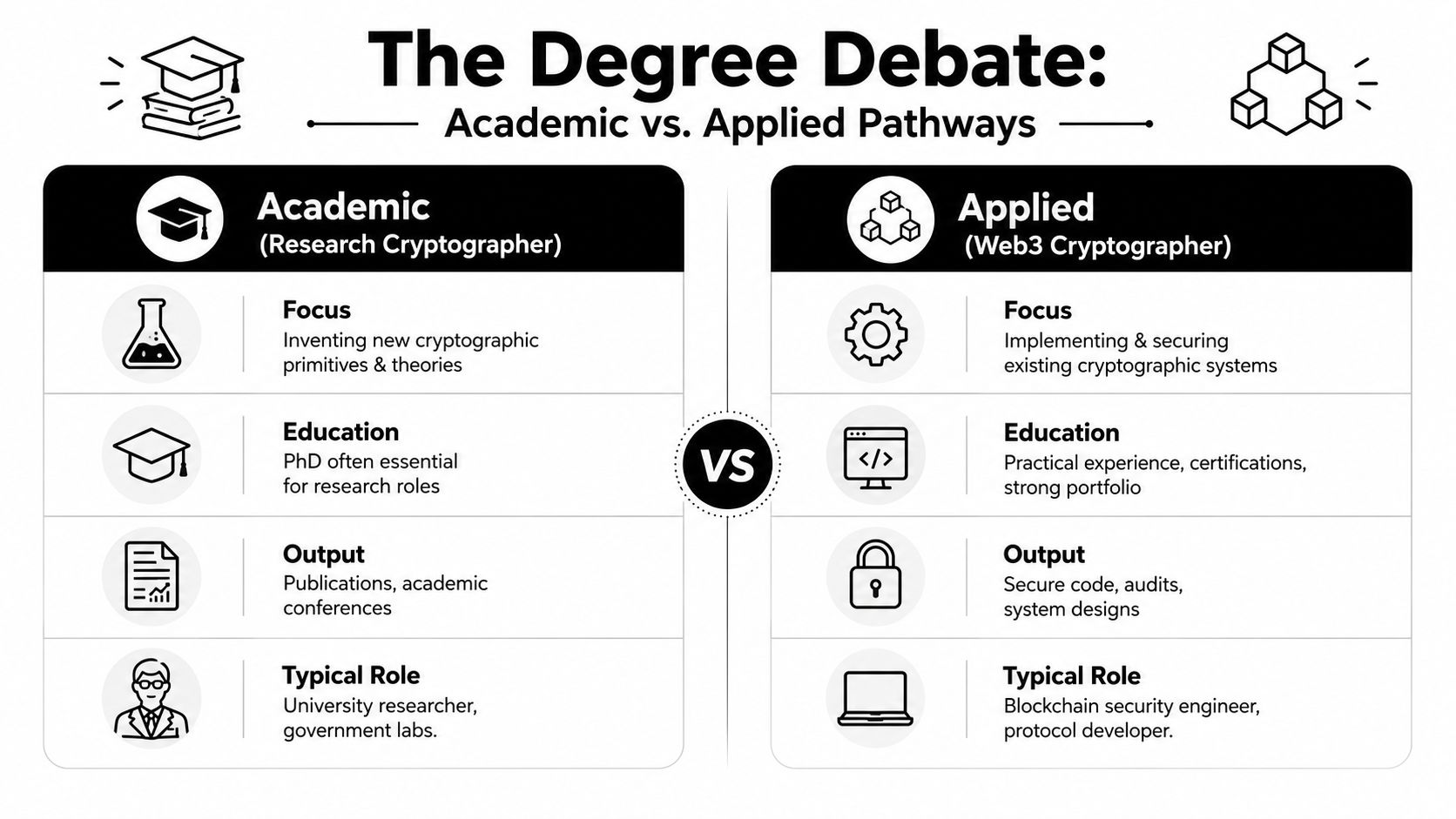
If you want to invent new primitives, publish original research, or work in highly theoretical R&D, advanced academic training is still the cleanest route. That part hasn't changed. What has changed is the growth of teams that need people to apply cryptography, not just create it.
Two paths with different hiring filters
The cleanest way to think about it is this:
| Path | What employers want most | What you produce |
|---|---|---|
| Research cryptographer | Advanced degrees, publication-level depth, original theory work | New constructions, formal analysis, research output |
| Applied cryptographer | Strong engineering, secure implementation, protocol judgment | Production code, audits, design reviews, safe integrations |
According to CyberDegrees on becoming a cryptographer, most cryptography positions require at least five years of professional experience in information security, but there's also an emerging 2024 to 2025 trend where blockchain protocols hire Applied Cryptographers with bachelor's degrees who can implement ZK-SNARKs or lattice-based cryptography in Rust or Solidity.
That trend matters because Web3 security teams often hire for implementation pressure. They need people who can move from cryptographic paper to safe system behavior. That's very different from hiring someone to develop a new hardness assumption.
What the applied path is and isn't
The applied path isn't a shortcut for people who couldn't handle theory. It's a separate specialization with its own failure modes.
An applied cryptographer in Web3 might:
- Audit protocol use of commitments, signatures, or proving systems
- Review how keys are generated, stored, rotated, and combined
- Implement proof verification or threshold signing in production code
- Catch dangerous composition errors between smart contracts and off-chain systems
A research cryptographer might spend that same time proving properties, improving constructions, or working on novel cryptographic systems.
Teams shipping code care whether you can prevent misuse of a sound primitive under production pressure.
For candidates deciding whether formal education should stay central, program choices like a BCA specializing in AI and cyber security can help build a structured technical base. But for the applied path, that structure only pays off if it leads to real implementation skill.
What hiring managers actually trade off
A candidate with a doctorate but weak coding habits can be risky for an applied role. A candidate with strong systems experience, disciplined Rust code, and a credible cryptography portfolio can be far more useful from day one.
That doesn't make the degree irrelevant. It changes its weight.
If I'm hiring for protocol research, I care a lot about formal depth. If I'm hiring for applied Web3 security, I care whether you can take a known primitive, use the right library, preserve its guarantees, and explain the edge cases without hand-waving. That's a different bar, and it's reachable without following the traditional academic script all the way to the end.
Building a Portfolio That Gets You Hired
Most portfolios fail because they look like schoolwork. A hiring manager doesn't need proof that you watched lectures. They need proof that you can move from concept to safe implementation.
The strongest route I've seen is simple and strict. Master prerequisites in C++, Rust, or Go. Solve CryptoPals. Operationalize libsodium. Then implement a full protocol using existing primitives, as outlined in this practical learning path for cryptography.

Stage one means language fluency, not syntax familiarity
If you pick Rust, I expect ownership discipline, error handling, and careful interface design. If you pick C++, I expect attention to memory safety boundaries and dependency hygiene. If you pick Go, I expect clean concurrent code and sane API handling.
Don't build your first portfolio item around original cryptographic design. That's where candidates start inventing danger.
Start by proving you can:
- Read mature codebases without getting lost
- Write tests around edge cases
- Explain serialization, randomness, key lifecycle, and failure handling
- Use established libraries instead of improvising
A polished GitHub profile helps, but presentation matters too. If you need help packaging technical work into something employers can scan fast, these professional portfolio strategies are worth borrowing for structure and clarity.
Stage two is CryptoPals for technical judgment
CryptoPals is valuable because it builds intuition through failure. It forces you to manipulate bytes, reason about modes, and stop treating cryptography like a black box.
What a hiring manager learns when you've done this well:
- You have grit. You can stay with hard material instead of collecting buzzwords.
- You understand attack surfaces. You've seen how small misuse becomes breakage.
- You can explain mechanics. You're not reciting “AES good, ECB bad” without understanding why.
Don't just say you completed challenges. Publish concise writeups. Show your assumptions, false starts, and final reasoning.
A candidate who can explain why their first approach failed is usually stronger than one who only presents a clean final answer.
Stage three is where libsodium separates serious candidates
This is the point where a lot of people stop being theoretical and start being employable.
Using libsodium well tells me you understand primitive selection, inputs and outputs, authenticated encryption expectations, key handling, and API boundaries. It also tells me you're willing to work with reviewed components instead of writing fragile custom crypto.
Useful portfolio ideas here include:
- A secure messaging prototype using authenticated encryption and explicit nonce handling
- A signing service demo that separates key material from the application layer
- A small CLI tool that encrypts and signs structured data with clear threat-model documentation
For candidates aiming specifically at protocol security, openings like this blockchain security researcher role at OpenZeppelin map closely to the kind of portfolio depth that gets attention.
Stage four is protocol implementation
This is the project that makes interview loops easier because it gives everyone something concrete to ask about.
Build a full protocol using existing primitives. A simplified TLS-style handshake is a strong option. A threshold-signing workflow, secure transcript exchange, or a minimal proving-verification pipeline can also work if you keep the scope realistic.
Add these artifacts:
- Architecture notes that state what you reused and why
- Threat model notes that identify trust assumptions and obvious attacks
- Test coverage for invalid inputs, replay attempts, malformed messages, and key mismatch cases
- A short postmortem on what you would change in a second version
This video is a useful companion while you're thinking about the practical learning curve and how to frame your progression.
What to avoid in a cryptography portfolio
The wrong project can hurt you.
- Custom primitives usually signal poor judgment unless you're explicitly doing research
- Buzzword repos with no tests or threat model look cosmetic
- Massive unfinished codebases hide your actual understanding
- Copied implementations without commentary tell me nothing about how you think
The best portfolio isn't the largest one. It's the one that proves you can handle cryptographic software with restraint.
From Portfolio to Paycheck Securing Your Cryptographer Role
By the time you interview, your portfolio has already become your strongest signal. The interview just reveals whether the work is yours and whether you understand the decisions inside it.
That's why hands-on projects matter more than polished self-description. A candidate who built a real protocol component can answer follow-up questions at depth. A candidate who assembled a resume around concepts usually collapses once the discussion turns concrete.
According to NetGuardia's cryptographer career guide, entry-level cryptographer salaries in the USA range from $80,000 to $100,000, senior experts earn $150,000 to $180,000, the median annual salary was about $115,200 as of late 2023, and top earners reach $195,000+. Those numbers reflect the premium on scarce, defensible skill.
Present projects like engineering evidence
Your resume shouldn't say “studied zero knowledge” or “interested in applied cryptography.” It should point to concrete work.
A better format looks like this:
- Implemented a protocol component using established primitives in Rust
- Documented threat assumptions, failure cases, and test coverage
- Audited library usage choices and explained why unsafe alternatives were rejected
- Built reproducible demos that another engineer can run and inspect
That structure works because it gives interviewers threads to pull. It turns your experience into evidence.
Expect interview questions that expose depth quickly
For Web3 security teams, generic coding rounds aren't enough. You'll often get discussion-heavy interviews where the panel wants to understand how you think under adversarial conditions.
Questions I'd expect include:
| Interview question | What the interviewer is checking |
|---|---|
| Why did you use this library instead of another one? | Judgment, dependency awareness, security conservatism |
| What assumptions make your protocol safe? | Threat modeling and conceptual depth |
| Where could nonce, randomness, or serialization bugs break this design? | Implementation realism |
| What would you change if this had to run in production? | Maturity and trade-off awareness |
You may also get live exercises. Not “invent a signature scheme” nonsense. More likely you'll be asked to review pseudocode, spot misuse of a primitive, reason about replay or malleability, or explain why a transcript binding step exists.
Interview performance is usually a mirror of project depth. If you built it, tested it, and debugged it yourself, the answers come naturally.
Web3 hiring rewards public technical credibility
This niche is smaller than general software hiring. People notice repeated names in audits, open-source repos, challenge writeups, and security discussions.
That means a smart job search often includes:
- Open-source contributions to crypto-adjacent tooling, libraries, or protocol infrastructure
- Technical writeups that explain one implementation decision or one failure mode well
- Participation in security communities where your reasoning is visible over time
- Targeted applications to roles that clearly value cryptographic systems work, such as this principal software engineer cryptography role at Anduril Industries
What gets offers and what doesn't
Candidates get offers when they show restraint, precision, and the ability to operate inside real engineering constraints.
They usually get rejected for one of four reasons:
- They know words, not systems.
- They treat cryptography as algorithm trivia instead of secure implementation.
- They can't explain failure cases in their own projects.
- They haven't built anything deep enough to anchor a serious interview.
If your goal is career progression, keep the lens simple. Your next role should increase one of these: system complexity, protocol exposure, audit responsibility, or cryptographic implementation depth. That's how an applied cryptography career compounds.
Your Future in Building Decentralized Trust
The shortest honest answer to how to become a cryptographer is this. Build enough mathematical depth to understand the guarantees, enough engineering discipline to preserve them in code, and enough public proof of work that a hiring team can trust you with production systems.
For Web3, that usually doesn't mean waiting for perfect credentials. It means choosing the applied path deliberately. Learn the foundations. Get strong in Rust, C++, or Go. Work through challenge sets that sharpen your instincts. Use real libraries like libsodium. Build protocol-level projects that survive scrutiny. Then talk about them like an engineer who understands both design and failure.
That combination is rare. It's also exactly why these roles are valuable.
The decentralized stack runs on trust assumptions made concrete through code. Someone has to evaluate those assumptions, implement them safely, and catch the places where elegant theory turns into brittle systems. That's the job.
And if you stick with it, you won't just be learning cryptography. You'll be helping build the security layer that lets decentralized systems deserve trust in the first place.
If you're ready to turn cryptography skills into a real Web3 role, Blockchain Jobs is a strong place to find security, protocol engineering, and applied cryptography openings across the ecosystem. It's especially useful if you want roles close to the work discussed here, including blockchain security, infrastructure, and protocol development positions.