Smart Contract Formal Verification: A Career-Ready Guide

You've reviewed the Solidity code, run the tests, fixed the obvious access-control issue, and booked an audit. Then an interviewer asks a deceptively simple question: “What exactly have you proved?” Many developers can describe audit findings and fuzzing campaigns, but struggle to define an invariant, explain a counterexample, or distinguish a failed proof from an incomplete specification. That gap separates familiarity with blockchain security from practical smart contract formal verification.
Formal methods matter because production protocols need more than confidence that common bugs weren't spotted. They need explicit statements about how balances, permissions, state transitions, and economic rules must behave, followed by tooling that reasons about those statements systematically. For engineers, that discipline is also a career signal. Hiring teams can teach a tool, but they'll look for people who can translate protocol risk into properties that a machine can check.
Why Formal Verification Matters Beyond Standard Audits
A developer finishes a lending contract and sends it to an audit firm. The auditors review the access-control paths, inspect external calls, test unusual repayment sequences, and report issues. The team fixes the findings and feels ready to deploy. That process is valuable, but it still depends on which paths reviewers think to inspect and which assumptions they make about the protocol's intended behavior.
A traditional audit asks, “Can we find a flaw in this implementation?” Formal verification asks, “Does this implementation satisfy this precisely defined property across the modeled behaviors?” The distinction matters for invariants such as a user not withdrawing more than their recorded balance, privileged functions remaining restricted, or a conservation relationship holding after every relevant state transition. A proof doesn't establish that the whole protocol is secure. It establishes the properties that the team specified and modeled.
The practical gap is specification quality. An overview of formal verification research for smart contracts describes the movement from translating Solidity programs into F* toward executable verification pipelines and Ethereum-focused verification milestones in the period from 2016 to 2018. That progression helped move formal verification from theoretical correctness arguments toward tooling that could reason about safety properties in Ethereum-era contracts.

What audits still do better
Audits provide human judgment around architecture, integrations, deployment assumptions, documentation, and threat models. They can identify a dangerous design choice even when nobody has written a formal property for it. They're also useful for reviewing off-chain components and operational controls that may sit outside the verification model.
Formal verification is narrower but deeper. It can produce a counterexample that shows the exact sequence violating a property, or establish that the modeled contract satisfies that property under the stated assumptions. The result depends on the boundaries. If the team proves an access-control rule but omits an upgrade administrator, the proof can be correct while the system remains exposed.
Practical rule: Never describe a verified contract as “secure” without naming the specification, assumptions, code version, and environment covered by the proof.
This is why a strong engineer treats formal verification as a complement to standard blockchain security audits, not as a replacement. In an interview, explain what each technique contributes. Say which properties you'd formalize, which risks require human review, and how a counterexample would change the implementation or specification.
Core Formal Methods You Should Understand
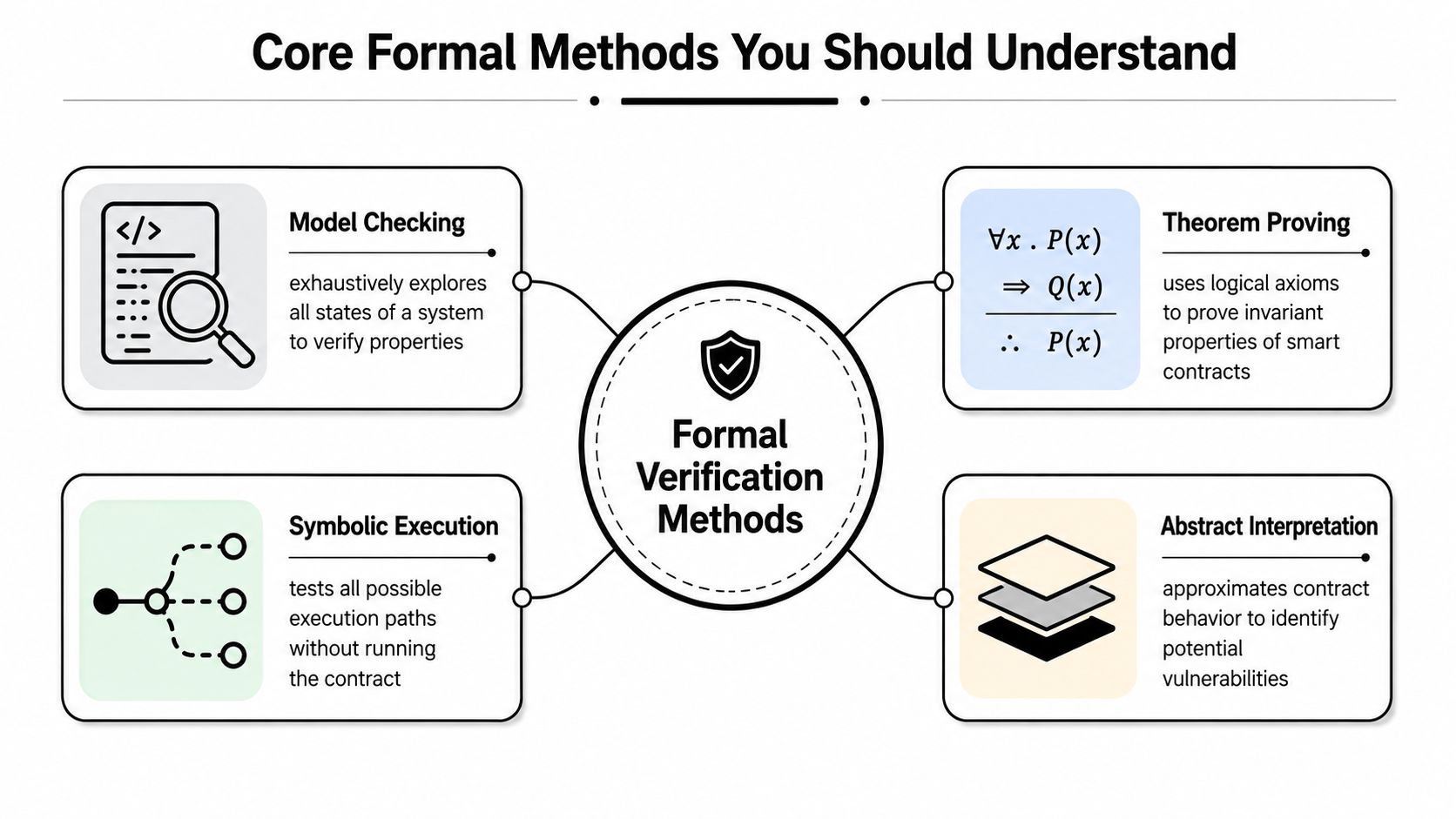
Interviewers rarely expect every candidate to be a theorem-proving researcher. They do expect you to know what a tool is doing. Start by separating the property, the model, and the solver or proof engine. A property states the required behavior. The model represents the program and relevant execution environment. The engine searches for a proof or a violating execution.
Theorem proving
Theorem proving expresses program behavior in a logic and derives a proof from axioms, definitions, and rules. It can handle rich properties, including relationships that span multiple functions or abstract protocol states. The cost is human effort. You may need to guide lemmas, define abstractions, and understand the proof assistant thoroughly.
This approach is a strong fit when the claim is mathematically structured and the protocol semantics need careful control. It's less attractive when a team needs rapid feedback on every small Solidity change and the property can be handled by a more automated method.
Model checking
Model checking explores reachable states of a model and checks whether temporal or invariant properties hold. If it finds a violation, it can often return a counterexample sequence that engineers can reproduce or inspect. The method works well for bounded or finite abstractions, but state explosion can make exhaustive exploration difficult as the model grows.
For interviews, don't say model checking “tests everything” without qualification. It checks everything within the modeled state space, abstraction, bounds, and assumptions.
Symbolic execution
Symbolic execution runs code with symbolic inputs instead of concrete values. One path may represent many possible inputs, and branch conditions divide the analysis into path constraints. This makes it useful for discovering paths that ordinary tests don't reach, though complex branching and inter-contract behavior can make path exploration expensive or incomplete.
SMT-based verification and abstract interpretation
SMT solvers decide logical constraints involving theories such as integers, bitvectors, arrays, and uninterpreted functions. Verification tools often translate contract obligations into solver queries. The solver is not the specification author. It can answer the encoded question, but it can't tell you whether the encoded question captures the protocol's real risk.
Abstract interpretation approximates program behavior using a simpler abstract domain. It can flag possible arithmetic, state, or control-flow problems efficiently, but an approximation may produce warnings that require investigation. Strong candidates explain the trade-off clearly: faster analysis gives useful signals, while deeper proofs require more modeling effort and may face harder automation limits.
Specification Patterns That Prove Real Properties
A proof is only as useful as the property it checks. The production skill is translating a protocol requirement into a statement with a defined truth condition, scope, and failure meaning. The ACM survey on smart contract verification identifies a central adoption problem: the vast majority of smart contracts lack formal specifications. Without machine-checkable requirements, a prover has no meaningful target.
Start with access-control invariants. List privileged roles, the functions each role may call, and the rules governing authority changes. A property could require that only the configured administrator changes a risk parameter. A stronger specification also limits how administrator status can change. In interviews, explain how the model handles initialization, upgrades, role revocation, and calls routed through proxies. Those details show whether you can specify a deployed protocol rather than only a small contract example.
Financial conservation and solvency
Balance properties need explicit accounting boundaries. For a token, relate the sum of recorded balances to total supply while modeling permitted minting and burning. For a lending protocol, separate the relationships among debt, collateral, reserves, interest accrual, and liquidation state. A single “balances are correct” rule usually hides the accounting questions that matter.
Cardano-focused work groups relevant properties into validity, liquidity, and fidelity, as discussed in the FMBC 2025 paper. Treat those categories as prompts, not finished specifications. Define what makes a position valid, how much liquidity must remain available, and whether implementation behavior matches the intended financial model.
Safety and liveness
Safety properties state that an unwanted event never occurs. Examples include unauthorized withdrawals never succeeding, modeled balances never becoming negative, and critical invariants surviving each permitted state transition. Liveness properties state that a desired event eventually occurs, such as a valid withdrawal completing or a governance action progressing under defined conditions.
Liveness requires more environmental modeling. Transaction ordering, external actors, callbacks, available resources, and protocol assumptions all affect the result. A candidate who claims the protocol cannot get stuck should identify the assumptions, the relevant transitions, and the point at which the guarantee stops applying.
A verifier can expose a bad assumption with a counterexample. It cannot repair a vague requirement for you.
Build a property inventory before writing rules:
- Authority: Who can call each sensitive function, and how can that authority change?
- Accounting: Which values must be conserved, bounded, or reconciled?
- State transitions: Which states are reachable, and which transitions must be impossible?
- External behavior: What assumptions apply to tokens, oracles, callbacks, and upgrades?
- Progress: Which valid operations must eventually complete, and what conditions enable progress?
These categories also give candidates a practical interview framework. Show the property, state its assumptions, and explain what a counterexample would mean for the protocol.
Leading Toolchains and Frameworks in Practice
Tool choice follows the proof question, language, chain, and team skill set. Certora is especially relevant for Solidity teams that want to express behavioral rules separately from implementation code and reason about protocol-level properties. The Certora Prover is a concrete career signal because a Certora role description describes proving mathematical properties of financial systems such as Aave and Lido, while also improving the prover itself.
The K Framework is oriented toward executable semantics and deep reasoning about language or virtual-machine behavior. Microsoft's Ethereum verification work also illustrates the value of translating Solidity into a formal setting such as F*. Other ecosystems, including Lean, Coq, ACL2, and Dafny, matter when the role involves proof assistants, language semantics, or high-assurance software beyond a single Solidity workflow.
A useful comparison looks like this:
| Tool | Ecosystem | Proof Style | Learning Curve |
|---|---|---|---|
| Certora Prover | Solidity and protocol verification workflows | Rule-based behavioral verification with automated reasoning | Moderate to advanced |
| K Framework | EVM semantics and language-level verification | Executable semantics and formal reasoning | Advanced |
| F* | Functional programs and high-assurance components | Dependent types and program proofs | Advanced |
| Lean | General theorem proving and formalized mathematics | Interactive theorem proving | Advanced |
| Coq | Proof assistants and verified software | Interactive theorem proving | Advanced |
| SMT-based analyzers | Multiple program-analysis ecosystems | Constraint solving and automated checks | Moderate to advanced |
The 2024 Solidity verification benchmark offers a more disciplined evaluation approach than marketing comparisons. It contains 323 verification tasks, each pairing a contract with a property, manually crafted ground truth, and multiple contract versions designed to test both satisfied and violated properties. The benchmark focuses on completeness, soundness, and expressiveness, which are better questions than asking whether a tool merely returns a passing result.
For career preparation, build depth in one workflow before collecting superficial familiarity with many tools. Candidates targeting smart contract development roles should be able to show a property, the model assumptions, a failing example, and the code change that resolved it.
Integrating Verification Into Development Workflows
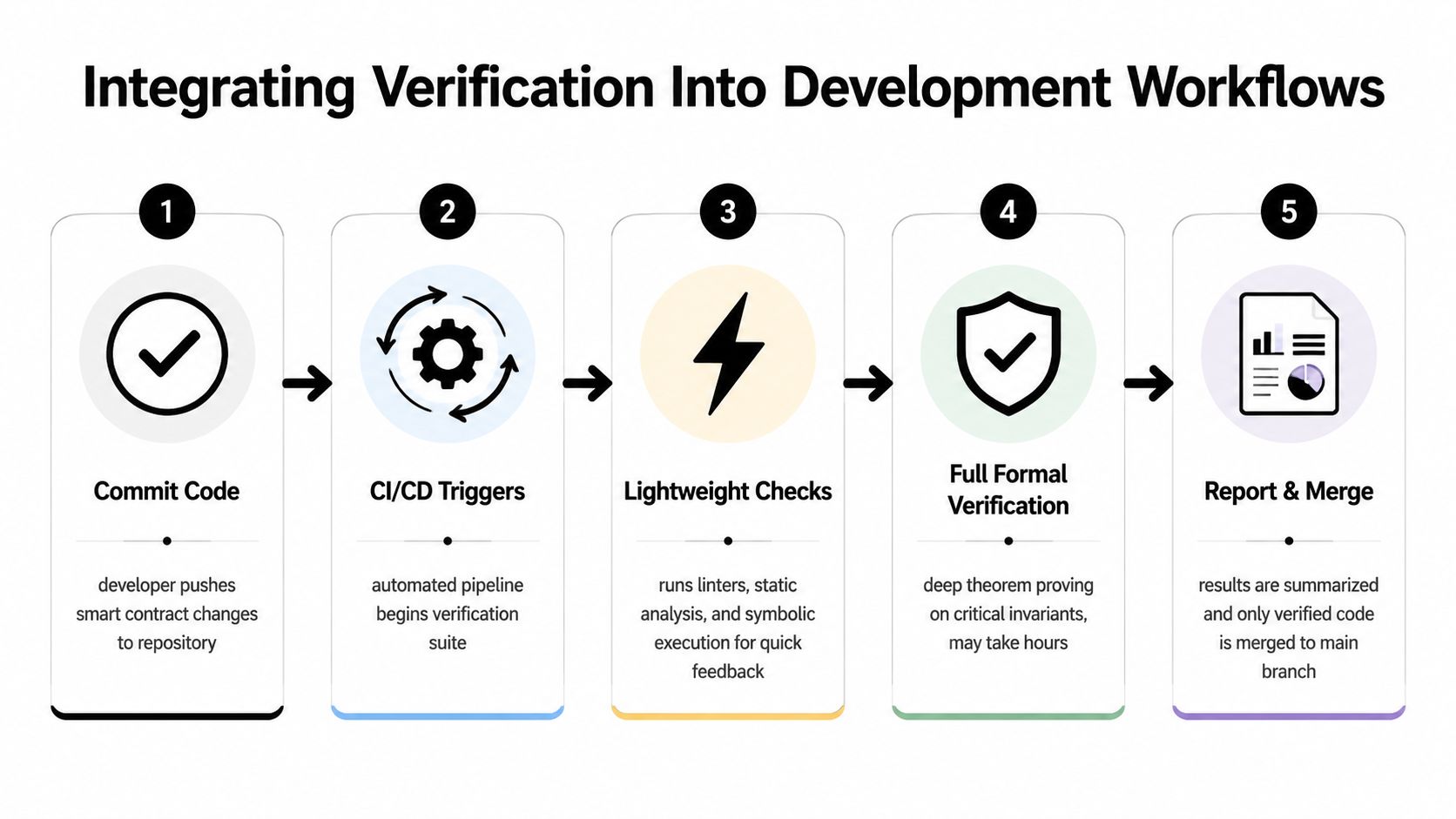
Formal verification fails operationally when teams treat it as a final ceremony. The useful pattern is incremental. Developers run cheap checks on every change, reserve deeper proofs for critical properties, and make failures visible without hiding them behind a manual process.
A practical pipeline
- Commit code and identify changed obligations. A change to transfer logic may affect accounting and authorization rules. A change to an upgrade path may require a different property set.
- Run lightweight checks first. Linters, static analysis, unit tests, and symbolic execution provide rapid feedback. They won't replace proofs, but they catch basic regressions before expensive analysis starts.
- Execute focused verification. Run rules tied to the changed functions and their dependent invariants. Keep assumptions explicit, especially for external calls, token behavior, oracle values, and upgrade boundaries.
- Run deeper proofs for critical releases. Full verification may require more modeling and solver time. Teams should schedule it around release candidates or high-risk changes rather than forcing every broad proof into every local edit.
- Review the report, not just the status. A passing result can reflect an over-constrained harness or an unreachable setup. A failing result may reveal a real bug, a missing lemma, or an incorrect property.
The workflow should also combine techniques rather than create a false choice between them. A 2025 analysis of formal verification and AI-assisted workflows describes formal verification as concentrated on specialized teams and critical properties, while fuzzing and invariant testing remain easier to adopt. The same discussion points toward AI-generated properties paired with symbolic execution, but generated rules still require human review.
Where teams lose time
Teams often write rules after implementation, discover that the contract's architecture makes key state relationships difficult to express, and then weaken the properties until the tool passes. That is backwards. Define the critical obligations during design, keep rules versioned with the code, and reject unexplained changes to assumptions.
Review standard: A green verification job is evidence only when the team can explain what it checked and what it deliberately left outside the model.
Real Protocols That Succeeded and Where Gaps Remain
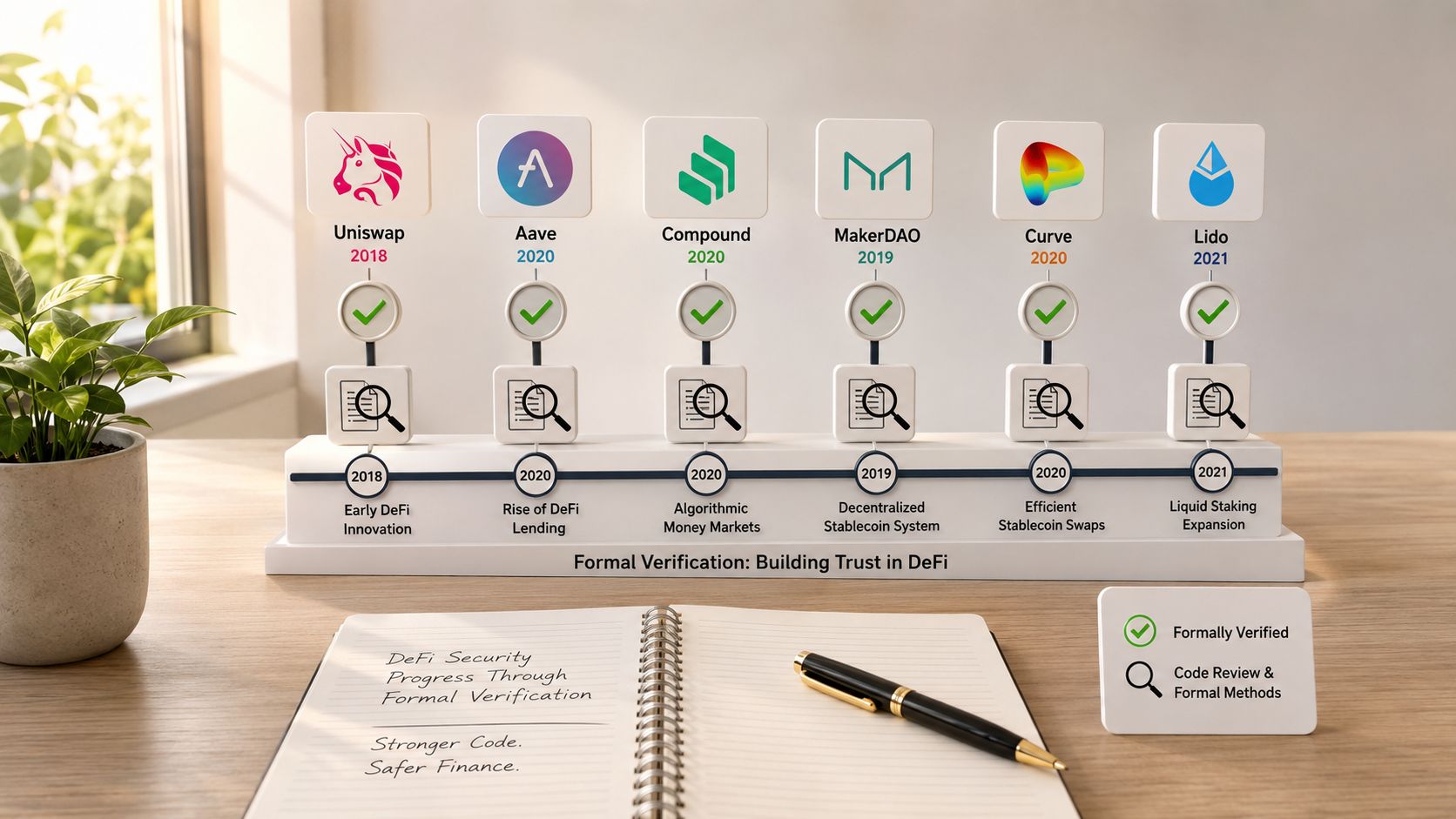
Production use gives formal verification its clearest test. A community-maintained record lists verified deployments including OpenZeppelin ERC20 on 2018-01-26, DappSys DSToken on 2018-03-12, Uniswap on 2018-10-12, Gnosis Safe on 2019-02-27, and the Ethereum 2.0 deposit contract on 2020-01-21. These entries do not show that every behavior was proven. They show that teams applied formal methods to deployed contracts and selected properties they could state precisely.
What successful verification looks like
A useful verification project starts with a defined scope. For a token, that scope may cover transfer accounting, authorization, and supply updates. For a multisignature wallet, it may cover owner thresholds, transaction execution, and replay resistance. For a deposit contract, it may cover input validity and the relationship between deposited data and recorded state.
By 2020, one empirical study reported verification work across 6,138 Ethereum smart contracts, with outcomes including 3,609, 5,436, and 5,616 contracts under different experiment configurations and properties. It also reported that each verification run could complete within 60 seconds in its benchmark. Those results show that automated analysis can operate at scale, while leaving the specification problem intact. The study also supports the broader observation that formal specifications remain uncommon.
Language design changes the proof burden. Move was designed with security and verification in mind and includes the Move Prover, while Solidity verification remains harder in practice. The difference does not make Move automatically safe or Solidity unsuitable. For interviews and engineering work, explain how ownership models, resource semantics, language constraints, compiler behavior, and available tooling affect what a team can prove and maintain.
The gaps worth discussing
Verification covers only the model and properties a team defines. Incorrect economic assumptions, unsafe integrations, flawed oracle assumptions, governance decisions, deployment configuration, and omitted properties can all remain outside it.
A credible engineer states those limits plainly. Explain what the proof establishes, then identify which system boundaries still require audits, tests, monitoring, or operational controls. That distinction is a stronger hiring signal than naming a verification tool alone.
Building Skills for Formal Verification Roles
Hiring managers look for evidence that you can move from protocol intent to executable proof obligations. Reading about invariants isn't enough. Build a small repository where each example includes the contract, specification, assumptions, failing version, corrected version, and a short explanation of the counterexample.
The technical foundation employers recognize
A Veridise formal methods researcher posting asks for advanced background in formal methods, programming languages, computer security, or a related field, with automated verification experience such as SMT solving or software model checking. It also lists Lean, Coq, or ACL2 as useful proof-assistant experience, alongside C++ and Rust. That combination tells you the role is not an audit-only position. It blends logic, implementation, language understanding, and systems engineering.
A Blockswap formal methods role requires at least 2 years of experience with model checking, formal verification, SAT or SMT solving, abstract interpretation, or related disciplines, plus a Master's degree in Computer Science or a related field. The posting also emphasizes defining correctness for smart contract logic and identifying security issues, so protocol modeling matters as much as tool operation.
Prepare across four layers:
- Logic: Understand invariants, preconditions, postconditions, quantifiers, counterexamples, abstraction, and solver limitations.
- Programming languages: Learn how types, semantics, compilation, and state models affect what can be proved.
- Protocol engineering: Know token accounting, upgradeability, governance, lending, liquidation, and external-call assumptions.
- Communication: Explain a proof to auditors, developers, protocol designers, and non-specialist customers without overstating its scope.
You don't need to claim mastery of every assistant. You do need to show deliberate progression. Start by learning Solidity thoroughly through resources such as this guide to learning the Solidity language, then add a verification workflow and publish artifacts that reviewers can inspect.
Nethermind's formal verification engineer posting is another important hiring signal. The work serves internal teams and external customers across the Ethereum ecosystem, so candidates need client-facing judgment, requirements discovery, and collaboration skills. The strongest portfolio project therefore includes a written threat model and a review-style explanation, not only a screenshot of a passing proof.
How to Position Formal Verification on Your Blockchain Career
Formal verification differentiates you when you present it as risk modeling plus engineering, not as tool name-dropping. On your resume, write what you specified, what system boundary you modeled, what toolchain you used, and how you handled a counterexample. “Used Certora” is weak. “Defined authorization and accounting rules for a Solidity protocol, investigated counterexamples, and documented model assumptions” gives an interviewer something concrete to probe.
Your portfolio should make the proof auditable:
- Include the property language and explain each rule in plain English.
- Show a deliberately broken implementation and the counterexample it produces.
- Document assumptions about tokens, callers, oracles, upgrades, and environment behavior.
- Explain which questions remain outside the proof and how testing or auditing covers them.
Interviewers commonly test whether you can distinguish proof failure, property failure, and model failure. They may ask how you'd prioritize invariants for a financial protocol, what makes a liveness claim credible, or how you'd combine formal methods with fuzzing. Answer with scope and trade-offs, not absolute security claims.
Target roles where the work aligns with your strongest layer, from protocol security engineering to formal methods research, verification engineering, and language or tooling development. Employers value people who can reason rigorously and still deliver usable feedback to a protocol team.
Career principle: The defensible specialization isn't knowing a prover's commands. It's knowing which promise a protocol must keep, how to state that promise precisely, and how to communicate what the proof does not cover.
Build one proof-driven project before applying broadly. Then use Blockchain Jobs to find blockchain security, protocol engineering, and formal verification opportunities where those artifacts match the role. Review the listings with your target tools and proof methods in mind, and apply with a portfolio that demonstrates both technical rigor and practical delivery.