How to Write Secure Code That Stands Up in Interviews
You can write clean features for months and still get tripped up the first time an interviewer asks, “How would you secure this?” That happens a lot in Web3 hiring loops, because the people across the table aren't just checking whether your code runs, they're checking whether you spot abuse paths, permission mistakes, secret leakage, and brittle assumptions before they reach production.
Secure coding is a craft skill, but it's also a career skill. The engineers who advance fastest are usually the ones who can explain why a design is safe, show that their pull requests don't widen attack surface, and turn those habits into evidence during interviews, performance reviews, and promotion conversations. If you're trying to get hired, survive the first 90 days, or build a path toward staff or protocol lead work, this is the playbook that matters.
The Secure Code Reality Check Engineers Face in Hiring Loops
A candidate walks into a system design round expecting questions about throughput, caching, and state management. The first pressure point often shows up earlier. The interviewer sketches an auth flow, points at an API, and asks who can call what, what happens when the client lies, and how the backend proves the request is allowed.
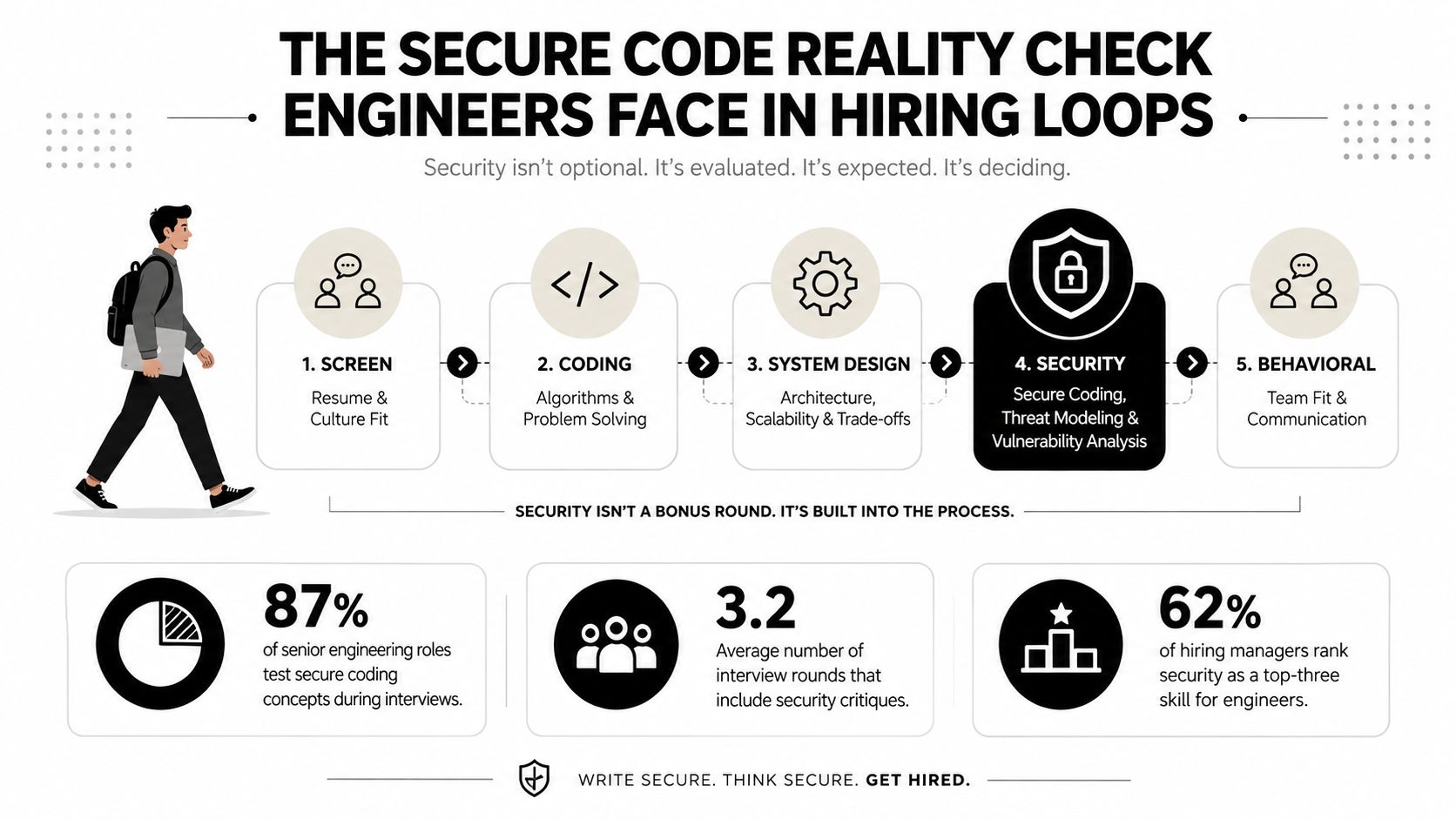
That is the reality in hiring loops now. Hiring managers in both Web3 and traditional software use secure-coding instincts as a seniority signal because they have seen strong engineers ship quickly and still leave gaps attackers can use. The best candidates do not treat security as a separate specialty. They talk about trust boundaries, server-side authorization, least privilege, and failure modes as part of every design discussion, because that is where the risk lives.
What interviewers actually probe
Interviewers are usually testing for judgment, not memorized checklists. They want to know whether you see authorization as a system property, whether you notice where trust changes hands, and whether you can explain how the design limits damage if one layer fails. A senior answer goes past “I would validate input” and into who gets to act, where enforcement happens, and how the API avoids privilege creep.
Broken access control is still the pattern that shows up again and again in reviews and assessments. That matters because secure code is not just about blocking injection. It is about making sure each action is allowed only where it should be allowed, and only by the caller that should have it. If your answer stays at the validation layer, interviewers usually keep probing until they hear a real authorization story.
Practical rule: if you cannot explain who is allowed to do what, the rest of the design is still soft.
The career impact is direct. These habits help you move through code review faster once you are on the team. They help you avoid becoming the engineer who ships the first security incident in the first 90 days. They also give you a promotion narrative managers can defend easily, because the story is about judgment and risk handling, not just output.
Designing Secure Systems Before You Write a Single Function
Secure code starts before the first function name exists. Design choices decide which risks are even possible, and the mistakes that survive into implementation are usually the ones that felt “obvious” during planning. Microsoft's Secure Habits guidance treated threat modeling as a normal development habit, and that still maps well to real work because the security failures that hurt teams most are usually design failures that got repeated in review Microsoft's secure habits archive. Senior engineers learn to spot where a feature crosses a trust boundary, because that is where a later exploit can turn a small mistake into a broader incident.
Threat modeling in interview language
In a system design round, speak in terms of assets, trust boundaries, and abuse cases. The asset might be a token transfer, an admin action, a customer record, or a signing key. The trust boundary is where untrusted data crosses into code that can change state. The abuse case is the sentence an attacker would write if they were trying to break your app on purpose.
That framing sounds simple, but it is what interviewers want to hear from candidates who are ready for bigger scope. They want to see you identify the high-value operation first, then explain how a client, API, queue, or contract could be pushed into doing something it should not do. In Web3 hiring loops, this often becomes the main test, because reviewers care less about whether you can recite terms and more about whether you can explain how an attacker would move across boundaries and what damage the design allows.
Pair design review with coding, not after it
Berkeley's secure-coding guidance says security has to be integrated across requirements, architecture, implementation, testing, deployment, and maintenance, and it recommends putting secure coding principles into architecture and design docs while using automated testing in the pipeline Berkeley secure coding guidance. That is the right mental model for interviews too. You are not describing a compliance step after the work is done, you are describing how the work gets built in the first place.
Model the attack before you model the feature, then make the code prove your assumptions.
The hiring signal here is subtle but important. Junior candidates describe the happy path. Senior candidates describe the happy path, the unhappy path, and the path an attacker will take. That difference shows up again in promotion conversations, because managers trust the engineer who can explain the trade-off between shipping quickly and leaving a design open to misuse.
Input Validation and Least Privilege in Day-to-Day Coding
Two habits show up in interviews more than anything else, because they are easy to ask about and hard to fake. The first is server-side input validation. The second is least privilege. Both are basic, both are often mishandled, and both tell interviewers whether you build software that survives contact with real users.
The validation rule that keeps showing up
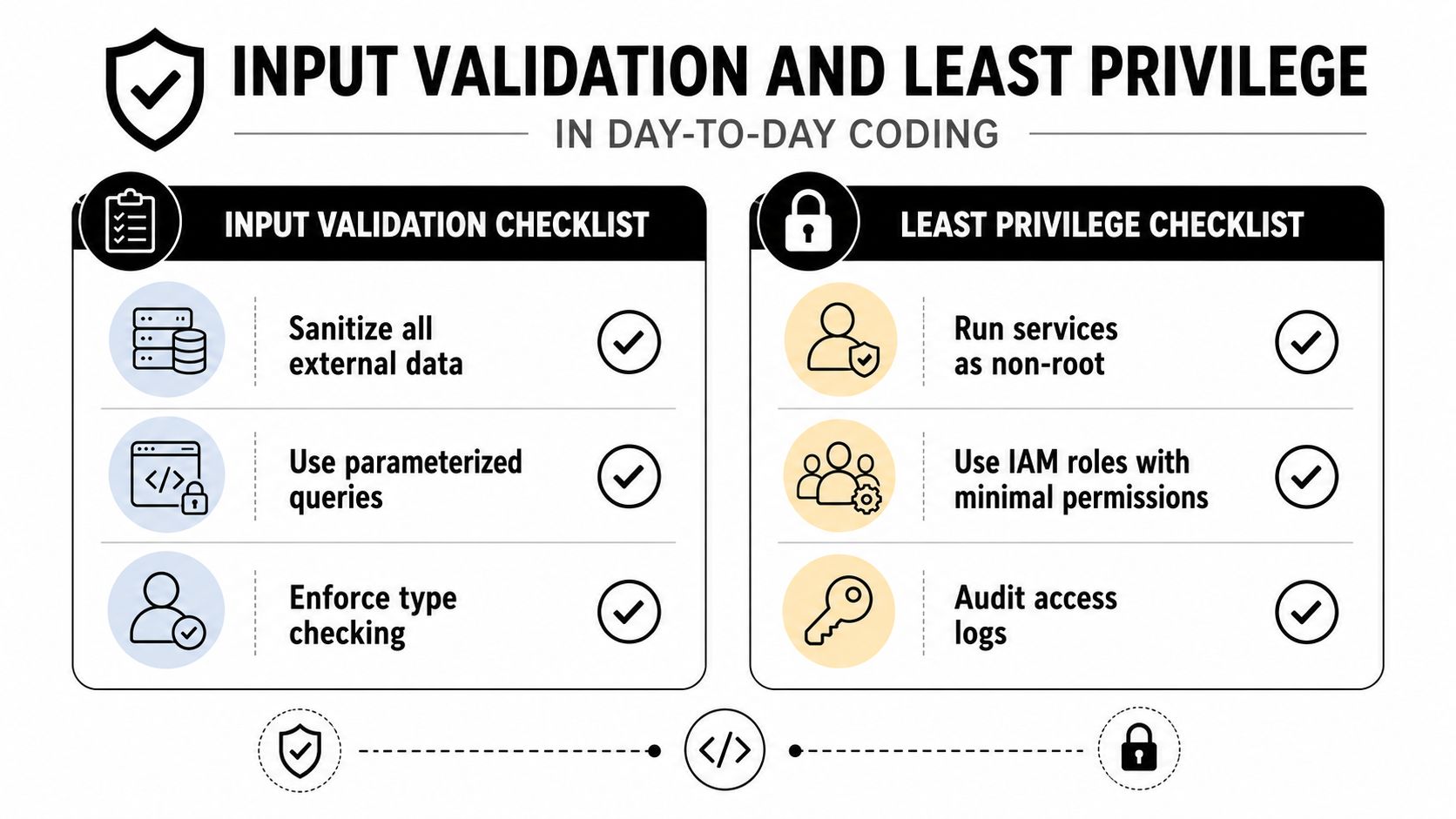
OWASP says to treat all client-provided and other untrusted data as hostile, validate centrally on a trusted system, define character sets such as UTF-8, canonicalize before validation, and reject failures instead of trying to repair them OWASP secure coding checklist. The SEI/CERT checklist says to validate input from all untrusted sources, and Veracode's guidance says validation must happen on the server side SEI secure coding practices.
That is the line interviewers want to hear. Client-side checks are UX, server-side checks are security. In TypeScript, Go, Rust, or Solidity, that means validating types, lengths, formats, and ranges before the value drives a query, a file path, a transfer, or a state change. It also means avoiding dynamic execution with user-supplied data and using built-in APIs instead of shell commands when the platform gives you safer options.
A reviewer will often ask how you handle malformed data from a browser, a queue, or another service. The strong answer is to validate at the boundary, normalize before business logic runs, and fail closed when the input does not match the contract. That is the same answer that shows up in promotion conversations, because it shows you can keep one bad request from becoming a wider incident.
Least privilege in real systems
The classic secure-coding text says to design, build, and test for least privilege, and to document privilege requirements for applications Pearson sample on least privilege. That translates cleanly into interview talk. Service accounts should only reach the resources they need. API scopes should be narrow. Filesystem permissions should be boring. Admin-only actions should be separated from normal user flows.
For everyday server hardening, a web hosting company is a useful reminder that permission boundaries matter outside app code too, especially when teams share environments and credentials across tools.
Interview answer to keep ready: “I validate on the server, I reject malformed input, and I run each service with the minimum permissions needed for its one job.”
That sentence plays well because it connects code, runtime permissions, and architecture. It also tells a reviewer that you are not assuming the UI protects the backend, which is a mistake that gets exposed quickly in Web3 APIs and admin consoles.
What interviewers look for is whether you can apply the same rule to the code path in front of you. If a request can touch money, ownership, or an admin action, the input contract needs to be explicit and the privilege boundary needs to be tight. In a web app or a smart contract, that is the difference between a feature that works in a demo and one that survives real users.
Dependencies and Secrets as Career-Defining Hygiene
A candidate who can explain secret handling and dependency control usually reads as safer than one who only talks about code style. In hiring loops, that matters. Interviewers want to know whether you can keep credentials out of git history, keep package risk under control, and do both without turning every release into a fire drill.
What strong operational habits look like
Secure-coding guidance keeps landing on the same operational habits, pre-commit hooks for secret detection and continuous dependency scanning, because the failure mode is broader than a buggy function. A team can also ship a vulnerable package or commit a credential that should never have been in the repo. Oligo secure coding guidance makes that gap plain, especially where teams still lack a real process for stopping credential exposure and insecure transitive dependencies.
Staff-level engineers talk about guardrails because they need controls that work under pressure. A pre-commit hook that blocks secrets before they leave a laptop is more useful than cleaning up after a leak. Continuous dependency scanning is more useful than discovering a CVE during a customer outage. That trade-off gets sharper when teams ship with AI-assisted coding, since generated code can hide sloppy package choices and copied credentials inside a review that looks routine.
How to turn hygiene into career evidence
Clean secret-scanning history is a portfolio signal. So is a maintained SBOM, if your team produces one. So is a calm, repeatable response when a bad package lands in production dependencies. In interviews, those artifacts let you answer behavioral questions with concrete examples instead of hand-waving.
Use this checklist on your own repos:
- Secrets at the edge: Add a pre-commit hook so credentials get blocked before they hit the repository.
- Packages under watch: Run dependency scanning continuously, not only before releases.
- Response ready: Know who patches, who verifies, and who communicates when a vulnerable package appears.
- Review the diff, not the hope: Don't assume a PR is safe because it is small or generated by a tool.
The hiring signal is direct. Mid-level engineers can explain how to use these tools. Staff+ candidates can explain what happens when the tools light up, how they keep the team shipping while the fix is in progress, and how they explain the trade-off in a promotion conversation.
Secure Coding Patterns That Matter for Web3 and Smart Contracts
A smart contract interview tests whether you understand what breaks after deployment. A normal backend can sometimes absorb a bad assumption and patch around it later. A contract often cannot. Authorization mistakes, unsafe external calls, and weak validation can stay live until a migration, a governance action, or an emergency pause changes the system, and interviewers know that trade-off.
What to memorize and what to compare
General application security gives you the baseline, but blockchain code demands tighter discipline around reentrancy guards, admin-function access control, and external calls. A backend service can sometimes correct a wrong assumption after the fact. A contract usually needs a migration plan, a governance vote, or a pause mechanism, which is why protocol interviews often sound like failure-containment reviews.
The strongest answers compare options instead of just naming patterns. If an external call is unavoidable, explain how you limit state changes before that call and why you reduce what the callee can do. If a function is admin-only, explain how that role is represented and why ordinary users cannot reach it. If the contract accepts user input, explain which values are checked on-chain and which assumptions are enforced by the calling system.
For a job-specific view of how this shows up in hiring, the Smart Contract QA Engineer role is the kind of posting that makes the expectation obvious. Security is part of the quality bar, not an optional extra.
Why Web3 candidates get tested harder
OWASP's broken-access-control lesson matters even more here, because smart contracts, admin consoles, and backend services often expose high-value operations such as token transfers, parameter updates, or governance actions. In practice, broken access control is what lets the wrong party touch a privileged path, and that failure mode maps directly to Web3 incidents.
A useful contrast is XSS thinking versus contract thinking. For a refresher on how interface abuse can work in the web layer, it can help to understand XSS vulnerability walls, but the Web3 question goes further. The harder test is whether an attacker can bypass intended role checks or push the protocol into moving value through a path that looked harmless in review.
Good Web3 answer: “I'd lock down the admin path, minimize external call impact, and assume the immutable deployment raises the cost of every validation mistake.”
That is the kind of answer that works in protocol interviews because it sounds like someone who has shipped security-sensitive code, not someone reciting a checklist. It also reads as career evidence. It shows you can explain the risk, the control, and the operational trade-off in the same breath.
Automated Testing and CI/CD Gates That Build Promotion Narratives
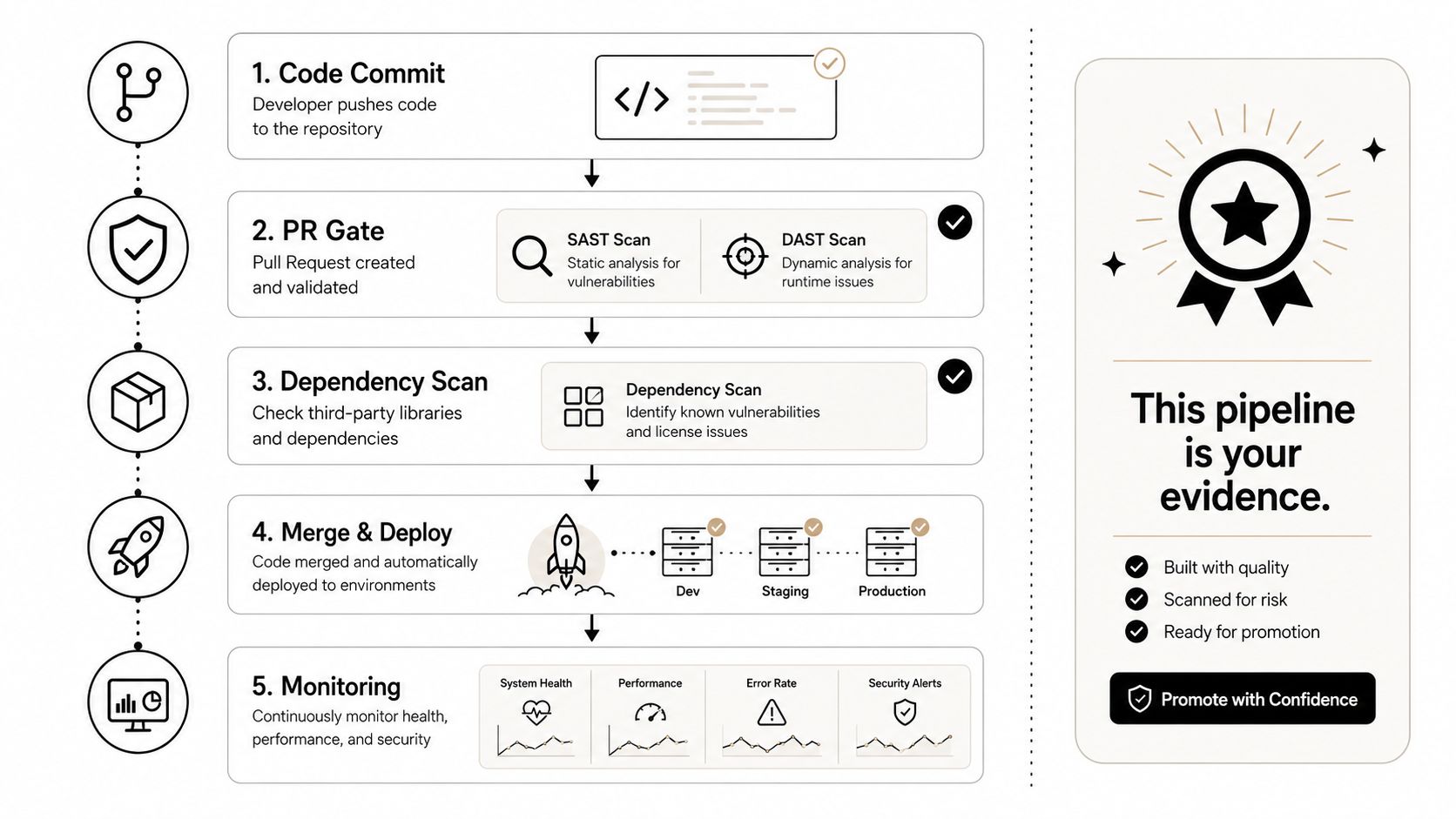
A broken gate is easy to spot in a postmortem. A useful gate leaves evidence before the incident ever happens. Security tooling works best when it is part of the delivery path, and the point is not to add ceremony. The point is to make the risk review visible enough that other engineers can trust it, reuse it, and talk about it in promotion meetings. Berkeley's secure coding guidance supports automated application security testing in the test process and focused review on high-risk areas such as authentication, authorization, input handling, cryptography, and data access. That is the kind of work that turns security effort into a credible career narrative.
What to put in the pipeline
Use the pipeline to show judgment, not just activity.
- SAST in pull requests: Catch obvious code-level issues before merge.
- DAST on running services: Validate the app the way an attacker sees it.
- Dependency scanning: Block risky packages before they spread.
- Security-focused review checklists: Spend human attention on auth, crypto, input, and access control.
- Automated regression coverage: When a security bug appears, keep it from coming back.
That order matters because it pushes detection earlier, where fixes are cheaper and review is sharper. It also cuts noise for reviewers, since they can focus on the paths that move value or expose privilege. In practice, this is the kind of setup that gives you concrete resume bullets and better stories for promotion conversations, because you can point to PR gates, cleaner reviews, and scans that became part of release flow instead of a manual scramble.
How to talk about it in interviews
Senior interviewers care about velocity and failure modes. Frame the tools as a way to keep engineers shipping without shipping blind. If a manager asks whether gates slow the team down, answer with trade-offs. Bad gates add friction and get bypassed. Targeted gates remove rework and catch high-risk changes before they reach a release branch.
Useful framing: security gates are not a handbrake, they are a quality filter that protects delivery speed.
That answer works in behavioral rounds too. It shows you can work with developers, product managers, and QA without turning every PR into a debate about security theater. It also maps cleanly to hiring loops for application security roles, including a senior application security engineer opening, where the question is whether you can make security checks practical enough that teams keep using them.
Your Secure Coding Career Roadmap and Interview Checklist
A secure code career is built in layers. The habits that get you hired are the same habits that help you survive the first quarter, earn trust in code review, and make a credible case for staff-level scope later. The point is to make your security decisions visible in a way interviewers, teammates, and managers can evaluate.
A practical roadmap
Start with design habits. Walk into interviews ready to identify assets, trust boundaries, and abuse cases, because senior interviewers will often probe whether you can reason about failures before you touch a function. Then harden your day-to-day coding around server-side validation and least privilege, since those are the questions people ask when they want to know whether you understand the basics or only know the vocabulary.
Make your repos cleaner than the average team's. Keep secrets out of git history, watch dependencies continuously, and know how you would respond when a vulnerable package lands in the stack. Berkeley recommends embedding security checks across the full development lifecycle, and that is the standard worth showing in both code review and hiring loops. After that, translate the work into automation. Security checks in PRs, focused review on high-risk paths, and repeatable regression tests all give you evidence you can point to during promotion discussions.
OWASP's shifted priority reflects how pervasive broken access control has become, so be ready to explain how your own code and review habits reduce that risk. That answer lands better than generic claims about being careful, because it shows you understand the failure mode and the trade-off between speed and exposure.
For a concrete place to browse security roles and compare what hiring teams want, the security jobs listing is a useful reference point.
Print-friendly checklist
- Can I explain the trust boundary? If not, the design is still incomplete.
- Do I validate on the server? Client-side checks do not count as security.
- Am I running with least privilege? Service accounts, API scopes, and admin paths should all stay narrow.
- Are secrets blocked before commit? If not, fix that first.
- Is dependency scanning continuous? One-off checks miss too much.
- Can I describe my PR gates clearly? Interviewers want concrete workflow answers, not slogans.
- Can I turn one security fix into a regression test? That reads as senior-level judgment.
If you can answer those questions cleanly, you are not just writing secure code. You are building the kind of reputation that gets forwarded in hiring loops and remembered in promotion meetings.