
Blockchain Penetration Testing: The Ultimate Career Guide

You're probably in one of two places right now. You already write smart contracts or backend systems and want to move into security, or you've done traditional pentesting and you're trying to understand why Web3 security feels like a different job entirely.
The confusion usually starts with the wrong mental model. A lot of people think blockchain penetration testing means reading Solidity, spotting reentrancy, and writing a PDF. That's part of it, but it's not the role that gets you hired for serious protocol work. The people who become valuable in this field can trace risk across contracts, wallets, APIs, nodes, governance, and user operations. They know that the bug isn't always in the contract. Sometimes it's in the signer flow, the admin path, the oracle dependency, or the assumptions the protocol makes about human behavior.
That broader view is why blockchain pentesting emerged as a distinct discipline in the first place. It has to simulate real attacks across smart contracts, nodes, APIs, wallets, and consensus mechanisms, not just review code, and it also has to account for keys, network interactions, and governance logic, as described in Tarlogic's overview of blockchain pentesting. If you want context for how non-code weaknesses can still hit crypto platforms hard, the cryptocurrency data breach at Blockchain.com is a useful reminder that attackers don't care which part of the stack your team forgot to model.
Security careers in Web3 reward people who can think in systems. That's why the most useful career reading isn't just exploit writeups. It's also hiring pattern recognition, role expectations, and how teams describe the problems they need solved. Browsing the Blockchain Jobs blog helps sharpen that lens because the gap between “can find a bug” and “can secure a protocol” shows up clearly once you read enough role descriptions and industry commentary.
Introduction Beyond Simple Code Audits
What junior candidates usually miss
A narrow auditor asks, “Where's the vulnerable function?”
A strong blockchain pentester asks, “What can an attacker control, what can they influence indirectly, and what assumptions break if markets, validators, or governance participants act adversarially?”
That difference matters in interviews. Hiring managers don't just want a person who can run Slither and point out unchecked calls. They want someone who can decide whether the protocol's real crown jewel is collateral accounting, upgrade authority, treasury control, bridge message validation, or wallet key management.
Practical rule: If your threat model starts and ends with the Solidity repository, you're thinking too small for senior Web3 security work.
The best candidates also understand why this field is unforgiving. Blockchain systems often hold direct financial value, and once something executes on-chain, cleanup options can be limited. That changes the culture of testing. Good teams treat pentesting as a pre-launch control and repeat it after major contract or infrastructure changes, not as a one-time badge.
The career value of a wider lens
When recruiters or security leads evaluate you, they're usually looking for four signals:
- Scope judgment. Can you identify what should be tested first when time is limited?
- Attack realism. Can you model how attackers chain small weaknesses into a serious exploit?
- Communication quality. Can you explain risk to engineers and non-engineers without sounding vague?
- Operational maturity. Do you understand that secure delivery involves retesting, environment validation, and control verification over time?
That's why blockchain penetration testing is one of the clearest career accelerators in Web3 security. It forces you to work across code, infrastructure, product logic, and stakeholder communication. If you get good at all four, you stop looking like a bug hunter and start looking like a security lead in training.
Scoping Engagements From a Hiring Manager's View
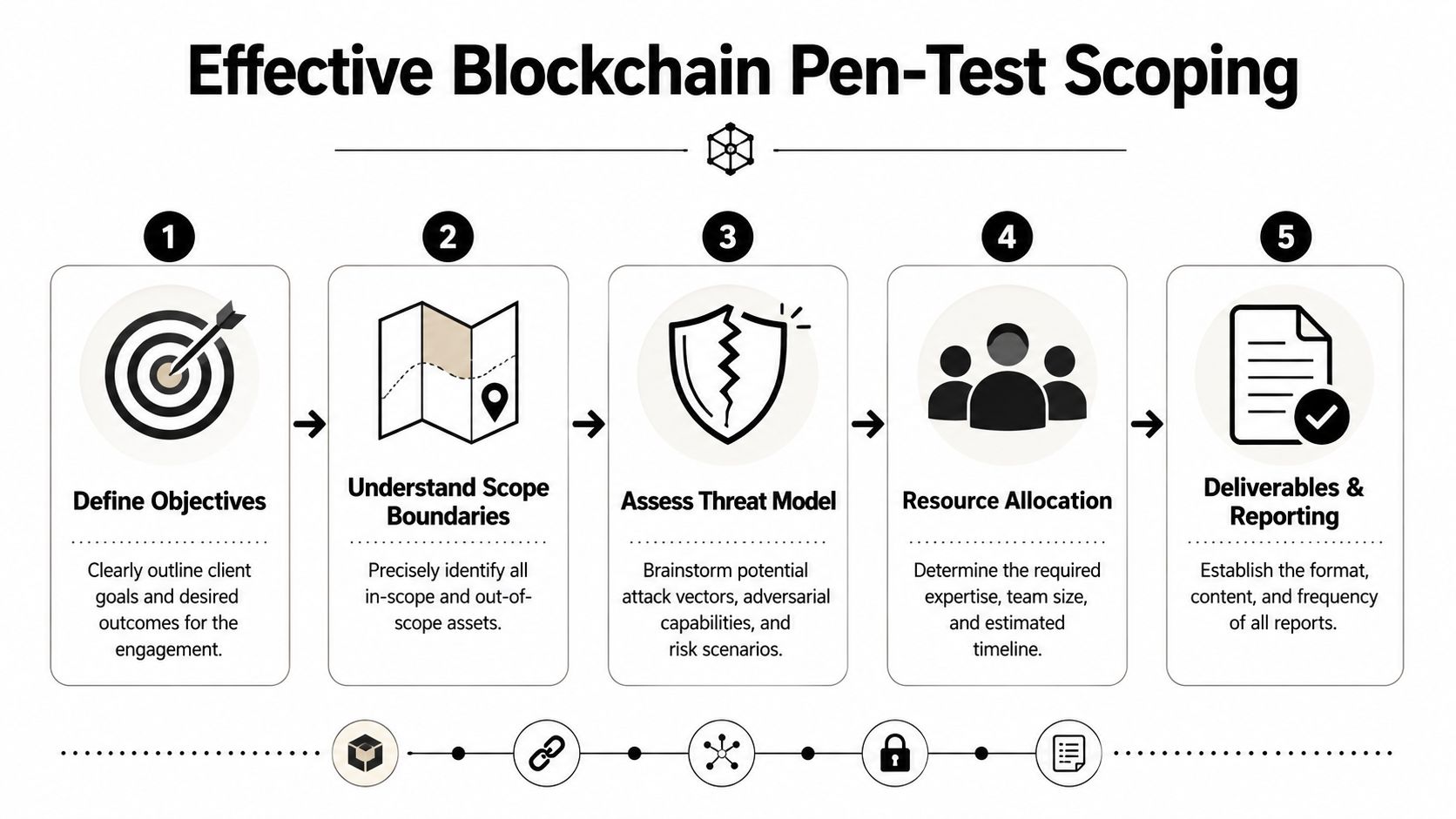
A protocol ships in two weeks. The founders want "a pentest." The contracts are only part of the system. There is an upgrade proxy, a relayer, an admin panel, a multisig, and an emergency pause role that one engineer still controls from a hardware wallet at home. If you scope that engagement as a contract review with a few API checks, you miss critical risk and signal junior-level judgment.
Hiring managers notice this fast. Candidates with real engagement ownership start by asking what can move funds, change authority, halt the system, or create irreversible state. Candidates without that experience jump straight to black-box versus white-box labels and tool names.
Start with the crown jewels
Before touching tools, identify the failure that matters most. That decision shapes depth, sequencing, and staffing.
For a lending protocol, the highest-risk path usually sits around liquidation logic, collateral pricing, privileged parameter changes, and any component that can freeze or drain markets. For a wallet product, signer flows, recovery paths, transaction building, session handling, and backend authorization often matter more than the contracts themselves. For an enterprise chain, validator permissions, node exposure, key custody, governance actions, and operational failover can carry more risk than the user-facing dApp.
Use a scoping order that reflects how attacks happen:
- Asset value. Which component controls funds, authority, or irreversible state?
- Exploitability. What can an attacker reach through the public internet, mempool behavior, governance access, or user workflows?
- Blast radius. Does failure affect one wallet, one pool, or the whole protocol?
- Change velocity. Which systems are changing often enough to justify deeper review and retesting?
- Control overlap. Where can one mistake bypass several defenses at once?
Junior pentesters often treat scope as inventory. Senior pentesters treat scope as prioritization under time pressure. That difference gets noticed in interviews and on live engagements.
Scope by attack surface, not by department
Org charts are useful for scheduling meetings. They are a bad way to define test boundaries.
Attackers do not care whether a weakness sits with the smart contract team, platform engineering, or product. They care whether they can chain it. A signer compromise combined with weak upgrade controls matters more than which manager owns each piece. An exposed admin endpoint tied to a relayer can be more dangerous than a medium-severity contract bug that looks impressive in a report.
Map the system the way an adversary would move through it:
- On-chain logic includes contracts, upgrade paths, role management, and invariant safety.
- Off-chain execution includes APIs, admin panels, keeper systems, relayers, and oracle integrations.
- Identity and authority includes wallets, multisigs, signer workflows, approval paths, and key-handling procedures.
- Network and protocol layer includes nodes, RPC exposure, peer configuration, and assumptions around consensus or sequencing.
- Governance and operations includes proposal flows, timelocks, emergency actions, deployment pipelines, and dependency management.
Here, the discipline separates itself from generic code review. Strong blockchain pentesting scope covers the full exploit path, not just the repository. The useful question is not "Which team owns this?" It is "What combination of access, code paths, and operational controls could let an attacker reach funds or authority?"
What impresses in an interview
If you are interviewing for a role like Senior Security Engineer, Penetration Testing at CertiK, answer scoping questions the way you would brief a client before kickoff.
Start with what you need to see. Ask for architecture diagrams, deployed addresses, privilege maps, upgrade authorities, oracle dependencies, signer workflows, incident runbooks, and emergency procedures. Then explain how those artifacts change the test plan. That shows judgment. It also shows you understand a point that hiring managers care about: scope is not paperwork. It is risk triage.
The strongest answer also includes trade-offs. A time-boxed engagement may go deepest on upgrade control, treasury movement, and privileged backend paths, while leaving lower-value surfaces for a later phase. A mature candidate can defend that choice clearly. A weak candidate promises full coverage and sounds unrealistic.
A good pentester finds bugs. A promotable pentester shows where limited time will reduce the most risk, and can explain that choice to engineers, founders, and security leadership without hand-waving.
The Core Pentesting Playbook Tools and Techniques
The middle of the job is where many candidates become interchangeable. Everyone names the same tools. Fewer people can explain what each tool is good at, what it misses, and what manual work still has to happen around it.
That distinction matters because the field has already moved beyond occasional, tool-driven reviews. In 2025, about 40% of companies moved to quarterly or continuous penetration testing, and web application flaws were involved in 73% of breaches, which maps directly to dApps and their connecting APIs, according to Deepstrike's 2025 penetration testing statistics. The same source notes that blockchain testing has matured into a hybrid model using manual review plus automated tools like Mythril, Slither, and Manticore.
Smart contract analysis
Slither is excellent for fast structural insight. It helps you identify risky patterns, inheritance surprises, access-control inconsistencies, and code smells early. Mythril and Manticore help with symbolic and deeper path exploration. If you know when to trust the output and when to challenge it, you look experienced.
Static analysis alone won't get you very far in interviews. Strong candidates pair it with dynamic thinking. They build adversarial test cases, manipulate call order, fuzz edge conditions, and check invariants under state transitions. Even when a role doesn't require heavy formal methods, interviewers want to hear that you know code safety is about behavior under pressure, not just linting output.
Node and protocol security
This is the area many app-focused candidates ignore, and it's one of the fastest ways to stand out.
Node and protocol testing covers things like exposed services, unsafe defaults, weak authentication around operational interfaces, poor segmentation between trusted and untrusted systems, and assumptions about peer behavior. You're not always hunting a dramatic remote exploit. Often you're proving that the protocol's operational design grants an attacker an undue advantage.
A good pentester asks uncomfortable questions here. Can an attacker influence data flow through a relayer? Can they abuse RPC functionality? Can a misconfigured node reveal sensitive operational detail? Can validator or operator assumptions be manipulated through a non-obvious path?
Application and API security
A lot of real-world blockchain risk lives in the off-chain parts. The frontend shapes transactions. The backend gates privileged actions. APIs expose sensitive workflows. Admin panels often become the bridge between ordinary web flaws and protocol-level impact.
Traditional pentesting experience carries over well, provided it is connected to blockchain consequences. Broken access control on an admin service isn't just a backend issue if it can alter signer permissions, oracle settings, withdrawal routes, or governance operations.
Good blockchain pentesters don't treat the web layer as “outside the real protocol.” They treat it as the place attackers often gain the leverage to touch the protocol.
Blockchain Penetesting Methods Compared
| Method | Objective | Key Tools | What This Shows on Your Resume |
|---|---|---|---|
| Smart contract static analysis | Find risky patterns, unsafe logic structures, and likely bug classes early | Slither, Mythril | You can triage code quickly and understand common contract failure modes |
| Symbolic and path exploration | Probe deeper execution paths and edge-case behaviors | Manticore, Mythril | You can go beyond surface findings and reason about complex state transitions |
| Manual business logic review | Identify flaws tools won't catch in incentives, authority, and workflow design | Architecture diagrams, threat models, custom test plans | You think like an attacker and understand protocol intent |
| Dynamic testing and fuzzing | Stress contracts with adversarial inputs and unusual sequences | Echidna, Foundry | You know how to validate invariants rather than just inspect code |
| Node and infrastructure testing | Find operational weaknesses in exposed services and protocol deployment | Standard pentest tooling, client-specific inspection methods | You can secure more than just the repository |
| API and web application testing | Test off-chain systems that shape or authorize on-chain actions | Web proxies, API testing workflows, custom scripts | You understand the full attack chain from UI to protocol impact |
What hiring teams actually hear
When you say “I use Slither,” that's basic familiarity.
When you say “I use Slither first to shrink the search space, then validate suspicious paths manually and build test cases around privilege boundaries and state assumptions,” that sounds like someone who can lead work.
Tool proficiency gets you shortlisted. Judgment about tool limitations gets you promoted.
Simulating Advanced Blockchain Attacks
The jump from junior to senior usually happens when you stop asking only “Is there a bug?” and start asking “Can an attacker turn this design into profit, control, or systemic failure?”
That's the heart of advanced blockchain penetration testing. The scanner may find the obvious flaw. The hard part is validating whether a protocol survives realistic adversarial behavior.

Economic attacks are a different skill
A contract can be perfectly clean from a traditional coding perspective and still be exploitable. That's why one of the field's toughest problems is validating resilience to economic and governance failures, not just code bugs, and why the market increasingly needs people who can design scenario-based red-team tests for flash-loan manipulation or malicious voting, as noted in Prescient Security's analysis of blockchain testing.
Here's what that looks like in practice.
You review a lending protocol. The contracts compile cleanly, role checks look sane, and static tools report the usual noise. A junior tester stops there. A senior tester asks whether temporary capital can distort the protocol's assumptions. Can a flash-loan-funded sequence move a price source, trigger a liquidation edge case, and settle before defensive actors can respond? Can a user route actions across multiple contracts in a sequence the original designers didn't expect?
That testing often requires custom harnesses and production-like simulations. It also requires business literacy. You need to understand what the protocol is trying to prevent, what profitable abuse looks like, and which assumptions depend on “normal” market behavior.
Governance and control-path abuse
Another senior-level habit is treating governance as an attack surface, not a compliance checkbox.
Suppose a protocol has a timelock and on-chain voting. That sounds strong on paper. A good pentester still asks:
- Proposal risk. Can a malicious proposal package multiple changes that look harmless in isolation?
- Execution path. Are there side effects in queued actions that alter future governance behavior?
- Privilege inheritance. Do admin roles, multisigs, or emergency powers bypass the intended governance process?
- Operational dependency. Can off-chain coordination, signatures, or frontends distort the actual voting outcome?
These are not hypothetical thought exercises. They're the basis of controlled adversarial testing.
Don't just review whether governance exists. Review whether governance can be weaponized.
A useful way to train this skill is to narrate attack paths as if you were briefing an incident commander. State the attacker goal, required resources, dependencies, timing constraints, and expected payoff. If you can do that clearly, you're already thinking at a more senior level.
Cross-contract and cross-function exploitation
A lot of nasty protocol failures don't come from one bad function. They come from legal interactions between functions that create an illegal outcome.
For example, the exploit path may require a deposit function, a reward claim path, a state update in another contract, and an external callback at just the wrong point. Nothing looks catastrophic in isolation. Together they create an opening.
That's why advanced testing focuses on sequences:
- Map state dependencies across contracts and roles.
- Identify trust assumptions hidden in call ordering.
- Force unusual transitions that normal user flows never trigger.
- Test authority drift after upgrades, emergency actions, or edge-case governance events.
This kind of reasoning is hard to fake in interviews because it comes from actual practice.
A good technical walkthrough on attack simulation can help you sharpen that mental model before you build your own labs:
The people who get trusted with protocol-critical work usually share one trait. They don't confuse a clean report from a tool with proof of safety under hostile conditions.
Reporting That Builds Your Reputation
Most pentesters underrate reporting because it happens after the interesting technical work. That's a career mistake.
Your report is the artifact people keep. It's what the engineering lead forwards internally. It's what the founder uses in a board update. It's what a future employer may ask you to anonymize and discuss in an interview. If the report is sharp, people assume your thinking is sharp. If it's messy, your technical skill gets discounted.
What a strong report proves
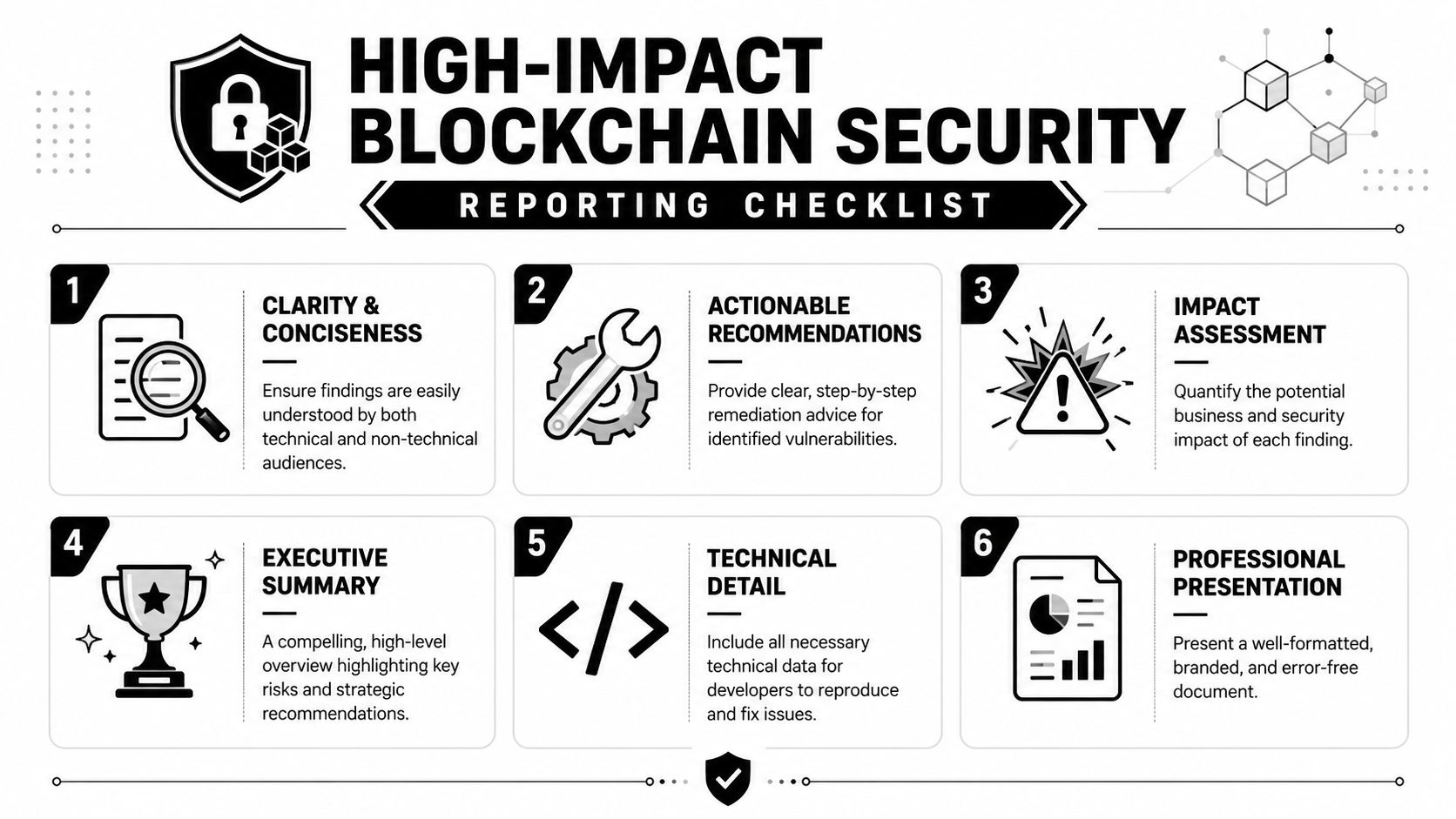
A strong blockchain penetration testing report proves three things at once.
First, it proves you can prioritize. Not every flaw deserves the same attention. A report should make clear which findings threaten funds, control, or protocol integrity and which ones are secondary hardening items.
Second, it proves empathy. Developers need reproducible findings, realistic remediation advice, and enough context to fix the issue correctly the first time. Executives need to know what matters, what changed, and what still needs follow-up.
Third, it proves operational maturity. Good reports don't just identify a flaw. They explain exploit conditions, assumptions, downstream consequences, and validation steps after remediation.
A practical structure that works
I'd structure the deliverable like this:
- Executive summary. State the few issues leaders need to understand immediately, with plain-language impact.
- Scope and assumptions. List what was tested, what wasn't, and which environmental assumptions shaped the results.
- Methodology. Briefly explain manual review, tooling, simulation, and validation steps without turning the section into marketing copy.
- Findings. For each issue, include affected components, attack path, reproducibility notes, impact, and remediation guidance.
- Retest results. Show which fixes were verified and what residual risk remains.
- Appendix. Include technical artifacts that help engineers reproduce and close the issue.
One of the better general references on structuring a readable deliverable is this effective pen test report guide. It's useful because it reinforces a truth junior testers often learn late: a report should help the client act, not impress them with jargon.
How to write findings that get remembered
Don't write findings like a scanner export. Write them like an attack brief.
Bad version: “Improper access control may allow unauthorized modification.”
Better version: describe who can exploit it, what they gain, what preconditions matter, how the exploit unfolds, and why the impact is significant in the context of the protocol's actual design.
A memorable report turns technical detail into decision quality.
The testers who build strong reputations are usually the ones whose reports developers like reading. That doesn't mean soft or watered down. It means precise, reproducible, and useful.
Building Your Career in Blockchain Security
A junior tester finds a reentrancy bug and writes it up. A stronger candidate explains why the bug was reachable in production, which assumptions made it viable, how the team could have caught it earlier, and what fix would reduce repeat risk across the codebase. Hiring managers remember the second person.
Careers in blockchain security grow from visible judgment. Technical skill gets you into the interview. Clear reasoning, disciplined testing, and useful reporting are what get you hired, trusted with larger scopes, and promoted into lead roles.

For people trying to break in
A portfolio should prove that you can do the work, not just talk about the field. Good hiring panels look for evidence that you can move from code review to attack validation to risk communication without losing accuracy.
A strong starter portfolio often includes:
- Public writeups that explain one exploit path clearly, including root cause, attack sequence, and remediation.
- Small review reports on open-source protocols or demo systems, even if they're self-initiated.
- Tool fluency shown through reproducible test harnesses, fuzz cases, or custom scripts.
- System thinking demonstrated through architecture notes, threat models, and scope decisions, not only bug lists.
- Communication skill visible in concise summaries that a product manager or founder could understand.
The difference between a weak portfolio and a strong one is usually framing. “I ran Slither and found issues” says very little. “I used static analysis to reduce the search space, then manually traced authority flows and built tests around upgrade control and oracle dependency risk” tells an interviewer how you approach real engagements.
That is what teams buy.
For interview performance
Many candidates study technical trivia and neglect process. That mistake costs offers.
Interviewers want to hear how you work under imperfect conditions. Documentation will be incomplete. Severity will be disputed. A suspected issue will fail validation. Engineers will ask whether the bug matters in the context of their protocol, not in the abstract.
Prepare answers that walk through a real sequence:
- Initial observation
- Hypothesis
- Validation method
- Exploit preconditions
- Impact in protocol context
- Remediation trade-offs
That structure signals maturity because it mirrors live client work. It also shows something that matters for career growth. Senior testers do not just find bugs. They reduce uncertainty and help teams make better decisions.
For hiring managers building teams
Strong blockchain security teams are built from complementary strengths. One tester may be sharper on EVM internals. Another may be better at infrastructure and web application attack chains. Another may spot economic abuse paths that pure code auditors miss. The best teams combine those skills and share a common standard for evidence.
When evaluating candidates, look for signs that they can connect disciplines:
| Hiring signal | What it usually means |
|---|---|
| Can explain trust boundaries clearly | Understands architecture, not just isolated snippets |
| Distinguishes exploitability from severity language | Prioritizes real risk instead of chasing dramatic wording |
| Describes failed testing paths | Has field experience and does not oversell |
| Writes concise remediation guidance | Can work productively with engineers |
| Notices off-chain dependencies quickly | Understands realistic attack chains |
I would hire the candidate with sound reasoning, steady validation habits, and decent tooling before I would hire someone with flashy exploit language and weak scoping discipline. That trade-off matters in client-facing work, where credibility is built one judgment call at a time.
A focused way to track demand for these skills is the Web3 security roles and hiring trends on this blockchain security jobs board. Job descriptions make the market readable. They show which teams want pure smart contract depth, which need broader pentesting capability, and which expect candidates to handle reporting, retests, and direct work with engineering.
The long game
Most careers in this field follow a clear progression. First, you learn to find issues. Then you learn to prove exploitability. After that, you learn to scope, prioritize, defend risk decisions, and guide remediation without creating noise.
This progression is the core value of blockchain penetration testing as a career. It builds technical depth, system-level judgment, and credibility with both engineers and leadership. Few security specialties train all three so directly.
If you want to stand out, document your thinking in public, keep your test artifacts reproducible, and get good at explaining trade-offs. The people who rise fastest are rarely the loudest. They are the ones other professionals trust when the scope is messy, the bug is subtle, and the fix has business consequences.
If you're ready to turn that skill set into your next role, Blockchain Jobs is a strong place to start. It's one of the few job boards built specifically for Web3 hiring, which makes it easier to find security roles that match your background, whether you're moving in from smart contract engineering, traditional pentesting, DevSecOps, or protocol research.