Smart Contract Developer Freelance: 10 Career Resources

The popular advice is to find a listing, send a proposal, and compete on price. That approach breaks down quickly in smart contract developer freelance work. You're not only selling Solidity implementation. You're asking a client to trust you with financial logic, deployment permissions, upgrade paths, testing discipline, and the consequences of an error that may be impossible to reverse.
A durable freelance pipeline starts earlier. You need credible opportunities, a way to judge whether the project and client are real, evidence that you can deliver secure code, and a pitch that speaks to the person approving the budget. You also need to distinguish feature work from audit-grade security work, price the assurance level accurately, and turn a successful engagement into repeat work or a stronger career signal.
The ten resources below sit at different points in that funnel. Some are discovery channels, some are engineering partners, and some are security-led vendors that can become employers, collaborators, or benchmarks for the level of work buyers expect. Use them to compare project fit, interview preparation, portfolio proof, delivery standards, and progression, not just access to another job board. If your application materials need work, these contract resume writing tips can help you present project ownership without turning your CV into a list of tools.
1. Blockchain Jobs Find Your Next Web3 Career Opportunity
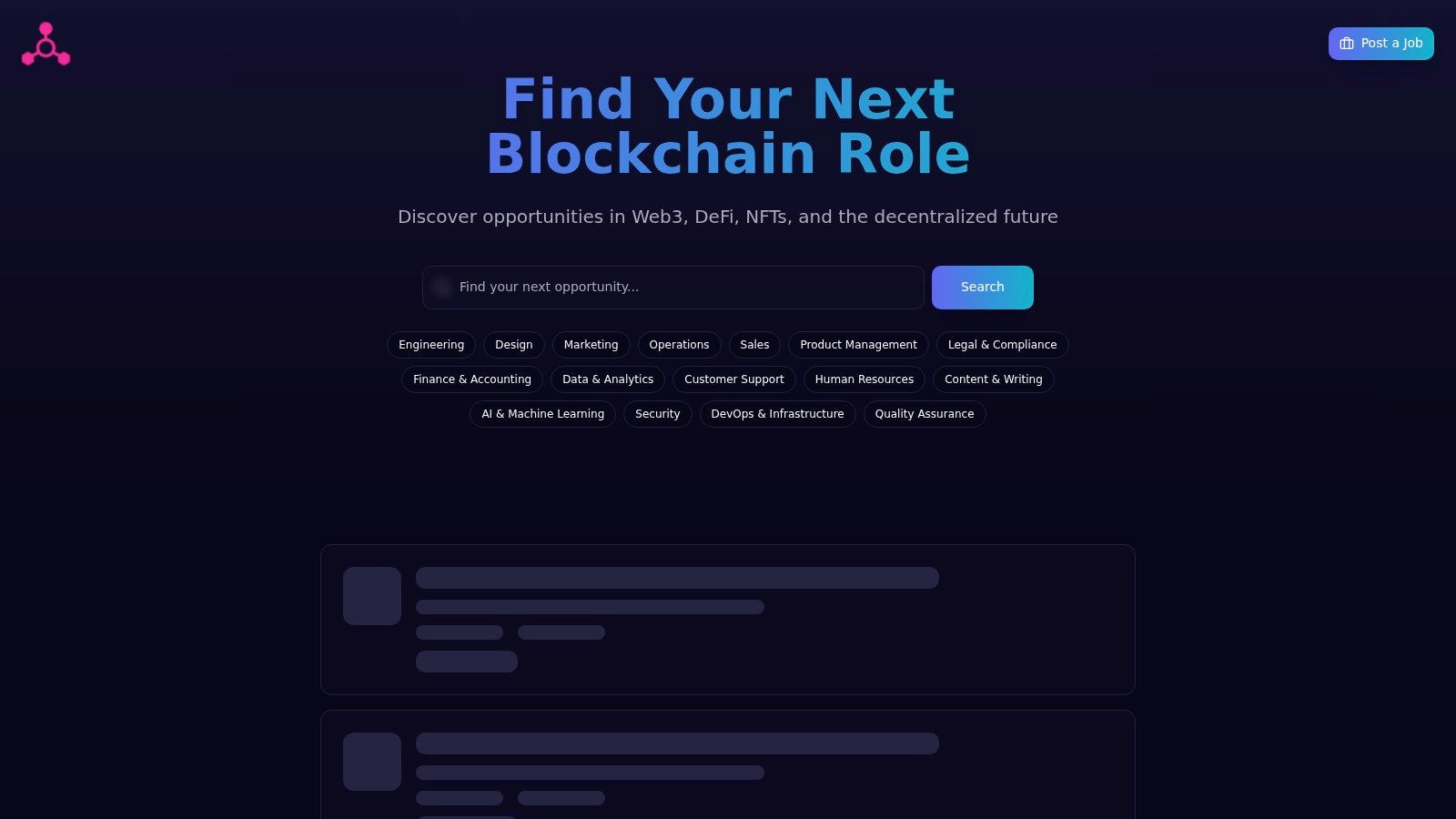
For a freelancer, Blockchain Jobs is useful because it narrows discovery before you spend time qualifying a lead. A general marketplace may contain blockchain work, but a specialist board makes it easier to search across engineering, security, infrastructure, product, legal, and operations roles where the client already understands Web3 terminology. That context matters when your value depends on explaining Solidity, EVM behavior, protocol risk, and deployment responsibilities to a decision-maker.
The board supports categories and filters for remote, freelance, and contract opportunities. Its recently added listings can help you respond while a role is still fresh, and the surrounding categories make it easier to spot adjacent work, such as protocol engineering, DevOps, security, or backend roles. That gives a smart contract developer more than one route into an engagement. A short contract can become a path toward broader ownership if you demonstrate that you understand the product around the contract.
Use the listing to qualify the buyer
A credible-looking role still needs diligence. Check whether the brief identifies the chain, contract responsibilities, testing expectations, deployment environment, review process, and decision-maker. Vague language around “build a token” or “launch a DeFi platform” usually means the scope is still immature. Ask what already exists, who owns the architecture, whether an audit is planned, and what happens after deployment.
Browse the Blockchain Jobs engineering listings with a qualification filter rather than applying everywhere. Look for evidence that the employer understands the difference between implementation and assurance. The strongest opportunity often gives you enough technical detail to write a proposal around risks and deliverables, not just availability.
Convert discovery into career leverage
Your application should connect one relevant repository or engagement to the exact work described. Show tests, explain design decisions, identify assumptions, and state what you owned. A client doesn't need a long biography. They need confidence that you can discuss storage layout, access control, gas behavior, upgradeability, and deployment procedures without hiding behind framework names.
Practical rule: Treat every listing as a technical screening document. If the client can't describe scope, ownership, and security expectations, price the discovery work separately or keep looking.
Pros
- Focused market: The Web3 specialization reduces irrelevant searches and puts crypto-native roles in one place.
- Useful filtering: Remote, freelance, contract, and category filters support a more deliberate search.
- Fresh opportunities: Recently added roles help you prioritize timely applications.
- Employer context: Listings from recognizable Web3 organizations can provide stronger signals than anonymous briefs.
Cons
- Narrower coverage: It won't replace a broad software marketplace if you want conventional technology roles.
- Variable diligence: You still need to verify scope, compensation, authority, and legitimacy with each employer.
Website: Blockchain Jobs
2. dOrg
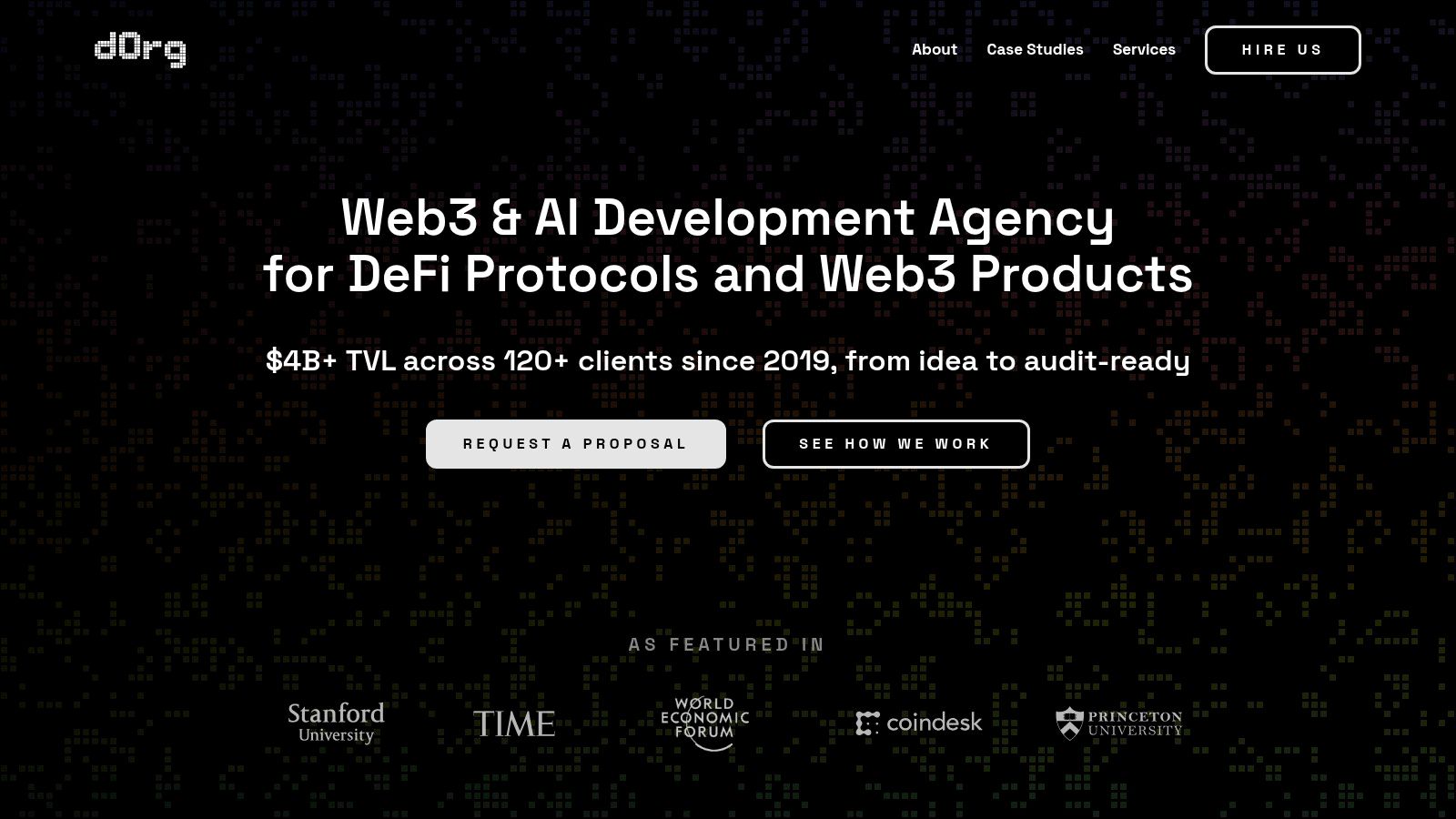
dOrg fits startups and DAOs that need senior Web3 capability without hiring a permanent team immediately. Its cooperative structure and sprint-based engagements give freelancers a delivery environment with shared technical ownership, rather than an isolated ticket backed by unclear architecture. An embedded tech lead and project manager also give clients a clearer route for decisions, reviews, and accountability.
The work can produce stronger career evidence than a narrow Solidity task. Engagements may cover architecture, governance, tokenomics, mechanism design, and end-to-end product engineering. Those responsibilities give candidates concrete material for interviews and proposals: explain why a design was chosen, how requirements became contract behavior, how QA was managed, and which risks were identified before audit preparation.
Where collaboration pays off
dOrg suits product teams prepared to join planning and review cycles. A vague brief followed by client silence is likely to create delays, because the model depends on active decisions about priorities, architecture, and acceptance criteria. Before applying, ask how sprint priorities are set, who approves technical choices, how code review operates, and whether the role could grow into ownership of a subsystem.
Use those answers to judge project fit and shape the proposal. A convincing candidate can describe how they would clarify scope, record assumptions, and deliver work that another engineer can review. The interview may also test communication, asynchronous delivery, technical judgment, and disagreement handling. Give a specific example of surfacing a risk early, documenting the trade-off, and keeping delivery on track without bypassing review.
Turn discovery into repeat work
dOrg can also suit developers who want freelance flexibility with a possible longer-term path. A strong engagement may lead to references, wider protocol exposure, and clearer proof of dependable delivery. Confirm availability and timing before promising a start date, since member schedules can affect capacity.
Pros
- Team structure: A tech lead and project manager clarify ownership and decisions.
- Security orientation: Audit-ready QA practices strengthen delivery evidence and portfolio material.
- Broader scope: Architecture, governance, mechanism design, and contracts support richer career proof.
- Conversion potential: Strong contractors may have a route into longer-term employment.
Cons
- Boutique capacity: Availability can depend on member schedules.
- Engaged-client model: Teams must participate rather than expect a passive vendor relationship.
Website: dOrg
3. Protofire
Protofire fits freelancers who want technically demanding protocol work rather than a small, isolated MVP. Its services cover smart contracts, infrastructure, rollups, appchains, explorers, indexing, maintenance, and internal audit hardening. Work spans EVM networks, Solana, and Cardano, so candidates may be judged on systems knowledge, operational discipline, and chain-specific trade-offs, not only Solidity syntax.
Start by identifying the actual engagement. Is the client hiring for contract implementation, protocol architecture, chain integration, deployment infrastructure, or post-launch support? That distinction should shape both your portfolio and proposal. A developer presenting only frontend-facing token features will struggle to persuade a team responsible for execution environments, indexing, automation, or cross-chain assumptions.
A practical proposal names the risks before discussing delivery speed. Describe the system boundary, dependencies, testing approach, and the decisions that require client input. If your experience involves a bridge, vault, lending system, or rollup component, explain its trust model and exactly what you owned. Feature implementation is useful evidence, but it does not by itself prove audit expertise.
Make systems work visible
Protofire's DeFi and infrastructure focus rewards portfolio material that connects contracts to the surrounding stack. Show deployment scripts, event design, test strategy, monitoring assumptions, and failure handling. During an interview, be ready to explain how an incorrect configuration, unavailable node, failed transaction, or unexpected event affects operations.
AI tools can support repetitive investigation and scaffolding, but human review remains part of the job. The Solidity Developer Survey 2025 reports that 88% of respondents use AI tools at least monthly, while 45% distrust AI output. Use that finding to frame your process: validate generated code, test edge cases, inspect dependencies, and reject suggestions that introduce unsafe assumptions. A short example of catching and correcting generated code is stronger than a general claim about productivity.
Convert delivery into continuity
Protofire's node operations and monitoring work may create recurring engagements after the initial release. Ask who owns alerts, incident response, deployment permissions, upgrades, and maintenance. Those questions expose operational scope early, improve pricing, and show decision-makers that you understand what keeps a protocol usable after deployment.
Pros
- Wide technical range: EVM, Solana, Cardano, rollups, appchains, and indexing support varied career development.
- Security evidence: Internal review practices can strengthen delivery proof.
- DeFi depth: The work suits developers interested in protocol primitives and infrastructure.
- Continuity: Node operations and monitoring may lead to post-launch work.
Cons
- Timezone coordination: A global team requires clear handoffs and meeting planning.
- Specialization bias: Gaming or consumer NFT portfolios may match fewer engagements.
Website: Protofire
4. LimeChain
LimeChain is a useful benchmark for freelancers pursuing production smart contracts, cross-chain systems, DeFi products, and enterprise tokenization. Its security-first positioning changes what a convincing proposal must contain. Show how you move from specification and threat modeling to testing, review, deployment, and support. A fast implementation matters less if the client cannot see how risks will be controlled.
The buyer changes the pitch. A startup may want a focused contract build and a practical release plan. An institutional client may require governance, integration planning, documentation, and stakeholder review. The same Solidity experience should be framed around the person who owns the risk and approves the release.
Price the scope, not just the coding
Market guides place freelance smart contract rates at roughly $75 to $125 per hour for junior freelancers and $350 to $500 or more per hour for expert specialists. They also describe custom smart contract builds around $10,000 to $30,000, with audits around $10,000 to $200,000 or more, depending on codebase size and scope, as summarized in this freelance Web3 contractor rate guide. These figures are not a quote for a specific engagement. They show why proposals should separate coding, assurance, review depth, and liability rather than offer one unexplained hourly figure.
A migration, bridge, or protocol change requires more discovery than a small feature. Ask whether the client expects independent audit coordination, formal verification, monitoring, or post-launch fixes. If audit-grade delivery is expected, list those activities, dependencies, and approval points in the proposal.
Turn institutional work into career evidence
LimeChain's institutional focus can help a freelancer build stronger career evidence. Document decisions, risks, review findings, and stakeholder approvals so future clients can assess delivery judgment, not only Solidity syntax. The trade-off is schedule uncertainty. Bridge and protocol scopes can expand, while EU-based collaboration may require planned overlap for US teams.
Use a narrow case study in outreach: the risk, the decision, the evidence, and the result. That format gives decision-makers a reason to discuss a broader engagement after the initial scope.
Pros
- Security-first delivery: Fits freelancers who can explain review and release discipline.
- Protocol experience: DeFi, bridges, and tokenization support credible portfolio material.
- Flexible buyer fit: Startup and enterprise work expose developers to different procurement expectations.
Cons
- Longer protocol scopes: Cross-chain work can extend timelines.
- Timezone planning: US teams may need scheduled overlap with the EU team.
Website: LimeChain
5. Labrys
Labrys is a useful target for freelancers who want to sell product responsibility, not only Solidity implementation. Its secure-by-design process connects specification, coding, review, and QA, while its work includes audited EVM systems and user-facing Web3 products. That combination gives you a stronger pitch to decision-makers who need contracts, wallets, APIs, deployment environments, and testing to work together.
Use Labrys's public work in stablecoins, real-world asset tokenization, and cross-chain messaging to choose a credible portfolio angle. Avoid repeating those labels without proof. Show the assumptions behind an asset model, authorization rules, message validation, upgrade decisions, test boundaries, and failure handling for external dependencies. A focused repository or case study makes discovery easier because clients can judge your reasoning before a call.
Test product judgment, then sell delivery
A strong interview answer should connect contract behavior to user outcomes. Explain wallet flows, failed transactions, indexing, permissions, and the frontend's contract assumptions. Demonstrate how unexpected input is handled and how the team would monitor or correct a release. A polished demo helps, but clear boundaries around your ownership help more when the client is assessing delivery risk.
Prepare for questions on reentrancy prevention, testing depth, EVM execution, and deployment pipelines. The blockchain developer roadmap covers gas, storage layout, execution, and testing, which are useful areas to review before technical interviews. In a proposal, connect each skill to an outcome, such as fewer release surprises, clearer QA handoffs, or safer contract integration.
Make async collaboration part of the proposal
Labrys operates from Australia. US-based freelancers and clients should agree on response windows, review periods, escalation paths, and the work that requires live overlap. APAC timezone differences can support productive handoffs when documentation is disciplined. They create friction when approvals, incident decisions, or scope changes depend on an unavailable person.
Convert a successful first engagement into longer-term work by leaving usable documentation, a release checklist, and a short list of follow-up risks. That gives the client a concrete reason to retain you for maintenance, monitoring, or the next product phase.
Pros
- Product alignment: Fits developers who understand contracts and dApps.
- Secure lifecycle: Supports a clear specification, review, and QA narrative.
- Relevant domains: Stablecoins, RWA tokenization, and cross-chain work can strengthen specialization.
Cons
- Timezone overlap: US teams need an explicit async operating model.
- Boutique capacity: Specialized teams may not fit every start date.
Website: Labrys
6. ChainSafe
ChainSafe fits freelancers who want work beyond isolated application contracts. Its scope spans smart contracts and audits alongside cross-chain research, protocol clients, validators, nodes, and infrastructure. That breadth makes project selection part of the application. Decide whether the role calls for a Solidity implementer, protocol engineer, security reviewer, or infrastructure contributor before you pitch.
Lodestar and Sygma show the level of evidence that can help in senior screening. Hiring teams may look for reasoning about interoperability, message passing, client behavior, key management, and failure modes. A deployed token alone says little about readiness for bridge or protocol work. Show the system around the contract, including assumptions, dependencies, and operational limits.
Use the interview to test project fit
ChainSafe can be a poor match for a basic MVP because its specialist processes and infrastructure scope may exceed the project's needs. For complex engagements, present threat models, integration tests, deployment procedures, incident considerations, and clear ownership boundaries. State what you did not own. That precision helps decision-makers assess risk without guessing.
Freelancers may be screened for Solidity, blockchain architecture, security fundamentals, Hardhat, Foundry, Slither, MythX, Docker, GitHub Actions, and related delivery tooling, as reflected in current blockchain freelance job requirements. A tool list is weak evidence on its own. Tie each important tool to a repository, pipeline, review note, or deployment decision, then explain the trade-off it addressed.
Use the interview to clarify access controls, repositories, environments, review gates, and release authority. Enterprise procedures can delay the first sprint, particularly for infrastructure or bridge systems. Ask who approves changes, who handles incidents, and which environments you can access. These answers reveal whether the promised responsibility matches the authority provided.
A well-run engagement can lead to audit support, maintenance, monitoring, or later protocol work. Leave clear decisions and usable delivery records so the client can see the value of retaining you.
Pros
- Layer coverage: Protocol, contract, application, and infrastructure work support broad progression.
- Security culture: Audit and review experience raises the standard for engineering evidence.
- Cross-chain depth: Strong fit for developers moving beyond single-chain feature work.
Cons
- MVP mismatch: Complex processes may be excessive for a small prototype.
- Onboarding time: Enterprise procedures can delay the first sprint.
Website: ChainSafe
7. Nethermind
Nethermind suits freelancers pursuing protocol-level credibility, advanced DeFi work, formal verification, or Starknet and Cairo specialization. Its association with the Ethereum execution client gives the environment a strong infrastructure orientation, while its development, research, security, and monitoring capabilities cover more than application contracts.
That makes the interview less about whether you can produce a working function and more about whether you understand execution behavior and system constraints. Prepare to discuss gas, storage, testing, deployment, formal methods, and monitoring in concrete terms. If you're positioning for Cairo or Starknet work, show that you can learn a different execution model rather than presenting EVM habits as universal.
Build for advanced screening
Nethermind's research-led setting favors a portfolio with readable reasoning. Include a concise architecture note, test strategy, known limitations, and deployment context. If you performed an optimization, explain the constraint and the trade-off. If you found a vulnerability, describe the root cause and the regression test without exposing confidential client details.
Availability can be a practical issue. High-demand teams may have longer lead times around major network events, and a more formal process may feel heavy compared with a small freelance client. That isn't a reason to avoid the opportunity. It is a reason to clarify start dates, expected interview stages, and the level of independence attached to the role.
Use the Nethermind remote worldwide general application when your profile fits the wider engineering environment rather than a single posted contract.
Pros
- Protocol lineage: Strong fit for Ethereum, L2, rollup, and DeFi progression.
- Security integration: Formal verification and monitoring broaden the career path.
- Non-EVM option: Cairo and Starknet work can create a differentiated specialization.
Cons
- Lead-time risk: Demand may affect availability.
- Process weight: The environment may be more structured than a small freelance engagement.
Website: Nethermind
8. OpenZeppelin
OpenZeppelin is most relevant when your freelance career is moving from implementation toward security ownership. Its Contracts libraries, security services, upgrade tooling, contract generation tools, advisory work, and post-deployment coverage reflect the standards buyers use when they want to reduce risk before an audit. A developer who wants to work in that orbit needs to demonstrate secure design, not just familiarity with standard components.
The career funnel here starts with proof. Show that you know when to use established patterns, when they don't fit, and how you test the boundary. Explain access control, upgrade authorization, initialization, storage compatibility, paused states, oracle assumptions, and integration risks. Reusing a library is not the same as understanding the threat model around it.
Make security visible before the audit
OpenZeppelin's continuous security model and embedded expertise are useful benchmarks for pitching. A client may not need a full audit immediately, but it may need architecture review, threat modeling, test planning, or pre-audit hardening. Scope those activities separately from feature coding so the client understands what it is buying.
Security-led engagements can cost more and take longer than rapid prototypes. That trade-off is appropriate when the system handles value or has upgrade and governance complexity. It is less appropriate when a founder only wants a disposable proof of concept. Ask what the code will do after the prototype, who can deploy it, and whether the team has budgeted for independent review.
For candidates, the senior smart contract auditor opportunity at SigintZero illustrates the kind of adjacent role to watch as auditing and engineering experience compound.
Pros
- Pattern expertise: Strong familiarity with common EVM designs and risks.
- Scalable security: Architecture advice, build support, audits, and post-deployment work cover multiple career stages.
- Long-term relevance: Security programs can lead to recurring advisory or embedded work.
Cons
- Premium positioning: The model may exceed an early MVP budget.
- Slower prototypes: Security gates can extend delivery compared with quick experimentation.
Website: OpenZeppelin
9. Zokyo
Zokyo fits projects where engineering, security, token economics, and compliance need to connect. That combination is useful for freelancers who want to move closer to product ownership or advisory work, because many real engagements fail at the handoff between contract code, token design, application integration, security review, and regulatory planning.
The single-vendor model can simplify coordination for a client, but it also raises the standard for role clarity. Ask whether you're joining the engineering squad, the security team, the product group, or a specialist review. A broad provider may have the right expertise while still needing time to assemble the correct team.
Pitch beyond Solidity
A strong proposal for this environment explains how your contract decisions affect token behavior, application integrations, testing, and launch operations. If you have worked with wallets, L1 systems, DeFi protocols, or compliance-sensitive product requirements, describe the interface between those areas. Don't claim legal expertise unless you have it. State where legal or compliance specialists should review assumptions.
The work may include audits, penetration testing, and formal verification, so interview preparation should cover both implementation and review discipline. Be ready to explain how you reproduce a finding, assign severity, write a regression test, and communicate a fix to non-specialist stakeholders. That communication skill often separates a useful reviewer from a developer who only reports a problem.
Choose the right engagement shape
A dev-only shop may be cheaper for a narrow feature. Zokyo's broader scope becomes more valuable when the client wants one partner across product, security, token economics, and compliance. The extra advisory work can add cost and scheduling complexity, so define the decision rights and deliverables before coding begins.
Pros
- Unified capability: Product, security, token design, and compliance can sit within one engagement.
- Ecosystem breadth: Work across L1s, DeFi, wallets, and related systems supports varied experience.
- Advisory progression: Developers can build communication and risk-assessment skills.
Cons
- Squad scheduling: The right specialists may not be available immediately.
- Broader costs: Compliance and advisory work adds value but may exceed a dev-only budget.
Website: Zokyo
10. LeewayHertz
LeewayHertz is a practical fit for freelancers who want to work where Web3 meets enterprise software. Its blockchain practice includes smart contracts, NFT marketplaces, DEXs, bridges, enterprise systems, and broader web, mobile, AI, integration, and data engineering. That mix can appeal to organizations that need blockchain features to fit an existing operating model rather than exist as a standalone protocol experiment.
The main hiring risk is role dilution. A broad studio may have excellent Web3 capability, but you should confirm who will write and review the contracts. Ask for the assigned senior engineer, the security process, chain experience, deployment ownership, and the expected split between blockchain and conventional product work.
Sell integration judgment
Enterprise buyers care about governance, permissions, data flow, and operational fit. A proposal should explain how the contract connects to identity, backend services, reporting, and existing workflows. If your portfolio includes automation or fintech work, describe the business process you improved and the controls you preserved. A list of chains won't answer an enterprise buyer's main concern, which is whether the system can be operated responsibly.
US presence can simplify communication for US clients, but a broader technology focus means the freelancer must verify staffing. Don't assume a blockchain logo means a dedicated protocol team. Request a delivery plan with named roles and explicit review responsibility.
Pros
- Enterprise fit: Useful for projects involving governance, integrations, and established workflows.
- Cross-functional delivery: Web, mobile, AI, data, and Web3 teams can support a complete product.
- Operational perspective: Smart contracts can be connected to real business processes rather than isolated demos.
Cons
- Staffing ambiguity: Confirm that experienced Web3 engineers will own the contract work.
- Budget pressure: A full-service US-oriented vendor may not suit an early-stage founder seeking the lowest cost.
Website: LeewayHertz
Top 10 Smart Contract Freelance Resources Comparison
| Service / Core Focus | Key USP ✨ | Quality ★ | Target 👥 | Value/Price 💰 |
|---|---|---|---|---|
| 🏆 Blockchain Jobs – Web3 job board | Niche, category-tagged listings + Recently Added feed; fast employer posting ✨ | ★★★★☆ | Crypto-native job seekers & hiring teams | 💰 Low–Med, targeted reach |
| dOrg – Dev cooperative | Embedded tech lead & PM, sprint-based squads; contract→hire pathway ✨ | ★★★★☆ | Startups, DAOs needing senior Web3 engineers | 💰 Medium, senior talent |
| Protofire – Multi-chain engineering | End-to-end dev + in-house audit hardening across EVM & non-EVM ✨ | ★★★★☆ | DeFi infra, rollups, cross-chain projects | 💰 Medium–High |
| LimeChain – Blockchain studio | Security-first smart contracts, cross-chain & enterprise delivery ✨ | ★★★★☆ | Startups & institutional protocol teams | 💰 Medium–High |
| Labrys – Product & QA studio | Secure-by-design lifecycle, audited/test-covered EVM products ✨ | ★★★★☆ | dApp teams prioritizing UX + security | 💰 Medium |
| ChainSafe – Multichain R&D | Protocol client & cross-chain stacks + infra/validator services ✨ | ★★★★☆ | Protocol teams, infra-heavy projects | 💰 High |
| Nethermind – Engineering & research | Ethereum client lineage, Cairo/Starknet expertise, formal verification ✨ | ★★★★☆ | L2/rollup & advanced DeFi research teams | 💰 High |
| OpenZeppelin – Security leader | Continuous security programs, contracts libraries & post-deploy support ✨ | ★★★★★ | Any team needing top-tier security | 💰 Very High |
| Zokyo – Security + product | Combined dev, audits, tokenomics & compliance advisory ✨ | ★★★★☆ | Teams needing dev + security + compliance | 💰 Medium–High |
| LeewayHertz – US software studio | Enterprise-grade Web3 dev, integrations & cross-functional teams ✨ | ★★★☆☆ | Enterprises & US-based organizations | 💰 Medium–High |
Turn the Right Resource Into Your Next Engagement
A resource only becomes valuable when it improves a decision. Start with focused listings and specialist networks, then shortlist opportunities by contract scope, chain, client credibility, review expectations, deployment responsibility, and the likely path after launch. A role that sounds exciting but has no owner for testing, audits, access control, or incident response isn't automatically a career opportunity. It may be an unmanaged liability.
Use interviews to test the client as carefully as the client tests you. Ask who wrote the specification, what code already exists, who can approve a deployment, how upgrades are governed, what an independent reviewer will receive, and how changes are documented. Listen for whether the team distinguishes a prototype from production software. Mature clients may not know every technical answer, but they should be willing to assign ownership and fund the work required to discover the answer.
Pricing should follow that clarity. A small feature, a migration, a new protocol, a bridge, and a security review carry different assumptions. Put deliverables, exclusions, review rounds, testing, deployment support, documentation, and post-launch availability into the proposal. Hourly pricing can work for exploratory work, while fixed milestones can create better control for defined deliverables. Don't accept a fixed price for an undefined threat surface.
Your pitch should be short, specific, and evidence-led. Lead with the client's problem, name the relevant system, and link to a repository or engagement that proves similar ownership. Explain one design choice, one security consideration, and one delivery result without exposing confidential details. Hiring managers want to know whether you can make sound decisions when the brief changes, not whether you can repeat every technology in the stack.
A strong portfolio is built around explainable repositories. Include tests, deployment context, review notes, architecture diagrams, and a clear statement of what you personally owned. Solidity remains the broadest-market skill combination with Ethereum in independent survey data, where 83.6% reported Solidity usage and 87.3% reported Ethereum usage, while Hyperledger Fabric appeared among 25.5% of respondents, according to the Solidity developer survey. Those figures can guide specialization, but they don't replace proof that you can secure and operate what you build.
Framework choices matter too. The Upwork smart contract freelancer cost guide cites the Solidity Developer Survey 2025, where 57% use Foundry as their primary framework, 33% use Hardhat, and 70% use ethers.js. Treat those tools as ways to demonstrate workflow, not as identity markers. A good interview answer connects Foundry or Hardhat to test coverage, deployment safety, debugging, and review.
Rates should reflect experience, specialization, and risk. A 2026 benchmark based on 150 or more vetted developer contracts across 20 countries and five regions places global freelance blockchain developer pricing from $27 to $105 per hour, with senior developers at $45 to $94 per hour and strong senior specialists reaching $105 per hour, as reported in this blockchain developer rate benchmark. Smart contract work can command a premium because errors in financial logic can create serious losses, but your proposal still needs to explain what the rate includes.
The demand history helps explain why specialist profiles can attract attention. An analysis of blockchain salary benchmarks reported that blockchain skills grew more than 6,000% year over year in Q1 2018, while Burning Glass Technologies identified 5,743 mostly full-time openings requiring blockchain skills, a 320% increase. Those are historical signals, not a guarantee of current freelance volume. Your practical response should be specialization, visible delivery quality, and a pipeline that doesn't depend on one marketplace.
Track applications, replies, interviews, proposals, follow-ups, and reasons for rejection. After each engagement, request permission to describe your ownership, collect a reference, and ask whether adjacent work exists. Referrals often come from a client who saw you communicate a risk clearly, deliver what you promised, and remain useful after the first release.
For broader discovery beyond Web3-specific boards, this guide to where to find remote roles can help you diversify your search. The goal isn't to apply everywhere. It's to maintain enough qualified conversations that you can reject unclear scope, negotiate sensible terms, and choose work that strengthens your next interview.
Start with one focused opportunity, qualify it rigorously, and prepare evidence before the call. Then deliver in a way that makes the client comfortable introducing you to the next team. That's how freelance smart contract work becomes a career rather than a sequence of disconnected gigs.
Blockchain Jobs brings together fresh Web3 opportunities across engineering, security, DeFi, infrastructure, product, and other specialist categories, including remote and contract roles. If you're building a smart contract developer freelance pipeline, visit Blockchain Jobs to find credible opportunities and turn your technical proof into your next engagement.