Learn Solidity Language: A Career Guide for Web3 Developers
If you want to learn the Solidity language, the journey doesn't start with Solidity itself. It begins with a solid foundation in JavaScript and a clear understanding of how the Ethereum Virtual Machine (EVM) actually works.
This isn't just about learning to code; it's about building the deep, practical knowledge that hiring managers look for and setting yourself up for a real career in Web3.
Your Roadmap from Zero to a Hired Solidity Developer
Becoming a Solidity developer is an exciting move into one of tech's most dynamic fields. But there’s a common mistake I see all the time: eager developers diving straight into writing smart contracts without grasping the fundamentals first.
This "code-first" approach almost always backfires. It leads to frustration, burnout, and a superficial understanding that falls apart the moment you're in a technical interview. A smarter, career-focused path starts with the prerequisites.
Building Your Foundation Before Day One
Before you write a single line of Solidity, mastering two key areas will give you a massive advantage over other junior candidates. Think of these as the non-negotiable building blocks for any serious developer aiming for a top-tier role.
- Get Comfortable with JavaScript: You need a strong command of JavaScript, especially asynchronous programming with Promises and
async/await. Why? Because virtually every decentralized application (dApp) needs a frontend to interact with its smart contracts, and JavaScript libraries like Ethers.js or Web3.js are how you make that connection. Hiring managers expect you to understand the full stack, not just the contract layer. - Understand the EVM Conceptually: You don’t have to be a low-level expert, but you absolutely need to know what the Ethereum Virtual Machine (EVM) is and what it does. It's the global computer that runs your smart contract code. In a job interview, being able to discuss concepts like the call stack, memory, storage, and gas will set you apart and prove you can write efficient, cost-effective code.
This visual shows how these foundational skills are the necessary inputs for effective Solidity development.
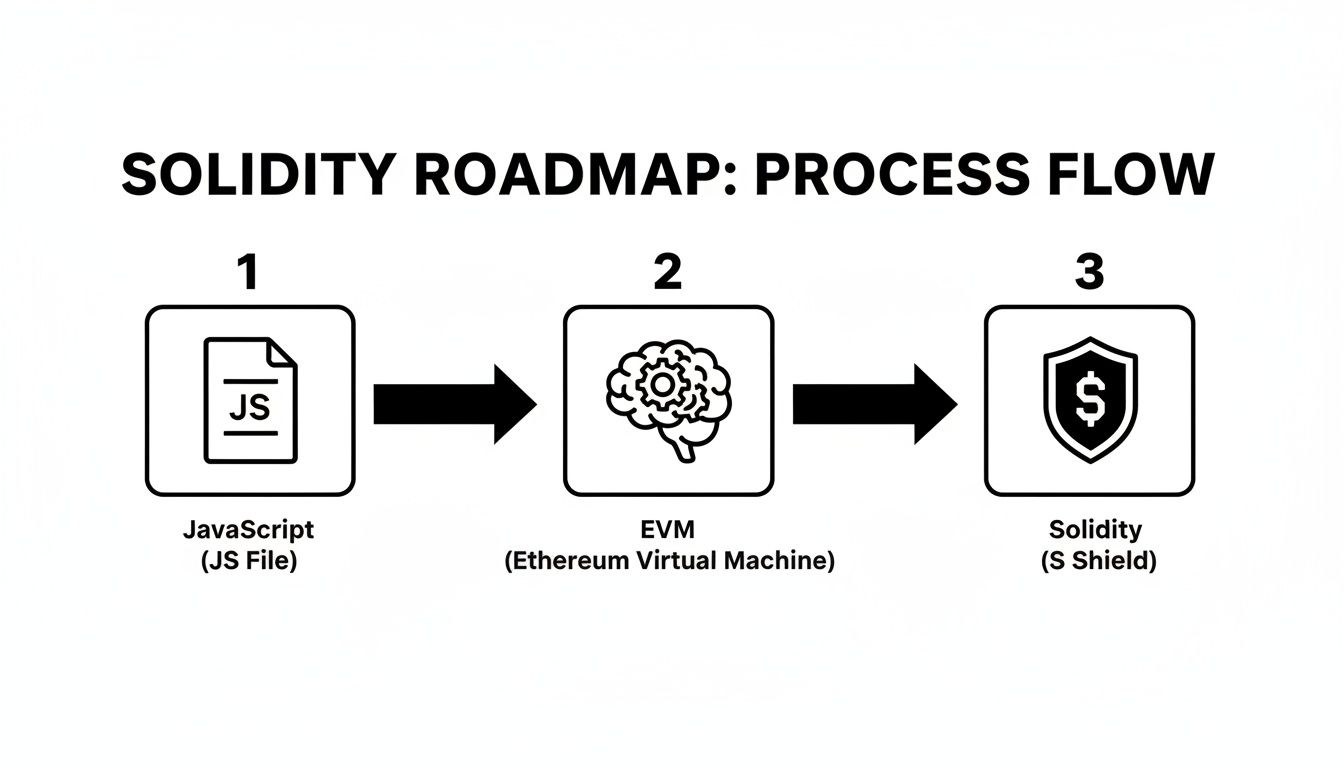
This flow isn't just a diagram; it's the reality of how dApps work. Mastering the pieces before the whole is the key to demonstrating your job readiness.
To help you structure your learning, here’s a high-level look at the path from foundational knowledge to job-ready expertise.
Essential Learning Path for Solidity Developers
| Phase | Core Skills to Master | Why It Matters for Your Career |
|---|---|---|
| Foundation (Pre-Solidity) | JavaScript (Async/Await), EVM Basics (Gas, Storage, Memory), Blockchain Fundamentals (Transactions, Blocks) | Shows you understand the entire dApp ecosystem, not just the contract. This is a huge differentiator in interviews. |
| Solidity Basics | Data Types, Functions, Mappings, Events, Constructors, Inheritance | This is the core syntax and structure. You can't pass a technical screening without a solid grasp of these fundamentals. |
| Intermediate Solidity | Interfaces, Libraries, Error Handling (require, revert), Smart Contract Design Patterns |
You move from writing code that works to writing code that is secure, efficient, and reusable—a key sign of a professional. |
| Advanced Concepts & Security | Assembly, Proxies (Upgradability), Reentrancy Attacks, Integer Overflows, Access Control | This is where you learn to protect assets and build robust systems. Security isn't optional; it's the most critical skill for a smart contract dev. |
| Tooling & Testing | Hardhat/Truffle, Unit Testing (Chai/Mocha), Local Blockchain (Ganache), Deployment Scripts | Proves you can work in a real-world development environment. Writing code is one thing; testing and deploying it is what gets products shipped and what employers hire for. |
| Portfolio & Job Readiness | Build & Deploy 2-3 dApps, Contribute to Open Source, Practice Interview Questions | Your portfolio is your proof. It demonstrates you can apply all the theory to create something tangible, making you a much stronger candidate. |
This roadmap isn't just a checklist; it's a strategy. Each phase builds directly on the last, ensuring you have the comprehensive skills companies are actively hiring for.
Why This Groundwork Matters in Job Interviews
Web3 hiring managers are looking for engineers, not just coders. They don't want someone who can only copy-paste a tutorial contract. They need people who can explain why their code works and how it fits into the bigger picture.
When you can confidently walk an interviewer through how a JavaScript frontend triggers a transaction, how the EVM processes it, and how that updates the state of your Solidity smart contract, you're operating on a different level. That end-to-end understanding is what gets you hired.
This approach also aligns perfectly with market demand. Solidity is the undisputed king, commanding a massive 65% market share of all smart contracts deployed. Its dominance on EVM-compatible chains like Polygon, Avalanche, and Binance Smart Chain makes it the single most valuable language for any aspiring Web3 developer.
Ultimately, mastering the fundamentals means you're not just learning a language—you're building a career. For a clear example of what companies are looking for, check out this job description for a smart contract engineer at Alchemy. You'll see it requires a broad skill set that goes far beyond just writing Solidity code. This roadmap is your first step to confidently meeting those requirements.
Getting to Grips with the Essential Solidity Toolkit
Knowing how to write Solidity is just the start. To build, test, and ship smart contracts that people can actually use, you need to master the professional toolkit. This is what separates a hobbyist from a hireable developer. Hiring managers want to see that you understand the entire workflow, from a quick idea to a secure, deployed application.
The tools you choose say a lot about your development philosophy. In an interview, you won't just be asked what you use, but why you chose it. Let's break down the essential gear.
Your First Stop: The Remix IDE
Every Solidity developer's journey begins with the Remix IDE. Think of it as your training ground. It’s a powerful, browser-based environment that requires zero setup. You can write code, compile it, and even deploy it to a test network right from your browser. This is perfect for learning the ropes without getting tangled in complex configurations.

Remix is incredible for rapid prototyping and debugging small contracts. While it's an indispensable learning tool, you'll quickly outgrow it. For serious, complex projects, you need to graduate to a local setup.
Mentioning Remix in an interview shows you know how to prototype quickly. But if it's the only tool in your arsenal, it might signal to employers that you haven't moved past the tutorial stage into more complex, team-based development.
Graduating to a Professional Local Environment
When you're ready to build real-world dApps for your portfolio, it's time to set up a local development environment. These frameworks are the workhorses of professional Solidity development, offering robust testing, scripting, and project management. The two main players you need to know are Hardhat and Foundry.
Hardhat (JavaScript-based): For a long time, Hardhat has been the industry standard. It uses JavaScript for writing tests and deployment scripts, which is a huge plus if you’re coming from a web development background. Its vast plugin ecosystem makes it incredibly flexible and powerful.
Foundry (Solidity-based): The new kid on the block, Foundry, is gaining serious traction, especially in security-focused circles. Its killer feature? You write your tests in Solidity. This eliminates the mental gymnastics of switching between JavaScript and Solidity, keeping you in the same mindset throughout the entire process.
Being able to intelligently discuss the pros and cons of both shows you’re thinking like a seasoned developer, which is a crucial skill for career progression and acing interviews.
Connecting Your Contracts to the World
A smart contract sitting on the blockchain isn't very useful on its own. You need a way for users to interact with it through a website or app. This is where frontend JavaScript libraries come in—they are the bridge between your user interface and your on-chain logic.
The two titans in this space are Ethers.js and Web3.js.
- Ethers.js: Generally seen as the more modern and lightweight choice, Ethers.js has become the go-to for most new projects. Its API is often described as more intuitive and developer-friendly.
- Web3.js: As the original Ethereum JavaScript library, Web3.js is still everywhere. You'll find it in countless established projects, so being familiar with it is a must for maintaining or contributing to existing codebases.
Proficiency with at least one of these is non-negotiable for getting hired. It proves you understand the full dApp stack. A developer who can explain how they'd use Ethers.js to listen for contract events or trigger a transaction is infinitely more valuable than one who only knows Solidity syntax. Make sure your portfolio projects clearly demonstrate this skill.
Building Smart Contracts That Get You Hired
You can read about Solidity all day, but at some point, you have to ship some code. That’s what hiring managers want to see. Your portfolio isn't just a collection of projects; it's the story of your skills and your proof that you can actually build things.
Let's move past the theory and get our hands dirty. We're going to walk through a project roadmap that does more than just teach you syntax. It’s designed to build a portfolio that answers the only question that matters in an interview: "Can you do the job?"
Your Foundational "Hello World" Contract
Every developer starts somewhere, but we’re going to give the classic "Hello World" a Web3 twist. Your first mission is to write a simple contract that just stores and retrieves a piece of data—a number, a string, anything.
The code itself will be dead simple. The real lesson here is mastering the entire development lifecycle.
- Write the code in Remix IDE. It's browser-based, so you can jump right in without any setup headaches.
- Compile it. Pay attention to what the compiler is doing and the artifacts it produces.
- Deploy it to a testnet. Seriously, don't skip this. Pushing your contract to a network like Sepolia is a huge learning moment.
- Interact with its functions. Use the Remix UI to call your functions and watch the state change.
This simple exercise becomes your first great interview story. You can confidently explain how you deployed code to a public blockchain, what a transaction hash is, and how you verified the contract’s state on a block explorer. It shows you get the whole picture, not just the code.
Showcasing Value Transfer with a Simple Token
Alright, you’ve deployed a contract. Now it's time to make it do something truly blockchain-native: handle value. Your next project is to build a basic token that mimics the core logic of the famous ERC20 standard. This is a big step up because it forces you to think about managing balances and who can do what.
Your token contract should have a few key pieces:
- A
mappingto track who owns how many tokens (mapping(address => uint256)). - A
mintfunction to create new tokens, which should only be callable by you (the owner). - A
transferfunction so users can send their tokens to someone else. - A
balanceOffunction to let anyone check an address's token balance.
In an interview, this project is gold. It’s your proof that you understand how state is managed on-chain. You can explain how mappings work or talk through the security implications of leaving the mint function unprotected. This shows you’re already thinking like a smart contract engineer.
This isn't just a coding exercise; it's a demonstration of your ability to manage on-chain assets. When you can articulate the logic behind your simple token, you're proving you have the foundational knowledge required for DeFi and other high-stakes applications.
Proving Your Grasp of Ownership with an NFT
The final piece of your foundational portfolio is a basic NFT contract, taking cues from the ERC721 standard. This project proves you can manage unique, one-of-a-kind assets—a skill that’s incredibly in-demand.
Building an NFT contract will force you to grapple with a few new ideas:
- Unique Token IDs: Unlike our last token, every single NFT needs its own unique identifier.
- Ownership Tracking: You’ll need a mapping that links each specific token ID to an owner's address.
- Metadata: How do you attach an image or other attributes to your NFT? You'll need a function that returns a URI for each token.
- Safe Transfers: Implement a
safeTransferFromfunction to prevent tokens from being sent to addresses that can't handle them.
This project is a powerful talking point. It lets you clearly explain the difference between fungible (ERC20) and non-fungible (ERC721) tokens, which is a go-to interview question. When you discuss how you handled the metadata, you’re showing a deep understanding of how on-chain logic connects to off-chain assets like JPEGs and JSON files—the backbone of the entire NFT world.
The momentum here is real. With well over 1 million verified smart contracts on Etherscan and tools like Remix making it easier than ever to build, you're stepping into a massive ecosystem. You can dig into some fascinating developer usage statistics to see just how active this space is. These three projects are your entry ticket. They prove you have the practical skills to start contributing from day one.
Understanding Advanced Solidity and Security Patterns
Getting a smart contract to work is one thing. Writing one that can securely handle millions of dollars is a completely different ball game. This is the skill that separates junior developers from the senior candidates commanding top-tier salaries. If you want to be a professional Solidity developer, this is where you earn your stripes.
In a technical interview, this is where the conversation shifts from "can you code?" to "can we trust you with our users' funds?" A single vulnerability can lead to catastrophic losses, so proving you have a deep understanding of security patterns isn't just a bonus—it's a non-negotiable requirement for any serious role.
Learning from the Ghosts of Exploits Past
If you want to write secure code, you have to understand how code breaks. I always tell new developers to study historical exploits. It’s not just an academic exercise; it’s a practical guide to what not to do. Every major hack offers a powerful lesson that interviewers will expect you to know inside and out.
The infamous DAO hack of 2016 is the classic case study. It was brought down by a reentrancy attack, where a malicious contract kept calling a function over and over before the first call had finished, draining funds with each loop.
When I'm interviewing candidates, I often ask about the DAO hack. If they can clearly explain the mechanics and how the Checks-Effects-Interactions pattern prevents reentrancy, it's a massive green flag. It shows they’ve done their homework and understand the why behind modern best practices.
Beyond reentrancy, you need to have a solid grasp of other common pitfalls:
- Integer Overflow and Underflow: This happens when math goes wrong and a number wraps around. Imagine a
uintvariable at0—if you subtract1, it doesn't become negative. It wraps around to the largest possible value for that data type. Modern Solidity versions have some built-in protections, but you need to know when and why this is a risk. - Access Control Flaws: This is a surprisingly common mistake. Functions that should be restricted, like
mintorwithdraw, are left open for anyone on the network to call. A simpleonlyOwnermodifier is a start, but for professional-grade dApps, you need to understand more complex systems like role-based access control.
Mastering Essential Design Patterns
Efficient and secure development isn't about reinventing the wheel. It's about using battle-tested design patterns that senior developers rely on every day. Mastering these is the fastest way to write cleaner, safer, and more gas-efficient code.
The Checks-Effects-Interactions (CEI) pattern is your go-to defense against reentrancy. It’s simple but incredibly effective.
- Checks: Do all your validation up front (e.g.,
require(msg.sender == owner)). - Effects: Update your contract's state before doing anything else (e.g., set the sender's balance to zero).
- Interactions: Call other contracts or transfer funds only after the state is updated.
By changing the state before the external call, you shut the door on any malicious contract trying to re-enter your function with outdated information.
Another critical concept is upgradability. By default, smart contracts on Ethereum are immutable. Once deployed, they’re set in stone. That's a huge issue if you find a bug or need to add a new feature. Proxy patterns solve this by separating the contract's logic from its storage. This lets you "upgrade" the logic code while all the user data stays put. It’s an advanced topic, but even mentioning it in an interview shows you're thinking about the long-term lifecycle of a project.
The Career Impact of Security Knowledge
The Solidity language has evolved significantly. Since version 0.4.0 in 2016, iterative updates have massively boosted security. These improvements have had a real-world impact, reducing reentrancy exploits by 70% in audited contracts, according to reports from ConsenSys. This history shows precisely why staying current with modern security practices is so critical for career growth.
Companies building DeFi protocols, NFT marketplaces, or any dApp with real value at stake are laser-focused on hiring security-minded developers. They aren't just looking for people who can write code; they're looking for guardians of their ecosystem. Job descriptions for these roles almost always list experience with security audits and deep knowledge of common attack vectors.
Take a look at the requirements for a real blockchain security engineer position—these skills are front and center.
Demonstrating your grasp of these advanced topics, from historical hacks to modern design patterns, is how you transition from just another applicant to a top candidate. It’s tangible proof that you have the maturity and foresight to build products that are not just functional, but truly secure.
Turning Your Solidity Skills Into a Web3 Career
You've put in the work and built a solid technical foundation. Now comes the real challenge: translating those Solidity skills into a real-world career. This phase is less about code and more about strategy. It's time to build a compelling case for yourself that proves you're a builder who can contribute from day one.
The job hunt in Web3 is a different beast. A traditional resume is fine, but what really talks is your on-chain activity and public contributions. Your GitHub profile becomes your new resume, and your portfolio projects are your proof of work. This is where you officially shift from learner to doer.

Crafting a Portfolio That Tells a Story
A great portfolio shows a clear progression of your skills. It needs to tell a story that starts with "I get the fundamentals" and ends with "I can build secure, useful dApps." Don't just dump code online—the README files are just as important as the Solidity itself.
For every project, make sure you include:
- A Clear Problem Statement: What problem does this solve? Why did you decide to build it?
- Technical Decisions: Explain why you chose a particular design pattern or tool. Did you consider any alternatives?
- Security Considerations: This is huge. Document the potential vulnerabilities you thought about and the steps you took to mitigate them. This is a massive green flag for any recruiter.
- A Deployed Contract Address: Include a link to the contract on a testnet explorer. This shows you can take a project from an idea all the way to deployment.
This level of detail transforms a simple side project into a powerful talking point for interviews.
Going Beyond Code to Build Your Brand
In Web3, your GitHub is the hub of your professional identity. Treat it that way. Pin your best projects, maintain a clean and professional commit history, and write a bio that clearly states you're a Solidity developer looking for your next opportunity.
Networking is just as crucial. The community is incredibly active on platforms like X (formerly Twitter) and Discord. Jump into technical discussions, ask smart questions, and contribute where you can. You're not just looking for a job; you're becoming a recognized part of the ecosystem.
Your personal brand is what gets you noticed, but your portfolio is what gets you the interview. Focus on building tangible proof of your skills, and then make sure people see it.
The financial incentive for mastering Solidity is substantial, as demand continues to outpace the supply of qualified developers.
Solidity Developer Salary Benchmarks
Salaries for Solidity developers reflect the high-stakes nature of the work. Here’s a general look at what you can expect in the US market as your career progresses.
| Experience Level | Average Annual Salary (US) | Key Responsibilities |
|---|---|---|
| Junior | $120,000 | Writing and testing basic smart contracts, assisting senior developers. |
| Mid-Level | $167,000 | Designing contract architecture, implementing complex logic, gas optimization. |
| Senior | $210,000+ | Leading protocol design, performing security audits, mentoring junior devs. |
As you can see, companies are willing to pay a premium for developers who can build secure, efficient, and reliable smart contracts.
Acing the Interview and Landing the Role
When you finally land that interview, your preparation will make all the difference. Be ready to talk through your projects with confidence. Don't just describe what you built—explain the tough challenges you ran into and how you worked through them.
Get ready for common interview tasks like:
- Live Coding Challenges: You'll likely be asked to write or debug a simple smart contract on the spot.
- Code Reviews: They might give you a piece of code and ask you to spot the security flaws. This is where knowing things like the Checks-Effects-Interactions pattern really shines.
- Conceptual Questions: Expect to be quizzed on the EVM, gas optimization, and common attack vectors like reentrancy.
Often, how you communicate your thought process is more important than getting the perfect answer immediately. Show the interviewer how you think and approach problems. It proves you have value beyond just your ability to write code.
When you're ready to start your search, checking out the top Web3 companies actively hiring is a great way to see what skills are currently in high demand.
Common Questions About Learning Solidity
When you’re diving into a new skill, a lot of questions pop up. Let’s tackle some of the most common ones I hear from developers starting their journey into Solidity, with an eye toward what really matters for landing a job.
How Long Does It Take to Learn Solidity?
There’s no magic number, but if you already have a solid JavaScript background and can dedicate real time to it, you can become proficient in roughly 3-6 months.
"Proficient" doesn't just mean you've finished a few tutorials. For hiring managers, it means you can build, test, and deploy a dApp from scratch and intelligently discuss the security trade-offs you made along the way. That’s the bar for being job-ready.
Is Solidity Still a Good Language to Learn?
Without a doubt. Its future is directly tied to the Ethereum Virtual Machine (EVM), which is the undisputed king of smart contract platforms.
EVM-compatible chains secure over 80% of the $200B+ locked in DeFi. And what language powers that ecosystem? Solidity. It’s used to write an incredible 65% of all smart contracts on the blockchain. You can dig into more of these programming language statistics to see just how dominant it is.
Learning Solidity gives you a direct line into the biggest and most valuable corner of the Web3 job market. It's simply the most sought-after skill for building on the blockchain.
When an interviewer asks why you chose Solidity, you can point to these metrics. It shows you've analyzed the market and are making a strategic career choice, not just following a trend.
What Is the Hardest Part of Learning Solidity?
It's not the syntax. The real challenge is rewiring your brain to think with a security-first mindset.
In regular web development, you can push a patch if you find a bug. With smart contracts, a single mistake can be permanent and lead to catastrophic financial losses. The stakes are just higher.
In an interview, talking about security patterns like the Checks-Effects-Interactions pattern or explaining the dangers of a reentrancy attack will impress a hiring manager far more than just writing clever code. It proves you have the maturity and discipline required for the job.
Do I Need to Be an Expert in Math?
No, you don't need a degree in advanced mathematics or cryptography. For most dApp development—whether it’s for DeFi or NFTs—a good grasp of basic arithmetic and logic will get you by just fine.
What you do need, however, is a deep respect for how computers handle numbers. Understanding concepts like integer overflow and underflow isn't an abstract academic exercise; it's a critical security practice. That’s the kind of practical, security-focused knowledge that gets you hired.
Ready to find your place in the future of tech? Blockchain Jobs is your dedicated hub for discovering top-tier roles in Web3, from engineering and security to product management and marketing. Start exploring opportunities and build your career today at https://blockchain-jobs.com.