
Find Web3 Job Openings: A 2026 Strategic Guide

You've probably already done the obvious things. You searched LinkedIn. You skimmed a few crypto company pages. You found job titles that looked promising, then read descriptions that felt half startup, half research lab, and half internet subculture. That's normal in Web3. The hiring market is real, but the signals are noisy.
The opportunity is bigger than many candidates assume. Coincub's Web3 Jobs Report 2025 says the sector added 66,494 new roles, a 47% rebound from 2024, and remote roles reached 26,925, up 40% year over year. That matters because it confirms two things. First, Web3 hiring didn't disappear. Second, it still favors distributed teams more than a lot of traditional tech hiring does.
Web3 job openings are often approached the wrong way. They treat them like regular tech roles with a crypto wrapper. Hiring teams usually don't. They want evidence that you can operate in open ecosystems, work asynchronously, and contribute without a lot of hand-holding. If you want a practical place to track the market while you build that profile, keep a focused resource like Blockchain Jobs in your rotation, but don't stop at browsing listings.
The Lay of the Land in Web3 Careers
A strong candidate lands in Web3, reads ten job descriptions, and gets mixed signals. One role asks for startup speed, another expects open-source credibility, and a third reads like a research brief written inside a Discord server. The confusion is normal. The mistake is treating that ambiguity like chaos instead of a hiring filter.
Web3 attracts people who want sharper ownership and clearer impact. Engineers want to work closer to infrastructure. Product leaders want a tighter feedback loop with users and contributors. Marketers, operators, legal counsel, and finance hires often come in for the same reason. The work is messier than traditional tech, but the scope is broader and the feedback on your decisions is immediate.
That changes how teams evaluate candidates.
A clean resume still matters, especially for showing scope and progression. It rarely gets someone hired by itself. Hiring managers want proof that you can contribute in public, work without heavy process, and make sound decisions when the spec is incomplete. In practice, that means the candidate with visible work usually beats the candidate with stronger polish.
What the market actually rewards
Web3 job openings are not limited to smart contract engineering. The demand is spread across product, ecosystem growth, operations, compliance, developer relations, content, support, and analytics. The market is also remote by default more often than many adjacent tech sectors, which expands access but raises the bar on written communication, self-direction, and time-zone discipline.
That is why a generic application underperforms. Teams are hiring for output, judgment, and context fit.
A focused search helps you see that pattern faster. Reviewing active roles on a specialized board like Web3 job openings at Blockchain Jobs makes the differences obvious. The titles vary, but the stronger postings usually point to the same underlying need. Ship useful work, communicate clearly, and understand the product, protocol, or community you want to join.
Why strong candidates still miss strong roles
Good applicants often lose ground for reasons that are easy to fix:
- They pitch interest instead of relevance. “Passionate about crypto” does not explain what problem they can solve.
- They apply to titles, not business needs. A team may post for growth, but the underlying gap is lifecycle messaging, onchain analytics, or partner onboarding.
- They ignore public signal. In Web3, thoughtful writing, shipped side projects, governance participation, and contribution history carry weight.
- They misread volatility. Market noise affects sentiment. It does not remove the need for product execution, legal review, security, support, and operations.
The hiring manager's question is simple. Can this person help us make progress soon, with limited hand-holding and high context requirements?
Candidates who answer that question clearly get interviews. Candidates who rely on resume language alone usually do not.
Hunting for Opportunities Beyond Mainstream Job Boards
If your entire search strategy is “apply on LinkedIn and wait,” you'll miss a big share of high-signal web3 job openings. Crypto-native teams often publish jobs in places that sit closer to the actual work. That means niche boards, company career pages, Discord communities, governance forums, and the social feeds of operators who mention hiring before a polished description exists.
A broader search surface gives you more volume. A sharper search surface gives you better odds.
Start with specialized boards, then move closer to the source
Specialized boards save time because they aggregate relevant openings across engineering, product, legal, operations, marketing, and support without forcing you to filter through unrelated tech jobs. They're useful for identifying active hiring patterns, title variations, and which companies are staffing multiple functions.
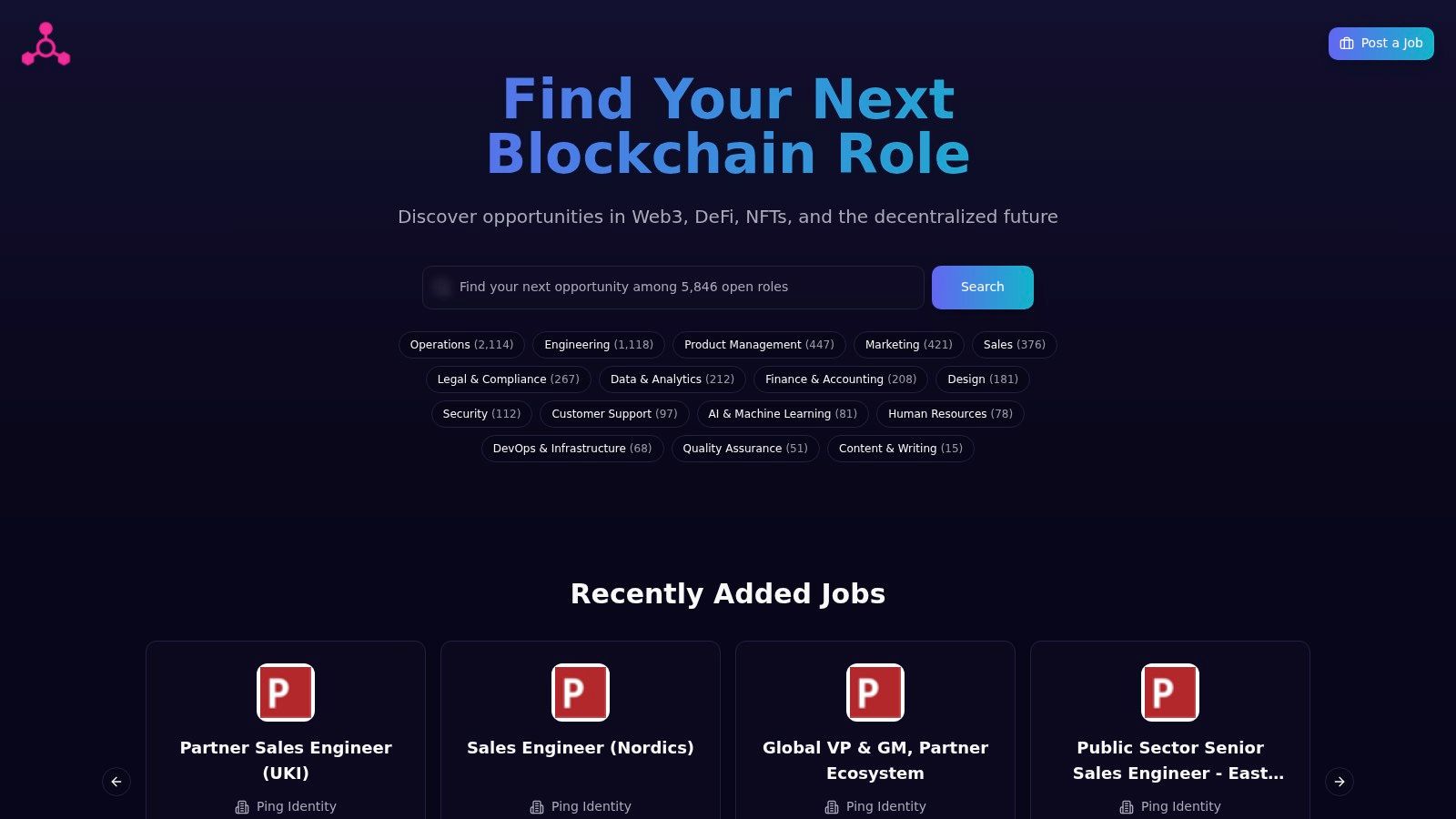
After that, go one level deeper and track Web3 companies that are actively hiring. The reason is simple. Company pages reveal more than the job title. You can see whether a team is building out legal before expansion, hiring growth before product maturity, or staffing developer relations to support ecosystem adoption. That context changes how you pitch yourself.
A company adding several non-engineering roles usually signals a different stage than a team only hiring protocol engineers and auditors.
The highest-signal roles often appear before the formal listing
Good Web3 opportunities often show up in community channels first. Founders and team leads mention needs in Discord. DAO contributors ask for help in governance forums. Ecosystem leads post on X when a team needs someone “yesterday.” If you only search formal listings, you'll arrive after the warmest candidates have already started conversations.
Use a layered search process:
- Scan curated boards for active demand and recurring job families.
- Check target company career pages for official openings and hiring patterns.
- Follow core contributors and team leads on X to spot informal hiring signals.
- Read DAO governance forums to understand where labor demand is emerging.
- Join relevant Discord servers and pay attention to contributor calls, grant programs, and community requests.
The best Web3 role for you might not be the one with the cleanest job description. It might be the problem a team keeps talking about in public.
What works better than mass applying
The strongest approach is targeted repetition. Pick a narrow slice of the market. For example, on-chain analytics roles, protocol product roles, compliance openings, or developer relations jobs. Then build a watchlist of companies, communities, and operators in that slice.
A simple comparison helps:
| Search method | What it gives you | Main weakness |
|---|---|---|
| Mainstream job boards | Broad visibility | Low signal, high competition |
| Specialized Web3 boards | Better relevance | Still mostly formal listings |
| Company career pages | Direct source of truth | Easy to miss early-stage needs |
| Discord and governance forums | Early hiring signals | Requires real participation |
| X and community feeds | Fastest pulse on demand | Noisy without curation |
Most candidates stay in the first row. Better candidates work across all five.
Building Your Proof-of-Work Portfolio
A resume gets you considered. Proof of work gets you taken seriously.
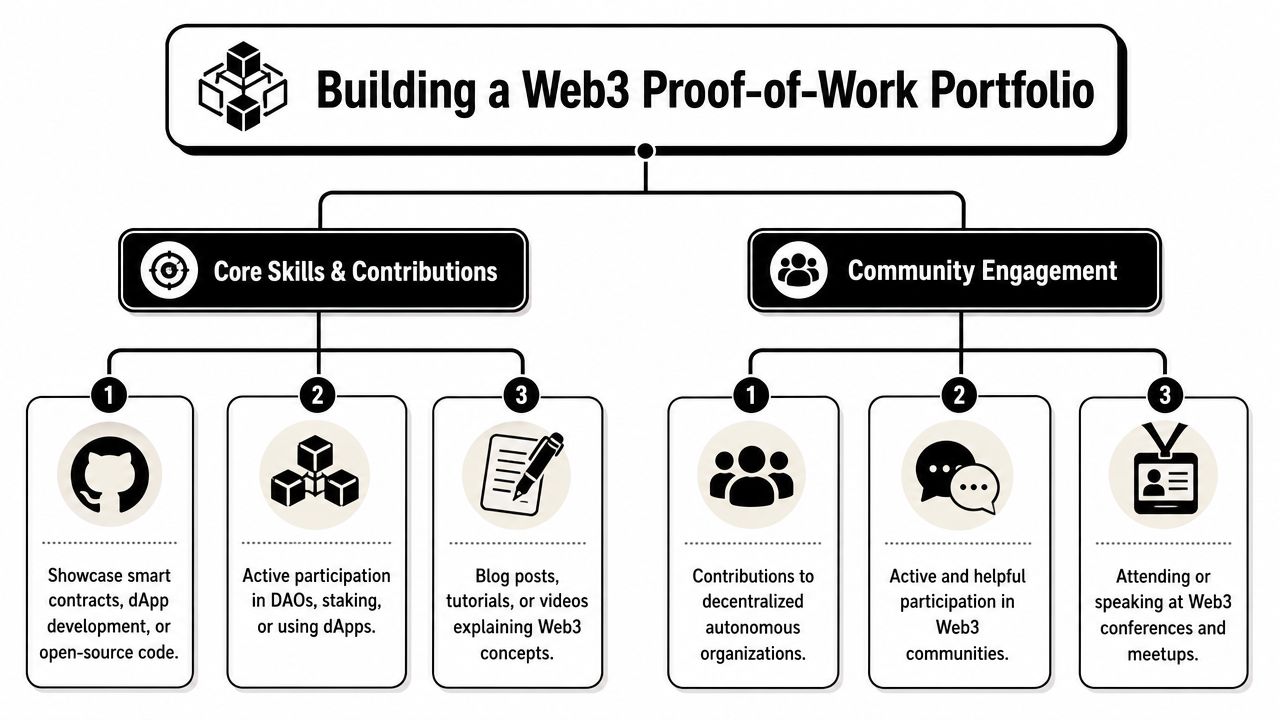
That distinction matters because Web3 hiring still leans heavily on visible output. Consensys's workforce survey found that 40% of respondents entered Web3 by applying for jobs, while a combined 35% came from contributing to projects or through referrals. Direct application still matters. So does showing public artifacts that make your skill easy to verify.
Your resume still matters, but it needs a different job
Your resume shouldn't try to prove everything. Its job is to frame your relevance fast. Hiring managers want to understand the work you've shipped, the environments you've operated in, and the kinds of problems you can solve without being told twice.
For Web3 roles, tighten your resume around:
- Shipped outcomes: product launches, growth systems, audits, dashboards, docs, integrations, governance work
- Relevant technical context: Solidity, Rust, TypeScript, SQL, smart contract testing, wallet UX, token incentives, compliance workflows
- Public-facing work: GitHub repos, forum posts, DAO proposals, conference talks, blog posts
- Operating style: async collaboration, cross-functional execution, community-facing communication
If your background is mostly Web2, don't hide it. Translate it. A growth marketer can show attribution discipline, funnel analysis, and experimentation. A lawyer can show complex regulatory review and policy interpretation. A product manager can show platform thinking, not just feature delivery.
Build artifacts people can click
A serious application package usually has at least a few things a reviewer can inspect immediately.
Some examples:
- A GitHub repo with clean readmes and current commits
- A Dune dashboard or other analytical work if you're data-oriented
- Governance posts or community proposals if you've contributed to DAOs
- Documentation samples, onboarding guides, or technical explainers
- Product teardowns or user research notes tied to real protocols
One underused asset is strong documentation. Teams often need people who can reduce complexity for users, developers, and partners. If that's part of your value, studying practical insights for developer documentation can help you present docs work as a hiring advantage instead of a side task.
Hiring test: If a recruiter opens your application and can't click into evidence within a minute, your proof of work is still too abstract.
On-chain activity can help, but only if it means something
Candidates sometimes overplay the “on-chain resume” idea. Having a wallet isn't impressive. Random NFT mints aren't proof of skill. Activity becomes useful when it supports a coherent story.
Good signals include:
- Thoughtful DAO participation tied to governance or operations
- Consistent use of protocols relevant to the role
- Testnet work, bounty submissions, or hackathon builds
- Measured commentary on ecosystem mechanics, not just price talk
That signal is strongest when paired with explanation. Show what you did, why it mattered, and what you learned.
A short walkthrough can help more than a long list of links. This overview is a decent primer for how candidates think about presenting their work in the space:
Package the story, not just the assets
A personal site or portfolio page helps because it turns scattered artifacts into a narrative. The best ones are simple. Who you are. What problems you solve. What you've shipped. Where to review your work. How to contact you.
That's enough.
Don't make a reviewer hunt across five platforms to understand you. Curate the strongest proof. Cut the rest.
Speaking the Language of Web3 Hiring Managers
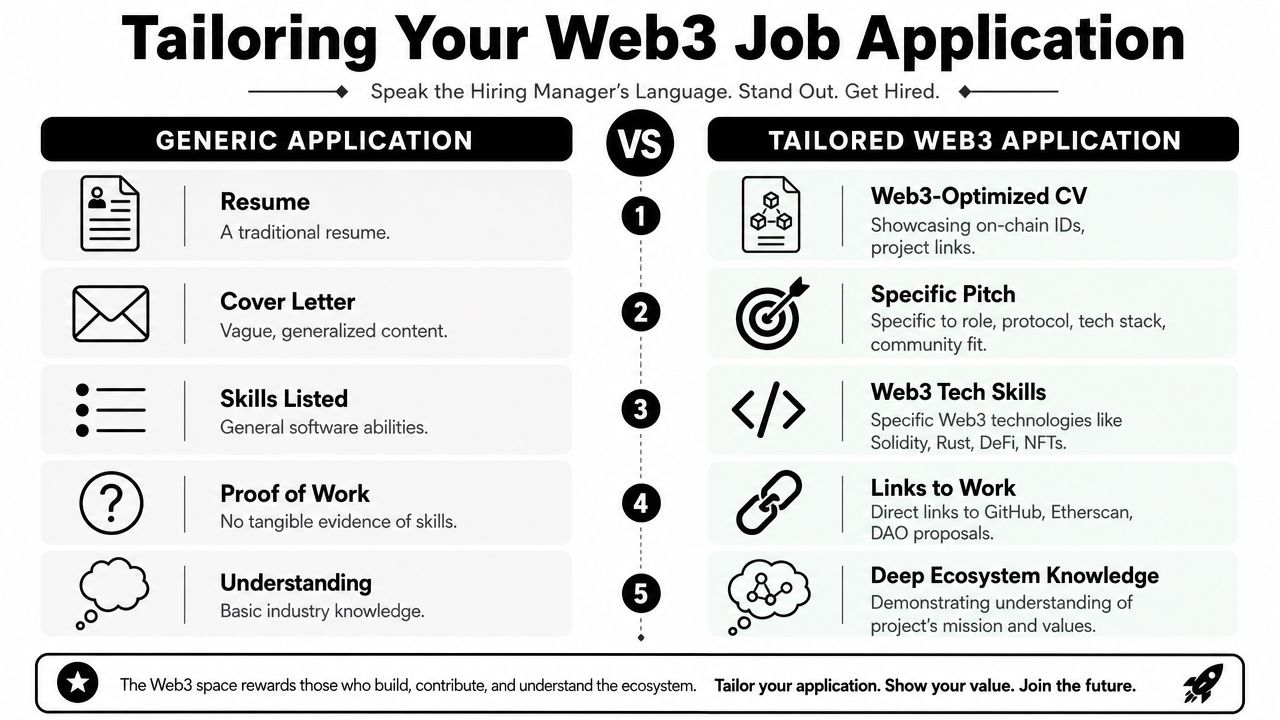
Generic applications die fast in Web3 because the work itself is rarely generic. A protocol engineer, a product lead, a performance marketer, and a general counsel might all work at the same company, but they're solving very different problems. If your application sounds like one-size-fits-all ambition, it reads as tourism.
The hiring manager usually wants one answer from your materials. Can this person help us with the exact bottleneck we have right now?
Different functions look for different evidence
Current listings show that demand now spans far beyond core engineering. Active Web3 openings include functions such as performance marketing, general counsel, product, and operations, which signals a more mature hiring mix than the old “everyone must code smart contracts” stereotype.
Here's how that changes your pitch.
| Role type | What hiring managers usually care about most | Weak signal |
|---|---|---|
| Engineering | Code quality, protocol understanding, shipped repos, security awareness | “Passion for crypto” without artifacts |
| Product | Mechanism thinking, user judgment, ecosystem understanding, prioritization | Generic SaaS PM language |
| Marketing and community | Distribution, messaging, community trust, analytics, retention instincts | Only paid social experience with no crypto context |
| Legal, finance, compliance, ops | Risk handling, process design, policy clarity, execution discipline | Abstract interest in decentralization |
Engineering candidates need specificity
If you're applying for engineering roles, name the actual stack and domain. Smart contracts. Indexing. Infrastructure. Security. Wallet UX. ZK. Data. Don't hide behind “full stack” unless the role is explicitly broad.
Hiring managers usually respond well to:
- Links to audited or deployed code
- Clear explanations of architectural decisions
- Evidence that you understand failure modes, not just happy paths
- Open-source contributions that show taste and maintenance discipline
If your work is confidential, create something public. A small tool, a test repo, a protocol integration, a contract review writeup. Anything reviewable beats a polished paragraph.
Product, growth, and operations candidates should translate, not imitate
Web2 candidates often make one of two mistakes. They either pretend they're already crypto-native when they're not, or they undersell highly transferable skills because they think only protocol knowledge counts.
A better pitch sounds like this:
- For product, explain how you think about incentives, governance, onboarding friction, trust, and ecosystem dependencies.
- For marketing, show you can do incrementality testing, funnel analysis, community messaging, and attribution without relying on vanity engagement.
- For operations or legal, show how you bring order to chaotic environments, document decisions, manage risk, and keep execution moving.
Strong non-engineering candidates don't win by acting like junior engineers. They win by solving business-critical problems that engineers shouldn't have to own alone.
Tailoring language is not cosmetic
Changing a few buzzwords on your resume doesn't count as tailoring. Real tailoring means your examples match the protocol, stage, and function.
If the company is hiring a performance marketer, talk about acquisition experiments, channel economics, creative testing, and retention loops. If it's hiring counsel, talk about cross-border coordination, policy risk, and how you communicate constraints without freezing execution. If it's hiring product, discuss roadmap trade-offs in systems where users, tokenholders, and contributors may all have different incentives.
That's what hiring managers mean when they say they want “fit.” They usually mean contextual competence.
Networking Authentically and Nailing the Interview
In Web3, networking works best when it doesn't look like networking. The candidates who build the strongest relationships usually start by being useful. They answer questions in Discord. They post thoughtful takes on product decisions. They contribute to governance conversations. They help other people understand what's going on.
That behavior does two things at once. It creates reputation before an interview, and it gives you better material once the interview happens.
Build familiarity before you ask for anything
Cold outreach still has a place. Cold entitlement doesn't. If you message a founder, recruiter, or team lead with a generic “would love to connect,” you're asking them to do the work of figuring out why you matter.
A stronger approach is narrower:
- Comment intelligently on something the team is building
- Ask a specific question after reading their docs or governance discussions
- Share a relevant artifact you made
- Offer a concise point of view tied to the role you want
If you need a broader framework for relationship-building without sounding transactional, these professional networking tips are useful because they focus on practical habits rather than forced personal branding.
Treat community participation as interview prep
The best interview prep in Web3 often starts before the call is scheduled. If you've spent time in a protocol's ecosystem, you'll answer better because you've already seen how the team talks, what users complain about, and where operational tension sits.
Before interviews, do this work:
- Use the product if you can. Wallet flow, onboarding friction, docs quality, community support, all of it.
- Read public materials. Docs, governance posts, launch announcements, technical explainers.
- Map the team's likely bottlenecks. Growth, compliance, retention, partner adoption, protocol design, developer experience.
- Prepare opinions. Not hot takes. Reasoned judgments.
What interviewers usually want to hear
Web3 interviews often test for judgment under ambiguity. They want to see how you reason when the answer isn't sitting in a playbook.
Expect prompts like:
- What protocol do you respect, and why?
- What would you improve in our onboarding or documentation?
- How would you explain this product to a skeptical user?
- What trade-offs would you make if regulation tightened?
- How would you measure success in this role?
Good answers are specific, structured, and grounded in the company's actual context. Weak answers drift into ideology, price chatter, or broad enthusiasm.
Go into the interview with two or three informed disagreements. Blind enthusiasm sounds less credible than respectful analysis.
Watch for cultural fit on both sides
You're evaluating them too. Web3 teams vary wildly in operating quality. Some are disciplined, clear, and mission-driven. Others are disorganized and use “decentralized” as cover for weak management.
Ask questions that reveal how they work:
- How are decisions made?
- What does success in the first months look like?
- How do remote teams handle handoffs and documentation?
- What does ownership mean when stakeholders include community members or tokenholders?
- What tends to slow execution today?
The answers tell you whether the role is hard in a healthy way or hard because the company is chaotic.
Securing Your Offer and Thriving Remotely
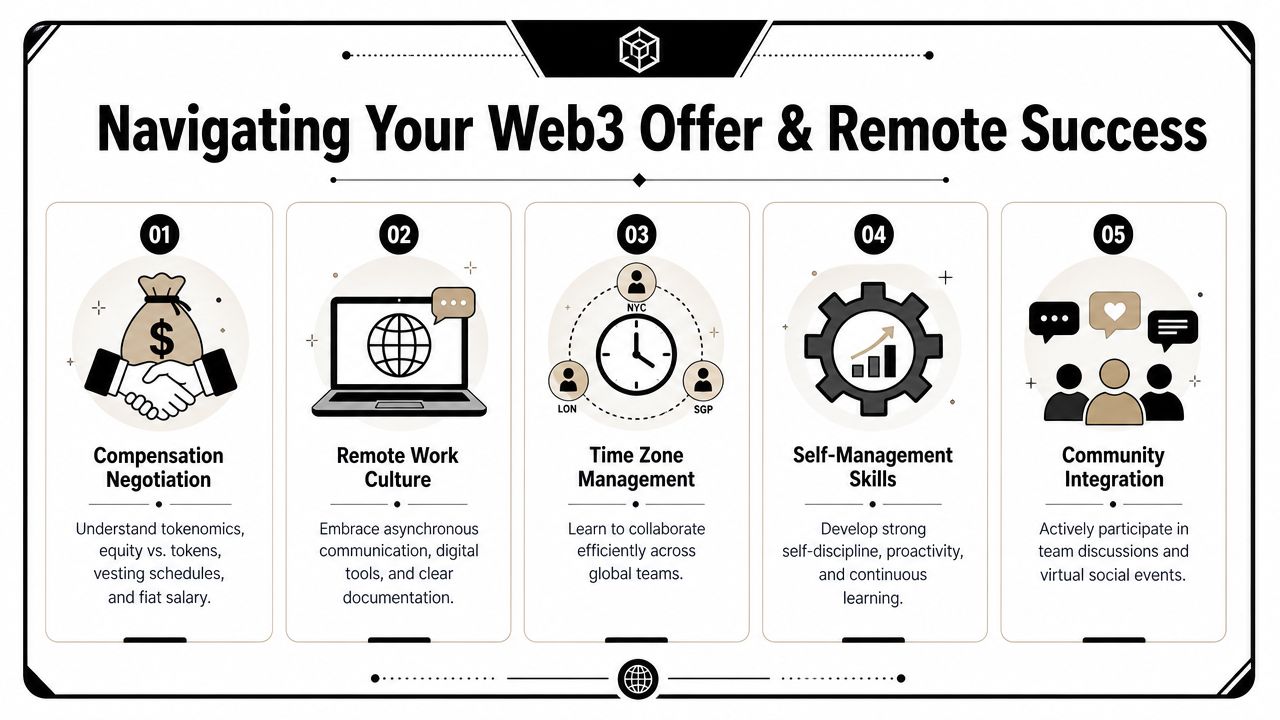
An offer in Web3 can look attractive and still be poorly understood. That usually happens when candidates focus on headline upside and skip the operating details. You need to evaluate the package as a whole. Base salary, any token component, vesting mechanics, reporting line, expectations, and how the team operates day to day.
That matters even more in specialized roles. Crypto recruitment coverage from March 2026 reported that some searches have lasted over a year, ZK engineer roles can take 4 to 8 months to fill, and protocol economist / mechanism designer roles may pay roughly $180k to $500k+ depending on seniority. If you have rare skills, you likely have more influence than you think.
Evaluate the offer like an operator
Ask practical questions:
- Base compensation: Is it paid in fiat, stablecoins, or some mix?
- Token package: What's the vesting schedule, and what conditions affect it?
- Scope: Are you being hired for a role, or for a moving target with no boundaries?
- Manager quality: Who reviews your work and unblocks you?
- Remote expectations: Which hours are shared, and which are async?
If the team sends paperwork digitally, it helps to know the mechanics ahead of time. This guide to signing offer letters electronically is a useful practical reference, especially if you're coordinating documents across jurisdictions.
Remote success is a performance skill
A lot of web3 job openings are remote-first, and many candidates still underestimate what that changes. Distributed work rewards people who write clearly, surface blockers early, and don't wait for permission to move obvious tasks forward.
If you're targeting fully distributed roles, track openings built for that model, such as remote Web3 jobs. Then judge yourself against the environment. Can you communicate well in writing? Can you leave a clear trail of decisions? Can teammates in another time zone pick up where you stopped?
People who thrive remotely usually do a few things consistently:
- They document decisions before confusion spreads.
- They escalate risk early.
- They make progress visible without performing busyness.
- They participate in team culture without needing constant meetings.
A good remote Web3 employee feels easy to collaborate with, even when nobody shares a timezone.
If you're actively searching for web3 job openings, Blockchain Jobs is one of the cleanest places to track serious roles across engineering, product, marketing, legal, operations, and remote-first teams. Use it as a focused starting point, then apply the playbook above so your application looks like it came from someone ready to contribute, not someone just trying to get in.