
Your Guide to Landing a Quantitative Developer Job

A quantitative developer job is about building the high-speed software that powers modern financial trading. These elite engineers turn complex mathematical models into robust, lightning-fast automated trading systems. To land a job in this field, you must prove you can build systems where profitability is measured in microseconds.
What Does a Quantitative Developer Really Do to Get Hired?
Think of a quantitative developer, or "quant dev," as the chief engineer of a Formula 1 racing team. A quantitative researcher is like the physicist designing the car's aerodynamics on a computer. The quant dev is the one who builds, tests, and fine-tunes the engine to ensure it performs flawlessly on the racetrack. Hiring managers look for this hands-on, performance-obsessed mindset.
They are the crucial bridge between theoretical strategy and real-world execution. Your primary mission in a quantitative developer job is to translate sophisticated mathematical trading models into production-ready, low-latency code. This isn't average software development; it's engineering systems where every nanosecond of delay can cost millions. In an interview, you must demonstrate an obsession with performance, reliability, and precision.
The Core Mandate: Architecting Profitable Systems
At its heart, the role is about building a financial firm's nervous system—the infrastructure that ingests market data, makes trading decisions, and executes orders automatically. This demands a unique blend of skills. From a hiring manager's perspective, the ideal candidate isn't just a coder; they're a problem-solver who deeply understands both technology and finance and can articulate how their skills generate profit.
For example, a quantitative engineer role at Blockchain.com highlights the demand for candidates who can apply these skills in the crypto space, a major growth area for quant careers.
A quant dev's success is directly tied to the firm's bottom line. Their code is the engine driving profitability, which means your performance has a tangible impact. This direct link is why a quantitative developer job is one of the most demanding and rewarding careers. Demonstrating an understanding of this commercial impact during interviews is critical for career progression.
In essence, a quantitative developer doesn't just support the trading desk—they are the trading desk. Their code makes the decisions, manages the risk, and executes the trades, operating at speeds no human ever could.
This high-stakes environment requires a specific mindset. If you're an aspiring quant dev, you must be prepared for a career where your work is constantly tested by live markets. The ability to write clean, efficient, and bug-free code under immense pressure isn't just a nice-to-have; it's a non-negotiable requirement for getting hired and advancing in this competitive field.
Core Skills That Get You Hired
To land a top-tier quantitative developer job, your resume must showcase more than just a passing familiarity with code. Hiring managers hunt for a specific blend of skills—a powerful combination of elite programming, sophisticated math, and a practical understanding of finance. Being strong in one or two areas is good, but demonstrating how you integrate all three is what secures an offer.
The world of software development is booming, with some projections showing a 22% jump in U.S. software engineering roles by 2029. Within that wave, quant developers are a highly sought-after and well-compensated niche. The demand is intense; from 2018 to 2024, the median salary for software developers in the U.S. climbed by 20%. To position yourself at the top of this market, explore the full dataset on MyCodelessWebsite.com.
This chart breaks down exactly where a quantitative developer fits into the bigger picture at a financial firm.
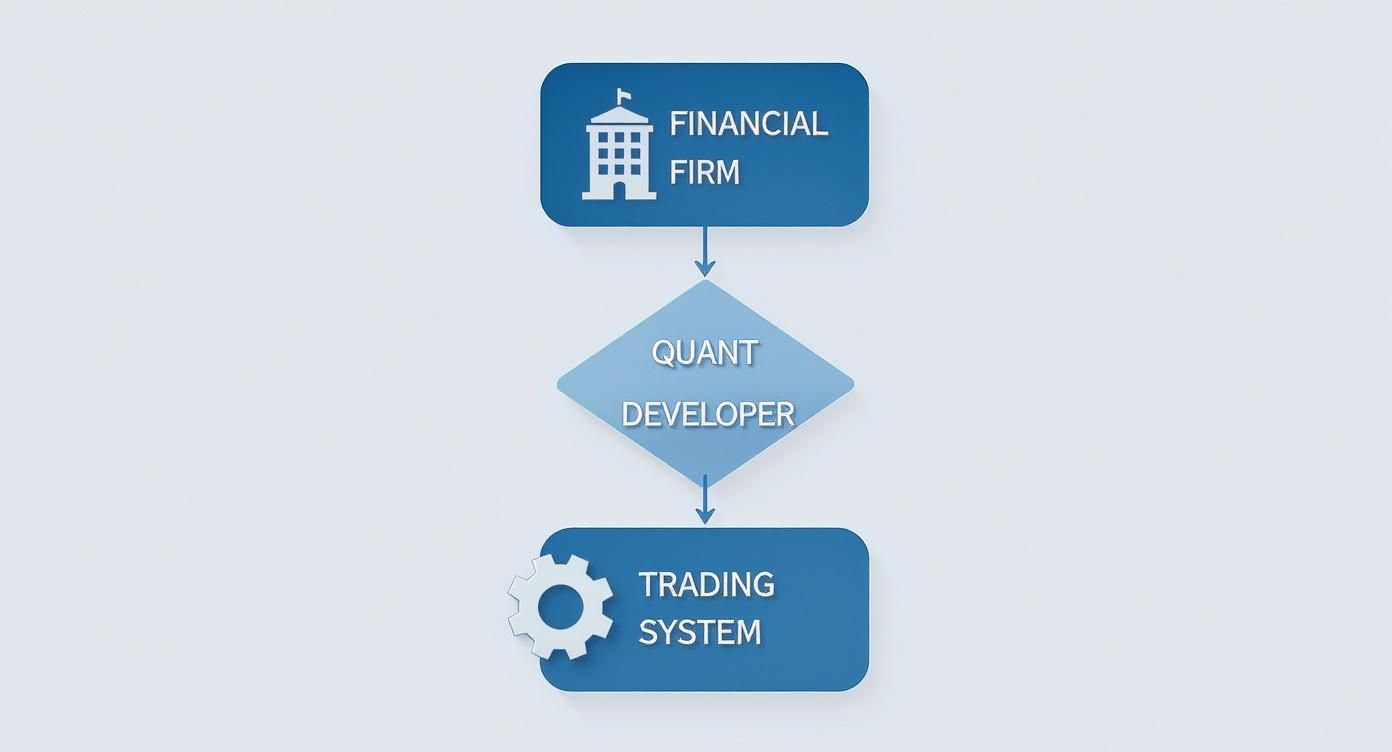
As you can see, the quant dev acts as the crucial bridge, turning a firm's strategic vision into the actual trading systems that drive revenue. Your career progresses as you become more effective at this translation.
To truly understand what it takes to get hired, let's break down the skills you'll need to master and prove in interviews.
Essential Skillset for Aspiring Quantitative Developers
The table below summarizes the core competencies that hiring managers look for. It's not just about listing these on your resume; it's about being able to demonstrate deep, practical knowledge of how they are applied in a trading context during the interview process.
| Skill Category | Core Competencies | Why It Matters for Hiring |
|---|---|---|
| Programming | C++ (low-latency, performance), Python (data analysis, modeling), Java (robust systems), Data Structures, Algorithms | Proves you can build everything from lightning-fast execution engines to complex research pipelines. This is the 'how'. |
| Mathematics | Stochastic Calculus, Linear Algebra, Probability & Statistics, Numerical Methods | Shows you can understand and correctly implement the complex models that underpin trading strategies. This is the 'what'. |
| Finance | Derivatives Pricing (Options, Futures), Risk Management (VaR), Market Microstructure | Demonstrates you understand the "why" behind the code and can build systems that are commercially viable and safe. |
Ultimately, a successful quant developer is a hybrid talent. Your career progression depends on your ability to combine the precision of a software engineer, the analytical rigor of a mathematician, and the market awareness of a trader.
The Programming Pillar
Your ability to write clean, efficient, and robust code is the absolute bedrock of this role. While general software engineering skills are a given, the quant space has specific demands that will be tested heavily in interviews.
- C++ for Performance: In high-frequency trading (HFT), speed is everything. C++ is the undisputed champion for minimizing latency, making it essential for building the fastest trading systems. Expect interview questions that test your deep knowledge of memory management and performance optimization.
- Python for Agility: For data analysis, prototyping models, and backtesting strategies, Python is the lingua franca. Its libraries like NumPy, Pandas, and Scikit-learn allow for rapid development.
Fluency in both shows you can operate across the entire development lifecycle, from research to deployment. Many firms also value Java for its reliability in building large-scale, high-throughput systems, as highlighted in this Java Quant Developer role for FX and Crypto.
Advanced Mathematics in Action
The "quant" part of the title is all about applied math. This isn't abstract theory; it's about applying sophisticated mathematical concepts to solve tangible financial problems.
A quant developer's job is to translate the language of mathematics into the language of machines. You’re not just solving equations; you’re building systems that use those solutions to make money.
During interviews, expect to be grilled on your practical application of concepts like stochastic calculus (for modeling asset prices), linear algebra (for portfolio optimization), and probability theory (for risk). You must be able to explain how these mathematical tools are used to construct and validate trading models, proving you grasp the logic that will drive your code.
Practical Financial Domain Knowledge
Finally, you must speak the language of the markets. You don't need to be a seasoned trader, but you must understand the financial products and market structures your systems will navigate. Lacking this knowledge is a common reason candidates fail interviews.
A few key areas to master before an interview:
- Derivatives Pricing: Know the fundamentals behind options, futures, and swaps. What drives their value?
- Risk Management: Understand concepts like VaR (Value at Risk) and how to build risk controls directly into your software.
- Market Microstructure: Be familiar with how order books function, the mechanics of trade execution, and why latency is so critical.
This domain knowledge is the glue that holds your technical skills together. It allows you to build solutions that are not just technically impressive, but are actually effective and profitable in the real world—the ultimate measure of success in any quantitative developer job.
A Day in the Life of a Quant Developer
Forget a typical nine-to-five software gig. The life of a quant developer is a fast-paced blend of deep, technical problem-solving and high-stakes teamwork. Your day is a constant push to find and maintain a competitive edge, where your code’s performance is measured in real-time profit and loss. Your career progression hinges on your ability to thrive in this environment.

Picture this: you arrive before the market opens for a stand-up meeting with quantitative researchers and traders. The conversation isn't about UI updates. It’s about shaving microseconds off order execution or dissecting the performance of a new trading signal. This is where you demonstrate your value to the team.
From Morning Briefing to Deep Work
A researcher might hand you a new mathematical strategy modeled in Python or MATLAB. Your task is to translate that model into highly optimized, production-grade C++ code. This requires a deep understanding of the math to ensure the implementation is both fast and accurate—a core competency tested in interviews.
A huge chunk of your day is spent deep in the code, focused on a few core challenges that directly impact your career success:
- Performance Tuning: Refactoring code to avoid CPU cache misses, rewriting a networking module to cut latency, or redesigning a data structure for instant lookups.
- Building Data Pipelines: Constructing pipelines to pull in, clean, and store terabytes of tick-by-tick market data for backtesting new strategies.
- Architecting Systems: Making architectural decisions that will affect the trading system's speed, resilience, and scalability for years to come. These decisions define your seniority and impact.
Then, your afternoon might be derailed by a production bug. When a trading system hiccups, millions can be on the line. This is where your mettle is tested, as you work under pressure to find the root cause of an anomaly. Excelling in these high-pressure situations is key to career advancement.
The Rush of Real-Time Results
As the markets wind down, your focus shifts to analysis. You'll review system performance, pore over execution logs, and prepare for the next trading day. This immediate feedback loop is one of the most compelling parts of a quantitative developer job.
"There's no feeling quite like watching a trading algorithm you wrote execute flawlessly in a volatile market. You see your logic, your code, directly impacting the firm's P&L in real time. It's an immense responsibility and an incredible professional thrill."
This daily rhythm of strategy, coding, and analysis is what makes the role so challenging and rewarding. It demands a rare mix of world-class engineering chops and a genuine fascination with financial markets. To progress in this career, you must love solving complex puzzles that have immediate, tangible results.
How to Navigate the Quant Developer Interview
To land a top-tier quantitative developer job, you must pass one of the most challenging interview processes in tech or finance. It's a full-on stress test of your problem-solving skills, technical knowledge, and how you think under pressure, designed to see if you can handle the intensity of the actual job.
The process is a multi-stage gauntlet, with each round drilling deeper into your skillset. It starts with an online coding challenge or technical phone screen, but the difficulty ramps up with each interview. Think of these stages as your chance to prove you have both the theoretical chops and the practical engineering mind to succeed.
The hiring market for quants is incredibly active. A recent hiring surge has made the field more competitive than ever. Strong candidates often juggle multiple offers, forcing firms to make decisions in less than a week. This means you must be on your A-game from the first conversation. To understand what firms seek, explore insights on the 2025 quant talent market.
Mastering the Technical Gauntlet
The core of any quant dev interview is a series of tough technical challenges wrapped in layers of mathematics and financial context. Your prep must be deep and specific.
- Advanced Algorithms and Data Structures: Go beyond the basics. Be ready for problems involving dynamic programming, graph theory (for network latency), and complex tree traversals. Interviewers want to see you identify the optimal approach and code it cleanly under pressure.
- Probability Puzzles and Brain Teasers: These test your analytical mind and how you approach unfamiliar problems. They often hinge on concepts like expected value, conditional probability, and combinatorics. The key is not just giving the right number—it's clearly explaining your logic and assumptions.
- System Design for Low-Latency Trading: Expect a system design question focused on trading. You won't be asked to build a social media app. Instead, you'll be asked, "Design a system to process a high-frequency market data feed with minimal latency," or "Architect a risk management service that can halt trading in milliseconds."
The goal of these interviews isn't just to see if you can solve a problem. It's to see how you solve it. Your communication, your ability to handle hints, and your approach to debugging a flawed solution are all being evaluated.
Sample Problems and the Interviewer's Mindset
To make this more concrete, here are a few examples of questions and what the interviewer is actually trying to assess:
- Probability: "You have a 100-sided die. What is the expected number of rolls to get a 6?" This is a direct test of your grasp of expected value and geometric distributions.
- Algorithms: "Given a stream of stock prices, design a data structure to efficiently find the moving average over the last N prices." This probes your understanding of structures like queues or circular arrays and, more importantly, your obsession with performance.
- System Design: "How would you build a matching engine for a crypto exchange?" With this, they’re digging into your knowledge of order books, concurrency, and fault-tolerant systems. See how these skills are framed in the real world in this Quantitative Developer position in crypto.
The best preparation is consistent, focused practice. Success comes from building a solid foundation and then running mock interviews until solving these problems feels like second nature.
Building a Resume That Gets You the Interview
Your resume is your ticket through the door, and you have about six seconds to make an impression. Recruiters at top firms are looking for one thing—evidence you can solve their incredibly difficult, high-stakes problems. A generic resume listing job duties is a one-way ticket to the "no" pile.
Your mission is to show, not just tell.

The most powerful way to do this? Quantify everything. Vague claims like "improved system performance" are filler. Anchor your accomplishments in hard numbers that speak to speed, efficiency, and profit. This is the single most important action you can take to improve your resume.
Think about how you can reframe your bullet points to tell a story of impact:
- Instead of this: "Worked on a low-latency trading system."
- Try this: "Cut P99 order execution latency by 150 microseconds by re-architecting the network protocol and optimizing data serialization, directly improving fill rates."
The second version demonstrates a deep understanding of the problem and showcases a measurable, impressive result. That's the language that gets you an interview.
Your Portfolio: The Proof is in the Code
A killer resume gets their attention, but a solid project portfolio proves you can actually do the work. It’s your chance to demonstrate the raw engineering talent and financial intuition the job demands. Your projects should show you understand the problems these firms face every day.
Think of your GitHub as the real interview. It must be clean, well-documented, and filled with code that shows you grasp both computer science fundamentals and their financial application. A messy or empty profile is a huge red flag to hiring managers.
To build a portfolio that gets you hired, focus on projects that mimic the work of a real quant developer.
Here are a few actionable project ideas:
- Build a Basic Backtesting Engine: Use Python with libraries like Pandas and NumPy to create a vectorized backtester. Start with a simple strategy like a moving average crossover. This project immediately shows you can handle financial data and rigorously test an idea.
- Implement an Options Pricing Model: Use C++ to code a Black-Scholes or Binomial options pricing model from scratch. This is a classic project because it proves you can translate complex financial math into high-performance code.
- Create a Crypto Market Data Connector: Write a tool that connects to the WebSocket API of an exchange like Coinbase or Binance to stream and save real-time market data. This shows you can manage fast-paced, live data feeds—a critical skill for any trading desk.
Treat every project like a professional product. Write a clear README explaining what it is, how it works, and how to run it. When your portfolio solves real-world financial engineering problems, you're not just telling them you’re capable—you're proving it.
What to Expect for Salary and Career Progression
The quantitative developer role is famous for lucrative pay, but it's important to understand the complete compensation structure. Your total compensation is far more than a base salary; it's a dynamic package directly tied to your performance, your team's success, and your career progression.
On paper, the average salary for a quantitative developer in the United States is around $112,500 per year. But this average is misleading. A junior dev might start between $66,000 and $82,600. In contrast, a top graduate from a target school landing a job at a high-frequency trading (HFT) firm could see a starting package between $120,000 and $300,000. To benchmark your potential earnings, you can review comprehensive research on quant developer pay.
Beyond the Base Salary: The Performance Bonus
The performance-based bonus is where the real earning potential lies. It can easily double, triple, or even eclipse your base salary. The systems you build and the algorithms you refine are the engines that generate the firm's profits. Your work is directly measurable, and your bonus reflects that impact.
Your bonus is a direct reflection of your impact. A successful year for your trading desk, driven by the systems you helped build, translates into a substantial payout. This is the high-stakes, high-reward nature of the job.
This direct link between your code and the company's P&L (Profit and Loss) defines the compensation structure and is a powerful motivator for career growth. Hiring managers are looking for candidates who are driven by this results-oriented environment.
How Location and Firm Type Impact Your Career Path
Where you work and for whom has a massive impact on your compensation and career trajectory.
- Financial Hubs: New York, Chicago, and London offer the highest salaries. The concentration of elite firms creates fierce competition for top talent, driving compensation up and providing more opportunities for career moves.
- Firm Type: A top-tier hedge fund or proprietary trading shop will almost always offer a higher earnings ceiling than a large investment bank due to more aggressive bonus structures. Crypto-native firms are now competing aggressively, offering competitive packages to attract developers with niche skills.
When evaluating a job offer, look beyond the base salary. An offer with a slightly lower base from a firm known for large bonuses could result in much higher total compensation. Understanding these dynamics is key to maximizing your earnings and making strategic career moves.
Common Questions from Aspiring Quants
If you're targeting a career as a quantitative developer, you likely have questions. Here are actionable answers to the most common ones.
Do I Really Need a PhD to Become a Quant Developer?
No. While a PhD is often required for quantitative researcher roles, it's not a prerequisite for developers. For a quant dev job, your software engineering skills and problem-solving ability are what truly matter.
Hiring managers are far more interested in what you can build. A strong Bachelor's or Master's in a technical field like computer science is a great foundation, but your project portfolio, open-source contributions, or competitive programming achievements are what will get you the interview.
What’s the Real Difference Between a Quant Developer and a Researcher?
The researcher is the strategist who invents a new play. They analyze data to find statistical edges and design the theoretical model.
The quantitative developer is the star athlete who executes that play on the field. They take the researcher's abstract model and turn it into a high-performance, rock-solid trading system that operates in milliseconds. To advance your career, you must excel at this high-stakes implementation.
Is C++ a Dealbreaker for Getting Hired?
For high-frequency trading (HFT) and other low-latency strategies, yes, C++ is often non-negotiable. When every nanosecond counts, the raw power and memory control of C++ are essential.
However, Python is just as crucial. It’s the go-to for data analysis, prototyping, and backtesting. The most sought-after candidates are fluent in both. They can explore ideas quickly in Python, then build the final, production-grade system in C++. Demonstrating this dual fluency is a huge advantage in the job market.
Ready to find your first quantitative developer job? At Blockchain Jobs, we connect top talent with leading firms in the Web3 and crypto space. Explore curated opportunities in a rapidly growing field.