
Secure Your Quantitative Research Internship for 2026
Let's be clear: a quantitative research internship isn't your typical gig. Forget fetching coffee or making copies. This is a high-stakes audition for a career at the nexus of finance, technology, and hardcore academia. You'll be thrown into the deep end, expected to tackle incredibly complex, data-driven problems from the moment you walk in. The goal? Use your advanced math and coding skills to find profitable signals hidden within mountains of noisy market data. It’s your chance to prove you have the intellectual firepower for one of the most competitive—and rewarding—fields out there.
What a Quant Research Internship Really Involves

A quantitative research internship places you directly on the front lines of financial innovation. Elite firms like Citadel, G-Research, and Point72 treat their interns as junior members of the research team. You're not just shadowing; you're contributing to projects with real-world market impact. This internship is the primary interview for a full-time role; every project, every interaction is an evaluation.
From day one, you’re immersed in an intense, results-driven environment. Your summer project won't be some theoretical exercise that gets filed away. It will be a live-fire test of your abilities. You might be asked to:
- Develop and backtest a brand-new trading signal.
- Analyze massive, unconventional datasets to uncover a hidden edge.
- Refine an existing predictive model to make it faster and more accurate.
Hiring managers are searching for a very specific type of person. They often recruit heavily from top-tier PhD and advanced Master's programs in fields like physics, mathematics, and computer science.
The core expectation is that you can conduct independent, rigorous research. They aren't just hiring you for what you know, but for your ability to solve problems they haven't even encountered yet.
To succeed, you'll need to demonstrate a very specific set of attributes. Here’s a look at what top-tier quant shops are truly looking for in their interns.
Key Attributes of a Top-Tier Quant Internship
| Attribute | What Recruiters Expect |
|---|---|
| Independent Research | You can take a vague problem, formulate a hypothesis, and design a research plan to test it with minimal hand-holding. This is the #1 trait assessed. |
| Technical Proficiency | You're fluent in Python or C++, comfortable with statistical analysis, and can manage and clean large datasets effectively. This is your ticket to the interview. |
| Problem-Solving Acumen | You enjoy tackling open-ended, complex puzzles and can think creatively and logically under pressure. This is tested in every interview stage. |
| Intellectual Curiosity | You have a genuine passion for finding patterns and understanding the "why" behind market movements, not just the "what." This is what separates a hire from a pass. |
Ultimately, these attributes are what separate a good candidate from a great one. Firms are betting that you have the raw talent and drive to become a future leader on their team.
The Career Trajectory and Rewards
The quant internship market is brutally competitive for a good reason: the career path is exceptionally lucrative. More importantly, the internship is the main pipeline for landing a full-time offer. These roles aren't just for Wall Street anymore, either. Many quant skills are directly transferable to cutting-edge crypto and DeFi firms, where on-chain data presents a whole new frontier for generating alpha. You can see how these skills apply in the web3 space by checking out roles like this research engineer intern position.
The financial incentives are enormous, reflecting how much these firms value raw talent. On a pro-rated basis, compensation for these 10-to-12-week programs can range from $184,000 to $369,000 annually, showing the massive premium placed on quantitative skillsets.
A successful internship is your golden ticket to a full-time role where you can earn top-tier pay while working on some of the most challenging intellectual puzzles in the world. It’s a demanding path, but for those with the right mix of analytical chops and intellectual curiosity, it’s an incredibly rewarding one.
Building Your Essential Technical and Math Toolkit

Before you even think about applying for a top-tier quantitative research internship, you need to be honest about your technical and math skills. They have to be rock-solid. Hiring managers aren't just scanning for keywords on your resume; they’re actively looking for proof that you can apply these tools to solve messy, ambiguous financial problems, often under serious pressure. This is where you show you have the analytical horsepower for the job.
It’s no longer a bonus—programming is a baseline requirement. Firms expect you to have intermediate, if not advanced, skills in languages like Python or C++. Some even use R, C#, Java, or MATLAB. Many internship programs dive straight into complex topics like options theory and statistical modeling, expecting you to keep up. This proves that just knowing a language isn't the point; you must be able to use it to model what's happening in the real world. You can see how these skills are being applied in the crypto space by looking at current AI and machine learning job openings.
Mastering the Right Programming Languages
For any aspiring quant, Python and C++ are the two languages you absolutely must know. They serve very different, yet equally critical, roles inside a trading firm. Your ability in these will be tested in every interview.
Python: This is your bread and butter for research, data analysis, and prototyping new models. Your skill will be judged by how well you handle libraries like NumPy for numerical crunching, Pandas for slicing and dicing data, and Scikit-learn for machine learning tasks. A typical interview question might involve cleaning a disorganized dataset or backtesting a simple trading strategy using these very tools.
C++: This is the language of high-performance, production-level code. If you're interested in roles touching high-frequency trading (HFT) or anything requiring low-latency execution, a solid grasp of C++ is non-negotiable. Expect interviewers to grill you on data structures, algorithms, memory management, and clean object-oriented design.
The real test isn't just writing code that works. It's about writing code that is efficient and scalable. A hiring manager will always choose the candidate who can solve a problem with an O(n log n) algorithm over one who provides a less optimal O(n²) solution.
The Mathematical Bedrock of Quant Finance
Coding is only half the battle. You also need a deep, almost intuitive, command of specific mathematical concepts. You won't be asked to just regurgitate formulas from a textbook; you'll be expected to use them to reason your way through brain teasers and market-based problems. Your goal should be to understand these ideas from first principles to pass the dreaded "quant brain teaser" part of the interview.
Here are the key areas to focus on:
Probability and Statistics: This is the language of uncertainty and the absolute heart of quantitative research. You should be ready for interview questions on Bayesian probability, expected value, and common statistical distributions. A classic interview puzzle you might encounter is: "If you have a 51% edge on a bet, what is the optimal amount to wager?"
Linear Algebra: This is essential for wrangling the large, multi-dimensional datasets you'll be working with. Make sure you're comfortable with concepts like eigenvalues, eigenvectors, and matrix decompositions. These are the building blocks for powerful techniques like Principal Component Analysis (PCA), which is often used in risk management.
Calculus and Differential Equations: While you probably won't be solving complex integrals on a whiteboard, a working knowledge of calculus is critical for understanding derivatives pricing (think the Black-Scholes model) and solving optimization problems.
Ultimately, your mission is to prove to recruiters that you can think like a scientist. When you combine strong programming chops with a robust mathematical intuition, you're showing them you have what it takes to pass the technical screen and tackle the real challenges of a quantitative research internship.
Crafting a Portfolio That Gets You Noticed
Your resume might get you past the first-round bots, but it's your portfolio that gets a real person—a hiring manager—to actually want to talk to you. For a quant research internship, your portfolio is the single most powerful tool you have to prove you can do the work. This is where you show, not just tell, that you can wrestle with messy problems, dig into independent research, and explain complex findings in a way people can understand.
A standout portfolio fundamentally changes the conversation. It moves from what you've learned in a classroom to what you've actually done. It’s tangible proof. While your university projects are a decent starting point, what really grabs a recruiter's attention is work you've done on your own, driven by pure curiosity. This is your chance to show them you already think like a quant.
Build Projects That Look Like the Real Work
The most effective projects are the ones that mimic what you’d be doing day-to-day as a quantitative research intern. Don't just grab a perfectly clean dataset and run a textbook regression. That’s not the job. Instead, you need to showcase your entire problem-solving journey. And in this industry, a well-organized GitHub repository is the standard way to do that.
Think of it as telling a story with your code and your analysis. You want to walk the recruiter through your brain. That means documenting everything:
- The Big Question: Start by laying out the hypothesis. What question are you trying to answer, and why is it interesting in the first place?
- The Data Grind: Be explicit about where your data came from and, more importantly, the headaches it gave you. Quant finance is built on messy, incomplete data. Showing you can handle that is a huge green flag.
- Your Methods: Explain which statistical models you picked and justify your choices. Your code should be clean, readable, and well-commented.
- The Outcome: What did you find? Was your initial idea right? Wrong? What did you learn along the way? A failed hypothesis that’s backed by solid, rigorous work is often way more impressive than a simple, predictable success.
I'll let you in on a little secret: a portfolio project that honestly details the struggles of data cleaning and even admits to null results is often more compelling to me than some perfect, "canned" project. It shows resilience and intellectual honesty, two traits we value immensely in a researcher.
Project Ideas That Actually Impress Quant Recruiters
If you want to stand out, you have to step away from the common academic datasets everyone uses. Pick projects that force you to go out and find, clean, and structure the data yourself. That's what shows the kind of initiative firms are desperate to find.
Here are a few ideas that are directly in line with what a quant intern would be tasked with:
Back-test a Simple Alpha Signal: Find a well-known academic paper on a factor (like momentum or value), and try to replicate a simplified version of it. Apply it to a group of stocks and analyze its historical performance, making sure to account for things like transaction costs and the Sharpe ratio. This shows you get the fundamentals of strategy research.
Dig into a Novel DeFi Dataset: The crypto and blockchain space is a goldmine of public, on-chain data. You could, for example, analyze the lending rates on a platform like Aave or look for patterns in trading volumes on Uniswap. This signals that you're interested in the new frontiers of finance and can handle non-traditional data.
Model Volatility with GARCH: Grab the historical price data for an asset and build a GARCH model to forecast its volatility. This is a classic econometric technique used every single day in risk management and options pricing, making it incredibly relevant.
At the end of the day, your portfolio should feature two to three high-quality, in-depth projects. Forget quantity; it's all about quality. A single, well-documented project that demonstrates rigorous thinking is worth a dozen superficial analyses. This is your proof that you have the skills and the mindset to be a great quant intern and start contributing from your very first day.
Navigating the Quant Interview Gauntlet
Getting a quantitative research internship is as much about surviving the interview process as it is about having the right skills. This isn't your standard interview; it's a multi-stage gauntlet designed to test your intellectual horsepower, problem-solving abilities, and how you handle extreme pressure.
It's a tough road, but it’s not random. Each stage has a clear purpose. If you understand what they're looking for at each step, you can show them you have exactly what it takes.
From that very first call, the hiring team is already assessing your potential. They're not just looking for someone who can solve a puzzle. They want to see how you communicate your thought process, especially when you're stumped.
The Stages of a Quant Interview
While the specifics might vary from firm to firm, the quant interview process tends to follow a predictable path of escalating challenges. You’ll start with broad conversations and quickly move into deeply technical territory.
The interview sequence is a marathon, not a sprint. Knowing what’s coming next helps you conserve your energy and focus on what matters at each hurdle. Here's a breakdown of what you can generally expect.
| Interview Stage | Primary Focus | Preparation Strategy |
|---|---|---|
| Initial HR Screen | Culture fit, genuine interest, and communication skills. | Articulate why you want this specific role and firm. Have your resume and portfolio stories down cold. |
| Technical Phone Screen | Problem-solving logic and foundational knowledge. | Practice probability puzzles, mental math, and basic coding questions. Focus on explaining your approach out loud. |
| Take-Home Data Challenge | Real-world application of your research and coding skills. | Treat it like a mini-project. Document everything in a clean Jupyter Notebook. Explain your data cleaning, modeling choices, and insights clearly. |
| The "Superday" | Performance under pressure, deep technical knowledge, and collaboration. | Get plenty of rest. Review your projects, practice whiteboard coding, and prepare to think on your feet for hours. |
This process is designed to see if you can handle the core workflow of a real quant.
The entire interview funnel is essentially a test of your ability to execute the fundamental quant research process. It's about seeing if you can think systematically.
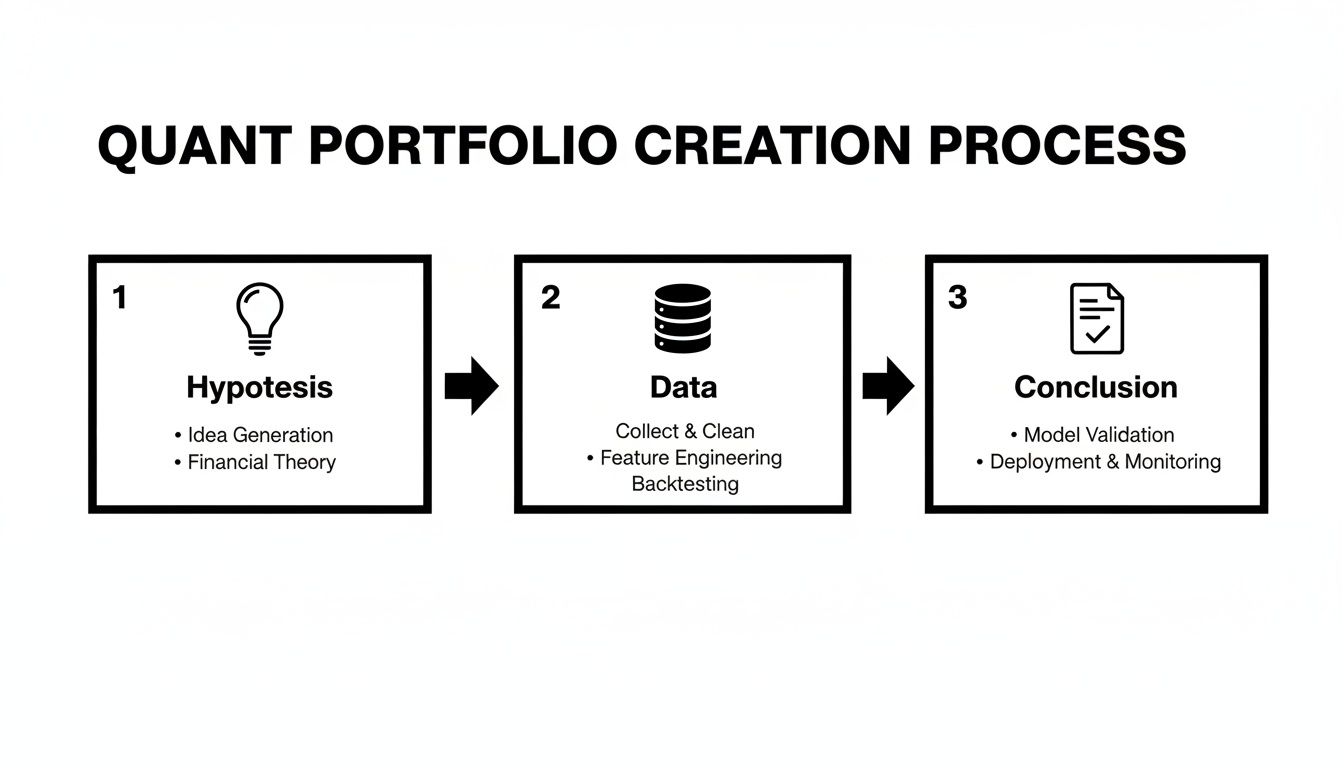
This simple loop—forming a hypothesis, wrangling data to test it, and drawing a conclusion—is everything. It's what you'll do in a take-home challenge and what you'll need to demonstrate in a case study.
Acing the Questions and Case Studies
In these interviews, how you think is more important than having the perfect answer. When you get a tough question, the worst thing you can do is go silent. You need to start talking.
"That's a great question. I don't have the answer off the top of my head, but here’s how I’d start breaking it down..."
This is your go-to opener. It shows you’re not rattled and that you have a structured way of approaching problems, which is precisely what they want to see.
If it's a brain teaser, state your assumptions out loud. For a coding problem, discuss the data structures or algorithms you're considering and explain the trade-offs.
Let's walk through a classic mini-case study: "You have access to real-time satellite imagery of every Walmart parking lot in the US. How would you use this data to predict Walmart's quarterly earnings?"
A great answer doesn't involve some magical formula. It involves a structured approach:
- Clarify the Goal: The objective is to find a proxy for in-store foot traffic that correlates with revenue.
- Form a Hypothesis: More cars in the parking lot should indicate more shoppers, which points to higher sales.
- Outline the Data Process: I'd start by building an image recognition model to count cars. Then, I'd aggregate this data by store, by day, and look for trends leading up to the earnings report.
- Acknowledge the Nuances: You have to account for confounding variables. This includes seasonality (the Christmas rush), store hours, and noise in the data (like employees' cars taking up spots). I'd need to normalize the data to make it a reliable signal.
This kind of methodical thinking is what gets you the quantitative research internship. It proves you can turn a messy, real-world problem into a structured research project.
How to Turn Your Internship into a Full-Time Offer

So, you landed the quant research internship. Congratulations. Now the real work begins—think of the next 12 weeks as your interview for a full-time job. Your mission is to become so valuable that the team can't imagine functioning without you.
The first hurdle is always the steep learning curve. Every firm has its own unique world of proprietary tools, massive datasets, and internal code libraries. How quickly you get up to speed is your first real test. I always tell interns to spend their first week just documenting everything. Create your own personal "quick start" guide. It shows initiative and, more importantly, it helps you become self-sufficient fast.
The Art of Asking Smart Questions
Let's be clear: senior quants are incredibly busy. Respecting their time is paramount. A cardinal sin is asking a question you could have answered with a ten-minute search of the internal wiki or Google. It just signals a lack of resourcefulness.
When you do get stuck and need to ask for help, frame your question to show you’ve already put in the work.
- A bad question sounds like this: "My code isn't working, can you help?"
- A great question sounds like this: "My model is producing NaNs when I process the tick data from 2018. I've already checked for divide-by-zero errors and I've isolated the issue to the volatility calculation module. My best guess is it's an edge case with how we handle stale quotes. Have you seen anything like that before?"
The goal is to transform from a student who needs answers into a colleague who collaborates on solutions. Show them your thought process, not just your problem. This is how you build credibility and earn respect.
Owning Your Project and Beyond
Just delivering on your assigned summer project is the bare minimum—it’s what’s expected. To really lock in that return offer, you have to go beyond the baseline. Take complete, undeniable ownership of your project.
This doesn't just mean executing the plan you were given. It means actively hunting for ways to improve it, flagging potential risks before they become problems, and exploring interesting tangents that could add real value.
Communicating what you're doing is just as important as the work itself. Send concise, regular updates to your mentor and manager. Stick to the key findings, any roadblocks you've hit, and what your plan is for the next steps. Use charts and other visualizations to make your points land with impact.
When it comes time for your final presentation, don't just give a report on what you did. You need to build a compelling case for why your work matters and how it could be expanded upon. Prove you’re not just a temporary intern, but a future full-time quantitative researcher who can contribute from day one.
To get a feel for different firms and see what's out there, you might want to join an internship community to stay plugged into future openings.
Common Questions on Landing a Quant Internship
Getting into quantitative research can feel like a black box. You've probably got a ton of questions floating around. Let's tackle some of the ones I hear most often from aspiring quants trying to break into the field.
Do I Really Need a PhD for an Internship?
This is a big one. While you'll see PhDs in physics, math, and computer science everywhere at top-tier firms, it's not the only path. The truth is, hiring managers are looking for PhD-level research maturity, which isn't always tied to the degree itself.
If you're an exceptional Master's student or even an undergrad with some serious research under your belt—think published papers or major competition wins—you can absolutely be a strong contender. It's less about the diploma and more about proving you have the deep mathematical intuition and independence to wrestle with open-ended, complex problems.
What Kind of Projects Should I Build If I Have No Finance Experience?
Don't sweat the lack of direct finance experience, especially for an internship. Recruiters are far more interested in your raw problem-solving abilities. Your project portfolio is where you prove you can handle messy, real-world data and apply rigorous statistical thinking.
Here are a few ideas to get you started:
- Predicting Sports Outcomes: Grab some historical stats and build a model to predict winners or point spreads. This shows you can work with time-series data and probabilities.
- Analyzing Public Data: Dig into a large public dataset, like the NYC taxi ride data, and model something interesting like trip demand. It's a classic for a reason.
- Crypto & On-Chain Analysis: Analyzing on-chain data from a DeFi protocol is a fantastic way to demonstrate your skills on novel, complex data structures, which is highly relevant today.
The most important part? Document everything meticulously. Your methodology, your code, your thought process—put it all on GitHub. That’s how recruiters will see how you think.
How Good at Programming Do I Actually Have to Be?
You need to be more than just familiar with a language; you need to be truly proficient. The technical bar for quant research internships is incredibly high, and they will test you for both correctness and efficiency under serious pressure.
Your coding skills will be put under a microscope with tough, timed problems. If you're using Python, you need to be an expert with libraries like NumPy, Pandas, and Scikit-learn. For C++, a deep understanding of data structures, algorithms, memory management, and OOP is non-negotiable.
Interviewers will expect you to write clean, optimized code on the spot—often on a whiteboard. You’ll need to explain its time and space complexity using Big O notation as you go. This isn't something you can cram for; it takes consistent, dedicated practice.
Ready to find your place in the fast-moving world of decentralized technology? Blockchain Jobs is the go-to job board for roles in Web3, DeFi, and crypto. Explore curated opportunities and connect with the companies building the future at https://blockchain-jobs.com.