
React Native Jobs Remote: 10 Boards and Application Tips
The biggest job sites aren't automatically the best places to find React Native jobs remote. They bury mobile roles beneath general JavaScript, frontend, and software-engineering listings, leaving candidates to decode whether “remote” means worldwide, US-only, contractor-only, or outside the company office.
Niche boards solve part of that problem. They filter more closely around React Native, expose useful signals such as seniority, salary, region, and employment type, and usually send applicants to a recognizable employer or applicant-tracking system. That doesn't make every listing strong. You still need to check Expo versus bare React Native, native iOS and Android work, testing, release ownership, time-zone overlap, and the interview process.
The boards below are judged on four practical questions: How strong is the React Native signal? Can you verify US or time-zone eligibility? Does the listing contain enough screening detail? Where does the application go? The aim isn't to collect links. It's to build a search that supports better applications, stronger interviews, and deliberate career progression.
If you're still deciding which development path fits your target roles, this comparison of Expo and React Native is a useful starting point.
1. React Native Jobs
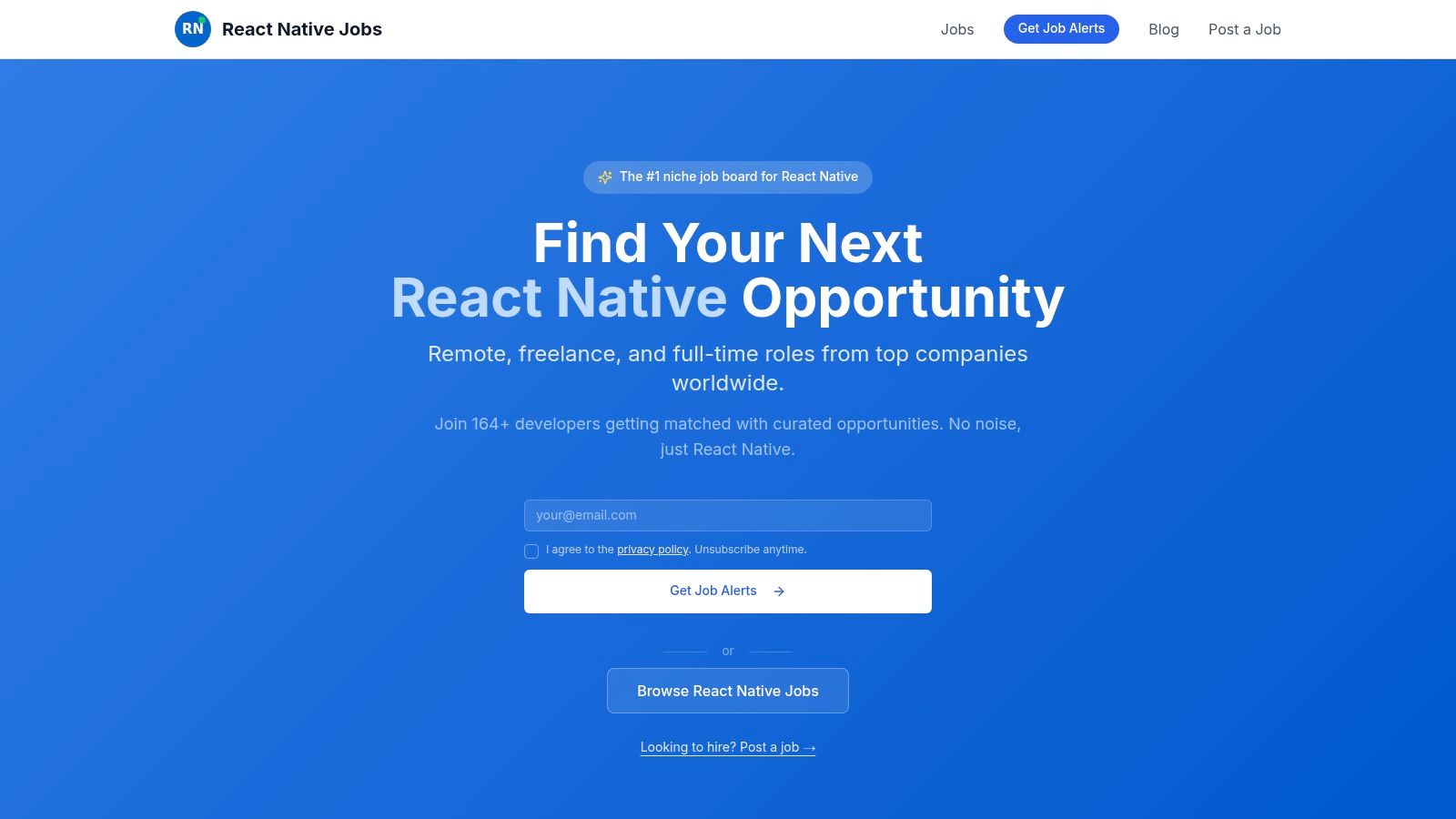
A specialist board can produce better React Native matches than a larger general platform, even with fewer listings. React Native Jobs has a clear React Native signal, so candidates spend less time separating mobile roles from web-focused JavaScript vacancies. Its listings include remote, freelance, junior, and internship opportunities.
That focus also makes the board's email alerts useful. Set alerts for React Native terms, then review each posting rather than trusting its title. Check whether the role uses Expo or bare React Native, expects TypeScript, involves native-module ownership, includes app-store releases, and accepts candidates in your country and time zone.
Practical rule: Use a specialist board to reduce search noise, not to skip verification. “Remote” still requires checks for country, contract, payroll, and time-zone overlap. Review when to choose React Native before narrowing your search to mobile roles.
The trade-off is coverage. A focused board offers fewer adjacent product, design, and management roles than a general platform, so it works best as a high-signal alert source alongside broader searches. For related mobile and Web3 openings, compare these React Native mobile developer roles as well.
2. React Jobs Board
React Jobs Board sits one layer above React Native. That broader scope is useful when you're open to roles that combine mobile and web work, or when a startup describes its stack as React first and expects the mobile engineer to move between platforms.
Listings generally point back to company career pages, which gives you a cleaner application path than a form that traps your information inside an aggregator. Before applying, follow the source link and compare the board summary with the employer's full description. The original posting often reveals whether the role is React Native, whether the company wants a mobile specialist, and whether “remote” is limited to a particular hiring market.
How to use the broader React signal
Search for React Native first, then inspect related React roles only when the job description includes mobile delivery. A React background is common among React Native developers, but web experience alone doesn't prove competence with platform-specific builds, device testing, native integrations, or app-store releases.
This board is particularly useful for startup and scale-up discovery. Those employers may describe the product problem more clearly than larger companies, which helps you tailor your application around the work rather than repeating framework keywords. It's less useful if you want only dedicated React Native vacancies and don't want to spend time separating web roles from mobile roles.
Treat the board as a discovery layer. Apply through the employer's own career page whenever possible, record the original job title, and preserve the exact stack language for interview preparation.
3. We Work Remotely React Native Category
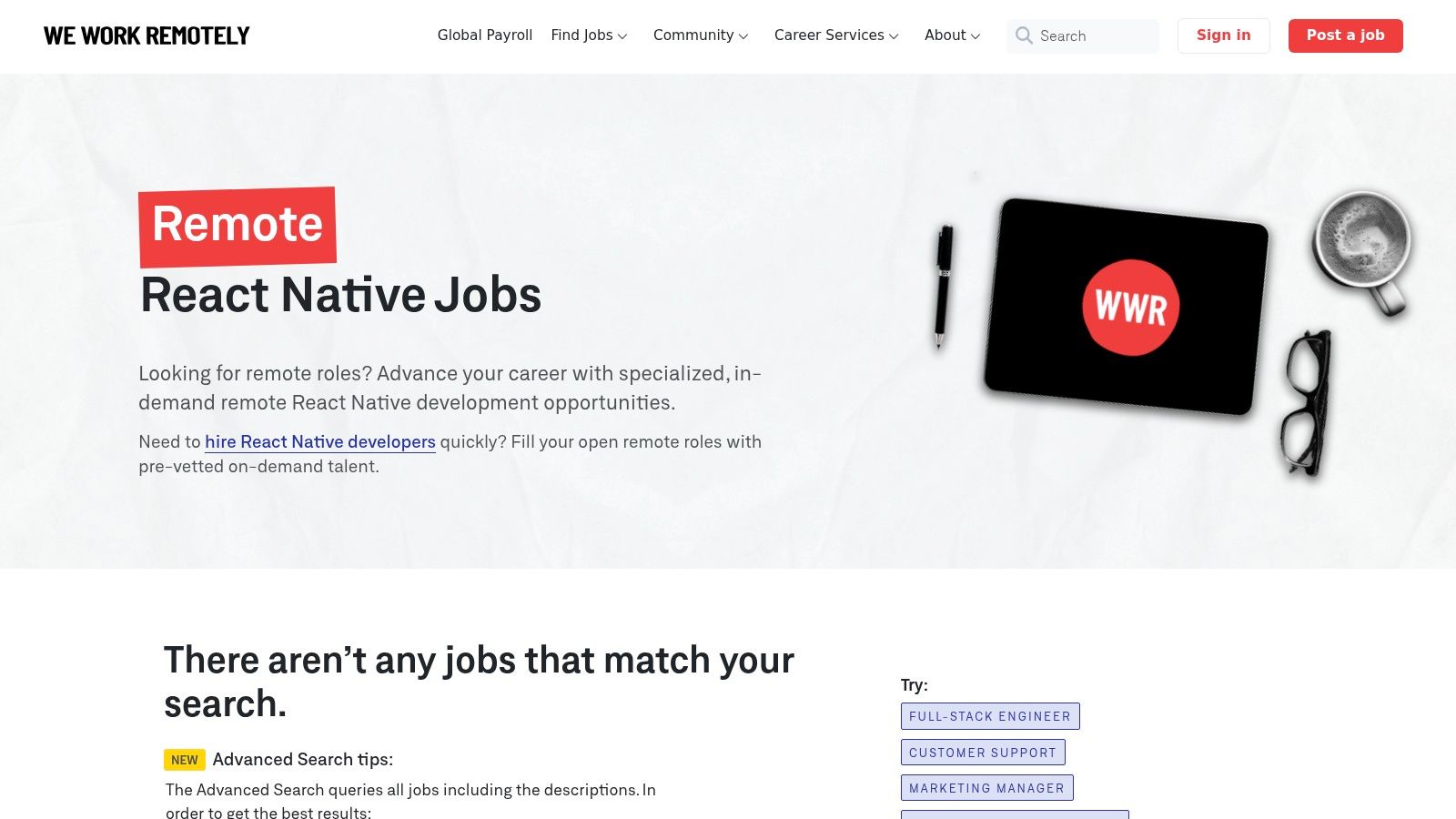
We Work Remotely's React Native category is valuable because remote work is the board's central context rather than an optional filter. Its React Native page gives mobile candidates a more direct route into remote engineering listings, with tags that can indicate contract or full-time status, seniority, and geographic expectations.
That context still doesn't remove ambiguity. A listing can be remote and remain restricted to the United States, a region, or selected time zones. Read the eligibility language before investing in an application written just for that role. If the posting names overlapping hours, employment restrictions, or a required country, treat those as screening criteria rather than administrative details.
The board's established remote audience can mean stronger competition, so a generic React Native résumé won't be enough. Lead with shipped mobile work, native integration, release ownership, and the kind of asynchronous collaboration you've handled. If the role is US-remote, state your work authorization or contractor availability plainly.
For salary context and broader mobile career planning, compare the listing with this overview of mobile developer salaries. Don't treat any external range as an offer expectation. Use it as one input alongside seniority, location, employment model, and the depth of native work required.
4. Remote OK React Native Filter
Remote OK's React Native search is built for fast scanning. Its React Native filter, region labels, and salary or benefits indicators can help you decide quickly which listings deserve a closer read. That's useful when your search includes worldwide roles, US-friendly roles, and positions with different employment models.
Speed creates its own risk. Search filters can produce entries where React Native is only one part of a broad engineering description, so open the full listing before applying. Check whether the company needs a mobile owner, a general JavaScript engineer, or someone maintaining an existing app. Those are different interview tracks.
A quick screening pass
Use the listing metadata to ask four questions:
- Stack fit: Does the role name React Native, TypeScript, Expo, native iOS or Android, and the relevant state-management approach?
- Geographic fit: Does “worldwide” really include your country, or does the company use a contractor or employer-of-record arrangement?
- Compensation fit: Is the salary attached to the same employment model and geography that applies to you?
- Application path: Does the redirect lead to the employer's own ATS, a recruiter form, or another aggregation page?
A role that passes those checks deserves a focused application. One that fails several should remain a tracking note, not a high-priority submission. Candidates also searching adjacent JavaScript roles may find this collection of remote web development jobs useful, but the same geographic checks apply.
5. Remotive React Native Developer Category
Remotive's React Native developer page is designed around remote-first work, with category browsing, alerts, and feeds that suit candidates who want a repeatable search rather than occasional manual checking. Its curation can reduce obvious spam, while direct links to company ATS pages make the application path easier to inspect.
The useful distinction here is between discovery and monitoring. Browse the category to understand which types of companies hire remotely, then use alerts or a feed to keep the search current. Don't assume every relevant vacancy appears in one category. A company may file a role under mobile engineering, JavaScript, or software development while still requiring React Native experience.
What to inspect before applying
Read beyond the framework name. Strong listings usually make the product context, ownership level, platform scope, and collaboration model reasonably clear. You're looking for evidence that the employer knows the difference between a React web developer and a mobile engineer who can diagnose build, device, performance, and release problems.
Remotive can be less useful when you need a large volume of narrowly filtered React Native roles. Its strength is remote context and workflow support, not guaranteed depth in one mobile category. Keep a separate tracker for roles found there, including the employer, country eligibility, application date, and interview stage. That record will show whether the board is producing interviews, not merely interesting search results.
6. Himalayas React Native Jobs
Himalayas' React Native jobs page takes a filter-led approach. Country, time zone, seniority, and employment type are more useful to a remote React Native candidate than a simple “remote” label, particularly when you're comparing US eligibility with broader international options.
This makes the board well suited to early-stage and startup searches. Those listings can offer meaningful ownership, but they may also expect one engineer to cover architecture, native integration, CI, releases, and production support. Read the responsibilities as a scope document. If the company wants a single person to own both product delivery and mobile infrastructure, prepare interview examples that show independent prioritization and troubleshooting.
The board's mobile browsing and alert options are helpful for maintaining momentum, but notifications shouldn't replace qualification. Cross-posted roles may appear in several places, so record the original employer and avoid submitting duplicate applications through different routes.
Match seniority to evidence
A senior title should mean more than years with React Native. Look for expectations around architecture, migration work, performance investigation, native code, release management, and mentoring. A mid-level role may emphasize feature delivery and testing, while a junior role may focus more on component work and guided development.
If the description is vague, ask about the first project you'd own, the current Expo or bare setup, the supported platforms, and how the team handles production incidents. Those questions help you decide whether the role supports the next step in your career or adds another framework keyword to your résumé.
7. Wellfound React Native
Wellfound's React Native category is strongest when you want startup context rather than a generic stream of vacancies. Listings often present company stage, role scope, and compensation or equity information in a way that supports an early screening decision. Remote filters can also help isolate US-remote opportunities.
Startup hiring rewards candidates who can connect technical decisions to product outcomes. Don't submit a résumé that only lists React Native, Redux, and TypeScript. Explain what you shipped, what constraints shaped the architecture, how you handled platform differences, and whether you owned releases or production fixes.
The interview trade-off
Direct access to founders or recruiters can shorten the distance between application and conversation, but startup processes vary widely. One company may run a focused technical discussion around its current mobile problem. Another may ask for a broad unpaid exercise without defining the role. Ask who will review the work, how long the exercise should take, and whether the task reflects the actual stack.
Wellfound's volume also follows startup funding and hiring cycles, so it's better used as one channel rather than your only source. Set up a complete profile, but tailor each application to the company's product and stage. The most convincing candidates show they can make sensible trade-offs with incomplete information, not just reproduce a tutorial app.
8. JS Remotely and JavaScript Jobs
JavaScript Jobs, formerly associated with JS Remotely, offers a JavaScript-focused search with an explicit React Native tag. That keeps the surrounding inventory closer to your technical background than a general remote board, while still exposing roles where React Native sits alongside React, Node.js, or shared TypeScript systems.
The platform is particularly useful for mid-level and senior candidates who want roles with broader JavaScript ownership. Read carefully, though. A JavaScript listing with a React Native tag may expect backend work, web delivery, or responsibility across a larger product surface. That can be a career advantage if you want to become a product-minded mobile engineer. It can also be a poor fit if you're seeking deep native specialization.
Verify the application destination
Branding and redirects can make the search path less obvious than on a specialist board. Confirm that the listing is current, identify the actual hiring company, and apply through the employer's ATS when the original posting provides one. Save the job description because titles and requirements can change after the redirect.
For US candidates, check whether the employer hires domestically or uses a global contractor model. For candidates outside the US, confirm whether the company accepts applications from your country and whether working-hour overlap is required. A JavaScript-only inventory increases technical relevance, but it doesn't guarantee location flexibility.
9. React Native News Jobs Board
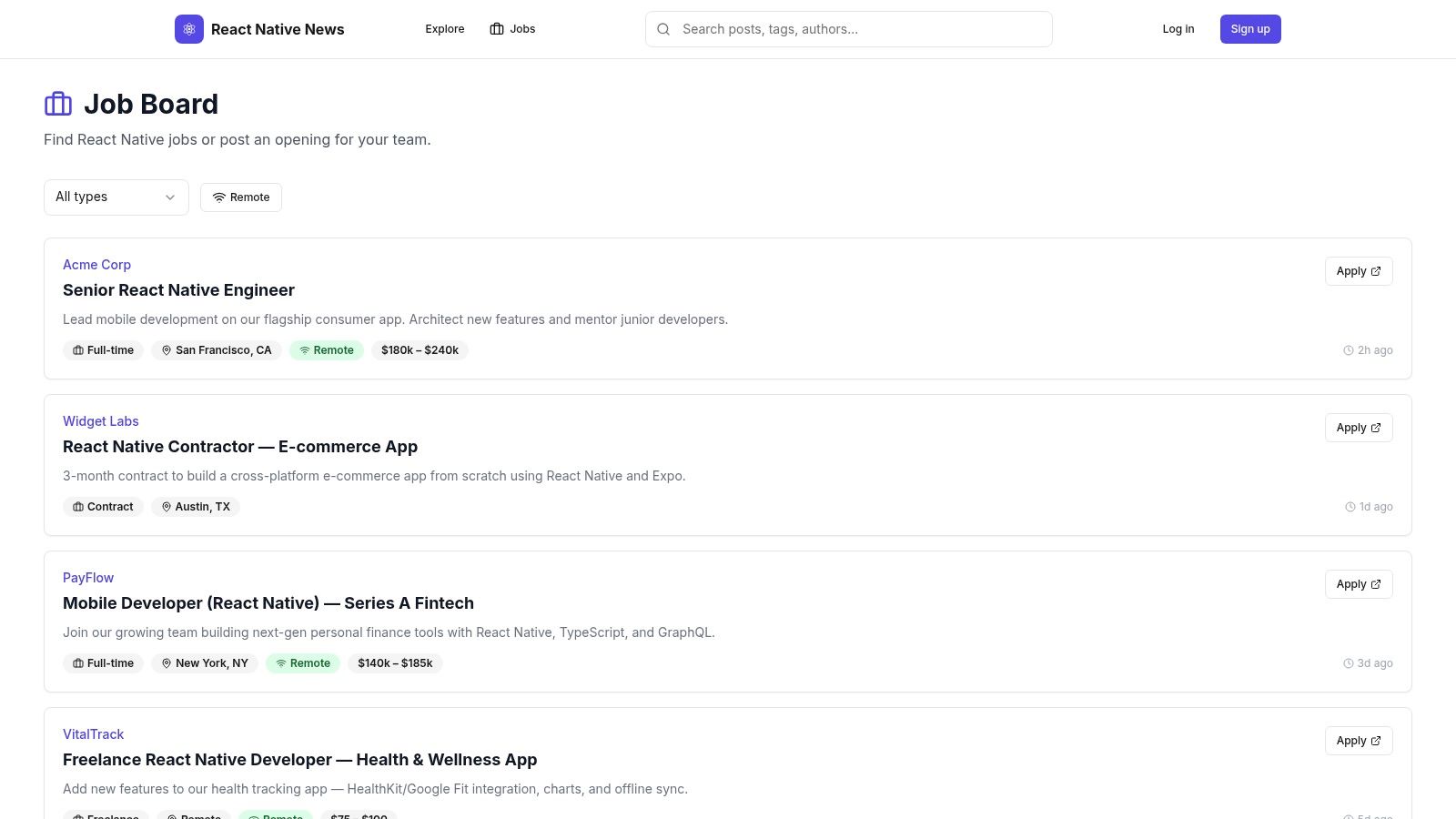
React Native News' jobs board is close to the community itself, which gives its listings a strong React Native signal. Posts may include more stack detail than a generic job advert, including Expo-based development, contract work, or the specific mobile problem the team needs solved.
That technical proximity changes how you should evaluate an opening. Look for clues about whether the employer contributes to the ecosystem, maintains an existing app, or needs a short-term specialist. A contract role can be a useful way to add a shipped project, production debugging, or release experience to your portfolio, but clarify ownership, duration, payment terms, and expected availability before treating it as a long-term career move.
Turn stack details into interview preparation
If the post mentions Expo, prepare to discuss where the managed workflow helps and where native access or custom modules change the decision. If it names iOS and Android, prepare examples of platform-specific behavior, build configuration, and device testing. If it mentions performance, be ready to explain how you distinguish JavaScript-thread work from UI-thread problems.
Community boards can be intermittent, so alerts and repeat visits matter. The smaller volume is a reasonable trade-off when each listing gives you better material for a focused application. Don't judge the board by how many roles it shows on one visit. Judge it by whether the roles lead to conversations with teams doing real React Native work.
10. React Remote Jobs
React Remote Jobs keeps its navigation centered on React and React Native, with a dedicated category for mobile roles. That makes it a convenient remote-first browsing tool when you want to move between React Native vacancies and broader React positions without entering a general employment marketplace.
The main advantage is speed. Category buttons let you reach the relevant inventory quickly, which is useful when you're maintaining several searches. The drawback is that role volume and listing detail can vary, and external ATS redirects may provide more useful information than the board page itself.
Start with the React Native category, then qualify each posting against your target progression. Are you trying to deepen native iOS and Android skills, move toward technical leadership, or become a full-stack product engineer? The same title can support very different paths depending on release ownership, architecture responsibility, and the level of contact you have with product and design.
Career filter: A good remote role should add evidence you can use in the next search, not just another familiar framework name.
Save examples of the strongest descriptions you find. Their repeated requirements can help you improve your résumé, portfolio, and interview stories. If several employers ask for Expo, TypeScript, native debugging, CI/CD, or written technical communication, treat those patterns as signals about the skills you should make visible.
Top 10 Remote React Native Job Boards Comparison
| Board | Focus & Coverage | UX & Quality (Rating) | Value (Price) 💰 | Target Audience 👥 | Standout ✨ / 🏆 |
|---|---|---|---|---|---|
| React Native Jobs | RN-only (remote/on-site/freelance) | ★★★★☆ Minimal, developer-focused | 💰 Free browse; employer-paid posts | 👥 RN devs (all levels) | ✨ RN-only curation; tailored email alerts 🏆 |
| React Jobs Board (reactjobs.io) | React + React Native; startup/scale roles | ★★★★☆ Strong filters, dev-first | 💰 Free to browse; paid listings | 👥 React/RN devs, startups | ✨ Aggregates web roles with company links |
| We Work Remotely, React Native | Large remote-only board with RN category | ★★★★☆ High volume, distraction-free | 💰 Free browse; paid job posts | 👥 Remote engineers (US-heavy) | 🏆 Established remote community; timezone tags |
| Remote OK, React Native filter | Large remote-tech board; RN filter | ★★★★☆ High volume; salary metadata visible | 💰 Free browse; paid employer features | 👥 Global remote RN devs | ✨ Salary & benefits indicators for quick screening |
| Remotive, RN category | Curated remote-only board + community | ★★★★☆ Curated feed, alerts & API/RSS | 💰 Free browse; paid posts for employers | 👥 Remote-first RN devs & power users | ✨ Job alerts, public API/RSS 🏆 |
| Himalayas, React Native | Remote-first search with deep filters & app | ★★★☆☆ Mobile app; timezone & seniority filters | 💰 Free to users; paid employer options | 👥 Remote startup RN devs (US-friendly) | ✨ Mobile alerts + time-zone fit filters |
| Wellfound (AngelList), React Native | Startup-focused marketplace with RN roles | ★★★★☆ Clean UI; comp transparency | 💰 Free apply; companies may pay to feature | 👥 Startup/growth RN devs, founders | 🏆 Salary/equity ranges + direct chats |
| JS Remotely / JavaScript Jobs | JavaScript-focused board with RN tag | ★★★☆☆ Steady senior/mid listings | 💰 Free browse; paid postings | 👥 JS/RN engineers (mid–senior) | ✨ JS-only focus increases relevance |
| React Native News, Jobs | Community-driven RN hub & jobs section | ★★★☆☆ Community-curated; intermittent | 💰 Mostly free/community listings; paid posts possible | 👥 RN community, Expo & contract devs | ✨ Community-sourced roles with stack details |
| React Remote Jobs | React/React Native remote-first aggregator | ★★★☆☆ Centralized remote inventory | 💰 Free browse; employer-paid listings | 👥 Remote React/RN developers | ✨ Fast category navigation; dedicated RN section |
Turning Remote Board Searches Into Interviews and Growth
A remote job search works better as a controlled process than as a daily burst of applications. Start by setting React Native-specific alerts on two or three boards, choosing a mix of specialist and remote-first sources. One board can provide stack relevance, another can provide geographic breadth, and a third can expose startup or community roles that don't appear in the same places.
Verify eligibility before you customize anything. Read whether the employer accepts candidates from your country, whether the role is US-only, whether contractors are allowed, and which time zones must overlap. Available posting data illustrates why the word “remote” needs more scrutiny: one dataset found 19% of React Native listings were fully remote, while 14% were hybrid, with the rest not clearly flexible, as reported by GetUHIRED's React Native insights. That isn't a universal market measurement, but it is a useful warning against assuming that a remote label means worldwide access.
Then read the technical description for the signals that determine interview fit. Expo and bare React Native imply different levels of native access. State management can reveal whether the team expects feature delivery or architectural ownership. Native modules, iOS and Android build systems, testing, CI/CD, release management, and production debugging all deserve separate attention.
Build applications around evidence
React Native's ecosystem requires more than UI implementation. The 2025 State of React Native survey collected 3,501 responses, and nearly 50% of respondents reported adopting the New Architecture. That makes migration experience, TurboModules, Fabric, and compatibility troubleshooting useful differentiators when a role involves a modernizing codebase. The same survey reported that 54% identified better debugging as their top unmet need, so prepare examples that show how you isolated and fixed a production issue.
Performance discussions should be concrete. React Native's official performance documentation advises checking performance in release builds, not only in development. Be ready to explain how you profile slow renders, distinguish JavaScript-thread bottlenecks from UI-thread issues, and validate a change in a production-like environment.
Competition is also concentrated. Karat's analysis of remote engineering reported that candidates interviewing for remote roles represented a 44% concentration of elite software-engineering talent in the US. Your résumé should therefore lead with proof: shipped applications, native integrations, performance or crash investigations, automated tests, app-store releases, and clear written decisions.
Track every application by board, company, location, stack, date, and outcome. A 2025 account of one senior engineer's search recorded 80 applications with no response, 32 producing no interview, 30 remaining in interview processes, and 5 offers, as described in the candidate's job-search report. The lesson is not to copy that application volume. It's to measure where your own qualified applications produce screens and interviews.
Compensation should be discussed with the employment model attached. One 2025 hiring guide estimated US annual compensation across junior through senior React Native levels at approximately $80,000 to $189,000, compared with $48,000 to $120,000 for comparable Latin American talent, with ranges varying by seniority, as outlined by Near's React Native hiring guide. Use such figures as context, not a promise. Ask whether the number is salary, contractor pay, or total compensation, and whether location changes the range.
Candidates who also want crypto-native employers can compare these boards with Blockchain Jobs, which highlights remote-friendly positions and includes an Engineering category. Its listings can be relevant when a mobile role uses React Native and TypeScript across iOS and Android, but apply the same discipline: confirm location, stack, seniority, and the actual hiring process.
Blockchain Jobs offers a dedicated search across Web3 roles, including Engineering, DevOps, Product, Design, and other categories, with remote-friendly listings and a Recently Added Jobs feed. Add it to your React Native search when you want to compare mobile opportunities from crypto-native companies alongside specialist boards.