2026 Mobile Developer Salaries: Your Guide to Fair Pay
Compensation for mobile developers can differ by tens of thousands of dollars a year depending on the market you target. The biggest gap I see is not iOS versus Android. It is traditional product teams versus Web3 companies that need mobile engineers who can ship secure wallet flows, transaction signing, and high-stakes onboarding without breaking trust.
That changes the question a developer should ask. Salary is not just about years of experience or a familiar title. It is about whether your skill set maps to revenue, security, and hard-to-fill hiring needs.
I've watched strong candidates leave money on the table because they sold themselves as framework specialists. Employers rarely stretch comp because someone knows Swift, Kotlin, or React Native in isolation. They pay more for engineers who can own releases, reduce app store risk, improve performance, and handle sensitive flows like payments, identity, and blockchain interactions.
The upside is still there. Experience, location, and stack all affect pay, but the fastest jumps tend to come from specialization and from choosing a market where supply is tight. Web3 stands out here because many teams need mobile talent that can bridge product polish with blockchain complexity, and that combination is still hard to hire for.
One useful signal is AppLighter's latest React Native study. If you are deciding between native and cross-platform work, it gives a clearer view of where teams are investing and what they expect from mobile engineers who want to move up the compensation ladder.
Your Guide to Mobile Developer Salaries in 2026
Mobile developer salaries make more sense when you stop treating them as a single market. A junior Android engineer in a cost-sensitive company, a senior iOS specialist in Cupertino, and a mobile engineer shipping wallet-enabled Web3 apps may all carry similar titles, but they aren't competing in the same compensation bracket.
That's why salary advice often feels incomplete. Developers hear a national average and assume it applies to their next interview. It usually doesn't. Hiring teams price risk, scarcity, product impact, and replacement difficulty. If you can own app architecture, accessibility compliance, release quality, or secure backend integration, your salary potential rises fast.
What hiring teams actually evaluate
Recruiters and hiring managers usually look at a mobile profile through four lenses:
- Platform depth: Can you go beyond feature work and own native behavior, debugging, and app lifecycle issues on iOS or Android?
- Product complexity: Have you shipped payments, authentication, media, offline sync, push flows, or regulated user journeys?
- Scope of ownership: Did you just build tickets, or did you lead architecture, CI/CD, release process, and developer experience?
- Market scarcity: Are you easy to replace, or do you bring hard-to-find skills like SwiftUI polish, Kotlin Multiplatform, React Native with native bridging, or blockchain integration?
Practical rule: Your pay rarely tracks effort alone. It tracks how expensive your skill set is to replace.
Where the upside sits
For most developers, the cleanest path to higher earnings isn't random job hopping. It's targeted progression. Build stronger negotiation stories. Choose a stack with durable demand. Learn how compensation packages are structured. Then decide whether a move into blockchain is worth the premium and volatility.
That's the lens to use for every interview this year. Not “What's the average?” but “Why would this company pay more for me than for the next credible candidate?”
Decoding Your Total Compensation Package
A salary number is only the visible part of the offer. If you're evaluating mobile developer salaries seriously, you need to read the whole package, not just the base.
Base salary is the engine. Bonus, equity, and in Web3, token grants, are the turbochargers. Some offers look strong because the base is high. Others look weak until you model the upside correctly. The mistake I see most often is treating very different forms of compensation as if they carry the same certainty.
Base, bonus, and equity
Start with the component you can spend every month.
- Base salary: This is the most reliable part of the package. It matters most for lifestyle, future raises, and negotiation anchors.
- Performance bonus: Good if it's tied to realistic goals. Less useful if the company has a vague or opaque payout history.
- RSUs: Usually easier to understand than options. They're shares granted on a vesting schedule.
- Stock options: Potentially valuable, but they require more diligence. Ask about strike price, vesting, exercise windows, and what happens if you leave.
If you're comparing a mature public company to an early-stage startup, don't pretend both equity packages carry the same risk profile. They don't. A high base with stable equity may beat a flashy offer full of upside that never materializes.
For remote roles, pay structure matters just as much as headline comp. Remotely's guide to structuring remote compensation is useful because it frames how employers think about fairness, geography, and package design. That context helps in negotiation, especially when a company uses location bands.
How Web3 packages differ
Web3 introduces another layer. You may get a standard base salary plus tokens, or a lower salary with a heavier token component. Neither is automatically better.
When a company includes tokens, ask direct questions:
- What is the vesting schedule? A token grant without a clear vesting plan isn't useful.
- What determines value? Is the token already liquid, or is liquidity uncertain?
- What is the grant meant to replace? Is it upside on top of a market base, or a substitute for salary?
- What happens on termination? You need to know what remains vested and what you lose.
The best offer is the one you can explain on paper after the interview excitement wears off.
A fast evaluation checklist
Use this before you say yes to any mobile role:
| Compensation element | What to ask |
|---|---|
| Base salary | Is this competitive for my level, stack, and location? |
| Bonus | Is payout tied to individual performance, company performance, or both? |
| Equity | Are these RSUs or options, and what is the vesting schedule? |
| Tokens | Is this genuine upside or compensation filling a gap in cash pay? |
| Remote pay policy | Is the company paying local, national, or global rates? |
A clean package beats a complicated one you can't value. If an employer struggles to explain the structure, that's already useful information.
Salary Benchmarks by Experience and Location
A senior mobile developer in the U.S. can earn about 12 times what a peer in India earns, based on country-level figures published by UVIK's global software developer rates analysis. That gap is why weak benchmarking costs real money. Developers often compare themselves to the wrong market, then accept an offer that looks strong locally but sits well below what their skills can command internationally.
Experience and location shape the band, but hiring model matters too. A local employer, a U.S.-based remote company, and a Web3 startup hiring globally can price the same mobile engineer very differently. I see this most often with candidates who have solid app shipping experience and still anchor too low because they only look at local salary surveys.
2026 mobile developer salary ranges
Use the table below as a negotiation reference, not a script. The U.S. ranges are broad market bands from earlier salary research in this article. The country averages are from UVIK, and each cited figure is labeled at the point of use for clarity.
| Experience Level | United States | Switzerland | United Kingdom | Germany | India |
|---|---|---|---|---|---|
| Entry level | $80,000 to $110,000 | High-paying market, see senior average of $115,000 (UVIK) | Below U.S. market, see senior average of $94,267 (UVIK) | Below U.S. market, see senior average of $77,332 (UVIK) | Lower-paying market, with senior average context below (UVIK) |
| Mid level | $100,000 to $125,000 | High-paying market, see senior average of $115,000 (UVIK) | Below U.S. market, see senior average of $94,267 (UVIK) | Below U.S. market, see senior average of $77,332 (UVIK) | $12,000 average (UVIK) |
| Senior | $125,000 to $160,000 or more in broad U.S. market ranges cited earlier in this article | $115,000 average (UVIK) | $94,267 average (UVIK) | $77,332 average (UVIK) | $20,000 average (UVIK) |
The practical point is simple. Employers use salary data that supports their compensation model. If the company hires nationally in the U.S., your benchmark is different from a firm using local city bands. If the team hires globally, they may anchor to lower international ranges unless your experience is hard to replace.
That matters even more in Web3. A mobile engineer who can build wallet flows, secure key handling, or mobile-first dApp experiences often sits outside standard local salary logic. Roles like this Android engineer opening at Rain show how blockchain-adjacent mobile work can pull compensation upward when the product directly touches custody, payments, or onchain user actions.
What U.S. candidates should watch
U.S. pay stays strong for developers who own releases, performance, and architecture, not just ticket delivery. The highest offers usually go to engineers who can point to shipped apps, measurable app health improvements, and clear decision-making under product constraints.
Remote work does not erase geography. Some companies still pay more in San Francisco, Seattle, and New York because they compete against local employers with bigger budgets. Others use one national band. Your job is to ask which model they use before compensation talks get serious.
Developers moving from traditional mobile into Web3 should benchmark both markets. If you only compare against standard mobile roles, you can miss a meaningful premium for blockchain product experience. If you only chase token-heavy offers, you can overestimate the cash value of the package.
How to use benchmarks in interviews
Use salary data to support your case with evidence from your work history.
- Early career: Tie your value to shipped features, app store releases, crash reduction, test coverage, or subscription improvements. Tenure alone rarely gets you to the top of the band.
- Mid level: Show ownership across the full delivery cycle. Hiring teams pay more for engineers who can work with product, design, QA, and backend without constant direction.
- Senior: Be specific about architecture decisions, migrations, release reliability, performance tuning, and mentoring. That is what separates a high-end senior from a generic one.
- Web3 transitioners: Frame blockchain work in mobile terms first. Wallet integration, transaction signing UX, secure storage, and compliance-sensitive flows are easier for hiring managers to price when you connect them to business risk and user trust.
Developers working across native and hybrid stacks should also understand how stack choice affects marketability. Capgo's hybrid development insights are useful if you are weighing cross-platform breadth against the higher pay that often comes from deeper native ownership in complex apps.
Benchmarks help when they are tied to the role in front of you. The strongest negotiation position comes from matching your experience to the company's pay model, then showing why your work belongs at the top of that band.
How Platform and Tech Stack Drive Your Value
Not all mobile skills price the same. Recruiters know it. Engineering managers know it. You should know it before the interview starts.
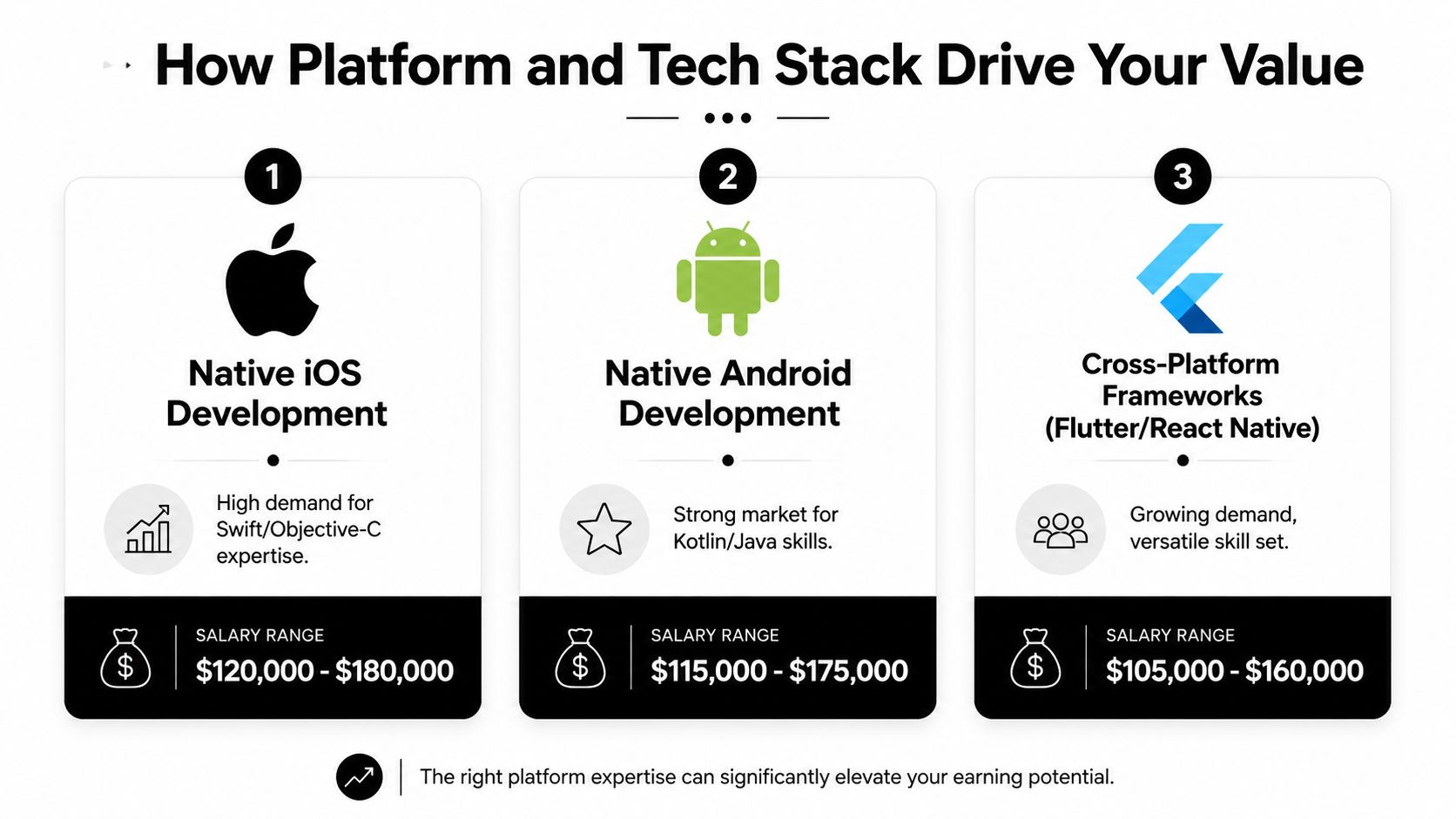
The headline point is simple: platform expertise directly impacts pay; iOS developers in Cupertino average $153,000 per year, and developers proficient in SwiftUI, Kotlin Multiplatform, or React Native command higher wages because those skills are scarce in high-performance cross-platform work, according to DevITJobs salary data.
Native depth still wins in hard interviews
Companies pay a premium for developers who can solve the messy problems that appear in production. Native iOS and Android engineers often stand out here because they can debug OS behavior, handle platform-specific APIs, and make decisions that improve app quality under real constraints.
That doesn't mean cross-platform is weaker. It means the best cross-platform candidates aren't “JavaScript-only mobile developers.” They understand bridges, performance trade-offs, native modules, release pipelines, and when not to force shared code.
A hiring manager will notice the difference quickly.
Cross-platform pays when it solves the right problem
React Native, Flutter, and Kotlin Multiplatform become more valuable when the company needs speed without giving up too much performance or maintainability. Candidates who can speak clearly about those trade-offs tend to negotiate better because they sound like engineers, not framework advocates.
If you work in hybrid stacks, Capgo's hybrid development insights are worth reading for the architectural side of the discussion. That perspective helps in interviews where teams want someone pragmatic, not dogmatic.
A role like Android Engineer at Rain also shows what employers look for when mobile work intersects with product scale and Web3 infrastructure. These jobs usually favor developers who can handle both feature delivery and systems thinking.
What actually increases your market value
Use this as a career filter when choosing what to learn next:
- Native specialization: Best when you want depth, harder interview loops, and strong upside in product-led teams.
- Cross-platform with native competence: Strong option when you can prove you reduce duplication without creating performance debt.
- Architecture and platform ownership: Often more valuable than another UI framework because it signals seniority.
- Security and compliance work: Especially useful in finance, healthcare, and blockchain apps where failure costs more.
The mistake is learning tools in isolation. The valuable candidate can explain why a given stack fits the company's constraints, users, release cadence, and hiring model.
The Web3 Premium Why Blockchain Mobile Roles Pay More
Web3 mobile roles often pay meaningfully more than standard mobile positions because employers are hiring for two scarce skills at once: strong app engineering and sound judgment around moving money, managing keys, and reducing security risk. That combination is hard to find, and compensation reflects it.
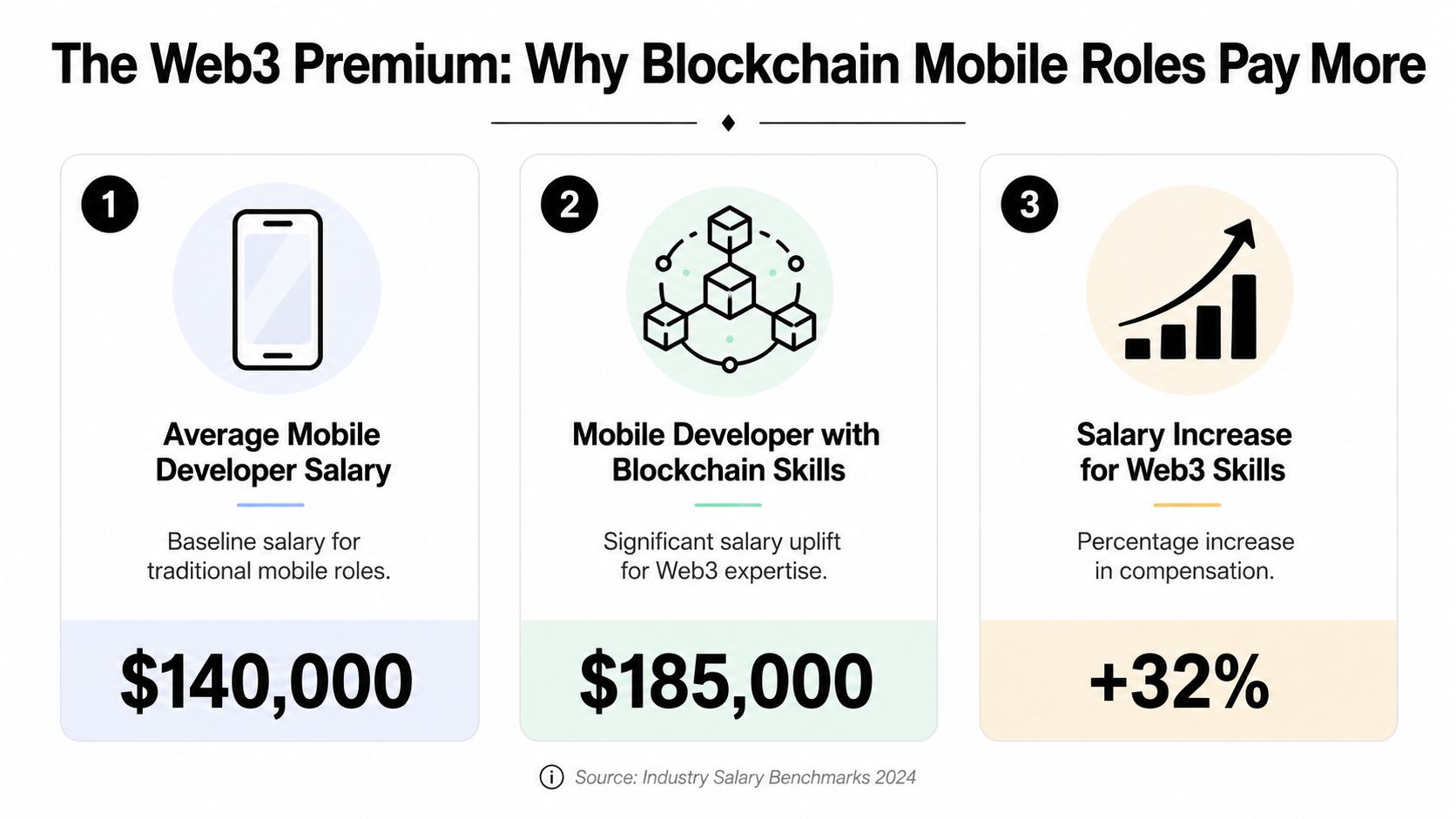
I see the gap most clearly during hiring. A company can find mobile developers who have shipped polished consumer apps. It can also find blockchain engineers who understand contracts and protocol mechanics. Finding someone who can ship a reliable mobile product and make good decisions around wallets, signing, custody, account abstraction, and transaction safety is much harder.
The Day-to-Day of Web3 Mobile Work
Web3 mobile work is still mobile engineering first. The difference is that mistakes carry heavier consequences because users are approving transactions, managing assets, and trusting the app with security-sensitive actions.
Common responsibilities include:
- Wallet integration: Connecting self-custody or embedded wallet experiences without breaking onboarding
- On-chain interaction: Surfacing balances, signatures, transfers, and contract actions through mobile-friendly flows
- Security-focused UX: Building approval screens, recovery paths, and permissions users can understand before they commit
- Infrastructure coordination: Working with relayers, indexers, APIs, and backend services that make blockchain features usable on a phone
That last point matters more than many developers expect. High-paying Web3 mobile jobs rarely involve only frontend ticket work. Teams want engineers who can reason across app performance, API reliability, security reviews, and failure states.
Why employers pay more for this skill mix
The premium comes from hiring risk and business risk.
If a fintech or wallet product hires a mobile developer who is great at animation and weak on transaction safety, the company gets a polished app with expensive failure modes. If it hires a protocol-native engineer who lacks mobile product judgment, the app may be technically correct and still lose users during onboarding, signing, or recovery. The best-paid candidates reduce both risks.
That is why senior openings in this category look different from standard app roles. A role like Principal Mobile Engineer at MetaMask by Consensys signals platform ownership, security judgment, and product depth. Employers at that level are paying for engineers who can make trade-offs that affect trust, retention, and operational risk.
Here's a good primer on how the ecosystem thinks about the space from a broader industry lens:
If you already have strong iOS, Android, or cross-platform experience, adding blockchain fluency is often a faster path to higher compensation than starting over as a pure smart contract engineer.
When the premium is worth pursuing
This path is not automatically better. Some Web3 companies over-index on token compensation. Some mobile experiences are still immature. Some teams move fast and leave engineers carrying too much product and security ambiguity.
The premium is worth pursuing if you want higher ownership, can explain security trade-offs clearly, and are comfortable working closer to financial infrastructure than a typical consumer app role. For mobile developers who want to raise earning power without leaving product engineering, Web3 remains one of the clearest specialty tracks.
Strategies for Salary Negotiation and Career Growth
Most developers don't lose compensation because they lack talent. They lose it because they walk into negotiation with weak framing. Good employers will pay for impact. They won't build your business case for you.
Remote work adds another complication. While U.S.-based mobile developer roles can top $150k in the 90th percentile, global remote developers average $70,877 annually, according to ZipRecruiter's mobile application developer salary data. That gap is why you need clarity on whether a company uses location-adjusted pay or a global flat rate.
Build your negotiation case before the call
Don't start with “I'm looking for more.” Start with evidence.
Bring a compact narrative that covers:
- What you shipped
- What complexity you owned
- What became easier, faster, safer, or more reliable because of your work
- Why that maps to the upper part of the role's band
This works in interviews and internal reviews. Managers can defend compensation increases more easily when your contribution is tied to delivery, quality, hiring advantage, or technical risk reduction.
Hiring lens: The strongest negotiation story is one a recruiter can repeat to the hiring manager in two sentences.
Handle remote pay conversations directly
When a company says it has a remote salary philosophy, ask follow-up questions until the answer is concrete.
- Ask about the band source: Is the range based on HQ, national U.S., or global market data?
- Clarify adjustment rules: If you move, does compensation change?
- Separate pay from convenience: “Remote” doesn't automatically mean premium compensation.
- Discuss total package mechanics: Especially if a lower base is paired with equity or tokens
A vague compensation philosophy usually becomes a problem later.
Skills that move you into a better bracket
If your goal is higher mobile developer salaries, don't just stack buzzwords. Choose skills that map to expensive business problems.
Good bets include:
- Architecture ownership: Modularization, release pipelines, and maintainability
- Performance work: Startup time, rendering quality, memory use, and crash reduction
- Security-sensitive product areas: Authentication, payments, secure storage, wallet flows
- Cross-platform with judgment: React Native or Kotlin Multiplatform used selectively and well
- Web3 integration: Wallet SDKs, signing flows, and mobile UX for blockchain interactions
Interview for the next level, not your current one
The biggest jump usually comes when your interview answers sound one level higher than your title. A mid-level candidate who talks like a feature owner can move up. A senior candidate who talks like a platform leader gets access to better roles and stronger offers.
That means your prep shouldn't stop at algorithms or framework trivia. Be ready to discuss trade-offs, product constraints, failure recovery, release risk, and how you make decisions under ambiguity. That's what separates a solid mobile engineer from a highly paid one.
Finding High-Paying Mobile Roles in 2026
The biggest pay gap in mobile hiring is not between iOS and Android. It is between generic app work and mobile roles tied to security, money movement, and blockchain products.
That difference matters when you search. Broad salary averages can tell you the market is healthy, as noted earlier, but they do not tell you where the best offers sit. The highest-paying openings tend to cluster in companies where mobile engineers own sensitive user flows, support revenue-critical features, or ship infrastructure-level product work. In 2026, that increasingly includes Web3 teams building wallets, custody products, trading interfaces, and mobile experiences around signing, authentication, and asset movement.
A role like Mobile Engineer at Fireblocks is worth studying even if you are not applying yet. It shows how top-paying employers define value. They are not asking for someone to ship screens fast. They want engineers who can handle secure transaction flows, reduce failure risk, and build trust into the product itself.
A better search process looks like this:
- Filter for business-critical mobile teams. Payments, fintech, digital identity, wallet infrastructure, and custody products tend to pay more than content or utility apps.
- Read for responsibility, not just stack. “Own architecture,” “improve reliability,” and “design secure flows” are stronger salary signals than a long list of frameworks.
- Check how compensation is built. Some Web3 companies offer a lower base with meaningful token upside. Others pay premium cash because they need proven security and product judgment now.
- Favor roles where your background maps to expensive problems. Experience in auth, payments, regulated products, or performance work often transfers well into higher-paying blockchain mobile jobs.
- Use specialist job boards before broad ones. General platforms create volume. Niche platforms surface companies that already know why strong mobile talent is expensive.
This is the practical part many developers miss. Higher pay rarely comes from sending more applications. It comes from targeting roles where your work affects trust, revenue, or asset security.
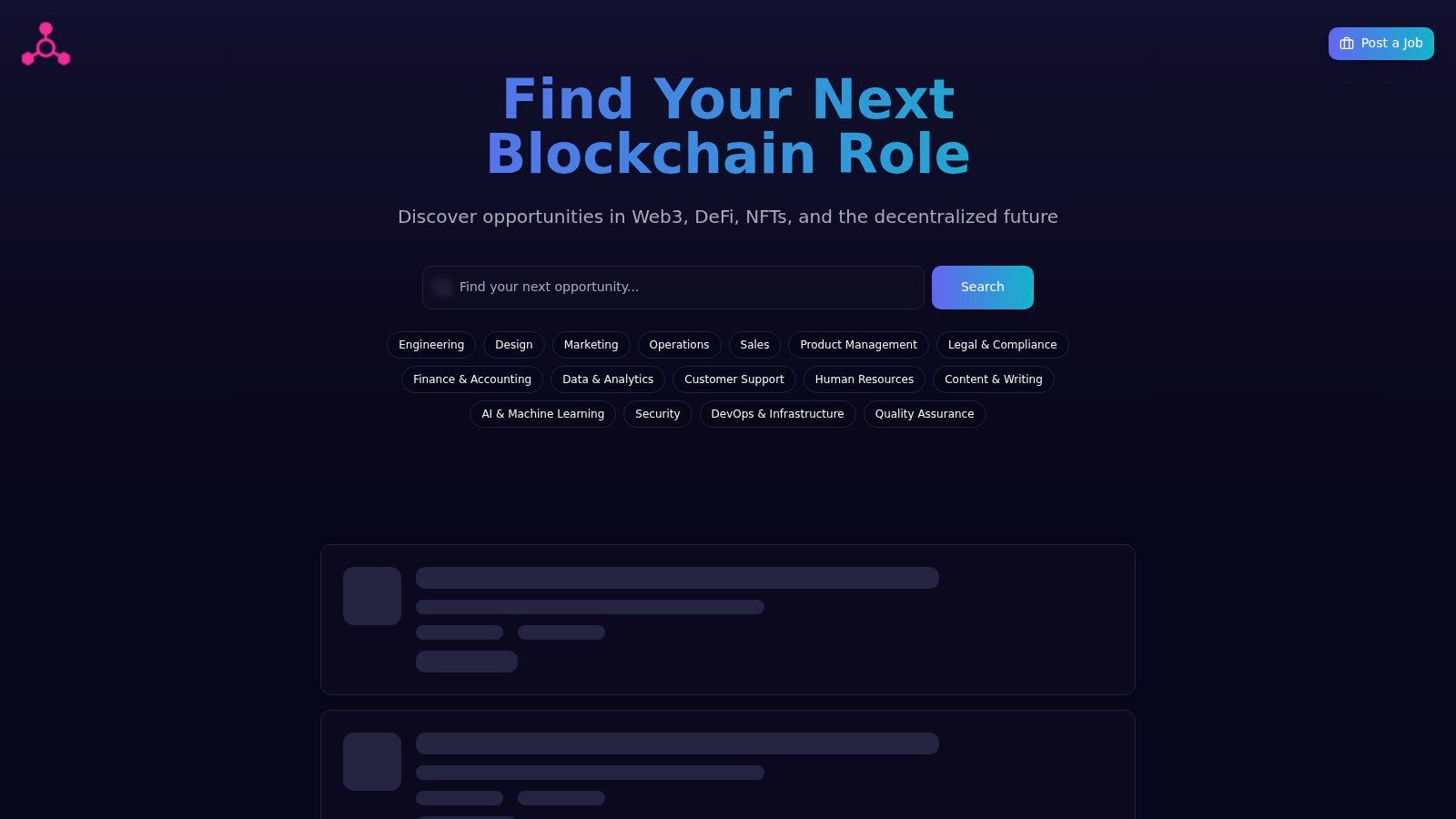
If your goal is to move from standard mobile compensation into the Web3 premium band, start with Blockchain Jobs. It is a focused place to find blockchain, DeFi, and remote-friendly mobile roles where the right experience can turn into stronger cash offers, better equity or token upside, and faster compensation growth.