Land Your Next Role: A Career Guide to Regulatory Compliance Jobs Remote
The demand for skilled compliance professionals who can work from anywhere has exploded. As companies in finance, tech, and healthcare navigate a complex web of global regulations, they've realized the best talent isn't always local. This shift has created a vibrant, competitive market for experts seeking flexibility without compromising their career progression. This guide provides actionable insights to help you navigate the hiring process, ace interviews, and accelerate your career in remote compliance.
Why Hiring Managers are Seeking Remote Compliance Experts

Let's be clear: the compliance world is no longer chained to a physical office. The past few years proved that even the most critical compliance tasks can be managed securely and effectively from anywhere. Hiring managers now understand that expertise, not a zip code, is what matters when navigating today's regulatory minefield.
This shift creates a true win-win. For organizations, it means lower overhead and access to a global talent pool. For you, the professional, it means a direct path to roles with top-tier firms that were once geographically out of reach, all while gaining a better work-life balance and accelerating your career growth.
Getting a Feel for the Current Job Market
The numbers paint a clear picture of the remote governance, risk, and compliance (GRC) landscape. Understanding this data is the first step in positioning yourself effectively for your next career move.
Remote Compliance Job Market at a Glance
| Metric | Data Point | Source/Note |
|---|---|---|
| Total U.S. GRC Jobs | 18,000+ | Overall market size |
| Fully Remote GRC Jobs | ~5,200 | A significant 28% of all GRC roles |
| Typical Salary Range | $95,000 - $170,000 | Varies by experience, specialization, and company |
| Data Source | Concertium | Analysis of remote GRC job trends |
This table shows that remote work isn't a niche perk—it's a core hiring strategy. It means you have a substantial number of opportunities to target.
The real takeaway for your job search is that companies aren't just filling seats. They're strategically hunting for specialized skills in high-demand areas like data privacy, anti-money laundering (AML), and international trade. This makes your unique expertise more valuable than ever in salary negotiations.
The Roles and Career Paths People Are Fighting For
The demand for regulatory compliance jobs remote spans multiple specializations, creating clear pathways for career growth. As you plan your next move, focus on these high-growth titles:
- AML/KYC Analysts: The front-line defense, digging into transactions and customer identities. A great entry point to gain foundational skills.
- GRC Managers: The strategic thinkers who design and oversee an organization's entire governance, risk, and compliance framework. A common next step for experienced analysts.
- Compliance Officers: The internal watchdogs ensuring the company adheres to policies and laws. A senior role requiring broad expertise.
- Privacy Specialists: The guardians of data, focusing on regulations like GDPR and CCPA. A rapidly growing field with high earning potential.
These roles are prevalent in nimble tech startups and innovative blockchain companies. For a great example of a target role, review this Senior Compliance Specialist role that’s 100% remote. Analyzing job descriptions like this is key to understanding what skills hiring managers are prioritizing right now.
Building Your Remote-Ready Compliance Skillset
Landing a top-tier remote compliance job isn't just about knowing the rules. It’s about proving you can deliver results autonomously. Hiring managers are searching for self-starters who can own their role and proactively manage risk from anywhere in the world. To get hired and promoted, you must master both your technical expertise and the soft skills that signal you're a remote-first professional.
Your technical expertise gets you the interview, but your soft skills convince a manager you can thrive on a distributed team and are ready for leadership.
Must-Have Technical Compliance Skills
Your foundational knowledge is your ticket to the game. When a recruiter or hiring manager scans your resume, they’re looking for specific competencies that solve their biggest headaches. To position yourself for a senior role and higher pay, demonstrate deep expertise in these areas.
- Anti-Money Laundering (AML) & Know Your Customer (KYC): This is ground zero for many industries, including Web3. Be prepared to discuss your hands-on experience with transaction monitoring, sanctions screening, and customer due diligence during interviews.
- Data Privacy & Protection: You must know regulations like GDPR, CCPA, and LGPD. In an interview, talk about projects where you ran Data Protection Impact Assessments (DPIAs) or managed data subject access requests, not just your theoretical knowledge.
- Risk Modeling & Assessment: Can you build a risk assessment framework from scratch? Prepare examples of how you have developed methodologies, conducted control testing, and mapped out risk mitigation strategies that work in a remote environment.
The Soft Skills That Seal the Deal
When you’re working remotely, how you work is just as important as what you know. Managers need to trust you'll communicate clearly and handle your responsibilities without constant supervision. These are the skills that lead to promotions.
Interview Pro Tip: Proactive communication is a game-changer. A hiring manager will always choose the candidate who can describe a time they immediately flagged a potential risk in a shared Slack channel over one who waited for a weekly team call. It shows ownership and an understanding of how successful remote teams operate.
Make sure you're developing and highlighting these critical remote-work skills in your resume and interviews:
- Asynchronous Communication: Master writing clearly in tools like Slack, Asana, or email. Your goal is to provide full context so teammates in different time zones can act on your messages without a follow-up call.
- Virtual Stakeholder Management: Demonstrate your ability to build rapport, influence decisions, and manage expectations with colleagues and leaders you may never meet in person.
- Digital Problem-Solving: Get comfortable using compliance software, GRC platforms, and data analytics tools. Be ready to explain how you investigate issues independently and present data-backed solutions.
Certifications That Boost Your Career ROI
Think of certifications as proof of your expertise. They provide instant credibility that can unlock senior roles and justify higher salary requests. Choose a certification that aligns directly with your target career path.
- Certified Anti-Money Laundering Specialist (CAMS): The gold standard for anyone pursuing a career in financial crime prevention.
- Certified Compliance & Ethics Professional (CCEP): An excellent choice for generalists aiming for broader corporate compliance or ethics officer positions.
- Certified in Risk and Information Systems Control (CRISC): Highly valuable for roles at the intersection of compliance, IT, and technology risk.
Investing in the right certification can shorten your path to a leadership position. Recruiters often search for these acronyms specifically. Notice how this remote Senior Regulatory Compliance Specialist opening will likely attract candidates with these credentials. Having them on your resume makes you an expert they can’t ignore.
How to Write a Resume That Beats the Bots
Before a human sees your resume, it must pass the Applicant Tracking System (ATS). These bots scan for keywords and specific formatting. To land top regulatory compliance jobs remote, your resume must be smart enough for the machine and compelling enough for the hiring manager.
Start by mirroring the language in the job description. If a posting repeatedly mentions "virtual audits," "remote risk assessment," or "distributed teams," ensure those exact phrases are in your resume. This is a technical requirement to pass the initial filter.
Tailoring Keywords for the Remote Landscape
Think beyond standard compliance jargon. A hiring manager for a remote role needs someone who can thrive without direct oversight. Weave in keywords that signal you're a remote work professional:
- Collaboration Tools: Be specific. Name the tools you’ve used, like Asana, Jira, Slack, or Microsoft Teams. This shows practical experience.
- Remote Processes: Use action verbs that demonstrate remote effectiveness. Use phrases like "conducted remote KYC/AML reviews," "managed virtual policy implementation," or "led cross-time-zone regulatory projects."
- Autonomy & Ownership: Sprinkle in words that signal independence. Phrases like "independently managed," "self-directed," "proactively identified," and "worked autonomously" are exactly what hiring managers want to see for a remote position.
This infographic shows how your technical skills, soft skills, and certifications combine to create a powerful profile for remote work.
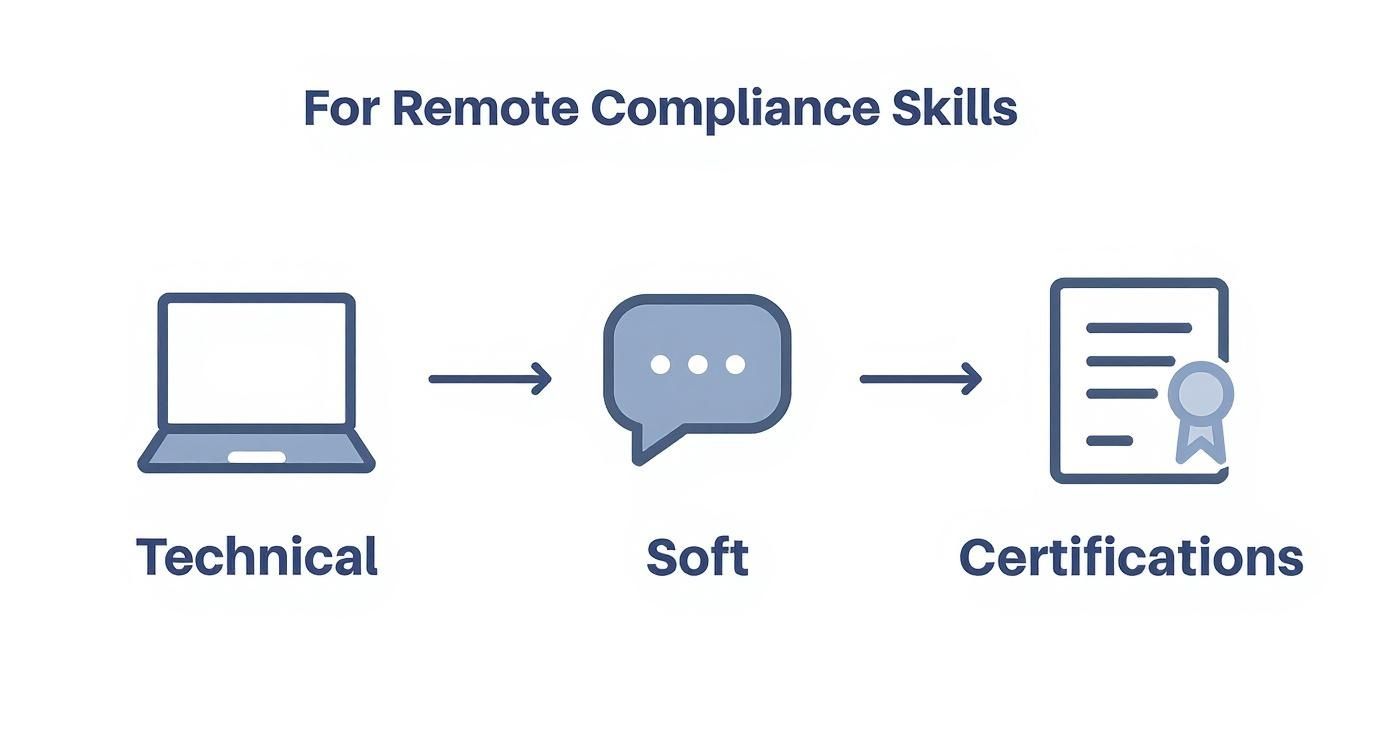
None of these elements work in isolation. Your certifications add weight to your technical claims, while your soft skills prove you can apply that knowledge effectively in a remote setting.
From Passive Duties to Impactful Achievements
Once you're past the ATS, you have about six seconds to impress a human. This is where you must switch from listing responsibilities to showcasing accomplishments. Each bullet point should be a mini-success story with a problem, an action, and a measurable result.
The biggest mistake job seekers make is listing what they were "responsible for." A hiring manager doesn't care about your old job description. They want to see the results you can deliver without hand-holding. This is doubly true for remote roles.
Don't just say you handled policy updates. Show how you owned that project and what positive outcome it had. This is the difference between a resume that gets ignored and one that lands an interview. Frame yourself as a professional who drives results, not just a person who completes tasks.
I always advise candidates to reframe their experience this way. It's a small change with a huge impact on your job search success.
Transforming Your Resume for Remote Compliance Roles
Here’s a practical guide to turning bland duty descriptions into compelling, achievement-focused statements that will catch a recruiter's eye and lead to interviews.
| Generic Statement (Before) | Impact-Driven Bullet Point (After) |
|---|---|
| Responsible for conducting KYC reviews. | Independently managed and cleared 300+ high-risk KYC profiles per quarter with 99.8% accuracy, working autonomously within a distributed team. |
| Updated company compliance policies. | Proactively identified regulatory gaps and spearheaded a virtual project to overhaul 5 key AML policies, resulting in a 15% reduction in false positives. |
| Participated in team meetings. | Collaborated with a cross-functional, remote team using Slack and Jira to streamline the incident reporting process, cutting resolution time by 25%. |
| Monitored transactions for suspicious activity. | Developed and implemented a new transaction monitoring rule that improved detection of illicit activities by 18%, presenting findings to leadership via monthly video conferences. |
Notice how the "After" column uses numbers, action verbs, and specific remote-work context. This approach proves not just what you did, but how well you did it in a remote setting.
Nailing the Virtual Interview
Acing a remote interview isn't just about a stable internet connection. This is your live audition to prove you can operate autonomously and build trust entirely through a screen. You must demonstrate the soft skills—proactive communication, a strong virtual presence, and independent thinking—that remote hiring managers value as much as technical expertise.
https://www.youtube.com/embed/0siE31sqz0Q
Mastering the virtual interview is critical for career growth in the compliance world. The demand for remote pros is strong, with an average salary around $121,031 a year. With ranges spanning from $70,000 to over $165,000, your interview performance is the final step to landing a top-tier offer. It's wise to review insights about the remote compliance job market to understand your market value before the interview.
Setting the Stage for Success
Your interview environment sends a non-verbal message about your professionalism. A chaotic background or poor lighting can signal a lack of attention to detail—a red flag in the compliance field.
- Curate Your Background: Choose a neutral, uncluttered space. A clean wall or organized bookshelf is ideal. A tasteful virtual background is also acceptable.
- Do a Tech Rehearsal: Test your camera, microphone, and the interview platform (Zoom, Teams, or Google Meet) a day in advance. Ensure your face is well-lit from the front.
- Eliminate All Distractions: Inform your family or roommates of your interview time. Close all unnecessary tabs on your computer to avoid distracting notifications.
Answering Behavioral Questions with Remote-First Stories
Behavioral questions are your chance to prove how you've handled situations in the past. For a remote role, frame your stories to highlight your independence and remote collaboration skills. Use the STAR method (Situation, Task, Action, Result) with a remote-work spin.
Instead of saying: "My team and I had a disagreement about a new policy."
Try this approach: "The product manager, based in a time zone six hours ahead, and I had different views on a new data privacy feature. Since we couldn't just grab a conference room, I initiated an asynchronous discussion in a shared document to outline our perspectives before our video call, which made our live conversation much more productive."
This framing instantly shows the interviewer you understand and can overcome the unique challenges of remote collaboration.
Interview Pro Tip: When they ask, "Tell me about a time you managed a complex project," detail how you used Asana for task visibility, sent weekly updates to reduce meetings, and presented the final results to a distributed leadership team via video. This proves you can deliver results without being in an office.
Tackling the Remote Case Study
Many compliance interviews include a case study. In a remote setting, this tests your presentation and communication skills as much as your analytical abilities.
- Master the Screen Share: Practice presenting your analysis using the screen share feature. You need to switch seamlessly between documents without fumbling.
- Narrate Your Thought Process: Since you can't use a physical whiteboard, verbalize your logic. Say things like, "First, I'm identifying the primary regulatory risk. My next step is to assess the control environment by analyzing X and Y."
- Keep Your Audience Engaged: Pause to ask questions like, "Does that approach make sense so far?" This transforms a presentation into a collaborative problem-solving session, which hiring managers love to see.
Nail these elements, and you’ll prove you’re not just a candidate who can do the job, but one who will thrive doing it from anywhere.
Negotiating Your Offer and Remote Perks

Getting the job offer is a major milestone, but your work isn’t done. When the offer letter arrives, your role shifts from candidate to negotiator. This is your opportunity to secure a package that reflects your value in a competitive market for regulatory compliance jobs remote.
Before discussing the offer, research salary data for your specific role, experience level, and location. Even for remote roles, some companies adjust pay based on cost of living. This data is your primary leverage in any negotiation.
Moving Beyond the Base Salary
A strong offer is about the total compensation package. Once you've established a fair base salary, broaden the conversation to other high-impact areas that contribute to career progression and financial growth.
- Signing Bonus: If the company can't meet your base salary expectations, a signing bonus can bridge the gap. Frame it as a way to cover transition costs.
- Performance Bonus: Ask for specifics. Is it tied to individual, team, or company performance? A key question is, "What have the average bonus payouts been for this role over the past two years?"
- Stock Options or RSUs: This is crucial for long-term wealth building, especially in tech and Web3. Understand the vesting schedule and the company's valuation.
- Professional Development Budget: Negotiate for a dedicated annual budget for certifications (like CAMS or CCEP), conferences, or courses. This is an investment in your career growth and demonstrates your commitment to staying current.
Negotiation Script: "Thank you for the offer; I'm very excited about this opportunity. Based on my research for senior remote compliance roles, the market rate is closer to [Your Target Salary]. I'd also love to discuss a professional development budget to ensure I can continue bringing the most current regulatory insights to the team."
Clarifying Remote-Specific Perks and Expectations
For any remote role, non-monetary benefits directly impact your effectiveness and work-life balance. Before signing, get clarity on the company’s remote work policies.
Push for specifics on:
- Home Office Stipend: Ask if they provide a one-time or annual stipend for your desk, chair, and monitors. This is standard at most remote-first companies.
- Work Hours and Flexibility: Clarify if the role requires set hours or if the company embraces asynchronous work. This is critical for autonomy.
- Internet and Phone Reimbursement: Inquire about reimbursement for a portion of your monthly internet and phone bills, as they are essential tools for your job.
Getting these details confirmed in writing ensures you start your new job with everything you need to succeed. Top companies hiring for roles like this remote Regulatory Affairs and Licensing UK Lead role already know that a comprehensive package is key to attracting and retaining top talent.
Answering Your Top Questions About Remote Compliance Careers
As you explore remote regulatory roles, a few key questions often arise. Getting clear answers can streamline your job search and help you make informed career decisions.
Where Are the Best Places to Actually Find These Jobs?
While large platforms like LinkedIn are useful, the best opportunities are often on specialized job boards. This strategy is like fishing in a well-stocked pond instead of the ocean.
Niche boards focused on remote work, like Remote.co and FlexJobs, pre-filter for quality remote-first companies, saving you significant time.
For senior or highly technical roles, go deeper. Industry-specific job boards from organizations like the Association of Certified Anti-Money Laundering Specialists (ACAMS) or the Society of Corporate Compliance and Ethics (SCCE) list positions you won't find elsewhere.
Are There Many Entry-Level Remote Compliance Jobs?
Honestly, truly entry-level remote compliance jobs are less common. Most companies hiring remotely want professionals who can operate independently from day one, which favors candidates with a few years of experience.
However, they do exist. Target titles like "Compliance Coordinator" or "KYC Analyst." To improve your chances, secure a relevant internship, earn a foundational certification, and highlight any experience with remote collaboration tools on your resume.
Career Tip: Prove you're “remote-ready” even if you haven't had a remote job. In interviews, discuss projects where you worked independently, managed your own schedule, and used tools like Slack or Asana. This demonstrates the self-discipline hiring managers look for.
How Do I Prove I'm a Good Remote Worker if I've Never Worked Remotely?
This is a common interview challenge. The key is to reframe your past experiences through a remote-work lens. Don't just list what you did; explain how you did it in a way that highlights self-sufficiency.
For example, describe a project you managed with little direct supervision. Detail how you used clear written communication, shared documents, and scheduled video calls to keep stakeholders aligned without being in the same office. Emphasize your proactive communication and organizational skills—these are the core traits of every successful remote professional and are essential for career progression.
Ready to find your next opportunity in the decentralized world? Blockchain Jobs is the leading job board for roles in Web3, DeFi, and crypto. Explore hundreds of remote and hybrid openings from top companies in the space. Find your next role at https://blockchain-jobs.com.