Best Language for Smart Contracts: Which to Learn in 2026
The most popular advice about smart-contract languages starts in the wrong place: learn Solidity because it's popular, or learn Rust because it's faster. Neither recommendation tells you whether you can reach the employers using that language, explain their execution environment in an interview, or demonstrate that your code won't lose assets.
The best language for smart contracts follows the chain you intend to build on, the risks you'll manage, and the hiring market you can enter. For a career decision, syntax is the easy comparison. The harder question is which specialization you can turn into credible, reviewable engineering work.
Quick Pick Which Language Fits Which Goal
There's no universal winner. Solidity is the practical default for broad EVM opportunities. Rust fits Solana and performance-sensitive protocol work. Move deserves consideration when asset-preservation guarantees matter more than ecosystem breadth.
Vyper and Motoko answer narrower questions. Vyper suits deliberately constrained EVM contracts, while Motoko makes sense when you've already chosen the Internet Computer. Neither should be treated as a shortcut around understanding its execution environment.
Smart-contract languages by best fit
| Language | Best fit | Main ecosystem | Learning curve |
|---|---|---|---|
| Solidity | EVM chains, DeFi and broad job reach | Ethereum and EVM layer-2 networks | Moderate, with many EVM quirks |
| Vyper | Small, auditable EVM contracts | Ethereum and EVM chains | Low for Python developers |
| Rust | High-throughput and non-EVM protocols | Solana and other non-EVM chains | Steep, due to ownership and account models |
| Move | Asset-centric protocols where safety comes first | Sui and Aptos | Moderate, due to the resource model |
| Motoko | Applications on the Internet Computer | Internet Computer | Moderate, due to the actor model |
Solidity was created specifically for contracts executed by the Ethereum Virtual Machine. That alignment explains why choosing an EVM network usually leads candidates toward Solidity tooling, libraries, testing conventions, and audit practices.
Treat the learning-curve labels as planning guidance, not measures of production readiness. Python familiarity can make Vyper readable without teaching you secure authorization. Rust experience can help with Solana without teaching you its account model.
Apply the chain, asset, and job filter
- Which chain will I build on? Match its execution environment to the ecosystem column, then choose the corresponding toolchain.
- What assets will the code hold? Custody, scarce assets, and complex permissions require closer examination of language guarantees and application invariants.
- Which jobs am I targeting? Count accessible openings before committing to a specialization, then build the portfolio artifact those roles require.
Your first language should support a complete hiring story: a target ecosystem, a working application, and defensible security decisions.
Ecosystem Reach and Hiring Demand Compared
Ethereum retained the largest overall blockchain developer community across North America, South America, Europe, Asia, and Africa in Electric Capital's developer analysis. That supports Solidity as a default for ecosystem reach, but developer participation isn't the same measurement as vacancies, applicant competition, or compensation.
Use the visual comparison as orientation, not as a measured salary or vacancy ranking.
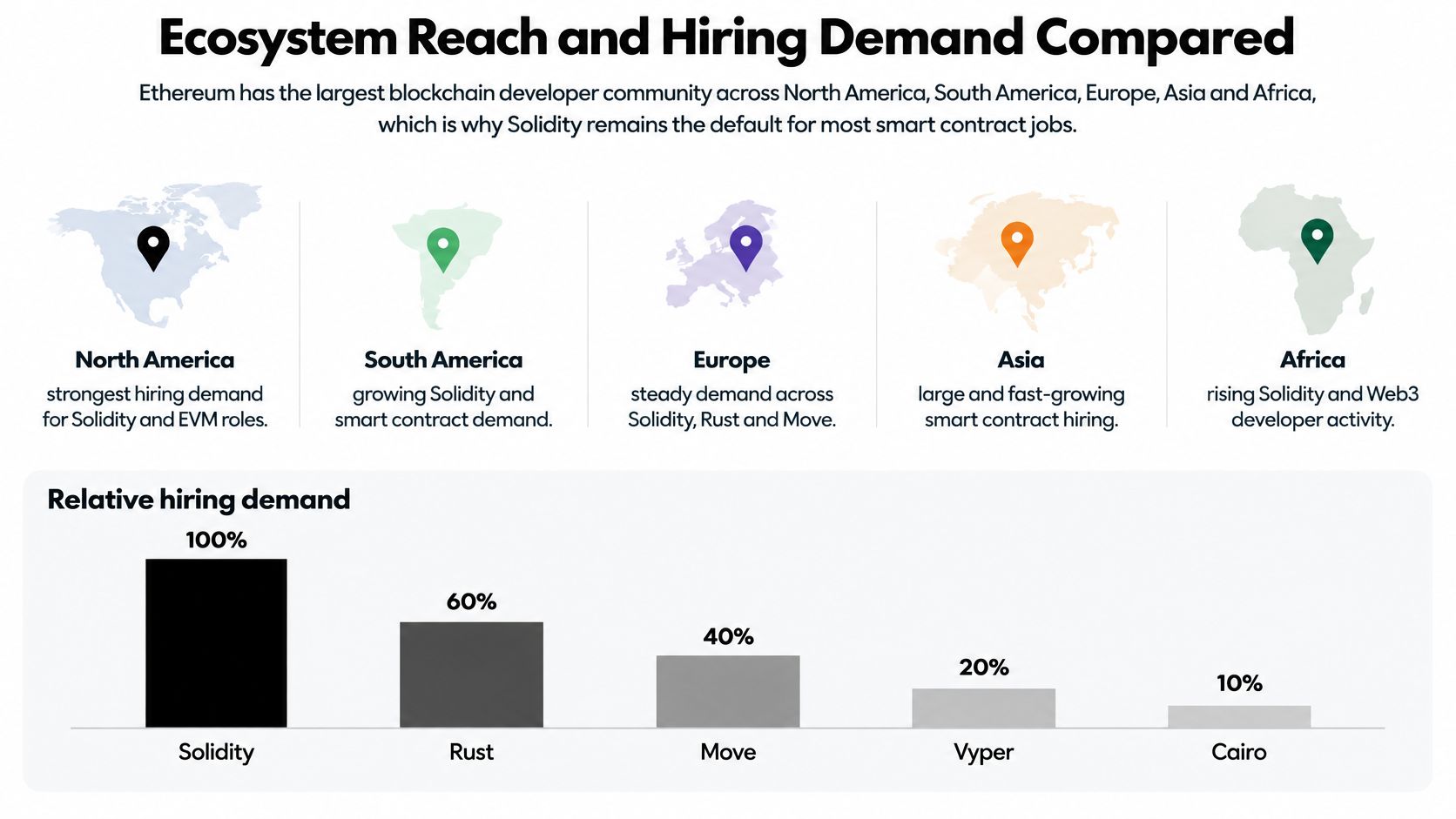
The challenger signal is substantial: Electric Capital reported 39,148 developers entering crypto in 2024, including 7,625 building on Solana, an 83% year-over-year increase and the first time since 2016 another ecosystem outpaced Ethereum in attracting new developers, according to The Block's coverage.
A Rust developer with Solana experience therefore targets a more specialized pool than a general Solidity applicant. That changes which experience matters in interviews, but it doesn't establish that competition is lower or salaries are higher. New developers can become applicants, founders, contributors, or infrastructure engineers rather than smart-contract hires.
Count opportunities you can actually accept
At Blockchain Jobs, we list 6,934 open roles across crypto, DeFi, and Web3. Our 21 role categories include Engineering, the largest category with 1,624 listings; those totals aren't counts of language-specific smart-contract vacancies.
- Set your eligibility filters. Filter engineering listings by target city or remote arrangement, and check geographic restrictions.
- Count language mentions. Record roles naming Solidity, Rust, Move, or Vyper. Use the Solidity developer jobs guide to sharpen your EVM search.
- Repeat for your shortlisted chains. Separate application development from validators, SDKs, and backend infrastructure.
- Compare actual offers of work. Review seniority requirements and the salary ranges shown in each listing.
A listing can name several languages. Count overlapping requirements rather than interpreting every mention as an independent vacancy.
For additional context alongside your listing review, use this video.
Hiring rule: Match the language to employers you can realistically join, not to the ecosystem with the loudest growth narrative.
Safety Guarantees and Their Runtime Cost
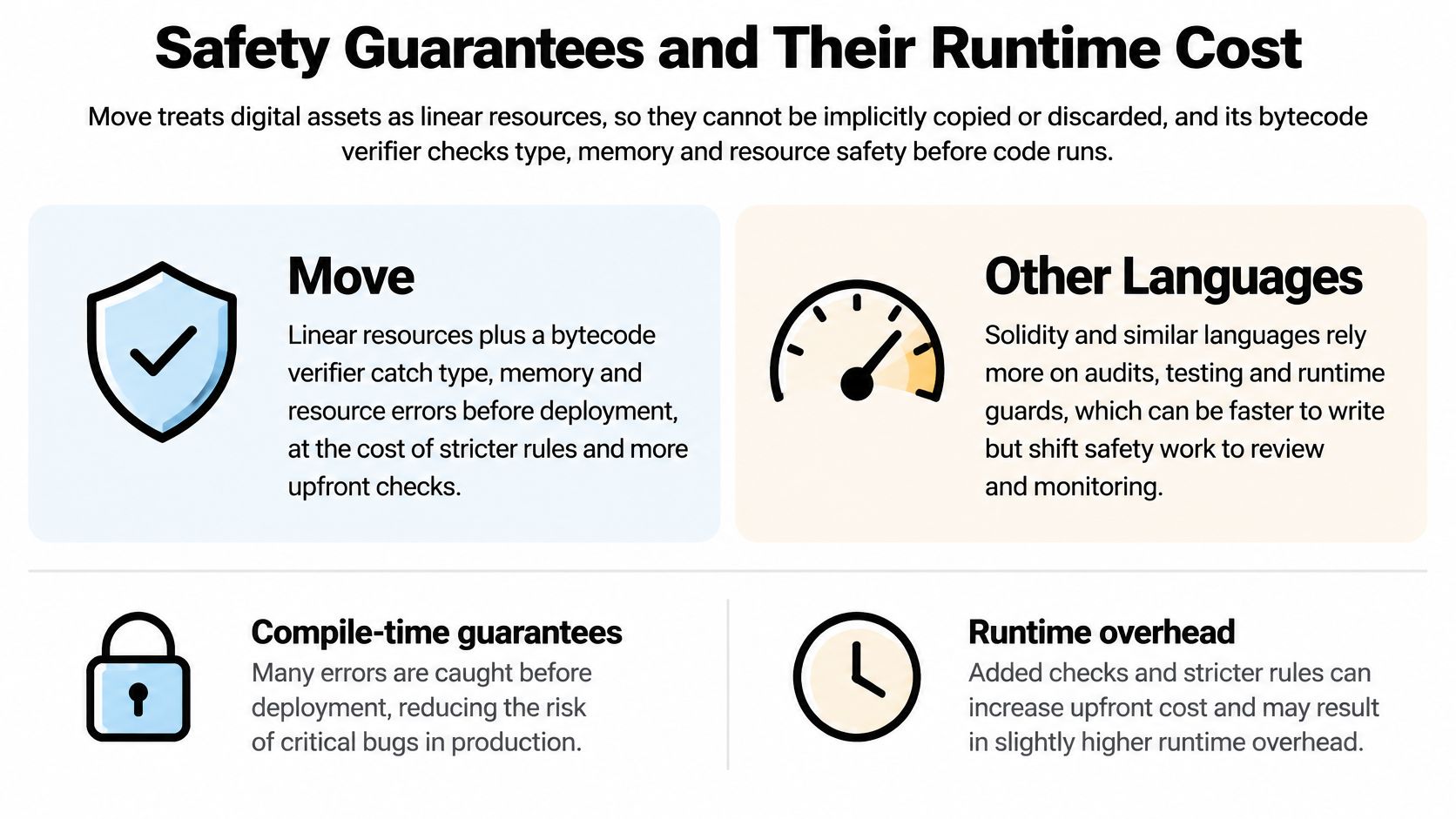
Safer language design doesn't remove application bugs. It changes which mistakes the language prevents, which checks the runtime performs, and which obligations remain with developers and auditors.
Move treats digital assets as linear resources that can't be implicitly copied or discarded, while its bytecode verifier checks type, memory, and resource safety before publication, as described in the formal-verification comparison published by Dagstuhl. The comparison also finds that Move can require fewer specifications to establish equivalent ownership and asset-preservation properties.
Solidity generally represents token accounting through contract-managed balances. Engineers must explicitly express relationships between deposits, withdrawals, permissions, and liabilities. Flexibility is useful, but it leaves more accounting obligations for the application team to define and verify.
The visual highlights the design trade-off; bytecode verification shouldn't be confused with proof that an entire application is correct.
Separate resource safety from business correctness
A Move analysis identified 2,882 potential vulnerabilities across 137 modules from 20 open-source projects, with arithmetic overflows accounting for 61.3% of detections and cross-module state pollution for 18.5%, according to the comparative security study. These are potential findings from the analyzed projects, not confirmed exploits or a universal vulnerability rate.
A resource can remain impossible to duplicate while an application grants the wrong party permission to transfer it. A lending protocol can preserve ownership rules while calculating collateral incorrectly. Those are different assurance problems.
For interviews, ask a Move candidate to identify what the resource system guarantees and what the protocol still has to prove. A strong answer distinguishes possession of a resource from authorization to perform a business action.
Rust offers memory safety and control over computational resources, but neither establishes correct pricing, liquidation logic, or signer authorization. Candidates should explain these boundaries without presenting compiler acceptance as a security verdict.
Use smart-contract formal verification to frame the next question: which invariant is being proved, under which assumptions, and across which dependencies?
Benchmark the protection you intend to deploy
A Move benchmark modeling a perpetual-futures exchange with 100 markets found combined runtime safety checks reduced throughput by approximately 28–29%; trusted-code exemptions lowered overhead to 13–16%, while asynchronous checking reduced it to roughly 10–11% at 16–32 workers, according to the Move execution benchmark.
That isn't a chain-to-chain speed ranking. Virtual-machine implementation, consensus, hardware, transaction conflicts, and state-access patterns also affect throughput.
For architecture reviews and technical interviews, require candidates to explain:
- Transaction mix. Benchmark transfers, liquidations, and shared-state updates representative of the application.
- Trust boundaries. Identify which framework code receives exemptions and why that trust is acceptable.
- Contention. Measure competing access to shared state rather than assuming more workers always help.
- Failure behavior. Check how rejected operations affect correctness and operational visibility.
Choose Move when preventing asset-loss classes dominates the risk assessment. Choose Solidity when EVM integration and ecosystem reach carry more weight. Either way, benchmark the actual workload and assess whether the team can operate its assurance process.
Tooling and Learning Curve by Language
Learning syntax is only the entry point. The employable skill is moving from a contract specification to reproducible tests, a deployment, and a clear explanation of failure behavior.
Start with the concept your background won't teach you
Solidity. Begin with Foundry or Hardhat, then write tests before building a large application. Concentrate on EVM behavior: gas consumption, storage layout, external calls, upgradeability, and reentrancy defenses. Treat code review, testing, audits, and correctness proofs as production preparation rather than optional polish.
Vyper. Start with the Vyper compiler and a small contract test suite. Its deliberately limited feature set can make code easier to review, but you must accept fewer language features and inspect the available libraries before designing around them. Python-like syntax doesn't make EVM execution behave like a Python process.
Rust on Solana. Ownership is only part of the adjustment. You must also reason about account serialization, instruction data, signer checks, and account validation. Solana's Rust program documentation distinguishes native Rust development from Anchor, which adds higher-level workflows, an IDL specification, generated TypeScript clients, command-line tools, and workspace management.
Build a native program before relying heavily on Anchor. Then demonstrate that you understand which validations the framework generates and which business rules you still supply.
Choose the ecosystem before installing its tools
Move. Pick Sui or Aptos first, then use that ecosystem's CLI and test workflow. The central learning task is expressing asset handling through resources and permissions, not translating Solidity storage patterns line by line. Write invariant tests around transfers, destruction, and authorization.
Motoko. Start with the Internet Computer SDK and a small canister application. The difficult transition is the actor model and reasoning about asynchronous interactions. An EVM developer should approach it as a different execution model, not as Solidity with new keywords.
Use the blockchain development tools guide to select a coherent workflow instead of collecting overlapping tools.
Finish a tested deployment in your first ecosystem before adding another language. An interviewer can inspect a working system; a list of unfinished tutorials proves very little.
Security Tests Interviewers Use and Results
Language familiarity is the weakest evidence of review ability a candidate can offer. Many candidates who write fluent Solidity still miss one or more of the vulnerabilities that appear most often in interview exercises: reentrancy, improper access control, unchecked low-level calls, and integer overflow. Remediation guidance for each pattern is documented in Solidity's security considerations.
That gap between fluency and detection is the reason to test concrete security mechanics instead of accepting syntax knowledge as proof of competence.
Common Solidity vulnerabilities and the questions that expose them
| Vulnerability | Interview question |
|---|---|
| Reentrancy | Rewrite the withdrawal with Checks-Effects-Interactions |
| Improper access control | Which function needs a role or owner check, and why? |
| Unchecked low-level calls | How does the code handle a failed call? |
| Integer overflow | How does the language prevent or check arithmetic overflow? |
Run an exploit-to-remediation exercise
- Present a vulnerable withdrawal function. Look for systematic tracing of balances, permissions, and external interactions rather than immediate pattern naming.
- Ask why reentrancy occurs. The candidate should explain how an external callee can regain control before the caller has established safe state.
- Request a rewrite. With Checks-Effects-Interactions, the candidate validates inputs and permissions, updates state, and only then makes external calls. A reentrancy guard also requires an explanation of its coverage and limitations.
- Ask for an exploit test. Look for an adversarial receiver, assertions showing the broken invariant, and a regression test demonstrating the fix.
A guard added without understanding the call sequence earns partial credit at best. Ask whether another entry point shares the same vulnerable state, because a candidate who secured one function may have left an identical path open elsewhere.
For Rust candidates, adapt the exercise to signer checks, account ownership, serialization assumptions, and arithmetic handling. For Move candidates, test capability checks, resource ownership, and the distinction between permitted operations and correct business outcomes.
Publish the reasoning, not just the patch
For practice interpreting external security communication, read Mayan's smart contract security audit results. Ask what was assessed, which assumptions matter, and what evidence you'd need before applying any conclusion to a different deployment.
Publish exploit tests, remediation notes, and stated assumptions in a public repository. Explain why the defect was possible, why the fix works, and what remains outside the test's coverage. That artifact gives an interviewer something concrete to assess when you move toward auditing or security engineering.
Pick Your Career Path and Build the Proof
Choose a career path before choosing a second language. Otherwise, you can spend months accumulating syntax while remaining unable to demonstrate the responsibilities of any particular role.
The ecosystem distinction is explicit in Solana's migration guide: EVM development primarily uses Solidity, while Solana programs use Rust. Your portfolio should therefore demonstrate the target runtime's behavior, not merely translate the same toy contract between languages.
Career paths, primary languages and portfolio proof
| Career path | Primary language | Second language | Portfolio proof |
|---|---|---|---|
| Ethereum and layer-2 application developer | Solidity | Vyper or Rust for tooling | ERC-20 or NFT contract with Foundry tests and gas measurements |
| Solana program engineer | Rust with Anchor | Solidity for cross-chain work | Native Rust program plus Anchor project with a TypeScript client |
| Move protocol engineer | Move | Solidity for EVM bridges | Asset-handling module with invariant tests |
| Smart-contract auditor | Solidity | Rust or Move to review cross-chain code | Public audit-style report with exploit tests |
| Formal verification or security research | Move or Solidity | Rust for comparison | Published verification write-up with stated assumptions |
Treat these as portfolio recommendations, not universal employer requirements. Read the actual listing and adjust the project to the responsibility you're trying to prove.
Make the project reviewable without your help
For an EVM application role, build an ERC-20 or NFT contract with Foundry or Hardhat tests, gas measurements, a documented threat model, and an audit-style report. Explain EVM execution, access control, token-standard behavior, and any upgradeability decisions. Include deployment instructions that another engineer can reproduce.
For Solana program engineering, make the native program small enough to inspect closely. Use the Anchor application to demonstrate account validation, instructions, an IDL, and a working TypeScript client. Explain failure cases instead of showing only a successful transaction.
For Move protocol work, focus the project on asset-handling rules and invariant tests. Show which actions must be impossible and how your tests challenge authorization boundaries.
Your project should resemble reviewable engineering work, not a screenshot-only demonstration.

For auditing, prioritize a concise report that connects each finding to an exploit, impact, remediation, and remaining assumptions. For verification research, publish the property, model, proof obligations, and limitations. A proof without explicit assumptions is difficult for an employer to evaluate responsibly.
Turn the specialization into a job search
Progression toward protocol engineering, security engineering, or technical leadership requires stronger evidence than another language badge. Add more complex financial logic only when you can explain its invariants, review dependencies, and defend operational choices.
- Pick the chain where accessible listings sit. Use your vacancy counts to choose EVM work for Solidity or Vyper, Solana for Rust, or Sui and Aptos for Move.
- Build the project that matches your path. Include reproducible tests and a remediation note for a bug you found or fixed. Make the repository readable before adding features.
- Track matching openings and compensation. Follow listings for your chain and city, compare disclosed salary ranges, and record recurring requirements you haven't yet demonstrated.
Our salary-display filter helps narrow that comparison: 1,100 open roles show a salary. Users can also sign up for email alerts that send new blockchain and Web3 jobs once a day as they're posted.
Career checkpoint: Add a second language when it opens a specific role or responsibility, not when learning your first language becomes difficult.
For most candidates, the best language for smart contracts is the one they can turn into employable proof. Build depth first, then expand where real openings justify the effort.
Blockchain Jobs offers category-tagged Web3 openings with filters for arrangement, level, contract type, and city. Visit Blockchain Jobs to compare roles for your chosen ecosystem, identify the portfolio evidence they require, and set up alerts for matching opportunities.