How to Land Remote Manual QA Tester Jobs
The appetite for sharp, remote manual QA testers has never been bigger, especially in emerging fields like Web3. If you have a knack for spotting what others miss, this isn't just a job—it's a launchpad into the tech world that offers flexibility and serious career progression. Landing your first or next role is about having a clear strategy to stand out in a competitive hiring market.
Your Roadmap to a Remote Manual QA Career
The move to remote-first teams has blown the doors wide open for remote manual QA tester jobs. Companies need professionals who can systematically test applications, write clear bug reports that developers can actually use, and collaborate effectively. This guide provides a hiring-focused roadmap to help you secure one of these roles.
Sizing Up the Opportunity
The demand is real and growing. At any given time, there are tens of thousands of active QA openings. A quick market scan shows around 83,000 QA engineer positions available in the US alone, with a significant portion dedicated to manual testing roles you can perform from anywhere.
This demand is particularly high in Web3, where the stakes are enormous. Every smart contract, crypto wallet, and DeFi protocol requires meticulous manual testing to protect user assets. You can get a real-time pulse on this by browsing current remote QA job openings.
This flowchart maps out the journey, from learning the ropes to nailing the interview and getting hired.
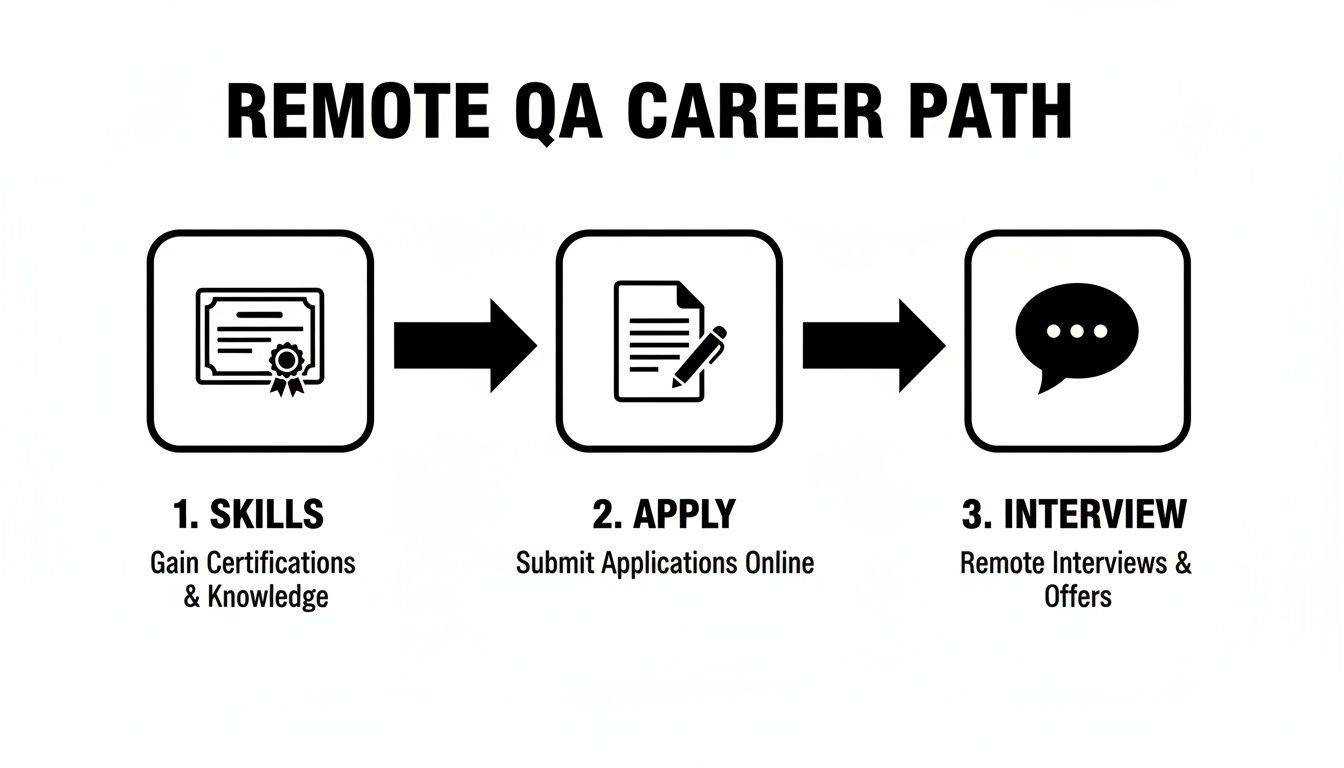
The takeaway is simple: your career progression depends on a clear plan. First, build the skills hiring managers are looking for. Then, market those skills effectively in your application. Finally, prove your value in the interview.
As someone who has hired QAs, I can tell you that a candidate who connects the dots for me—showing exactly how their skills solve my problems—is infinitely more impressive than someone with a laundry list of software they've touched.
Getting into this field isn't about luck; it's about executing a smart career strategy. This guide gives you that plan—field-tested advice to help you land a great remote role. Just look at this remote QA Lead position at Tether; it's a perfect example of what top-tier companies are searching for right now.
Building Your Remote QA Skillset
To land a great remote manual QA job, your resume needs to do more than just list tools like Jira or TestRail. Hiring managers don't care that you've heard of these tools; they want evidence you can use them to drive results and make the development process smoother.
Think of it this way: anyone can list "Jira" on a resume. To get hired, you must demonstrate you can write a bug report so clean and precise that a developer can reproduce the issue on the first try. That’s the difference-maker in an interview.
An exceptional bug report is a work product that showcases your value. It’s not just a description of what’s broken; it’s a clear, concise, and reproducible roadmap that saves developers hours of guesswork. Mastering this skill is one of the fastest ways to advance from applicant to employee.
Mastering the Core Technical Skills
Every hiring manager for a remote QA role is looking for evidence of practical ability. They need to know you can think like a frustrated end-user while documenting like a detail-obsessed engineer. During an interview, be prepared to demonstrate these skills.
Here are the skills you absolutely must be able to demonstrate:
- Writing Crystal-Clear Bug Reports: This is non-negotiable. Your reports need an unambiguous title, the exact steps to reproduce the issue, what you expected to happen versus what actually happened, and attachments like screenshots, screen recordings, or console logs. A developer should be able to follow your ticket and see the bug for themselves in minutes. This is a skill you'll be asked about in every interview.
- Developing Thorough Test Cases: Don't just stick to the happy path. To impress in an interview, talk about how you move beyond simple pass/fail checks. Your test cases should cover edge cases, negative scenarios (what happens when a user does something wrong?), and user flows that aren't immediately obvious. This shows you're thinking critically about quality, not just checking boxes.
- API Testing Fundamentals: Even as a manual tester, getting comfortable with a tool like Postman is a massive career advantage. Knowing how to check API endpoints shows you can test beyond the user interface and help pinpoint issues deeper in the tech stack. Mentioning this on your resume will get you more callbacks.
A candidate who can walk me through a complex bug they found, explaining how they isolated it and why their report made the fix easy, is ten times more valuable than one who just lists a dozen testing tools. Practical problem-solving wins interviews.
The Non-Negotiable Remote Soft Skills
When you're working remotely, your soft skills are as critical as your technical abilities for career progression. Companies need to trust that you are a proactive communicator and a self-sufficient problem-solver.
A distributed team's success hinges on the quality of its communication. Mastering asynchronous communication is your superpower here. You must be able to explain complex issues clearly in writing, whether it's a quick Slack message, a detailed email, or a comment in a Jira ticket.
You also have to prove you're a self-starter who can manage your own time and priorities. Remote work isn't for those who need micromanagement. For example, a senior QA engineer is expected to drive improvements in testing strategy independently—a quality top companies actively seek out. You can see this reflected in real-world job posts, like this Senior QA Engineer position at Binance.
Getting Noticed in Web3
If you're aiming for a role in the blockchain space, you’ll need to add another layer to your skillset to get past the screening process. Generic QA experience often isn't enough to make the cut.
Web3 hiring managers are specifically looking for testers who understand the unique flows of decentralized applications (dApps). This means getting hands-on with things like connecting a crypto wallet (like MetaMask), approving transactions, and understanding the concept of gas fees.
Showing you're already familiar with these core concepts proves you can test the application from the perspective of an actual crypto user, which is an invaluable skill that will set you apart from other candidates.
Crafting an Application That Gets Interviews

Your resume, LinkedIn, and portfolio are the gatekeepers to your next interview. To land top-tier remote manual QA tester jobs, these documents must do more than list your past duties—they need to showcase your impact.
A generic resume that just says "responsible for testing new features" is a one-way ticket to the "no" pile. To get an interview, you must demonstrate results.
Quantify Your QA Impact
A recruiter spends about six seconds on your resume before making a decision. Numbers are your best tool to grab their attention and prove your value. Stop describing your duties and start framing them as achievements.
Review your past projects and find the data. Ask yourself:
- How many critical bugs did I find before a major release?
- Did my testing reduce customer-reported issues? By what percentage?
- How many test cases did I author for a complex new feature?
- Did I introduce a process that saved the team X hours per week?
This approach turns a flat bullet point into a compelling success story. For example, "Performed regression testing" becomes "Identified 150+ bugs in pre-production, reducing critical post-launch defects by 20%." This simple shift tells a hiring manager not just what you did, but the value you delivered.
A hiring manager sifts through hundreds of applications. The ones that get a second look are those that immediately answer the question, "How will this person make our product and team better?" Quantifiable results are the fastest way to do that.
To ensure your resume passes the initial automated screening, you must include the right keywords. Applicant Tracking Systems (ATS) are programmed to search for specific terms, and if your resume lacks them, it may never reach a human.
Resume Keyword Optimization for Manual QA Roles
| Keyword Category | Essential Keywords | Example Usage in Resume |
|---|---|---|
| Testing Types | Manual Testing, Regression Testing, Smoke Testing, Sanity Testing, User Acceptance Testing (UAT), End-to-End Testing, Exploratory Testing, API Testing | • Executed comprehensive regression testing suites for bi-weekly sprint releases. • Conducted UAT sessions with stakeholders to validate new features against business requirements. |
| Core QA Skills | Test Case Design, Test Plan Creation, Bug Reporting, Defect Tracking, Test Scenarios, Quality Assurance, Test Execution | • Authored and maintained detailed test plans and over 500+ test cases for a new e-commerce platform. • Championed a clear bug reporting process, reducing ticket resolution time by 15%. |
| Tools & Platforms | Jira, TestRail, Zephyr, Asana, Postman, Confluence, BrowserStack, GitHub | • Managed defect lifecycle using Jira and documented test evidence in Confluence. • Utilized Postman for preliminary API testing to validate endpoint responses. |
| Web3/Blockchain | dApp, Smart Contract, Wallet, Blockchain, Testnet, Mainnet, DeFi, NFT, Etherscan | • Performed end-to-end testing on a DeFi lending protocol deployed on the Ethereum Testnet. • Specialized in manual testing for crypto wallet integrations and dApp user flows. |
By weaving these terms naturally into your experience section, you not only demonstrate your expertise but also ensure your application makes it through the first filter and into the hands of a hiring manager.
Optimize Your Digital Footprint
For QA professionals, a polished LinkedIn and a strategic GitHub profile are non-negotiable career tools. They allow you to attract recruiters and showcase your skills before you even speak to them.
Your LinkedIn Profile
Your LinkedIn headline is prime real estate. Don't just settle for "Manual QA Tester." Optimize it with keywords recruiters search for. A stronger headline is: "Manual QA Tester | Web & Mobile App Testing | ISTQB Certified | Web3 & DeFi Enthusiast." This makes you more discoverable and signals your specializations.
Your GitHub Portfolio
Thinking GitHub is just for developers is a career-limiting mistake. It’s the perfect platform to build a public portfolio that shows your skills, providing concrete evidence to hiring managers.
Create repositories to showcase:
- Detailed Bug Reports: Find bugs in open-source projects and publish your impeccably written reports. Document the steps to reproduce, expected vs. actual results, and include screenshots.
- Thorough Test Plans: Pick a popular app and write a sample test plan for it. Show how you'd break down features, define scope, and plan your testing strategy.
This isn't extra credit; it's a strategic move. It demonstrates initiative and gives hiring managers tangible proof of your abilities. This is how you stop being just another application and become the candidate they have to interview.
Where to Find the Best Remote QA Jobs

Scrolling through massive, general-purpose job boards is an inefficient way to find your next role. The most promising remote manual QA tester jobs are often on specialized platforms and within professional communities.
Your goal isn't to apply to the most jobs; it's to get interviews for the best jobs. This requires a targeted, strategic approach.
Ditch the Giants and Go Niche
Large, generic job platforms are a black hole for applicants. You compete against thousands, making it nearly impossible to stand out. Your time is better spent on niche job boards tailored to your target industry, giving you a direct line to hiring managers seeking your specific skills.
If you’re targeting a role in the Web3 space, a site like Blockchain Jobs is invaluable. It filters out the noise, presenting roles at companies building decentralized technology. For great remote roles at tech startups, another excellent resource is Arc.dev.
A hiring manager at a crypto company once told me they prioritize candidates from industry-specific boards. It signals genuine interest in the ecosystem, not just someone mass-applying to any open role.
Uncover Hidden Gems in QA Communities
Many of the best jobs are never publicly listed. They’re filled through referrals and word-of-mouth in private online communities. This is your access to the hidden job market.
Joining QA communities on platforms like Discord and Slack is one of the smartest career moves you can make. These groups are more than chat rooms; they're hubs where senior testers, team leads, and hiring managers share advice, solve problems, and post job openings you won't find anywhere else.
Turn Networking into Your Superpower
Don't just join these groups and lurk. Your goal is to become known as a sharp, helpful member of the community to advance your career.
Here’s an actionable plan:
- Be the problem-solver: When someone posts a testing question you can answer, provide a clear, thoughtful response.
- Share your knowledge: Found a weird bug or read an insightful article on QA strategy? Post it and start a conversation to build your reputation.
- Engage intelligently: If a hiring manager posts a role, don't just drop your resume. Ask a smart question about their testing culture or a specific challenge their team faces.
This proactive engagement gets you noticed by the right people. You become more than a name on a resume. When a manager needs a reliable remote tester, your name will be top of mind. For a role like a Senior QA Engineer at Tether, the strongest candidates are often those who are already respected voices within these niche communities.
Acing the Interview and Negotiating Your Salary
The interview is your opportunity to prove you are the solution to the hiring manager's problems. It's where you show you are a thoughtful, hands-on professional who can handle the realities of software testing. Success here comes from preparation and the ability to articulate your experience as a story of value.
When hiring for remote manual QA tester jobs, managers are evaluating your thought process, not just your knowledge. They want to see how you tackle a problem when the documentation is thin and the developers are busy.
Answering Common Interview Questions
You will face behavioral and technical questions. A classic scenario you must prepare for is, "Walk me through how you'd test a new feature with little to no documentation."
This question tests your initiative. A weak answer is, "I'd ask the developers for more information." This shows a lack of resourcefulness. A strong response demonstrates that you can drive the process forward independently.
Here's how to structure a winning answer:
Start with the User: "My first step is to approach it from a user's perspective. What problem does this feature solve? I’d explore the application to understand where it fits into existing workflows."
Collaborate Smartly: "Next, I'd investigate existing resources. I’d check Jira or Confluence for related tickets or design documents. With that context, I would approach the product manager or developer with specific, intelligent questions to fill the gaps, rather than just asking 'what does this do?'"
Use Exploratory Testing: "With a baseline understanding, I would begin exploratory testing. I'd emulate a curious user, intentionally trying to break things, testing positive and negative paths, and identifying edge cases."
This structured answer proves you take ownership and can make progress in ambiguous situations—a critical trait for any remote team member.
When a candidate tells me how they think, not just what they know, they immediately stand out. The best QAs are investigators at heart, and that's the quality I'm hiring for.
A great tool for structuring your answers is the STAR method (Situation, Task, Action, Result). It helps you turn your experiences into compelling stories that showcase your skills in action.
Negotiating a Salary That Reflects Your Value
You received an offer—congratulations! Now it's time to negotiate. Your ability to negotiate effectively demonstrates your ability to advocate for value, a core skill for a QA professional.
Before discussing numbers, do your research. Salaries for remote manual QA testers vary based on company size, industry, and required skills.
Data from Remote Rocketship shows the average annual salary for a mid-level remote manual QA tester is around $63,076. However, broader US market data from ZipRecruiter indicates an average of $89,334, with top earners reaching $122,500.
For senior roles at established tech companies, especially in a niche like Web3, the range can climb to $150k-$170k.
Armed with this data, you can enter the negotiation with confidence. When asked for your salary expectations, provide a well-researched range, not a single number. This creates room for discussion and shows you’ve done your homework.
Always justify your request by connecting it to the value you bring—your experience, specialized skills, and the quantifiable impact you’ve made in previous roles. Negotiation is a standard part of the hiring process; be prepared to advocate for your worth.
Common Questions on Landing a Remote QA Role
As you pursue remote manual QA jobs, several key questions will arise. Having clear, actionable answers is crucial for your career progression. Let's tackle the most common hurdles.
Can I Get a Remote Manual QA Job With No Experience?
Yes, but you must be strategic. To overcome a lack of formal experience, you need to create your own track record. You don't need a paid job to build a portfolio that will impress hiring managers.
Start by testing open-source software. Find a project on GitHub, test it thoroughly, and document your findings in professional-grade bug reports. This provides tangible proof of your skills. Also, consider an entry-level certification like the ISTQB Foundation Level to demonstrate foundational knowledge. Target smaller startups in your job search, as they are often more willing to hire for potential. In your applications and interviews, highlight transferable skills like problem-solving and attention to detail from previous experiences.
From a hiring manager's point of view, a candidate with zero formal experience but a GitHub profile full of well-written bug reports is way more interesting than someone with a bare-bones resume. It shows you have real initiative and a genuine passion for quality.
What Is the Biggest Challenge of Working As a Remote QA Tester?
The biggest challenge is communication, especially across different time zones. In an office, you can quickly clarify an issue with a developer at their desk. Remotely, your success depends on your ability to write with absolute clarity.
Your career progression will hinge on how well you can author unambiguous bug reports, ask precise questions, and provide clear status updates in tools like Slack and Jira. There is no room for vague descriptions. Additionally, you must be highly self-disciplined to manage your schedule and meet deadlines without direct supervision. This autonomy requires a high level of personal accountability, a key trait every hiring manager seeks.
Should I Specialize in a Niche Like Web3 or Mobile Testing?
Absolutely. Specializing is one of the fastest paths to increasing your career opportunities and salary. General QA principles are the baseline; they are the price of entry.
Diving deep into a high-demand area—like blockchain, iOS/Android mobile testing, or a specific SaaS industry—instantly makes you a more compelling candidate for higher-paying, specialized remote roles. It shows you understand the unique technical challenges, user behaviors, and business logic of that domain. This focused knowledge helps you find more subtle, critical bugs, making you a far more valuable asset to any team in that niche and accelerating your career growth.
Ready to find your place in the future of tech? Blockchain Jobs is the go-to job board for opportunities in Web3, DeFi, and the decentralized world. Stop sifting through generic listings and connect directly with innovative companies looking for your skills. Find your next role in blockchain today!