
Maximize Your SEC Attorney Salaries in 2026

You’re probably sitting in one of three seats right now.
You’re a law firm associate who’s tired of billing every six minutes and wondering whether an SEC role buys you credibility, sanity, and a stronger long-term platform. Or you’re already in government and trying to figure out if staying put is smart, or if you’re underpricing yourself. Or you’re circling a fintech, exchange, or token project and asking the most important question in any legal career move: what does this path do to my earning power?
That’s the right question.
Most articles on sec attorney salaries stop at a single number and leave you with the wrong takeaway. Salary isn’t just compensation. It’s signal. It tells you how the market values your regulatory judgment, your enforcement fluency, your drafting skill, and your ability to keep a business out of trouble.
If you want to build a high-value career in securities law, especially around financial regulation and crypto, you need to understand what each market is buying. The SEC buys judgment, process, and institutional rigor. A law firm buys revenue production and client confidence. A startup or Web3 company buys risk translation. Same legal brain. Different economics.
Your Next Career Move Starts With Understanding Pay
A mid-career attorney I’d call highly marketable usually comes to me with the same problem. On paper, the options all look respectable. An SEC role offers prestige and a clean story on a résumé. A firm role offers more cash. A fintech or crypto company offers upside, uncertainty, and a chance to get closer to the business.
That attorney often makes the wrong comparison.
They compare title to title. They should compare trajectory to trajectory.

What salary really tells you
An SEC paycheck doesn’t just tell you what you’ll earn this year. It tells future employers where you’ve been trained, how close you’ve worked to investigations, disclosures, enforcement posture, and internal decision-making. Private employers know that. So do crypto companies trying to stay ahead of regulatory pressure.
The same applies in reverse. A higher private-sector salary usually means the employer expects you to carry client pressure, business pressure, or regulatory ambiguity with less institutional shelter.
That’s why sec attorney salaries matter beyond payroll. They sit at the center of your career strategy.
Practical rule: Don’t ask which role pays more today. Ask which role makes you more expensive in two to three hiring cycles.
The crossroads most attorneys miss
Ambitious lawyers often treat government service like a detour. That’s too simplistic. In the right sequence, it’s a pricing mechanism. It can validate your expertise in a way private employers can monetize later.
Other lawyers make the opposite mistake. They assume prestige alone will cover the opportunity cost of passing on a stronger private offer. It won’t. Prestige is useful only if you know when to capitalize on it.
If you’re serious about maximizing sec attorney salaries over the course of a career, stop thinking like a job applicant and start thinking like a portfolio manager.
Your résumé is the asset. Each move either raises its market value or stalls it.
Deconstructing Attorney Compensation Public vs Private
Government and private-sector legal pay run on different engines. If you don’t understand that, you’ll misread every offer you get.
Federal compensation is built for stability. Private compensation is built for variance. One is closer to a bond. The other is closer to equity. Neither is automatically better. But they reward different personalities and different career timing.
How federal pay works
At the SEC, compensation is structured and visible. You’re looking at salary bands, grade levels, and locality adjustments. That makes the system easier to model. It also makes negotiation more disciplined. You’re rarely negotiating from scratch. You’re arguing for fit within an established framework.
That predictability matters more than people admit.
If you’re moving from a firm into government, you’re usually taking a more controlled package. If you want a useful overview of what comes with federal employment beyond salary, the Federal Employee Benefits Handbook is a practical place to review the broader package.
How private-sector pay works
Private legal compensation is less tidy. Base salary matters, but it’s only part of the story. Your total package may include bonus eligibility, sign-on compensation, deferred compensation, or equity. In startup and Web3 environments, that mix gets even more uneven.
That creates two common errors:
- Overvaluing base salary: A higher base can still be a weak offer if the role is under-scoped, politically unstable, or missing upside.
- Overvaluing upside language: “Potential” doesn’t pay rent. If a company can’t explain how bonus, token, or equity value is earned and realized, treat that part of the package as speculative.
The recruiter’s lens
When I evaluate legal offers with candidates, I focus on three questions:
What’s guaranteed
Base salary, title, reporting line, and role scope.What’s likely
Bonus practices, promotion timing, and whether the legal team has real influence.What’s possible
Equity, token upside, external visibility, and exit options.
A stable package is easier to compare. A variable package is easier to oversell.
The best career decisions usually come from matching the compensation model to your stage. If you need training, signaling power, and a credentialed platform, structured government pay can be a smart trade. If you’ve already built the right reputation and want to monetize it, private practice or in-house work often gives you more room.
The mistake is treating all legal pay like salary alone. It isn’t.
The Official SEC Pay Scale Explained
The SEC is one of the few legal employers where you can read the compensation architecture and make a realistic forecast before the interview. That transparency is a major advantage if you know how to use it.
According to SEC attorney salary data reported by Indeed, federal government attorneys at the U.S. Securities and Exchange Commission earn a median base pay of $117,288 per year, which is 13% to 15% above the national average for attorneys. The SEC also maintains a salary cap of $292,300 including locality pay for all SK staff as of April 2026.
The grades that matter
The same Indeed data shows that SEC attorneys follow a graded pay structure:
| Grade | Salary range |
|---|---|
| SK-13 | $99,557 to $168,668 |
| SK-14 | $114,315 to $193,670 |
| SK-15 | $121,180 to $209,165 |
At this juncture, smart candidates distinguish themselves from passive applicants.
A weak candidate asks, “What does the role pay?” A strong candidate asks, “Given my enforcement, disclosure, investigations, or regulatory counseling background, where do I fit within the band?”
How to read an SEC job posting
Start with the grade. The grade tells you more than the title. It signals expected seniority, independence, and likely internal responsibility. Broadly speaking, higher grades reflect more ownership, more judgment calls, and often more supervisory or strategic input.
Then look at the scope language. If the posting emphasizes investigations, rule interpretation, settlement work, market structure, or leadership responsibilities, don’t treat that as generic legal boilerplate. That language is your evidence for positioning yourself within the pay band.
Use your interview to connect prior experience to the job’s risk profile.
For example, if you’ve done any of the following, make it concrete:
- Handled securities investigations and managed regulator-facing responses
- Advised on disclosures under time pressure with senior stakeholders involved
- Worked on internal reviews where judgment mattered more than form-filling
- Led junior lawyers or coordinated with compliance, finance, and product teams
What the structure means for career planning
The SEC’s pay ladder rewards clarity. That’s good news if you want a career path you can model.
You won’t see the same compensation volatility you’d find in a firm or startup. But you do get something many attorneys undervalue early on: a legible progression system. That helps with timing. It helps with negotiation. It also helps you decide whether the role is a destination or a launchpad.
If you’re interviewing with the SEC, your job isn’t to sound brilliant in the abstract. Your job is to prove you can operate at a specific grade with minimal supervision.
Where candidates leave money on the table
Most lawyers undersell transferable experience. They describe tasks. They don’t describe judgment.
That costs them.
If your background includes securities litigation, public company counseling, broker-dealer work, internal investigations, fund formation, token classification analysis, or regulatory response work, frame it around complexity and consequence. The SEC doesn’t pay more because you’ve touched the subject matter. It pays for demonstrated readiness to handle it at the agency’s standard.
That’s the key lesson in sec attorney salaries on the government side. The pay scale is fixed, but your entry point isn’t automatic.
How SEC Salaries Compare to Private and In-House Roles
Here’s the blunt answer. If your only goal is immediate cash compensation, the SEC usually won’t beat specialized private-sector roles.
According to ZipRecruiter’s SEC attorney salary data, the average SEC attorney salary in the United States is $108,160 per year as of April 2026. The same source reports that securities attorneys earn an average of $228,907 in 2026, which is more than double the average SEC attorney salary. That gap exists for a reason. Private employers pay for revenue-linked expertise, high-stakes transactions, and client risk.
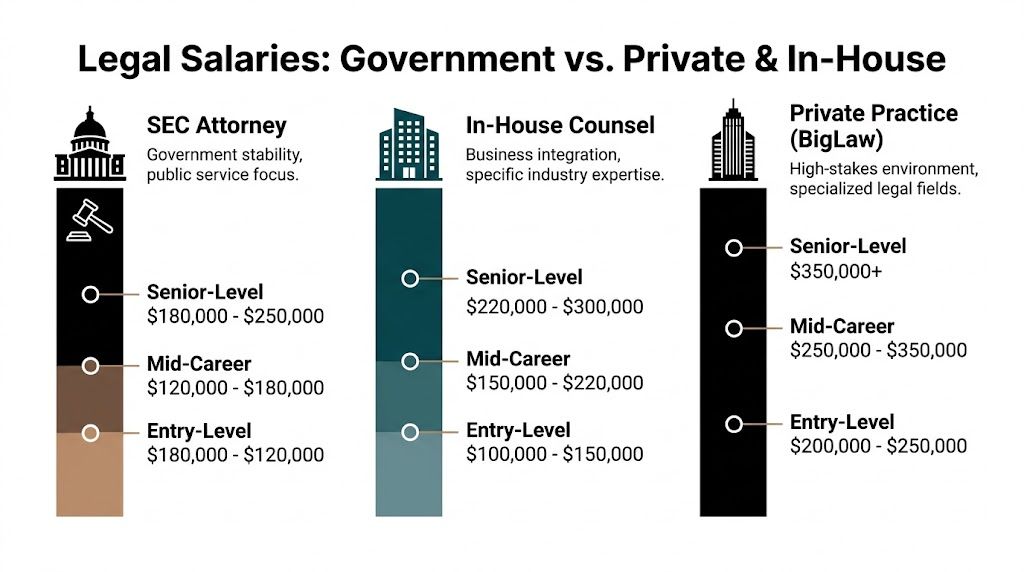
The comparison that actually matters
A direct government-versus-private comparison gets messy fast because compensation structures differ. Government gives you transparent salary and a steadier package. Private practice and in-house work often layer bonus, business pressure, and more aggressive expectations on top of salary.
Use this table as a decision framework, not a fake precision exercise.
| Role | Base Salary Range | Typical Bonus | Total Comp (Est.) | Key Intangibles |
|---|---|---|---|---|
| SEC staff attorney | Structured by grade and locality within agency bands | Usually more limited and structured than private practice | More predictable than private roles | Prestige, regulatory training, credibility with future employers |
| In-house compliance or securities counsel | Often varies by company scale and sector | Common, sometimes meaningful | Can exceed government packages depending on company and scope | Closer to business, narrower platform, stronger path to executive advisory work |
| Specialized securities attorney in private practice | Often strongest on pure cash compensation | Bonus can materially change package | Usually highest near-term earnings ceiling | Billable pressure, client development expectations, faster pay acceleration |
If you’re exploring adjacent opportunities, the current market for legal and compliance roles in blockchain gives a useful read on how employers frame these jobs.
Why private roles pay more
The short version is simple. Firms and some in-house groups can tie your work more directly to revenue, deal flow, or enterprise risk. That changes compensation logic.
A securities lawyer at a firm might support offerings, transactions, investigations, or complex advisory matters where the client is paying heavily for speed, expertise, and confidence. The SEC doesn’t operate on that model. It operates on public mission, defined pay architecture, and institutional continuity.
That’s why comparing sec attorney salaries to private practice without accounting for business model is pointless.
Which path wins
That depends on what you’re optimizing for.
- Choose the SEC if you want durable signaling power, highly transferable regulatory credibility, and a cleaner long-term platform.
- Choose private practice if you want stronger short-term cash and can tolerate intensity, client pressure, and less predictability.
- Choose in-house if you want proximity to operators and business decisions, especially if you enjoy translating law into execution.
A lower-paying role can still be the highest-value move if it upgrades your future market position.
The attorneys who build the strongest compensation arcs usually don’t chase the biggest first number. They choose the role that makes the next offer larger and easier to win.
The X-Factors That Drive Your Earning Potential
Two attorneys can have similar résumés and earn very different amounts. That isn’t random. It usually comes down to a few market levers that serious candidates can influence.
One of the biggest is geography. According to Comparably’s SEC attorney salary analysis, San Jose, California sits $46,641 above the national average, which the source describes as a 97% premium. That tells you where regulatory-adjacent legal talent gets priced aggressively.
Geographic arbitrage is real
If you work in or around a venture-heavy, fintech-dense market, employers don’t just pay for legal skill. They pay for context. They want lawyers who understand capital formation, product risk, fast-moving executive teams, and regulator scrutiny in the same conversation.
That’s why location isn’t just about cost of living. It’s about employer density and deal density.
If you’re trying to raise your compensation ceiling, ask yourself where your specialty is most expensive. For securities and crypto-adjacent lawyers, the answer often isn’t generic corporate America. It’s the markets where regulated finance and innovation collide.
Institutional arbitrage matters too
The second lever is institutional branding.
“SEC experience” carries weight because it signals a certain kind of legal training. It suggests you’ve worked close to live regulatory questions, understand how enforcement logic is built, and can spot issues before they mature into expensive problems.
That premium doesn’t vanish when you leave government. In many cases, that’s when it becomes more monetizable.
Specialization beats general competence
Generalist lawyers can make good careers. Specialists usually get paid faster.
In this market, the strongest premium tends to attach to lawyers who can do one or more of these well:
- Translate enforcement risk into operational advice executives can act on
- Handle disclosure and regulatory interpretation without over-lawyering the business
- Work across finance and product teams when the facts don’t fit old templates
- Apply securities analysis to digital assets and platform structures with confidence
The market rarely pays extra for effort. It pays for scarce judgment in expensive situations.
What to do with this
You can’t control every pay variable. You can control enough.
Target hiring markets where your expertise is costly to replace. Build a reputation around a narrow, commercially relevant problem set. Then make sure your résumé and interviews show not just subject-matter familiarity, but decision-making under pressure.
That’s how attorneys push sec attorney salaries upward in practice. Not by waiting for fairness. By becoming hard to substitute.
The Crypto Premium Understanding Web3 Legal Salaries
Web3 companies don’t hire lawyers because they like legal process. They hire lawyers because regulatory uncertainty can break product strategy, fundraising, listings, partnerships, and expansion plans.
That’s why SEC-fluent attorneys attract attention in this market.
A protocol foundation, token issuer, exchange, NFT platform, or infrastructure company doesn’t just need a memo. It needs a lawyer who can look at a product roadmap, a governance structure, a token design, and a communications strategy and say what creates unnecessary securities risk.
That skill is rare.

Why former SEC talent stands out
Web3 employers value lawyers who understand not only black-letter law, but regulatory posture. They want someone who can predict how a fact pattern may be received by regulators, not someone who can only summarize doctrine after the fact.
That’s especially true when the business is moving faster than the legal framework.
A lawyer with SEC or close securities-regulatory experience can often do three jobs at once:
- advise leadership on legal exposure,
- help product and business teams shape launch decisions,
- and reassure investors, board members, and counterparties that someone credible is watching the edges.
That combination is expensive in any market. In crypto, it’s often mission-critical.
What a Web3 legal offer usually includes
You shouldn’t evaluate a crypto legal offer like a government role. The package usually has more moving pieces.
Look for clarity around:
Base salary
This is your foundation. If the company is vague here, stop.Cash bonus or performance component
Ask how it’s determined, who decides, and whether there’s a track record of payment.Equity or token compensation
This is where upside may sit, but it also carries the most confusion. Ask about vesting, liquidity, transfer restrictions, and what happens if the project changes direction.Scope and authority
A strong package attached to a weak seat at the table is still a weak offer.
If you want a live example of how top crypto employers position these roles, review a product lead counsel opportunity at Binance.
How to price risk
I’m generally bullish on strong legal talent moving into Web3. I’m not bullish on lawyers accepting chaos disguised as upside.
Use a simple filter.
A good Web3 legal role gives you meaningful influence, complex problems, and compensation that reflects uncertainty. A bad one gives you broad liability, thin internal support, and compensation that depends on a future event no one can explain cleanly.
The right move depends on your appetite. If you already have securities credibility and want to push your earnings higher while working on frontier issues, crypto can be a smart bet. If you still need foundational training, a premature move can leave you under-supported and under-credentialed.
My view
The crypto premium is real when the company respects legal as a strategic function. It disappears when the business wants legal cover without legal authority.
Take the role if you’re being hired to shape decisions. Pass if you’re being hired to absorb blame.
Your Negotiation and Career Progression Playbook
Most attorneys negotiate too late and too vaguely. They wait until an offer arrives, then ask for more money without building the case. That’s amateur behavior.
Your advantage starts before the first interview.

Start with your market story
You need a crisp explanation of why you command a stronger package. Not a life story. Not a list of responsibilities. A market story.
Build it around evidence such as:
- Regulatory depth from SEC-facing matters, investigations, disclosures, or enforcement-adjacent work
- Business fluency shown through partnership with finance, product, compliance, or executive teams
- Specialized edge in securities regulation, digital assets, broker-dealer issues, token analysis, or public company work
- Judgment under pressure demonstrated in messy situations where there wasn’t a template
If you can’t explain your value in plain English, hiring managers will default to the middle of the band.
Interview for level, not approval
A lot of lawyers enter interviews trying to sound smart and agreeable. That’s not enough. Employers already assume the shortlisted candidate is competent. What they’re testing is level.
Level means they want to know whether you can operate at the salary they’re considering.
Use examples that show:
- what problem landed on your desk,
- what legal risk mattered,
- how you advised the business or client,
- what judgment call you made.
That structure works in government, firms, and crypto companies because it shows how you think.
Don’t describe your workload. Describe the decisions you were trusted to make.
Negotiate with specifics
For SEC roles, your room to negotiate is narrower, but it’s not nonexistent. Your main argument is placement within grade and band. Tie your case to directly relevant experience, leadership scope, and the complexity of prior matters.
For private-sector roles, widen the frame. Don’t fixate on base salary alone.
Ask about:
- Bonus mechanics
- Title and reporting line
- Promotion timing
- Equity or token terms
- Decision-making authority
- Expectations around hours, travel, and regulator contact
If a company dodges those questions, that’s not a communication issue. It’s a warning.
Use sequencing to your advantage
Career progression in securities law rewards sequencing more than loyalty.
A common high-value path looks like this in practice:
- build technical credibility in private practice or a specialized in-house seat,
- move into the SEC for institutional validation and regulatory depth,
- then exit into a stronger-paying role where that experience is priced at a premium.
The reverse can also work. Some lawyers start at the SEC, gain the credential, and then move into firms, financial institutions, or Web3 companies that need immediate regulatory sophistication.
Neither path is definitively superior. The key is to move when the market can clearly value the last step.
If you’re considering a lateral into a crypto company after building strong regulatory experience, a role like senior counsel in legal and compliance at OpenSea reflects the kind of market-facing opportunity that can convert expertise into broader strategic influence.
The mistakes to avoid
The most expensive mistakes I see are predictable.
- Staying too long in an under-scoped role that stops teaching you anything new
- Jumping too early into startup chaos without enough institutional training
- Accepting title inflation instead of real authority and better economics
- Negotiating emotionally instead of tying compensation to role level and business value
You don’t maximize sec attorney salaries by chasing every opportunity. You do it by choosing the moments when your experience is easiest to price and hardest to replace.
Charting Your Path in Securities Law
The smart way to think about sec attorney salaries is not as a single market number, but as a map.
Government service gives you structure, credibility, and a transparent ladder. Private practice gives you stronger near-term earning power and a higher cash ceiling. In-house work gives you operational influence. Web3 can give you strategic scope and upside, but only when the company treats legal as part of the core business.
That’s the choice. Not prestige versus money. Not safety versus ambition. It’s a question of which environment values your current skill set, and which one will make your next move more valuable.
The levers you can actually pull
You have more control than most attorneys think.
You can choose a market where your expertise is expensive. You can specialize in the parts of securities law that businesses struggle to handle without help. You can interview for level instead of hoping someone notices your potential. And you can leave roles once the signaling value has been captured.
Those levers matter more than passive résumé accumulation.
The long view wins
Attorneys who build strong compensation over time usually understand one thing early. Legal careers don’t compound automatically. Experience only turns into money when the market can recognize, trust, and buy it.
That’s why role selection matters. So does timing. So does knowing what employers are really hiring for when they search for SEC talent, securities counsel, or crypto-savvy legal leadership.
If you want a broader primer on the function itself, this overview of what a securities lawyer does is a useful refresher on the scope of the work behind these compensation paths.
Securities law is only getting more central to finance, regulation, and digital assets. That’s good news for attorneys who know how to position themselves. Your skills are valuable. The point is to place them where they’ll be priced correctly, then move again when the market is ready to pay more.
If you’re ready to turn legal and regulatory experience into your next move, Blockchain Jobs is one of the best places to find Web3 roles across legal, compliance, product, and leadership. It’s a clean way to track where crypto employers are hiring, how they frame legal talent, and which opportunities are worth a serious look.