
A Guide to Software Engineer Salaries in Dubai
If you're a software engineer eyeing Dubai, the numbers are compelling. Salaries here are seriously competitive, starting around AED 120,000 (USD $32,700) for junior developers and climbing past AED 420,000 (USD $114,400) for those at the principal level. And the best part? It's all tax-free, which means your take-home pay gets a massive boost.
Your Quick Guide to Dubai Software Engineer Salaries
Dubai's tech scene isn't just growing; it's exploding. This boom has kicked off a fierce competition for top-tier software engineers, pushing salaries higher and higher. Whether you're planning a move, prepping for an interview, or aiming for a raise, knowing the local salary landscape is your first, most crucial step for career progression.
What you'll quickly notice is that experience is king here. The market places a huge premium on proven skills, and this is reflected directly in the compensation packages. A developer walking into their first job interview will be having a very different salary discussion than a senior engineer who has spent a decade shipping complex products.
For those just starting out, the initial salary is only part of the equation. The real career goal is to soak up experience that will set you up for a major pay jump in just a few years. Use your early roles to build a portfolio of impactful projects that you can leverage in future interviews.
Software Engineer Salary in Dubai by Experience Level
Let's break down what you can realistically expect to earn as you climb the career ladder. The pay scale isn't a slow, steady incline; it features significant leaps at key milestones, rewarding those who invest in their skills and take on more responsibility. Use this data not just as a benchmark, but as a roadmap for your career progression.
The table below gives a snapshot of what software engineers are earning in Dubai right now, based on their years in the game.
| Experience Level | Years of Experience | Annual Salary Range (AED) | Annual Salary Range (USD) |
|---|---|---|---|
| Junior Engineer | 0-2 years | AED 120,000 – AED 180,000 | $32,700 – $49,000 |
| Mid-Level Engineer | 3-5 years | AED 180,000 – AED 240,000 | $49,000 – $65,400 |
| Senior Engineer | 6-10 years | AED 240,000 – AED 300,000 | $65,400 – $81,700 |
| Principal Engineer | 10+ years | AED 300,000 – AED 420,000+ | $81,700 – $114,400+ |
These figures make it clear: as you gain experience and prove your value, the financial rewards grow substantially. This data is your best friend when you're negotiating a job offer or planning your next career move.
The biggest salary jumps happen when you move from a junior to a mid-level role, and then again from mid-level to senior. Why? Because companies in Dubai aren't just paying for code. They're paying a premium for seniors who can mentor junior devs, own architectural decisions, and directly influence business goals—skills you should actively develop and highlight in interviews.
At the end of the day, what you earn comes down to the value you bring to the table. A killer portfolio, mastery of in-demand tech, and the ability to articulate your impact are what will push you into the upper end of these salary brackets during your job search.
For more deep dives into tech careers, check out our other articles on the Blockchain Jobs blog.
Decoding Your Total Compensation Package in Dubai
When a job offer lands in your inbox, it's easy to fixate on the base salary. But in Dubai's tech scene, that's just the tip of the iceberg. Looking only at that number is like judging a car by its paint job—you're missing what’s under the hood. A truly competitive offer is a full package, and knowing how to read it is crucial for your financial future and career growth.
Your base salary is the foundation, but the real value is in the total compensation. This is where bonuses, equity, and other perks come into play, often adding a massive chunk to your annual take-home pay. In a market as hot as Dubai, companies use these extras to lure in and keep the best engineers.
Beyond the Base Salary
Think of your compensation package as a financial toolkit. Some parts give you immediate cash, while others are geared toward long-term wealth. Getting a handle on how they all fit together is the only way to properly weigh one offer against another during your job hunt.
Here are the main components you’ll almost always see:
- Performance Bonuses: These are usually linked to how you, your team, or the company performs. During the interview process, it's a great idea to ask how these bonuses are structured and how consistently they've been paid out in the past. This gives you insight into the company's financial health and performance culture.
- Equity and Stock Options: This is huge, especially in the startup and Web3 world. Getting equity means you own a piece of the company. It’s a long game, but the payoff can be life-changing if the company takes off. Ask critical questions about vesting schedules and the company's valuation.
- Sign-On Bonuses: A one-time cash payment to get you in the door. These are often negotiable and can be a big help with relocation costs or covering any pay gaps while you switch jobs. Don't be afraid to ask for one if it's not offered.
The chart below shows just how much your base salary—the starting point for your total package—can grow with experience.
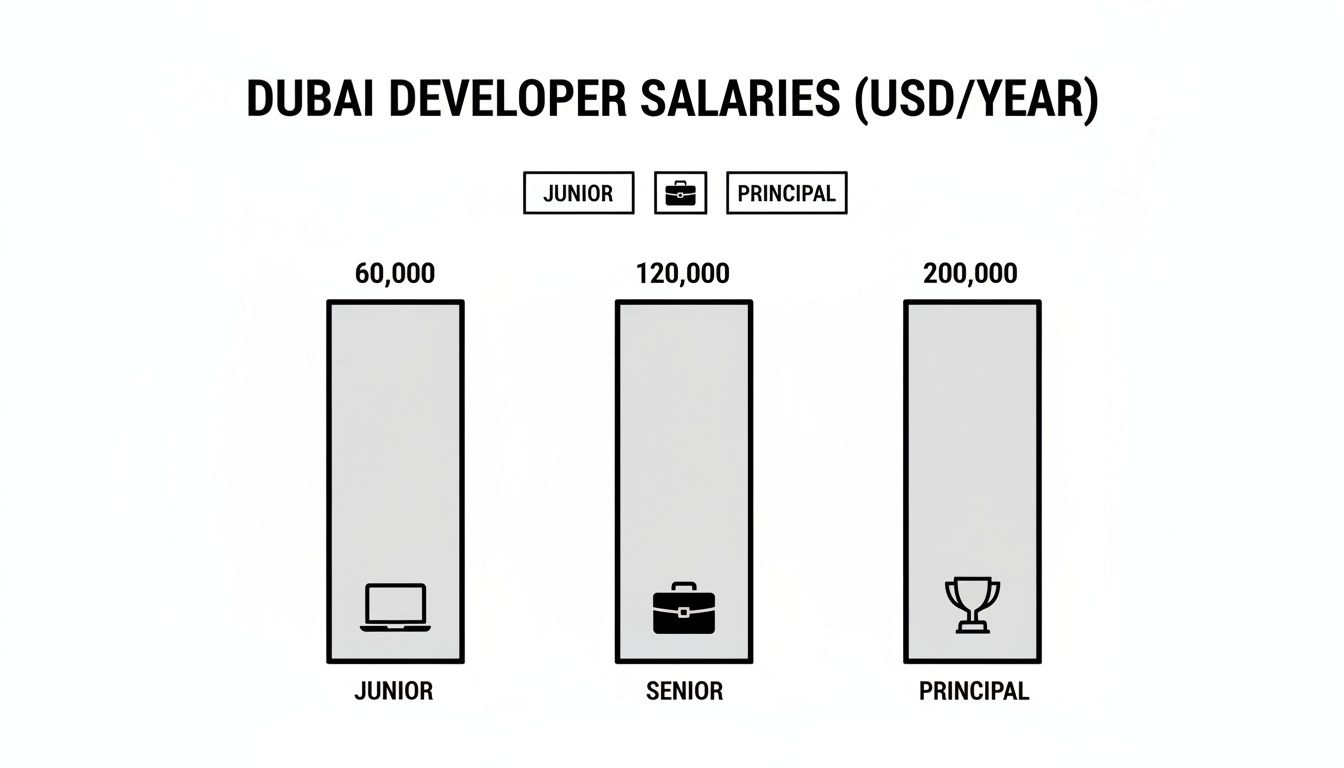
As you can see, those jumps from junior to principal are steep. A higher base almost always means a bigger potential for bonuses and other variable pay.
How Company Type Shapes Your Pay
Who you work for will completely change the structure of your pay. A massive global corporation and a scrappy FinTech startup reward their people in very different ways. Knowing the difference helps you chase the right kind of opportunity for your career goals.
Big, established tech companies tend to offer higher base salaries and predictable, well-defined bonus plans. Their benefits are usually top-notch, covering everything you can think of. It’s the path of stability, often with structured career progression ladders.
On the flip side, startups and Web3 firms might offer a lower base salary but make up for it with a generous slice of equity or token allocations. This is the high-risk, high-reward play. If the company hits it big, your equity could be worth far more than a slightly higher salary elsewhere. When interviewing, you need to dig into the vesting schedule, the company's funding situation, and their long-term vision.
Don't just add up the numbers on an offer letter—weigh the potential. An AED 250,000 base with promising equity at a Web3 startup could blow a AED 300,000 base at a traditional company out of the water if you believe in the project. Your choice depends entirely on your risk appetite and career aspirations.
At the end of the day, understanding the full picture of software engineer salaries in Dubai means looking beyond that monthly paycheck. The median total compensation for software engineers in Dubai recently hit AED 300,041, cementing the city's status as a top tech market in the Middle East.
Data shows the salary range for the middle 50% of engineers falls between AED 233,603 and AED 414,056, with the top talent commanding salaries upwards of AED 520,000 a year. This confirms that about half of all software engineers in Dubai are earning over AED 300,000, making it a globally competitive place to build a career. For more granular data, you can explore detailed Dubai compensation data on Levels.fyi.
How In-Demand Skills Impact Your Earning Potential
In Dubai's tech scene, not all software engineering jobs are built the same. Sure, a generalist developer can land a great role, but if you want to seriously accelerate your earning potential and career progression, specialization is the name of the game. The salary gap between a standard full-stack engineer and someone with deep expertise in Web3 or AI isn't just a minor bump—it's a massive jump.
The reason is simple: supply and demand. Dubai is aggressively positioning itself as a global hub for technologies like blockchain, artificial intelligence, and cybersecurity. As companies race to build the next big thing, they’re all fighting for the same small pool of experts. This fierce competition for talent naturally drives salaries through the roof.
For an engineer, this spells opportunity. Mastering a high-demand skill is the single most effective way to maximize your software engineer salaries in Dubai. It completely flips the script during the hiring process, turning you from just another applicant into a prized asset that companies are willing to pay a premium for.

The High-Value Specializations Commanding Top Dollar
While the tech world moves fast, a few key specializations consistently pull in the highest paychecks. If you're plotting your next career move, honing your skills in these domains is a smart bet for boosting your income and future-proofing your career.
Right now, the most lucrative fields are:
- Web3 and Blockchain Development: With Dubai’s push to become a global crypto capital, engineers who can build on decentralized protocols are in a class of their own. Skills in Solidity, Rust, and smart contract architecture are pure gold on your CV.
- AI and Machine Learning: From FinTech to logistics, nearly every industry is scrambling to implement AI. Engineers who can design and deploy ML models are seeing exceptional salary offers.
- Cybersecurity Engineering: As our world becomes more digital, the need for top-tier security talent has exploded. Professionals who can defend critical infrastructure from sophisticated threats are considered indispensable—and are compensated accordingly.
Quantifying the Salary Premium
So, what does this actually look like in your bank account? A senior blockchain engineer can often command a salary 25-40% higher than a senior full-stack developer with the same level of experience. This "specialist premium" is a direct reflection of the immediate value these niche skills bring to a business.
To make this crystal clear, I've put together a table that shows just how much more these in-demand roles can earn.
Salary Premiums for In-Demand Tech Specializations in Dubai
| Specialization | Average Salary Range (AED) | Typical Premium Over Generalist Role (%) |
|---|---|---|
| Generalist Software Engineer | 240,000 – 300,000 | 0% |
| AI / Machine Learning Engineer | 300,000 – 420,000 | 20-30% |
| Cybersecurity Engineer | 320,000 – 450,000 | 25-35% |
| Web3 / Blockchain Engineer | 350,000 – 500,000+ | 30-45%+ |
The trend is obvious: the closer your skills are to the intersection of finance and next-gen technology, the more you'll get paid. For Web3 roles, in particular, the total compensation package can shoot even higher when you factor in token allocations, which can often dwarf a traditional cash bonus.
Showcasing Your Expertise in Job Interviews
Having the skills is one thing, but knowing how to sell them in an interview is a whole other ballgame. Your mission is to show how your expertise solves expensive problems or unlocks new revenue streams.
During your interviews, frame your specialized skills in terms of business impact. Instead of saying, "I'm proficient in Solidity," explain, "I built and deployed a smart contract that securely processed over $10 million in transactions, reducing manual overhead by 60%."
This approach ties your technical skills directly to the company's bottom line, making it incredibly easy for a hiring manager to justify that top-tier salary offer. Prepare specific, data-driven stories from your past projects that prove you aren't just a coder—you're a strategic problem-solver.
A great way to get a feel for what employers are looking for is to check out current job postings. For example, this Experience Design Lead role in Dubai gives you a real-world look at the skills companies are prioritizing right now.
Balancing Dubai's Tax-Free Salary and Cost of Living
That impressive salary offer looks great on paper, but what does it actually mean for your bank account? The true value of any salary is what’s left after you pay your bills. Dubai's most famous financial perk—zero income tax—is a massive draw for software engineers, but it's only one side of the coin. You have to weigh that benefit against the city's living costs to see the full picture.
The lack of income tax gives your take-home pay an immediate, powerful boost. Let's say you're a software engineer earning AED 300,000 (approx. $81,700) a year. In Dubai, every single dirham of that goes to you. In another tech hub like London or Berlin, you could easily see 25-40% of that disappear to taxes, a loss of thousands of dollars annually.
This tax-free environment is the foundation of Dubai's appeal to global talent. It gives you the freedom to save aggressively or simply enjoy a higher quality of life than you might on a similar salary elsewhere. This is a huge financial advantage and a critical point to keep in mind when you're interviewing and negotiating.
A Realistic Look at Dubai's Main Expenses
Of course, a tax-free salary doesn't mean a cost-free existence. Dubai is a world-class city with expenses to match, and companies know this when they set the software engineer salaries in Dubai. Your budget will be dominated by a few key categories: housing, transportation, and, if you have kids, schooling.
Housing: This is your big-ticket item, no question. A modern one-bedroom flat in a sought-after neighborhood like Dubai Marina or Downtown will run you anywhere from AED 70,000 to AED 110,000 ($19,000 to $30,000) a year.
Transportation: While the metro is clean and efficient, most professionals find a car is necessary for real convenience. You should plan for car payments, fuel, and insurance, which can easily add up to AED 2,000-3,500 ($545 to $950) each month.
International Schooling: For engineers moving with family, this is a massive financial consideration. Tuition at reputable international schools is steep, often falling between AED 40,000 to AED 95,000 ($11,000 to $26,000) per child, per year.
Getting a handle on these numbers is non-negotiable when you're looking at a job offer. A fantastic-sounding salary can get eaten up pretty quickly if the compensation package doesn't account for these major costs.
Calculating Your True Purchasing Power
To figure out where you’ll really stand financially, you have to look past the gross salary number. Take entry-level software engineers in Dubai, for example. Recent data shows new grads pulling in around USD 47,000 annually. With zero income tax, that figure is much more potent than it would be in the US or Europe. Still, with Dubai's high cost of living, compensation packages are often structured to help with those big expenses in a premium city. You can find more details on the salary landscape for engineers in Dubai.
When you get to the interview stage, don't shy away from talking about the cost of living. You can frame it professionally: "Based on my research into Dubai's rental market, a salary in the range of X would be needed to maintain a comparable standard of living. I was wondering if your packages typically include things like a housing allowance or other support?"
This approach does two things: it shows you've done your homework and it elevates the discussion from just a salary figure to a more holistic conversation about your financial well-being. Good companies that are serious about attracting top talent will often include allowances for housing, schooling, or an annual flight home—all of which directly boost your real purchasing power.
At the end of the day, your goal is to figure out your potential savings rate. Subtract your estimated annual living expenses from your tax-free salary. That final number is the most honest measure of what a job offer in Dubai is actually worth, and it's the key to making a smart career move.
How to Actually Negotiate Your Dubai Tech Salary
Landing a great software engineer job in Dubai is one thing. Making sure the offer reflects what you're truly worth? That's the real win.
In Dubai's tech scene, salary negotiation isn't just an option; it's practically part of the interview process. If you don't negotiate, you're leaving money on the table. It’s that simple. You could be missing out on thousands of dirhams every year.
Think of the first number they give you as a starting point—an opening bid, not the final price. Companies, especially the bigger ones, operate with salary bands for every role. They almost never lead with their best offer, which leaves a gap for a well-prepared candidate to close. Your job is to build a solid case for why you deserve a number closer to the top of that band.
Walking into this conversation with confidence and solid research is crucial. It signals to the employer that you know your value and are serious about the opportunity. Remember, this isn't about being confrontational; it's a professional conversation to find a number that works for everyone.
Come Prepared with Market Data
Before you even dream of mentioning a number, do your homework. Showing up with data turns a hopeful ask into a business case. Your goal is to ground your salary expectations in the reality of the Dubai software engineer market.
First, figure out what people with your exact skills and experience level are actually making. Use the salary tables from earlier in this guide as your starting point. Then, dig into job postings for similar roles in Dubai and see what ranges they’re advertising. This research helps you land on a realistic, defensible target.
Once you have your number, get ready to justify it. Your argument should stand on three solid legs:
- The Going Rate: "My research shows that senior blockchain engineers in Dubai are typically earning between AED X and AED Y. Given my expertise in smart contract security, my value is at the higher end of that scale."
- Your Proven Impact: "At my last company, I spearheaded a project that boosted user retention by 15%, which had a direct impact on revenue. I'm confident I can drive similar results for your team."
- The Cost of Living: "I've also looked into the cost of living in Dubai, especially for housing and international schools for my kids. My requested salary takes into account what's needed for my family to relocate and for me to be 100% focused on the job from day one."
Frame Your Value with Confidence
How you say it matters just as much as what you're asking for. Whether you're on a call or writing an email, keep your tone professional, confident, and collaborative. Ditch the ultimatums and demands.
Instead of a blunt, "I need X amount," ease into it. Always start by saying how excited you are about the role and the company. This reinforces your genuine interest and makes the salary talk feel less like a hurdle and more like a final detail to lock in.
A better way to phrase it: "Thank you so much for the offer! I'm really excited about the chance to join the team and work on [Project Name]. I've reviewed the compensation package, and based on my experience leading DevOps teams and the current market rates here in Dubai, I was targeting a base salary closer to AED [Your Target Number]. Is there any flexibility there?"
This approach is polite, backed by data, and opens a dialogue instead of shutting one down.
Don't Just Negotiate the Salary—Negotiate the Package
This is the classic rookie mistake: getting fixated on the base salary. In Dubai, the total compensation package is where the real value often lies. Many benefits can dramatically sweeten the deal, and if a company can't budge on salary, they often have wiggle room elsewhere.
Be ready to discuss the whole picture:
- Housing Allowance: A hefty, tax-free allowance for your rent is a standard and incredibly valuable perk.
- Relocation Support: This can cover everything from family flights and shipping your belongings to temporary accommodation when you first arrive.
- Sign-On Bonus: A one-time cash injection can be a huge help with the immediate costs of moving.
- Annual Flight Tickets: Many companies will pay for a round-trip ticket home each year for you and your family.
- Education Allowance: If you have kids, a schooling allowance is a massive financial benefit, often worth tens of thousands of dollars annually.
By looking at the complete offer, you open up more paths to a "yes." It also shows the employer you're thinking long-term, which makes you an even more compelling candidate.
Finding a Top-Tier Tech Job in Dubai
Knowing the salary numbers is one thing, but actually landing a role that pays a top-tier software engineer salary in Dubai is another beast entirely. A scattergun approach to job searching just won't work here. You have to be strategic, especially if you're targeting the high-growth Web3 and FinTech scenes.
The best strategy is a mix of smart online positioning and good old-fashioned networking. Your aim isn't just to blindly apply for jobs; it's to get on the radar of the right people in a very competitive market. That means polishing your online brand and knowing which platforms deliver quality leads over sheer volume.
Get Your Digital House in Order
Before you even think about applying, your digital resume needs to be flawless. Recruiters in Dubai are constantly scouring a few key platforms for talent, and your profile is their first introduction to you. Make it a good one.
- Sharpen Your LinkedIn Profile: This is your number one asset. Your headline should scream your specialty—something like "Senior Blockchain Engineer | Solidity & Rust | Dubai." Flesh out your experience with bullet points that show your impact with hard numbers.
- Tune Your CV for the Dubai Market: Emphasize the skills that are white-hot in the local market, like blockchain development, AI/ML, or cybersecurity. Remember, many recruiters are expats themselves, so stick to a clean, professional format that's easy to skim. Ditch personal details like photos or marital status; they're not standard practice in international tech circles.
Hunt on Niche Job Platforms
Big, generic job boards are a black hole for your CV. If you want the premium gigs, especially in Web3, you have to go where the serious companies are posting. Blockchain-specific job platforms are where the real gems are.
Take a look at this feed from Blockchain.jobs. It’s a perfect example of a curated list of relevant, fresh roles in the Web3 space.
See how the listings are for specific, high-demand roles like "Backend Engineer" or "Product Manager" at well-known crypto firms? This is how you cut through the noise and find roles that match your career ambitions.
Don't Forget to Network
Honestly, the best jobs are often filled before a public job description is ever written. Building genuine connections is your backdoor pass to these hidden opportunities.
Never underestimate the power of a quick coffee, virtual or in-person. A simple message to an engineer or team lead at a company you respect can lead to insider info or, even better, a direct referral. A referral is the single best way to get your resume moved to the top of the stack.
Start attending local tech meetups in Dubai—you'll find plenty happening around Dubai Internet City. These events are fantastic for putting faces to names, getting a real feel for a company's culture, and hearing about openings before they go wide. A personal connection can make all the difference when you're up against hundreds of other applicants.
Curious what one of these top-tier roles looks like on paper? This posting for a Binance Accelerator Program position in Dubai gives you a great idea of what major players are looking for.
Common Questions Answered
When you're looking at jobs in Dubai, especially in the tech scene, a lot of practical questions pop up. Let's tackle some of the most common ones that software engineers ask when they're thinking about making a move.
What’s a Realistic Salary for a Senior Web3 Engineer?
For a senior software engineer who has spent 5-8 years deep in the blockchain or Web3 world, you should be looking at a base salary between AED 350,000 and AED 500,000 a year. This isn't just a random number; it's a direct reflection of how much companies are willing to pay for hard-to-find skills like Solidity or Rust.
But here’s the important part: that base salary is often just the beginning. Most Web3 companies in Dubai sweeten the deal with hefty performance bonuses or token packages. If you're a top-tier candidate landing a role at a well-funded crypto firm, it’s not unusual to see your total annual compensation pushed well past AED 600,000 once you factor in those extras. This is a key point to bring up during salary negotiations.
Do Companies in Dubai Help with Relocation?
Yes, absolutely. It's standard practice for most mid-to-large-sized companies here to offer a relocation package, especially the big multinational firms and funded startups. They know they're competing for talent on a global scale, and this is a key part of how they attract people.
A typical package will usually cover the essentials:
- One-way flights for you and your direct family.
- Temporary housing when you first land, like a hotel or serviced apartment for a few weeks.
- Help with all the paperwork, including your visa.
Remember, the specifics are almost always negotiable. Make sure you bring this up during the offer stage so you can get the support you need to make the move as smooth as possible.
Think of it this way: a company's willingness to put together a solid relocation package is a great sign. It shows they're not just hiring for a role; they're investing in you for the long haul. It's a positive indicator of their commitment to their employees.
Is Negotiating a Salary Offer Normal in Dubai?
Not just normal—it's expected. If you're a professional in Dubai's tech world and you accept the first offer without a conversation, you're making a classic rookie mistake.
Hiring managers almost always build a little wiggle room into their initial offer because they assume a good candidate will negotiate. To do it right, you need to come prepared. Have your market research ready, be able to point to your specific skills, and clearly explain the value you're bringing. Honestly, not negotiating is like leaving money on the table.
How Much of My Salary Should I Set Aside for Rent?
A good rule of thumb is to plan on spending between 30% and 40% of your monthly pay on housing. Rent is easily the biggest expense you'll have in Dubai, so getting this part right is crucial for managing your budget.
Let’s put that into perspective. If you're a mid-level engineer making about AED 20,000 a month, you should be looking at a rental budget of AED 6,000 to AED 8,000. That's enough to get you a really nice one-bedroom apartment in popular neighborhoods like Dubai Marina, JLT, or even Downtown Dubai.
Ready to find your next high-paying role in the heart of the Web3 revolution? Blockchain Jobs is the premier platform for connecting top tech talent with leading companies in Dubai and around the world.