
Startups on Blockchain: DeFi, NFTs, Web3 Jobs 2026
Global investment in blockchain-related startups reached approximately $27.4 billion by mid-2025, already surpassing the $24.1 billion total for all of 2024, according to SQ Magazine's blockchain statistics roundup. That number changes how founders, candidates, and recruiters should think about startups on blockchain. This isn't just a niche engineering market anymore. It's a labor market.
The bigger mistake I still see is treating Web3 hiring like a pure technology question. It isn't. The best outcomes usually come from matching the right business model, risk profile, and compensation structure to the right stage-specific talent. A strong Solidity engineer can still fail in the wrong environment. A sharp product manager from fintech can outperform a crypto-native candidate if the company needs operational discipline more than ideology.
That's why the core discussion around startups on blockchain has to move past chain tribalism and token hype. Hiring managers need better role definitions. Candidates need clearer career maps. Both sides need a more sober way to evaluate whether a company can execute.
Decoding the Blockchain Startup Landscape
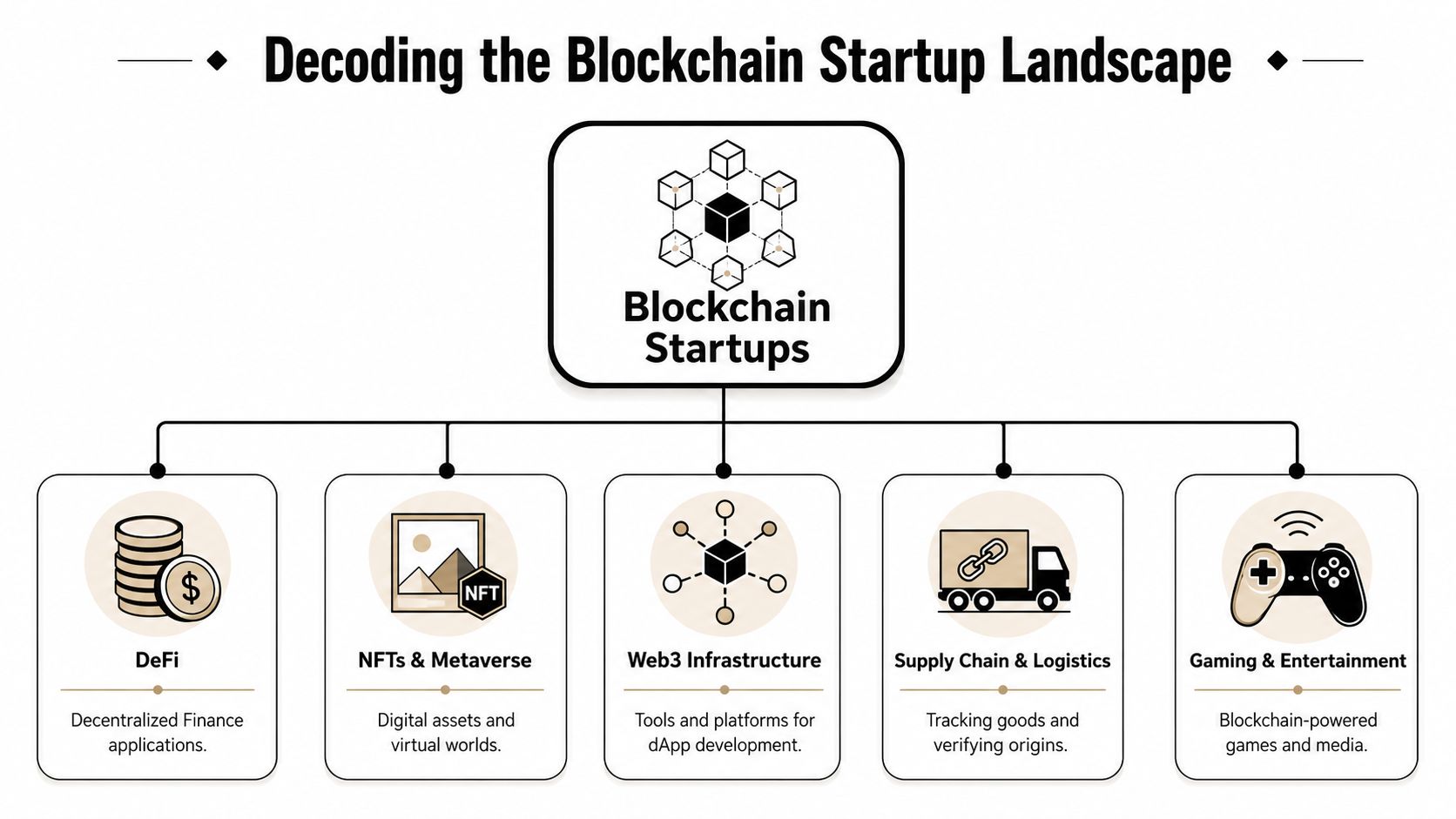
The term “blockchain startup” often evokes images of a token, a wallet, or a trading app. In practice, the market is much broader. The easiest way to understand startups on blockchain is to sort them by what job they perform in the ecosystem, then map that to the kind of people they hire.
DeFi and financial rails
DeFi is the closest thing to a decentralized Wall Street. These startups build exchanges, lending systems, staking products, stablecoin infrastructure, and asset-management tools. Their hiring bias usually leans toward smart contract engineering, protocol design, risk analysis, and market-structure fluency.
Career tip: If you come from trading systems, fintech, payments, treasury, or quantitative product work, DeFi is often a better fit than consumer NFT or gaming startups. Interviewers will care whether you understand liquidation risk, settlement logic, wallet UX, and incentives.
NFTs gaming and consumer Web3
NFT marketplaces, blockchain games, and creator platforms work more like a mix of e-commerce, entertainment, and digital ownership infrastructure. They often need user-facing product teams more than deep protocol researchers. Community, growth, partnerships, and design matter far more here than many technical candidates expect.
Research into over 1,400 funded blockchain firms shows the largest cluster comprises startups building applications on existing blockchains, such as exchanges, NFT marketplaces, and Web3 entertainment platforms, as noted in this OECD-related discussion. That matters for careers because employers often prioritize smart contracts, tokenomics, and user-facing Web3 product design rather than only core protocol development.
Candidates who only pitch themselves as “passionate about blockchain” usually lose to candidates who can explain user behavior, incentives, and retention.
Infrastructure scaling and tooling
Infrastructure startups are the digital highway system. They build RPC layers, indexing tools, wallets, dev platforms, middleware, cross-chain services, Layer-2 systems, and analytics products. These companies tend to hire backend engineers, DevOps talent, protocol engineers, developer-relations people, and technical product managers.
A good mental model is this: application companies sell an experience, infrastructure companies sell reliability. If you've worked on distributed systems, cloud platforms, APIs, security tooling, or observability, this category often gives you a cleaner transition into Web3.
For candidates comparing verticals, browsing active teams in a curated list of blockchain companies hiring can help clarify where your background maps best.
DAOs enterprise use cases and supply chain
DAOs function like internet-native organizations with governance layers, contributor networks, and treasury processes. They hire for governance operations, community systems, grants, research, and occasionally legal-compliance hybrid roles.
Then there are enterprise and logistics startups. These use blockchain for traceability, identity, and operational verification. Some teams combine blockchain with AI and IoT, as seen in examples such as Bext360 and Slync, where engineers need to connect smart contracts, oracles, and off-chain analytics into real workflows, discussed in ND Labs' overview of blockchain startups.
Career snapshot across categories
- DeFi: Best for people who like financial logic, risk systems, and precision.
- NFTs and gaming: Best for builders who care about user engagement, creator economics, and community loops.
- Infrastructure: Best for engineers who enjoy reliability, throughput, platform abstraction, and developer experience.
- DAOs: Best for operators who can manage ambiguity, governance, and coordination.
- Enterprise and supply chain: Best for hybrid profiles who can bridge blockchain, operations, compliance, and integrations.
Following the Money in Web3 Startups
Hiring success in Web3 usually comes down to one question. What pays the team six months from now?
I see candidates get this wrong in both directions. Some evaluate a blockchain startup as if it were a standard SaaS company with a token attached. Some founders sell vision without explaining the operating model. Neither helps with hiring. Durable roles come from durable cash flow, credible treasury management, and a business model that can survive a weak token market.
Revenue models that actually matter
Some blockchain startups earn money in familiar ways. They sell software subscriptions, infrastructure access, enterprise integrations, or API usage. Those businesses are easier to assess because customer demand, margins, and headcount planning follow patterns hiring managers already know.
Other companies run closer to a market system than a normal software product. Revenue can come from transaction fees, validator economics, staking activity, marketplace volume, treasury deployment, or a mix of all five. That changes how you evaluate jobs. Engineering is still central, but product, finance, legal, token design, and ecosystem operations all affect whether revenue holds up.
For candidates exploring blockchain engineering roles, this matters more than brand or hype. A protocol with active users but weak fee capture can still struggle to support payroll. A quieter infrastructure company with contracted customers may offer better long-term career value.
Venture funding versus token funding
Funding source shapes the job.
A venture-backed startup usually has clearer reporting lines, tighter board oversight, and more predictable headcount planning. Compensation is often easier to benchmark. So are promotion paths.
A token-funded startup can hire faster and spend more aggressively when treasury conditions are favorable. It can also freeze hiring just as fast if runway depends too heavily on the native asset. I have seen teams look well funded on paper and still cut offers because their treasury dropped with the market and too little operating capital was held in stable assets or fiat.
The practical question is simple. How much of runway depends on token price, and how much comes from contracted revenue or cash reserves?
If leadership cannot answer that clearly, treat it as a hiring risk.
How to diligence a startup before taking the job
You do not need full internal access to assess a Web3 company. You need sharp questions and direct answers.
- Treasury mix: Ask what portion of operating expenses is held in fiat, stablecoins, or native tokens.
- Revenue quality: Separate real customer demand from circular on-chain activity that flatters dashboards but does not support payroll.
- Token distribution: Ask who holds large allocations, what token releases are coming, and whether employee token grants have realistic liquidity assumptions.
- Decision speed: Check whether execution depends on a small leadership group, a foundation, or governance votes that slow product and hiring decisions.
- Entity structure: Ask which legal entity employs staff, how payroll works across jurisdictions, and where compliance responsibility sits.
Hiring managers should welcome these questions. Strong candidates ask them because they are assessing career durability, not just upside. In Web3, that is not skepticism. It is basic diligence.
The Most In-Demand Jobs at Blockchain Startups
The biggest hiring issue in Web3 isn't a total lack of talent. It's role confusion. A 2023 McKinsey report on digital assets work highlights that only 22% of firms have a clear skills taxonomy for blockchain roles, and turnover runs 1.5 to 2x higher than in traditional tech startups, according to reporting summarized by the University of Surrey article on blockchain startup failure. That's exactly why job descriptions in this market often feel bloated, contradictory, or detached from stage reality.
The roles founders should define more sharply
Protocol Engineer
This person designs the system itself. At seed stage, they're often writing core logic, reviewing architecture, and making stack choices. By Series A and beyond, they shift toward performance, maintainability, and coordination with security, product, and ecosystem teams.
Smart Contract Auditor or Security Engineer
Early on, this role may be part-time, external, or paired with engineering leadership. As the company grows, it becomes central. Auditors review contract logic, attack surfaces, upgradeability risks, and operational controls. Mature teams also need people who can translate security findings into release decisions.
Web3 Product Manager
At seed stage, this person often acts like a founder extension. They turn protocol constraints into usable flows, define wallet journeys, and keep engineering work tied to a real user need. At Series A+, they usually take on roadmap governance, segmentation, analytics, and cross-functional coordination.
Token Economist
Not every startup needs one immediately. But if the product includes staking, governance, incentives, marketplace rewards, or treasury-dependent growth, someone must own incentive design. In stronger teams, that person works closely with finance, product, and legal rather than operating as a detached theorist.
Community and Ecosystem Manager
This role is commonly misunderstood. Good community hires don't just post on social channels. They support launches, gather market feedback, manage contributors, coordinate ambassadors, and help developers or creators stay active in the ecosystem.
Blockchain Compliance Specialist
This role becomes essential much earlier than many founders expect. Once a startup touches wallets, token distribution, identity, institutional onboarding, or cross-border workflows, compliance stops being optional and starts shaping product decisions.
If you're hiring technical talent specifically, a focused set of blockchain engineering roles usually gives a better picture of current market demand than generic tech boards.
Key Roles in Blockchain Startups by Stage
| Role | Core Skills | Focus at Seed Stage | Focus at Series A+ Stage |
|---|---|---|---|
| Protocol Engineer | Solidity or Rust, systems design, testing, architecture | Build core contracts and choose architecture | Improve scalability, reliability, and upgrade paths |
| Smart Contract Auditor | Threat modeling, code review, exploit patterns | Pre-launch review and critical fixes | Ongoing audit process, incident prevention, release gating |
| Web3 Product Manager | Wallet UX, roadmap discipline, user research | Validate use case and simplify onboarding | Scale product operations and cross-team execution |
| Token Economist | Incentive design, governance logic, treasury thinking | Model emissions and participation incentives | Refine sustainability and align incentives with growth |
| Community and Ecosystem Manager | Communication, partnerships, contributor ops | Build early trust and user feedback loops | Manage programs, creator or developer ecosystems |
| Compliance Specialist | AML or KYC workflows, policy interpretation, controls | Reduce launch risk and shape process basics | Formalize reporting, approvals, and jurisdictional controls |
What candidates should say in interviews
Strong candidates show that they understand stage-specific trade-offs.
- For seed-stage roles: Emphasize comfort with ambiguity, ownership, and building without a full playbook.
- For growth-stage roles: Emphasize process, team coordination, and knowing how to professionalize without slowing execution.
- For any role: Explain how your work affects user trust, not just shipping speed.
The best Web3 interviews sound less like “I love crypto” and more like “Here's how I'd reduce user drop-off, contract risk, or compliance friction in your current setup.”
Understanding Web3 Compensation Packages
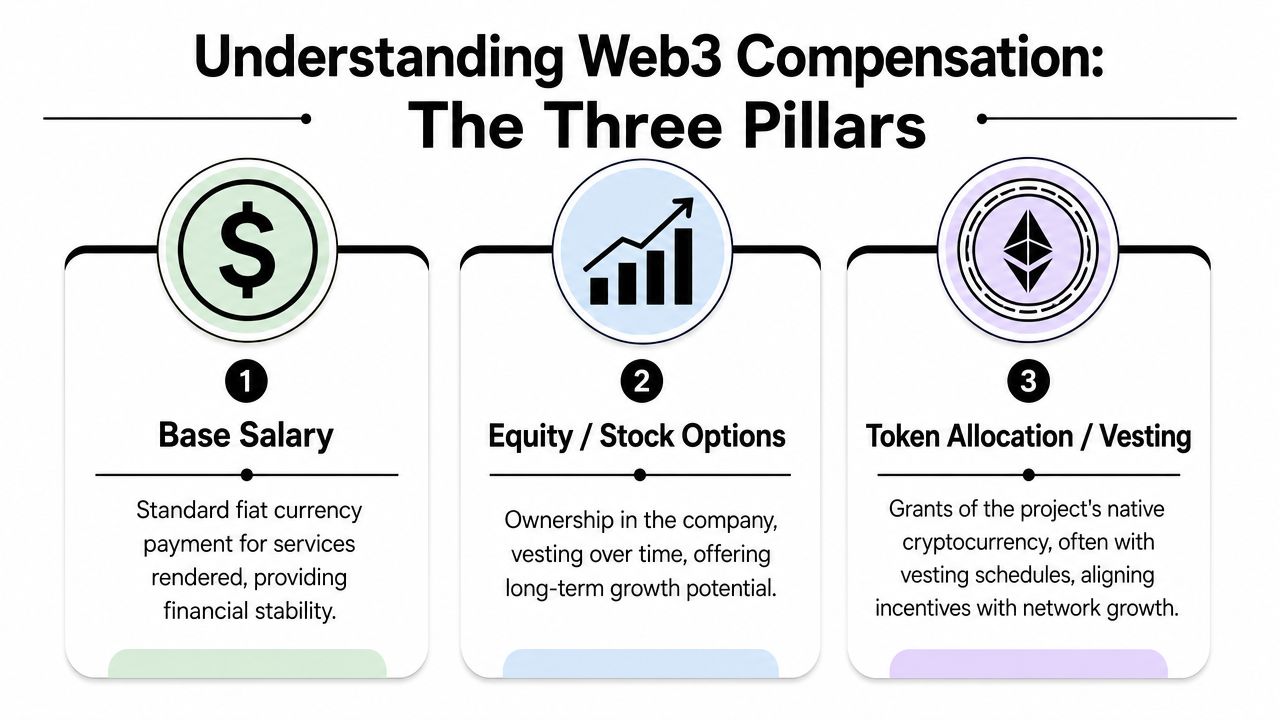
A blockchain startup offer is rarely just salary. It's usually a three-part package with very different risk profiles, and candidates who ignore that often make poor career decisions.
The three pillars
Base salary pays your bills. It's still the cleanest measure of how the company values your role in the short term. If a company pushes aggressively toward token-heavy comp while staying vague on cash runway, be careful.
Equity or stock options give you upside tied to the legal entity. In venture-backed startups, this can be familiar territory. In token-native startups, candidates sometimes undervalue equity because tokens feel more exciting. That's a mistake when the company is building durable enterprise or infrastructure value.
Token allocation or token warrants can be meaningful, but they require more scrutiny. You need to understand vesting, lockups, liquidity expectations, and whether the token is central to product usage or mostly narrative.
Why payroll mechanics matter
Compensation in Web3 also gets messy operationally. Many blockchain-native teams still rely on hybrid on- and off-chain payroll setups, and a 2024 World Bank report noted that over 90% of remittance value still flows through traditional rails, as discussed in the AOFund resource on blockchain and operational gaps. In plain terms, even crypto-native companies often pay people through a patchwork of fiat payroll, contractor platforms, stablecoin transfers, and local compliance workarounds.
That's especially relevant for finance candidates and operators reviewing blockchain finance and accounting roles. A startup's payroll process tells you a lot about its maturity.
How to assess an offer like an operator
Don't ask only “What's the upside?” Ask whether the package works if the market turns sideways.
- Check salary resilience: Can your base support your real-life needs without relying on token appreciation?
- Review vesting terms: Understand timing, cliffs, lockups, and what happens if you leave or the token launches later than expected.
- Separate equity from token value: They solve different incentives and shouldn't be mentally bundled.
- Ask about payout rails: Find out how payroll works across jurisdictions, not just what currency appears in the offer.
Candidates who treat compensation like portfolio construction usually make better long-term moves than candidates who chase headline upside.
Tech Stacks and Critical Risk Factors
A lot of people still evaluate startups on blockchain as if the main question is “Which chain are they building on?” That's too narrow. Tech stack matters, but security posture and regulatory design often matter more to whether the company survives long enough to keep hiring.
Stack choices shape roles but don't decide outcomes
You'll commonly see EVM and Solidity in DeFi, wallets, and Ethereum-compatible application layers. Rust often shows up in ecosystems that prioritize performance and low-level control. Go appears in infrastructure and chain-related backend work. Cosmos SDK, Hyperledger Fabric, Corda, and private Ethereum variants come into play when a team needs more structured enterprise or consortium-style deployments.
A 2023 systematic review of blockchain adoption notes that venture-backed blockchain ventures increasingly use modular, permissioned, or hybrid ledger designs such as Hyperledger Fabric, Corda, or private Ethereum variants to meet regulatory, latency, and throughput requirements, as covered in the ScienceDirect literature review on blockchain adoption. That's an important hiring signal. Some of the best jobs in this market go to people who can bridge decentralization ideals with enterprise realities.
Security and compliance create some of the best career opportunities
The market outlook is large. The global blockchain market is projected to grow from USD 54 billion in 2026 to USD 611 billion by 2031, and startups that embed regulatory-by-design components such as programmable compliance and on-chain identity are better positioned for government pilots and faster production timelines, according to MarketsandMarkets' blockchain technology market analysis.
That projection supports a practical conclusion. Security engineers, auditors, compliance specialists, and product people who understand identity and reporting controls are likely to stay in demand because they reduce existential risk.
For technical candidates, studying resources on mastering secure coding is useful because Web3 employers increasingly screen for disciplined engineering habits, not just language familiarity.
A startup can recover from a delayed feature. Recovering from an exploit, a broken treasury process, or a preventable compliance failure is much harder.
What hiring managers should prioritize
- Security ownership: Someone must own secure release processes, not just ad hoc code review.
- Compliance-aware product design: Product and legal should meet early, not after launch.
- Integration thinking: Teams need people who can connect on-chain logic with off-chain systems, reporting, and user operations.
Learning From Successful Blockchain Startups
You can learn a lot from well-known companies without pretending their path is easily repeatable. The useful lens is hiring sequence. What role became essential as the company's strategy sharpened?
Uniswap Polygon and OpenSea through a hiring lens
Uniswap is a good example of a DeFi company where protocol design, smart contract review, and legal-compliance judgment all matter. At an early stage, the advantage came from protocol engineering and product clarity. As the company matured, roles tied to governance, ecosystem growth, and legal interpretation became harder to avoid.
Polygon shows what infrastructure hiring looks like when scale becomes the product. Teams like this need protocol engineers, partner-facing developer roles, DevOps depth, and product managers who can translate technical complexity into adoption.
OpenSea reflects the consumer side of blockchain startups. Marketplace businesses need strong user-facing product design, trust and safety thinking, creator or partner operations, and community instincts. The core lesson isn't “copy these brands.” It's that each company's hiring map followed its business model.
A useful way to keep sharpening your view is to listen to founders and operators discuss how products, teams, and ecosystems evolve in public conversations like this:
What to copy and what not to copy
Copy the discipline, not the mythology.
- Do copy clear role scoping: Strong teams know why a role exists before they hire for it.
- Do copy cross-functional trust: Security, product, legal, and growth can't operate in silos for long.
- Don't copy prestige hiring: Big names don't fix vague mandates.
- Don't copy hype-led compensation: If incentives are hard to explain, they're harder to retain against.
Your Career Questions Answered
How can I land a non-technical role in a blockchain startup
Start by positioning yourself around a business problem, not around your curiosity about crypto. Operations, compliance, finance, community, content, partnerships, and product ops all exist in this market. The strongest non-technical candidates usually show one of two things: they've worked in adjacent regulated or digital-first industries, or they can point to concrete on-chain fluency such as wallet use, governance participation, creator tooling, or ecosystem research.
What are the biggest red flags when evaluating a Web3 company
Watch for fuzzy role definitions, evasive answers about runway, unclear reporting lines, and compensation that depends too heavily on token upside. Another warning sign is when founders talk endlessly about listings, community excitement, or “future decentralization” but can't explain current users, operating discipline, or who owns security and compliance decisions.
If nobody can tell you who makes final product, security, or treasury decisions, the company probably has an execution problem.
As a recruiter what channels work best for sourcing Web3 talent
Specialized channels outperform broad ones because the candidate pool is narrower and more context-dependent. Good sourcing usually combines crypto-native job boards, developer communities, technical referrals, founder networks, ecosystem events, and direct outreach anchored in a real understanding of the stack and stage. The best recruiter message in this market isn't longer. It's sharper. It explains why the company matters, why the role exists now, and what kind of operator or builder will succeed.
What should I prepare for a blockchain startup interview
Prepare for three layers. First, know the product and the user flow. Second, know the role's stage-specific priorities. Third, know the risk surface. Engineers should expect questions about testing, security, and architecture trade-offs. Product candidates should expect onboarding, wallet friction, and incentive questions. Compliance and operations candidates should expect process-design questions, not just policy knowledge.
If you're hiring or exploring your next move in Web3, Blockchain Jobs is one of the most direct ways to find focused opportunities across engineering, product, operations, finance, compliance, security, and community roles without digging through generic listings that don't understand the market.