7 Web3 UX UI Designer Jobs: Where to Look in 2026
A product designer with three years of fintech work sends a careful application to a DeFi wallet team and hears nothing back. The portfolio is fine. The channel is wrong. General tech searches bury wallet, exchange, and dApp interface roles under unrelated SaaS, so the right hiring manager never sees the work.
This guide covers seven boards that surface crypto-native UX UI designer jobs. I grouped them by how specialized they are and by the work arrangements they support, including remote, contract, US-based, and early-stage startup roles. For each one I include the check I want a candidate to run before applying or walking into an interview. Skip any feed that cannot name the product domain in the title or the first lines of the description.
Startup design inventory still matters as a contrast. Underdog.io's startup design job channels show how wide those feeds get. Use them when you want volume. Use the boards below when the product is a protocol, a wallet, or a marketplace and the interview will test whether you understand trust, not just layout.
1. Blockchain Design Jobs
A wallet flow and a game marketplace may both need a UX/UI designer, but the interview will test different product risks. Start with the design category rather than the full board to keep the search focused on design roles.
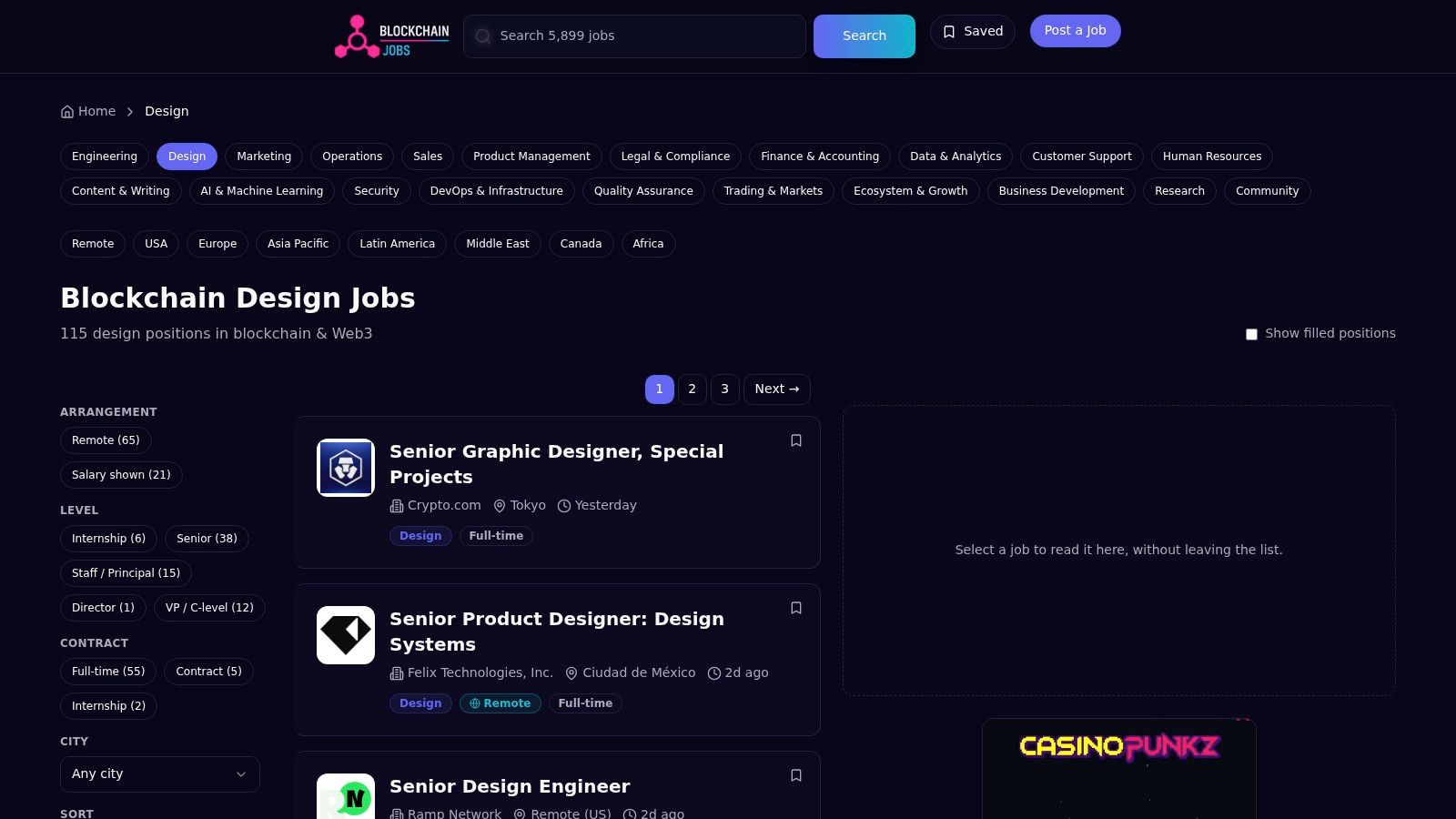
Blockchain Design Jobs lists UX/UI and product-design roles across blockchain and Web3 products. Filters cover remote status, seniority, and contract type. Use them to distinguish, for example, a staff design-systems role from a short-term dApp contract; each calls for different evidence of scope and ownership.
What the listing should show
Start with the product surface. Wallets, DeFi, dApps, NFT marketplaces, and gaming products expose different failure states, so check whether the posting names the product and the user problem. Then check arrangement and level. Listings are grouped by region, including Remote, USA, Europe, Asia Pacific, Latin America, Middle East, Canada, and Africa. Level filters run from Internship through VP / C-level, and job details open in the list view so you can compare scope without losing your place.
Moving from a first UX role to a senior title usually takes several years. Early-career candidates should show ownership of a complete crypto-product problem, such as making a signing flow understandable, rather than relying on a gallery of polished screens. For interview preparation, see this guide to blockchain UX designer jobs.
Practical rule: Before applying, identify the risk the interface creates. Signing, bridging, and irreversible sends deserve more attention than a polished dashboard.
The trade-off is clear: this is a live job category, not a guide to employers, pay bands, or application strategy. Listings reflect current posts, which makes the page more useful for finding openings than a static company list, but it does not provide salary benchmarks in one place.
2. Web3Jobs.io
Web3Jobs.io keeps a dedicated UX/UI Design category covering product, interface, visual, and design-engineering roles, including remote and US-based posts. Browsing is free. Filters and tags cover location, skills, and job type, and some cards show salary, location, and how recently the role was posted. I use it as a first pass when the brief is "crypto product," not "any designer title in tech."
The feed is international, and UX/UI tags sometimes pull in adjacent creative or engineering work. Confirm the opening on the employer's own application page before you rewrite a case study around it.
Hiring teams on these products screen for handoff, not mood boards. A Figma design statistics roundup reports Figma usage at 82.3% for UI design and says 46.3% of respondents experience significant inconsistencies between design systems and implementation. The same roundup cites a 2025 designer survey in which 84% of designers collaborate with developers at least weekly.
- Inspectable files: Share components, tokens, and responsive states, not only polished frames.
- Error and signing states: Annotate network failures and confirmation copy the way you would annotate a button.
- Handoff notes: Say what engineering should not reinterpret.
If the file cannot survive a weekly engineering review, it will not survive a wallet launch.
3. Web3.career
Web3.career is the companion search when the first board runs thin. It has a dedicated design-jobs page and a remote-design filter. Listings span design and product-design openings, including US-based and remote roles, and cards may show salary, location, tags, and posting age. Search itself appears free. Broader Web3 inventory sometimes surfaces a strong role under a title other than UX/UI Designer, which is useful if you read past the label and useless if you do not.
Global posts mean you must check location and visa lines yourself. Category quality varies, and some roles are brand or marketing design rather than hands-on interface work.
For interviews, I want case studies that match how UX people spend their week. Nielsen Norman Group's UX careers research, a survey of 722 UX professionals worldwide, found that 87% of UX designers have conducted qualitative usability testing, although only 41% conduct it often. Put one tested flow in the portfolio. A wallet recovery path or a failed-transaction state will outperform another untested home screen.
4. CryptoJobsList
If you are targeting dApp, wallet, or DeFi employers but do not yet know their names, CryptoJobsList focuses on cryptocurrency, blockchain, and Web3 hiring. Design roles sit alongside protocol, product, operations, and marketing jobs. Search by design title and location, then check each posting for the product and interface work behind its title.
Remote roles and different employment types appear, but remote eligibility may depend on your country. Company size varies, and compensation is often missing, so confirm the range with the employer rather than reading into an undisclosed figure. Check the company site if a post looks old.
Occupation growth is real, but it does not guarantee a junior seat. The Adobe brief on creative professions cites Bureau of Labor Statistics projections of 128,900 web and digital interface designer jobs in 2024 and 137,900 in 2034, a 7.0% gain. Use this guide to crypto job boards to assess whether a listing describes product design or uses a broad title for other work.
5. LinkedIn Jobs
A crypto team may advertise a UX role under several titles, or describe a wallet interface as general product design. LinkedIn Jobs' broad results help surface those openings across industries and experience levels. Search UX Designer, UI/UX Designer, and Product Designer, then narrow by location, date, and company. Alerts can keep a search current, while company pages and messaging help you check who is hiring and whether the role is still active. Search is free, and paid plans are optional.
The trade-off is noise. Duplicate listings, stale posts, and recruiter reposts can bury relevant work, and some application flows require sign-in. Check the company's own site before applying. For a Web3 design role, confirm that the product involves real wallet, DeFi, dApp, NFT, or gaming work, and ask what the designer will own: interaction flows, a design system, or production assets.
Salary benchmarks can help distinguish interface design from narrower graphic production work. The Bureau of Labor Statistics profile for web developers and digital designers reports a $99,520 median annual pay for web and digital interface designers and projects 5% growth from 2025 to 2035. Compare a crypto role's pay with its responsibilities, location, and employment arrangement before judging the offer. For adjacent visual roles, see brand designer jobs. The LinkedIn job search organization guide can help keep saved roles and alerts manageable.
6. Wellfound
Wellfound is where I look when the candidate wants a startup, sometimes a founding design seat, and can live with uneven process. Product Designer listings often show salary, equity, experience level, and whether the role is remote or tied to a US city. Profiles and matching are part of the product, and you can browse and apply without a paid subscription. Crypto companies appear, but they are not the whole feed. You will also see ordinary SaaS.
Some posts are old or demand a narrow stack. Early-stage scope swings from "own the entire product" to "redraw the landing page," and stability swings with the round.
Equity is not a design critique. Ask what shipped last quarter and who reviews research before you trade cash for a title.
AI fluency is now part of that conversation. The Cisco AI Workforce Consortium report found that 78% of analyzed G7 roles included AI skills, with emerging design work covering generative UI, AI design systems, and conversational interfaces. On a wallet team, use AI to explore variants. Do not hand it permission copy, consent, or fraud warnings. Those stay human.
7. Maneki
Maneki describes its feed as roles aggregated from public company career pages and hiring systems. That is the feature and the risk. You can search a Web3-focused list organized around DeFi, NFT and gaming, wallets, oracles, and security, with remote-anywhere and regional options. Design openings show up across those sectors, and browsing appears free. I like it when a protocol's own careers page is hard to find and I want one place to see several teams.
Aggregated posts go stale. Check the source listing for date, location, and whether US-only candidates are eligible. The count of true UX/UI seats moves week to week, so do not build a weekly plan on one empty search.
CareerOneStop's occupation profile reports 8,300 projected annual job openings for U.S. web and digital interface designers over 2025 to 2035. That is the whole occupation, not crypto alone. Treat Maneki as a way to find the Web3 slice, then confirm the employer still has the seat.
- Source check: Open the company careers page and match the title.
- Sector check: A gaming client and an oracle dashboard are not the same portfolio story.
- Eligibility check: Remote-anywhere still fails if the contract excludes your country.
How the Web3 UX UI designer job boards compare
| Item | Specialty focus | Work arrangement | Compensation visibility | Best for |
|---|---|---|---|---|
| Blockchain Design Jobs | Blockchain and Web3 UX/UI and product design | Remote-friendly roles, with level filters from Internship to VP / C-level | A filter identifies jobs with salary information | Designers seeking focused Web3 design listings |
| Web3Jobs.io | Web3 and crypto UX/UI, product, and design engineering | Remote and US-based roles | Salary may be shown | Finding specialized Web3 design roles |
| Web3.career | Web3 design and product design | Remote and US-based roles | Salary may be shown | Expanding a Web3-focused search |
| CryptoJobsList | Crypto, blockchain, and Web3 design, including dApps | Remote and varied employment types | Some listings may show compensation | Exploring crypto-native design opportunities |
| LinkedIn Jobs | UX design across industries, including blockchain by keyword | Location-based listings; filters and alerts | Not specified | Broad searches, networking, and location-specific roles |
| Wellfound | Startup Product Designer roles, including some crypto companies | Remote and US-specific roles | Salary and equity may be shown | Designers interested in startups and early-stage roles |
| Maneki | Web3 design across DeFi, NFTs, wallets, and other sectors | Remote and regional opportunities | Not specified | Browsing aggregated Web3 openings across sectors |
Turning Board Searches into Interview-Ready Offers
Pick two or three boards that match your specialty and your arrangement, then stop collecting tabs. One niche design category, one broader crypto feed, and one startup or LinkedIn alert is enough. More feeds mostly duplicate the same wallet and DeFi posts under slightly different titles.
Track every application against a short list. Confirm the listing is still current on the employer site. Verify location and contract eligibility, including whether "remote" means your country. Tailor one case study to the product area in the req, such as wallets, DeFi, or dApps. Rewrite the outcome in numbers you can defend, like fewer failed sends or a shorter recovery path, and leave the rest of the portfolio alone.
Set alerts so new roles reach you as they post, and answer within a day while the hiring manager still remembers the req. Before the first call, use the product. Create a wallet, trigger an error, and note where trust breaks. That prep beats another generic "I love users" story.
Consistent, targeted searching is what turns UX UI designer jobs into offers and clearer progression. A proposal you can adapt per team keeps that work from restarting at zero. Grab a free UX proposal template download and rewrite it around the product you just used, not around a fictional app.
Blockchain Jobs is a Web3 job board with a Design category for UX/UI and product-design roles across wallets, DeFi, NFTs, and other decentralized products. Filter by level, region, and remote work, save roles, and get a daily email when new jobs in your level are posted. Visit Blockchain Jobs and run the design search before your next application.