The Internet of Money: Your 2026 Web3 Career Guide

You're probably in one of three spots right now. You work in tech or finance and keep seeing Web3 roles that sound promising but oddly vague. You're early in your career and trying to separate durable opportunities from hype. Or you already have solid experience, and you want to know whether the internet of money is a real career category or just another buzzword recruiters throw around.
It's a real category, but most explanations miss what candidates need. They explain blockchains, tokens, and protocols. They don't explain where the jobs sit, how hiring managers evaluate people, or what separates a tourist from someone who can operate in this market.
That's the lens worth using. The internet of money isn't just a technology story. It's a labor market story. When value starts moving through internet-native rails instead of slow, fragmented financial systems, companies need engineers, product builders, compliance operators, treasury people, growth teams, and legal specialists who understand what they're building and why it matters.
From Information to Value Redefining the Internet
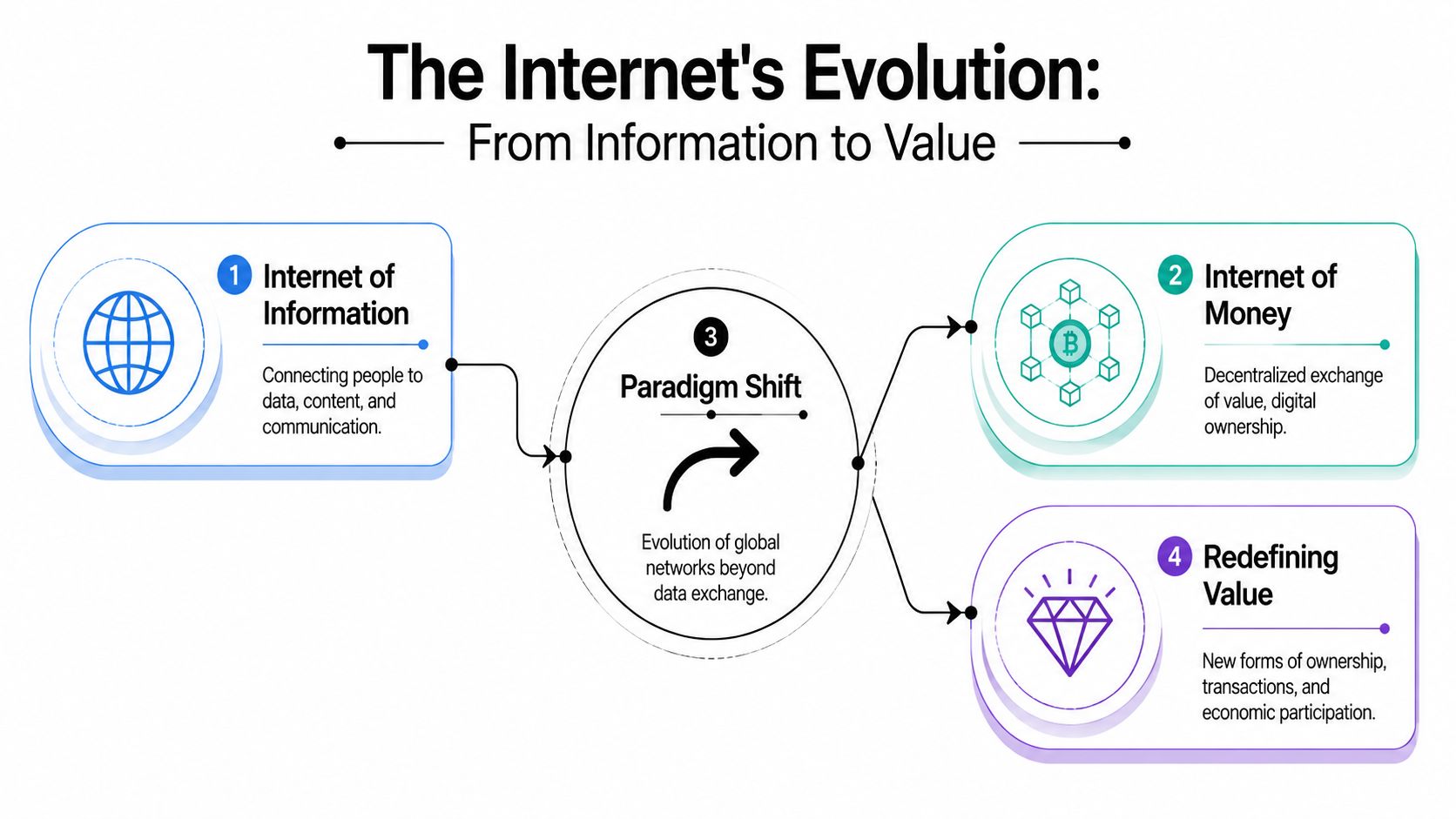
The original internet changed how information moved. Email replaced letters for many use cases. Search compressed research time. Publishing stopped requiring a printer, a broadcaster, or a distributor. The network became the default layer for communication.
The internet of money applies that same shift to value transfer. Instead of asking banks, card networks, custodians, and intermediaries to coordinate every movement of money, the network itself becomes a larger part of the transaction system. That doesn't remove institutions from every use case, and it doesn't make regulation disappear. It changes where trust, coordination, and settlement happen.
Why this matters to your career
If you're evaluating the field as a candidate, start with the economic reason companies keep building here. The IMF argued that broad, inexpensive digital money and phone-based transactions could extend financial services to 1.7 billion people without traditional bank accounts, with lower-income markets positioned to gain heavily from that shift, as noted in the IMF's analysis of digital money and a new era.
That matters in interviews because it gives you a grounded answer to a common question: “Why does this infrastructure matter beyond speculation?” A strong answer isn't “crypto is the future.” A stronger answer is that internet-native money can reduce friction in payments, expand access, and create new product rails in places where legacy banking coverage is uneven.
Use that framing if you come from:
- Engineering: You're not just building token features. You're building reliability, custody flows, wallet UX, and settlement logic.
- Product: You're deciding which user pain is worth solving. Cross-border transfers, onchain payments, treasury movement, and merchant acceptance all need product judgment.
- Operations and support: Someone has to manage exceptions, user education, transaction reviews, and partner workflows.
- Legal and compliance: New rails create fresh obligations around licensing, disclosures, sanctions screening, and consumer protection.
How recruiters hear the phrase
When candidates say “I want to work in the internet of money,” the phrase only helps if they can translate it into business reality. Recruiters and hiring managers usually want evidence that you can answer three practical questions:
| What they're testing | Weak answer | Strong answer |
|---|---|---|
| Do you understand the category? | “It's decentralized finance.” | “It's internet-native movement of value across new settlement rails.” |
| Can you connect it to users? | “People can use crypto.” | “Users need cheaper transfers, faster settlement, and better access.” |
| Do you know where you fit? | “I'm open to anything in Web3.” | “My background maps to payments product, protocol engineering, or compliance ops.” |
Practical rule: Don't pitch yourself as “passionate about blockchain.” Pitch yourself as useful inside a financial infrastructure shift.
The biggest early-career mistake I see is treating the whole space like one job family. It isn't. The internet of money creates different kinds of work depending on where value is created, stored, exchanged, and governed. Once you understand that, role selection gets easier and interviews get sharper.
The Core Technologies and the Jobs They Create
A lot of candidates over-rotate on terminology. They memorize consensus models, throw around words like modularity, and still can't explain what work needs to be done. Hiring teams care much more about whether you understand the operating surface of the stack.
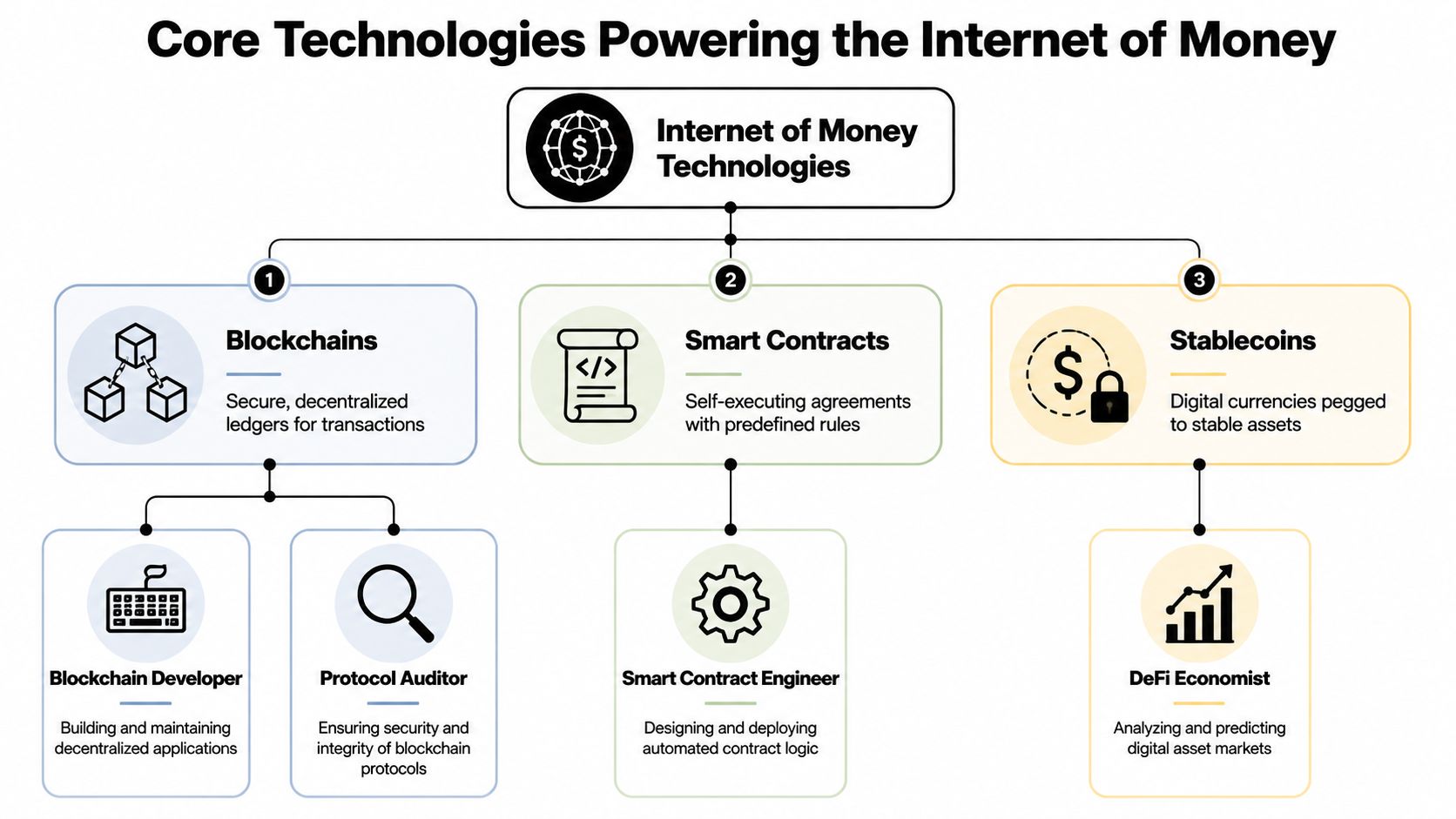
Start with the simplest useful view. Blockchains record state across a decentralized network. Smart contracts execute logic on that network. Stablecoins give users a digital unit of value designed for steadier pricing than volatile assets. Layer-2 systems try to improve usability by moving activity off the most congested base layers while still anchoring to them.
Blockchains and protocol work
The core technical draw is the trust model. Antonopoulos describes Bitcoin as a decentralized platform with no central points of control, where value transfer becomes a protocol like internet communication, and where the network uses incentives and punishments so trust sits in the system rather than a third party, as summarized in The Internet of Money Volume 2.
That idea creates jobs for people who can build or inspect systems where failure is expensive. Protocol engineers work on clients, nodes, networking, data availability, and chain-level mechanics. Infrastructure engineers keep RPC services, indexers, and developer platforms reliable. Security reviewers and auditors look for assumptions that break under adversarial conditions.
If you're a software engineer trying to map your path, review live blockchain engineering roles and compare the language against a solid Talantrix Blockchain Developer JD template. That comparison helps you see which requirements are universal, such as distributed systems thinking and smart contract familiarity, versus which are company-specific.
Smart contracts and product execution
Smart contracts turn business logic into code that executes onchain. That sounds clean. In practice, it creates work at the seam between code, incentives, and user behavior.
A smart contract engineer isn't just writing Solidity or Rust. They're thinking about upgrade patterns, permissioning, oracle dependence, gas efficiency, failure modes, and admin controls. Product managers in this area need to understand what should be onchain, what should remain offchain, and where users will get confused or harmed. Designers who do well here know that wallet interactions, signatures, approvals, and transaction previews are part of UX, not an afterthought.
A useful interview line is this: “Onchain logic is transparent and composable, but every decision you encode becomes harder to change later. That raises the bar for specification, testing, and communication.” Hiring managers tend to trust candidates who respect the trade-off.
Here's a short explainer that's worth watching before interviews if you want to tighten your mental model:
Stablecoins and financial roles
Stablecoins are where many non-engineers finally see their entry point. They connect crypto rails to familiar financial needs: settlement, payments, treasury movement, and accounting treatment. That creates room for treasury managers, finance analysts, risk operators, reconciliation specialists, and compliance staff who can work across wallets, exchanges, banking partners, and internal controls.
A good candidate in stablecoin-adjacent hiring speaks both languages. They can discuss settlement flows with a product lead and controls with a finance team.
Layer-2 systems create a similar split. Engineers focus on scaling architecture, bridges, monitoring, and developer tooling. Product and growth teams focus on onboarding, liquidity movement, and user education. If you can explain not only what the technology does, but which part of the operational burden it moves, you'll stand out.
Real-World Use Cases and Hiring Trends
The best way to understand the internet of money is to look at where companies already hire around it. Not in theory. In workflows.
Cross-border remittances are the clearest example. Circle notes that the World Bank has long cited around $550 billion in yearly cross-border remittances, which is why digital-money systems keep targeting this category, as discussed in Circle's piece on the convergence of money and the internet. When money crosses borders, delays, intermediaries, FX friction, and liquidity management become product problems as much as financial ones.
Remittances and payments rails
A remittance-focused company doesn't just need blockchain engineers. It often needs:
- Product managers: To map user journeys across payout methods, wallet funding, and local market constraints.
- Operations specialists: To handle liquidity movement, exceptions, transaction support, and partner coordination.
- Compliance analysts: To review flows, sanctions exposure, and jurisdiction-specific onboarding rules.
Candidates with payments, fintech, or marketplace backgrounds often underestimate how transferable their experience is here. If you've worked on settlement, fraud tooling, merchant onboarding, or payment ops, you're already closer than you think.
DeFi and internet-native financial products
DeFi is where the internet of money becomes programmable. Lending, trading, collateral management, staking, and onchain asset issuance all sit here. The jobs are broader than outsiders assume.
A DeFi team may hire a smart contract engineer, but it may also need a protocol researcher, token operations manager, data analyst, technical writer, and ecosystem growth lead. The product challenge is rarely just “ship the contract.” It's making sure users understand risk, interfaces explain state clearly, and governance or incentive systems don't break behavior.
The strongest DeFi candidates don't sell certainty. They show they can reason through incentives, attack surfaces, and user confusion.
If you want to sharpen your view on how teams describe these markets in practice, reading current commentary on the Blockchain Jobs blog is useful because it exposes the language employers and candidates use when discussing active niches.
Creator economies and gaming
Not every use case is a payment corridor or a lending market. NFT infrastructure, creator monetization, and Web3 gaming all sit under the broader internet-of-money umbrella because they deal with digital ownership and value transfer.
These niches usually hire for a different profile mix:
| Niche | Problem being solved | Roles you'll see |
|---|---|---|
| Creator tools | Ownership, royalties, fan monetization | Community manager, partnerships lead, product designer |
| Gaming | In-game assets, marketplace flows, player economies | Economy designer, backend engineer, live ops manager |
| Marketplaces | Discovery, transaction flow, trust and safety | Growth marketer, trust and safety analyst, customer support lead |
What doesn't work in interviews is treating these categories as interchangeable. A gaming studio doesn't want a generic “crypto enthusiast.” It wants someone who understands player behavior, sinks and faucets, marketplace abuse, and live economy management. A creator platform wants someone who can balance monetization with onboarding simplicity.
That specificity is where hiring trends become a career advantage.
Navigating the Economic and Regulatory Landscape
You join a wallet startup as the second product hire. In week one, the team is debating blocked jurisdictions, KYC triggers, custody design, and what happens when a user sends funds to the wrong address. That is the internet of money in practice. The job is never just shipping features. The job is shipping a product a company can defend, operate, and grow.
That is why strong candidates talk about economic design and regulation as operating constraints, not abstract talking points. In hiring loops, this matters because companies want people who understand how money movement changes the risk profile of a product. A social app can tolerate some ambiguity. A payments app, exchange, or stablecoin business usually cannot.
Why regulation creates hiring demand
Regulation drives headcount because someone has to turn legal obligations into daily process. That work sits across legal, compliance, operations, product, and risk. If a company serves retail users, handles cross-border flows, lists tokens, or touches fiat rails, the coordination burden rises fast.
You can see that directly in active legal and compliance roles in blockchain. Read enough of those job descriptions and the pattern becomes clear. Employers are hiring for licensing analysis, AML programs, sanctions screening, transaction monitoring, disclosure review, incident response, and governance controls. For candidates, that is useful interview prep. It shows what companies are judged on once real money is involved.
The career point is straightforward. Regulation does not sit off to the side of the business. It shapes product scope, onboarding flow, market expansion, support playbooks, and banking relationships.
What hiring managers want to hear
Weak candidates treat regulation as a brake on innovation. Strong candidates explain the trade-off. Faster onboarding can improve conversion, but it may increase fraud exposure. Broader token access can help growth, but it may raise listing risk or banking pressure. Cross-border expansion can increase revenue, but it adds licensing and sanctions complexity.
That answer lands because it sounds like someone who has worked with real constraints.
Use language like this in interviews:
- For product roles: “The onboarding flow has to balance conversion with identity checks, fraud controls, and the jurisdictions the company can support.”
- For legal roles: “Good legal work shows up in product decisions, escalation paths, disclosures, and documentation that other teams can use.”
- For operations roles: “A policy only matters if support, risk, and compliance can apply it consistently during edge cases.”
- For strategy roles: “Market entry depends on more than demand. It depends on banking access, licensing posture, and how much operational overhead each region adds.”
One of the clearest signals of senior judgment is knowing that governance failures become hiring priorities after a company learns the hard way. Reviewing cases such as the FTX securities class action is useful for more than industry awareness. It gives candidates concrete language for discussing custody, disclosures, board oversight, conflicts of interest, and internal controls.
This is also where the career angle becomes practical. If you are coming from fintech, audit, legal ops, fraud, or policy, Web3 does not need you to become a protocol engineer. It needs people who can reduce ambiguity, write workable rules, and help teams ship products without creating avoidable risk.
That is a real hiring lane, and good candidates know how to frame it.
How to Build Your Career on the Internet of Money
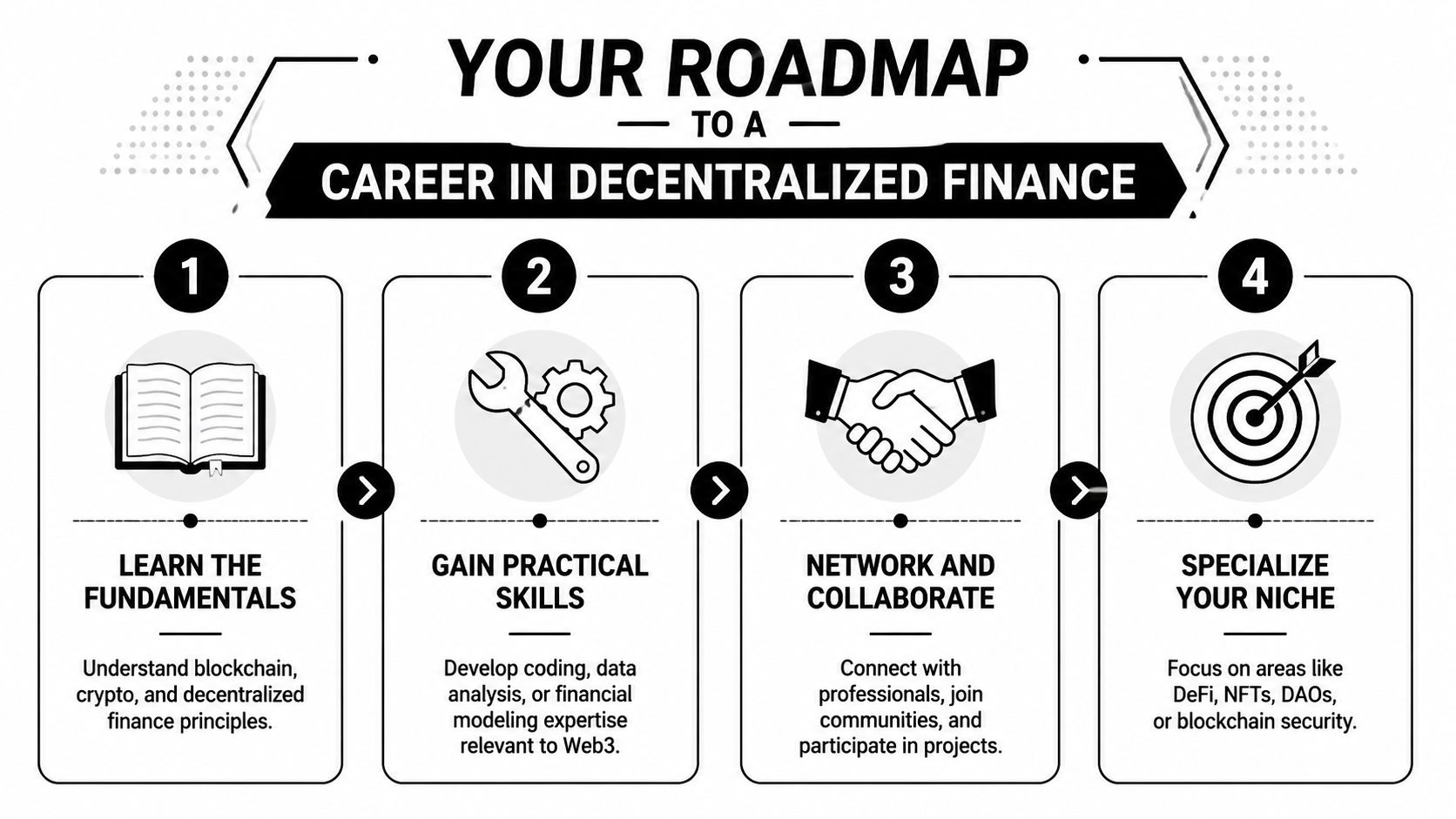
Breaking into this field is more accessible than people think. The barrier isn't that you need to know everything. The barrier is that you need to show where your existing skill set fits, then prove you can operate with the extra complexity Web3 adds.
That means fewer grand claims, more evidence. Fewer hot takes, more artifacts. A GitHub repo, a protocol teardown, a product spec for wallet onboarding, a compliance memo, a SQL dashboard from onchain data, a community playbook. Those all beat “I'm passionate about decentralized finance.”
Pick a lane before you pick a company
Most candidates do this backwards. They choose a brand first, then try to force-fit themselves into whatever opening exists. That usually leads to weak applications.
A better approach is to choose your lane first.
Engineering
If you come from software, decide whether you're strongest in frontend, backend, infra, or protocol-level work. Frontend engineers should get comfortable with wallet connections, transaction states, signing flows, and failure messaging. Backend engineers should learn indexing, event handling, reconciliation logic, and secure integrations with custody or exchange systems. Protocol-leaning engineers need stronger grounding in contract architecture, testing, audits, and adversarial thinking.
Interview prompt you may get:
“How would you design a user-safe transaction flow for a wallet-based app?”
Good answer themes:
- clear pre-transaction review
- explicit risk and fee communication
- effective handling of pending, failed, and dropped states
- sensible defaults over maximal optionality
Product and design
Product managers and designers do well here when they can simplify complexity without hiding important risk. Good Web3 PMs know where user education belongs in the product and where it becomes a crutch for bad UX. Good designers understand that signatures, token approvals, network switching, and recovery flows are part of the main experience.
A practical way to build credibility is to rewrite an existing Web3 onboarding flow. Show the old state, your revised flow, and your rationale. Hiring teams love candidates who can reduce confusion.
Interview prompt:
“How would you explain the value of stablecoins to an enterprise partner?”
A strong answer doesn't start with ideology. It starts with use case. Settlement speed, transferability, treasury movement, and integration potential. Then it acknowledges trade-offs such as counterparties, compliance expectations, and operational controls.
Go-to-market roles are not second-tier
A lot of talented candidates think the only “real” Web3 jobs are engineering roles. That's false. Plenty of companies fail because they can build but can't explain, distribute, support, or govern what they built.
Go-to-market roles include:
- Community and social: Best for people who can educate, moderate, and turn noisy user feedback into actionable insight.
- Business development: Strong fit for candidates with partnerships, payments, fintech, or platform sales backgrounds.
- Content and education: Valuable if you can translate complex systems into crisp user-facing language without misleading people.
What works in these interviews is proof of judgment. Show that you can communicate nuance. If you've managed technical communities, written product education, or worked on adoption in complex categories, make that explicit.
Build proof, not just knowledge
Candidates often stall at this point. They keep studying but don't publish anything.
Use one of these proof assets:
| Career track | Best proof asset | What it signals |
|---|---|---|
| Engineer | Smart contract project, integration demo, security write-up | You can ship and reason technically |
| Product | Feature spec, onboarding redesign, market map | You think in trade-offs and priorities |
| Legal or compliance | Short policy memo, regulatory comparison, risk framework | You can turn ambiguity into action |
| Growth or community | Campaign teardown, education series, community ops plan | You know how adoption actually happens |
Don't wait until you have a perfect portfolio. A clear, specific piece of work beats a polished but generic personal brand.
The internet of money rewards people who can connect infrastructure to outcomes. If you can do that in public, even on a small scale, you become easier to hire.
Your Next Step into the Decentralized Economy
The internet of money is no longer a niche concept reserved for protocol insiders. It's a hiring category spread across engineering, product, finance, operations, legal, compliance, design, and growth. The opportunity isn't limited to people who can write smart contracts from scratch.
The practical edge comes from understanding where you fit. If you're technical, tie your background to infrastructure, contracts, security, or data. If you're commercial, focus on payments, partnerships, user education, and market entry. If you're on the legal or risk side, position yourself as someone who can help a company move forward without guessing its way into avoidable problems.
There's also a mindset shift that matters. Stop asking whether you're “Web3 enough.” Start asking whether your skills solve a real problem inside internet-native financial systems. That framing leads to better applications, better interview answers, and better career decisions.
If you're serious about making a move, shortlist roles by function first. Then study the language in those job descriptions. Look at how companies describe users, risk, product constraints, and technical scope. That's where the market tells you what it values.
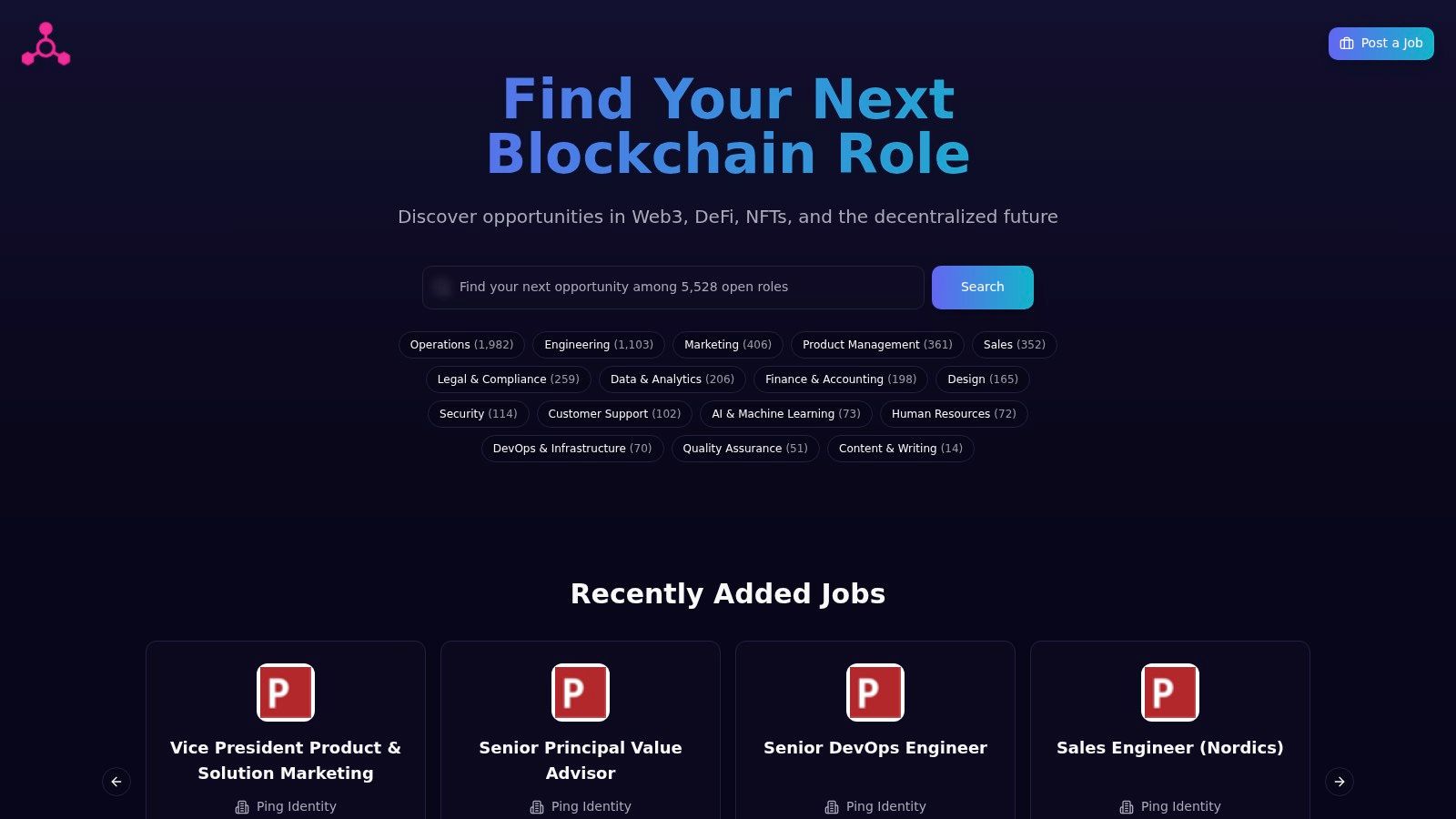
If you're ready to turn this understanding into action, explore current openings on Blockchain Jobs and target roles that match your actual strengths, not just the trendiest titles.