
Web 3.0 Security: A Career Guide for 2026

USD 2.25 billion to USD 33.53 billion is the scale of Web 3.0's projected jump from 2023 to 2030, with a 49.3% CAGR, according to Grand View Research's Web 3.0 market report. That number matters for one reason: when a stack grows that fast, attackers arrive early and hiring follows close behind.
A lot of developers still treat Web 3.0 security as a narrow specialty for auditors and cryptographers. That's the wrong frame. Security is one of the clearest paths from “solid protocol engineer” to “hard-to-replace technical hire.” If you can explain how contracts fail, how keys get exposed, how integrations break trust assumptions, and how teams operationalize defense after deployment, you're no longer competing as a generic blockchain developer.
This is a career guide disguised as a technical guide. The technical part matters because interviews in this space punish shallow understanding. The career part matters because strong candidates often know the basics but struggle to translate that knowledge into portfolio proof, hiring signals, and promotion advantage.
Why Web3 Security Is Your Next Career Move
Billions have already moved into Web3. Security hiring follows the money, because every new protocol, wallet, bridge, and staking product adds fresh attack surface and real financial risk.
That demand changes the career math for a mid-level developer. Teams can train someone on a specific stack. They have a much harder time finding engineers who can spot unsafe trust assumptions, question upgrade paths, review privileged roles, and explain how an exploit would play out in production. Those skills travel well across protocol engineering, wallet infrastructure, DevSecOps, audit work, and security research.
In practice, security specialization gives you a clearer route out of the crowded pool of generalist blockchain developers. It also gives you stronger interview material. Hiring managers remember candidates who can walk through failure modes, discuss trade-offs between shipping speed and assurance, and explain where decentralization claims break down under operational pressure.
A practical way to validate demand is to review the companies already hiring across the ecosystem at blockchain companies actively building in Web3. Read beyond job titles. Security work often shows up inside backend, protocol, infrastructure, wallet, SRE, and platform engineering roles because many teams need builders who can prevent incidents before they become public postmortems.
The trade-off is straightforward. Security work is harder. You need better judgment, more patience, and a higher tolerance for ambiguity. You also build scarcer skills.
That scarcity is what gets you hired faster and trusted sooner.
Web3 also rewards engineers who understand that code is only one layer of defense. Strong candidates can connect contract design with wallet security, signer hygiene, deployment controls, monitoring, incident response, and governance risk. If you want a useful framing for that broader posture, Titanium Computing zero trust security is a good reference point. The core lesson carries over well to decentralized systems. Trust should be constrained, verified, and continuously re-checked, not assumed because a component sits inside your stack.
Practical rule: In Web3 hiring, security depth raises your ceiling even when the role title doesn't include the word “security.”
That is why this path compounds well over time. It improves your code reviews, makes your architecture decisions easier to defend, and gives you portfolio proof that maps directly to senior-level expectations. If your goal is to become the engineer people pull into critical launches, incident reviews, and high-stakes design discussions, security is one of the fastest ways to get there.
The Web3 Security Mindset and Threat Model
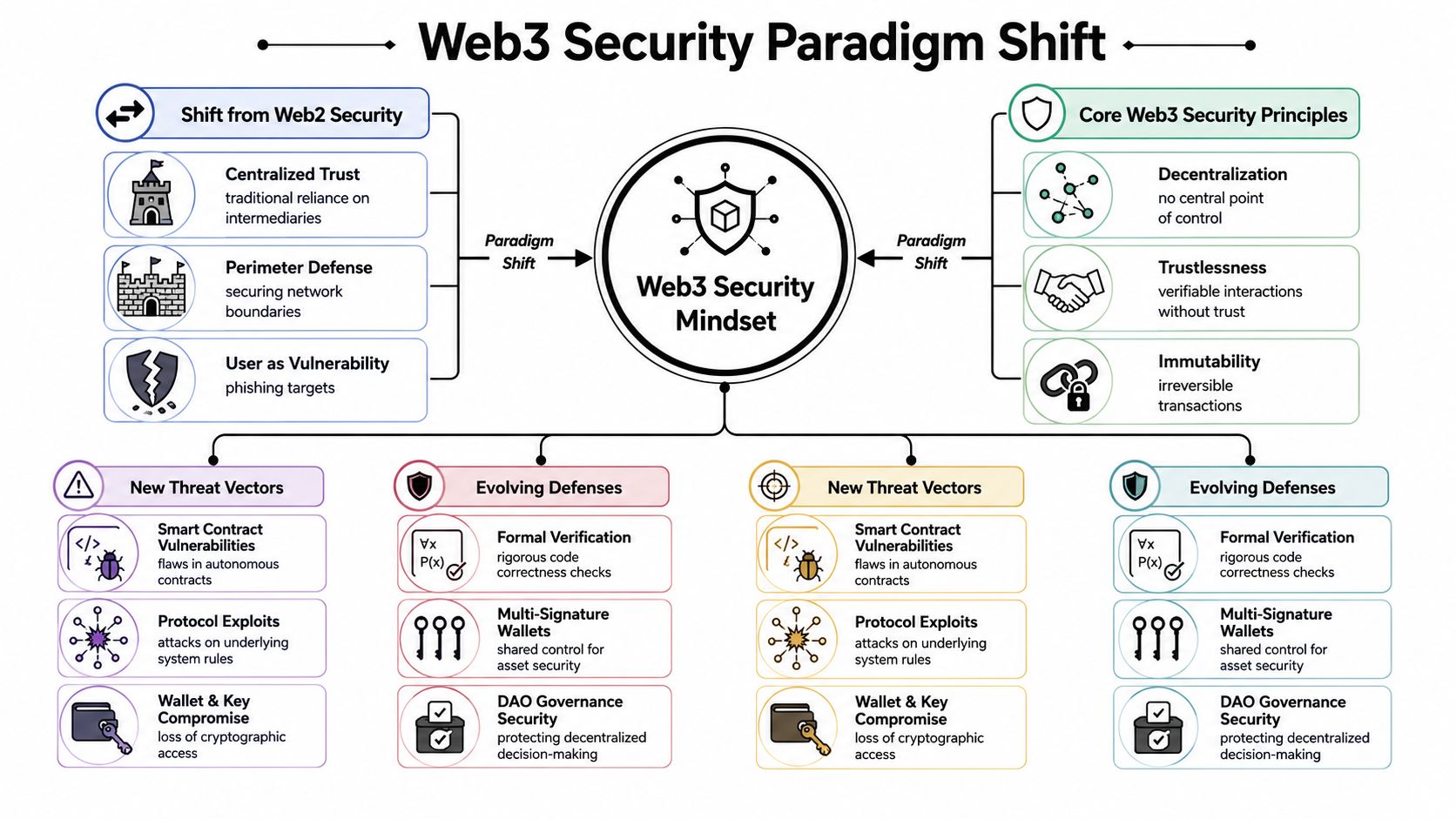
Web2 security often starts with perimeter thinking. Protect the app, the server, the admin panel, the database, the internal network. Web3 security starts from a harsher premise: the system is public, state is inspectable, transactions are adversarially tested, and mistakes are often permanent.
Think of the contrast like this. A traditional corporate server is a private building with guarded entrances. A DeFi protocol is closer to a public bank vault with transparent walls and scripted doors. Everyone can inspect the mechanism. Anyone can try the handle. The only defense is whether the mechanism itself resists abuse.
What trustlessness changes
In interviews, candidates often say “blockchain is trustless” and stop there. That answer is too shallow. Trustlessness doesn't remove trust. It relocates it into code, cryptography, protocol design, wallet behavior, signing flows, governance rules, and off-chain dependencies.
That means your threat model has to include more than contract bugs:
- Code risk means flawed state transitions, unsafe external calls, bad access control, or broken upgrade paths.
- Economic risk means an attacker can manipulate incentives without violating code correctness.
- Governance risk means the protocol can be captured through voting concentration, rushed proposals, or weak execution safeguards.
- Operational risk means multisig procedures, deployment practices, API handling, and incident response can fail even if the contracts are clean.
- User path risk means phishing, fake interfaces, poisoned approvals, and wallet compromise still defeat the system.
A useful parallel comes from the broader idea of Titanium Computing zero trust security. The principle maps well to Web3. Don't assume any component is trustworthy by default, not the frontend, not the signer, not the relayer, not the bridge, not the governance actor. Verify each trust boundary explicitly.
A simple threat model for a lending protocol
Take a DeFi lending market. Most developers first look for contract exploits. That's necessary, but incomplete. A stronger review asks four questions.
What controls collateral value?
If pricing depends on an oracle or a thin market, the protocol may accept bad collateral or liquidate healthy positions incorrectly.What privileges exist?
Admin roles, pausers, upgrade keys, and treasury controls can become the shortest path to loss if governance or key custody is weak.What can be manipulated economically?
Interest curves, liquidation incentives, flash-loan-assisted positions, and rounding behavior can create extraction paths.What assumptions exist off-chain?
Frontend signing prompts, keeper bots, APIs, and monitoring pipelines can all become attack surfaces.
Later in the interview, that's usually where strong candidates separate themselves. They don't just recite vulnerabilities. They identify system assumptions.
The historical reminder is severe. The $97 million Liquid Global hack in 2021 remains a defining example of Web 3.0 risk, showing how exchange security failures and smart contract weaknesses can cascade into catastrophic asset loss, as described by HKCERT's analysis of Web 3.0 cyber security and the Liquid Global breach.
That case is worth studying because it forces the right mindset. Security isn't only about writing better Solidity. It's about anticipating how real attackers move across wallets, interfaces, code paths, and human behavior.
A useful walkthrough on this broader subject is below.
If you want to sound senior in a security interview, describe assumptions before you describe tools.
Core Technical Security Controls
When hiring managers test depth, they usually probe three areas: contracts, keys, and nodes. If you can explain one common failure mode and one dependable defense in each area, you'll already sound more prepared than many candidates.
Contract controls that actually matter
Smart contract security starts with state discipline. Reentrancy, unsafe external calls, authorization mistakes, and flawed upgrade patterns still show up because teams optimize for feature delivery before they harden invariants.
The interview answer that works is concrete. Don't say, “I'd secure the contract with best practices.” Say what you would inspect:
- External call ordering: Check whether state changes happen before any external interaction.
- Privilege boundaries: Review role assignments, emergency powers, ownership transfer logic, and upgrade authorization.
- Invariant safety: Define what must always remain true, then test that under edge-case execution.
- Failure behavior: Confirm how the protocol handles paused states, oracle failure, liquidation errors, and token quirks.
Solidity patterns matter, but interviewers usually care more about whether you understand why a control exists. A reentrancy guard helps, but it doesn't replace disciplined architecture. A library reduces implementation risk, but it doesn't eliminate protocol-level logic errors.
API security is now table stakes
A lot of developers assume the blockchain layer carries the trust model for everything around it. That assumption breaks fast when APIs, relayers, and backend services enter the picture.
Approximately 70% of Web3 DApp API interactions are unencrypted and unsigned, which leaves them exposed to interception and spoofing. Enforcing TLS and digital signing has been shown to reduce API-based exploits by 95%, according to Cloudflare's analysis of Web3 security risks in unsigned API traffic.
That statistic should change your checklist immediately. If your DApp depends on API-delivered data, transaction preparation, wallet coordination, indexing, or relaying, then transport security and message authenticity aren't optional.
Hiring signal: If you can explain why signed API responses matter in a trust-minimized stack, you're already thinking beyond chain-only security.
Key management separates hobby projects from real systems
Private key handling is where many otherwise competent teams become fragile. The trade-off is always convenience versus blast radius. A single hot key gives speed. It also gives an attacker a clean win if that key is exposed.
For production environments, interviewers expect you to discuss layered control rather than a single product choice:
- Hardware-backed custody reduces the chance that a workstation compromise leads directly to asset loss.
- Multisignature approval flows slow down unilateral mistakes and force visibility on privileged actions.
- Role separation keeps deployment, treasury, upgrade, and emergency powers from collapsing into one operator path.
- Signer hygiene means clean devices, clear approval review, and minimized standing privileges.
Candidates sometimes over-focus on “which wallet should I use?” The stronger answer is architectural. Explain the signing policy, the approval workflow, the emergency path, and how you'd reduce the impact of one compromised signer.
Node and infrastructure hardening
Node security doesn't get as much airtime in entry-level discussions, but it matters in real jobs. If a team runs its own infrastructure, poor secrets handling, weak RPC exposure, or bad observability can create both security and reliability failures.
A practical review usually includes these questions:
| Infrastructure area | What can go wrong | What a strong candidate says |
|---|---|---|
| RPC exposure | Untrusted access or manipulated assumptions | Restrict access, authenticate clients, and monitor unusual request patterns |
| Secrets handling | Credentials leak through CI, logs, or shared systems | Use managed secret storage and keep credentials out of developer workflows |
| Deployment process | A rushed release introduces silent risk | Require review, repeatable release steps, and rollback planning |
| Observability | Exploits stay invisible too long | Instrument event monitoring around privileged actions and abnormal state changes |
A good way to sharpen your language around contract-focused roles is to read how real teams frame the work in a remote smart contract auditor job listing at Nethermind. Pay attention to how often review depth, communication, and protocol reasoning sit alongside Solidity expertise. That's exactly how interview loops are built.
Securing Oracles and Cross-Chain Bridges
Bridges and oracles sit at the edges of trust, which is why they attract attackers. They connect chains to each other, and chains to external data. That makes them indispensable and dangerous at the same time.
The failure pattern is consistent. Teams secure the contract they control, then inherit risk from the system they depend on. In practice, this means a perfectly reasonable lending market can fail because its price feed is brittle, or a secure token contract can still be drained because a bridge validator path is weak.
Oracle risk is usually assumption risk
An oracle is not just a data pipe. It's a claim about reality that the protocol chooses to believe. If the source is wrong, delayed, manipulated, or too easy to influence, the protocol executes bad decisions with full confidence.
For interview purposes, the strongest way to discuss oracle security is to focus on decision criteria:
- Source diversity: Does the system depend on one source, or can it resist a bad input?
- Update behavior: What happens during volatility, outage, or stale data conditions?
- Manipulation cost: Can an attacker move the underlying market cheaply enough to distort protocol behavior?
- Fallback logic: Does the protocol fail safely if the feed becomes unreliable?
That's more convincing than saying “use a secure oracle.” A senior reviewer wants to hear how you evaluate trust assumptions under stress.
Bridge security is harder than it looks
Cross-chain bridges fail in several distinct ways. The contract logic can be flawed. The validator or signer model can be too concentrated. Message verification can be weak. Operational controls around upgrade keys and emergency procedures can be underspecified.
What makes bridges especially tricky is that they span multiple systems at once. You're not protecting one application. You're protecting the integrity of a message passing process across chains, signers, infrastructure, and governance.
A bridge is only as strong as its weakest verification step, not its strongest contract.
That's why bridge reviews need a different mental model from standard app audits. You're looking for where trust gets compressed. If too much authority sits in a small signer set, a single coordination failure can bypass otherwise elegant code. If message validity depends on off-chain services that aren't independently checked, then “decentralized” becomes a branding term instead of a security property.
What employers want you to say
When interviewers ask about bridges or oracles, they're often testing whether you can move beyond isolated code review. Strong answers usually include some mix of the following:
- System boundaries: Identify where on-chain guarantees stop and external assumptions begin.
- Failure containment: Explain how a protocol limits damage when an integration becomes unsafe.
- Privilege analysis: Map who can pause, upgrade, sign, override, or recover.
- Monitoring strategy: Describe what abnormal events would trigger investigation or emergency action.
This is the kind of knowledge that pushes you into protocol security, infrastructure security, or research-oriented roles. It shows you can reason about the ecosystem, not just one contract file.
Operational Security and The Process Layer
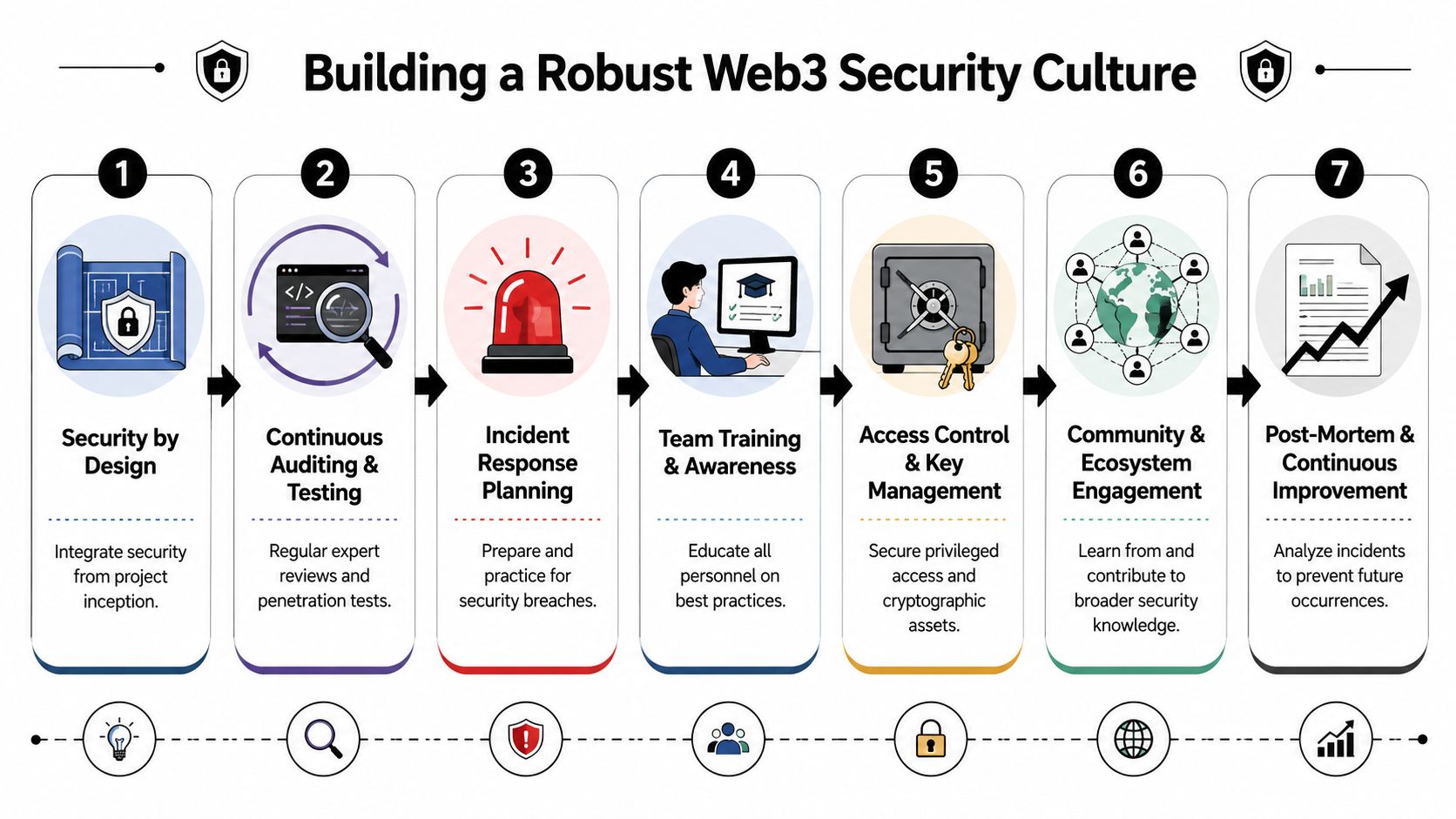
A lot of teams learn the same lesson late: secure code without secure process still fails. Senior security work lives in the process layer. That includes review gates, deployment discipline, incident handling, access policies, and post-mortem habits.
The candidates who get trusted with larger systems know how security work flows before and after deployment. They don't treat an audit as a magic stamp. They treat it as one checkpoint inside a larger operating model.
Before deployment
The strongest Web3 teams build review into delivery. Security checks happen when architecture is still flexible, not after the contracts are feature-complete and politically hard to change.
A practical pre-deployment routine looks like this:
- Threat model the design before implementation hardens assumptions.
- Write explicit invariants for money flow, permissions, and liquidation logic.
- Automate baseline checks in CI so obvious issues don't depend on human memory.
- Use external review wisely for critical logic, especially novel mechanisms.
- Plan rollout controls such as pausing, circuit breakers, or limited initial scope where appropriate.
Formal verification can be valuable for high-assurance components, but it isn't a replacement for design clarity. Teams get the most value when they know exactly which properties they want proven.
After deployment
Many mid-level developers undersell themselves in the context of post-deployment security. This area represents operational work, and operational work is where trust is earned.
You need monitoring that catches dangerous behavior quickly. You need incident response that people have already rehearsed. You need a clear path for user communication, key rotation, contract pausing, and partner coordination.
For people moving into senior roles, it helps to think in terms of operating loops:
- Detect: Watch privileged actions, unusual state changes, failed assumptions, and integration anomalies.
- Triage: Decide who investigates, how severity is assigned, and what authority exists to act.
- Contain: Pause what should be pausable, revoke what can be revoked, and isolate blast radius fast.
- Recover: Patch, migrate, communicate, and validate state.
- Learn: Turn the event into a process improvement, not a forgotten fire drill.
One useful mental model from outside crypto is the discipline of assessing and controlling operational risks. The vocabulary differs, but the core idea maps directly: identify what can go wrong, rank impact and likelihood qualitatively, define controls, and revisit them as the system changes.
Bug bounties, audits, and culture
Audits help. Bug bounties help. Neither works well if the internal team treats security as outsourced. The strongest security culture does three things consistently:
- Invites scrutiny: The team wants researchers, reviewers, and internal engineers to challenge assumptions.
- Respects process: Privileged actions, upgrades, and emergency steps follow documented procedures.
- Closes loops: Every issue becomes a lesson for coding standards, review checklists, and monitoring.
Manager test: Can this person improve our security process, not just find isolated bugs?
That question comes up in hiring panels all the time. If you answer with examples of review workflows, escalation paths, and lessons learned from incidents or audits, you sound ready for more than an individual contributor seat.
Building Your Web3 Security Career and Getting Hired
If you want the blunt version, this is a very good time to specialize. Security positions in the Web3 job market are the highest-paying roles, with an average salary of $153,295, and Security Engineer roles saw 100% growth in demand over the last 3 months, according to CryptoJobsList trends data for Web3 roles. That combination matters because it rewards both technical depth and positioning.
But high pay doesn't mean easy entry. Hiring managers want evidence. They want to see that you can think through a protocol, communicate findings clearly, and operate carefully under ambiguity.
What paths actually exist
Not every security role in Web3 is the same. Some are contract-heavy. Some are research-heavy. Some sit closer to infrastructure or product security.
| Role Title | Primary Focus | Key Skills | Career Tip |
|---|---|---|---|
| Smart Contract Auditor | Reviewing protocol code and identifying exploit paths | Solidity, EVM internals, testing, invariant thinking, report writing | Publish short public reviews of open-source contracts to prove judgment |
| Security Engineer | Building controls across contracts, infrastructure, and operations | Secure SDLC, key management, API security, monitoring, incident response | Show that you can improve process, not just spot bugs |
| Protocol Security Researcher | Analyzing economic design and systemic protocol risk | Threat modeling, mechanism analysis, adversarial reasoning, deep reading | Write teardown notes on governance, oracle, or liquidation assumptions |
| AppSec Engineer for Web3 Products | Securing wallets, frontends, APIs, and backend services around crypto products | Web security, auth flows, signing flows, client security, abuse cases | Don't present Web2 security experience as separate from Web3. Bridge it |
| Infrastructure Security Engineer | Protecting nodes, secrets, CI, deployment paths, and production systems | Cloud security, secrets handling, observability, access control, response playbooks | Emphasize reliability and security together |
How to build a portfolio without waiting for a title
Most candidates make the same mistake. They wait to get hired into security before they start producing security artifacts. That's backwards.
You can build a strong portfolio right now:
- Review open-source contracts: Write concise findings, severity reasoning, and mitigations.
- Document threat models: Pick a live protocol and map assumptions around governance, pricing, upgrades, and custody.
- Create testing examples: Show fuzz tests, invariant tests, and edge-case analysis in a public repo.
- Study incidents: Publish short lessons learned from real failures without pretending you were involved.
- Contribute responsibly: If you find an issue, disclose it properly and document the process after it's safe to discuss.
If your resume feels too generic, it helps to browse blockchain developer resume samples and compare how stronger candidates frame achievements, tools, and scope. Don't copy language blindly. Use it to tighten signal. Hiring teams should understand your security depth in the first scan.
What to say in interviews
The strongest interview answers are specific, structured, and calm. Use a simple pattern:
- State the risk clearly.
- Explain the underlying assumption that fails.
- Describe how you'd test or verify it.
- Offer a mitigation with a trade-off.
For example, if asked about upgradeable contracts, don't just say “they're dangerous.” Explain that upgradeability introduces privileged control and operational risk, then discuss access restrictions, review requirements, deployment procedures, and the trade-off between agility and trust minimization.
“I look for where irreversible behavior depends on a small number of assumptions. That's usually where the real risk sits.”
That kind of answer works because it sounds like lived practice, not memorized jargon.
How to position yourself for interviews
A strong application package usually includes:
- Resume signal: Security-focused projects, reviews, incident analysis, and tools you've used.
- Public proof: GitHub repos, writeups, audit-style notes, conference talks, or technical threads.
- Role targeting: Apply directly to Web3 security jobs that match your demonstrated strengths rather than spraying every role.
- Story clarity: Be able to explain why you moved toward security and what kinds of systems you want to protect.
Mid-level developers often worry they're too early. Usually they're not. If you can reason about contracts, integrations, trust boundaries, and process, you already have material for a strong transition.
Conclusion The Future of Decentralized Trust
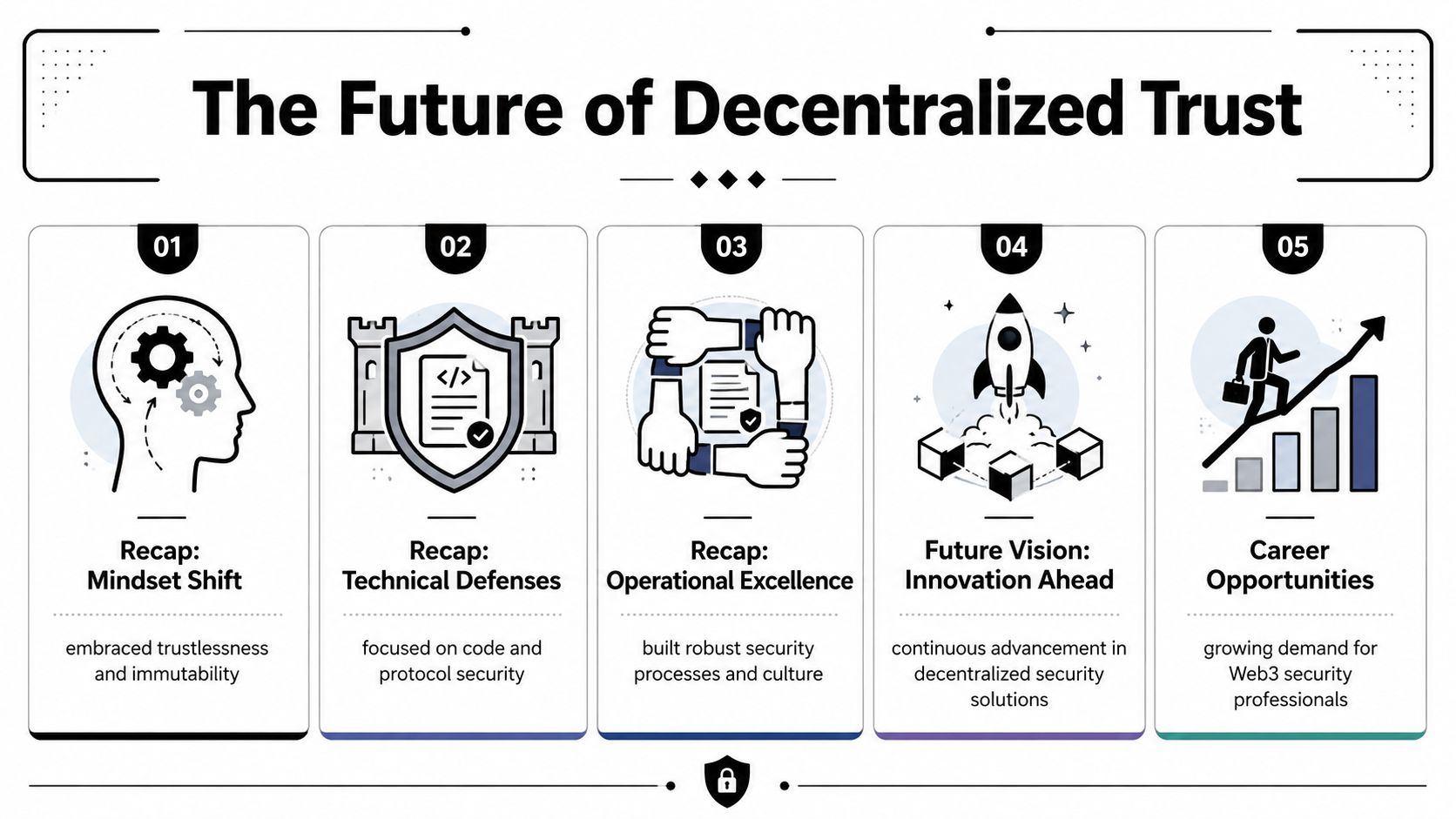
The fundamental shift in Web 3.0 security isn't just technical. It's professional. Teams no longer need engineers who can only ship features into adversarial environments. They need people who can spot dangerous assumptions, reduce blast radius, and help the organization build safer habits over time.
That's why the strongest career path in this field blends three layers. First, you need the mindset to think in terms of trust boundaries, incentives, and irreversible execution. Second, you need technical control over contracts, keys, infrastructure, and integrations. Third, you need process maturity so your work survives mainnet conditions, not just test suites.
Where the field is heading
Several trends are pushing the work forward.
AI-assisted review is becoming more useful for code triage, pattern spotting, and analyst productivity. It can help surface suspicious paths faster, but it still struggles with protocol context, economic intent, and nuanced threat assumptions. Good security engineers will use AI as an amplifier, not a substitute for judgment.
Zero-knowledge systems are also changing the conversation around privacy and verification. They reduce some exposure while introducing new implementation and usability challenges. If you want long-term advantage, learn enough to discuss where cryptographic strength can still be undermined by interface mistakes, integration flaws, or weak operational practice.
Regulatory pressure will also shape the field. Even technically decentralized products increasingly need stronger controls around access, monitoring, incident handling, and accountability. Security leaders who can translate between engineering and governance will become more valuable.
What long-term success looks like
You don't need to master everything at once. You do need to build in the right order.
Start with smart contract reasoning and threat modeling. Add key management, API trust, and infrastructure basics. Then learn how real teams handle audits, incidents, monitoring, and communication. That sequence turns knowledge into judgment, and judgment is what gets people hired, promoted, and trusted with critical systems.
The best people in this field stay curious and a little skeptical. They review assumptions. They ask who holds power, what happens when an integration lies, how a user can be tricked, and what recovery looks like after failure. That mindset builds better systems and stronger careers at the same time.
If you're ready to turn Web3 security knowledge into your next role, Blockchain Jobs is a practical place to start. You can explore security openings across protocols, infrastructure companies, wallet teams, and crypto-native startups, compare how employers describe the work, and find roles that match your stage, whether you're moving from smart contract development into auditing or aiming for a broader security engineering path.